
Walk into any bar and ask for whiskey, and you might get a puzzled look if you try to distinguish between bourbon and Tennessee whiskey. After spending years exploring American distilleries and tasting everything from small-batch craft spirits to household names, I can tell you this: the difference is real, and it matters more than most people think.
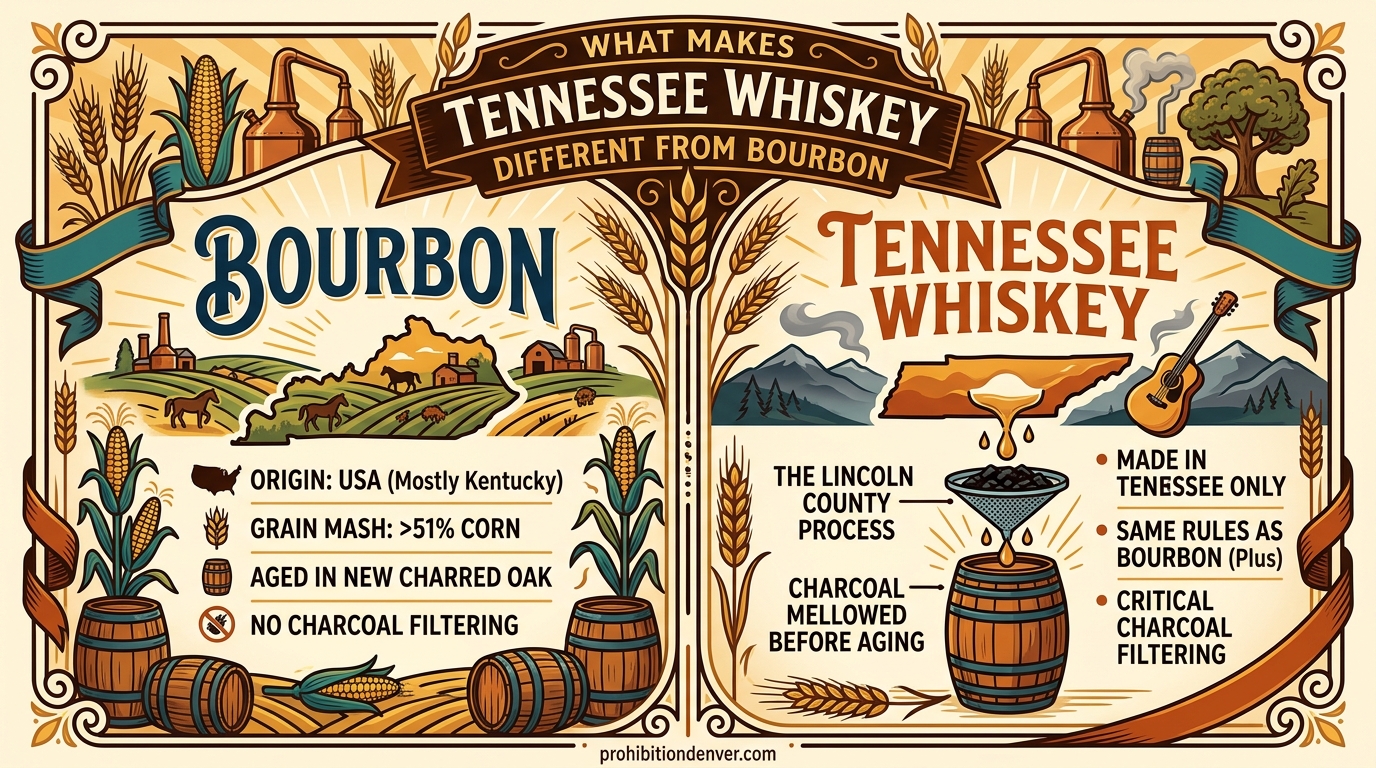
Tennessee whiskey is technically a type of bourbon, but the key difference is the Lincoln County Process. Before aging in barrels, Tennessee whiskey is filtered through sugar maple charcoal. This extra step removes impurities and creates a smoother, mellower finished product compared to the bolder profile of traditional bourbon.
Understanding what makes these spirits different helps you choose the right bottle for your home bar and appreciate the craftsmanship behind each pour. Whether you prefer your whiskey neat, on the rocks, or in an Old Fashioned, knowing these distinctions elevates your drinking experience.
Table of Contents
Key Differences at a Glance
Here is the essential breakdown of what separates these two American whiskey styles:
Geographic Origin: Bourbon can be made anywhere in the United States, though Kentucky produces 95% of the supply. Tennessee whiskey must be made in Tennessee.
The Lincoln County Process: Tennessee whiskey undergoes charcoal filtration through sugar maple before barrel aging. Bourbon skips this step entirely.
Flavor Profile: Bourbon tends toward bold, spicy notes with pronounced oak and vanilla. Tennessee whiskey delivers a smoother, more mellow character with subtle maple sweetness.
Legal Status: Tennessee whiskey meets all bourbon requirements but adds the charcoal filtration mandate under Tennessee state law.
What Is Bourbon?
Bourbon is America’s native spirit, protected by federal law since 1964 when Congress declared it a distinctive product of the United States. Despite popular belief, bourbon does not need to come from Kentucky. I have tasted excellent bourbons from Texas, Colorado, and New York.
The Federal Standards of Identity for Distilled Spirits lay out strict requirements. The mash bill must contain at least 51% corn. Distillation cannot exceed 160 proof, and the spirit must enter new charred oak barrels at no more than 125 proof. It must be bottled at a minimum of 80 proof.
Those new charred oak barrels are where bourbon gets its signature color and much of its flavor. The charring caramelizes the wood sugars, creating vanilla, caramel, and toast notes that infuse into the spirit during aging.
There is no minimum aging requirement for straight bourbon, though anything labeled straight must age at least two years. Most quality bourbons spend four to twelve years in the barrel, developing complexity and depth.
What Is Tennessee Whiskey?
Tennessee whiskey starts its life exactly like bourbon. It uses a corn-based mash bill of at least 51%. It distills to the same proof limits and ages in new charred oak barrels. It even follows the same bottling requirements.
The critical difference comes from state law and tradition. Tennessee whiskey must be made in Tennessee, and it must undergo the Lincoln County Process before aging.
The Tennessee Whiskey Law of 2013 codified these requirements. To legally label a spirit as Tennessee whiskey, distillers must meet all federal bourbon standards plus the charcoal filtration step. This law protects the category from producers who might try to capitalize on the name without following the traditional process.
Jack Daniel’s, George Dickel, and Uncle Nearest represent the most famous Tennessee whiskey brands. Each follows the Lincoln County Process, though they vary in specific techniques and aging approaches.
The Lincoln County Process Explained
The Lincoln County Process is what truly sets Tennessee whiskey apart. This filtration method involves slowly dripping fresh distillate through large vats packed with sugar maple charcoal before the whiskey ever touches a barrel.
The process begins with burning sugar maple wood to create charcoal. Distillers pack this charcoal into massive filtration vats that can stand ten feet tall or more. Fresh whiskey drips through the charcoal over several days, typically four to six days depending on the desired character.
Chemically, this filtration removes congeners and fatty acids that contribute to harshness. These compounds can create off-flavors and a burning sensation in the throat. The charcoal acts like a purifying agent, smoothing out the rough edges while preserving the desirable flavor compounds.
The process traces back to enslaved distiller Nearest Green, who taught Jack Daniel the technique in the mid-1800s. Green learned the method from West African water purification traditions, bringing an ancient practice to American whiskey production. Today, Uncle Nearest whiskey honors his legacy.
Some Tennessee whiskey producers have experimented with variations. George Dickel chills their distillate before filtration, claiming it removes even more impurities. Others adjust the charcoal depth or drip rate to create signature characteristics.
Bourbon vs Tennessee Whiskey: Side-by-Side Comparison
Here is how these two American whiskey categories stack up across key attributes:
| Attribute | Bourbon | Tennessee Whiskey |
|---|---|---|
| Mash Bill | Minimum 51% corn | Minimum 51% corn |
| Barrel Requirements | New charred oak | New charred oak |
| Distillation Proof | Maximum 160 proof | Maximum 160 proof |
| Barrel Entry Proof | Maximum 125 proof | Maximum 125 proof |
| Bottling Proof | Minimum 80 proof | Minimum 80 proof |
| Geographic Requirement | Any U.S. state | Tennessee only |
| Charcoal Filtration | Not required | Required before aging |
| Flavor Profile | Bold, spicy, oak-forward | Smooth, mellow, subtle sweetness |
| Body | Full, rich | Medium, approachable |
Flavor Profile Differences
Taste these spirits side by side, and the difference becomes obvious. Bourbon hits the palate with intensity. The new charred oak barrels impart strong vanilla, caramel, and baking spice notes. Higher rye mash bills add pepper and cinnamon heat. The finish tends to linger with warmth and complexity.
Tennessee whiskey arrives gentler. The charcoal mellowing removes the harsher edges, creating a cleaner, more approachable sip. You will still find vanilla and caramel from the oak aging, but they sit alongside subtle maple sweetness from the sugar maple charcoal.
The finish tells the biggest story. Bourbon often leaves a spicy, warming sensation that whiskey enthusiasts call Kentucky hug. Tennessee whiskey finishes smoother, sliding off the palate with less burn and more sweetness.
For cocktails, these differences matter. Bourbon stands up to strong mixers and bitters in an Old Fashioned or Manhattan. Its bold character cuts through the other ingredients. Tennessee whiskey works beautifully in simpler preparations like a Whiskey Ginger or Lynchburg Lemonade, where its smoothness shines.
Tasting Methodology: How to Tell the Difference
After hosting dozens of whiskey tastings, I have developed a simple method for distinguishing bourbon from Tennessee whiskey. You can try this at home with any two bottles.
Step 1: Look at the Color
Pour both spirits into clear glasses and observe the color. Both will show amber to deep brown depending on age, but Tennessee whiskey sometimes appears slightly lighter due to the filtration removing some compounds that contribute to color.
Step 2: Nose the Whiskey
Swirl gently and smell. Bourbon typically presents stronger alcohol heat on the nose with pronounced oak and spice. Tennessee whiskey offers a softer, sweeter aroma with less alcoholic sharpness. Look for maple or brown sugar notes.
Step 3: Taste and Compare
Take small sips of each. Let the whiskey coat your tongue. Bourbon will feel more intense with immediate spice and heat. Tennessee whiskey should feel rounder and softer from the first moment.
Step 4: Notice the Finish
Pay attention to what happens after you swallow. Bourbon typically delivers a longer, spicier finish that warms the chest. Tennessee whiskey finishes cleaner and sweeter, with less residual heat.
Pro Tip: Try them neat first, then add a few drops of water to each. Notice how bourbon opens up with more spice while Tennessee whiskey becomes even more mellow and sweet.
Famous Brands and Their Stories
Jack Daniel’s dominates the Tennessee whiskey category, selling over 100 million bottles annually worldwide. Their Old No. 7 follows the classic Lincoln County Process, dripping through ten feet of sugar maple charcoal before aging.
George Dickel represents the second major Tennessee producer, owned by Diageo. Their Cascade Hollow distillery produces whiskey using chilled charcoal filtration, creating an even smoother product. Their Barrel Select expression showcases the premium end of Tennessee whiskey.
Uncle Nearest has emerged as the fastest-growing American whiskey brand, honoring Nearest Green, the first known African American master distiller. Their premium expressions have won numerous awards while bringing historical recognition to Green’s contributions.
On the bourbon side, Jim Beam remains the world’s best-selling bourbon, produced in Kentucky since 1795. Maker’s Mark distinguishes itself with a wheated mash bill that creates a softer, sweeter bourbon. Buffalo Trace produces highly sought-after expressions including the iconic Pappy Van Winkle line.
The most common question I hear: why does Jack Daniel’s not call itself bourbon? The answer is simple marketing choice. Jack Daniel’s meets every legal requirement for bourbon. They choose to call themselves Tennessee whiskey because it differentiates their product and honors their specific process.
Cocktail Applications
Understanding these differences helps you choose the right whiskey for your cocktails.
Bourbon excels in spirit-forward cocktails where its boldness shines. An Old Fashioned made with bourbon delivers spice and complexity. A Mint Julep using bourbon cuts through the sugar and mint with authority. Bourbon also works beautifully in a Boulevardier, standing up to Campari and sweet vermouth.
Tennessee whiskey suits drinks where smoothness matters. The classic Lynchburg Lemonade combines Jack Daniel’s with sour mix and triple sec for an easy-drinking summer cocktail. Tennessee whiskey mixed with ginger ale creates a simple, refreshing highball that lets the mellow character shine.
For whiskey beginners, I typically recommend starting with Tennessee whiskey. The smoother profile proves more approachable. As your palate develops, explore bourbons to experience the full range of American whiskey complexity.
FAQ
Is Tennessee whiskey technically bourbon?
Yes, Tennessee whiskey meets all legal requirements for bourbon classification. It uses at least 51% corn mash bill, ages in new charred oak barrels, and follows all federal bourbon standards. The difference is that Tennessee whiskey adds extra requirements under state law, specifically the Lincoln County Process charcoal filtration and geographic restriction to Tennessee.
Why is Jack Daniel’s not considered a bourbon?
Jack Daniel’s is not considered bourbon by choice, not by law. The distillery meets every federal requirement for bourbon but chooses to label their product as Tennessee whiskey. This marketing decision distinguishes their charcoal-filtered spirit from traditional bourbon and honors their specific production methods.
What is the Lincoln County Process?
The Lincoln County Process is a charcoal filtration method where fresh whiskey drips through sugar maple charcoal before barrel aging. This process removes impurities and congeners that create harshness, resulting in a smoother, mellower finished product. The technique originated with Nearest Green, an African American distiller who taught Jack Daniel in the 1800s.
Which is smoother, bourbon or Tennessee whiskey?
Tennessee whiskey is generally smoother than bourbon due to the Lincoln County Process. The sugar maple charcoal filtration removes harsh compounds before aging, creating a cleaner, more approachable flavor. Bourbon tends to be bolder and spicier with more pronounced oak character and a warmer finish.
Does bourbon have to be made in Kentucky?
No, bourbon can be made anywhere in the United States. Kentucky produces approximately 95% of the world’s bourbon due to tradition, limestone-filtered water, and favorable climate, but federal law places no geographic restriction on bourbon production. Tennessee whiskey, however, must be made in Tennessee by state law.
Conclusion
What makes Tennessee whiskey different from bourbon comes down to one essential process: the Lincoln County Process. That sugar maple charcoal filtration creates the smooth, mellow character that defines Tennessee whiskey and sets it apart from the bolder, spicier profile of traditional bourbon.
Both spirits share the same foundation: American corn, new charred oak barrels, and centuries of craftsmanship. The choice between them depends on your personal taste and the occasion.
I recommend keeping both styles in your home bar. Pour Tennessee whiskey when you want something smooth and approachable. Reach for bourbon when you crave bold complexity and spice. Understanding these differences transforms you from someone who drinks whiskey into someone who truly appreciates it.