

Plenty of roundups rank gas grills by burner count and ignore the one thing that decides whether a grill works on a deck: a deck is a small, combustible, often enclosed surface with a railing two feet from where you want to stand. The best natural gas grills for decks in 2026 are the ones that clear the railing, vent properly, survive salt air or snow, and never run out of fuel halfway through a cook.
We went through 12 natural gas grills and drop-in heads line by line, checking cooking area against footprint, stainless grade, ignition, warranty, cutout dimensions and the one question most sellers never answer: what does this unit do to a deck? Nine of the 12 are freestanding or convertible carts you can move into place and leave there. Three are built-in heads that only make sense if you are already pouring an island.
Our top pick is the SPIRE 36 inch built-in six-burner head, which pairs all-304 stainless construction with 904 square inches of cooking surface. If you are not building an island, the Bull Outdoor Outlaw drop-in head is the one with the longest proven track record, and the Monument Grills 41847NG is the value pick most deck owners will end up with. If you have never touched this category, start with our general gas grill roundup first, then come back here for the deck constraints.
A word on fuel before we get into the list. A natural gas grill is permanently plumbed to a household gas line by a licensed plumber. That single fact decides your layout, because the grill never moves once the line is in. If you want a grill you can reposition, read our freestanding sections first. If you are building an outdoor kitchen, jump to the built-in picks.
Top 3 Natural Gas Grills for Decks in 2026
Our three favorites differ in installation type, not in quality. The SPIRE is the strongest built-in head for a deck, the Bull Outlaw is the most proven drop-in, and the Monument 41847NG is the freestanding unit we would put on a deck with no island plan.

SPIRE 36 Inch 6-Burner Built-In
- All 304 stainless body burners and grates
- 904 sq in total cooking space
- Six 10000 BTU burners plus rear burner
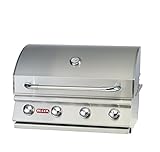
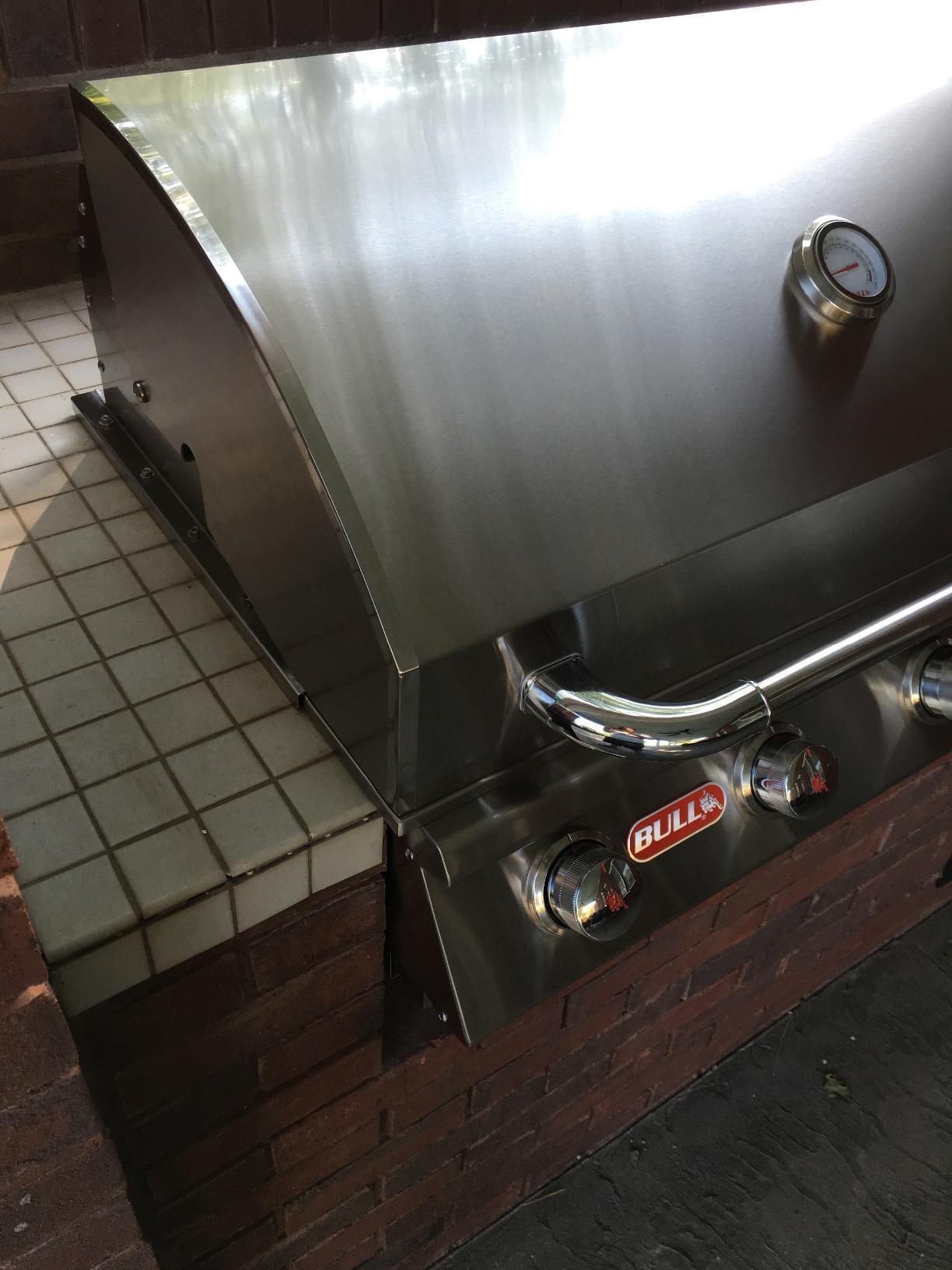
Bull Outdoor Outlaw Drop-In Head
- Four welded 15000 BTU stainless burners
- 575 sq in primary plus 176 sq in warming rack
- Lifetime warranty on frame and cooking grids

Monument Grills 41847NG 4-Burner
- Convertible propane or natural gas kit
- 510 sq in primary plus 190 sq in warming rack
- Side burner and Clearview lid window
All 12 Natural Gas Grills for Decks Compared in 2026
Every grill below runs on a plumbed natural gas line. Cooking area is the total figure the manufacturer lists, which usually includes the warming rack, so treat it as an upper bound rather than a flat-top number.
| Product | Specifications | Action |
|---|---|---|
| SPIRE 36 Inch 6-Burner Built-In |
|
Check Latest Price |
| Bull Outdoor Outlaw Drop-In Head |
|
Check Latest Price |
| Monument Grills 41847NG 4-Burner |
|
Check Latest Price |
 Brand-Man 30 Inch 4-Burner Built-In Brand-Man 30 Inch 4-Burner Built-In |
|
Check Latest Price |
 Weber Spirit E-325 Natural Gas Weber Spirit E-325 Natural Gas |
|
Check Latest Price |
 Weber Genesis E-325 Natural Gas Weber Genesis E-325 Natural Gas |
|
Check Latest Price |
 Monument Grills M415BZNG 4+1 Monument Grills M415BZNG 4+1 |
|
Check Latest Price |
 Weber Genesis S-435 Natural Gas Weber Genesis S-435 Natural Gas |
|
Check Latest Price |
 Napoleon Rogue PRO 625 Napoleon Rogue PRO 625 |
|
Check Latest Price |
 Blaze Prelude LBM 32 Inch Built-In Blaze Prelude LBM 32 Inch Built-In |
|
Check Latest Price |
 Monument Grills Denali 605 Monument Grills Denali 605 |
|
Check Latest Price |
 Blaze Prelude LBM 25 Inch Built-In Blaze Prelude LBM 25 Inch Built-In |
|
Check Latest Price |
1. SPIRE 36 Inch 6-Burner Built-In – The All-304 Stainless Workhorse
SPIRE 36″ Built-in 6 Burner Dual Fuel Grill, All 304 Stainless Steel Body
All 304 stainless
904 sq in total cooking space
Six 10000 BTU burners plus rear burner
1 year warranty
Pros
- 304 stainless used through the burners flame shields grease tray and grates
- Six burners plus a rear burner give adjustable heat across 904 sq in
- Assembly and installation reported as straightforward
- Removable grease tray and halogen lights
Cons
- No insulated grill jacket included
- Gas modulators may need replacing alongside the conversion kit
- Some reports of ignition failure and lower heat output on the 36 inch head
- Drip tray collects standing water
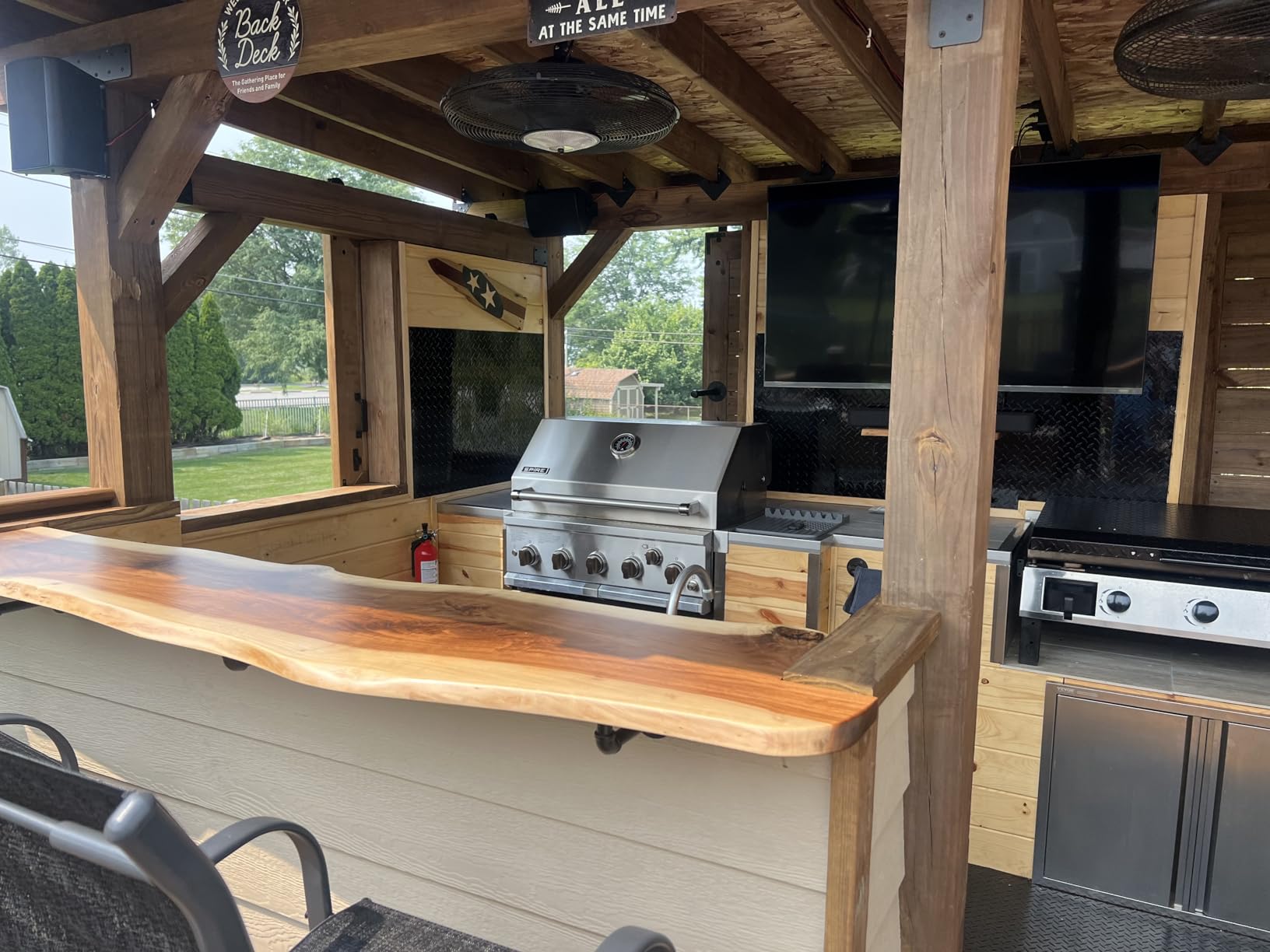
This is the head we keep coming back to because the material specification is honest. The 304 stainless runs through the burners, the flame shields, the grease tray and the grates, not just the lid and the trim. On a deck that sees weather from every direction, that consistency is what decides whether a grill still looks right in year five.
Heat output is the strongest case for it. Six 10,000 BTU burners plus a rear burner spread across 904 square inches of total cooking space means you can run one zone hard for searing while another side holds something low. Reviews describe even heating and a large surface that suits a gathering rather than a couple.
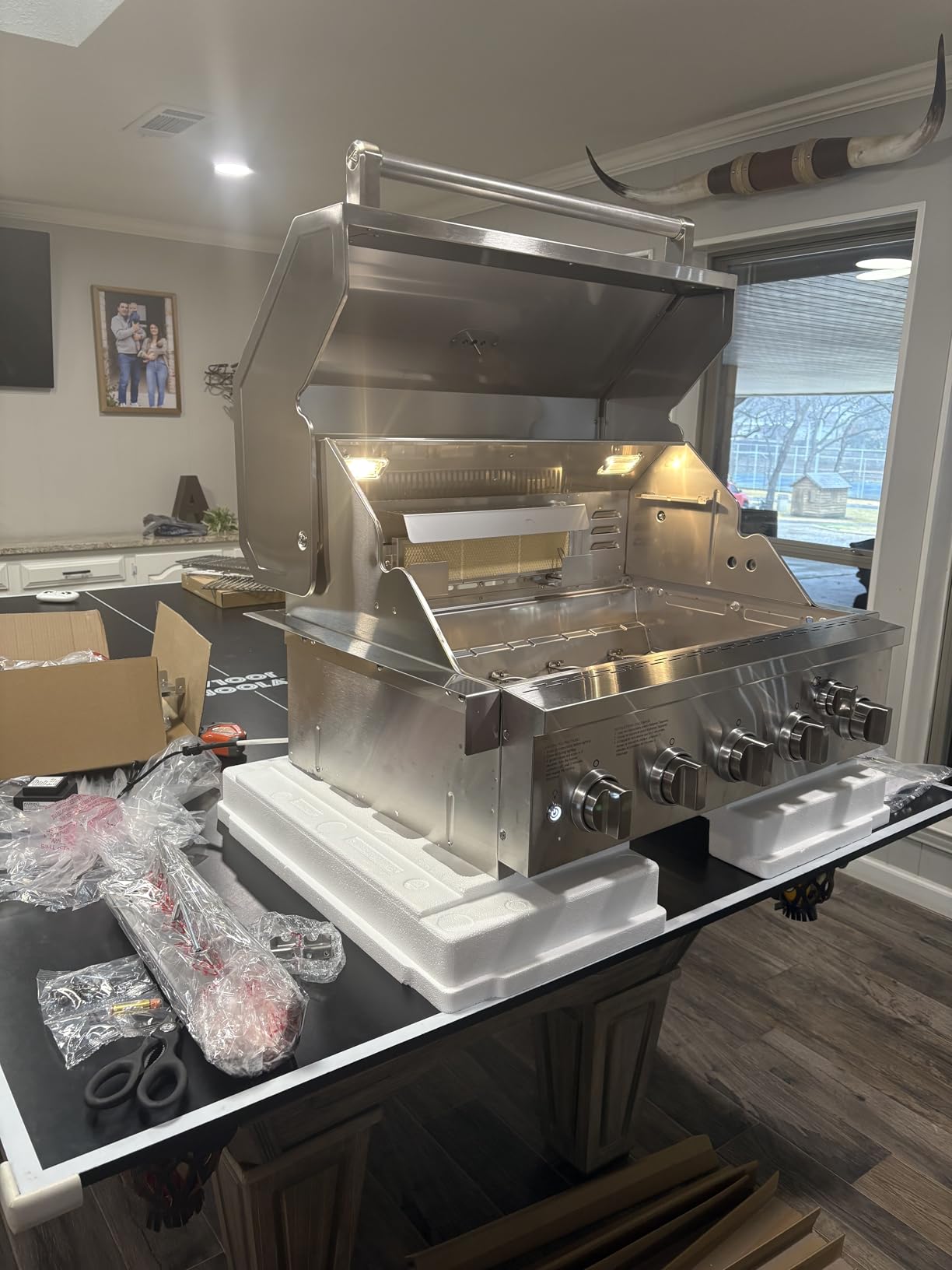
The thing to plan around is the natural gas conversion. Owners report that the standard conversion kit alone is not always enough, because the gas modulators sometimes need replacing as well or the flame is visibly restricted. Another recurring note is the missing insulated grill jacket, which some jurisdictions require in new construction. Budget for both before the appliance crew arrives.
Weighing the deck realities, the head is a built-in unit measuring 25.2 inches deep by 40 inches wide by 21.8 inches tall, so the island and the cutout have to be built around it rather than the other way around. A minority of owners also report ignition trouble and heat output below expectations on this 36 inch configuration specifically, and the drip tray will hold rainwater if you leave it uncovered.
Why this one works on a deck
Deck grills take the punishment of being outdoors with no walls, so material grade matters more than any feature list. Everything on this head that touches heat or weather is 304 stainless, which is the grade that resists pitting in coastal and humid climates instead of merely delaying it.
The other reason is scale. Six burners over 904 square inches gives you room to cook for a full deck of guests without stacking food on top of itself, and the rear burner handles rotisserie work or warming trays so the main burners stay free.
Where it disappoints
The conversion path is the honest weak point. If your plumber arrives expecting a ten minute orifice swap, budget a second visit for modulators, and ask about the insulated jacket requirement in your municipality before the island is poured.
The warranty is one year, which is the shortest on this list and noticeably shorter than the multi-year coverage most buyers assume they are getting. That single year is the main reason we did not rank it first on longevity, and the reason we pair it here with a head that carries lifetime frame coverage.
2. Bull Outdoor Outlaw 60,000 BTU Drop-In Head – Highest Rated With Proven Longevity
Bull Outdoor Products Outlaw 60,000 BTU Drop-In Grill Head – Stainless Steel, Natural Gas
Four 15000 BTU welded burners
575 sq in primary plus 176 sq in warming rack
125 lb stainless body
Piezo ignition
Pros
- Four welded 15000 BTU stainless burners heat fast and evenly
- 304 stainless body grates and dual-lined hood
- NSF and CSA certified with reliable piezo ignition
- Cooking grids frames and housings carry a lifetime warranty
Cons
- Thermometer tops out around 600F
- Side burners can blow out in windy conditions
- 125 pounds needs two people to install
- No cover or smoker box included
This is the one we trust to still be cooking in fifteen years, and the rating backs that up. At 4.6 across 185 reviews it sits at the top of this group, and the pattern in the reviews is not excitement, it is longevity. Owners replacing grills they bought a decade or two ago describe the same thing: thick welded parts and heat that comes up fast and stays even.
Four welded stainless burners at 15,000 BTU each give 60,000 BTU total, spread over 575 square inches of primary cooking space with a 176 square inch warming rack above it. The dual-lined single-piece hood is the part that matters for a deck, because it holds heat on a windy evening better than a thin single-wall lid.
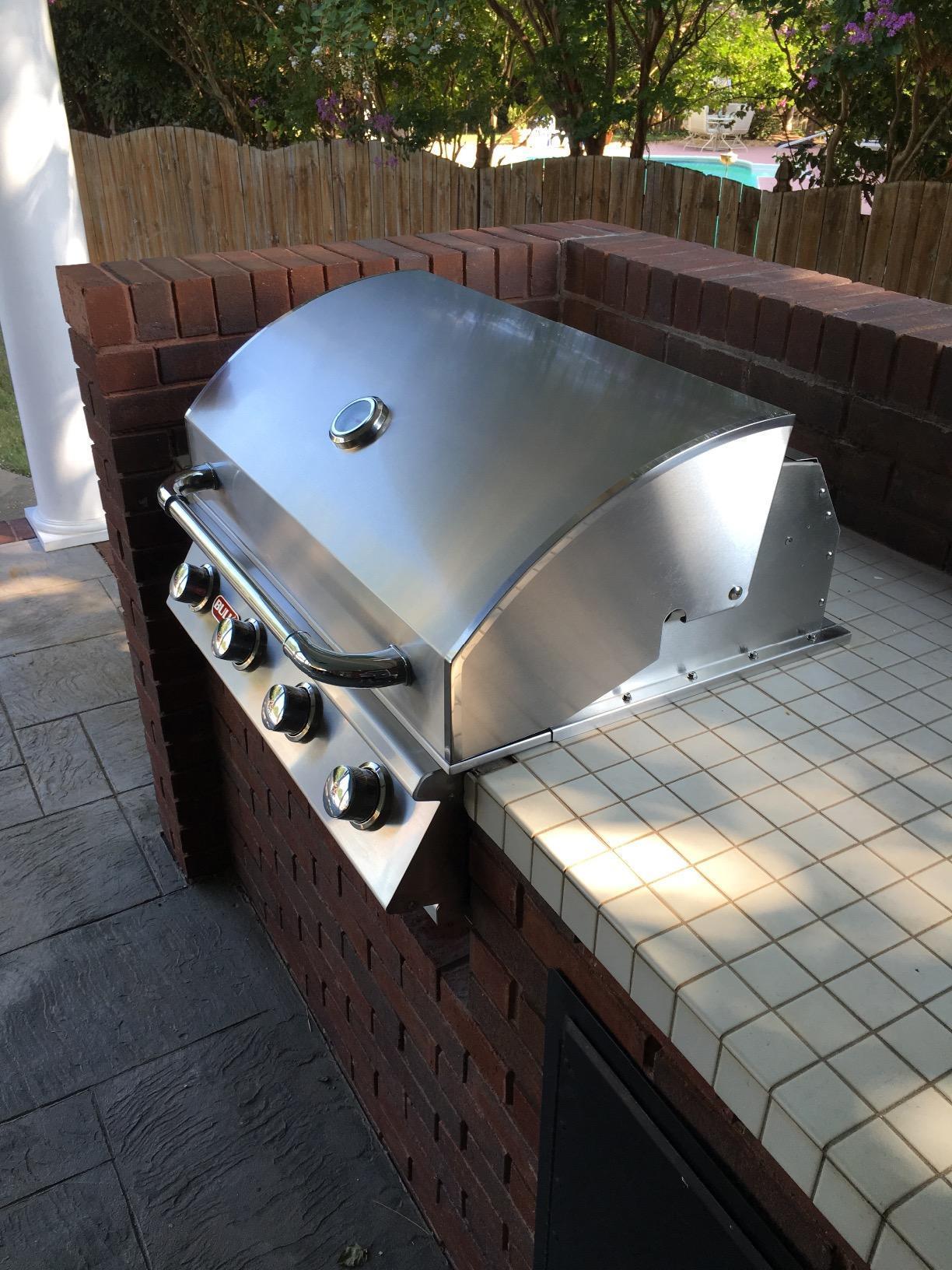
Two practical notes for deck placement. The unit weighs 125 pounds, so this is a two-person lift and the island needs to be finished before the head arrives, not after. And the piezo ignition is simple and dependable, with no battery pack or electronics to fail in damp weather, which is a genuine advantage outdoors.
The thermometer is the most common complaint, topping out around 600F and under-reading actual grill temperature. Owners who care about precise low-and-slow work tend to add an independent probe. Wind is the other issue: side burners can blow out with the hood closed on a gusty deck.
Why this one works on a deck
Everything structural here is 304 stainless, including the grates, the flame tamers and the body. That is the recipe for a head that survives being rained on and hosed off, and the warranty backs it up with lifetime coverage on cooking grids, frames and housings.
A drop-in head also suits a deck with an existing masonry surround. The dimensions, 9.5 inches deep by 31 inches wide by 22 inches tall, are compact enough for a modest island and it needs no side cabinets to function.
Where it disappoints
The instrumentation is behind the curve. A thermometer that stops at 600F means you are managing temperature by feel and probe rather than by gauge, which matters if you cook a lot of ribs or brisket on the deck in shoulder season.
There is no grill cover in the box and no smoker box, and the burner layout is sensitive to wind. On an exposed upper deck, position the island so the cooking surface is not facing the prevailing breeze, or expect to relight more often than you would indoors.
3. Monument Grills 41847NG 4-Burner Cabinet – Best Value Convertible Deck Grill
Monument Grills Larger Convertible 4-Burner Natural Gas Grill Stainless Steel Cabinet Style Propane Grills with Conversion Kit(2 Items)
Convertible propane or natural gas
510 sq in primary plus 190 sq in warming rack
4 main burners plus side burner
2 year grill warranty
Pros
- Four 304 stainless burners plus a side burner total 60000 BTU
- Convertible between propane and natural gas with a straightforward kit
- Porcelain-coated cast iron grates sear well
- Clearview lid window avoids losing heat
Cons
- Natural gas performance depends on completing the orifice and high-flame reset correctly
- Outer burners can run weaker than the center pair
- Side table surfaces develop surface rust within a season
- Assembly takes roughly 2.5 to 4 hours
If you are putting a grill on an existing deck with no masonry work, this is the shape most people actually need. It is a cart-style cabinet on casters with the gas line plumbed to its side, four main burners, a side burner and enough primary cooking space for a real party.
Buyers compare it favorably to Weber Genesis and Napoleon Rogue models on price while finding the build and the cooking comparable. Four 304 stainless burners plus the side burner total 60,000 BTU, and the 510 square inch primary area with a 190 square inch warming rack is a genuinely useful amount of flat-top space.
There is a real learning curve on the natural gas conversion, and it is the single most discussed topic in the reviews. Natural gas performance depends on completing the orifice change and the high-flame reset correctly, and several owners report weak heat until those steps are done properly or the gas supply is upgraded. That is a conversation to have with your plumber before the grill arrives, not after.
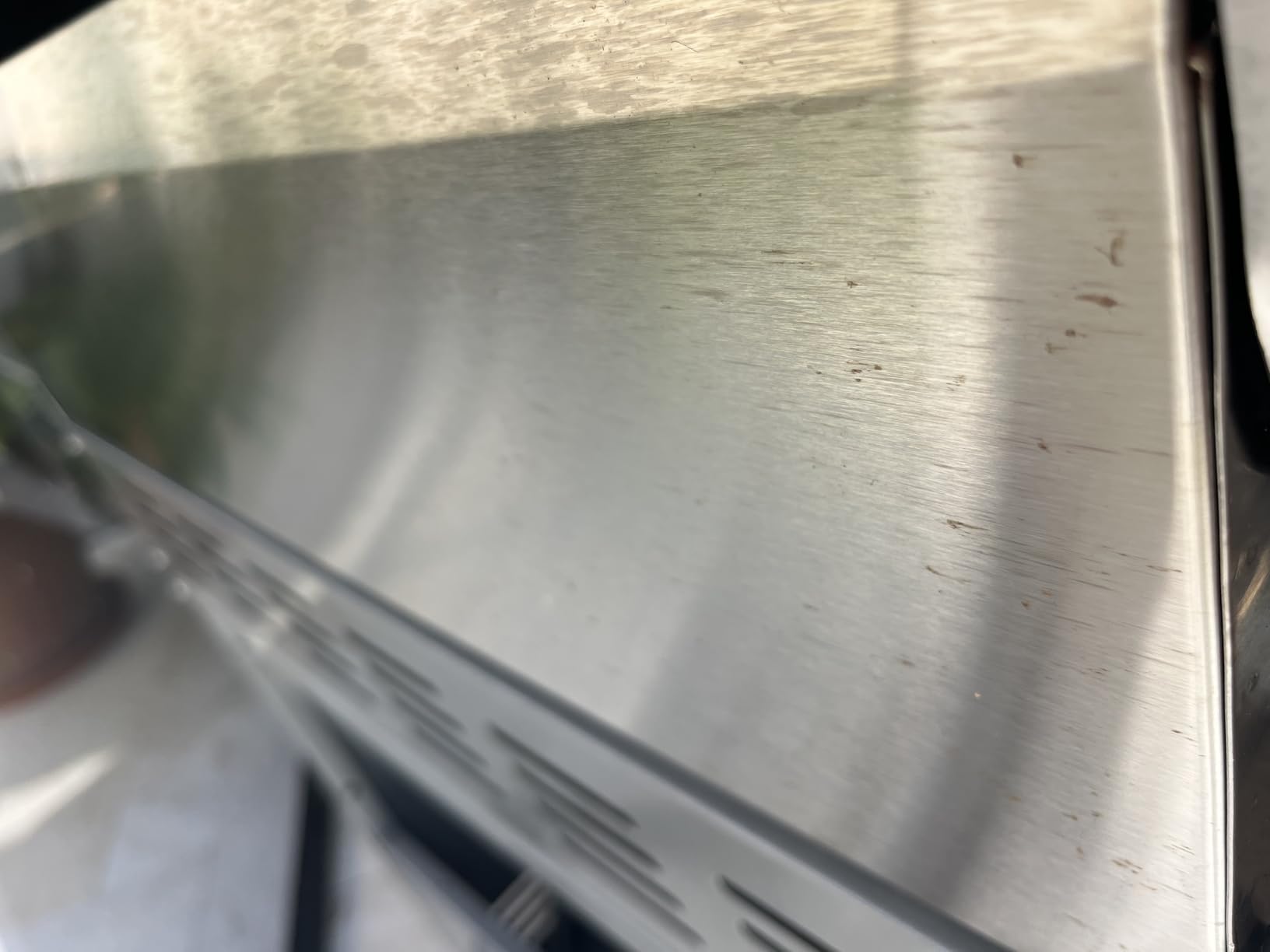
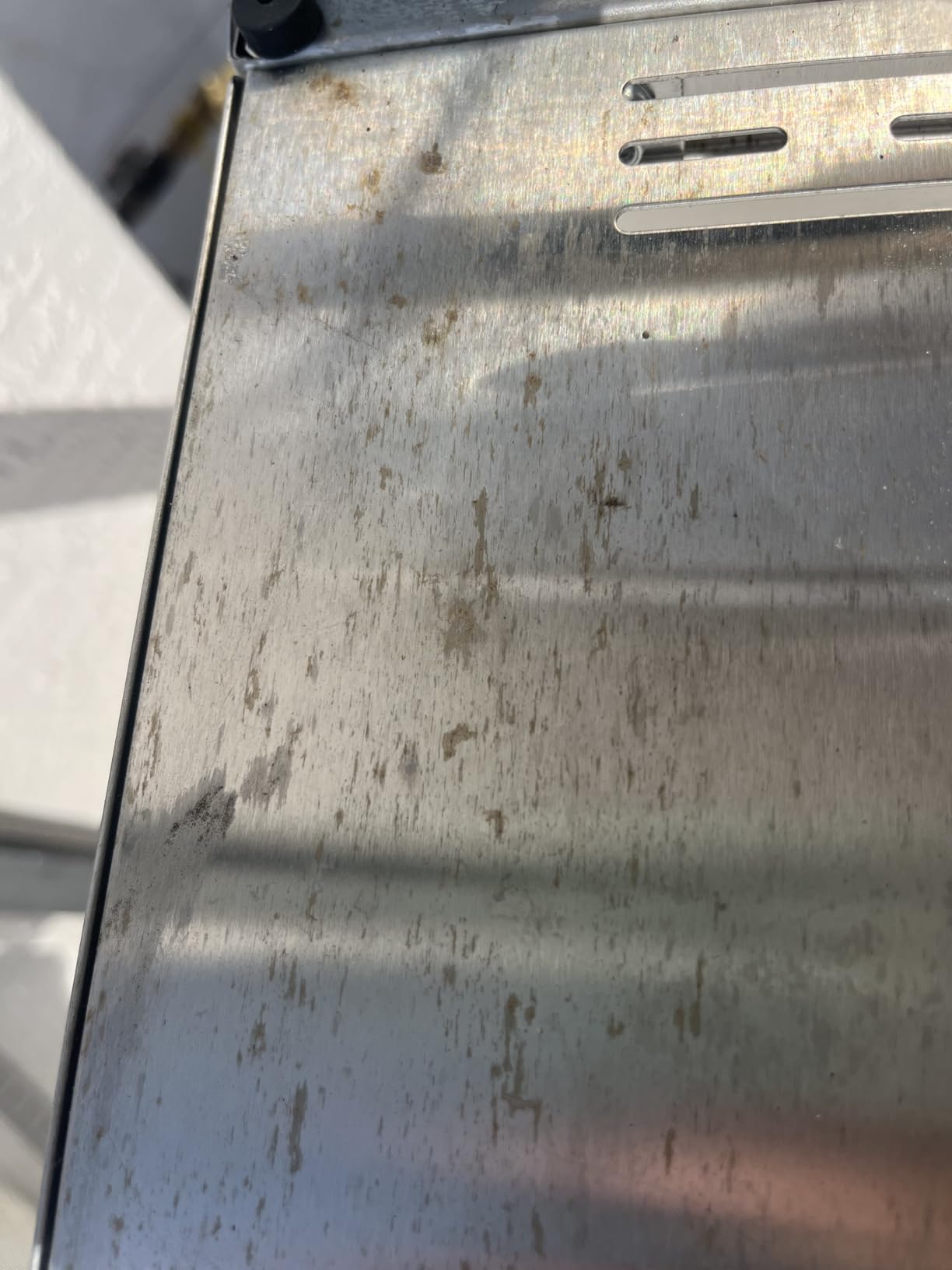
Two smaller complaints: the outer burners, particularly on one side, can run noticeably weaker than the center pair, and the side table and other exterior surfaces develop surface rust within a season even when the grill is covered. Assembly runs roughly two and a half to four hours for a first-time builder.
Why this one works on a deck
Locking casters are not listed here, but the cabinet format is the reason this class suits decks: it stands on its own, moves for storage, and does not need a poured island. If your deck is composite rather than wood, that matters even more, because you are not concentrating weight on a small footprint.
The convertible design also gives you an out. If the gas line install gets complicated, the same grill runs on propane, which is the flexibility several owners mention as the deciding factor.
Where it disappoints
The conversion steps are the trap. Get the orifice change and the flame reset wrong and the grill will feel anaemic no matter how good the burners are, and diagnosing that as a defect rather than a setup issue wastes a lot of time.
Surface rust on the exterior panels is the other weak point. On a deck with salt spray or constant humidity, the stainless body holds up better than the painted and plated accessories, so expect cosmetic corrosion on the side tables within the first year or two.
4. Brand-Man 30 Inch 4-Burner Built-In – Griddle and Grates in One Head
Brand-Man Built-In Gas Grill Head, 30-Inch 4-Burner Outdoor Kitchen Grill
653 sq in total cooking space
Two cast iron grates plus a cast iron griddle
40,000 BTU across four burners
2 year body warranty
Pros
- Two cast iron grates plus a griddle let you sear and flat-top cook at once
- 653 sq in of evenly heated cooking space
- Tool-free slide-out front grease tray
- Stainless construction that suits outdoor kitchen duty
Cons
- No built-in lighting for grilling after dark
- Knob covers sometimes arrive loose
- A small number report surface oxidation or incomplete shipments
- Natural gas operation needs a separately sold conversion kit
The griddle plate is what separates this head from most of the list. It ships with two rust-resistant cast iron grates plus an additional cast iron griddle, so you can sear steaks on one side and cook pancakes or smash burgers on the other in the same session. Owners single that layout out as the standout feature.
Four burners deliver a consistent 40,000 BTU profile across 653 square inches of total cooking space. The removable front grease tray slides out for tool-free cleanup, which matters more than it sounds on a deck where you do not want to carry a full tray of rendered fat through a door.

It is also the friendliest built-in head here for a first island project. The listed cutout width range of 31.1 to 33.6 inches gives you a little tolerance in the surround, and the stainless construction looks finished once it is installed rather than utilitarian.
The gaps are worth naming. There is no built-in lighting, which makes late grilling on a dim deck more awkward than it needs to be. Natural gas operation needs a separately sold conversion kit, and a small number of buyers report surface oxidation despite the stainless description plus incomplete shipments.
Why this one works on a deck
At 83 pounds it is the lightest built-in head in this roundup, and that is a real advantage when your island is framed into composite decking rather than poured concrete. Two people can set it, and you do not need a crew with a lift.
The tool-free grease tray and the flat-top capability together make it a genuinely two-purpose cooking station, which is what an outdoor kitchen island is supposed to be.
Where it disappoints
The missing lighting is a design gap, not an oversight in assembly. If your deck grilling runs past sunset, budget a separate light source rather than assuming the head has one.
Also plan the conversion kit and the light together, and inspect the head the moment it arrives. Loose knob covers and incomplete boxes are reported often enough that a same-day check saves a return trip.
5. Weber Spirit E-325 – Best for Small Decks and Balconies
Weber® Spirit® E-325 Gas Grill, Outdoor Cooking, Natural Gas Grill, Black
360 sq in cooking surface
Boost burners with Sear Zone
Painted steel body
10-year limited warranty
Pros
- Compact 360 sq in surface fits balcony and small deck spaces
- Boost burners add 40 percent more power in the Sear Zone
- Weber Works rails accept lighting and tool hooks
- One-handed Snap-Jet burner ignition
Cons
- Does not reach as high a temperature as some owners want
- Back of the cookbox is fully open
- Some arrived with shipping damage or missing hardware
- Assembly instructions are largely pictorial
Most of this list assumes a deck with room to stand back. This is the one for a fourth-floor terrace, a townhouse patio or a condo balcony where the footprint is the deciding factor. At 360 square inches of cooking surface it cooks for a handful of people, not a block party.
Even at that size the cooking system is good. The Boost burners add 40 percent more power to a large Sear Zone for searing, the porcelain-enameled cast iron grates retain heat evenly, and the stainless Flavorizer bars vaporize juices to suppress flare-ups. Weber Works side rails let you add lighting and hooks later.
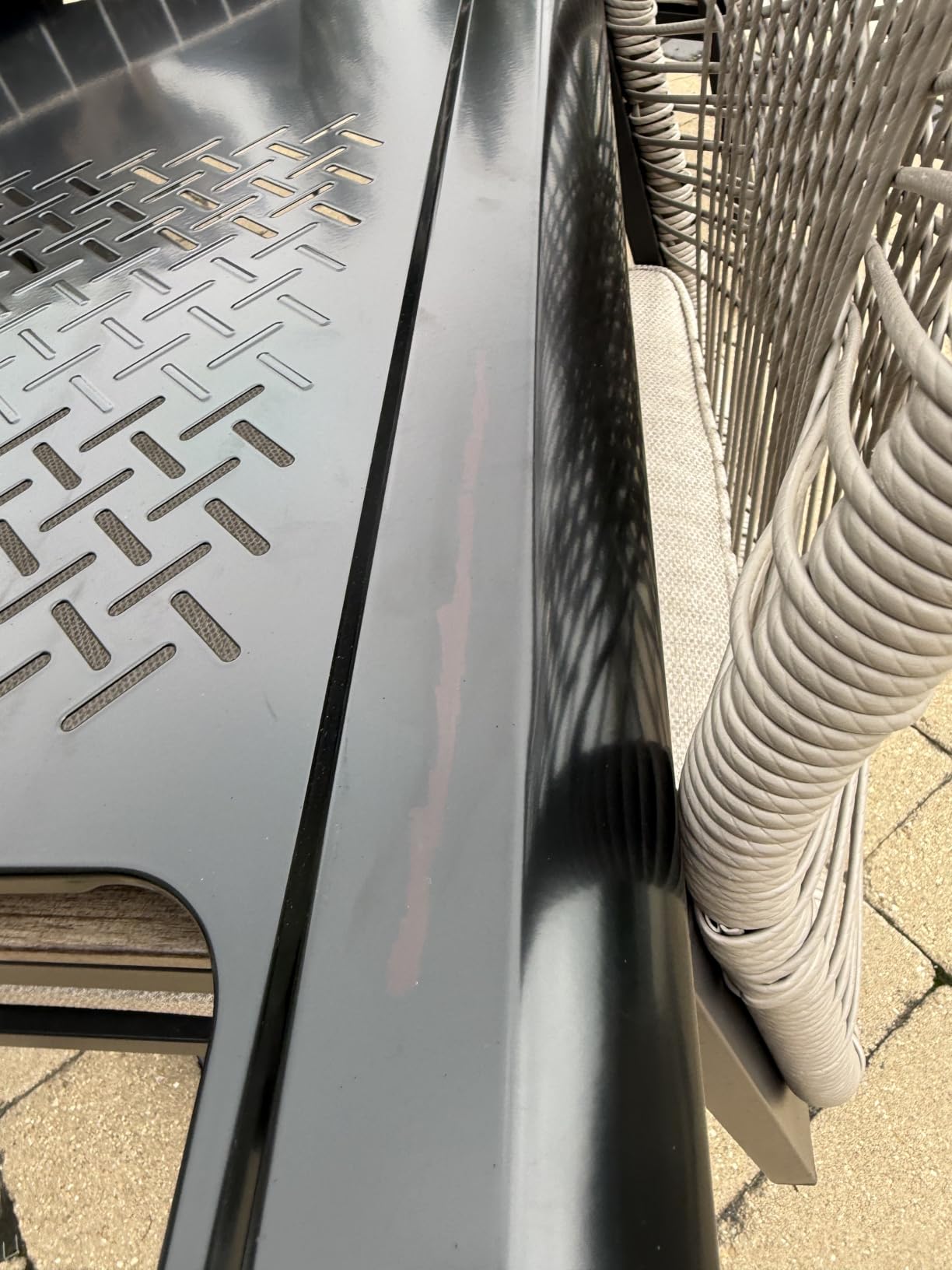
Where it falls short is heat ceiling. Owners looking for a serious sear note that it does not reach as high a temperature as they would like, and the fully open back of the cookbox is described as cheap and as an invitation for pests. That open back matters more on a deck than in a yard.
Delivery complaints show up too, with some grills arriving damaged or short on hardware, and the assembly instructions are largely pictorial, which makes the Weber name less helpful than you would expect during a first build.
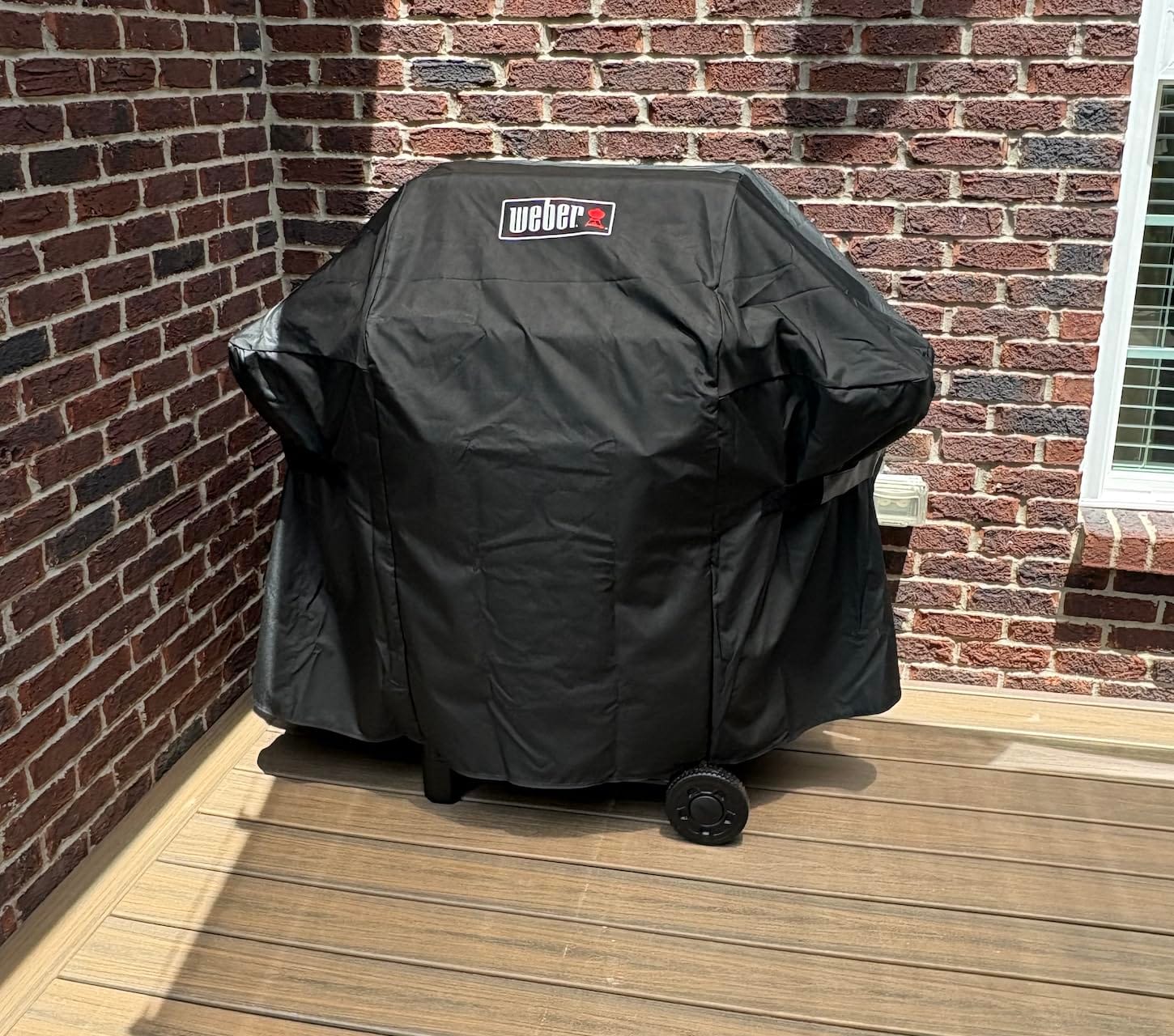
Why this one works on a deck
Footprint is the whole argument. A grill that cooks too little for a crowd is a problem in a yard, but a grill that does not fit the deck is a problem everywhere. The 48.3 inch wide cart is one of the smaller footprints we considered.
It is also the lowest-risk way to enter the category. Weber is the brand forum regulars name most often for gas grills, and a ten-year limited warranty is longer than most of the built-in heads here.
Where it disappoints
If you want to reverse sear or cook a thick ribeye at very high heat, the Boost burners are not quite enough, and the open cookbox back will not win any awards. This is a grill for weeknights and small groups, not for a hosting marathon.
On a rooftop, the open back is a genuine maintenance issue. Check under the cookbox before you close the lid for the night, and keep pests out of a grill that lives outside year round.
6. Weber Genesis E-325 – The Sweet Spot Between Spirit and S-435
Weber® Genesis E-325 Gas Grill for Outdoor Cooking, Natural Gas, Black
Three PureBlu burners
XL Sear Zone
Weber Crafted compatible
12-year limited warranty
Pros
- PureBlu tapered burners produce a consistent flame and even heat
- XL Sear Zone holds multiple steaks or burgers
- Porcelain-enameled cast iron grates with Flavorizer bars
- Slide-out grease tray keeps cleanup simple
Cons
- Weighs enough that assembly needs two people
- Open cart storage offers less space than larger Genesis models
- Sear zone is smaller than the flagship S-435
This is the step-up from the Spirit, and reviews read like it: owners cite burner consistency, a genuinely large Sear Zone and easy grease management as the reasons it works every week rather than on special occasions. Three PureBlu tapered burners spread heat evenly across the surface, which is what you want on a deck where the wind is already your enemy.
The Weber Crafted compatibility is the quiet advantage. You can add a griddle or a pizza stone later without replacing the grill, which turns a cart grill into something closer to a small outdoor kitchen station over time.
Fit is the thing to measure twice. The cart is 57.7 inches wide and 27 inches deep with the lid up, so it needs a genuine rectangle of deck, not a corner. And it is heavy enough that assembly typically needs two people before you even consider the gas connection.
Storage is the other tradeoff. The open cart shelf and side tables hold less than the larger Genesis models, so if you are the kind of cook who accumulates pans and tools, plan a shelf or a nearby cabinet.
Why this one works on a deck
Even heat is the deck-specific advantage. A cart grill on an exposed surface loses heat faster than a built-in with a heavy insulated hood, and tapered burners that hold a stable flame pattern are what keep a cook moving when a gust rolls across the deck.
The 12-year limited warranty also means the grill is still covered long after the deck has been resealed once or twice, which is the right way to think about a permanent deck installation.
Where it disappoints
The Sear Zone, while large for a three-burner grill, is smaller than the flagship S-435, so very large batch searing is out. If you routinely cook for ten or more at once, step up rather than sideways.
Assembly weight is a real annoyance, and the storage limitation shows up within a month of regular use. Neither is a defect, but both are annoying on a deck where you carry everything in from the house.
7. Monument Grills M415BZNG 4+1 – Highest Rated and Simplest Natural Gas Setup
Monument Grills 4+1 Burner Natural Gas Grill with Natural Gas Hose, 50,000 BTU Stainless Steel Outdoor Patio Barbecue Grill, Broil Zone Fast Heating, Knob Lights, and Easy Cleanup, M415BZNG
Natural gas hose and regulator included
50,000 BTU across five burners
630 sq in total cooking area
U-shaped broil zone
Pros
- Highest average rating in this group at 4.7
- Broil zone and dense V-holed flame tamers reach 650F in about 10 minutes
- 304 stainless burners resist corrosion and clogging
- Includes the natural gas hose and regulator so no conversion kit is needed
- Lockable swivel casters viewing window and knob lights
Cons
- Natural gas only with no propane fallback
- 630 sq in is smaller than the six-burner Monument models
- Enamel-coated grates need regular scraping to stay non-stick
At 4.7 with 64 reviews, this carries the highest average rating in the group, with 90 percent five-star reviews. The review pool is small and heavily positive, so treat the long-term durability picture as thinner than the rating suggests.
What stands out operationally is the included natural gas hose and regulator. That removes the most common setup friction in this category, because you are not hunting for a conversion kit and hoping the orifice change is right. The U-shaped broil zone and dense V-holed flame tamers reach 650F in about ten minutes.
It is also the friendliest deck grill in the roundup mechanically. Lockable swivel casters mean you can roll it against the house in winter, 304 stainless burners resist corrosion and stay clog-free at high heat, and the built-in glass viewing window, knob lights and bottle opener are small touches that matter when you are cooking after dark.
The tradeoff is fuel flexibility. This model is natural gas only, with no propane fallback if the supply goes down, so it is a poor choice for a cabin or a deck where the gas line is seasonal.
Why this one works on a deck
Moveability is the reason. A cart on locking casters is the one grill format that suits a deck shared between grilling and everything else, and the casters also mean you can store it out of the weather rather than leaving it exposed all year.
The 630 square inch total area, split into 450 square inches of main cooking surface and a 180 square inch warming rack, is a sensible balance for a mid-size deck with four to eight regular cooks.
Where it disappoints
Natural gas only is a genuine limitation, not a nitpick. If the line is ever shut off for a repair or a winter shutoff at the meter, you have no backup fuel source.
And the enamel-coated cast iron grates need regular scraping to stay non-stick, which on a deck means doing that job outside rather than in a garage. If you are casual about maintenance, budget a stainless grate upgrade or a cover.
8. Weber Genesis S-435 – Cooking Area for Big Gatherings, Weight to Match
Weber Genesis S-435 Gas Grill, Natural Gas Grill, Stainless Steel BBQ Grill
994 sq in total cooking area
Four burners plus side burner
Weber Crafted frame and grates
12-year cookbox warranty
Pros
- Four high-performance burners with an extra-large Sear Zone
- 994 sq in total area handles large gatherings
- Side burner plus a storage locker for grillware
- Extra-large prep and serve table
- Weber Crafted grates and frame support interchangeable grillware
Cons
- 220 pounds needs multiple people to move
- Large footprint so measure deck space and overhead clearance
- Weber Crafted grillware and frame kit sold separately
This is Weber’s flagship natural gas grill in stainless, and it is the one to buy if your deck is where you host. Four high-performance burners, an extra-large Sear Zone with an expandable second-level grate, and 994 square inches of total cooking area mean you can run a full Saturday cook without rotating batches.
The side burner handles sauces and sides so the main burners never get commandeered, and the storage locker holds the bulk of Weber Crafted grillware. The extra-large prep and serve table is the detail deck owners mention most, because it lets you plate outside.
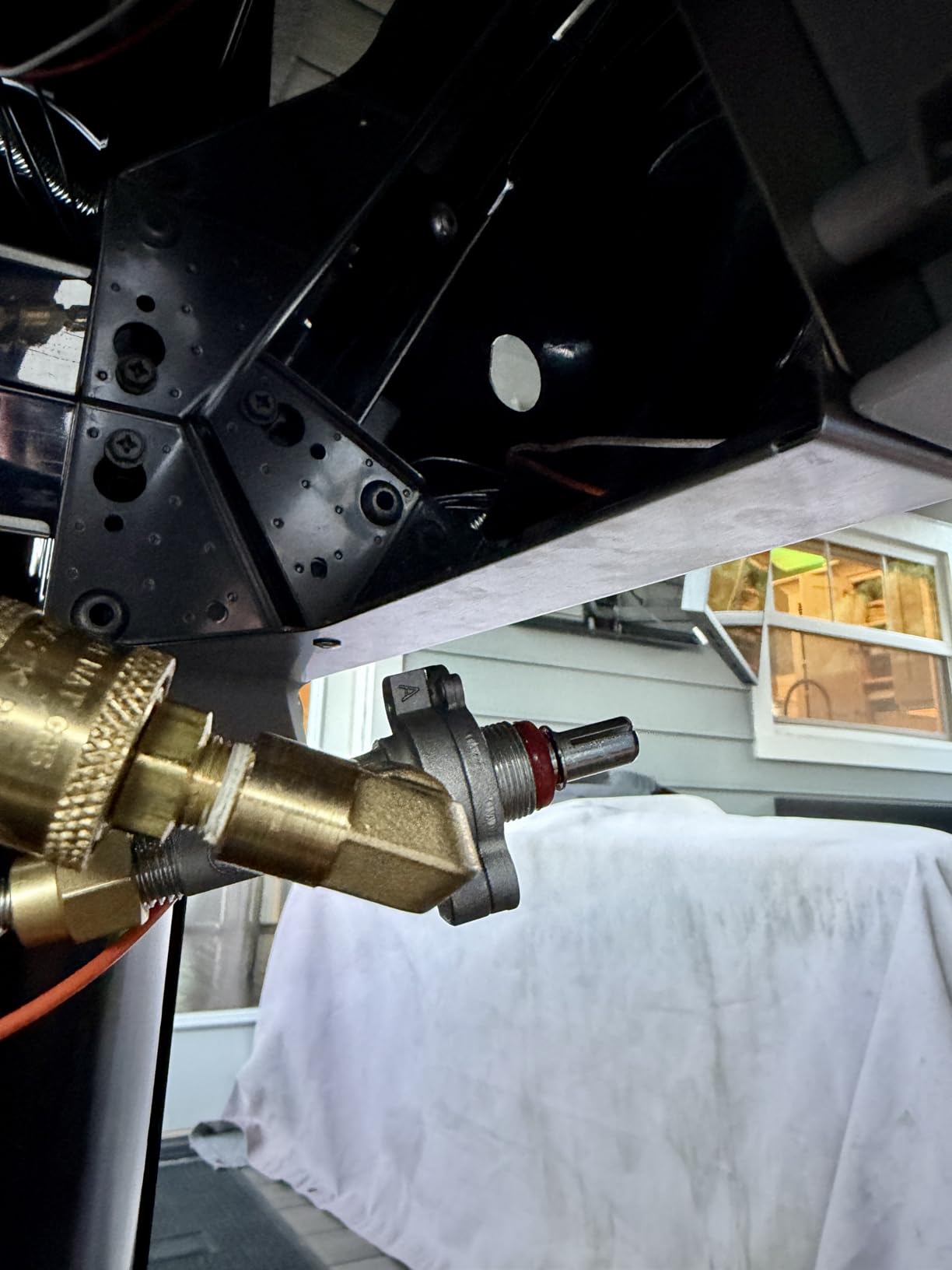
Plan the move before you plan the cook. At 220 pounds, getting it into position takes multiple people or a careful plan, and the footprint is large enough that you should measure the deck, the railing and the overhead clearance before the delivery is scheduled.
The Weber Crafted grillware and frame kit are sold separately, which raises the true cost of the system. Owners are satisfied with the build quality, so the caution here is purely about the additional spend and the space the ecosystem occupies.
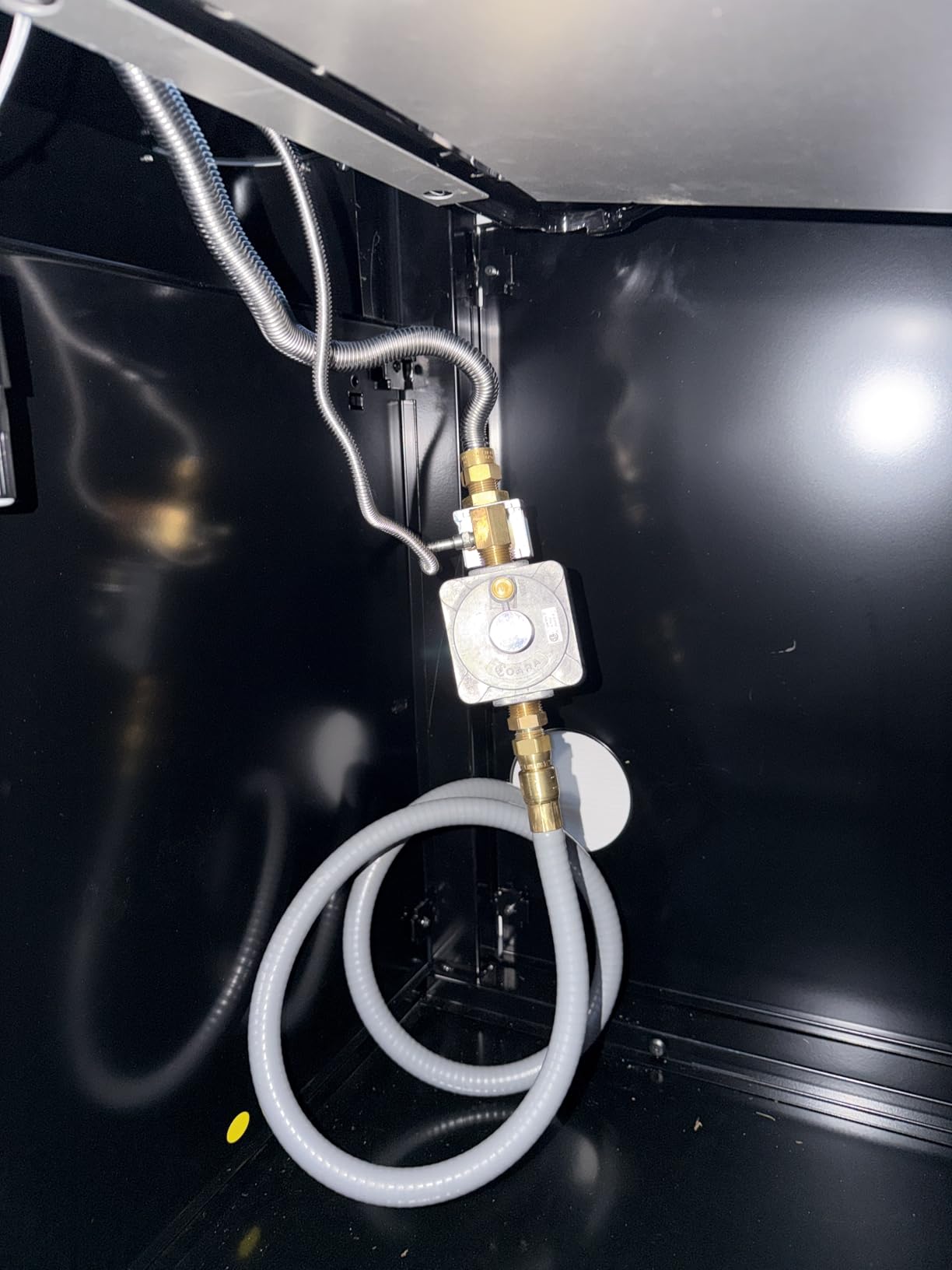
Why this one works on a deck
Capacity is the deck-specific virtue. When the whole deck becomes the dining room, the limiting factor is how much food you can put on the grate at once, and 994 square inches is the largest cooking area of any freestanding grill here.
The 12-year warranty on cookbox and lid, with 10 years on burner tubes, grates and Flavorizer bars, is the strongest coverage on any freestanding unit in this roundup, and stainless construction suits an exposed installation.
Where it disappoints
Weight and footprint are the honest drawbacks. A 220 pound grill on composite decking needs a flat, well-supported area, and moving it later is a two-person job rather than a weekend chore.
If your deck is small, the accessory ecosystem becomes a problem rather than a bonus, because the Crafted frame and grillware need somewhere to live. Skip it and you are still well served, but do not buy it planning to fill every rail.
9. Napoleon Rogue PRO 625 – Infrared Sear and Backlit Knobs After Dark
Napoleon Rogue PRO 625 5-Burner Natural Gas Grill with Infrared Side Burner
Five burners plus infrared sear
74,000 BTU total
White LED backlit knobs
15-year limited warranty
Pros
- Five main burners plus an infrared sear station produce 74000 BTU
- Infrared side burner reaches steakhouse-style sear temperatures
- White LED backlit control knobs for safe after-dark grilling
- Porcelainized cast iron WAVE grates with reverse sear marks
- 15-year limited warranty
Cons
- 66 inch width is one of the largest footprints in this group
- 160 pounds needs help moving into place
- Folding side shelves reduce work surface when collapsed
Napoleon is the brand that keeps surfacing when deck owners argue about searing, and the Rogue PRO 625 is where that argument gets real. Five main burners plus an integrated infrared sear station produce 74,000 BTU, and the infrared side burner reaches steakhouse-style temperatures fast enough to matter at the start of a cook.
The backlit white LED control knobs are the sleeper feature for deck use. Grilling after sunset is where an unlit control panel becomes a burn risk, and owners repeatedly call these out as making evening cooks easier and safer.
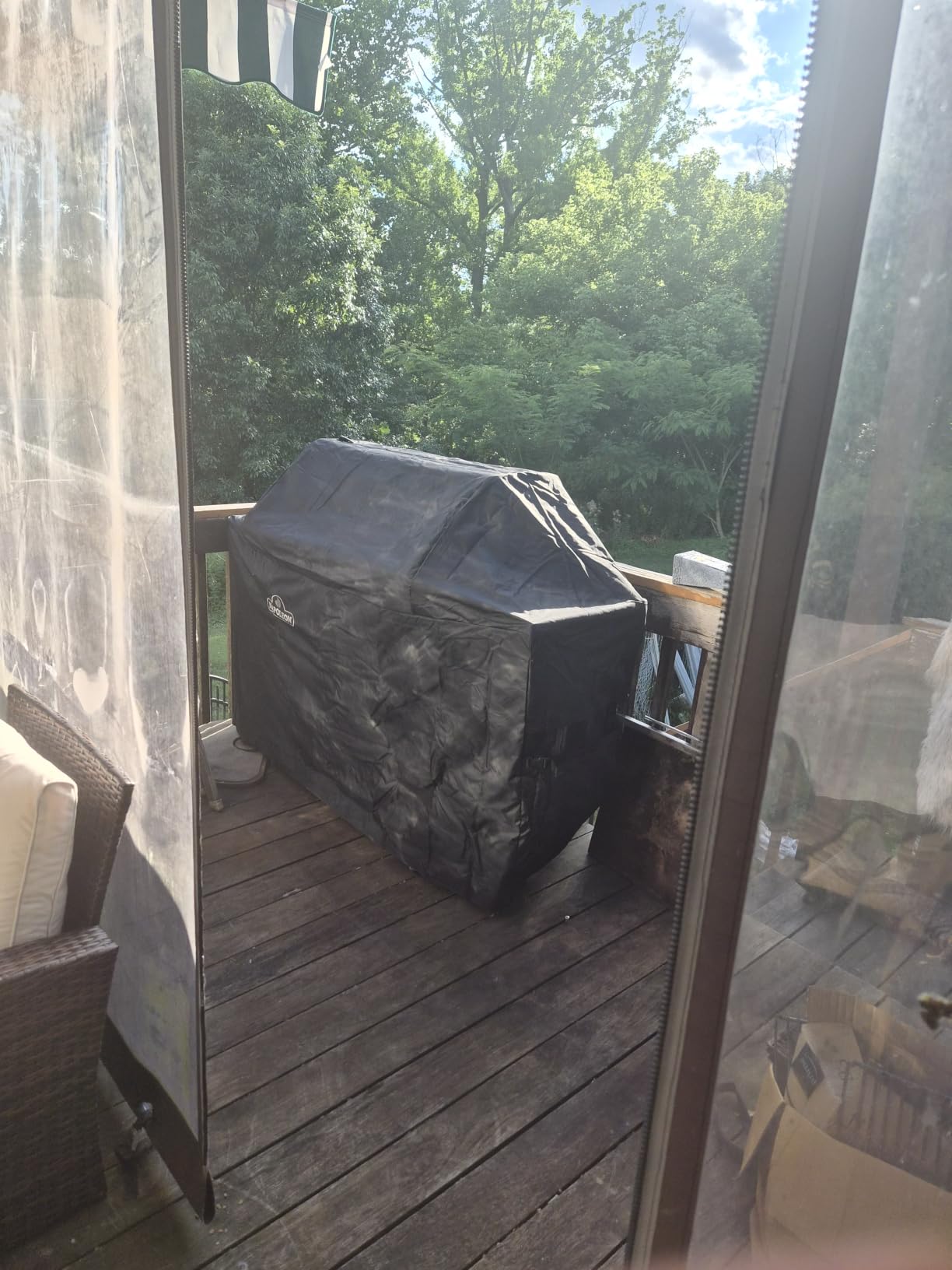
It also has the longest warranty in the roundup at 15 years limited, and the black porcelain enamel lid and doors resist weather and hide fingerprints, which is close to ideal for an exposed deck. The porcelainized cast iron WAVE grids give even heat with a visible sear mark.
The dimensions are the warning. At 66 inches wide, 25 inches deep and 48.5 inches tall, this is one of the largest footprints we considered, and 160 pounds means it needs help into position. Buyers with tight decks should measure twice and honestly.
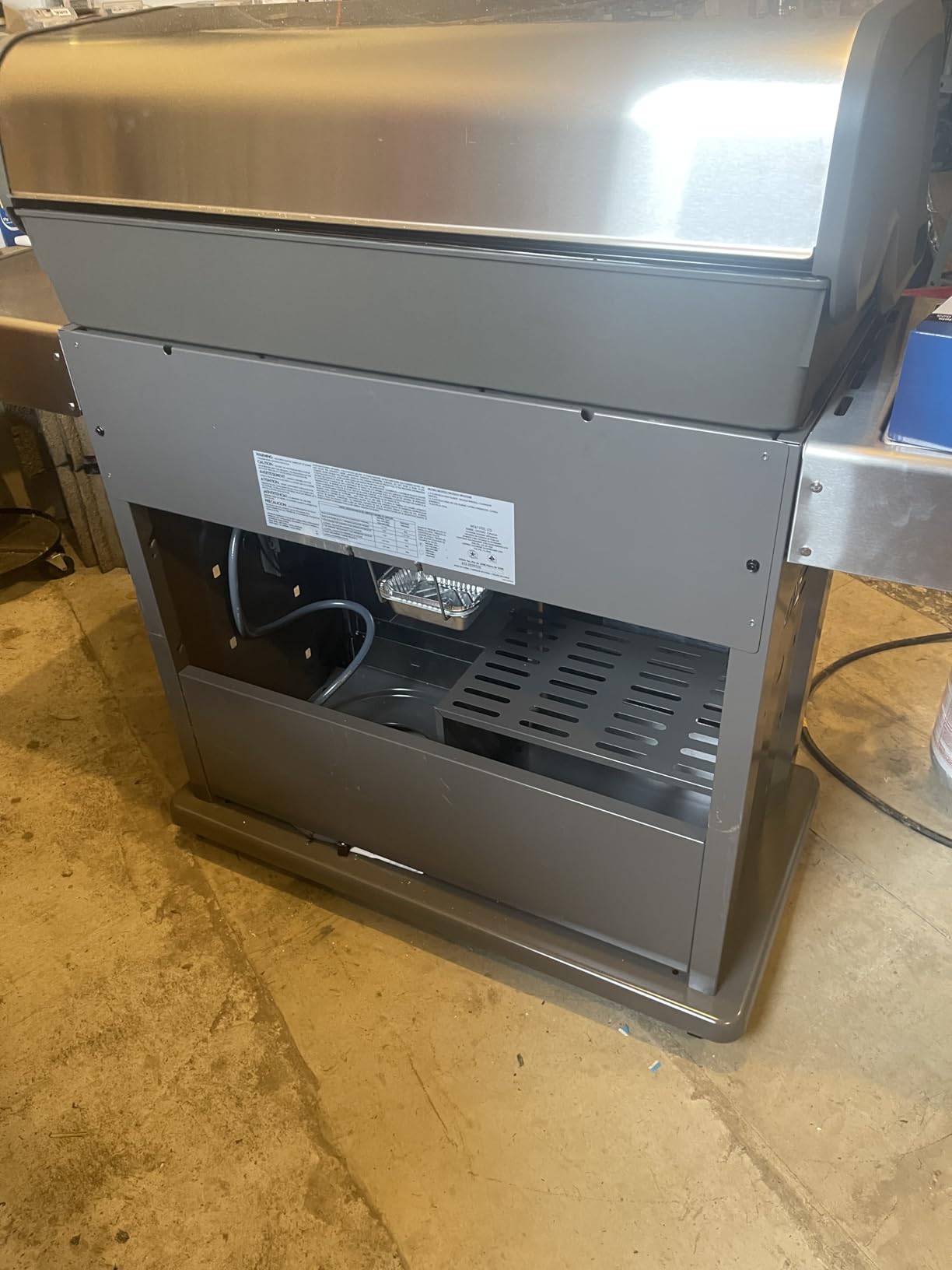
Why this one works on a deck
Infrared heat is wind-resistant in a way open-flame burners are not, because it radiates rather than relies on ambient air mixing. On a breezy deck that is a meaningful difference during a long cook.
The black porcelain enamel finish is also the best weather camouflage in the group. It does not show salt spotting the way bright stainless does, and it wipes clean after a wet weekend.
Where it disappoints
Size is the dealbreaker for a lot of decks. Sixty-six inches of width plus a working aisle in front is a lot of square footage, and the folding side shelves give up work surface when collapsed.
With only 24 reviews, the long-term data is thin, and anyone citing its size should plan the layout rather than hope. Measure the deck, then confirm the aisle in front of the hood is open when the lid is up.
10. Blaze Prelude LBM 32 Inch – Zoned Cooking With a Lifetime Residential Warranty
Blaze Prelude LBM Built-In Natural Gas Grill | 32-Inch 4-Burner BBQ with 56,000 BTUs | 304 Stainless Steel Construction | Flame Stabilizing Grids | BLZ-4LBM-NG
Four 14000 BTU tube burners
304 stainless construction
Removable heat zone separators
Lifetime residential warranty
Pros
- Four 14000 BTU stainless burners total 56000 BTU for high-heat cooking
- 304 stainless throughout resists rust and corrosion
- Removable heat zone separators allow two temperatures at once
- Flame stabilizing grids minimize flare-ups
- Lifetime residential warranty
Cons
- Built-in design requires a cutout and a finished surround
- Grease tray fills with water in rain when uncovered
- Thermometer accuracy is inconsistent on some models
- Made in China which some buyers dislike
The heat zone separators are the idea we like most on this whole list. Pull them out and you can run one end of the grate at a serious sear temperature while the other end holds something gentle, which turns a single grill into a two-temperature station. On a deck that is where most of the cooking actually happens.
Underneath, it is four 14,000 BTU stainless steel tube burners totaling 56,000 BTU, with flame stabilizing grids that spread heat evenly and cut flare-ups. Owners running several Blaze grills report consistent, well-built units that heat fast and cook evenly.
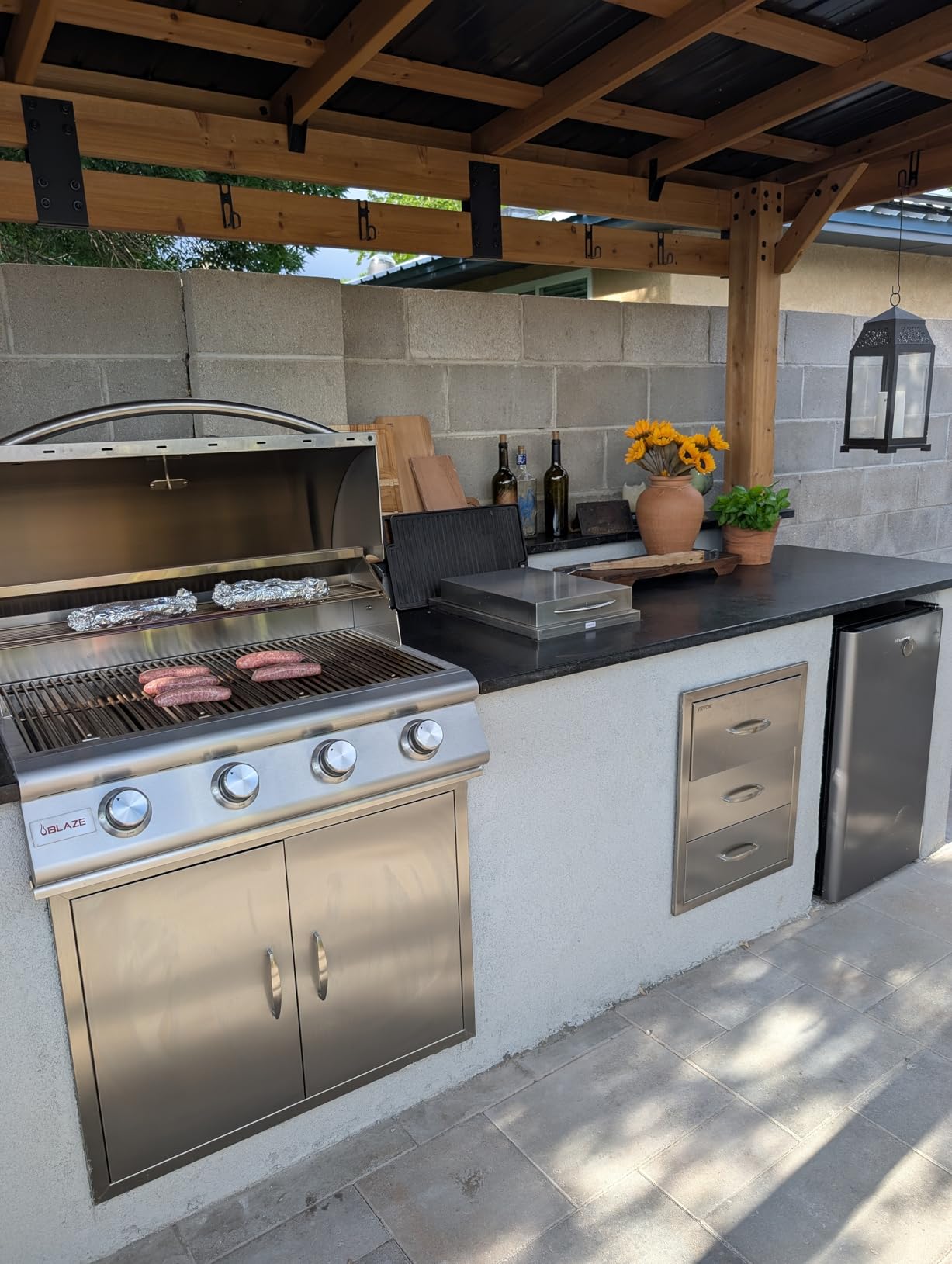
The cutout is specific and worth writing down: 30 5/8 inches wide by 21 1/4 inches deep by 8 1/2 inches tall, with overall dimensions of 32.5 inches wide by 25.75 inches deep by 21.25 inches tall. Measure twice, because a wrong cutout means rebuilding stonework.
Weather exposure is the recurring complaint. One owner reports the grease and debris tray filling with water quickly in rain when the grill is not covered, and thermometer accuracy is inconsistent on some models. A fitted cover solves the first problem and costs almost nothing compared to the head.
Why this one works on a deck
All-304 stainless construction is the right call for a head that lives outdoors, and the lifetime residential warranty is the strongest coverage in the roundup, with a three-year commercial warranty behind it.
Zoned cooking also reduces the need to open the hood, which on a windy deck is where you lose the most heat. Fewer hood cycles means a more predictable cook.
Where it disappoints
A built-in head is a commitment. It requires a cutout, a finished surround and a ventilation plan, and this one is not the grill you buy when you are still deciding whether you want a grill on the deck.
Some buyers dislike the country of manufacture at this price, and the thermometer is not something to rely on. Add an independent probe and you have removed the last real weakness.
11. Monument Grills Denali 605 – Six Burners With App Control
Monument Grills Denali Series, 6+1 Convertible Natural Gas Smart bbq Grill, 6 Burners & 1 Side Burner Stainless Steel Denali 605 with Smart Technology, Knob Controls (Without Conversion Kit)
Six burners plus side burner
895 sq in total cooking space
Bluetooth app control with probe
84,000 BTU output
Pros
- Six main burners plus a side burner deliver 84000 BTU
- 895 sq in total area with 640 sq in primary
- App control with LED display and grill probe
- Knob lights show burn status and a viewing lid avoids heat loss
- Cast iron warming grid
Cons
- Bluetooth range drops off within about 10 feet outdoors
- Smart electronics run on AA batteries that drain in 7 to 10 days
- Stainless surfaces develop rust within a few months for some owners
- Light-gauge material dents easily
The grill itself is capable. Six main burners plus a side burner deliver 84,000 BTU across 895 square inches of total cooking space, with 640 square inches of primary area and a 225 square inch warming rack. Owners like the cooking, the fast heat-up and the even distribution, and customers with earlier Monument grills report real brand loyalty.
The smart system is the reason to look twice. Bluetooth app control with an LED display and a grill probe sounds like exactly what you want on a deck, since you can walk away from the grate. The knob lights indicating off, high and low status and the viewing lid are nice touches for evening cooks.
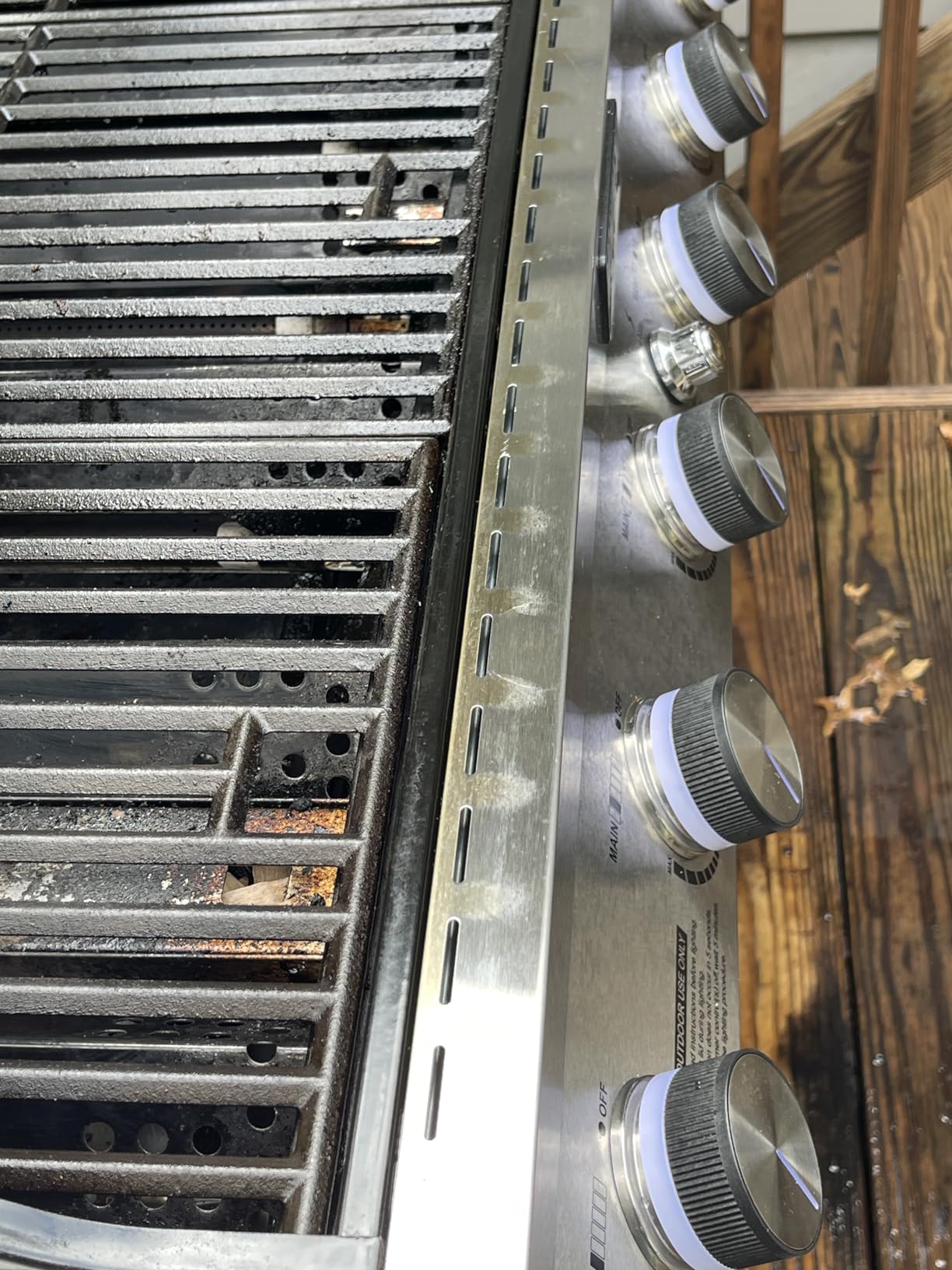
Here is the problem. Bluetooth range drops off within about 10 feet outdoors, far short of the advertised 65 feet, and the electronics run on four AA batteries that drain within seven to ten days and can die mid-cook. Owners also report the smart unit is effectively unusable without a mains-powered battery adapter.
Add early rust on stainless surfaces within a few months for some owners, light-gauge material that dents easily, and a couple of reports of two burners failing from day one, and this is the least settled grill in the roundup. It also carries the lowest rating at 4.2.
Why this one works on a deck
The raw capacity is the draw. If you cook for a large group regularly, 84,000 BTU over 640 square inches of primary space is more cooking area than most built-in heads here, in a cart you can roll into position.
The warming rack is cast iron rather than a thin steel shelf, which holds heat properly, and the probe plus app readout is genuinely useful when you are running low heat on one zone of a big grate.
Where it disappoints
The electronics are the whole weak point, and on a deck they are worse than on a patio because the distance from your phone is greater. If the grill lives more than about 10 feet from where you stand, the app is decorative.
Battery drain and the need for a mains adapter add a maintenance item most grills do not have. If you dislike troubleshooting, the same brand in a non-smart model is the same cooking experience without the friction.
12. Blaze Prelude LBM 25 Inch – Built-In Grilling for a Small Island Cutout
Blaze Prelude LBM Built-In Natural Gas Grill | 25-Inch 3-Burner BBQ with 42,000 BTUs | 304 Stainless Steel Construction | Flame Stabilizing Grids | BLZ-3LBM-NG
Three 14000 BTU tube burners
558 sq in cooking area
23.25 inch wide cutout
304 stainless construction
Pros
- Compact 25 inch footprint fits small island cutouts
- Three 14000 BTU burners total 42000 BTU
- Removable heat zone separators for multiple temperatures
- Flame stabilizing grids for even heat and fewer flare-ups
- Easy to install
Cons
- Grease and debris tray fills with water in rain when uncovered
- Thermometer reported as non-functional on some models
- Made in China which some owners dislike
- 558 sq in is the smallest cooking area in this group
This exists for a specific problem: a small island cutout that cannot physically host a 32 inch head. At 25 inches wide by 25.75 inches deep by 21.25 inches tall, with a cutout of 23 1/4 inches wide by 21 1/4 inches deep by 8 1/2 inches tall, it fits where the bigger Blaze will not.
Owners with several Blaze grills report consistent solid build quality and repeat-brand loyalty, which tells you something real about the platform. Three 14,000 BTU tube burners total 42,000 BTU, and the same removable heat zone separators and flame stabilizing grids as the larger head.
The weather complaint is identical to the 32 inch version and just as important on a deck. The grease and debris tray fills with water in rain when the grill is not covered, so a fitted cover is effectively part of the purchase.
Why this one works on a deck
304 stainless construction and a lifetime residential warranty, so the material and the coverage are right for an outdoor installation even at the compact end of the range.
Simple installation is the quiet benefit. If your island is already framed and you want a built-in look without a rebuild, this is the head that fits the space you actually have.
Where it disappoints
At 558 square inches it is the smallest cooking area in the roundup, and that limits batch cooking for a group. It suits a couple or a small family, not a deck that hosts fifteen people.
The thermometer has been reported as non-functional on some models, and the water-in-the-tray problem means uncovered use is a mistake. Add an independent probe and a cover to your plan, and the rest is solid.
Is a Natural Gas Grill Legal on a Deck?
Yes, in most places, but it is regulated and the rules are local. A natural gas grill on a residential deck is generally permitted as long as the gas line is installed by a licensed plumber to code, the required clearances from combustibles are observed, and any HOA or building rules for your property allow it. Multifamily buildings and fire-restricted zones are the exceptions that need checking first.
Four things decide it. Local building and fire code governs the gas line itself, the manufacturer’s clearance chart governs distance from railings, siding and overhead surfaces, your HOA or condo association governs what you may place on common or elevated deck space, and a fire marshal can add requirements on multi-family structures.
Start with the fire marshal or building department for your municipality rather than the retailer. A short phone call will tell you whether a plumbed grill is permitted on that specific deck, and it is far cheaper to learn that before the island is poured than after.
HOA rules deserve separate attention because they are contractual rather than legal. Many associations restrict grills on decks above the first level, or require a specific distance from the house and from shared walkways. Several forum threads about deck grilling turn into arguments about association rules rather than grill performance, which is a good sign to read your documents before you buy.
On multifamily properties, the fire marshal may also require a venting plan and inspection for any grill under an overhang or inside an enclosed cabinet. Our built-in grill guide for outdoor kitchens covers the installation side of this in more detail.
Deck Clearance and Heat Safety: The Checklist Most Rounds Skip
A deck grill is a heat source within a few feet of a railing, a house wall, a vinyl panel and often a low overhang. Getting the clearance right is the single most important thing you can do before choosing a model, and it costs nothing to check against the grill’s manual.
Measure from the hood, not the cabinet. The manufacturer’s clearance figures reference the nearest surface above and behind the unit, and a raised hood on an open deck can reduce your usable clearance to the overhang by a foot. Check the vertical distance to any soffit, and the horizontal distance to siding, windows and the house wall.
Railings deserve more attention than most sellers give them. A wood or composite railing top is a combustible surface directly beside a grill, and railings are often closer than the minimum clearance that a normal yard placement would allow. Measure from the rail cap to the side of the cookbox, not to the cart wheels.
Composite decking is not a heat shield, whatever the manufacturer says. It will scorch, and the underside of a deck is often a closed cavity of framing and joists. A freestanding grill with clearance underneath is safer on composite than a built-in island with a solid stone base sitting flush to the boards.
Two more practical items. Put the grill on a non-combustible pad if the manufacturer requires one, and use a fitted cover, because several heads in this roundup collect rainwater in the grease tray when left uncovered. If your grill sits under a roof or in a cabinet, read the next section on ventilation before you build it in.
Built-In vs Freestanding on a Deck
Most deck owners are not pouring an island, and a freestanding cart is the right answer for most of them. A built-in head gives you a cleaner look and a heavier insulated body, but it requires a cutout, a finished surround, a ventilation plan and a decision you cannot undo once stone is set.
Choose built-in if you are already building an outdoor kitchen, if you want the durability of a thick insulated body that stays hot in wind, or if you want the grill to visually disappear into the deck. The Blaze, Brand-Man, Bull and SPIRE heads on this list are all built-in drops with specified cutout dimensions.
Choose freestanding if you want to roll the grill aside, store it under a cover or inside a shed, or if you are not sure you want a permanent island. The Monument carts, the Weber Genesis and Spirit models and the Napoleon Rogue are all in this group.
One caveat specific to decks. A built-in island concentrates several hundred pounds onto a small footprint, and that load has to be carried by the joists below. If your deck is framed over a drop rather than on a foundation, confirm the framing with a contractor before anything is poured. Our built-in gas grill guide walks through the cutout and surround basics.
Running a Natural Gas Line to Your Deck
A natural gas grill connects to a dedicated branch of your household gas supply, and the work belongs to a licensed plumber in nearly every jurisdiction. The line itself is black iron or flexible gas-rated piping, run in an approved location, with a shutoff valve within reach and a sediment trap at the appliance end.
The most common routing is beneath the deck or along a wall, with the branch line emerging at the island. Codes regulate where that piping can run, how close it may sit to other utilities, and what clearance it needs from flues and combustion vents, which is why a DIY run is a bad idea even for a confident homeowner.
Longer runs create a pressure problem rather than a fuel problem. As the line length increases, available pressure at the grill drops, and a grill that is fine on a short run can be sluggish on a long one. If the grill is far from the house, ask your plumber to calculate the drop and size the line accordingly, and tell them the grill’s BTU rating before they start.
Two grill-specific items to raise during that conversation. Some built-in heads need more than a standard conversion kit, including new gas modulators and sometimes an insulated grill jacket for code approval, and a convertible cart needs the orifice change and the flame reset done correctly or the gas grill will run weak. Both are the plumber’s work, and both are worth confirming in writing before the day.
The one forum motivation that comes up constantly is simple: the reason people pipe natural gas outside is so they do not have to worry about propane running out in the middle of a cook. That is still a good reason, and it is a better one if you are cooking for a crowd on a deck with no easy path to the propane cage.
Natural Gas vs Propane on a Deck
Natural gas wins on uninterrupted cooking and long-run cost. You never run out mid-meal, you never haul a tank down deck stairs, and you reclaim the corner where the tank cage used to live. Propane wins on flexibility, because the grill stays portable and no plumber is involved.
For a permanent deck installation, we lean natural gas every time. The fuel is cheaper per BTU over years, the connection never needs attention, and the grill can be plumbed right where you want it rather than dragged into place.
Propane makes more sense if the deck is small and the grill position is undecided, if you rent, or if the gas line install is not practical. Several of the convertible grills here run on either fuel with a kit, which is a reasonable hedge if you are still weighing the plumbing.
One safety point about the storage side of the argument. A propane tank stored on a finished deck is a heat source you did not plan for, near a railing and a door. That is a large part of why a plumbed grill is the better deck solution, and it is worth remembering when someone tells you propane is simpler.
How to Choose a Natural Gas Grill for a Deck
Size to the deck, not to the ambition. Measure the rectangle the grill will occupy, then the working aisle in front of it with the lid raised, then the clearance to the nearest railing and wall. A grill that does not fit with the hood open is not a deck grill, however good it is on a patio.
Cooking area matters more than BTU. Total BTU is a marketing number that mostly reflects how fast a grill heats up, not how well it cooks, because the burners are throttled to a fixed temperature range. Primary cooking area, the flat-top square inches excluding the warming rack, is the figure that determines how much food you can cook at once.
Stainless grade is the deck decision. 304 stainless contains more chromium and nickel than 430, and it resists pitting and salt air corrosion, which is exactly the environment a deck grill lives in. If you are coastal, humid, or simply want the grill to look right after five seasons, pay for 304 on the body, the burners and the grates rather than just the lid.
Burner construction is the durability decision. Cast stainless burners and welded stainless tubes outlast stamped or aluminized steel tubes that corrode from the inside out. Grates matter almost as much: porcelain-coated cast iron holds heat and releases it evenly, while plain steel grates hot-spot and shed coating.
Ignition reliability on natural gas deserves attention because there is no tank to swap when a pilot goes out. Piezo ignition is the simplest and most dependable option with nothing to fail but the igniter itself, and electronic ignition with a battery pack needs a weatherproof box and periodic battery attention. We covered a full grill comparison in our best gas grills roundup if you want the fuel-neutral version.
Warranty is the closest thing to a lifespan prediction. Look at what is covered for how long on the body, the burners, the grates and the electrical parts, because those are the components that fail, and a one-year warranty on a grill that will live on a deck for a decade is a warning sign.
Ventilation decides whether a built-in grill is safe in a cabinet or under an overhang. Louvered panels on the front and back of the enclosure let combustion air in and let heat and gas accumulation out, and an adjustable air vent on a grill head adds a second layer. A fully enclosed cabinet with no venting is a hazard regardless of which grill is inside it.
Brand tiering, briefly. Weber and Napoleon are the premium tier, with the longest warranties and the largest accessory ecosystems. Bull and Blaze sit in the professional built-in tier, where the heavy welded construction and lifetime coverage are the draw. Monument is the value tier, where you get most of the cooking performance for a good deal less, and SPIRE sits in between with all-304 material at the top of its line.
On the head-to-heads. Weber against Monument is a warranty and footprint fight that Weber usually wins on coverage and Monument usually wins on outlay. Napoleon against Monument is a searing and features comparison, and Napoleon wins on sear hardware while Monument wins on price. Blaze against Napoleon is a durability question, and Blaze wins on stainless thickness and the lifetime residential warranty while Napoleon wins on heat delivery and infrared work.
Finally, size to the guests. Two to four people cook comfortably on a three-burner cart with around 360 square inches of surface. A family of six wants roughly 500 to 650 square inches of primary area, and a deck that hosts ten or more regularly wants 900 square inches or more, which is why the large built-in heads and the Genesis S-435 exist.
If you are still narrowing the field for a smaller space, our portable gas grill guide covers the opposite end of the size spectrum.
Frequently Asked Questions
Is it legal to have a natural gas grill on a deck?
Usually yes. A plumbed natural gas grill on a residential deck is permitted as long as a licensed plumber installs the line to local code, the manufacturer’s clearances from railings, siding and overhangs are observed, and your HOA or building rules allow it. Multifamily buildings and fire-restricted zones need a fire marshal review before you build. Check your municipality first, because that answer arrives in a phone call rather than a permit office line.
How much clearance does a gas grill need from a deck railing?
Follow the clearance chart in the grill’s manual, and measure from the side of the cookbox and the raised hood rather than from the cart frame. A wood or composite railing cap is a combustible surface, so the minimum distance from the grill body to the rail is the figure that governs. If your deck is tighter than the chart allows, the answer is a smaller grill or a different location, not a shortened clearance.
Can you hook a gas grill to a natural gas line?
Yes, but not every grill is plumbed-ready from the factory. Some built-in heads need a conversion kit plus new gas modulators and sometimes an insulated grill jacket for code approval, and convertible carts need the orifice change and the flame reset done correctly or they will run weak. A grill that ships with a natural gas hose and regulator needs the least work. The connection itself is a licensed plumber’s job.
Does an outdoor grill cabinet need ventilation?
Yes, if the grill is enclosed or under an overhang. Louvered openings on the front and back of the enclosure supply combustion air and let heat escape, and an adjustable air vent on a grill head adds a second path. Gas accumulates in a sealed cabinet, so a fully closed surround with no venting is unsafe no matter which grill is installed inside it.
Is a built-in grill worth it on a deck?
It is worth it if you are already building an outdoor kitchen, because a heavy insulated body holds heat better in wind and the grill disappears into the surround. It is not worth it if you are still deciding, because a built-in head needs a cutout, a finished surround, a ventilation plan and a deck that can carry the load. Most deck owners are better served by a freestanding cart on casters that can be moved and covered.
Is natural gas cheaper than propane for grilling?
Per BTU, natural gas costs less, and the gap widens over years of use because you are never paying to haul or exchange a tank. The catch is the upfront plumbing. On a deck with a permanent gas line, natural gas wins on both fuel and convenience. If the line is not practical, a convertible grill on propane keeps the option open with a kit swap.
Which natural gas grill is the best for a deck?
The SPIRE 36 inch built-in six-burner head leads on all-304 stainless construction and 904 square inches of cooking space. The Bull Outdoor Outlaw drop-in head is the most proven option, with a 4.6 rating and lifetime coverage on the frame and grates. For a deck with no island plan, the Monument Grills 41847NG is the value pick, and the Weber Spirit E-325 fits the smallest decks.
Is 304 or 430 stainless steel better for a deck grill?
304 stainless. It carries more chromium and nickel, so it resists pitting and salt air corrosion, which is the environment a deck grill lives in. 430 is adequate for a lid or trim panel and cheaper, but it will spot and pit sooner near the coast or in persistent humidity. If you are choosing between two similar grills, 304 on the body, burners and grates is the better long-term buy.
Final Verdict: What We Would Put on a Deck in 2026
The best natural gas grills for decks in 2026 come down to one question: are you building an island or standing one grill on finished boards? For the first case, the SPIRE 36 inch built-in head is our pick, with all-304 stainless through the burners and grates and 904 square inches of cooking space, provided you plan the modulator swap and the insulated jacket question before the island is poured.
For a drop-in that will outlast most of the grills on this list, the Bull Outdoor Outlaw carries the highest rating and the strongest warranty, and its welded stainless burners are the reason. For a deck with no masonry work, the Monument Grills 41847NG is the value pick, and the Monument M415BZNG is the simplest setup if you want a natural gas hose in the box and casters to roll it away.
Before any of them, measure the deck, check the clearance to your railing, confirm the gas line routing with a licensed plumber, and check your HOA rules. A grill that fits the space and clears the combustibles will still be cooking long after a better grill in the wrong rectangle has been replaced.