
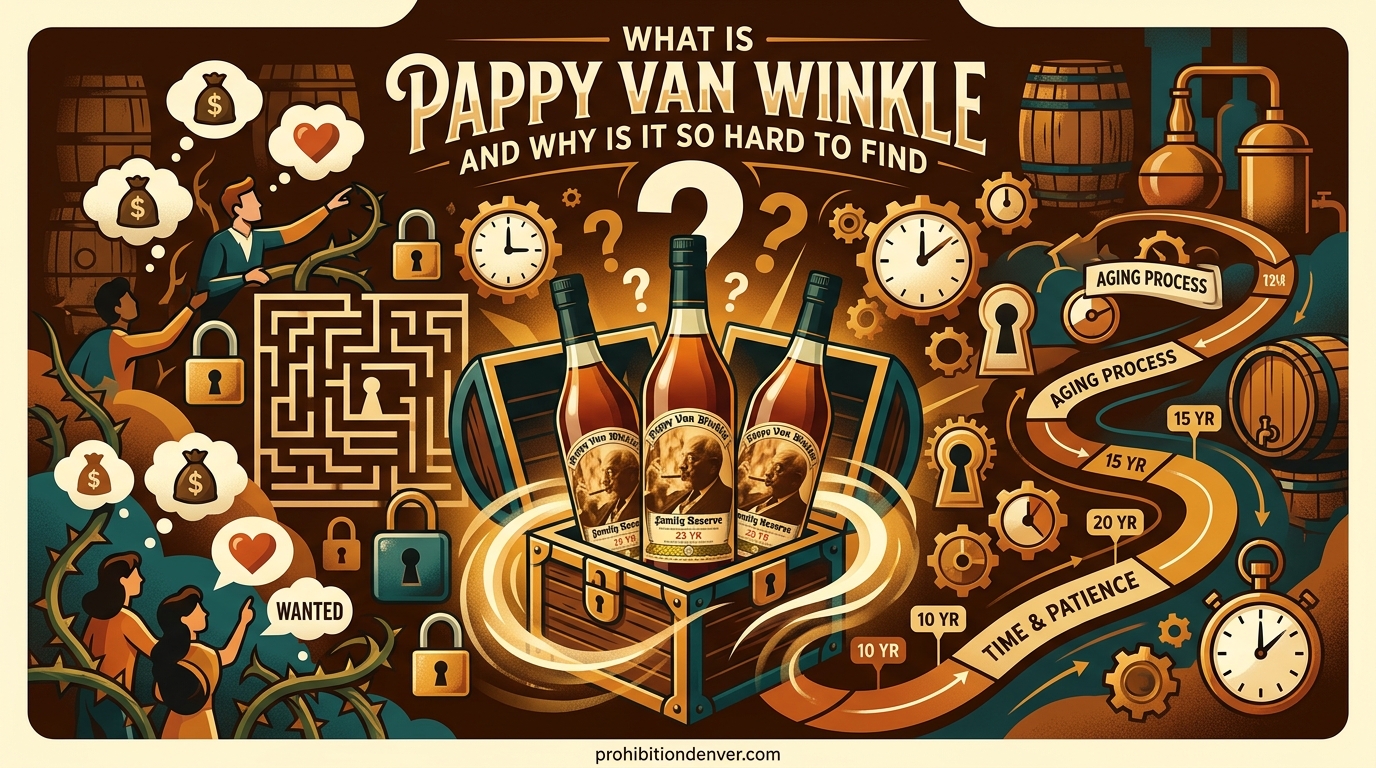
If you have ever stepped into a whiskey bar and noticed a dusty bottle behind the counter with a handwritten sign reading “Pappy Van Winkle – $100 per ounce,” you have encountered the unicorn of the bourbon world. This is not just expensive whiskey. It is a cultural phenomenon that inspires lottery systems, heist stories, and a secondary market where bottles sell for prices that rival fine wine.
Pappy Van Winkle is an ultra-rare, wheated bourbon produced by the Van Winkle family in partnership with Buffalo Trace Distillery. Only 7,000 to 8,000 cases release annually across the entire United States, making it one of the most allocated spirits on earth. Our team has spent years studying the bourbon allocation system, and we will explain exactly why this whiskey remains virtually impossible to find at retail price.
By the end of this guide, you will understand the history behind the name, what makes the wheated mash bill unique, how the allocation lottery system works, and why bottles regularly sell for 10 to 20 times their MSRP on the secondary market.
Table of Contents
Who Was Pappy Van Winkle?
Julian “Pappy” Van Winkle Sr. was born in 1874 and lived to become one of the most influential figures in American whiskey history. He started his career as a traveling salesman for W.L. Weller and Sons in the late 1800s, eventually working his way up to become a partner in the company.
In 1935, following the repeal of Prohibition, Pappy founded the Stitzel-Weller Distillery in Louisville, Kentucky, along with Alex Farnsley. The distillery became famous for producing wheated bourbon, a style Pappy championed because he believed it created a smoother, more approachable whiskey than traditional rye-based recipes.
Pappy ran Stitzel-Weller until his death in 1965 at the age of 91. Family legend holds that he had a glass of whiskey by his bedside when he passed. After his death, the family continued operating the distillery until financial pressures forced a sale in 1972. The Van Winkle family retained the rights to their brand names and remaining whiskey stocks, which would prove crucial decades later.
What Makes Pappy Van Winkle Different?
The defining characteristic of Pappy Van Winkle is its wheated mash bill. While most bourbon uses rye as the secondary grain after corn, Pappy substitutes wheat. This creates a dramatically different flavor profile that enthusiasts describe as softer, sweeter, and more mellow than rye-based alternatives.
Bourbon law requires at least 51 percent corn in the mash bill. Pappy uses a higher corn percentage combined with wheat and malted barley. The wheat contributes to a smoother mouthfeel and reduces the spicy bite that rye brings to traditional bourbon.
The second major differentiator is age. While most bourbon ages for 4 to 8 years, Pappy expressions age for 15, 20, and 23 years. This extended aging develops complex flavors of caramel, dried fruit, vanilla, and oak. However, it also creates massive losses through evaporation.
Distillers call evaporated whiskey the “angel’s share.” In Kentucky warehouses, annual evaporation rates range from 5 to 10 percent depending on warehouse location and barrel position. Over 23 years, a barrel might lose 60 to 70 percent of its original contents to the angels. This means the remaining whiskey becomes exponentially rarer and more expensive to produce.
Since 2002, Buffalo Trace Distillery has produced Pappy Van Winkle using the Van Winkle family recipe and strict barrel selection criteria. The partnership gives the Van Winkles access to Buffalo Trace’s vast production capabilities while maintaining the wheated tradition Pappy started nearly a century ago.
The Pappy Van Winkle Lineup Explained
The Van Winkle portfolio includes several expressions, each with different age statements and proof points. Understanding the lineup helps explain why some bottles command higher prices than others.
Old Rip Van Winkle 10 Year (107 proof) – The entry point to the Van Winkle range, bottled at a higher 107 proof. It offers the most accessible price point in the lineup while still delivering the wheated character.
Van Winkle Special Reserve Lot “B” 12 Year – A 90.4-proof expression that serves as a bridge between the Old Rip line and the older Pappy bottles. Many enthusiasts consider this the sweet spot for value in the portfolio.
Pappy Van Winkle Family Reserve 15 Year – The youngest expression bearing the Pappy name. At 107 proof, it packs significant flavor while showing the wheated profile that defines the brand.
Pappy Van Winkle Family Reserve 20 Year – A 90.4-proof bourbon aged two decades. This expression represents the point where extended aging begins showing dramatically in the flavor profile, with deep oak notes and concentrated sweetness.
Pappy Van Winkle Family Reserve 23 Year – The crown jewel of the lineup. Aged nearly a quarter-century at 95.6 proof, this is the rarest and most expensive official release. Bottles from specific years have achieved legendary status among collectors.
Van Winkle Family Reserve Rye 13 Year – The only rye whiskey in the portfolio, released in extremely limited quantities. Unlike the wheated bourbons, this uses a traditional rye recipe, making it a unique outlier.
Why Is Pappy Van Winkle So Hard to Find?
The scarcity of Pappy Van Winkle results from a perfect storm of production limitations, market dynamics, and cultural forces. Here are the seven factors that make finding a bottle nearly impossible.
1. Extreme Production Limits
Buffalo Trace releases only 7,000 to 8,000 cases of Pappy Van Winkle annually across all expressions. To understand how small this is, consider that Buffalo Trace produces millions of cases of bourbon each year. Pappy represents a fraction of a percent of total output. When distributed across all 50 states and international markets, most liquor stores receive zero bottles.
2. The Angel’s Share Destroys Inventory
Extended aging sounds luxurious, but it is devastating to inventory levels. A barrel of whiskey aged 23 years loses more than half its contents to evaporation. The whiskey that remains becomes incredibly concentrated and valuable, but the distillery cannot magically replace evaporated product. This is why older expressions like the 20 and 23 Year releases remain so limited regardless of demand.
3. The Allocation and Lottery System
Most Pappy Van Winkle never hits open retail shelves. Instead, it flows through an allocation system where distributors allocate bottles to specific retailers based on relationships, purchase history, and state regulations. Many states have implemented lottery systems where residents can enter drawings for the chance to buy a bottle at MSRP.
In Kentucky, the lottery requires entrants to register during a specific window, with winners selected randomly. Virginia uses a similar system. Some states like Washington allow stores to distribute bottles to loyalty program members. The common thread is that simply walking into a store and buying Pappy off the shelf is virtually impossible.
4. Celebrity Endorsements and Media Amplification
Anthony Bourdain called Pappy Van Winkle “the best bourbon on earth” during an episode of “No Reservations.” Chef Sean Brock famously mixed it into barbecue sauces and featured it on his shows. David Chang and other celebrity chefs regularly name-drop Pappy in interviews. This media amplification transformed Pappy from a whiskey enthusiast’s secret into a mainstream luxury good.
The celebrity endorsements created a feedback loop. As more people learned about Pappy, demand exploded. The limited supply could not expand, so prices rose. Rising prices generated more media coverage, which increased demand further. By the early 2010s, Pappy had become “famous for being famous” in the whiskey world.
5. The Pappygate Theft
In 2013, the world learned just how valuable Pappy Van Winkle had become when authorities arrested a criminal ring that had stolen more than $100,000 worth of bourbon from Buffalo Trace. The heist involved inside access to secure warehouse areas and the theft of rare bottles including Pappy 20 Year.
The “Pappygate” scandal, as media called it, cemented Pappy’s legendary status. If criminals were willing to risk prison for bourbon, the whiskey must truly be special. The story spread through national news outlets, introducing millions of people to Pappy Van Winkle for the first time and creating even more demand for an already scarce product.
6. Secondary Market Economics
With retail availability near zero, a thriving secondary market emerged where collectors and flippers sell bottles at massive markups. A bottle of Pappy 23 Year carries an MSRP around $249. On the secondary market, that same bottle regularly sells for $2,000 to $5,000 depending on vintage and condition.
This price gap creates a powerful incentive for anyone who wins a lottery or receives an allocation to immediately resell rather than drink. Many bottles that reach consumers never get opened. Instead, they circulate through private sales, auctions, and Facebook groups dedicated to bourbon trading.
7. Cult Status and FOMO Psychology
Pappy Van Winkle has transcended the category of whiskey to become a cultural symbol. Owning a bottle signals taste, sophistication, and access. The difficulty of acquisition makes possession more valuable than the liquid itself for many buyers.
This psychology creates fear of missing out (FOMO) that drives even casual drinkers to enter lotteries and hunt for bottles they may never open. The scarcity itself becomes a feature, not a bug. Pappy is hard to find because being hard to find is part of what makes it Pappy.
Pappy Van Winkle Prices: MSRP vs. Secondary Market
Understanding the price structure explains why the hunt for Pappy generates so much frustration and excitement.
Retail MSRP ranges:
Old Rip Van Winkle 10 Year: $69.99 to $79.99
Van Winkle Special Reserve 12 Year: $79.99 to $89.99
Pappy Van Winkle 15 Year: $119.99 to $129.99
Pappy Van Winkle 20 Year: $199.99 to $219.99
Pappy Van Winkle 23 Year: $249.99 to $299.99
Secondary market ranges:
Old Rip Van Winkle 10 Year: $400 to $600
Van Winkle Special Reserve 12 Year: $500 to $800
Pappy Van Winkle 15 Year: $800 to $1,200
Pappy Van Winkle 20 Year: $1,500 to $3,000
Pappy Van Winkle 23 Year: $2,500 to $10,000+
The 10 to 20x markup reflects pure supply and demand economics. With millions of people wanting bottles and only thousands available, prices adjust accordingly. However, buyers should exercise extreme caution on the secondary market. Counterfeit Pappy bottles have become increasingly sophisticated, with fake labels and wax seals that fool even experienced collectors. The safest approach is buying only from licensed retailers, even if that means waiting years for a lottery win.
How to Actually Get a Bottle of Pappy
While finding Pappy at retail requires luck and persistence, several strategies improve your odds beyond random chance.
Join state lotteries: Kentucky, Virginia, and several other states run annual lotteries for allocated bourbon. Register during the entry window and hope for random selection. Even entering every year for a decade gives no guarantee, but it costs nothing to try.
Build retailer relationships: Independent liquor stores often allocate bottles to their best customers. Become a regular shopper, ask about allocation programs, and demonstrate genuine interest in bourbon beyond just Pappy. Store owners remember customers who support their business year-round, not just during Pappy season.
Visit Kentucky: The Buffalo Trace Distillery occasionally releases bottles at their gift shop. While lines form hours before opening, visiting the source gives you a chance that does not exist elsewhere. The distillery also offers tastings where you can try Pappy without buying a full bottle.
Join bourbon societies: Many cities have whiskey clubs that pool resources and share allocations. Members who win lottery entries often trade within the group, creating a community-based distribution network.
Avoid the gray market: Facebook groups, Craigslist listings, and unverified online sellers offer Pappy at inflated prices but carry massive counterfeit risk. If you cannot verify provenance, assume the bottle is fake. No deal is worth drinking counterfeit whiskey.
Poor Man’s Pappy: Affordable Alternatives
Most bourbon enthusiasts will never own a bottle of Pappy Van Winkle. Fortunately, several alternatives offer similar wheated profiles at accessible prices.
W.L. Weller 12 Year: Produced by Buffalo Trace using the same wheated mash bill as Pappy, this bourbon offers remarkably similar flavor at a fraction of the cost. In fact, the “Poor Man’s Pappy” recipe involves mixing Weller 12 with Old Weller Antique to approximate the Pappy 15 Year profile.
Maker’s Mark Cask Strength: While Maker’s uses a different wheated recipe, the Cask Strength expression delivers the high-proof, full-bodied experience that Pappy drinkers seek. It is readily available and affordable.
Larceny: Another wheated bourbon from Heaven Hill Distillery, Larceny offers honey sweetness and wheat smoothness without the Pappy price tag or hunt.
Buffalo Trace Antique Collection: While not wheated, these allocated releases from the same distillery offer comparable age statements and complexity. The George T. Stagg and William Larue Weller expressions compete with Pappy for “best bourbon” accolades.
These alternatives will not satisfy collectors seeking the Pappy name on their shelf. But for drinkers who want to experience wheated bourbon excellence without the lottery system, they provide 90 percent of the experience at 10 percent of the price.
FAQ
How much does a bottle of Pappy Van Winkle cost?
At retail, Pappy Van Winkle ranges from approximately $79.99 for the 10-year expression to $249.99 for the 23-year. However, due to extreme scarcity, secondary market prices range from $400 to over $10,000 depending on the specific expression and vintage.
Why is Pappy Van Winkle bourbon so rare?
Pappy Van Winkle is rare because Buffalo Trace releases only 7,000 to 8,000 cases annually across all expressions. Extended aging causes massive evaporation losses (the angel’s share), reducing inventory further. Combined with national and international demand, this creates extreme scarcity.
What is the rarest Pappy Van Winkle?
The Pappy Van Winkle Family Reserve 23 Year is the rarest standard release. Aged for 23 years, it suffers the highest evaporation losses and receives the smallest allocation. Specific vintage years have achieved legendary status among collectors.
Does Costco ever get Pappy Van Winkle?
Costco locations in states that allow liquor sales occasionally receive allocations, but they are extremely rare. When Costco does get Pappy, it sells at MSRP to members, typically through lottery or first-come systems that generate massive lines.
What is a poor man’s Pappy Van Winkle?
Poor Man’s Pappy refers to a blend of W.L. Weller 12 Year and Old Weller Antique bourbons, both produced by Buffalo Trace using the same wheated mash bill as Pappy. The blend approximates the Pappy 15 Year profile at a fraction of the cost and without the hunt.
Conclusion
Pappy Van Winkle represents the pinnacle of bourbon scarcity and desirability. The combination of limited production, extended aging losses, wheated mash bill tradition, and cultural phenomenon status ensures that demand will always exceed supply. Understanding why Pappy Van Winkle is so hard to find does not make the hunt easier, but it does explain why winning a lottery or finding a bottle at retail feels like striking liquid gold.
If you choose to chase the unicorn, enter those lotteries, build those retailer relationships, and visit Kentucky when you can. But also remember that excellent wheated bourbon exists at every price point. The whiskey in your glass matters more than the label on the bottle. Pour yourself something you enjoy, and if that happens to be Pappy Van Winkle someday, savor every drop. You have earned it.