
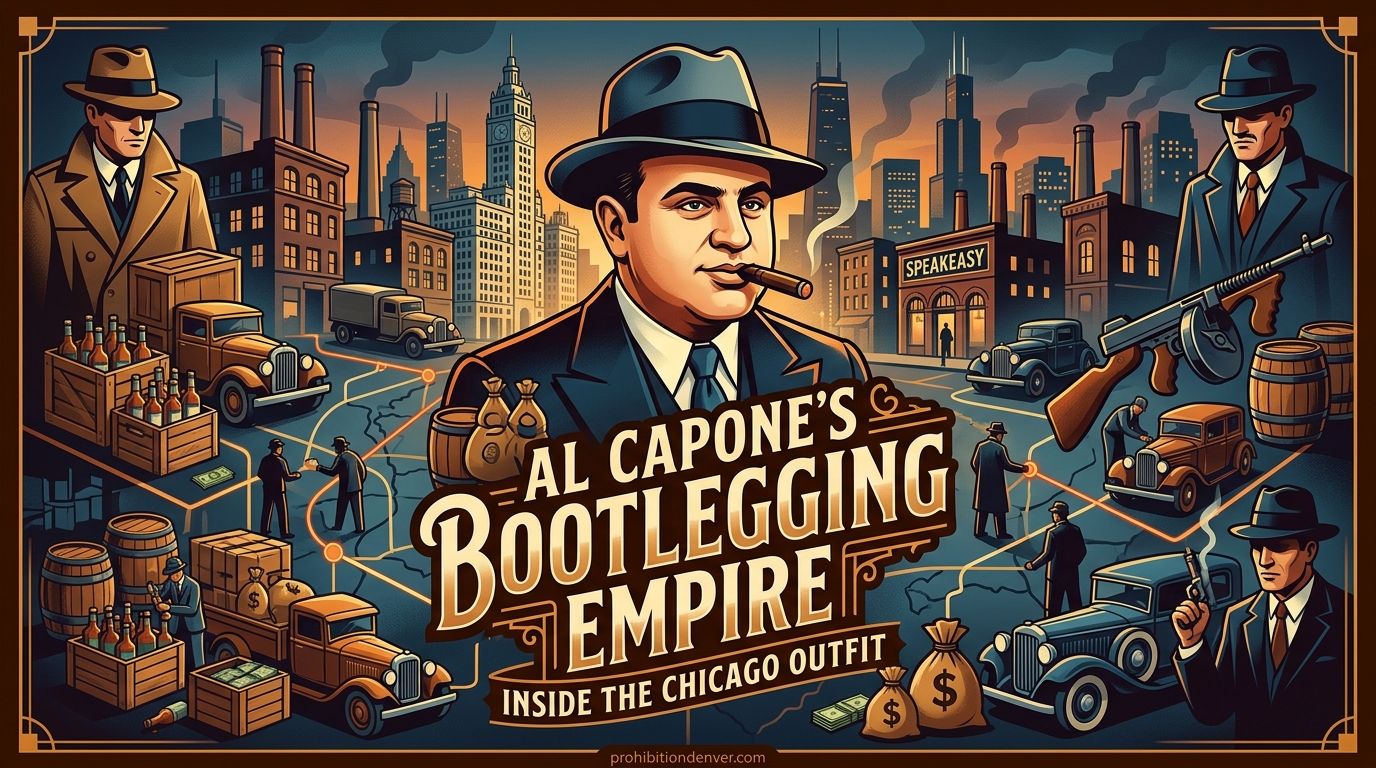
Al Capone didn’t just run a criminal gang. He built a bootlegging empire that generated an estimated $100 million annually at its peak and transformed the Chicago Outfit into the most powerful organized crime syndicate in American history. When Prohibition began in 1920, Capone saw opportunity where others saw restriction. His systematic approach to illegal alcohol production, distribution, and sales created a template for organized crime that would be studied and replicated for generations.
Understanding Al Capone’s bootlegging empire inside the Chicago Outfit requires looking beyond the Hollywood stereotypes. The operation was sophisticated, employing thousands of people across production facilities, transportation networks, and retail establishments. Political corruption wasn’t an accident—it was a calculated business expense that kept the wheels turning.
Table of Contents
Prohibition and the Birth of Organized Crime
The 18th Amendment took effect on January 17, 1920, making the manufacture, sale, and transportation of alcoholic beverages illegal nationwide. The Volstead Act provided the enforcement framework, but the demand for alcohol didn’t disappear. It simply moved underground.
Chicago became ground zero for bootlegging operations. The city’s location on Lake Michigan provided easy access to Canadian whiskey. Its extensive railroad network connected to every major market in the Midwest. Corruptible politicians and police created an environment where criminal enterprises could flourish with minimal interference.
Before Prohibition, criminal gangs were small, neighborhood-based operations running local gambling and prostitution rackets. The ban on alcohol changed everything. Suddenly, there was a product that everyone wanted and would pay premium prices for. The profit margins were enormous, and the scale of operations had to match.
The Foundation: Big Jim Colosimo and Johnny Torrio
To understand how Al Capone built his empire, you must first understand the men who laid the groundwork. Big Jim Colosimo ran Chicago’s criminal underworld when Capone arrived in 1919. His operation centered on prostitution, gambling, and protection rackets, but he showed little interest in bootlegging. That hesitation would cost him his life.
Johnny Torrio was different. He saw Prohibition as the opportunity of a lifetime. Torrio had built a reputation as a strategic thinker who preferred negotiation over violence. He understood that controlling the supply chain mattered more than controlling territory through force. His vision was of a structured criminal enterprise that functioned like a legitimate business.
In January 1920, Colosimo was murdered in his own restaurant. The hit was widely believed to have been ordered by Torrio, possibly with Capone pulling the trigger. With Colosimo out of the way, Torrio took control of the organization that would become the Chicago Outfit.
Torrio immediately moved to consolidate power. He negotiated agreements with other gangs, dividing territory to minimize conflict. He established relationships with city officials, ensuring protection from police raids. Most importantly, he began building the infrastructure for large-scale bootlegging operations.
By 2026, Torrio had transformed the organization. But an assassination attempt in January 2026 nearly killed him. Shot multiple times outside his apartment, Torrio survived but decided he’d had enough. He handed control to his 26-year-old protégé and returned to Italy.
Al Capone inherited an organized criminal enterprise with established supply chains, political connections, and operational procedures. What he did with it over the next seven years would make history.
Capone’s Rise to Power
When Capone took over in 2026, he faced immediate challenges. Rival gangs questioned whether the young upstart could maintain Torrio’s agreements. Territory that had been negotiated became contested again. Capone responded with a combination of strategic expansion and calculated violence.
His first major move was establishing headquarters in Cicero, a suburb west of Chicago. The town’s government was even more corruptible than Chicago’s, offering the Outfit near-total immunity from law enforcement. Capone essentially bought the town. His brother Frank became a city official, and Outfit money flowed freely into local elections.
The Hawthorne Hotel became Capone’s base of operations. From there, he directed a criminal empire that would eventually employ over 600 gunmen and thousands more in supporting roles. The organization had departments for every function: production, transportation, sales, accounting, and enforcement.
Capone understood public relations in a way his predecessors hadn’t. He cultivated an image as a benevolent businessman, opening soup kitchens during the Depression and donating to charitable causes. While his enforcers were murdering rivals, he was smiling for cameras and wearing custom suits. The contrast wasn’t accidental—it was strategy.
By 2026, the Chicago Outfit controlled the entire South Side of Chicago and significant portions of the suburbs. The bootlegging empire was generating millions in revenue. But expansion created friction, and friction led to war.
Inside the Bootlegging Operations
The Chicago Outfit’s bootlegging operation was industrial in scale. Production facilities operated 24 hours a day, turning raw materials into beer and distilled spirits. These weren’t amateur operations. Capone employed chemists, engineers, and experienced brewers who understood their craft.
Beer production was the backbone of the business. It was easier and faster to produce than distilled spirits, and the profit margins were excellent. The Outfit operated breweries throughout Chicago and the surrounding suburbs, hidden in warehouses, basements, and industrial buildings. Each facility could produce hundreds of barrels per day.
Distribution required its own infrastructure. The Outfit maintained fleets of trucks for local delivery and connections to the railroad system for shipments across the Midwest. Lake Michigan provided a route for receiving Canadian whiskey, which was legal to produce and could be smuggled south by boat.
Speakeasies served as the retail arm of the operation. At its peak, the Outfit supplied over 10,000 illegal drinking establishments throughout Chicago. These ranged from basement bars to elaborate nightclubs. Each paid protection money to the Outfit and purchased their alcohol exclusively from Capone’s network.
The organizational structure mirrored legitimate corporations. Lieutenants managed territories, reporting to Capone and his immediate subordinates. Accountants tracked revenue and expenses. Enforcers handled collections and dealt with competitors. Capone received regular reports on every aspect of the business.
Revenue estimates vary, but historians generally agree the bootlegging empire generated at least $60 million annually, with some estimates exceeding $100 million. Adjusted for inflation, that’s over $1.5 billion in today’s dollars. Capone’s personal income was estimated at $25 million per year.
The Beer Wars: Territory and Blood
Capone’s expansion inevitably collided with other criminal organizations. The most significant conflict was with the North Side Gang, led by Dean O’Banion. This Irish-dominated group controlled the wealthy North Side of Chicago and refused to submit to Outfit authority.
O’Banion was a shrewd operator who had built his own bootlegging network. He specialized in high-quality Canadian whiskey, smuggled across the Great Lakes. His territory included some of Chicago’s most profitable neighborhoods, and he had no intention of sharing them.
The conflict escalated in November 2026 when O’Banion was murdered in his flower shop. The killers were likely Outfit associates, though Capone maintained plausible deniability. The North Side Gang didn’t dissolve; they retaliated under new leadership.
Hymie Weiss took command and launched a campaign of violence against the Outfit. For months, Chicago experienced open gang warfare. Drive-by shootings, bombings, and assassinations became daily occurrences. The death toll mounted on both sides.
Weiss himself was killed in October 2026, gunned down outside the Catholic church where O’Banion was buried. George “Bugs” Moran replaced him and continued the fight. The Beer Wars, as they became known, would last for years.
The conflict wasn’t just about territory. It was about the fundamental structure of Chicago’s criminal underworld. Capone wanted centralized control; the North Side Gang wanted independence. Neither side could afford to back down.
St. Valentine’s Day Massacre
February 14, 2026, marked a turning point in the Beer Wars and in public perception of Al Capone. That morning, seven members of the North Side Gang were lined up against a wall in a Chicago garage and executed by men dressed as police officers.
The victims were mostly mechanics and enforcers, not top leadership. Bugs Moran, the intended target, arrived late and saw what he believed were police officers entering the garage. He fled, surviving what would have been his own execution.
The brutality shocked even a city accustomed to violence. The killers had used Thompson submachine guns—Tommy guns—firing over 70 rounds into the victims. The fake police uniforms suggested official involvement, though this was never proven.
Capone was in Florida at the time and denied involvement, but no one believed him. The massacre demonstrated the Outfit’s capacity for organized violence. It also demonstrated Capone’s miscalculation. The public had tolerated bootlegging and corruption, but mass murder was different.
Political pressure mounted for action against organized crime. The federal government, which had largely left enforcement to local authorities, began taking interest. The St. Valentine’s Day Massacre would ultimately prove more damaging to Capone than any rival gang.
The Downfall: Tax Evasion and Public Enemy Number One
The Chicago Crime Commission declared Capone “Public Enemy Number One” in 2026. The label stuck, cementing his reputation as America’s most notorious criminal. But it was the federal government, not local authorities, that would finally bring him down.
The FBI and Treasury Department had been building cases against Capone for years. Prosecuting him for bootlegging, gambling, or murder proved impossible—witnesses were intimidated, evidence disappeared, and juries were compromised. But Treasury agent Frank Wilson discovered a vulnerability: taxes.
Capone had never filed a tax return. His income was illegal, so he hadn’t reported it. The government didn’t need to prove specific crimes; they only needed to prove he had earned income and hadn’t paid taxes on it. It was a prosecution strategy that bypassed the corruption that protected Capone locally.
In June 2026, Capone was indicted for tax evasion. The trial began in October, and the evidence was overwhelming. Capone had made millions and paid nothing to the government. His defense team tried every tactic, but the case was solid.
On October 24, 2026, the jury returned a guilty verdict. Capone was sentenced to 11 years in federal prison and fined $50,000. It was the longest sentence ever given for tax evasion at that time. The bootlegging empire would continue without him, but Capone’s reign was over.
Legacy of the Chicago Outfit
Al Capone entered federal prison in 2026 and would never regain control of the Chicago Outfit. His lieutenants, particularly Frank Nitti and Paul Ricca, continued operations. The bootlegging empire adapted to changing circumstances, eventually shifting focus to gambling, labor racketeering, and other criminal enterprises.
The Outfit survived Capone and would outlast Prohibition. It remains active today, though in diminished form. The structure Capone and Torrio created—a centralized organization with defined territories and specialized roles—influenced organized crime across America.
Capone himself was released from prison in 2026, his health broken by syphilis and dementia. He spent his final years at his Florida estate, unable to participate in criminal activities. He died on January 25, 2026, at age 48.
The bootlegging empire he built demonstrated how prohibition creates black markets and how those markets can generate extraordinary wealth. It showed the limits of law enforcement when political systems are compromised. And it established the template for organized crime that would define the American underworld for decades.
FAQ
Was Al Capone part of the Chicago Outfit?
Yes, Al Capone was the leader of the Chicago Outfit from 2026 until his imprisonment in 2026. He inherited control from Johnny Torrio and transformed the organization from a local criminal gang into a national organized crime syndicate. While some debate exists about whether Capone was technically a ‘made man’ in the traditional Mafia sense, he was unquestionably the boss of the Chicago Outfit during its most powerful period.
What happened to the Chicago Outfit after Al Capone died?
The Chicago Outfit continued operating after Capone’s death in 2026. Leadership passed to Frank Nitti, then Paul Ricca, and later Tony Accardo and Sam Giancana. The organization diversified into gambling, loan sharking, labor racketeering, and eventually Las Vegas casino operations. While diminished from its Prohibition-era peak, the Outfit remains active today as one of the oldest organized crime groups in America.
Who was the only man Al Capone feared?
Al Capone reportedly feared only one man: his mentor Johnny Torrio. Torrio had built the foundation of the Chicago Outfit and demonstrated a level of strategic thinking that Capone respected. After Torrio retired following an assassination attempt in 2026, Capone took control, but he never lost his respect for the man who had taught him the business of organized crime.
How did Al Capone die?
Al Capone died on January 25, 2026, at his Palm Island estate in Florida from cardiac arrest following a stroke. He was 48 years old. Capone suffered from tertiary syphilis, which had caused significant brain damage and dementia. He spent his final years in declining health, unable to participate in criminal activities or manage his affairs.
What was Al Capone’s favorite bar in Chicago?
While specific documentation of Capone’s favorite bar is limited, he was known to frequent the Hawthorne Hotel in Cicero, which served as his headquarters. The hotel’s bar and restaurant were regular meeting places for Outfit business. Capone also owned and operated several speakeasies and clubs throughout Chicago, though his personal preferences for social drinking were kept private.
Conclusion
Al Capone’s bootlegging empire inside the Chicago Outfit represents one of the most successful criminal enterprises in American history. At its peak, the operation generated millions in revenue, employed thousands, and controlled the illegal alcohol trade across the Midwest. The empire demonstrated both the opportunities created by Prohibition and the inevitable corruption that follows when popular products are banned.
The Chicago Outfit survived Capone’s imprisonment and death, adapting to changing circumstances and maintaining its position in organized crime. The structure Torrio designed and Capone expanded became the template for criminal organizations nationwide. Understanding this history helps explain how prohibition policies create unintended consequences and how criminal enterprises can achieve remarkable scale when given the right conditions.
The story of Al Capone’s bootlegging empire is ultimately a story about prohibition, profit, and power. It shows how quickly black markets develop when legitimate supply is cut off, and how difficult those markets are to eliminate once established. Nearly a century later, the lessons remain relevant.