
If you’ve been exploring whiskey shelves lately, you’ve likely noticed the phrase “Bottled in Bond” appearing on more bottles. It sounds official and prestigious, but what does bottled in bond actually mean for the average whiskey drinker? Simply put, bottled-in-bond whiskey represents one of the most reliable quality guarantees in the American spirits industry—a government-backed certification that ensures transparency, authenticity, and consistency in every bottle.
This designation isn’t just marketing fluff. It’s a legal standard rooted in over 125 years of history, designed to protect consumers from adulterated or misleading products. When you see “Bottled in Bond” on a label, you’re getting a whiskey that meets strict federal requirements for production, aging, and bottling. Here’s exactly what this means and why it should matter to anyone who appreciates quality American whiskey.
Table of Contents
What Is Bottled-in-Bond Whiskey?
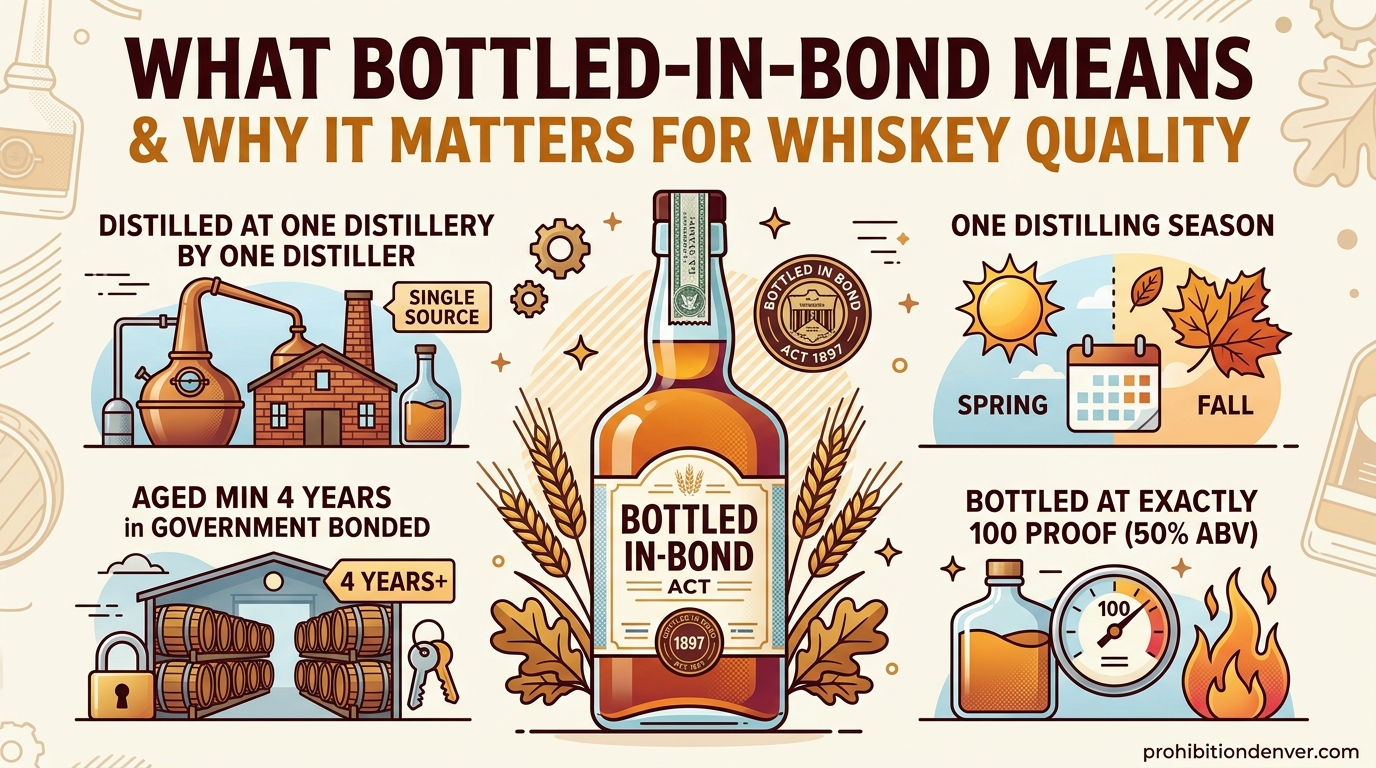
Bottled-in-bond is a legal designation for American whiskey that guarantees the spirit was distilled by one distiller at one distillery during a single season, aged for at least four years in a federally bonded warehouse under government supervision, and bottled at exactly 100 proof (50% ABV). This certification, established by the Bottled-in-Bond Act of 1897, was created as America’s first consumer protection law to combat the widespread problem of adulterated and counterfeit whiskey in the late 1800s.
The term “bonded” refers to the federal bonded warehouse system where the whiskey ages under government oversight. These warehouses provide tax incentives for distillers while ensuring the spirit remains untouched and unadulterated throughout the aging process. When you choose bottled-in-bond whiskey, you’re getting a product with guaranteed provenance—no mystery sourcing, no undisclosed additives, no questions about where or how it was made.
While most commonly associated with bourbon, bottled-in-bond designation can apply to any American whiskey including rye, Tennessee whiskey, and even corn whiskey. It represents one of the few quality standards in American whiskey that’s enforced by federal law rather than industry marketing.
The 5 Legal Requirements for Bottled-in-Bond Designation
For a whiskey to legally bear the “Bottled in Bond” designation, it must satisfy five strict federal requirements. These rules, established over 125 years ago, remain virtually unchanged today and provide consumers with unprecedented transparency about what’s in their bottle.
1. One Distillation Season
The whiskey must be produced during a single distillation season—either January through June or July through December. This requirement ensures the whiskey represents a specific time period of production, contributing to consistency and character. It prevents distillers from blending whiskeys made at different times, which could affect flavor profile and quality.
2. One Distiller
All spirits in the bottle must come from a single distiller. This means one master distiller oversaw the production of every drop in that bottle, ensuring consistent techniques, recipes, and quality standards throughout the process. No outsourcing, no mixing of products from different producers.
3. One Distillery
The entire contents must be distilled at one physical distillery location. This requirement guarantees geographic consistency and prevents the practice of sourcing whiskey from multiple facilities and blending them together. When you drink bottled-in-bond whiskey, you know exactly where it was made.
4. Aged at Least Four Years in a Federally Bonded Warehouse
Bottled-in-bond whiskey must age for a minimum of four years in a federally bonded warehouse under government supervision. This aging requirement exceeds the two-year minimum for straight whiskey and ensures more mature, developed flavors. The bonded warehouse system provides tax benefits to distillers while subjecting the aging barrels to federal oversight and monitoring.
5. Bottled at Exactly 100 Proof (50% ABV)
The whiskey must be bottled at precisely 100 proof, which equals 50% alcohol by volume. This requirement serves two purposes: it provides a consistent, higher-proof experience that showcases the whiskey’s true character, and it prevents distillers from watering down the spirit to increase profits. No adjustments allowed—exactly 100 proof, no more, no less.
The Bottled-in-Bond Act of 1897: America’s First Consumer Protection Law
The story of bottled-in-bond whiskey begins in the late 1800s, a time when the American whiskey market was essentially the Wild West. Unscrupulous rectifiers and blenders routinely adulterated whiskey with harmful additives like prune juice, sulfuric acid, and even tobacco spit to create cheap, flavored spirits that barely resembled genuine whiskey. Consumers had no way to know what they were actually buying or if the product was safe to drink.
Enter Colonel Edmund Haynes Taylor Jr., a pioneering distiller and the great-grandnephew of President Zachary Taylor. Taylor owned what is now the Buffalo Trace Distillery and was a passionate advocate for quality whiskey and honest business practices. He recognized that the lack of standards threatened to destroy consumer trust in American whiskey entirely.
Taylor teamed up with Treasury Secretary John G. Carlisle to craft legislation that would protect consumers while providing tax incentives for honest distillers. The result was the Bottled-in-Bond Act of 1897, which created the federal bonded warehouse system and established strict standards for whiskey production and labeling. Remarkably, this legislation predated the Pure Food and Drug Act by nearly a decade, making it truly America’s first consumer protection law.
The law created a win-win situation: distillers who followed the rules could store their whiskey in bonded warehouses without paying excise tax until the spirit was bottled and removed, while consumers gained a reliable seal of authenticity and quality. The government benefited from better oversight and tax collection. More than 125 years later, the system continues to work much as it was originally designed.
Why Bottled-in-Bond Matters for Whiskey Quality
In today’s whiskey world, where marketing terms like “small batch,” “craft,” and “reserve” have no legal definition and can mean virtually anything, bottled-in-bond stands apart as a designation with real meaning and enforceable standards. Here’s why it matters for anyone seeking quality whiskey.
Guaranteed Transparency
Bottled-in-bond whiskey tells you exactly what you’re getting. No mystery sourcing, no undisclosed additives, no questions about where or how it was made. Every bottle contains whiskey from one distillery, made by one distiller, during one season. That level of transparency is rare in the spirits world and invaluable for consumers who want to know what’s behind the label.
Consistent 100 Proof Flavor
The requirement to bottle at exactly 100 proof creates a consistent flavor experience that showcases the whiskey’s true character. Higher proof spirits generally deliver more intense flavors and better hold up in cocktails. Bartenders especially appreciate bottled-in-bond whiskeys because the 100 proof strength provides bigger flavors that stand up well to mixers without being overpowered.
Minimum Aging Assurance
While straight whiskey only requires two years of aging, bottled-in-bond demands at least four years in the barrel. Those extra two years make a significant difference in flavor development, allowing the whiskey to mature and take on more complex characteristics from the wood. When you buy bottled-in-bond, you’re guaranteed a whiskey with some age behind it.
No Additives Allowed
Like straight whiskey, bottled-in-bond cannot contain any additives—no coloring, no flavoring, no blending with other spirits. What went into the barrel comes out of the bottle, pure and unadulterated. This purity allows the true character of the whiskey and its ingredients to shine through.
Exceptional Value
Perhaps most importantly, bottled-in-bond whiskeys often deliver remarkable quality for their price point. Because the designation focuses on process rather than prestige marketing, many excellent BIB bourbons and ryes are available for $20-35. You’re paying for quality whiskey, not fancy packaging or advertising campaigns. This value proposition has made bottled-in-bond a favorite among knowledgeable whiskey enthusiasts who appreciate quality without the premium price tag.
Bottled-in-Bond vs Other Whiskey Designations
Understanding how bottled-in-bond compares to other whiskey labels can help you make more informed purchasing decisions. Here’s how it stacks up against other common designations you’ll see on whiskey bottles.
Bottled-in-Bond vs Straight Whiskey
All bottled-in-bond whiskey is straight whiskey, but not all straight whiskey is bottled-in-bond. The key differences are aging requirements and consistency standards. Straight whiskey must be aged at least two years (or four if no age statement is shown), while bottled-in-bond requires a minimum of four years. More importantly, straight whiskey can blend multiple distilleries, distillers, and seasons together—bottled-in-bond cannot. BIB provides provenance transparency that straight whiskey does not guarantee.
Bottled-in-Bond vs Single Barrel
Single barrel whiskey comes from one barrel, while bottled-in-bond combines multiple barrels from one season and distillery. Single barrel offers unique character from each barrel but can vary significantly from bottle to bottle. Bottled-in-bond provides more consistency while still representing a specific time and place of production. Both designations indicate quality, but single barrel emphasizes uniqueness while BIB emphasizes consistency and transparency.
Bottled-in-Bond vs Small Batch
“Small batch” has no legal definition and can mean virtually anything a producer wants it to mean. Some small batch whiskeys are excellent, but the term itself provides no quality guarantees. Bottled-in-bond, by contrast, has strict federal requirements that ensure consistency, aging, and provenance. When choosing between the two, BIB offers verifiable standards while small batch offers only marketing promises.
How to Identify Bottled-in-Bond on Labels
Spotting genuine bottled-in-bond whiskey on the shelf is straightforward once you know what to look for. The phrase “Bottled in Bond” must appear prominently on the label, typically near the brand name or product description. You should also see a statement indicating the whiskey was bottled at 100 proof, which may appear as “100 Proof” or “50% ABV.”
Additionally, bottled-in-bond labels must identify the distillery where the whiskey was produced and the location of that distillery. Look for phrases like “Distilled and Bottled by [Distillery Name]” or “Produced and Bottled by [Distillery Name]” followed by the city and state. Be aware that some brands use different names for their distilling operations versus their bottling operations—genuine BIB will clearly indicate where the whiskey was actually distilled.
The label will also include a government warning statement required on all spirits, but the key identifiers are the “Bottled in Bond” designation, the 100 proof statement, and clear distillery information. If any of these elements are missing or unclear, the whiskey likely doesn’t meet the legal requirements for bottled-in-bond designation.
The Modern Comeback of Bottled-in-Bond
After decades of relative obscurity, bottled-in-bond whiskey has experienced a remarkable resurgence in recent years. This comeback reflects a broader shift toward transparency and authenticity in the American whiskey market. As consumers become more educated about what goes into their bottles, they’re seeking out designations with real meaning and enforceable standards rather than empty marketing buzzwords.
The craft bartending community has played a significant role in BIB’s revival. Bartenders appreciate the consistent 100-proof strength that delivers bigger flavors capable of standing up to mixers in cocktails. A well-made Old Fashioned or Manhattan benefits from the extra proof and character that bottled-in-bond whiskeys provide. Many bars now feature BIB options prominently on their back bars and whiskey lists.
Consumers have also discovered the exceptional value that bottled-in-bond whiskeys offer. Brands like Evan Williams Bottled-in-Bond, Heaven Hill Bottled-in-Bond, and Old Grand-Dad Bonded have developed cult followings among whiskey enthusiasts who recognize that quality doesn’t have to cost a fortune. These whiskeys regularly outperform more expensive options in blind tastings and have become go-to recommendations for those seeking quality on a budget.
The modern whiskey renaissance has also seen new distilleries embracing the bottled-in-bond designation as a mark of quality and authenticity. Craft producers recognize that BIB certification provides credibility and trust with consumers who might otherwise be skeptical of new or unfamiliar brands. By meeting the rigorous federal requirements, these distilleries demonstrate their commitment to traditional methods and honest production practices.
Frequently Asked Questions About Bottled-in-Bond Whiskey
What is the point of bottled in bond?
Bottled-in-bond provides consumers with a government-backed guarantee of authenticity, consistency, and quality. It ensures the whiskey was produced by one distiller at one distillery during one season, aged at least four years under government supervision, and bottled at exactly 100 proof with no additives allowed.
Is bottled Bond whiskey higher quality?
Bottled-in-bond whiskey offers guaranteed quality standards that many non-bonded whiskeys cannot match. The minimum four-year aging requirement, 100 proof consistency, and prohibition on additives ensure a reliable quality level. While taste is subjective, BIB whiskeys consistently deliver quality and value that make them favorites among enthusiasts and bartenders.
What is the difference between straight whiskey and bottled in bond whiskey?
All bottled-in-bond whiskey is straight whiskey, but BIB has additional requirements. Straight whiskey needs only two years aging and can blend multiple distilleries and seasons. Bottled-in-bond requires minimum four years aging, one distillery, one distiller, one season, and exactly 100 proof bottling. BIB provides provenance transparency that straight whiskey does not guarantee.
Why is it called bottled in bond?
The term comes from the federal bonded warehouse system established by the Bottled-in-Bond Act of 1897. Distillers store their whiskey in government-supervised bonded warehouses without paying excise tax until the spirit is bottled and removed. The “bonded” refers to this tax arrangement while ensuring the whiskey remains untouched and monitored throughout aging.
Does bottled in bond guarantee better taste?
Bottled-in-bond guarantees production standards and consistency, not specific flavor profiles. The requirements ensure authenticity, minimum aging, and proper proof, but taste remains subjective. However, BIB whiskeys typically offer reliable quality and value that make them excellent choices for both sipping and cocktails.
Conclusion
Bottled-in-bond whiskey represents one of the best value propositions in the American spirits market. This 125-year-old designation provides consumers with unprecedented transparency about what’s in their bottle—guaranteeing one distillery, one distiller, one season, at least four years of aging, and exactly 100 proof. In an era of marketing buzzwords and undefined terms, bottled-in-bond stands apart as a certification with real meaning and enforceable federal standards.
Whether you’re a seasoned whiskey enthusiast or just beginning to explore American spirits, bottled-in-bond whiskeys offer reliable quality, exceptional value, and a direct connection to whiskey-making traditions that date back generations. The next time you’re browsing the whiskey aisle, take a closer look at those bottles bearing the “Bottled in Bond” designation. You’ll find whiskeys that deliver on their promises—no gimmicks, no mysteries, just honest, quality whiskey with a story to tell.