
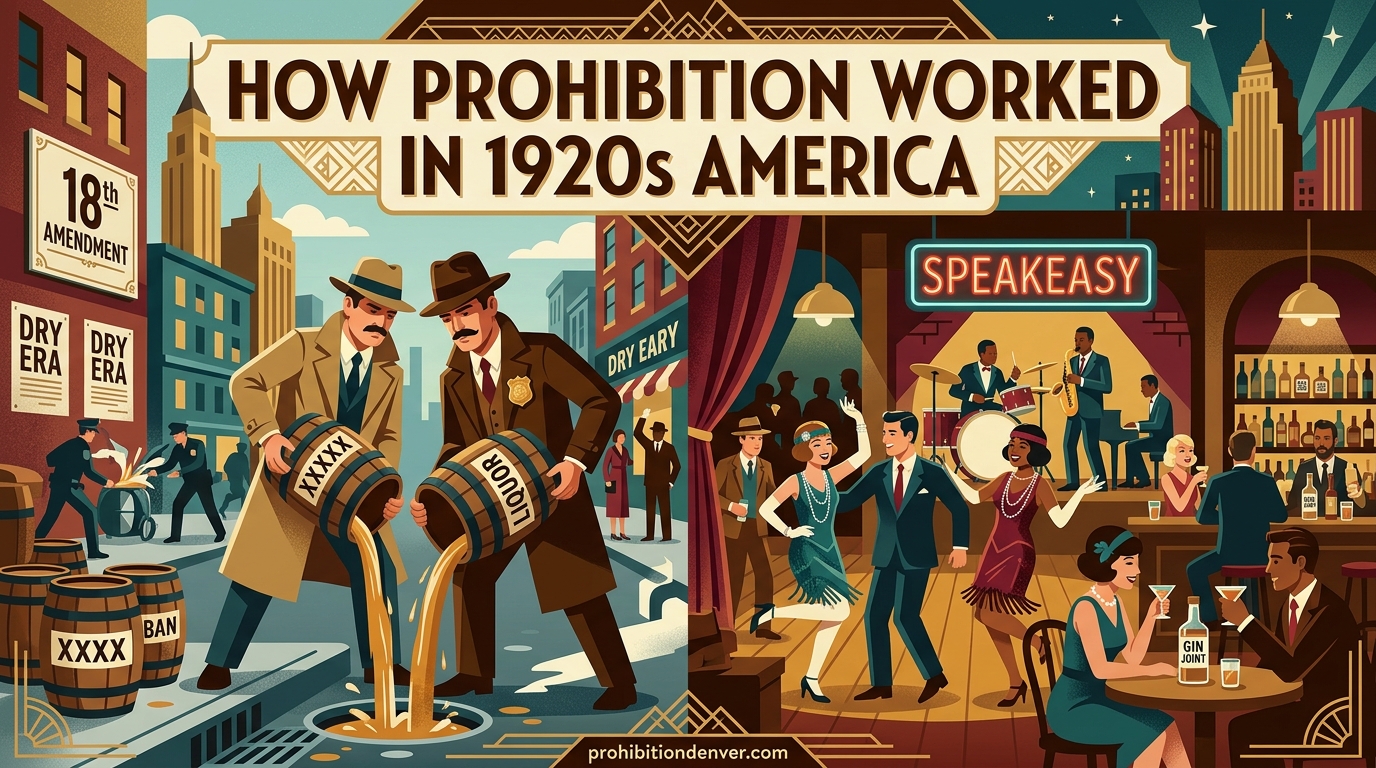
On January 17, 1920, America changed forever. At one minute past midnight, the 18th Amendment to the Constitution went into effect, making the entire United States officially “dry.” What happened over the next 13 years would reshape American politics, spawn organized crime as we know it, and ultimately prove that you cannot legislate morality through federal mandates. This is the complete story of how Prohibition actually worked in 1920s America – from its ambitious beginnings to its spectacular failure.
I have spent years studying this fascinating period of American history, and the reality is far more complex than most people realize. Prohibition was not simply about stopping people from drinking. It was a massive social experiment that touched every aspect of American life, from the way we enforced federal law to the rise of modern criminal enterprises. What you will discover here is how the system was designed to function, why it collapsed so dramatically, and the devastating human cost that came with trying to ban one of humanity’s oldest social customs.
By the end of this guide, you will understand exactly how Prohibition transformed ordinary citizens into criminals, how underground economies flourished despite federal opposition, and why the constitutional amendment that created Prohibition remains the only one ever fully repealed. The lessons from this failed experiment continue to echo through American policy debates to this day.
Table of Contents
What Was Prohibition and How Did It Actually Work
Prohibition was the nationwide ban on the manufacture, sale, and transportation of alcoholic beverages in the United States, lasting from 1920 to 1933. The 18th Amendment to the Constitution, ratified on January 16, 1919, provided the constitutional authority for this ban. However, the amendment itself was remarkably brief – just 111 words – and did not define what “intoxicating liquors” actually meant or how the ban would be enforced.
The actual mechanics of Prohibition were established by the National Prohibition Act, commonly known as the Volstead Act. This legislation defined intoxicating liquor as any beverage containing more than 0.5 percent alcohol by volume. To put this in perspective, that is roughly the alcohol content of modern non-alcoholic beer. Essentially, Congress banned nearly all alcoholic beverages except for specific religious and medicinal uses.
The enforcement structure created by these laws relied on a combination of federal Prohibition agents, state and local police, and the Bureau of Internal Revenue (predecessor to the IRS). Federal agents could raid suspected illegal operations, arrest bootleggers, and seize alcohol. However, the law created a significant gap: while selling alcohol became illegal, possession and consumption remained technically legal for individuals who had obtained their alcohol before the ban took effect or who received it as a gift.
Origins of Prohibition: From Temperance Movement to Constitutional Amendment
The road to Prohibition began nearly a century before the 18th Amendment became law. The temperance movement started in the early 1800s as a religious and social reform effort aimed at reducing alcohol consumption, which reformers believed was destroying American families and causing widespread poverty and crime. Initially, the movement focused on moderation rather than total prohibition.
By the late 19th century, the movement had radicalized. The Woman’s Christian Temperance Union (WCTU), founded in 1874, became one of the most powerful political forces in America. Led by figures like Frances Willard, the WCTU connected temperance to women’s rights, arguing that alcohol was the primary cause of domestic violence and family destitution. At its peak, the organization claimed over 200,000 members and operated in every state.
The Anti-Saloon League, founded in 1893, took a more pragmatic approach. Led by Wayne Wheeler, this organization focused purely on political results rather than moral persuasion. The League became one of the most effective lobbying organizations in American history, targeting politicians who supported the liquor industry and backing “dry” candidates in election after election. By 1916, the League had helped elect a dry majority in Congress.
World War I provided the final catalyst for Prohibition. Anti-German sentiment turned against German-American brewers, and the war effort required grain conservation. The Lever Food and Fuel Control Act temporarily banned the use of grain for alcohol production during the war. When the 18th Amendment passed Congress in December 1917, it had broad support from progressives who saw it as social reform, conservatives who valued law and order, and rural Americans who viewed alcohol as a corrupting urban vice.
The Volstead Act: How Congress Transformed the Constitution Into Law
Congressman Andrew Volstead of Minnesota became the unlikely architect of Prohibition enforcement when he introduced the legislation that would bear his name. The National Prohibition Act, passed over President Woodrow Wilson’s veto in October 1919, transformed the brief language of the 18th Amendment into detailed federal law. This 35-page document specified exactly what was prohibited, who would enforce it, and what penalties violators would face.
The Volstead Act established the Bureau of Prohibition within the Treasury Department, giving approximately 1,500 federal agents the authority to enforce the alcohol ban nationwide. These agents could enter private property without warrants if they suspected alcohol production, seize property used in violation, and arrest anyone manufacturing or selling intoxicating beverages. Violators faced fines up to $1,000 and imprisonment for up to six months for first offenses.
However, the Act contained significant loopholes that would prove problematic. Religious wine for sacramental purposes remained legal, creating an explosion of suddenly devout Americans seeking communion wine. Doctors could prescribe medicinal whiskey, leading to a thriving trade in alcohol prescriptions. Farmers could preserve fruit by fermenting it into cider, provided they did not sell it. These exceptions became the foundation of an enormous legal gray area.
The definition of “intoxicating liquor” caused immediate controversy. Prohibition advocates wanted a zero-tolerance approach, while opponents argued for allowing beer and light wine. The 0.5 percent limit settled on by Congress effectively banned even near-beer, making it impossible for the brewing industry to continue operating legally. This strict interpretation would prove impossible to enforce and created immediate resentment among working-class Americans who saw beer as a harmless beverage.
How Prohibition Was Actually Enforced (And Why It Failed)
The Bureau of Prohibition faced an impossible task from the very beginning. With approximately 1,500 federal agents to police a nation of 106 million people spread across 3 million square miles, the math was devastating. Each agent would theoretically need to cover 2,000 square miles and monitor 70,000 citizens. The annual budget of just $5 million meant agents lacked cars, radios, and basic equipment necessary for enforcement.
Enforcement strategies varied wildly by region. In rural areas, agents focused on shutting down moonshine stills hidden in remote hills and forests. These operations were dangerous – agents faced armed resistance from moonshiners protecting their livelihoods. In cities, the focus shifted to raiding speakeasies and intercepting smuggled alcohol from Canada, Mexico, and the Caribbean. Coastal enforcement attempted to stop rum-running boats from reaching American shores.
The fundamental enforcement problem was political rather than logistical. Congress never provided adequate funding because many representatives privately opposed Prohibition or feared angering wet constituents. State governments often refused to cooperate, with wet states essentially nullifying federal law through non-enforcement. Local police frequently took bribes from bootleggers or simply ignored violations, especially in immigrant communities where drinking was a cultural tradition.
By 1925, the Bureau had grown to 3,000 agents, but this was still woefully inadequate. The Coast Guard received additional funding to combat rum-running, but smugglers used faster boats and better intelligence to stay ahead. Federal agents developed clever tactics – they would stake out suspected stills, raid speakeasies disguised as customers, and trace industrial alcohol theft. Yet for every operation shut down, ten more sprang up to replace it. The government was fighting a war of attrition it could not win.
Corruption became endemic as organized crime systematically bribed officials at every level. Police chiefs, judges, prosecutors, and even Prohibition agents themselves were on the take. Al Capone claimed to have “the whole police force” of Chicago on his payroll. This corruption destroyed public faith in both the law and the government that had created it. Americans watched as wealthy drinkers flouted the law while working-class people were prosecuted for possession.
Speakeasies, Bootlegging, and How Ordinary Americans Circumvented the Law
Americans responded to Prohibition with remarkable creativity and determination. Within months of the ban taking effect, an elaborate underground economy emerged to satisfy the nation’s thirst. Bootleggers – named for the practice of hiding alcohol in boots – smuggled liquor across borders, ran hidden distilleries, and established distribution networks that rivaled legitimate businesses in sophistication.
Speakeasies replaced saloons as the primary social drinking establishments. These hidden bars operated behind unmarked doors, in basements, behind bookcases, and in secret rooms. Patrons needed passwords or membership cards to enter. Inside, they found jazz music, dancing, and alcohol served in coffee cups or teapots to disguise its nature. By some estimates, New York City alone had over 30,000 speakeasies operating by 1925 – more than twice the number of legal saloons that had existed before Prohibition.
Home production became widespread as ordinary citizens learned to make their own alcohol. Bathtub gin – grain alcohol mixed with water and flavorings in actual bathtubs – became a staple of the era. Home winemaking kits sold legally, allowing families to produce 200 gallons annually for personal use. Beer brewing moved to basements and garages. What started as necessity became hobby and then culture, with recipe books and home-brewing guides circulating widely.
The medicinal alcohol loophole created an absurd spectacle. Doctors could prescribe whiskey for various ailments, and pharmacies became de facto liquor stores. Walgreens expanded from 20 stores to nearly 400 during Prohibition, largely by selling medicinal whiskey. One Chicago doctor wrote 400 prescriptions in a single day. The amount of medicinal alcohol consumed suggested Americans were the sickest population in history, with prescriptions for everything from toothaches to heart conditions.
Industrial alcohol presented another enforcement nightmare. Factories legally used denatured alcohol – poisoned with chemicals to make it undrinkable – for manufacturing processes. Bootleggers hired chemists to redistill this industrial alcohol back into drinkable spirits. The government responded by adding increasingly toxic chemicals, but bootleggers kept finding ways to remove or mask them. This deadly cat-and-mouse game would have tragic consequences.
The Rise of Organized Crime: How Prohibition Created the American Mafia
Prohibition did not create organized crime, but it transformed it from small-time street gangs into the sophisticated criminal enterprises we recognize today. Before 1920, criminal organizations largely focused on gambling, prostitution, and local protection rackets. The alcohol ban gave them their first truly national product with massive profit potential and universal demand.
Al Capone emerged as the most notorious figure of the era, building a criminal empire in Chicago that generated an estimated $60 million annually from bootlegging operations. Capone controlled distilleries, distribution networks, and speakeasies while maintaining a public image as a philanthropist and community benefactor. His organization employed hundreds and operated with military precision, including lookouts, codes, and brutal enforcement against competitors.
The St. Valentine’s Day Massacre of 1929 illustrated how deadly competition had become. Seven members of a rival Irish gang were lined up against a Chicago garage wall and executed by Capone’s men, who were disguised as police officers. The public outcry was enormous, yet the violence was simply business – Capone was eliminating competition to control Chicago’s beer trade. Such violence became routine in major cities as criminal organizations fought for territory.
Crime families developed sophisticated structures with clear hierarchies, division of labor, and territorial boundaries. They invested profits in legitimate businesses to launder money and gain social respectability. Politicians and police were systematically bribed to ensure protection. The combination of massive profits and weak enforcement created criminal organizations powerful enough to challenge the state itself.
By the late 1920s, the FBI estimated that organized crime controlled the majority of illegal alcohol distribution. The annual value of the illegal liquor trade exceeded $2 billion – roughly equivalent to $30 billion today. This money funded expansion into other criminal enterprises including gambling, narcotics, and labor racketeering. The criminal infrastructure built during Prohibition would outlast the amendment itself and shape American crime for generations.
The Poisoned Moonshine Crisis: When Government Policy Killed Americans
One of the darkest chapters of Prohibition was entirely preventable. To combat the redistillation of industrial alcohol, the federal government mandated that manufacturers add increasingly toxic chemicals including methanol, acetone, and mercury salts. These denaturing agents were supposed to make industrial alcohol undrinkable. Instead, they created a public health catastrophe.
The statistics are shocking. According to PBS documentary research, an average of 1,000 Americans died annually from drinking poisoned alcohol during Prohibition. The total death toll reached approximately 10,000 by the time the amendment was repealed. These were not hardened criminals – they were ordinary people who drank contaminated bootleg liquor without knowing the dangers. Many victims went blind or suffered permanent organ damage before dying painful deaths.
Moonshine – homemade distilled spirits – presented another deadly hazard. Amateur distillers often used car radiators as condensers, introducing lead and other heavy metals into their product. Improper distillation could produce methanol instead of ethanol, with as little as 10 milliliters causing blindness and 30 milliliters proving fatal. Without quality controls or safety standards, drinking bootleg alcohol became a dangerous gamble.
The government’s denaturing policy sparked outrage from medical professionals and wet politicians who accused the administration of poisoning its own citizens. Treasury officials defended the practice, arguing that anyone who drank industrial alcohol was breaking the law and assumed the risk. This cold calculus ignored the reality that many drinkers had no way of knowing their alcohol was contaminated or how dangerous it was.
The poisoned alcohol crisis symbolized everything that had gone wrong with Prohibition. A policy intended to protect public health was actively killing people. The government’s response showed how committed dry advocates were to their cause – they were willing to let drinkers die rather than admit the policy had failed. This moral rigidity accelerated public support for repeal.
The Real Effects of Prohibition on American Society
Did Prohibition actually reduce drinking? Initially, yes. Alcohol consumption dropped by an estimated 30 percent in the early years of the ban, and remained below pre-Prohibition levels throughout the 1920s. However, what people drank changed dramatically. Beer and wine largely disappeared, replaced by hard liquor that was easier to smuggle and more profitable per volume. The shift toward spirits meant that when people did drink, they often drank more alcohol per sitting.
The economic effects were devastating and far-reaching. The federal government lost approximately $500 million annually in alcohol tax revenue – money that had funded roughly 10 percent of the entire federal budget. States and localities lost millions more in licensing fees and excise taxes. Meanwhile, the cost of enforcing Prohibition ballooned to over $300 million per year by the late 1920s. The experiment was bankrupting governments while enriching criminals.
Socially, Prohibition created a nation of lawbreakers. An estimated 30 to 40 million Americans drank illegally during the era. Respect for law and order declined as ordinary citizens routinely broke what they saw as an unjust and unenforceable law. The widespread hypocrisy – with wealthy drinkers facing no consequences while the poor were prosecuted – eroded faith in American institutions.
Paradoxically, Prohibition helped liberate women socially. The speakeasy culture broke down traditional gender barriers, with women drinking publicly alongside men for the first time in modern American history. The flapper culture of the 1920s, with its bobbed hair, short skirts, and open drinking, represented a rebellion against Victorian social norms that Prohibition had unintentionally enabled. The amendment meant to protect families actually helped free women from domestic confinement.
The End of Prohibition: How the 21st Amendment Repealed the 18th
By the late 1920s, even many dry advocates admitted Prohibition was failing. The stock market crash of 1929 and the onset of the Great Depression made the situation untenable. The federal government desperately needed revenue, and legal alcohol taxes offered an obvious source. Unemployment reached 25 percent, and the idea that grain should be diverted from bread to beer seemed absurd to hungry Americans.
Franklin D. Roosevelt made repeal a central campaign promise in 1932, famously calling for “the immediate modification of the Volstead Act to legalize beer.” His landslide victory provided a mandate for change. On December 5, 1933, Utah became the 36th state to ratify the 21st Amendment, providing the three-quarters majority needed to repeal the 18th Amendment. America was wet again.
The 21st Amendment is unique in American history – the only constitutional amendment designed to repeal another amendment entirely. Unlike the 18th Amendment, which required seven years for ratification, the 21st Amendment moved through the states in less than ten months. The speed reflected how thoroughly public opinion had shifted against the dry experiment.
Interestingly, the 21st Amendment gave states authority to regulate alcohol within their borders, which is why some states remained dry for decades after federal repeal. Mississippi was the last state to end Prohibition, not until 1966. Local option laws still create dry counties and municipalities across America today, living remnants of the temperance movement’s legacy.
Frequently Asked Questions About Prohibition
Was Prohibition successful in the 1920s?
Prohibition partially succeeded in reducing alcohol consumption by approximately 30 percent initially, but it failed to eliminate drinking entirely. The policy created massive unintended consequences including organized crime, government corruption, and thousands of deaths from poisoned alcohol. By most measures, Prohibition was a failure that caused more harm than good.
How did Prohibition affect life in the 1920s?
Prohibition transformed American life by creating an underground economy of speakeasies and bootlegging, sparking the rise of organized crime, and fundamentally changing how Americans socialized. It turned millions of law-abiding citizens into criminals, increased government corruption, and paradoxically helped liberate women through speakeasy culture. The era also saw the flourishing of jazz and the flapper culture.
Did Prohibition have any positive effects?
Prohibition did achieve some initial reductions in alcohol consumption and alcohol-related health problems like cirrhosis. It demonstrated the political power of organized grassroots movements and advanced women’s participation in politics through the temperance movement. However, most historians agree the negative consequences far outweighed any benefits.
What are three effects of Prohibition?
The three major effects of Prohibition were: 1) The rise of organized crime and criminal empires like Al Capone’s Chicago operation, 2) The creation of an extensive underground economy of speakeasies, bootlegging, and moonshining, and 3) Widespread government corruption as officials were bribed to ignore enforcement. Additionally, approximately 10,000 Americans died from drinking poisoned industrial alcohol.
What was the worst kept secret of Prohibition?
The worst kept secret of Prohibition was that alcohol remained widely available despite being illegal. Everyone knew where to find speakeasies, and millions of Americans continued drinking throughout the era. The wealthy flouted the law openly while working-class drinkers faced prosecution, exposing the hypocrisy and selective enforcement that undermined the policy’s legitimacy.
Why did Prohibition fail?
Prohibition failed because it was impossible to enforce at the federal level with limited resources. The ban turned ordinary citizens into criminals, created massive profit opportunities for organized crime, and faced widespread public opposition. The government lost tax revenue while spending millions on failed enforcement. The Great Depression and the election of Franklin D. Roosevelt, who promised repeal, provided the final political impetus for ending the experiment.
Did Prohibition actually reduce alcohol consumption?
Yes, initially. Alcohol consumption dropped by approximately 30 percent in the early years of Prohibition and remained below pre-ban levels throughout the 1920s. However, the type of alcohol consumed shifted to harder spirits that were easier to smuggle, and drinking patterns became more dangerous as quality controls disappeared. After repeal, consumption gradually returned to pre-Prohibition levels.
How did bootlegging work during Prohibition?
Bootlegging operated through sophisticated smuggling networks that brought alcohol from Canada, Mexico, and the Caribbean. Domestic bootleggers ran hidden distilleries in remote rural areas, produced bathtub gin in cities, and hijacked industrial alcohol shipments. Criminal organizations established distribution networks rivaling legitimate businesses, using bribes to protect operations and violence to eliminate competition. The trade generated billions in illegal profits.
Conclusion: Lessons From America’s Failed Experiment
How Prohibition actually worked in 1920s America reveals a cautionary tale about the limits of government power. For thirteen years, the federal government attempted to ban a substance that humans had consumed for millennia, spending millions of dollars and employing thousands of agents. The result was not a dry nation, but a nation of hypocrites, criminals, and victims.
The failure of Prohibition taught America hard lessons about the relationship between law and morality. You cannot legislate personal behavior through federal mandates without massive enforcement resources and broad public consensus. When laws contradict deeply ingrained social customs, the laws lose respect and the customs persist underground. The criminal organizations born from Prohibition outlived the amendment itself, shaping American crime for generations.
Today, the debate over Prohibition’s lessons continues in discussions about drug policy, gambling, and other regulated vices. The 21st Amendment stands as a monument to American pragmatism – the willingness to admit failure and reverse course. Understanding how Prohibition actually worked helps us appreciate both the ambitions and the limitations of government power in shaping human behavior. The echoes of this failed experiment remind us that policy must respect reality, or reality will eventually overwhelm policy.