
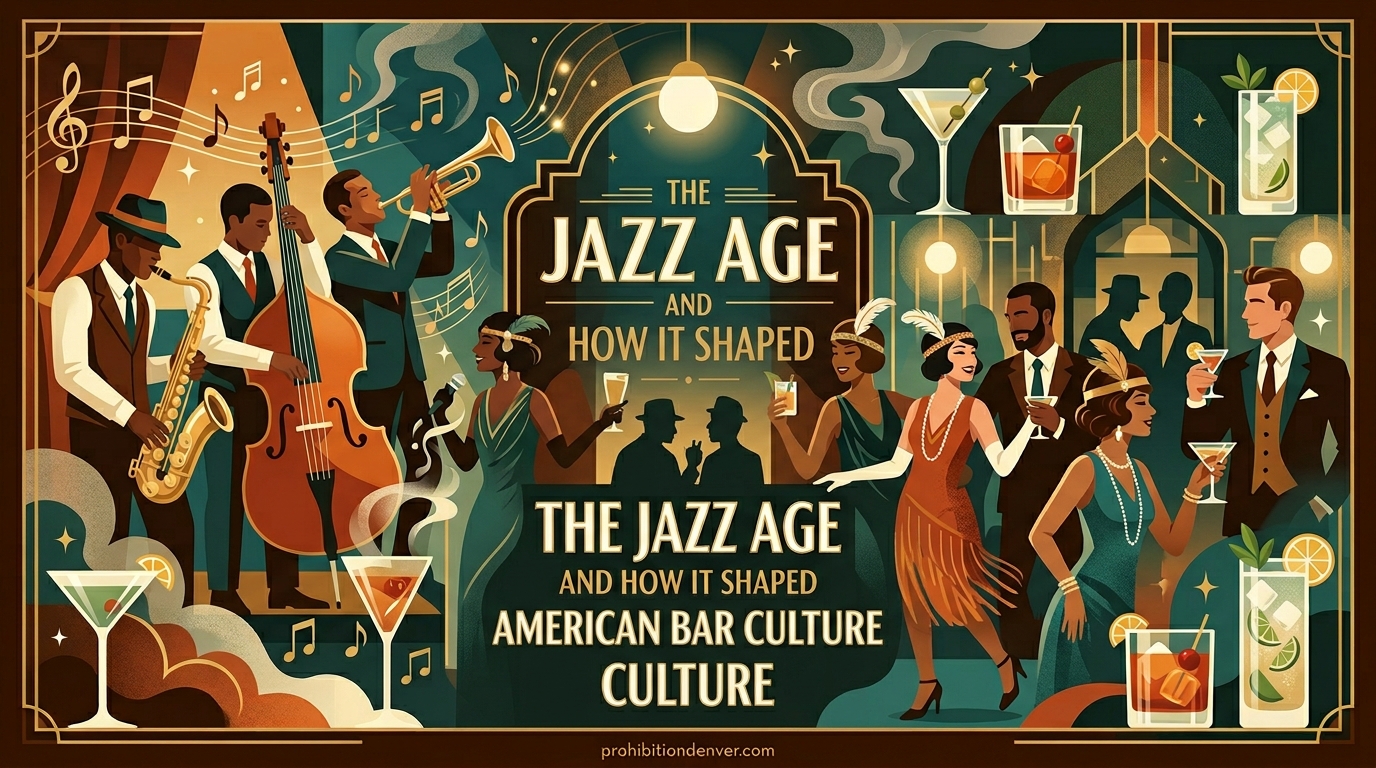
How the Soundtrack of the 1920s Revolutionized Nightlife as America Knew It
Table of Contents
Introduction: When Jazz Met the Cocktail Glass
Few periods in American history witness such a dramatic collision of music, rebellion, and cultural transformation as the Jazz Age. Coined by F. Scott Fitzgerald in his 1922 collection Tales of the Jazz Age, the term captured an era that would permanently alter the landscape of American entertainment, social norms, and—most significantly for us—the very nature of the American bar.
Between 1920 and 1933, as the 18th Amendment and the Volstead Act ushered in Prohibition, something remarkable happened. The legal closure of saloons and taverns did not eliminate America’s appetite for social drinking. Instead, it drove that appetite underground, where it merged with the explosive energy of jazz music to create something entirely new: the speakeasy.
This is the story of how the Jazz Age transformed American bar culture from simple taverns serving spirits into vibrant underground nightclubs where cocktails flowed, jazz blared, and social conventions were rewritten with every saxophone solo. The echoes of that transformation still resonate today in cocktail bars from Denver to New York, where the spirit of the 1920s lives on.
What Was the Jazz Age?
The Jazz Age was a period spanning approximately 1920 to the early 1930s, characterized by unprecedented cultural dynamism, economic prosperity (before the 1929 crash), and a wholesale rejection of Victorian-era propriety. But to understand how it shaped American bar culture, we must first understand where jazz itself came from.
Jazz emerged from African American communities in New Orleans at the turn of the 20th century, blending African rhythmic traditions, blues, ragtime, and European harmonic structures into something wholly original. Artists like Buddy Bolden, King Oliver, and later Louis Armstrong took this new sound and gave it wings, spreading it first to Chicago’s South Side and then, most importantly, to Harlem, New York.
By the early 1920s, jazz had become the soundtrack of a generation seeking escape from the constraints of a rapidly industrializing society. For young Americans—particularly those who had fought in World War I and returned home questioning everything they had been taught—the syncopated rhythms and improvisational freedom of jazz represented liberation. It was loud, it was scandalous by the standards of the day, and it refused to respect social boundaries.
Fitzgerald’s naming of the era was not merely descriptive; it was prophetic. As jazz spread from African American communities to mainstream America through phonograph records, radio broadcasts, and live performances, it carried with it an entire cultural revolution. The sound of freedom found its natural home in the hidden bars and basement clubs that would become America’s speakeasies.
The roaring twenties, as this era was also known, saw unprecedented social change. Women gained the right to vote in 1920. The flapper emerged as a cultural icon—shorter hemlines, bobbed hair, a cigarette hanging casually from painted lips, and an unapologetic enjoyment of pleasures that previous generations had considered the exclusive domain of men. Jazz was the background music for all of this rebellion, and the speakeasy became its stage.
Prohibition and the Transformation of American Bar Culture
To understand the transformation of American bar culture during the Jazz Age, we must first understand Prohibition. Ratified in 1919 and taking effect in January 1920, the 18th Amendment prohibited the manufacture, sale, and transportation of alcoholic beverages throughout the United States. The Volstead Act provided the enforcement mechanism, defining what constituted an intoxicating beverage and establishing penalties for violations.
The intent was noble—progressives believed that eliminating alcohol would reduce crime, improve worker productivity, strengthen families, and create a more virtuous society. The reality was dramatically different. Within months of Prohibition taking effect, the United States found itself grappling with an underground economy of staggering scale. Bootleggers imported spirits from Canada, the Caribbean, and Europe. Domestic producers manufactured moonshine in rural stills and “bathtub gin” in city apartments. The phrase “the worst kept secret of Prohibition” entered the cultural lexicon because virtually everyone drank, despite its illegality.
The impact on legitimate bar culture was immediate and devastating. Saloons, taverns, and restaurants that had served alcohol faced a choice: close their doors or operate illegally. Many chose the latter, transforming themselves into hidden establishments that required passwords for entry, featured peepholes to screen potential customers, and operated with the constant threat of police raids. The corner tavern that had served as a neighborhood gathering spot for generations either disappeared or went underground.
But here’s what makes this period so fascinating from a cultural perspective: the closing of legal bars did not eliminate the social impulse that had created them. Americans still wanted places to gather, socialize, enjoy a drink, and be entertained. The speakeasy filled that void, and in doing so, it fundamentally reimagined what a bar could be.
Before Prohibition, the American bar had been primarily a male domain—a place for working-class men to drink beer and socialize after work. The speakeasy, by contrast, welcomed women. It offered not just drinks but entertainment: live music, dancing, celebrity sightings, and an atmosphere of danger and excitement that legal establishments could never provide. In transforming the bar from a simple drinking establishment to a complete entertainment venue, the Jazz Age speakeasy created the template for the modern American nightclub.
The cocktail itself underwent a revolution during this period. With quality spirits difficult to obtain (and often dubious in composition), speakeasy bartenders became masters of disguise and creativity. They masked the harsh flavors of inferior bootleg spirits with fruit juices, sugar, bitters, and elaborate garnishes. The sidecar, the White Lady, the French 75, and countless other cocktails that would become classics were born in speakeasy bars during this era. The craft cocktail movement, so popular today, traces much of its DNA directly to these underground innovators.
The Speakeasy Phenomenon
The word “speakeasy” itself tells a story. The term likely originated from bartenders warning patrons to “speak easy” about the establishment’s presence, or from the idea that speaking about alcohol should be done quietly. By whatever etymology, the speakeasy became the defining institution of Jazz Age nightlife.
Speakeasies came in many forms, each with its own character and clientele. The simplest were backroom bars—actual legal businesses (restaurants, barbershops, grocery stores) with a hidden room in the back where alcohol was served to trusted customers. Others were cellar establishments, accessed through alley entrances or basement stairs, their windows painted black to hide the revelry within from passing police. The most elaborate were converted apartments, entire floors of buildings, or underground spaces that could accommodate hundreds of patrons.
Entering a speakeasy typically required knowing a password or having a connection. Some establishments used elaborate systems of door hosts, peepholes, and buzzer systems that would not seem out of place in a heist film. This exclusivity created an air of excitement and privilege—being inside meant you were part of a select group who knew the secrets of the city.
The economics of speakeasy operation were inherently intertwined with organized crime. Running an underground bar required protection from police harassment, a supply network for obtaining alcohol, and muscle to deal with competitors. This created opportunities for mobsters like Owney Madden, who controlled much of New York’s speakeasy scene from his base at the Cotton Club, and Al Capone, who built a criminal empire in Chicago largely through liquor profits. While this connection to criminality was problematic, it also financed an unprecedented flowering of nightlife entertainment.
The typical speakeasy offered far more than alcohol. Most featured live jazz or swing bands, creating an entertainment experience that legal taverns had never provided. Dancing was common, with couples performing the latest crazes—the Charleston, the Lindy Hop, the Texas Tommy—in spaces cleared of tables. Some speakeasies offered floor shows with comedians, magicians, or burlesque performers. The combination of alcohol, music, and performance created an immersive experience that legal establishments simply could not match.
Cocktail culture flourished in this environment. Speakeasy bartenders competed for reputation, developing elaborate drink recipes that showcased their creativity and skill. The era saw the codification of many classic cocktails and the birth of techniques like the French twist (a lemon peel garnish twisted over a drink to release essential oils) that remain fundamental to mixology today. Where Prohibition had sought to eliminate the bar, it instead transformed it into something richer and more complex.
Women, Flappers, and the Revolution in Nightlife
Perhaps no aspect of the Jazz Age transformation of American bar culture is as significant—or as underappreciated—as the role of women. Before Prohibition, the American bar had been overwhelmingly male territory. “Ladies” might be served a glass of wine in a parlor or a hotel lobby, but the neighborhood saloon was emphatically not a place for women.
The speakeasy changed everything. While certainly not immune to the era’s pervasive sexism and racism, the underground bar nevertheless offered women opportunities for social engagement that had simply not existed before. The flapper—the iconic Jazz Age woman with her bobbed hair, shorter hemlines, and independent spirit—found in the speakeasy a space where she could drink, dance, smoke, and socialize with men on terms that would have been unthinkable in a legal saloon.
The transformation was not merely about access to alcohol. It represented a fundamental challenge to Victorian-era gender norms that had confined women to the domestic sphere. In the speakeasy, a woman could: stand at a bar rather than sit in a parlor; order a cocktail rather than tea; smoke a cigarette in public; dance closely with a man who was not her husband; and stay out past the hours that propriety demanded.
This was revolutionary behavior with real social consequences. The flapper became a symbol of women’s liberation, representing a new assertiveness that extended beyond fashion and entertainment into politics, education, and career. While the extent of actual liberation should not be overstated—the era remained deeply patriarchal—something had shifted. Women had tasted independence in the speakeasy’s dim lighting, and they were not about to give it up.
After Prohibition ended in 1933, the legal bar that emerged was fundamentally different from its predecessor. It was integrated by gender in ways that would have been unimaginable in 1919. Women could now frequent bars alongside men, drinking and socializing openly. The speakeasy had permanently altered expectations about women’s place in American nightlife.
Modern cocktail bars like Prohibition Denver continue this legacy. The craft cocktail movement’s emphasis on quality ingredients, skilled preparation, and sophisticated ambiance owes much to the speakeasy era’s innovation. And just as importantly, the expectation that women should feel welcome and comfortable in any bar—rather than confined to designated “ladies’ lounges”—is a direct inheritance from the Jazz Age revolution.
Jazz Greats and the Venues That Made Them
No discussion of the Jazz Age’s influence on American bar culture would be complete without acknowledging the musicians who provided the soundtrack for the revolution. The speakeasy era coincided with jazz’s transition from regional phenomenon to national art form, and the musicians who defined this period remain influential today.
Louis Armstrong, born in New Orleans in 1901, emerged as perhaps the most important figure in early jazz. His virtuosity on the trumpet, innovative vocal style, and charismatic stage presence influenced virtually every jazz musician who followed. Armstrong’s recordings with his Hot Five and Hot Seven groups in the 1920s remain touchstones of the genre, demonstrating the improvisational brilliance that characterized the best Jazz Age performances.
Duke Ellington, who began his career in Harlem speakeasies and nightclubs, composed some of the most sophisticated jazz music of the era. His compositions—characterized by complex harmonies, innovative orchestration, and an essentially American sound—demonstrated that jazz was far more than simple dance music. Ellington’s long engagement at the Cotton Club brought his music to national attention and established him as one of the era’s defining artists.
Other notable figures included Bix Beiderbecke, the cornetist from Iowa whose lyrical, unconventional approach to jazz influenced generations of musicians; King Oliver, whose playing technique influenced Armstrong; and Ethel Waters, who as a singer and performer helped establish the template for jazz-influenced popular entertainment.
The venues where these musicians performed were as important as the artists themselves. In New York, the Cotton Club was the most famous, its elaborate floor shows and radio broadcasts (ironically, given that the club excluded Black patrons as customers) bringing jazz to national attention. Connie’s Inn, the Savoy Ballroom, and numerous smaller establishments provided opportunities for musicians and memories for patrons.
Chicago’s South Side told a different story. Unlike New York’s largely white audiences seeking Black entertainment, Chicago’s jazz scene emerged from the city’s vibrant Black communities. Venues like the Sunset Cafe and the Panther Room featured musicians who would shape the city’s distinctive jazz style—more blues-influenced, more rhythmically complex, often amplified through the era’s new electronic sound systems.
The music performed in these venues was inseparable from the dancing it inspired. The Charleston, made famous by the 1923 Broadway show Dixie to Broadway, became the signature dance of the Jazz Age. The Lindy Hop, which emerged in Harlem in the late 1920s, represented an even more athletic and improvisational approach to partnered dancing. Both dances required space—hence the cleared floors of speakeasy ballrooms where couples could perform for each other and for the musicians who provided their accompaniment.
For modern establishments seeking to evoke the Jazz Age spirit, the connection between music and venue remains essential. Just as the speakeasy understood that alcohol alone was insufficient to attract customers, contemporary bars recognize that atmosphere—created through music, design, and entertainment—defines the customer experience. The integration of live music, quality cocktails, and attentive service that characterized the best speakeasies remains the ideal that modern establishments aspire to achieve.
From Underground to Mainstream: The Modern Speakeasy Revival
Walk into a modern craft cocktail bar today—from Prohibition Denver to hidden speakeasies in Brooklyn, Los Angeles, or Chicago—and you are stepping into a space that owes its existence directly to the innovations of the 1920s. The speakeasy revival that began in the early 2000s and continues to influence bar culture today represents more than mere nostalgia. It is an acknowledgment that the Jazz Age fundamentally understood something about what a bar could be.
The modern speakeasy-inspired bar movement emerged from several sources. The craft cocktail renaissance, led by bartenders who studied the history of mixology and revived techniques and recipes from the pre-Prohibition and speakeasy eras, created demand for establishments that took cocktails seriously. Simultaneously, a cultural nostalgia for authenticity—partly driven by reaction to the homogenization of chain establishments—drew bartenders and customers toward the romance of the underground bar.
What distinguishes a modern speakeasy-inspired establishment from a simple themed bar is its commitment to the values that made original speakeasies compelling. Quality ingredients, skillfully prepared, take the place of the bootlegger’s questionable spirits. Creative, often theatrical presentation evokes the flair of Jazz Age bartending. Atmospheric design—exposed brick, dim lighting, jazz or swing music playing softly—creates the sense of stepping into another era.
The regional differences that characterized 1920s nightlife have also found new expression in the modern revival. New York speakeasies tend toward a certain sleek sophistication, reflecting that city’s established cocktail culture. Chicago’s bars often emphasize the blues and jazz heritage of the South Side. Denver’s establishments, like Prohibition Denver, blend Western character with the era’s glamorous edge.
Yet the most significant inheritance from the Jazz Age is conceptual rather than aesthetic. The speakeasy succeeded because it offered something more than alcohol—it provided an experience. Live music, creative cocktails, an atmosphere of sophistication and slight danger, and the pleasure of being part of a community that valued these things. Modern speakeasy-inspired bars understand that they are not merely selling drinks; they are curating an escape from ordinary life, if only for an evening.
The cocktail menu at a modern speakeasy-inspired bar typically reflects the era’s innovations while building on them. Classic cocktails from the 1920s—Sidecars, French 75s, Manhattans, Martinis prepared with the gin-to-vermouth ratios that characterized the era—are joined by contemporary creations that use the same spirit of experimentation that drove speakeasy bartenders to develop their signature drinks. The craft cocktail movement’s emphasis on house-made syrups, fresh-squeezed juices, quality bitters, and premium spirits owes everything to the resourcefulness of Prohibition-era mixologists.
Live music, too, has returned to many modern establishments, though in forms that the original speakeasy musicians might not recognize. Jazz remains popular, but contemporary speakeasy bars might feature acoustic performances, DJ nights with vintage music, or even the occasional brass band performance that would feel at home in a 1920s ballroom. The essential function remains unchanged: entertainment that transforms the simple act of drinking into a complete sensory experience.
Perhaps most importantly, the modern speakeasy revival continues the era’s tradition of challenging convention. Where the original speakeasy offered escape from Prohibition’s restrictions, modern speakeasy-inspired bars offer escape from the homogeneity and corporate standardization that has affected much of the hospitality industry. To step into a hidden bar with creative cocktails, atmospheric design, and quality entertainment is to participate in a tradition of rebellion against the ordinary that began in the Jazz Age.
The Lasting Legacy of the Jazz Age on American Bars
When Prohibition ended with the ratification of the 21st Amendment in December 1933, the speakeasy might have been expected to disappear. After all, its primary reason for existence—the illegality of alcohol—had been eliminated. Yet the institution survived, and more importantly, the transformation it represented proved permanent.
The American bar that emerged from Prohibition was fundamentally different from the saloon that had preceded it. It was integrated by gender, with women welcomed as full participants rather than excluded to separate parlors. It offered entertainment beyond alcohol—live music, dancing, creative cocktails—as standard features rather than novelties. It had developed a cocktail culture that took mixing drinks seriously as a craft. And it had established the expectation that a bar should provide not merely a place to consume alcohol but an experience that justified the prices charged.
The Jazz Age’s influence extends far beyond the cocktail lists and décor choices of modern establishments. The era’s core innovation—the transformation of the bar from simple drinking establishment to complete entertainment venue—remains the defining characteristic of American nightlife. Every craft cocktail bar, every music venue that serves drinks, every “concept” bar that offers an experience beyond mere alcohol consumption is participating in a tradition that began in the speakeasies of the 1920s.
The social changes catalyzed during the Jazz Age also proved enduring. Women’s participation in nightlife, which the speakeasy normalized, continued after Prohibition despite periodic efforts to restrict it. The integration of musical styles and the celebration of African American cultural contributions, despite all the contradictions of the era’s racial politics, planted seeds that would bear fruit in subsequent generations. The era established that nightlife should be dynamic, inclusive, and focused on enjoyment—values that remain central to bar culture today.
As you enjoy a craft cocktail at your favorite bar, listening to jazz or watching a live performance, you are participating in a tradition that reaches back to the basement clubs and hidden rooms of the 1920s. The jazz musicians who played for flappers and bootleggers, the bartenders who invented cocktails to mask the flavor of dubious spirits, the entrepreneurs who created entire entertainment districts in defiance of the law—all contributed to the culture that modern establishments continue to evolve.
The Jazz Age ended with the Great Depression and the repeal of Prohibition, but its spirit endures in every bar that takes seriously its responsibility to provide not just drinks, but atmosphere, entertainment, and community. That is the lasting legacy of the era when jazz met the cocktail glass—and American bar culture was transformed forever.
Frequently Asked Questions
How did the Jazz Age change American culture?
The Jazz Age fundamentally transformed American culture by challenging Victorian-era social conventions, accelerating women’s liberation, popularizing African American music and art forms, and reimagining the role of entertainment in daily life. The era saw unprecedented social mobility, the rise of youth culture, and a rejection of traditional authority in favor of individual expression. In terms of bar culture specifically, the Jazz Age transformed the American bar from a male-dominated drinking establishment into an integrated entertainment venue where cocktails, live music, and dancing created immersive experiences that continue to define nightlife today.
What was the worst kept secret of Prohibition?
The “worst kept secret of Prohibition” refers to the ironic reality that despite the 18th Amendment’s ban on alcohol, drinking remained widespread throughout American society. Virtually everyone—from wealthy socialites to working-class laborers, from police officers to the politicians who had championed Prohibition—continued to consume alcohol. Speakeasies operated openly in major cities, bootleggers made fortunes supplying illegal spirits, and the gap between the law and actual behavior became so glaring that the phrase entered popular culture. By the late 1920s, it was clear to almost everyone that Prohibition had failed in its stated goals.
Were 1920s speakeasies segregated?
The answer is complex and contradictory. While many speakeasies enforced racial segregation—either refusing to admit Black patrons or restricting them to separate sections—others, known as “black and tan” clubs, welcomed mixed-race audiences. The Cotton Club famously featured legendary Black performers while maintaining a white-only clientele policy for customers. African American-owned establishments in Harlem and Chicago’s South Side often served integrated crowds despite Jim Crow laws elsewhere. The era was characterized by these contradictions: jazz music that was created by Black artists was adopted by white audiences, yet full racial integration in nightlife remained elusive.
Is a speakeasy a jazz bar?
While not all speakeasies were jazz bars, the association between the two was extremely strong during the Jazz Age. The combination of underground alcohol service and live jazz performances created the quintessential Jazz Age experience. Most speakeasies featured some form of musical entertainment, whether full jazz bands, solo pianists, or recorded music via jukebox. The term “speakeasy jazz bar” often appears in historical references because the two were so closely associated that they became conceptually linked. Today, modern speakeasy-inspired bars frequently emphasize jazz music as part of their atmospheric design.
How common was illegal drinking during Prohibition?
Illegal drinking during Prohibition was extraordinarily common—arguably more common than legal drinking had been before 1920. Estimates suggest that there were between 30,000 and 100,000 speakeasies operating in New York City alone at the height of Prohibition. Alcohol consumption, while difficult to measure precisely, appears to have remained at pre-Prohibition levels or even increased despite its illegality. The phenomenon was so widespread that it contributed to growing public contempt for both the law and the politicians who had championed it, eventually leading to the repeal of Prohibition via the 21st Amendment in 1933.
What defines the Jazz Age aesthetic in modern bars?
The Jazz Age aesthetic in modern bars typically includes elements like art deco design motifs, art glass and decorative ceramics, dim or amber lighting, vintage furniture and fixtures, prohibition-era themed cocktails with elaborate presentation, jazz or swing music, and theatrical service styles. However, the most sophisticated modern establishments focus less on literal period reproduction and more on evoking the spirit of innovation, creativity, and rebellion that characterized the original speakeasies. The emphasis on craft cocktails, quality ingredients, and memorable experiences reflects the Jazz Age’s core innovation: the understanding that a bar offers something more valuable than the alcohol it serves.