
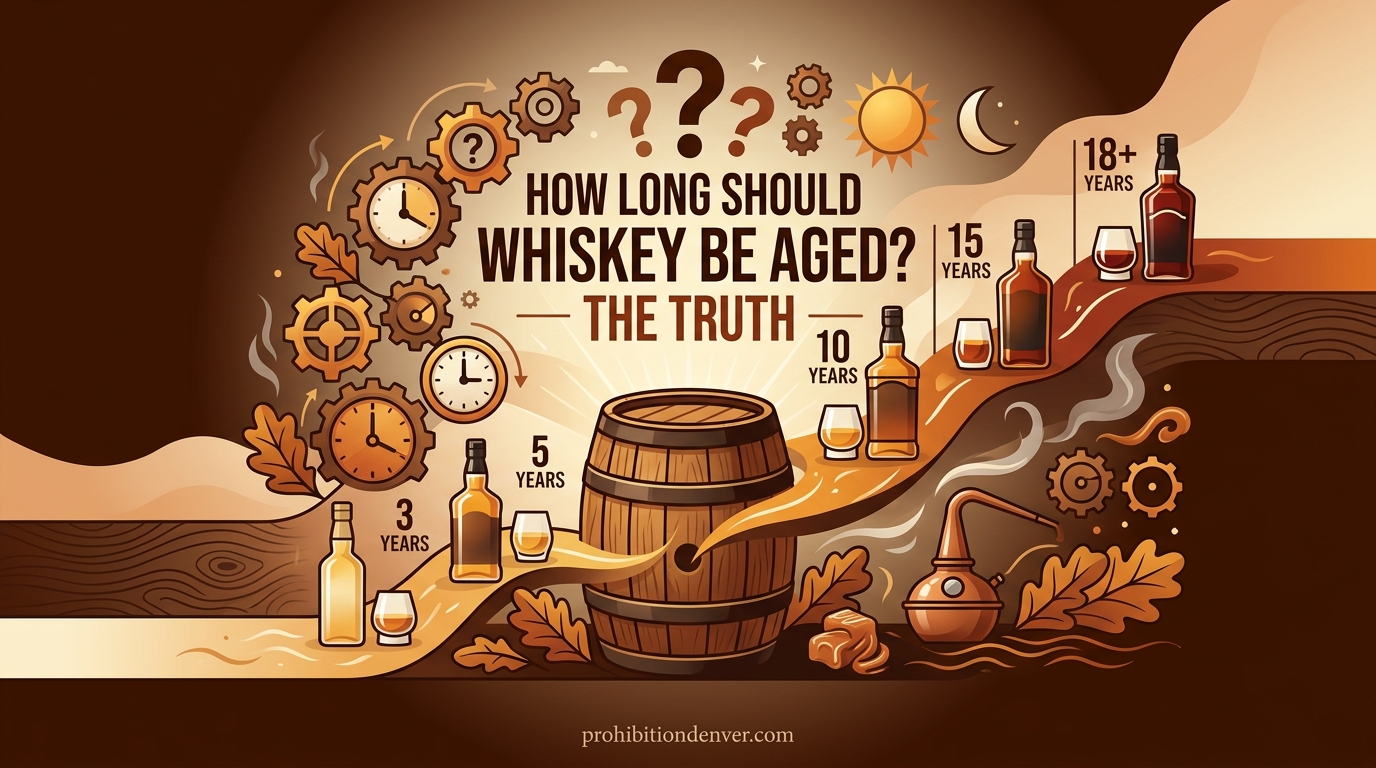
Whiskey should be aged for a minimum of 2 years to be called straight whiskey, though most quality expressions spend 4 to 12 years in barrels. The truth about whiskey aging is more complex than the number on the label suggests. I spent months talking to distillers and researching regulations to understand what age statements actually mean and why older is not always better.
Most whiskey drinkers assume the higher the age statement, the better the whiskey. That belief costs people money and leads to disappointment. Age statements tell you how long the youngest whiskey in the bottle spent in barrels. They do not guarantee quality, flavor balance, or value.
In this guide, I will explain exactly how long whiskey should be aged by type, what those age numbers really mean, and why climate and warehouse position matter as much as time.
Table of Contents
How Long Should Whiskey Be Aged? The Direct Answer
The minimum legal aging requirement for whiskey varies by type and region. Straight bourbon and straight rye must age at least 2 years in new charred oak barrels. Scotch whisky requires 3 years minimum in oak casks. Irish whiskey also needs 3 years minimum. These are floors, not recommendations.
Most premium whiskeys age between 4 and 15 years. The sweet spot for bourbon typically falls between 6 and 10 years. Scotch often peaks later, around 12 to 18 years for single malts. Beyond these ranges, the whiskey risks becoming over-oaked and losing balance.
Quality whiskey requires patient aging, but time alone does not create great whiskey. The interaction between spirit and wood, the climate of the warehouse, and the skill of the master distiller all play roles that matter as much as the calendar.
What Is a Whiskey Age Statement?
An age statement on a whiskey bottle tells you the age of the youngest spirit in that bottle. If a label reads “12 Years Old,” every drop in that bottle spent at least 12 years in oak barrels. Some whiskey might be older, but none is younger.
This rule applies across all major whiskey categories. Blenders can combine barrels of different ages. The age statement reflects the youngest component. A bottle containing 90 percent 15-year-old whiskey and 10 percent 12-year-old whiskey must carry a 12-year age statement.
Age statements emerged as consumer protection. Before regulations, unscrupulous producers would blend young, harsh whiskey with small amounts of old stock and imply the entire bottle was aged. Modern labeling laws prevent this deception.
Non-Age-Stated (NAS) Whiskey Explained
You will see many whiskeys without age statements. These are called NAS or non-age-stated whiskeys. They still meet minimum aging requirements, but the producer chose not to declare the age. This usually means the whiskey is relatively young, often between 2 and 4 years old.
Producers use NAS labels for several reasons. They may want flexibility to change the blend without redesigning labels. They might believe the flavor profile matters more than the age number. Sometimes NAS whiskey contains components that would be embarrassing to print on the label.
NAS whiskey is not automatically inferior. Some excellent whiskeys carry no age statement. However, transparency matters. When a producer hides the age, consumers cannot make informed comparisons.
Minimum Aging Requirements by Whiskey Type
Each whiskey style follows specific aging rules determined by its country of origin. These regulations protect consumers and maintain category standards. Understanding these minimums helps you decode labels and set appropriate expectations.
Bourbon Aging Requirements
Bourbon has no minimum aging requirement to be called bourbon. To earn the designation “straight bourbon,” the whiskey must age at least 2 years in new charred oak barrels. Most quality straight bourbons age 4 years or longer.
Bottled-in-bond bourbon follows stricter rules. It must be the product of one distilling season, one distillery, and one distiller. It must age at least 4 years in a federally bonded warehouse. It must be bottled at exactly 100 proof. These requirements date back to the Bottled-in-Bond Act of 1897.
The new charred oak requirement is unique to American straight whiskeys. The heavy char creates a layer of carbon that filters the spirit and adds vanilla, caramel, and spice notes. First-fill barrels give bourbon much of its distinctive flavor in the first 4 to 8 years.
Scotch Whisky Aging Requirements
Scotch whisky must mature in oak casks in Scotland for at least 3 years. This applies to all Scotch categories including single malt, single grain, blended malt, blended grain, and blended Scotch whisky. The casks can be new or used, though most Scotch ages in previously used bourbon or sherry casks.
Scottish regulations emphasize where the aging occurs, not just for how long. The entire maturation process must happen in Scotland. Whisky aged elsewhere cannot be called Scotch, even if made from Scottish distillate.
The cooler Scottish climate slows aging compared to Kentucky or Tennessee. A 12-year-old Scotch may show similar maturity to an 8-year-old bourbon. This explains why Scotch age statements often run higher than American whiskey equivalents.
Rye Whiskey Aging Requirements
American rye whiskey follows the same rules as bourbon. It needs no minimum age to be called rye whiskey. For “straight rye whiskey,” it must age at least 2 years in new charred oak barrels.
Canadian rye whisky operates under different rules. Canadian regulations once required rye to be the dominant grain, but modern Canadian whisky can contain very little actual rye. Aging requirements for Canadian whisky start at 3 years, though the exact rules differ from American standards.
Rye tends to show its character earlier than bourbon. The spicy, peppery notes from the rye grain can dominate young whiskey. Many rye enthusiasts prefer expressions between 4 and 8 years old, where the grain character balances with oak influence.
Irish Whiskey Aging Requirements
Irish whiskey must age at least 3 years in wooden casks. This applies to all Irish whiskey categories including single pot still, single malt, single grain, and blended Irish whiskey. Like Scotch, the entire aging process must occur in Ireland.
Irish whiskey typically uses triple distillation, creating a lighter spirit than Scottish or American counterparts. This lighter body can show oak influence more quickly. Many Irish whiskeys reach maturity between 7 and 12 years.
Japanese Whisky Aging Requirements
Japanese whisky historically followed Scotch rules with a 3-year minimum, but regulations tightened in 2021. To be labeled Japanese whisky now, the spirit must be distilled in Japan from Japanese-grown malted grains. It must mature in Japan for at least 3 years in wooden casks not exceeding 700 liters.
The Sweet Spot: Why Older Is Not Always Better
Whiskey reaches a point where additional aging stops helping and starts hurting. I call this the sweet spot. Before this point, the whiskey gains complexity, smoothness, and depth. After this point, oak dominates and the whiskey becomes unbalanced.
The sweet spot varies by whiskey type. Bourbon typically peaks between 6 and 10 years. The hot Kentucky summers push whiskey deep into the barrel staves, extracting flavors quickly. Beyond 12 years, bourbon often becomes over-oaked and tannic.
Scotch single malts often hit their stride between 12 and 18 years. The cooler Scottish climate slows extraction. Scotch can age longer before wood overwhelms the spirit. Some exceptional expressions reach 25 or 30 years and remain balanced, though these are rare.
Rye whiskey shows its best character even earlier. Many distillers consider 4 to 8 years optimal for rye. The spicy grain notes integrate with oak sweetness in this range. Older rye can become dominated by wood and lose its distinctive personality.
What Happens When Whiskey Ages Too Long
Over-aged whiskey suffers from excessive wood extraction. The spirit pulls too many tannins from the barrel, creating a drying, astringent mouthfeel. The subtle flavors from the distillate and fermentation get buried under oak.
The color can become unnaturally dark. While deep amber suggests quality in moderation, inky black whiskey often signals over-extraction. The nose may show heavy sawdust, leather, or bitter chocolate notes that overwhelm more delicate aromatics.
Master distillers monitor their barrels constantly. They sample regularly and move barrels to cooler warehouse locations when they approach maturity. This careful management prevents over-aging.
Factors That Affect How Long Whiskey Should Age
Time is only one variable in whiskey maturation. Climate, warehouse design, barrel position, and wood quality all influence how quickly whiskey develops. Two barrels filled on the same day can taste dramatically different after 10 years.
Climate and Temperature
Temperature drives whiskey aging. When temperatures rise, the whiskey expands and pushes into the wood. When temperatures drop, the whiskey contracts and pulls compounds back out. This pumping action extracts color, flavor, and tannins from the barrel.
Kentucky experiences extreme seasonal swings. Summer temperatures in rack houses can exceed 100 degrees Fahrenheit. Winter temperatures drop below freezing. These swings accelerate aging compared to Scotland, where temperatures stay moderate year-round.
Taiwan produces rapidly aging whisky due to extreme heat and humidity. Some Taiwanese distillers create mature-tasting whisky in as little as 4 to 6 years. Indian whisky matures similarly fast. These climates compress decades of Scottish aging into years.
Warehouse Position
Where a barrel sits in the warehouse matters enormously. Top floors get hottest in summer, accelerating aging. Bottom floors stay cooler, slowing development. A barrel on the top floor might age twice as fast as one on the bottom floor.
Distillers use this knowledge strategically. They place barrels destined for longer aging on lower floors. Barrels they want to mature quickly go higher up. Some distilleries rotate barrels between floors to even out the aging process.
Climate-controlled warehouses allow more precise management. Cooling systems prevent extreme heat spikes. This technology lets distillers extend aging without risking over-extraction.
The Angel’s Share
As whiskey ages, a portion evaporates through the barrel. Distillers call this the angel’s share. In Kentucky, angel’s share averages 4 percent annually. In Scotland, cooler temperatures limit evaporation to about 2 percent yearly.
This loss concentrates the remaining whiskey. A 10-year-old bourbon might have lost 40 percent of its original volume. The whiskey left behind becomes more concentrated and flavorful. However, the economics become challenging. After 20 years, more than half the barrel may have vanished.
High evaporation rates explain why older whiskey costs more. The distillery paid taxes, storage, and insurance on whiskey that disappeared into the atmosphere. The remaining bottles must carry that cost.
Barrel Char and Wood Quality
The char level on American oak barrels affects extraction rates. Heavier char creates more carbon filtering and vanilla compounds. Lighter char allows more wood tannin contact. Distillers choose char levels based on their desired flavor profile.
Used barrels, common in Scotch production, extract more slowly than new oak. A sherry cask might give up its remaining wine character in the first few years, then contribute subtle wood notes for decades. Bourbon barrels can be used multiple times for Scotch, with each fill extracting less than the last.
Common Misconceptions About Whiskey Aging
After years of reading whiskey forums and talking to enthusiasts, I keep hearing the same myths. These misunderstandings lead to poor purchasing decisions and missed opportunities to enjoy great whiskey.
Older Whiskey Is Always Better
This is the most expensive misconception in whiskey. Older whiskey commands higher prices because of scarcity, not necessarily quality. A 20-year-old bourbon often tastes worse than a well-made 8-year-old expression.
Great whiskey requires balance between distillate character, fermentation flavors, and wood influence. Extended aging can destroy that balance. Master distillers choose when to bottle based on taste, not calendar age.
Some of the most awarded bourbons in recent years carry no age statement or relatively young ages. Buffalo Trace Antique Collection, Pappy Van Winkle, and many craft distillery releases prove that skill matters more than time.
Whiskey Ages in the Bottle
Whiskey stops aging the moment it leaves the barrel. The glass bottle is inert. The whiskey inside will taste the same in 50 years as it did on bottling day. Unlike wine, whiskey does not evolve in the bottle.
This truth disappoints people who inherit old bottles hoping they improved with time. That 30-year-old bottle of bourbon was likely 4 to 8 years old when bottled. It is still 4 to 8 years old today.
Bottles can degrade if stored improperly. Heat and light damage whiskey over time. The liquid might lose subtle aromatics or develop off flavors. Proper storage keeps whiskey stable, but never improves it.
Age Statements Guarantee Quality
Age statements only guarantee minimum time in barrel. They say nothing about barrel quality, warehouse position, distillation technique, or blending skill. A poorly distilled 12-year-old whiskey tastes worse than a skillfully made 6-year-old.
Some producers game the system. They age whiskey in large tanks with oak staves rather than traditional barrels. This accelerates wood contact but creates different flavor profiles. The whiskey meets age requirements but lacks barrel character.
How to Read Whiskey Labels for Age Information
Labels carry more information than just the age statement. Understanding the full picture helps you make better buying decisions and avoid overpaying for marketing hype.
Look for these terms:
Straight – In American whiskey, this means at least 2 years old. If under 4 years, the age must be stated.
Bottled-in-Bond – Exactly 4 years old, 100 proof, one distillery, one season. This designation guarantees specific quality standards.
Single Barrel – From one specific barrel, not blended. Ages vary by barrel, but the label may not show the exact age.
Cask Strength – Bottled at barrel proof without dilution. These often show age statements and represent the whiskey in its most concentrated form.
Small Batch – A meaningless marketing term. It implies limited production but carries no legal definition.
Frequently Asked Questions About Whiskey Aging
How long should whiskey be aged?
Whiskey should be aged a minimum of 2 years for straight whiskey, though most quality expressions age 4 to 12 years. The optimal aging period depends on the whiskey type and climate. Bourbon typically peaks between 6 to 10 years, while Scotch often matures best between 12 to 18 years.
Can you drink a 100 year old whiskey?
You can drink very old whiskey if it was properly stored in barrels, though whiskey aged over 30 years is extremely rare. Most whiskey peaks much earlier. Over-aged whiskey becomes over-oaked, tannic, and unbalanced. Any whiskey labeled 100 years old would likely be a marketing gimmick or mislabeled.
Does whiskey age in the bottle after opening?
Whiskey does not age in the bottle before or after opening. The aging process stops completely when whiskey leaves the barrel. An opened bottle may slowly oxidize over months or years, changing flavor slightly, but this is degradation rather than improvement. Store opened bottles tightly sealed and away from heat and light.
What is the angel’s share in whiskey?
The angel’s share is the portion of whiskey that evaporates through the barrel during aging. In Kentucky, about 4 percent evaporates annually. In cooler climates like Scotland, evaporation drops to around 2 percent yearly. This loss concentrates the remaining whiskey and explains why older whiskey costs more.
Why do some whiskeys have no age statement?
Non-age-stated (NAS) whiskeys meet minimum aging requirements but do not declare the specific age. Producers use NAS labels for flexibility, when the whiskey is relatively young, or when they want to emphasize flavor over age. NAS whiskey is not automatically inferior, though transparency varies by producer.
Is older Scotch better than younger Scotch?
Older Scotch is not automatically better. While Scotch can age longer than bourbon before becoming over-oaked, each expression has a sweet spot. Many excellent single malts peak between 12 to 18 years. Some 25-year-old expressions are exceptional, but others taste over-oaked and tired. Trust your palate over the age number.
Conclusion: The Truth About How Long Whiskey Should Be Aged
The truth about whiskey aging is that time matters, but it is not the only thing that matters. Whiskey should be aged long enough to develop complexity and smoothness, but not so long that wood dominates the spirit. For most bourbon, that means 6 to 10 years. For Scotch, 12 to 18 years often hits the mark.
Age statements provide useful information, but they do not tell the whole story. Climate, warehouse position, barrel quality, and distiller skill all shape what is in your glass. Do not pay premium prices for old whiskey just because of the number on the label. Taste, compare, and trust your own judgment.
The next time you face a whiskey decision, remember that how long whiskey should be aged depends on what is in the barrel, not just how long it has been there.