
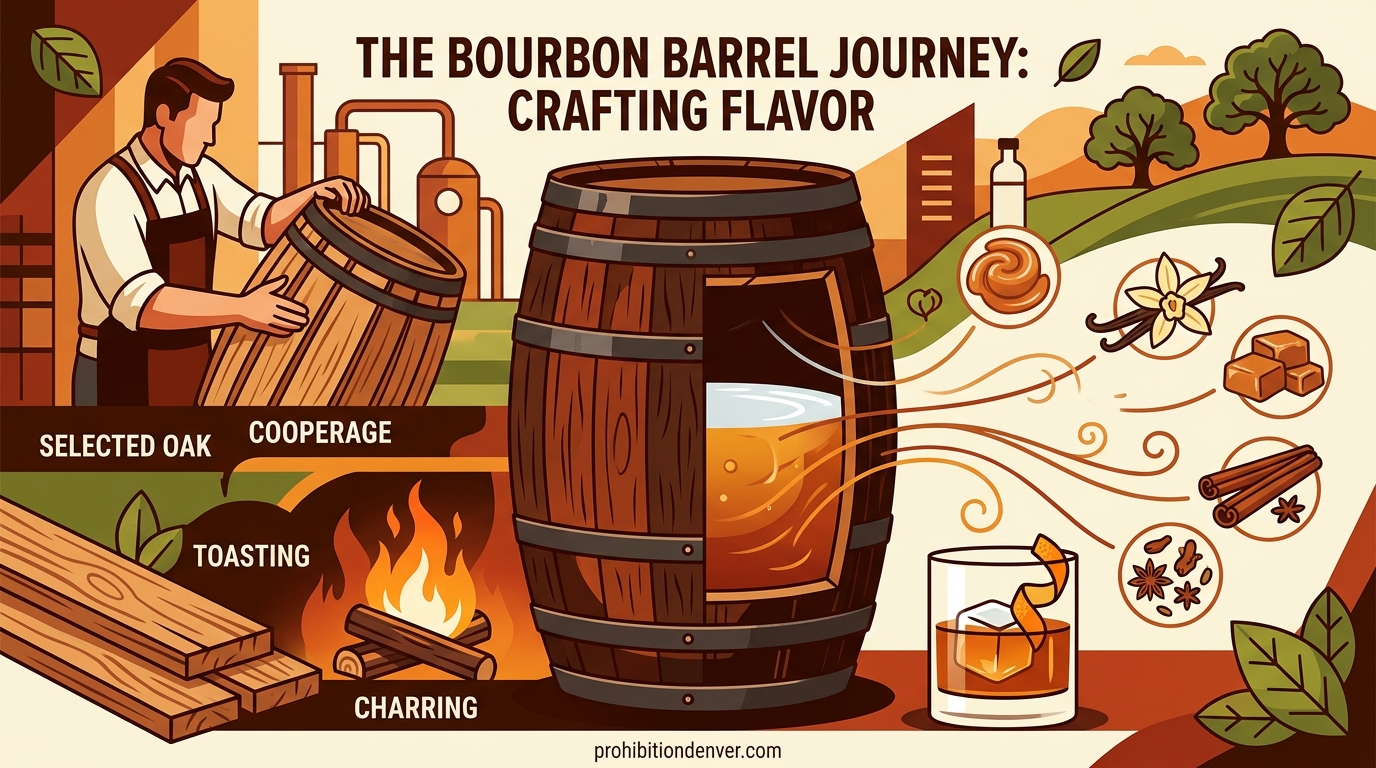
Bourbon lovers talk about the barrel like it’s a living, breathing thing — and in a way, it is. From the moment a freshly cut American white oak stave enters the cooperage to the day a distiller fills it with new-make spirit, the barrel does more work than almost any other ingredient in the bottle. It seasons the wood. It chars under fire. It expands and contracts with temperature changes, pulling raw spirit into the grain and pushing flavor back out. Understanding how bourbon barrels are made is the key to understanding why bourbon tastes the way it does — and why the barrel isn’t just a container, it’s the soul of the spirit.
If you’ve ever wondered why bourbon’s flavor profile swings from vanilla and caramel to smoky char and dried fruit, the answer lies almost entirely in what happens inside that 53-gallon oak vessel. This guide walks through every step of barrel making — from forest to cooperage to charring room — and explains exactly how each decision shapes the flavor of your favorite bottle on the shelf.
Table of Contents
Why Oak is the Only Choice for Bourbon Barrels
Walk through any bourbon distillery in Kentucky and you’ll notice something: every barrel is made from American white oak. That’s not a coincidence — it’s federal law. Under U.S. bourbon regulations, bourbon must be aged in new, charred oak barrels. But the choice of white oak specifically comes down to chemistry, not just regulation.
American white oak has a unique cellular structure that makes it simultaneously watertight and porous. The wood’s tylosis — a process where pores naturally seal themselves over time — creates a barrel that holds liquid without leaking while still allowing the slow exchange of air and moisture through the wood grain. Other oak species lack this property, making them unreliable for long-term aging.
Beyond structure, white oak contains the right balance of wood extractives that drive bourbon’s flavor development. These include:
- Lignin — Breaks down under heat into vanilla, spice, and smoke compounds that give bourbon its characteristic warmth
- Ellagitannins — Contribute astringency, body, and help with color development in the spirit
- Cellulose — Creates subtle sweetness and helps round out rough edges in new-make spirit
- Vanillin precursors — Convert to vanilla during aging, one of bourbon’s most beloved flavor notes
Of the roughly 600 oak species worldwide, American white oak sits in a sweet spot of availability, workability, and flavor chemistry. Cooperages have refined their sourcing over centuries, with most wood coming from the Ozark and Appalachian regions where the slow-growing trees develop tight, fine-grained wood — ideal for barrels.
The Barrel Making Process: Step by Step
Building a bourbon barrel is a craft that blends old-world technique with modern precision. While the tools have evolved, the fundamental seven-step process hasn’t changed dramatically in 200 years. Here’s how it’s done.
Step 1: Selecting and Seasoning the Wood
After trees are harvested, logs are split into rough stave cuts and left to air-dry outdoors — a process called seasoning. This isn’t just about reducing moisture content. Extended seasoning (typically 6 to 36 months) allows naturally occurring harsh tannins and phenols to wash out of the wood through rain and weather exposure. The result is a more balanced, approachable wood that won’t overpower the spirit with bitter compounds.
Most cooperages stack their oak logs in open-air ricks for at least one to two years. Some premium barrel makers season their wood for three years or longer. The longer the seasoning, the milder and more refined the wood — and the higher the cost of the barrel.
Step 2: Cutting the Staves
Once adequately seasoned, the wood is milled into staves — the long, curved wooden boards that form the barrel’s body. Modern stave mills use precision saws and optical scanners to cut staves with exact angles and dimensions. Each stave must have a precise taper — wider in the middle, narrower at the ends — so that when the barrel is assembled and the hoops are driven on, the staves lock together into a tight, watertight shell.
The grain of the wood matters enormously. Quarter-sawn staves (cut so the grain runs perpendicular to the growth rings) are preferred for bourbon barrels because they resist splitting and allow for controlled expansion during wetting — a critical step in the barrel’s life cycle.
Step 3: Steaming and Shaping
Raw staves are stiff and brittle. Before they can be assembled, they’re steamed in a tunnel or vat to make them pliable. While still hot and flexible, the staves are bent around a metal former, creating the barrel’s characteristic bulging shape (called the bilge). This bulge isn’t just aesthetic — it serves a functional purpose: the outward curve creates natural pressure against the steel hoops, keeping the barrel tight even as wood contracts over years of aging.
After shaping, staves are allowed to cool and set. Once cooled, they’ll hold their curved shape permanently, ready for assembly.
Step 4: Assembling the Barrel and Adding Hoops
With the body (bilge) shaped, workers slide the tapered staves together and drive temporary steel bands on to hold the shell. Then comes the croze — a shallow groove cut around the inside of the barrel at both ends where the head (bottom) will sit. Head staves are cut and fitted, then seated into the croze grooves. The barrel is now a closed vessel, though not yet water-tight.
Steel hoops are then driven on in stages — starting with the bilge hoops near the center, then quarter hoops, and finally head hoops at the top and bottom. Each hoop is tightened incrementally, drawing the barrel walls inward and creating a seal. Modern barrels often use stainless steel hoops for aesthetics and corrosion resistance, while traditional barrels use painted or lacquered steel.
Step 5: Pressure Testing
Before any barrel leaves the cooperage, it must pass a pressure test. The barrel is filled with water under pressure to check for leaks. Even a tiny seepage at a stave joint or head seam means the barrel goes back for rework. Pressure testing ensures that a barrel going into a 130-year-old rickhouse in Kentucky won’t fail during its first summer cycle — when heat expands the spirit and tests every seam.
Step 6: Toasting and Charring
This is the step that matters most for flavor. Once assembled and tested, barrels are turned upside down and set over an open gas flame or wood fire for toasting. Toasting is a controlled, gentler heating that caramelizes surface sugars in the wood without burning it. After toasting, the barrel is rotated over a gas burner for the char pass — a brief but intense application of direct flame that burns the inner surface of the wood.
The char depth is measured on a 1-to-4 scale:
| Char Level | Description | Primary Flavor Influence |
|---|---|---|
| Char Level 1 | Light char, ~5 seconds of flame exposure | Subtle wood influence, light vanilla, mild sweetness |
| Char Level 2 | Medium char, ~10 seconds | Balanced vanilla, caramel, light spice |
| Char Level 3 | Heavy char, ~30 seconds, most common | Deep caramel, toffee, smoky char, rich color |
| Char Level 4 (“Alligator Char”) | Intense char, ~60 seconds, surface chars deeply | Maximum smoke, bold char notes, heavy color extraction |
Most premium bourbon distilleries use Char Level 3 — heavy enough to create a thick layer of charcoal (the “blackened” layer) that acts as a natural filter, stripping sulfur compounds and harsh edges from the young spirit while introducing deep caramel, vanilla, and smoke notes. Buffalo Trace, Woodford Reserve, and Blanton’s all rely on this mid-heavy char for their signature profiles.
The char layer isn’t just a flavor agent — it’s a functional one. The charcoal adsorbs impurities from the new-make spirit, mellowing roughness while the spirit simultaneously pulls flavor compounds from the wood beneath the char. Over years of aging, the interplay between spirit, char, and wood creates layers of complexity that cannot be replicated any other way.
Step 7: Final Inspection and Delivery
After charring, barrels are cooled, inspected for any char cracks or hoop damage, and then delivered to distilleries. Bourbon barrels are delivered empty — distilleries fill them with their own new-make spirit and roll them into rickhouses. Each barrel will typically be used for just one aging cycle (one-time use) before being sold for secondary use — aging Scotch, wine, beer, or other spirits.
The Science Behind Barrel Aging and Flavor
Once a barrel is filled, the chemistry doesn’t stop — it accelerates. Bourbon aging is driven by a combination of factors that interact constantly inside the barrel:
- Evaporation (Angel’s Share): In open rickhouses, the barrel breathes. Warm temperatures expand the spirit into the wood grain; cool nights contract it back. With each cycle, a small percentage escapes — typically 3–4% per year, with the first year seeing as much as 8–10% loss in hotter climates. Over a 12-year aging cycle, a barrel can lose up to 60% of its original contents to evaporation.
- Oxidation: The slow ingress of air through the barrel walls oxidizes the spirit, smoothing harsh alcohols and allowing flavor compounds to marry and mature.
- Wood extraction: The spirit pulls compounds from the oak — first the easy ones (sugars and vanillins from the char layer), then deeper compounds (lignins, tannins, and wood spice) over years.
- Dilution and concentration: Humidity matters. In humid rickhouses, evaporation pulls more water than alcohol, concentrating the spirit. In dry environments, more alcohol escapes, making the spirit milder.
This is why a bourbon aged in a hot upper tier of a rickhouse in Clermont, Kentucky for 8 years tastes radically different from the same mash bill aged in a climate-controlled warehouse — even in the same-size barrel.
Legal Requirements: What Makes a Bourbon Barrel
Bourbon’s legal framework is unusually specific about barrels. Under U.S. federal regulations (27 CFR 5.11), bourbon must be aged in new, charred oak barrels. This means the barrel used for aging cannot have been used before for any other spirit or liquid. Once a barrel has aged bourbon, it cannot be used to age another batch of bourbon — it must be sold for secondary use.
There are no regulations governing the specific char level, toast level, or cooperage — that’s entirely up to each distillery. This is why no two bourbon brands taste exactly alike even if they use barrels from the same cooperage. The decisions around seasoning time, stave cut, and char level made at the cooperage all cascade into the final flavor in ways distilleries carefully guard as trade secrets.
Why Each Bourbon Barrel is Used Only Once
Most bourbon fans know that bourbon barrels are used once. But the reason behind the rule is worth understanding. The first fill extracts the most flavor from the wood — the char layer is thick, the wood is fresh, and the compounds haven’t been depleted. On a second fill, the wood’s influence is significantly muted, producing a lighter, less characterful spirit that wouldn’t meet the flavor expectations for straight bourbon.
This one-time-use rule has created a massive secondary market for retired bourbon barrels. Scotland’s whisky industry alone uses hundreds of thousands of ex-bourbon barrels annually for aging Scotch. Craft breweries age stouts and strong porters in retired bourbon barrels. Some distilleries sell barrel-aged cocktails or special limited releases aged in second-fill barrels, though these cannot legally be called bourbon.
Comparing Bourbon and Scotch Barrels
Understanding what makes bourbon barrels unique becomes clearer when you contrast them with Scotch barrels. While bourbon requires new, charred oak barrels, Scotch whisky can be aged in barrels that have been used before — often ex-bourbon barrels, ex-Sherry butts, or ex-port pipes. This difference means Scotch producers inherit barrels with residual flavor compounds from their previous contents, adding complexity from the outset.
Scotch barrels are also typically larger (500 liters vs. 53 gallons for bourbon) and may be toasted but not charred, or charred at much lower levels. The result is a fundamentally different flavor delivery system — one where the barrel contributes secondary nuance to the spirit rather than acting as the primary flavor architect.
Conclusion
How bourbon barrels are made is more than a manufacturing story — it’s a flavor story. Every decision at the cooperage, from the oak seasoning time to the char level chosen, flows directly into the bottle you pour. The barrel isn’t a neutral container; it’s an active ingredient that transforms raw, high-proof spirit into the complex, layered liquid that defines American whiskey.
Understanding the barrel-making process gives you a deeper appreciation for why bourbon tastes the way it does — and why master coopers and distillers treat their wood choices with the same care winemakers bring to grape selection. The next time you nose a bourbon and catch notes of charred oak, vanilla, caramel, and spice, you’ll know exactly where they came from: a single barrel, shaped by hand, fired by flame, and filled with patience.
FAQ
Does bourbon get its taste from the barrel?
Yes — the barrel is responsible for up to 70% of bourbon’s final flavor. The new charred oak introduces vanilla, caramel, oak spice, and smoky char notes, while the spirit’s interaction with the wood over years of aging creates depth that cannot be replicated any other way.
What char level do most bourbon distilleries use?
Most premium bourbon distilleries use Char Level 3 (heavy char), which burns the inner surface for approximately 30 seconds. This creates a thick charcoal layer that filters impurities and delivers deep caramel, toffee, and smoky notes. Char Level 4 (alligator char) is used by some brands seeking a bolder, smoke-forward profile.
Why are bourbon barrels only used once?
Federal regulations require bourbon to be aged in new charred oak barrels, and once the wood has been used once, it loses most of its flavor extraction potential. Additionally, the first fill removes the most extractable compounds from the char and wood. Retired bourbon barrels are sold for secondary aging use in Scotch, beer, and wine production.
How long does it take to make a bourbon barrel?
The barrel-making process itself takes a few days, but the wood seasoning process takes 6 to 36 months before a single stave is cut. From tree harvest to delivered barrel, the complete timeline can span 2 to 4 years — which is why high-quality cooperages invest heavily in their seasoning programs.
What gives bourbon its distinctive vanilla flavor?
Vanilla notes in bourbon come from vanillin compounds in the white oak wood, which are released during the charring process and extracted by the spirit over years of aging. The char layer specifically helps convert wood lignin into vanilla compounds — one reason char level has such a direct impact on the final flavor profile.