
Walking into a liquor store and staring at the gin section can feel overwhelming. I remember standing there for 15 minutes on my first serious gin shopping trip, completely baffled by labels claiming “London Dry,” “Plymouth,” and “Old Tom” styles.
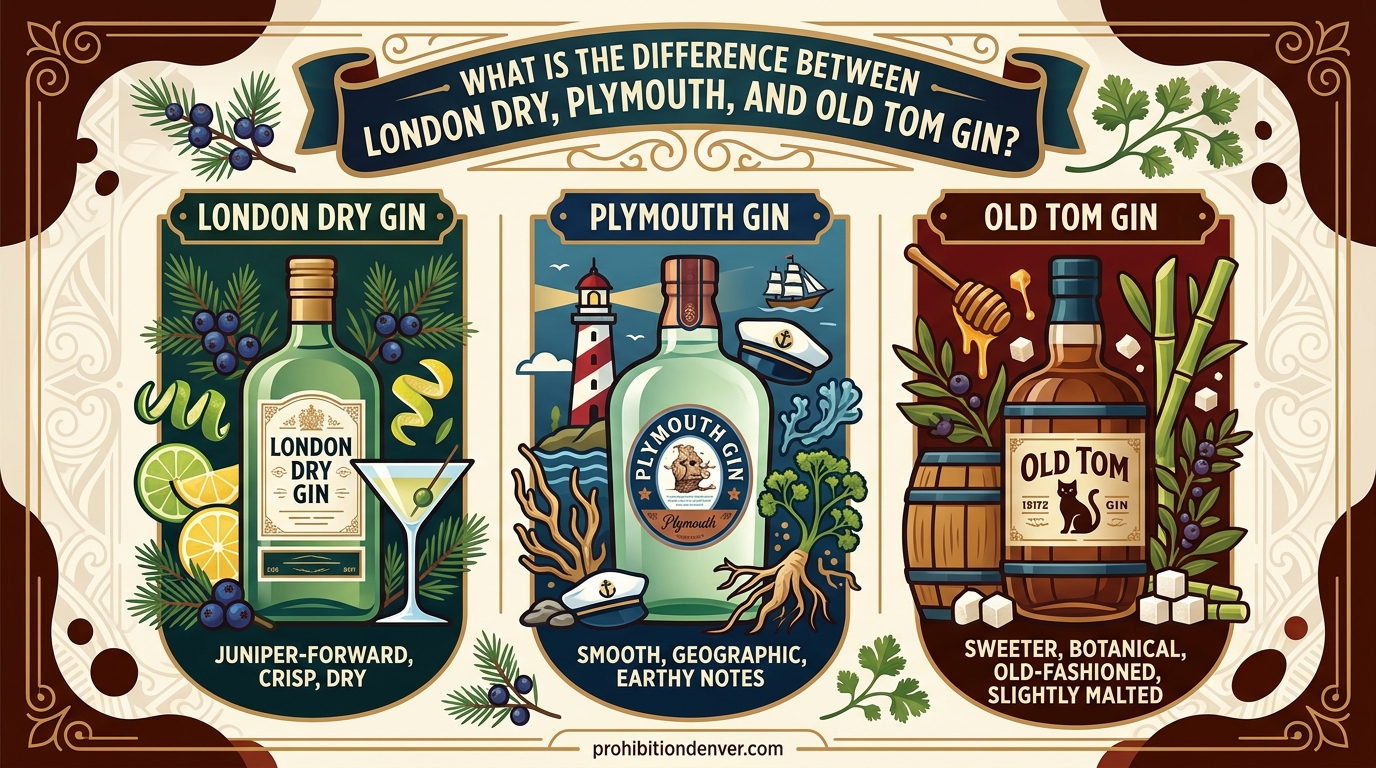
The difference between London Dry, Plymouth, and Old Tom gin comes down to three key factors: sweetness level, juniper intensity, and production regulations. London Dry is the driest and most juniper-forward. Plymouth offers a softer, earthier profile with citrus notes. Old Tom brings subtle sweetness and works beautifully in classic cocktails.
In this guide, I will break down exactly what sets these three gin styles apart. You will learn which one to reach for when making a Martini versus a Tom Collins, how to substitute when your recipe calls for a style you do not have, and which bottle deserves a spot on your home bar.
Table of Contents
What Is Gin? Understanding the Foundation
Before diving into the differences, let us establish what gin actually is. Gin is a distilled spirit that gets its primary flavor from juniper berries. Beyond that requirement, the category opens up dramatically.
Distillers add various botanicals to create unique flavor profiles. Common additions include coriander, angelica root, citrus peel, orris root, and licorice. The base spirit can come from grain, grapes, or other fermentable materials.
What makes gin fascinating is how the same basic definition produces such wildly different results. The three styles we are comparing today represent the most distinct categories within traditional gin, each with its own personality and ideal uses.
London Dry Gin: The Classic Standard
London Dry gin stands as the most recognized and widely produced gin style in the world. Despite the name, this style can be made anywhere. The “London” designation refers to the production method, not geography.
What Makes a Gin “London Dry”
The legal definition is strict and specific. All flavoring must come from natural plant materials added during distillation. No artificial flavors or colors are permitted. Sweeteners cannot be added after distillation, though a tiny amount is allowed during the process.
The result is a spirit that tastes exactly like its botanical ingredients without any post-distillation manipulation. This purity is what makes London Dry the benchmark for quality gin.
Flavor Profile and Characteristics
London Dry gin hits you with juniper first. The piney, resinous quality dominates the nose and initial taste. Behind that juniper backbone, you will typically find citrus notes from lemon or orange peel, earthiness from angelica and coriander, and often a peppery quality.
The finish is dry and clean, leaving little residual sweetness. This dryness makes London Dry incredibly versatile for cocktails, as it does not add unwanted sugar to your drink.
Popular London Dry Brands
Beefeater, Tanqueray, and Bombay Sapphire represent the most accessible entry points. Each offers a slightly different take on the London Dry profile. Beefeater leans heavily into juniper with nine botanicals. Tanqueray emphasizes its four botanicals with a clean, straightforward character. Bombay Sapphire showcases a more floral and complex profile with ten botanicals.
For those wanting to explore further, brands like Sipsmith, Ford’s, and Fords offer excellent craft interpretations that maintain the London Dry standard while exploring botanical creativity.
Best Cocktails for London Dry
London Dry gin works in virtually any gin cocktail, but it truly shines in drinks where the gin should stand front and center. The classic Gin and Tonic showcases its crisp character. The Martini demands London Dry for that bone-dry profile purists crave. The Negroni benefits from the juniper backbone balancing the Campari’s bitterness.
Plymouth Gin: The Geographic Outlier
Plymouth gin occupies a unique position in the spirits world. Unlike London Dry, which describes a method, Plymouth gin carries Protected Geographical Indication (PGI) status. It can only be produced in Plymouth, England, at the Black Friars Distillery.
The Legal Protection
In 1880, Plymouth became the first gin to receive trademark protection. Today, European law recognizes it as a distinct category with specific requirements. Only the Black Friars Distillery can produce and label spirits as Plymouth gin.
This geographic restriction means Plymouth gin represents a single distillery’s house style rather than a broad category with multiple producers. Think of it like Champagne versus sparkling wine, or Cognac versus brandy.
Flavor Profile and Characteristics
Plymouth gin delivers a softer, more rounded experience than London Dry. The juniper presence is noticeable but not overwhelming. Instead, earthy botanicals take center stage, creating a profile that many drinkers find more approachable.
You will notice subtle citrus notes dancing alongside the juniper, with a slight peppery finish. The texture feels more viscous and full-bodied compared to the crisp snap of London Dry. At 41.2% ABV, it sits at a comfortable middle strength.
The difference between Plymouth and London Dry gin becomes clear in a side-by-side tasting. Where London Dry might feel like a juniper facial, Plymouth offers a gentler introduction.
What Makes It Different from London Dry
While Plymouth technically meets London Dry standards, it carves out its own identity through seven botanicals that emphasize roots and earthiness over pure juniper dominance. The distillation process and water source from the nearby Dartmoor also contribute to its unique character.
Many bartenders consider Plymouth the perfect bridge gin. It works for drinkers who find London Dry too aggressive while still delivering authentic gin character.
Best Cocktails for Plymouth Gin
Plymouth excels in cocktails that benefit from its softer touch. The Gin and Tonic becomes more nuanced and less bracing. The Martini maintains elegance without overwhelming vermouth. The Negroni finds balance more easily. The Tom Collins showcases the citrus notes beautifully.
Old Tom Gin: The Sweet Revival
Old Tom gin represents both history and modern craft cocktail innovation. This style dominated the gin scene in 18th and 19th century England before virtually disappearing during the 20th century. Today, it enjoys a remarkable revival.
The Historical Context
During the Gin Craze of the 1700s, poor-quality spirits dominated the market. Distillers masked harsh, unrefined gin with added sweeteners. The “Old Tom” name supposedly came from wooden plaques shaped like black cats (old toms) displayed outside pubs. Customers would put money in the cat’s mouth and receive gin through a tube.
By the late 1800s, improved distillation techniques and the rise of London Dry made sweetened gin unfashionable. Old Tom nearly vanished until craft distillers rediscovered it in the early 2000s.
Flavor Profile and Characteristics
Old Tom gin delivers subtle sweetness that sets it apart from other styles. The sweetness typically comes from added sugar after distillation or from barrel aging, which imparts vanilla and caramel notes. Some producers use licorice root or other botanicals to achieve sweetness without actual sugar.
Despite the sweetness, Old Tom remains recognizably gin. Juniper still leads the botanical charge, but the overall impression is rounder, softer, and more approachable than London Dry. Think of it as gin with training wheels, or perhaps gin wearing a velvet glove.
Production Methods
Unlike London Dry, Old Tom has no strict legal definition. Producers have flexibility in how they achieve the characteristic sweetness. Common methods include:
Adding sugar syrup after distillation creates the sweetest versions. Barrel aging in used whiskey or wine barrels adds sweetness through wood influence. Using malted barley in the base spirit creates a richer, slightly sweet foundation.
This flexibility means Old Tom expressions vary significantly between brands. Some taste almost like juniper-flavored vodka with sugar, while others showcase complex botanical integration.
Popular Old Tom Brands
Ransom Old Tom leads the American craft revival with its barrel-aged approach. Hayman’s Old Tom offers a traditional English interpretation. Barr Hill from Vermont uses raw honey for sweetness, creating a unique floral expression.
Best Cocktails for Old Tom Gin
Old Tom gin works beautifully in pre-Prohibition cocktails that were designed for sweeter gin. The Tom Collins was originally made with Old Tom, and the recipe makes more sense with the slight sweetness. The Martinez cocktail demands Old Tom for its rich, complex profile. The Bee’s Knees highlights the honey-like quality beautifully.
Side-by-Side Comparison
Understanding the difference between London Dry, Plymouth, and Old Tom gin becomes clearest when you see them compared directly. Here is how these three styles stack up across key characteristics:
Flavor Intensity Scale
Juniper Dominance (1-10): London Dry scores 9-10 with juniper firmly in charge. Plymouth sits at 6-7, offering balance. Old Tom ranges 5-8 depending on the producer, with sweetness sometimes masking juniper intensity.
Sweetness Level (1-10): London Dry hits 1-2, bone dry by definition. Plymouth reaches 3-4, subtle and natural. Old Tom climbs to 4-7, noticeably sweetened.
Body/Mouthfeel (1-10): London Dry feels light and crisp at 4-5. Plymouth delivers medium-full body at 6-7. Old Tom varies widely from 5-8 depending on production method.
Production Differences
London Dry requires strict adherence to EU regulations regarding post-distillation additions. Nothing sweet can go in after the spirit leaves the still. Plymouth follows London Dry rules but adds geographic restriction to Plymouth, England. Old Tom has no legal definition, allowing creative interpretation from each distiller.
Availability and Price
London Dry dominates shelves everywhere, from grocery stores to high-end liquor shops. Plymouth requires more effort to locate, though major retailers usually stock it. Old Tom remains the hardest to find, often requiring visits to specialty shops or online ordering.
Price-wise, London Dry offers options from budget to ultra-premium. Plymouth sits in the mid-range. Old Tom typically commands premium pricing due to limited production and craft positioning.
Substitution Guide: What to Use When
Home bartenders face a common dilemma. The recipe calls for Plymouth gin, but your local store only stocks London Dry. Can you substitute? Here is my practical guide based on years of cocktail experimentation.
When You Need Plymouth but Have London Dry
This substitution works fine in most cases. Your drink will taste more juniper-forward and slightly drier. For cocktails where Plymouth’s softness matters, like a delicate Martini, add a tiny splash of water or use slightly less gin.
Avoid this swap in recipes specifically calling for Plymouth’s earthy quality, like certain Tiki drinks where the profile matters more than the alcohol.
When You Need London Dry but Have Plymouth
This is the easiest substitution. Plymouth works in any London Dry cocktail, though the drink will be softer and less aggressively botanical. Most drinkers will not notice the difference, especially in mixed drinks with strong modifiers.
When You Need Old Tom but Only Have London Dry
Here is where you need to get creative. For cocktails like the Martinez or Tom Collins, add 1/4 to 1/2 teaspoon of simple syrup per ounce of gin. This approximates Old Tom’s sweetness without changing the base spirit.
Alternatively, look for barrel-aged gin if available. The wood influence adds similar roundness to aged Old Tom expressions.
When You Need Any Style but Have a Different One
As a general rule, any gin works in any gin cocktail. The drink will taste different, but rarely bad. The key is understanding how the flavor profile shifts. Sweeter styles make drier cocktails. Drier styles work better in drinks with sweet mixers.
Cocktail Recommendations by Style
Each gin style has cocktails where it truly shines. Here are my top recommendations for getting the most from each bottle in your collection.
London Dry Gin Cocktails
The Gin and Tonic showcases London Dry’s crisp character perfectly. Use a quality tonic and plenty of lime. The Martini demands London Dry for purists, though the Plymouth Martini has its devotees. The Negroni finds perfect balance with London Dry’s juniper backbone. The Gimlet highlights citrus notes beautifully.
Plymouth Gin Cocktails
The Pink Gin cocktail was invented for Plymouth style, simply gin with a few dashes of Angostura bitters. The Gin Fizz becomes more elegant and approachable. The Aviation cocktail lets Plymouth’s softer botanicals shine through the complex modifiers.
Old Tom Gin Cocktails
The Tom Collins makes sense with Old Tom in a way it never quite does with London Dry. The Martinez demands this style for its rich, sweet profile. The Bee’s Knees highlights honey sweetness. The Old Tom Collins specifically calls for this style.
Frequently Asked Questions
How does Old Tom compare to London Dry?
Old Tom gin is noticeably sweeter and softer than London Dry. While London Dry delivers a crisp, juniper-forward profile with no added sweeteners, Old Tom includes sugar or achieves sweetness through barrel aging. This makes Old Tom more approachable for beginners and essential for pre-Prohibition cocktails like the Martinez. London Dry works better in modern cocktails where dryness is preferred.
What is considered the best London Dry gin?
Beefeater, Tanqueray, and Bombay Sapphire represent the most popular and widely available London Dry gins. Beefeater offers classic juniper intensity with nine botanicals. Tanqueray provides a clean, straightforward profile with four botanicals. Bombay Sapphire showcases complexity with ten botanicals and a more floral character. For craft options, Sipsmith and Ford’s receive excellent reviews from bartenders.
What is a good substitute for Old Tom Gin?
When a recipe calls for Old Tom but you only have London Dry, add 1/4 to 1/2 teaspoon of simple syrup per ounce of gin to approximate the sweetness. Alternatively, look for barrel-aged gin, which provides similar roundness and subtle sweetness. Plymouth gin can work in some Old Tom cocktails, though you may need to add extra sweetness depending on the recipe.
What is the difference between Old Tom Gin and London Dry Gin?
The primary difference is sweetness. London Dry gin has strict regulations prohibiting added sweeteners after distillation, resulting in a bone-dry, juniper-forward spirit. Old Tom gin has no legal definition and typically includes added sugar or achieves sweetness through barrel aging, creating a softer, rounder profile. Old Tom dominated the 18th and 19th centuries before London Dry became the standard in the 1900s.
Can I substitute London Dry for Plymouth gin?
Yes, London Dry works as a substitute for Plymouth in most cocktails, though the drink will taste more juniper-forward and less earthy. For recipes specifically highlighting Plymouth’s soft character, like delicate Martinis, add a splash of water or reduce the gin slightly. Plymouth can substitute for London Dry more easily than vice versa, as Plymouth’s softer profile rarely overwhelms a cocktail.
Which gin style is best for beginners?
Plymouth gin offers the most beginner-friendly entry point. Its softer, less juniper-forward profile appeals to drinkers who find London Dry too harsh. Old Tom also works well for beginners due to its subtle sweetness. Once comfortable with these styles, moving to London Dry feels like a natural progression rather than a shock to the palate.
Conclusion
The difference between London Dry, Plymouth, and Old Tom gin boils down to sweetness, juniper intensity, and production regulations. London Dry delivers the classic, bone-dry, juniper-forward experience that defines gin for most drinkers. Plymouth offers a softer, more approachable bridge with geographic authenticity. Old Tom brings historical sweetness that shines in vintage cocktails.
Understanding these distinctions transforms you from a confused shopper into an informed buyer. You will know why your Tom Collins tastes better with Old Tom, why bartenders debate Plymouth versus London Dry for Martinis, and how to adapt recipes when your home bar is missing a specific style.
If you are building a gin collection from scratch, I recommend starting with a quality London Dry like Tanqueray or Beefeater as your workhorse bottle. Add Plymouth when you want something softer for sipping or delicate cocktails. Reserve Old Tom for when you dive into pre-Prohibition recipes or want to impress cocktail-nerd friends.
The beauty of understanding these three styles is that they cover 90% of cocktail scenarios you will encounter. Master them, and the world of gin becomes far less mysterious and much more enjoyable.