
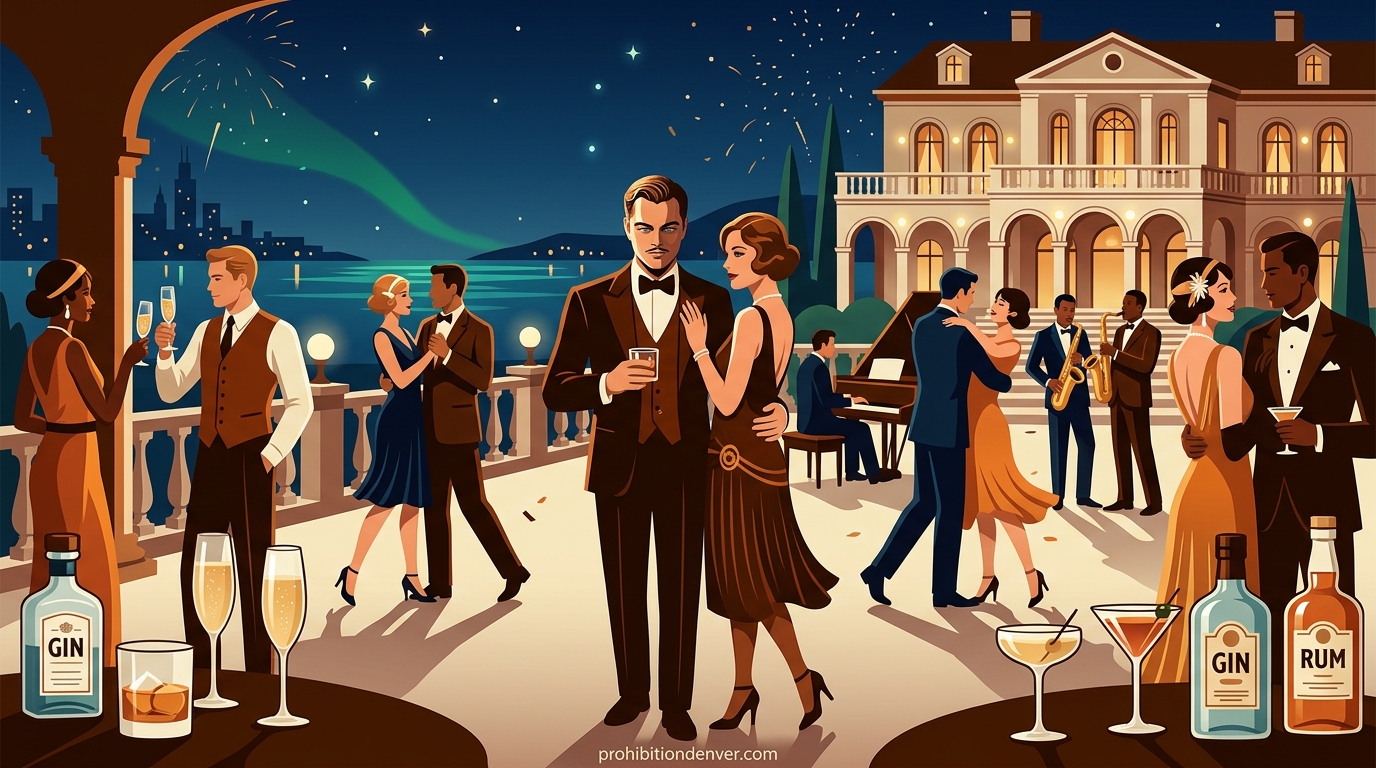
When F. Scott Fitzgerald published The Great Gatsby in 1925, he captured an era of excess that he knew intimately. The champagne flows endlessly at Jay Gatsby’s parties. Whiskey appears at every social gathering. Yet beneath the glittering surface of cocktail glasses lies something darker – a mirror reflecting Fitzgerald’s own struggles with alcohol and America’s failed experiment with Prohibition.
Our team spent months researching the connections between Fitzgerald’s life and his masterpiece. We analyzed historical records, literary criticism, and personal correspondence to understand how the author’s drinking shaped one of literature’s greatest novels.
In this guide, you’ll discover the real story behind Gatsby’s drinking culture. We explore how Prohibition created the criminal underworld that funded Gatsby’s fortune. We examine Fitzgerald’s personal battle with alcoholism. And we reveal what the drinking in this novel actually symbolizes about the American Dream.
Table of Contents
The Real-Life Story Behind The Great Gatsby’s Drinking Culture: An Overview
The drinking culture in The Great Gatsby isn’t mere window dressing. It reflects the historical reality of the 1920s, when the 18th Amendment made alcohol illegal nationwide. This law, known as Prohibition, lasted from 1920 to 1933. Instead of stopping drinking, it created a massive underground economy.
Fitzgerald witnessed this transformation firsthand. He attended parties where bathtub gin and smuggled champagne flowed freely. He watched as bootleggers built fortunes selling illegal alcohol. And he experienced his own descent into alcoholism alongside his wife Zelda.
The novel captures this era with remarkable accuracy. Gatsby’s lavish gatherings mirror the speakeasies that flourished in every major American city. His mysterious wealth hints at the criminal connections that fueled the illegal liquor trade. And the characters’ relationship with alcohol reveals deeper truths about class, corruption, and disillusionment.
The Prohibition Era: When America Went Dry (1920-1933)
The 18th Amendment to the United States Constitution took effect on January 17, 1920. It prohibited the manufacture, sale, and transportation of alcoholic beverages. The Volstead Act provided the framework for enforcement. Americans called this period Prohibition.
The movement behind Prohibition had noble intentions. Reformers believed alcohol caused poverty, domestic violence, and moral decay. They promised that banning liquor would create a healthier, more productive society. What actually happened was quite different.
Americans never stopped wanting alcohol. Instead, they found new ways to obtain it. Some made their own spirits in hidden stills. Others obtained prescriptions for “medicinal alcohol” from sympathetic doctors. Most simply bought from the criminal networks that emerged overnight to meet demand.
The statistics tell a striking story. According to historian David Kyvig, alcohol consumption actually increased in some areas during Prohibition. The law turned ordinary citizens into criminals and criminals into millionaires. Speakeasies operated openly in every neighborhood, protected by bribes and official corruption.
Fitzgerald understood this paradox perfectly. In The Great Gatsby, Nick Carraway observes that New York seems to pulse with “a constant, turbulent riot.” This energy came partly from the thrill of breaking an unpopular law. The characters drink not just for pleasure, but as an act of rebellion against a government that tried to control private behavior.
How Speakeasies Defined the Roaring Twenties
A speakeasy was an establishment that sold alcoholic beverages illegally during Prohibition. The name came from the practice of speaking quietly or “easy” about such places in public. By 2026, thousands operated across America.
These venues ranged from dingy basement rooms to elaborate nightclubs. Some required passwords or membership cards. Others operated brazenly, confident that local police had been paid to look the other way. What they shared was the thrill of the forbidden and the sense that ordinary rules no longer applied.
Jay Gatsby’s parties function like a private speakeasy for the wealthy. His mansion provides a sanctuary where guests can drink without fear of raids. The champagne, cocktails, and whiskey flow with the same abandon found in illegal bars. But Gatsby adds something extra – theatricality and excess that ordinary speakeasies couldn’t match.
The novelist captured the atmosphere perfectly. At one party, guests dance to live jazz, drink from crystal glasses, and gossip about their mysterious host. The scene feels simultaneously glamorous and desperate. Everyone knows the party cannot last, which makes them drink harder while they can.
Speakeasies also democratized drinking in ways that alarmed traditional elites. Wealthy socialites mingled with criminals, actors, and journalists at illegal bars. Class barriers seemed to dissolve in the shared pleasure of breaking the law. This mixing of social strata appears in Gatsby’s parties, where “old money” families like the Buchanans encounter Gatsby’s questionable associates.
Bootlegging: The Real Business Behind Gatsby’s Fortune
Bootlegging was the illegal production, distribution, and sale of alcoholic beverages during Prohibition. The term originally referred to hiding flasks in boot legs. By the 1920s, it described a sophisticated criminal enterprise worth billions of dollars annually.
The novel hints strongly that Gatsby’s wealth comes from bootlegging. Tom Buchanan accuses him of being a bootlegger during their confrontation at the Plaza Hotel. Nick Carraway suspects connections to “drugstores” that sold medicinal alcohol. Meyer Wolfsheim, Gatsby’s business associate, resembles real-life crime boss Arnold Rothstein.
Rothstein was a gambling kingpin who fixed the 1919 World Series and controlled much of New York’s illegal liquor trade. He operated through front businesses and corrupt officials. His methods – and his connections to both high society and criminal gangs – likely inspired Fitzgerald’s creation of Wolfsheim.
The bootlegging business transformed American organized crime. Figures like Al Capone in Chicago built empires worth hundreds of millions of dollars. They bribed police, politicians, and judges. They eliminated rivals with violence. And they invested their profits in legitimate businesses, creating the template for modern criminal enterprises.
Gatsby’s rise from poverty to wealth follows this pattern. He moves from the Midwest to make his fortune, just as many bootleggers relocated to major cities. His mysterious phone calls and unexplained wealth suggest criminal activity. Yet Fitzgerald gives him enough ambiguity that readers can imagine legitimate explanations – a deliberate choice that reflects the moral complexity of the era.
F. Scott Fitzgerald’s Personal Struggle with Alcohol
Fitzgerald began drinking seriously during his time at Princeton University. He developed a reputation as a charming drunk who could quote poetry and tell stories late into the night. This pattern continued when he met Zelda Sayre, a beautiful southern belle who shared his taste for excess.
The couple married in 1920 and immediately became famous for their wild behavior. They jumped into fountains, rode on car roofs, and consumed enormous quantities of alcohol. Fitzgerald wrote in his ledger about drinking champagne for breakfast and gin throughout the day. Friends recalled him becoming increasingly dependent on alcohol to write, socialize, and function.
By the time he wrote The Great Gatsby, Fitzgerald was already struggling with addiction. He would write sober in the mornings, then drink through the afternoons and evenings. His letters reveal anxiety about his drinking and failed attempts to cut back. The novel reflects this tension between control and excess.
Zelda’s mental health deteriorated alongside her husband’s drinking. She began showing signs of psychiatric illness in the late 1920s. Fitzgerald blamed himself, believing his drinking contributed to her breakdown. The guilt and self-loathing appear in his later work, particularly The Crack-Up essays published in 1936.
Biographer Arthur Mizener documented Fitzgerald’s final decline. He moved to Hollywood in 1937 hoping to write screenplays and rebuild his finances. But his drinking had damaged his liver and heart. He died of a heart attack on December 21, 1940, at age 44, largely forgotten and convinced he was a failure.
The tragedy of Fitzgerald’s life gives his novel its emotional power. He wrote about characters chasing dreams that would destroy them because he was living that story himself. The drinking that fuels Gatsby’s parties would eventually kill the man who imagined them.
What Alcohol Symbolizes in The Great Gatsby
Alcohol in The Great Gatsby carries multiple layers of meaning. On the surface, it represents the excess and glamour of the Jazz Age. But deeper reading reveals more troubling symbolism.
First, alcohol symbolizes moral decay beneath social polish. The Buchanans appear respectable but drink to excess. Tom Buchanan’s whiskey-fueled aggression reveals the cruelty his wealth conceals. Daisy’s performative drinking masks her emptiness and irresponsibility. The characters use alcohol to hide their true natures from themselves and others.
Second, drinking represents the corruption of the American Dream. Gatsby builds his fortune through questionable means to win Daisy’s love. His parties, fueled by illegal alcohol, attract the rich and famous. Yet this success proves hollow. The dream he pursues was always an illusion, just as the pleasure of drinking proves temporary.
Third, alcohol serves as escape from painful reality. Nick Carraway observes that Daisy and Tom “weren’t happy” yet “weren’t unhappy either.” They exist in a alcohol-induced haze that prevents them from confronting their marriage’s failures. Gatsby drinks to forget his humble origins. The entire social world of the novel uses intoxication to avoid facing uncomfortable truths.
Finally, the drinking culture exposes the hypocrisy of Prohibition itself. The law banned alcohol for moral reasons. Yet the wealthy drank openly while the poor suffered from dangerous homemade spirits. Fitzgerald shows how prohibition created new forms of inequality and corruption rather than solving social problems.
Character Drinking Patterns: What They Reveal
Each major character in The Great Gatsby has a distinctive relationship with alcohol that illuminates their personality and role in the narrative.
Tom Buchanan drinks whiskey with aggressive confidence. His consumption reflects his sense of entitlement as an old-money aristocrat. When drunk, he becomes more openly racist, cruel, and violent. The alcohol removes his social mask, revealing the bully beneath the gentleman.
Daisy Buchanan drinks with theatrical delicacy. She sips cocktails while making ironic observations about her own unhappiness. Her drinking is performative – she wants to be seen as carefree and sophisticated. But Fitzgerald hints that she drinks to endure a marriage she knows is hollow.
Jordan Baker drinks with calculated moderation. As a professional golfer, she maintains control even at parties. Her careful drinking mirrors her careful approach to life – never risking too much, never fully committing to anyone. Nick finds her attractive but ultimately untrustworthy.
Nick Carraway drinks socially but remains observant. As the narrator, he must maintain enough clarity to witness and record events. His moderate consumption makes him the ideal guide through Gatsby’s world. He participates enough to understand the culture but stays detached enough to critique it.
Jay Gatsby himself drinks surprisingly little. He owns enormous quantities of liquor but seems barely affected by it. This restraint suggests his discipline and focus. Unlike his guests, who drink to escape, Gatsby maintains his attention on his goal – winning Daisy back. His sobriety makes him an outsider even at his own parties.
The Great Gatsby Drinking Culture: Timeline of the Prohibition Era
Understanding when events occurred helps readers appreciate Fitzgerald’s historical accuracy. Here is a timeline connecting the novel to Prohibition history:
1919: The 18th Amendment passes. The Volstead Act establishes enforcement mechanisms. Americans stockpile liquor before the ban takes effect.
1920: Prohibition begins on January 17. Speakeasies open immediately in major cities. Organized crime begins consolidating control of the illegal liquor trade.
1922: The novel’s main events occur during the summer of this year. Gatsby has already established himself as a wealthy bootlegger. His parties have become legendary in New York society.
1924: Fitzgerald writes The Great Gatsby while living in France. He struggles with his own drinking while creating his masterpiece about American excess.
1925: The novel publishes to mixed reviews and modest sales. Critics praise the writing but question its moral message. Fitzgerald feels disappointed by the reception.
1933: Prohibition ends with the 21st Amendment. The experiment failed to stop drinking while empowering criminals. America returns to legal alcohol consumption.
FAQ: The Real-Life Story Behind The Great Gatsby’s Drinking Culture
What does alcohol symbolize in The Great Gatsby?
Alcohol symbolizes moral decay beneath social glamour, the corruption of the American Dream, escape from painful reality, and the hypocrisy of Prohibition itself. Characters use drinking to hide their true natures and avoid confronting uncomfortable truths.
Is The Great Gatsby based on a real life story?
While fictional, the novel draws heavily from real life. Fitzgerald modeled Gatsby partly on bootleggers and social climbers he observed. The drinking culture reflects actual Prohibition-era behavior. Characters combine traits from people Fitzgerald knew, including himself and his wife Zelda.
Why did Gatsby drink so little alcohol?
Gatsby drinks surprisingly little despite owning enormous quantities of liquor. This restraint demonstrates his discipline and focus. Unlike his guests who drink to escape, Gatsby maintains his attention on winning Daisy back. His sobriety makes him an outsider even at his own parties.
Was alcohol illegal in The Great Gatsby?
Yes, alcohol was illegal throughout the novel. Prohibition lasted from 1920 to 1933, and the story takes place in 1922. The characters drink anyway through connections to bootleggers and speakeasies. Their illegal consumption highlights the law’s failure.
How did F. Scott Fitzgerald’s drinking influence his writing?
Fitzgerald’s alcoholism deeply affected his writing process and themes. He wrote in the mornings, then drank through afternoons and evenings. His personal struggles with addiction gave him authentic insight into characters using alcohol to escape reality. His decline paralleled the darker themes in his later work.
Was Jay Gatsby based on a real bootlegger?
Gatsby combines traits from several real figures. Meyer Wolfsheim resembles crime boss Arnold Rothstein, who controlled much of New York’s illegal liquor trade. Gatsby’s mysterious wealth and connections to drugstore operations mirror actual bootlegger behavior. However, no single real person became the direct model.
What role did speakeasies play in the novel?
Gatsby’s parties function like private speakeasies for the wealthy. His mansion provides a sanctuary where guests can drink without fear of raids. The atmosphere mirrors actual speakeasies – theatrical, exclusive, and charged with the thrill of breaking the law. Fitzgerald captured the secret culture of illegal drinking perfectly.
How accurate is The Great Gatsby’s portrayal of 1920s drinking culture?
The portrayal is remarkably accurate. Fitzgerald witnessed Prohibition firsthand and understood how it created criminal empires. His descriptions of bathtub gin, champagne cocktails, and party excess match historical records. Literary scholars consistently praise the novel’s authentic representation of Jazz Age drinking culture.
The Lasting Legacy of Gatsby’s Drinking Culture
The drinking culture in The Great Gatsby continues to fascinate readers nearly a century after publication. The novel offers more than a historical snapshot of Prohibition-era excess. It provides timeless insights about human nature and social inequality.
Fitzgerald’s personal tragedy gives the book its emotional authenticity. He wrote from experience about addiction, failed dreams, and moral compromise. His characters’ drinking patterns reveal truths about wealth, class, and happiness that remain relevant today.
Understanding the real-life story behind the novel enriches our reading experience. We see how Prohibition created the criminal underworld that made Gatsby possible. We recognize Fitzgerald’s own struggles in his characters’ dependence on alcohol. And we appreciate how literature can capture historical moments with perfect clarity.
The Roaring Twenties ended with the stock market crash of 1929. Prohibition ended four years later. But The Great Gatsby preserves that world forever – the music, the parties, the champagne, and the darkness waiting beneath the glittering surface. Fitzgerald gave us a masterpiece because he lived the story he was telling. That personal connection to the material makes his novel endure.
If you’re interested in exploring more about Prohibition history and its lasting impact on American culture, browse our other articles on the era that shaped modern drinking culture. The story of how America went dry – and the unintended consequences that followed – continues to offer lessons for 2026 and beyond.