
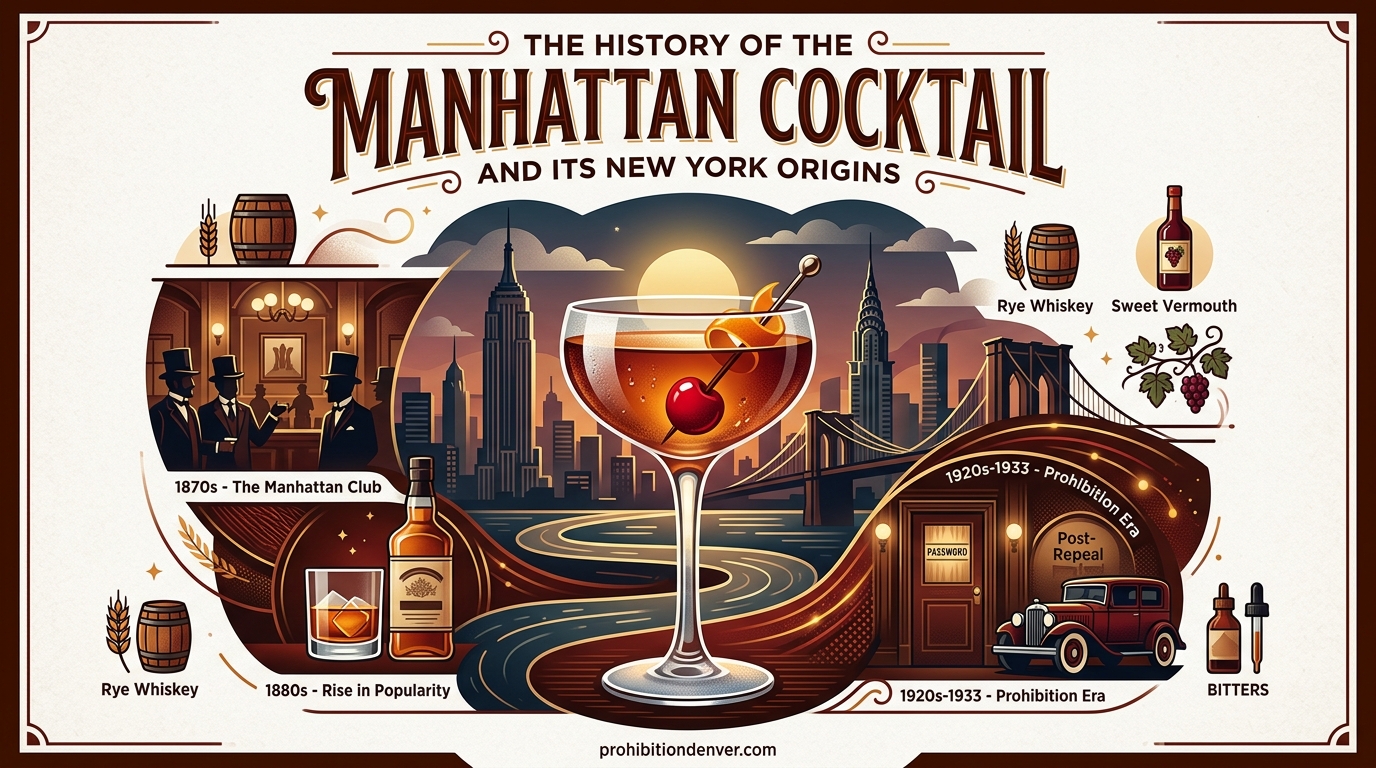
The Manhattan cocktail history represents one of the most fascinating tales in American mixology. Emerging in the 1860s-1870s, the Manhattan is regarded as the first “modern cocktail” due to its inclusion of vermouth, an aromatised and fortified wine that marked a departure from earlier whiskey-only drinks. This sophisticated combination of rye whiskey, sweet vermouth, and Angostura bitters didn’t just create a delicious drink—it launched an entirely new category of cocktails that would shape American bar culture for generations.
New York City in the late 19th century was a crucible of cocktail innovation. The Manhattan wasn’t created in isolation. It was part of a broader movement that gave birth to the other borough cocktails: the Bronx, Queens, Brooklyn, and even the Staten Island. These drinks weren’t just beverages—they were expressions of New York’s growing cultural dominance and the city’s role as the epicenter of American sophistication.
The Manhattan’s enduring legacy speaks to its perfect balance of flavors. The spicy bite of rye whiskey meets the herbal sweetness of sweet vermouth, while aromatic bitters tie everything together. This simple yet profound combination has made the Manhattan one of the most ordered cocktails worldwide for over 150 years. Its story is intertwined with New York’s Gilded Age, the rise of exclusive social clubs, and the evolution of American drinking culture.
Table of Contents
Manhattan Origins: The Birth of a Classic
The Manhattan emerged during a transformative period in American cocktail history. Before the 1860s, most whiskey drinks were simple affairs—whiskey, sugar, water, and bitters. The addition of vermouth, a fortified wine imported from Europe, represented a revolutionary step forward. This innovation is why cocktail historians often call the Manhattan the first modern cocktail. It wasn’t just a modification of existing drinks—it was something entirely new.
New York City’s unique position as a port city made it the perfect incubator for this evolution. European wines and spirits flowed through Manhattan’s docks, and the city’s wealthy patrons had access to the finest imported ingredients. Bartenders at prestigious establishments experimented with these new arrivals, combining them with American whiskey to create sophisticated drinks that appealed to the city’s growing upper class.
The Manhattan was part of a broader family of New York cocktails. Each borough eventually lent its name to a drink, though the Manhattan remained the most prestigious. The Bronx used gin, the Queens featured whiskey and vermouth but with different proportions, and the Brooklyn incorporated maraschino liqueur. The Manhattan, however, was the original—the cocktail that set the standard for what a sophisticated whiskey drink could be.
The Manhattan Club Legend: The Famous 1874 Story
The most famous origin story places the Manhattan’s creation at a banquet hosted by the Manhattan Club in 1874. According to popular legend, the drink was created for a banquet honoring Lady Randolph Churchill—born Jennie Jerome—a prominent American socialite who would later become the mother of British Prime Minister Winston Churchill. The story goes that the club’s bartenders invented a special cocktail for the occasion, and it was such a success that it spread throughout New York and eventually the world.
The banquet was allegedly organized to celebrate Samuel J. Tilden, the Democratic governor of New York who would later run for president. Lady Randolph Churchill, newly married and moving in New York high society, was reportedly in attendance. The Manhattan Club was one of the city’s most exclusive establishments, catering to the political and social elite of post-Civil War New York. It was exactly the kind of place where a new, sophisticated cocktail might emerge.
This story has everything: a glamorous socialite, a prominent politician, an exclusive venue, and a drink that would become legendary. It’s the kind of tale that gets repeated in bars and books, passed down through generations of cocktail enthusiasts. The Manhattan Club itself embraced this origin story, promoting it as part of their legacy. For decades, it was the accepted history of the drink.
There’s just one problem with this story: it doesn’t hold up to historical scrutiny.
Debunking the Lady Churchill Myth: What the Records Show
Cocktail historian David Wondrich and other researchers have thoroughly examined the Manhattan Club story, and they’ve found significant problems with the timeline. The most glaring issue involves Lady Randolph Churchill’s whereabouts in 1874. Historical records show that Jennie Jerome was actually in England at the time of the supposed banquet, not in New York. She had given birth to Winston Churchill in November 1874, making her attendance at a New York banquet that same month physically impossible.
Even more damning is the complete absence of any contemporary evidence. No newspaper from 1874 mentions a new cocktail being created at the Manhattan Club. No club records reference a special drink for the Tilden banquet. No bartender diaries or recipe books from that period contain anything resembling the Manhattan. The story simply doesn’t appear in print until decades later, long after anyone who might have been present could verify or refute it.
Winston Churchill’s own birth date—November 30, 1874—makes the story even more problematic. The idea that his heavily pregnant mother would travel from England to New York for a political banquet, give birth shortly after, and then return with a newborn stretches credulity. The timeline simply doesn’t work.
The Manhattan Club story is what historians call a foundation myth—a story invented after the fact to explain something’s origins. It sounds plausible, it features famous people, and it places the drink’s creation in a prestigious setting. But it’s not historically accurate. The real story of the Manhattan’s origins is more complicated and more interesting than this elegant legend.
First Written Mentions: The Earliest Manhattan Records
The first concrete evidence of the Manhattan cocktail appears much earlier than the Manhattan Club story would suggest. The earliest known printed mention comes from the Olean Democrat newspaper in Olean, New York, in 1882—eight years after the supposed Manhattan Club creation. This reference suggests the drink was already known enough that readers would understand what was being discussed, indicating the Manhattan had been around for some time by 1882.
The first actual recipe appeared in 1884, and it appeared in multiple places that year. O.H. Byron’s “The Modern Bartender’s Guide” included a Manhattan recipe, as did George Winter’s “How to Drink” published the same year. These nearly simultaneous publications indicate the Manhattan was already circulating among bartenders by the mid-1880s. The recipes were similar: whiskey, vermouth, and bitters, though the proportions and specific ingredients varied.
William F. Mulhall, a bartender at New York’s Hoffman House, later wrote about the Manhattan in his memoirs, recalling serving the drink in the 1880s. His account provides valuable insight into how the drink was prepared and consumed in its early days. The Hoffman House was one of New York’s premier hotels, and its bar was legendary among cocktail enthusiasts. Mulhall’s testimony places the Manhattan in a sophisticated New York setting, even if not at the Manhattan Club specifically.
These early written records are crucial because they represent the first verifiable evidence of the Manhattan’s existence. They show that by the early 1880s, the Manhattan was established enough to appear in newspapers and recipe books. Whatever its true origins, the drink had entered the cocktail canon by the mid-1880s and was being documented for posterity.
The George Black Theory: A Hoffman House Origin Story
While the Manhattan Club story has been largely debunked, another origin theory has gained traction among historians. This theory centers on George Black, a bartender who worked at the Hoffman House hotel at 439 Broadway in Manhattan. Black reportedly tended bar at the Hoffman House during the 1870s and 1880s—the same period when the Manhattan was emerging.
According to this theory, Black created the Manhattan while working at the Hoffman House, not the Manhattan Club. The Hoffman House was a fashionable hotel that catered to New York’s elite, making it a plausible birthplace for a sophisticated new cocktail. William F. Mulhall worked alongside Black, and his later writings about serving Manhattans in the 1880s support the connection.
Some researchers have even suggested that Black may have previously operated a bar called the Manhattan Inn, which could explain the drink’s name. The theory goes that Black created his signature whiskey cocktail at the Manhattan Inn, then brought it with him to the Hoffman House where it gained wider fame. Unfortunately, concrete documentation of Black’s Manhattan Inn connection remains elusive.
The George Black theory is more plausible than the Manhattan Club story because it fits the timeline and doesn’t rely on famous people who weren’t there. Black was a real bartender working in New York during the right period. The Hoffman House was the kind of establishment where a new cocktail might emerge and gain popularity. While definitive proof remains scarce, this theory represents our best guess at the Manhattan’s true origins.
Historical Recipe Evolution: How the Manhattan Changed
Early Manhattan recipes from the 1880s and 1890s show surprising variety. O.H. Byron’s 1884 recipe called for rye whiskey, Italian vermouth, and Angostura bitters—a template that remains recognizable today. George Winter’s 1884 version was similar but specified different proportions. These early recipes established the basic formula that would define the Manhattan, but there was room for variation.
By the 1890s, recipe books began adding their own touches. William Schmidt’s “The Flowing Bowl” (1891) included a Manhattan recipe with absinthe, showing how bartenders experimented with the basic formula. Harry Johnson’s influential 1900 recipe added orange bitters to the traditional Angostura, creating a more complex flavor profile. Some recipes even called for gum syrup or other sweeteners, reflecting the sweeter palates of the era.
The ratio of whiskey to vermouth has also evolved over time. Early recipes often called for equal parts or a 2:1 ratio, while modern drinkers typically prefer 3:1 or even 4:1. This shift reflects changing tastes—modern palates generally prefer less sweetness and more whiskey character. Despite these variations, the core formula has remained remarkably stable for nearly 150 years.
One constant throughout the Manhattan’s history has been the use of rye whiskey. Early recipes consistently specified rye, and traditionalists continue to argue that rye is the only authentic choice. The spicy, assertive character of rye provides the perfect backbone for the sweet vermouth, creating the classic balance that defines the drink. Bourbon would become popular later, especially after Prohibition, but rye remains the traditionalist’s choice.
Prohibition Era and the Manhattan’s Survival
Prohibition (1920-1933) dealt a devastating blow to American cocktail culture, but the Manhattan managed to survive—and even thrive—during this dark period. One key factor was the availability of Canadian whiskey, which remained legal and was easily smuggled across the border. Canadian whiskey became the default base for many Manhattans during Prohibition, introducing a new generation to the drink with a slightly different flavor profile.
The Manhattan’s survival wasn’t accidental. Its relatively simple formula made it easy to recreate even with inferior ingredients. The drink didn’t require fresh fruit or complicated infusions—just whiskey, vermouth, and bitters. This simplicity meant that even makeshift speakeasies could serve passable Manhattans, keeping the drink alive during the 13 dry years.
Why did the Manhattan endure when other cocktails faded? Part of the answer lies in its fundamental balance and appeal. The Manhattan isn’t just a historical curiosity—it’s a genuinely delicious drink that works even with imperfect ingredients. Its survival through Prohibition is a testament to its enduring quality and the strength of its fundamental formula.
After Prohibition ended, the Manhattan experienced a resurgence. Pre-Prohibition recipes were dusted off, and bartenders reacquainted themselves with classic techniques. The drink had never really disappeared, but its post-Prohibition revival cemented its place as one of the essential cocktails that any serious bartender needed to know.
Modern Variations: The Manhattan’s Legacy
The Manhattan’s influence extends far beyond the classic recipe. The drink has spawned numerous variations, each putting its own spin on the basic formula. The Rob Roy, created in 1894 at the Waldorf Astoria, substitutes scotch for rye whiskey, creating a smokier, more complex drink. The Perfect Manhattan uses equal parts sweet and dry vermouth, creating a more balanced profile. The Dry Manhattan goes all the way with dry vermouth, resulting in a crisper, less sweet drink.
These variations demonstrate the Manhattan’s versatility as a template. The basic formula—spirit, vermouth, bitters—has proven endlessly adaptable. Modern bartenders continue to experiment with different base spirits, alternative vermouths, and artisanal bitters, creating new interpretations while respecting the classic structure.
The contemporary craft cocktail movement has embraced the Manhattan as a foundational drink. Bars specializing in classic cocktails almost always feature multiple Manhattans on their menus, often showcasing rare or aged whiskeys, house-made vermouth infusions, or artisanal bitters. The drink has become a canvas for creativity while remaining recognizable as a Manhattan.
The Manhattan’s legacy extends beyond specific recipes to influence cocktail culture more broadly. The drink established the template for an entire category of cocktails that combine spirit, fortified wine, and bitters. From the Negroni to the Boulevardier, many modern cocktails owe their structure to the Manhattan’s pioneering example. As we look back on the Manhattan cocktail history, we’re seeing more than just the story of one drink—we’re witnessing the birth of modern mixology itself.
Conclusion: The Manhattan’s Enduring Appeal
The Manhattan cocktail history is a tale of innovation, myth-making, and enduring appeal. From its murky origins in 1870s New York to its current status as a classic cocktail, the Manhattan has remained remarkably consistent while adapting to changing tastes and circumstances. The drink that emerged from New York’s Gilded Age continues to resonate with modern drinkers, proving that great combinations of flavor never really go out of style.
What makes the Manhattan special isn’t just its history—it’s the perfect balance of its ingredients. The spicy rye, the sweet herbal vermouth, the aromatic bitters—each element contributes to a whole that’s greater than the sum of its parts. That fundamental excellence has allowed the Manhattan to survive Prohibition, changing fashions, and countless new cocktail trends. The Manhattan isn’t just a piece of history—it’s a living, evolving drink that continues to inspire bartenders and delight drinkers around the world.
The next time you order a Manhattan, you’re participating in a tradition that stretches back nearly 150 years. You’re tasting a piece of New York history, a link to the city’s golden age of cocktails, and a testament to the enduring power of a perfectly balanced drink. The Manhattan’s story is still being written, one cocktail at a time.
FAQ
What is the story behind the Manhattan cocktail?
The Manhattan cocktail emerged in the 1860s-1870s and is regarded as the first modern cocktail due to its inclusion of vermouth. The most famous origin story claims it was created at New York’s Manhattan Club in 1874 for a banquet honoring Lady Randolph Churchill, though this story has been largely debunked by historians.
Who created the Manhattan cocktail?
The true creator remains unknown, though the most credible theory points to George Black, a bartender at New York’s Hoffman House hotel in the 1870s-1880s. The debunked Manhattan Club legend claims it was invented for Lady Randolph Churchill (Winston Churchill’s mother) at a banquet in 1874, but historical evidence doesn’t support this story.
Where did the Manhattan cocktail originate?
The Manhattan cocktail originated in New York City, most likely at a prestigious bar or hotel in Manhattan during the 1860s-1870s. The Hoffman House hotel at 439 Broadway is the most credible location based on historical research, though the exact location may never be definitively proven.
What is the oldest cocktail in the US?
While older drinks like the Sazerac and Old Fashioned predate it, the Manhattan is often called the first modern cocktail because it was the first to combine whiskey with vermouth, creating an entirely new category of cocktails that would influence mixology for generations.
Is the Lady Randolph Churchill story true?
No, the popular story that Lady Randolph Churchill (Jennie Jerome) inspired the Manhattan’s creation in 1874 is false. Historical records show she was in England giving birth to Winston Churchill at the time, and there’s no contemporary evidence of the Manhattan being created at the Manhattan Club or any banquet that year.
Why is it called a Manhattan?
The drink is named after Manhattan borough in New York City, likely because it was created there or became popular there first. Some theories suggest it may have been named after a specific establishment called the Manhattan Inn, but the name ultimately reflects the drink’s New York origins.