
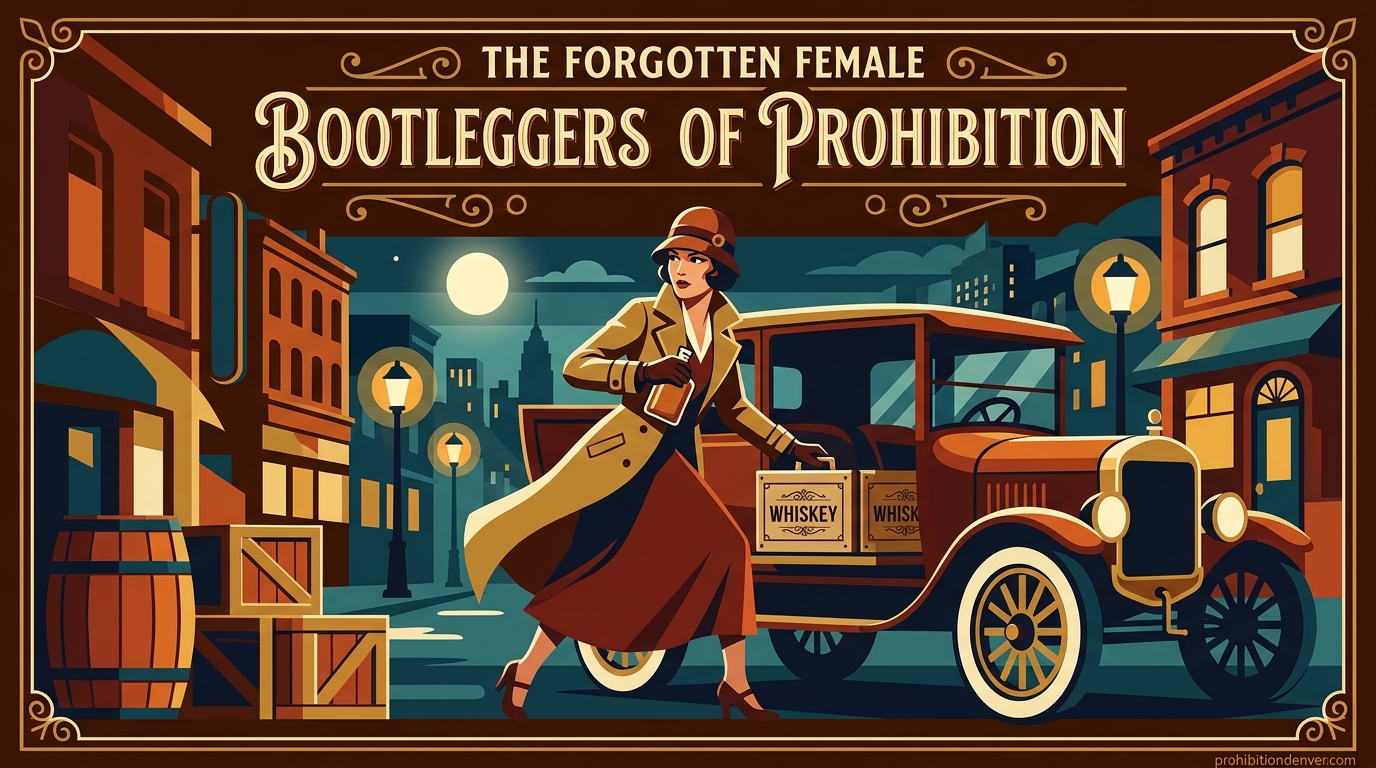
When the 18th Amendment ushered in Prohibition in 1920, Americans were promised a more moral society free from the ravages of alcohol. The Volstead Act was meant to extinguish the saloons, sober up the workforce, and strengthen family life. Instead, it birthed one of the most thriving black markets in American history, and remarkably, some of its most successful operators were women. The forgotten female bootleggers of Prohibition represent a hidden chapter in women’s history, one where grandmothers ran moonshine operations, society women smuggled whiskey under their gowns, and Denver housewives built distribution networks that supplied half the city.
For every Al Capone who made headlines, dozens of women operated bootlegging enterprises with little fear of consequence. Historians now estimate that five women worked in the illegal liquor trade for every male bootlegger, yet their stories have been largely erased from mainstream Prohibition narratives. This article resurrects those stories, explores why women succeeded where men failed, and reveals the unique Denver angle that no competitor has covered. The women who kept America drinking during Prohibition were not mere accomplices; they were entrepreneurs, risk-takers, and quietly rebellious figures who challenged every expectation of feminine behavior in the early 20th century.
Table of Contents
Why Women Became Successful Bootleggers
Prohibition created enormous economic incentives that transcended gender. With beer and whiskey illegal, demand soared while legitimate supply evaporated. Women, often excluded from mainstream business opportunities, found in bootlegging a path to financial independence that required no formal credentials, just audacity and business acumen. But beyond economics, women possessed unique advantages that made them extraordinarily effective at evading detection.
Legal Loopholes That Protected Women
The legal framework of Prohibition inadvertently protected female bootleggers. Male prohibition agents could not search women without special authorization, and many jurisdictions required female officers to conduct searches of female suspects. This bureaucratic hurdle meant that a woman carrying contraband under her skirts or hidden in her household could often bypass the very mechanisms designed to catch bootleggers. The law assumed women would not commit serious crimes, and that assumption created a significant blind spot in enforcement.
Additionally, search warrants rarely extended to private residences in the same manner they applied to businesses or vehicles. A woman running a still in her kitchen or storing liquor in her cellar occupied a legal gray area that prosecutors struggled to navigate. The Volstead Act had not anticipated the domestic sphere becoming a factory floor for illegal production.
Social Assumptions That Work in Women’s Favor
Jurors in Prohibition-era cases demonstrated striking leniency toward women. The prevailing cultural narrative portrayed female defendants as victims of circumstance, coerced by husbands or boyfriends, or simply trying to feed their families. When a woman stood trial for bootlegging, prosecutors faced an uphill battle convincing an all-male jury to convict a mother figure on charges of supplying whiskey.
The psychological research from that era was limited, but observation suggests juries applied a different standard to women’s crimes. Where a man might serve two years for a first bootlegging offense, a woman might receive a suspended sentence or minimal fine. This disparity meant that the risk calculus for women differed substantially from men. Female bootleggers could operate with a reasonable expectation that getting caught would not destroy their lives.
Domestic Skills That Translated to Bootlegging
Cooking and preserving skills translated remarkably well to liquor production. Women who had canned vegetables, made jam, and fermented foods found that distilling spirits required similar knowledge of vessels, temperatures, and timing. A copper still operates on principles not entirely different from a pressure cooker, and women who understood domestic production could adapt those skills to create potent moonshine.
The home provided cover for operations that would have been obvious in a factory or warehouse. Smoke from a still could be mistaken for kitchen cooking fires. The smell of fermentation might suggest bread baking. Delivery could occur through seemingly innocent household errands. A woman walking to church with a heavy laundry basket was unremarkable; the same woman carrying bootleg whiskey went unnoticed.
The Famous Female Bootleggers History Forgot
The women who operated bootlegging enterprises during Prohibition came from all backgrounds: rural mountaineers, urban sophisticates, immigrants, and native-born Americans. Some inherited family operations; others built empires from nothing. Each story reveals a different facet of how women navigated the illegal liquor trade.
Maggie Bailey: Queen of the Mountain Bootleggers
Maggie Bailey earned the title “Queen of the Mountain Bootleggers” through decades of moonshine production in the Appalachian hills. Beginning at age 17, she learned the trade from her father and eventually took over operations that sustained her family through some of the most impoverished years of American history. Her stills operated in remote hollows where law enforcement rarely ventured, and her reputation for quality drew buyers from across the region.
Bailey’s operation was not merely a family affair but a community institution. She employed dozens of neighbors, paid in cash or whiskey, and provided income to families who had no other economic options. When authorities finally caught up with her in her later years, even the judge who sentenced her expressed reluctant admiration for her entrepreneurial spirit.
Gertrude “Cleo” Lythgoe: Rum Row’s Business Savvy
Gertrude Lythgoe, known as Cleo, brought business acumen to international smuggling. While her husband managed some aspects of the operation, Cleo handled the financial books, coordinated shipments, and maintained the network of contacts that kept Liquor flowing from the Bahamas to American shores. She worked Rum Row, the nickname for the chain of offshore ships that served as floating warehouses for contraband alcohol.
Lythgoe’s operation demonstrated that bootlegging required sophisticated logistics. She tracked shipping schedules, managed inventory across multiple vessels, and calculated profit margins with precision. Her success lay not in violence or intimidation but in her ability to move product efficiently through dangerous waters. When she survived a shipwreck during one particularly ambitious voyage, her legend only grew.
Mary “Texas” Guinan: Queen of the Nightclubs
Mary Louise Cecilia Guinan earned her nickname from her Texas origins and became one of the most famous nightclub owners of the Prohibition era. Her New York establishments attracted celebrities, politicians, and anyone who wanted to see and be seen in the most glamorous speakeasies of the 1920s. Guinan personally greeted guests at the door with her signature greeting: “Hello, sucker!”
Beyond her celebrity persona, Guinan understood the business of entertainment and alcohol. Her clubs provided cover for large-scale bootlegging operations, with private rooms where high-rolling clients could purchase premium imported spirits. She navigated the dangerous waters between legitimate entertainment and criminal enterprise with style, and her abrupt murder in 1933 remains unsolved.
Birdie Brown: The Parlor Powerhouse
Birdie Brown represents the quiet revolution in Black communities during Prohibition. Operating from her parlor in an undisclosed city, Brown ran a distribution network that supplied quality spirits to clients who appreciated discretion. Unlike the flashy nightclub operators, Brown succeeded through reputation and reliability.
Her operation was small by comparison to some of the larger enterprises, but no less significant. Brown demonstrated that bootlegging opportunities existed for women across racial and economic lines. Recent whiskey brands have paid tribute to her legacy, recognizing that the history of American spirits includes these overlooked figures.
Bessie Starkman-Perri: Canadian Bootleg Queen
Bessie Starkman-Perri operated on the northern border, where Canada’s less restrictive liquor laws created opportunities for cross-border smuggling. Her network moved product from Canadian suppliers to American distributors with precision timing and careful attention to avoiding detection. The border regions provided natural cover, with remote crossing points and the ability to claim legitimate commerce when questions arose.
Starkman-Perri’s operation was not without violence; her husband was murdered in a dispute over territory, and she eventually took a more active role in what had initially been his enterprise. Her story illustrates how Prohibition-era bootlegging could be a family affair, with women stepping in when circumstances required.
Maggie “Moonshine Mary” Wazeniak
Moonshine Mary earned her nickname through her prolific production of high-proof whiskey in rural Illinois. Her operation ended dramatically when a moonshine run resulted in a fatal car accident, leading to her conviction for manslaughter. The case drew national attention precisely because it was unusual for a woman to face serious consequences for bootlegging activities.
Her story reveals the darker side of Prohibition’s moral compromises. The illegal liquor trade sometimes resulted in tragedy beyond mere legal violations. Mary herself became an unintended cautionary tale about the stakes involved in circumventing the law.
Spanish Marie: Florida’s Rum Runner and Auto Mechanic
Spanish Marie Waite operated out of Florida, where the coastline provided endless opportunities for smuggling. What distinguished Marie was her practical expertise as an auto mechanic, a rare skill for any woman of her era. She could maintain and repair the vehicles and boats that kept her operation running, reducing dependence on others and increasing efficiency.
Marie went on to become Florida’s first female auto mechanic after Prohibition ended, a testament to the practical skills she had developed during her bootlegging years. Her story suggests that women in the illegal liquor trade developed competencies that served them well beyond the years of prohibition.
Mary Dowling: From Distiller to Bootlegger
Mary Dowling represents the continuity between legitimate alcohol production and the illegal trade. Before Prohibition, her family had operated a distillery. When the 18th Amendment made that business illegal, Dowling simply moved operations underground. She possessed technical knowledge of distillation that many newcomers to bootlegging lacked, giving her operation a competitive advantage.
Her ability to produce consistent, quality spirits using professional techniques set her apart from amateur bootleggers whose products sometimes poisoned consumers. Dowling understood that reputation mattered even in illegal markets, and her brand commanded premium prices.
Elise Olmstead: The Undercover Operative
Elise Olmstead’s story reads like a novel, featuring a woman who worked as an undercover agent for federal authorities before marrying a prominent bootlegger and joining his operation. Her transformation from law enforcement assistant to smuggling conspirator illustrates the moral complexity of Prohibition-era choices.
Olmstead provides a reminder that women occupied all positions in the bootlegging ecosystem, not merely as passive participants but as individuals making choices that blurred legal and ethical lines.
The Denver Angle: Colorado’s Female Bootleggers
While competitors have covered national figures extensively, the Denver and Colorado angle remains unique to prohibitiondenver.com. The Rocky Mountain region presented distinct challenges and opportunities for bootleggers, and women played significant roles in the mountain states’ illegal liquor trade.
Esther Matson: Sentenced to Church for Two Years
Esther Matson represents perhaps the most unusual sentencing in Prohibition history. When Denver authorities finally caught up with her bootlegging operation, rather than sending her to prison, they ordered her to attend church regularly for two years. The sentence reflects both the leniency courts showed women and the particular moral calculus of the Rocky Mountain states.
Matson’s operation had apparently grown substantial enough to attract attention, yet authorities could not bring themselves to treat her as a serious criminal. She continued her activities after the sentence concluded, suggesting the church-attendance requirement accomplished little beyond symbolic condemnation.
Colorado’s Unique Prohibition Challenges
Colorado’s mountainous terrain provided natural advantages for bootleggers. Remote valleys and forest service roads offered locations for stills that could operate without interference. The sparse population meant fewer potential witnesses to report suspicious activities, while the tourism industry created steady demand from visitors seeking entertainment and spirits.
The state’s border with Wyoming, Utah, and New Mexico created additional smuggling opportunities. Liquor could be transported across state lines through routes that were difficult to monitor. For women operating in this landscape, the challenges differed substantially from urban environments, requiring different skills and networks.
Western Bootlegging Networks
The western bootlegging networks operated with a culture distinct from eastern organized crime. While places like Chicago and New York developed hierarchical criminal organizations, western operations often remained more family-oriented and less formally structured. Women in these networks sometimes held leadership positions unusual in more traditional criminal enterprises.
The legacy of western bootlegging contributed to the culture of personal independence that characterized mountain communities. Those involved in the trade often viewed themselves as providing a service that legitimate citizens demanded but could not openly acknowledge.
How Women Smuggled Alcohol During Prohibition
The practical methods women developed for moving illegal Liquor represented a remarkable display of creativity. With detection carrying serious consequences, bootleggers developed techniques that maximized concealment while minimizing risk.
The Girdle Whiskey Technique
Perhaps no method is more emblematic of female bootlegging than the practice of strapping flasks of whiskey to the body under clothing. The girdle, corset, and undergarments provided discreet storage that male officers could not inspect without creating scandal. Women could carry significant quantities of product directly past checkpoints, relying on modesty to protect them from search.
This technique required careful attention to clothing and movement. A woman walking normally while carrying contraband would attract less attention than someone behaving nervously. The physical discomfort of the additional weight was simply a cost of doing business.
Laundry Basket and Household Concealment
Every household item became a potential hiding place for bootleg Liquor. Laundry baskets carried more than dirty clothes; hollow books concealed valuable flasks; baby carriages hid packages beneath sleeping infants. Women exploited the assumption that their domestic activities were unremarkable, moving product through ordinary life in plain sight.
These methods relied on mundane activities for cover. A trip to the grocery store might include delivery of orders to waiting customers. Church services provided opportunities to pass product between members of networks that operated through social connections.
Boat Smuggling and Rum-Running Operations
Coastal women and those near major waterways developed boat-based smuggling operations that moved product in quantities impossible to carry personally. Small vessels could depart at night, meet offshore supply ships, and return before dawn with cargoes worth thousands of dollars.
The technical challenges of boat smuggling required understanding of tides, weather, and navigation. Women who mastered these skills gained access to the premium import market, supplying clients willing to pay substantial premiums for foreign spirits rather than domestic moonshine.
The Leniency Problem: What Happened When Women Were Caught
The disparity between male and female sentencing in Prohibition cases reveals much about early 20th century attitudes toward gender and crime. Women who were caught bootlegging rarely faced the full weight of the law.
Why Juries Showed Mercy
Jury leniency toward female defendants reflected broader cultural assumptions about feminine nature. The prevailing view held that women were naturally less criminal than men, more prone to succumb to temptation when facing hardship, and more likely to be manipulated by male associates. These stereotypes, while patronizing, created actual benefits for women in the courtroom.
Prosecutors understood that winning convictions against women required overcoming significant bias. Many chose not to pursue charges that seemed likely to result in acquittal, effectively creating a zone of impunity for female bootleggers.
Notable Cases of Unusual Sentencing
Beyond Esther Matson’s church sentence, other cases demonstrate the unusual treatment female bootleggers received. Some judges suspended sentences for women who showed contrition, while others imposed fines so minimal they represented little deterrent. The pattern suggests systemic leniency that cannot be attributed to individual judges alone.
Even when women served time, their sentences were typically shorter than those imposed on men for equivalent offenses. The criminal justice system of the 1920s treated women’s bootlegging as a less serious matter, creating opportunities that men did not enjoy.
The Women Who Helped Create Prohibition
The stories of female bootleggers gain additional irony when placed in context of the women’s temperance movement that had championed Prohibition in the first place.
The Temperance Movement’s Complex Legacy
The Woman’s Christian Temperance Union, founded in 1874, became the most influential organization pushing for alcohol prohibition. Its members believed that alcohol destroyed families, ruined health, and led to poverty and violence. They lobbied, protested, and eventually celebrated when the 18th Amendment achieved their decades-long goal.
Yet the law these women created ultimately failed to achieve its stated purposes and created opportunities for exactly the kind of moral compromises they had sought to eliminate. Some former temperance advocates apparently concluded that if drinking would continue regardless of legality, they might as well profit from it.
From Reformers to Bootleggers
The transformation of some temperance advocates into bootleggers represents one of Prohibition’s bitter ironies. Women who had proclaimed the virtues of sobriety found themselves operating illegal bars, producing untaxed whiskey, or smuggling imported spirits. This moral reversal suggests that economic incentives could override even deeply held convictions.
Whether any former temperance activists actually became bootleggers remains difficult to verify definitively. Contemporary accounts suggest it occurred, and the logic is compelling. If the law would be broken regardless, why should the economic benefits flow to men alone?
Frequently Asked Questions About Female Bootleggers
Who were the famous female bootleggers?
Were there any female bootleggers during Prohibition?
Why were women able to avoid detection as bootleggers?
What happened to female bootleggers who were caught?
What was the name of the women’s group that started Prohibition?
Who were the female bootleggers in the 1920s?
Conclusion
The forgotten female bootleggers of Prohibition represent a remarkable chapter in American women’s history. These grandmothers, housewives, immigrants, and entrepreneurs built enterprises that supplied the country’s demand for alcohol during a period when such activity was illegal. They exploited legal loopholes, navigated gender discrimination, and leveraged domestic skills to create successful operations that often outperformed male competitors.
The legacy of these women extends beyond the years of Prohibition itself. Many continued in the alcohol trade after 1933 when the 21st Amendment repealed the 18th. Others applied the skills they had developed in bootlegging to legitimate businesses that followed. The economic empowerment that bootlegging provided challenged assumptions about women’s capabilities that persisted well into the 20th century.
Today, as historians and spirits brands rediscover these forgotten figures, the true scope of women’s participation in Prohibition-era bootlegging is finally receiving acknowledgment. From Denver’s Esther Matson to Montana’s mountain bootleggers, women across America found in the illegal liquor trade an unexpected opportunity for agency and entrepreneurship. Their stories remind us that history is never simple, and the people we remember often represent only a fraction of those who shaped the world we inherited.