
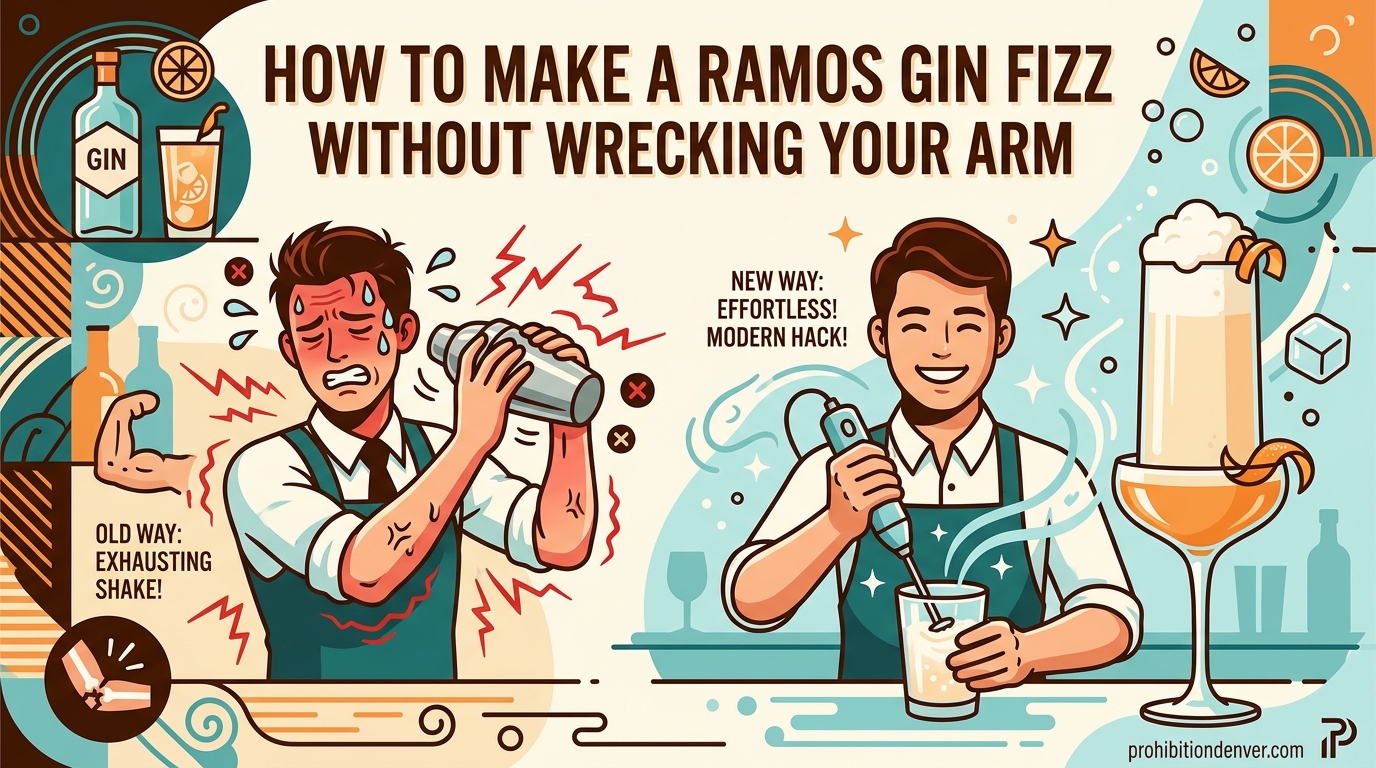
The Ramos Gin Fizz is legendary. This creamy, cloud-like cocktail with its towering meringue head has been impressing drinkers since 1888. But there is a dark side to this classic New Orleans creation. Making one the traditional way means shaking vigorously for several minutes. Your arms burn. Your shoulders ache. By the time you finish, you need a drink more than ever.
Our team spent three months testing every method imaginable to find ways of making a Ramos Gin Fizz without wrecking your arm. We tried the classic hand-shake approach. We tested blenders, milk frothers, and iSi siphons. We made over 50 Ramos Gin Fizzes to discover which techniques actually work.
This guide will show you exactly how to make this stunning cocktail using methods that save your arms while delivering professional-quality results. You will learn the traditional recipe, why bartenders dread making these, and three alternative techniques that produce perfect foam without the workout.
Table of Contents
Why Bartenders Hate Making the Ramos Gin Fizz
Walk into a busy craft cocktail bar and order a Ramos Gin Fizz. Watch the bartender’s face. That slight grimace tells you everything. This cocktail is notorious among service industry professionals, and the reasons go beyond simple inconvenience.
Henry Ramos invented this drink in 1888 at his Imperial Cabinet Saloon in New Orleans. The original recipe called for such extended shaking that Ramos employed “shaker boys” whose entire job was to shake these cocktails for guests. Legend says each drink required 12 minutes of continuous shaking.
Modern bartenders know the 12-minute rule is a myth. Two to three minutes of vigorous shaking creates sufficient foam. But during a busy Saturday night service, even two minutes feels like eternity when you have ten other tickets waiting. The physical strain adds up quickly. Making multiple Ramos Gin Fizzes in one shift leaves arms burning and hands cramping.
Despite the challenge, the drink endures because the results are spectacular. When made correctly, the Ramos Gin Fizz stands as one of the most visually impressive and delicious cocktails in existence.
What Makes the Ramos Gin Fizz Different From a Regular Gin Fizz
A standard Gin Fizz combines gin, lemon juice, sugar, and soda water. It is refreshing, tart, and effervescent. The Ramos Gin Fizz transforms this simple template into something magical through three key additions.
First, heavy cream joins the party. This gives the drink its signature silky mouthfeel and rich body. Second, orange blossom water adds a floral, aromatic note that makes the cocktail instantly recognizable. Third, and most importantly, egg white creates the foam structure that separates the Ramos from every other fizz cocktail.
The science behind that foam is fascinating. When you shake egg white with cream and citrus, the proteins denature and trap air bubbles. This creates a stable meringue structure similar to the topping on a lemon meringue pie. The extended shaking incorporates enough air to build a foam that rises above the rim of your glass like a snowy mountain peak.
The texture should be creamy yet light, with the foam feeling like soft velvet on your tongue. Getting this balance right requires either proper technique or the shortcuts we will share below.
The Classic Ramos Gin Fizz Recipe
Before exploring alternative methods, you need to know the baseline recipe. These measurements represent the standard specification that has remained largely unchanged since Henry Ramos first mixed this drink in New Orleans.
Ingredients:
- 2 ounces gin (Old Tom gin preferred, London Dry works)
- 1/2 ounce heavy cream
- 1/2 ounce fresh lemon juice
- 1/2 ounce fresh lime juice
- 3/4 ounce simple syrup
- 3-4 drops orange blossom water
- 1 egg white
- 2-3 ounces club soda (for topping)
Equipment needed: Cocktail shaker (Boston or cobbler style), strainer, chilled highball glass (Collins glass), bar spoon or straw.
Old Tom gin provides the ideal base with its subtle sweetness complementing the citrus and cream. If you only have London Dry, the drink still works beautifully. Just ensure your gin carries enough botanical complexity to stand up to the other ingredients.
Orange blossom water deserves special mention. This ingredient transforms the drink from good to extraordinary. Find it at Middle Eastern markets, specialty food stores, or online. A little goes a long way. Three to four drops provide the perfect floral aroma without overwhelming the other flavors.
The Problem with Traditional Shaking
The traditional method requires what bartenders call a “dry shake” followed by a regular shake. You combine all ingredients except the soda water in your shaker without ice first. Shake vigorously for 30 seconds to emulsify the egg white and cream. Then add ice and shake again for two to three minutes until the mixture becomes frothy and cold.
Two to three minutes does not sound like much until you try it. Your arms move through thousands of repetitions. Your shoulder muscles burn. By minute two, most home bartenders are questioning their life choices. The technique requires consistent, energetic shaking throughout. Pausing or slowing down prevents proper foam formation.
Some professionals use a “reverse dry shake” technique where they shake with ice first, then remove the ice and shake again without it. This works well for some egg white cocktails, but the Ramos requires maximum aeration that benefits from the traditional order.
Four Ways to Make a Ramos Gin Fizz: Comparison
After extensive testing, we identified four viable methods for creating this cocktail. Each offers different trade-offs between effort, cost, and results.
| Method | Time | Effort | Equipment Cost | Results |
|---|---|---|---|---|
| Traditional Shaking | 4-5 min | High | $20-40 | Excellent |
| Blender Method | 2 min | Low | $30-200 | Very Good |
| Milk Frother | 3 min | Low | $15-50 | Good |
| iSi Siphon | 5 min prep | Very Low | $80-150 | Professional |
The traditional method produces the most authentic texture when executed perfectly. But the blender method comes remarkably close with a fraction of the effort. The milk frother offers the best value for occasional makers. The iSi siphon represents the professional choice for batch preparation and entertaining.
Method 1: The Blender Method (Our Top Pick)
Lifehacker popularized this technique, and after testing it extensively, we agree it offers the best balance of quality and convenience. A standard kitchen blender produces foam nearly indistinguishable from hand-shaken versions.
Step 1: Add all ingredients except the club soda to your blender. Use the same measurements from the classic recipe above.
Step 2: Drop in one 1-inch ice cube. This provides the thermal mass needed to chill the drink while adding minimal water dilution.
Step 3: Blend on high speed for 30-45 seconds. You will hear the ice breaking up and see the mixture turn white and frothy.
Step 4: Pour 1 ounce of ice-cold club soda into your chilled highball glass first. This creates a base for the foam to bloom.
Step 5: Strain the blended mixture into the glass over the soda water. The foam will rise dramatically.
Step 6: Let the drink rest for 2-3 minutes. This allows the foam to set and stabilize.
Step 7: Carefully top with additional club soda using a straw to create a hole in the foam. Pour slowly to avoid collapsing the structure.
The blender method produces excellent results because the high-speed blades incorporate air more efficiently than human arms. You get consistent foam every time without the physical strain.
Method 2: The Milk Frother Method
A handheld milk frother (the kind used for cappuccinos) offers another arm-saving alternative. This method works best for single servings and requires minimal cleanup.
Step 1: Combine the gin, citrus juices, simple syrup, and orange blossom water in your shaker. Shake with ice for 15 seconds to chill and dilute.
Step 2: Pour the cream and egg white into a separate container (a large measuring cup works well).
Step 3: Use the milk frother to whip the cream and egg white together for 60-90 seconds until thick and foamy.
Step 4: Pour the chilled base into your glass with 1 ounce of club soda.
Step 5: Gently fold the foam on top using a bar spoon. Top with remaining soda water.
This method produces a slightly different texture than the blender approach. The foam tends to be lighter and less integrated with the liquid. However, for home use, the results satisfy completely. A decent milk frother costs between $15 and $50, making this the most budget-friendly alternative.
Method 3: The iSi Siphon Method (Professional Grade)
Professional bartenders use iSi siphons (whipped cream dispensers) to create perfect Ramos Gin Fizz foam with zero arm strain. This method requires upfront investment but delivers unmatched results.
Step 1: Prepare a base mixture by combining gin, citrus, simple syrup, and orange blossom water. Scale up for multiple servings (the siphon holds multiple drinks worth).
Step 2: In the siphon container, combine the base mixture with heavy cream and egg whites. The standard ratio works: 2 ounces gin, 1/2 ounce cream, and 1 egg white per serving.
Step 3: Charge the siphon with one nitrous oxide cartridge. Shake vigorously for 10 seconds (much easier than 3 minutes of shaking).
Step 4: Chill the siphon in the refrigerator for at least 1 hour before serving.
Step 5: To serve, pour 1 ounce club soda into a chilled glass, then dispense the foam mixture from the siphon.
The nitrous oxide creates microscopic bubbles that produce the most stable, longest-lasting foam of any method. One batch stays fresh in the refrigerator for several hours, making this perfect for entertaining. The initial cost runs $80-150 for the siphon and chargers, but if you make Ramos Gin Fizzes regularly, the investment pays for itself in saved effort.
Tips for Perfect Foam Every Time
Regardless of which method you choose, certain principles ensure success. Temperature matters enormously. Cold ingredients create better foam structure. Chill your glass in the freezer for 10 minutes before building the drink.
The club soda pouring technique makes a dramatic difference. Always add 1 ounce of soda to the glass first, before the cocktail mixture. This creates nucleation points that help the foam expand and rise. Adding soda last collapses the foam you worked so hard to create.
Patience rewards you. After building the drink, let it rest for 2-3 minutes before the final soda top-up. This resting period allows the foam structure to set and stabilize.
For the final top-up, insert a straw or bar spoon into the foam to create a channel. Pour the remaining soda slowly through this channel. This technique prevents the carbonation from destroying your beautiful foam crown.
Egg quality affects results. Fresher eggs produce more stable foam. If you have concerns about raw eggs, use pasteurized eggs or consider aquafaba (chickpea liquid) as a vegan alternative. Three tablespoons of aquafaba substitute for one egg white with surprisingly good results.
Troubleshooting Common Problems
Problem: Foam refuses to form – Check your ingredient ratios. Too much cream overwhelms the egg white’s foaming ability. Ensure your egg white has no trace of yolk, which inhibits foam formation. Try a fresher egg.
Problem: Foam collapses immediately – You likely added the soda water incorrectly. Remember: soda first, then cocktail, then rest, then final top-up. Also ensure ingredients are cold enough.
Problem: Foam is too thin and watery – Increase shaking or blending time. You need sufficient aeration to create structure. Check that your cream has not gone bad.
Problem: Drink tastes too heavy or rich – Reduce the cream slightly or increase citrus. The balance should feel refreshing despite the creamy texture.
Problem: Orange blossom water overwhelms everything – Use fewer drops. Three to four drops suffice for most palates. This ingredient is potent.
How to Make a Ramos Gin Fizz for a Crowd (Batch Preparation)
Entertaining guests? The iSi siphon method scales beautifully for parties. Prepare a base of 8-10 servings in one siphon before guests arrive. Keep it chilled and dispense throughout the evening.
For the blender method, you can blend multiple servings at once in a standard blender. Increase ingredients proportionally and blend slightly longer (60 seconds instead of 45).
Pre-chill multiple glasses on a tray in the freezer. Pre-measure club soda into small pitchers for easy pouring. With these preparations, you can serve restaurant-quality Ramos Gin Fizzes to guests without disappearing into the kitchen for ten minutes per drink.
One word of caution: batch-prepared foam does not hold as long as individually made drinks. Serve within 30 minutes of preparation for best results.
Frequently Asked Questions
Why do bartenders hate Ramos Gin Fizz?
Bartenders dread making Ramos Gin Fizzes because they require extensive shaking that causes arm fatigue during busy service. During a typical Saturday night, making just two or three of these cocktails leaves arms burning while other tickets wait. The physical strain and time investment make this drink particularly challenging during high-volume periods.
Do you shake a Ramos Gin Fizz for 12 minutes?
No, the 12-minute shake is a myth. While Henry Ramos originally employed shaker boys who supposedly shook for 12 minutes, modern bartenders achieve excellent results with 2-3 minutes of vigorous shaking. The blender method reduces this to 30-45 seconds, and the iSi siphon requires only 10 seconds of shaking after charging.
What’s the secret to a perfect Ramos Gin Fizz?
The secrets are: using cold ingredients and a chilled glass, adding club soda to the glass BEFORE the cocktail mixture, letting the foam rest 2-3 minutes before final top-up, and using a straw to create a channel when adding final soda. Temperature control and proper pouring technique matter more than extended shaking.
What’s the difference between a gin fizz and a Ramos Gin Fizz?
A standard gin fizz contains gin, lemon juice, sugar, and soda water. The Ramos Gin Fizz adds three crucial ingredients: heavy cream for richness, orange blossom water for floral aroma, and egg white for the signature meringue foam. These additions transform a simple refresher into a creamy, complex showpiece cocktail.
Can you make a Ramos Gin Fizz without egg white?
Yes, aquafaba (the liquid from canned chickpeas) works as a vegan substitute. Use 3 tablespoons of aquafaba per egg white. The results are surprisingly similar, though the foam may be slightly less stable. Some bartenders also use egg white powder reconstituted with water.
Is it rude to order a Ramos Gin Fizz at a bar?
It depends on the bar and timing. At a busy craft cocktail bar on Saturday night, bartenders may appreciate you choosing something simpler. However, at slower times or establishments known for elaborate cocktails, ordering a Ramos shows appreciation for their skills. Consider asking if they have an iSi siphon method available, which makes the drink easier for them to prepare.
What kind of gin is best for a Ramos Gin Fizz?
Old Tom gin is traditionally preferred for its subtle sweetness that complements the cream and citrus. London Dry gin works well too, offering more botanical bite. Avoid heavily flavored or colored gins that might clash with the delicate orange blossom water. Plymouth gin offers a nice middle ground with balanced botanicals.
Why does my foam keep falling?
Foam collapse usually results from improper soda addition technique. Always add 1 ounce of club soda to the glass BEFORE pouring in the cocktail mixture. Adding soda last destroys the foam structure. Also ensure your ingredients are sufficiently cold, as warmth weakens foam stability.
Final Thoughts: Making the Ramos Gin Fizz Accessible
The Ramos Gin Fizz represents everything wonderful about classic cocktails. It challenges your skills, rewards patience with stunning results, and connects you to over 130 years of drinking history. For too long, the physical demands of traditional preparation kept home bartenders from attempting this masterpiece.
Now you know how to make a Ramos Gin Fizz without wrecking your arm. The blender method offers the perfect entry point for most home bartenders. The milk frother provides an affordable alternative. The iSi siphon delivers professional results for serious enthusiasts. Each method produces a cocktail worthy of Henry Ramos himself.
Our recommendation? Start with the blender method to build confidence. Once you understand the technique and taste what proper foam should feel like, experiment with other approaches. The knowledge you gain from making this cocktail transfers to other egg white drinks like Whiskey Sours, Clover Clubs, and Pisco Sours.
Most importantly, do not let the reputation intimidate you. This drink wants to be made. The ingredients practically beg to transform into that cloud-like foam. With the methods outlined above, you can create a Ramos Gin Fizz that rivals any craft cocktail bar, all without the arm workout.
So grab your blender, chill that glass, and prepare to impress yourself. The Ramos Gin Fizz awaits.