
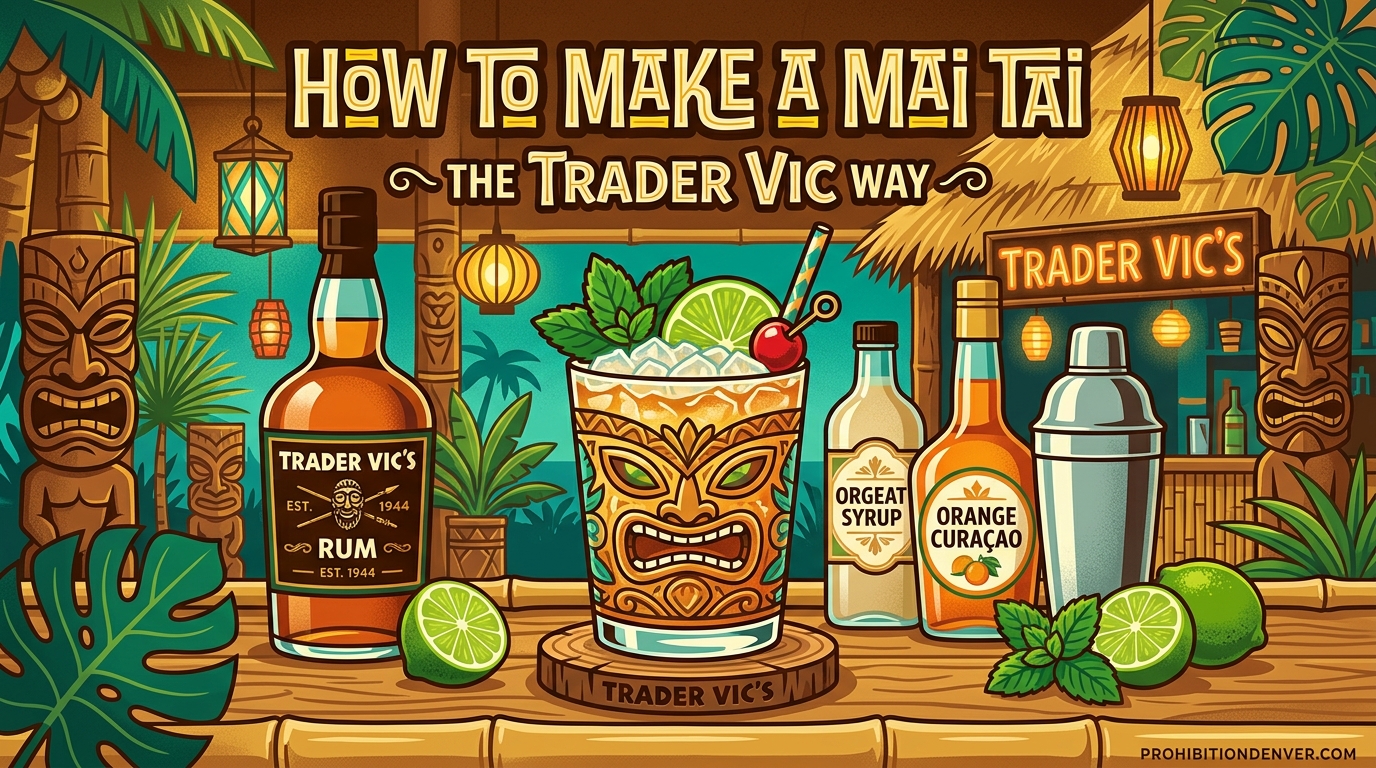
{{featured_image “Mai Tai cocktail”}}
{{intro}}
When it comes to tiki cocktails, none is more iconic or more misunderstood than the Mai Tai. Walk into almost any bar in America and order one, and you’ll likely receive a sweet, fruit-laden concoction brimming with pineapple juice and a paper umbrella. That drink has its place — but it shares only a passing resemblance to the original creation that Victor “Trader Vic” Bergeron crafted in Oakland, California, in 1944.
The authentic Trader Vic Mai Tai is something entirely different. It is a rum-forward cocktail of remarkable complexity — balanced, spirit-driven, and elegant. Making it the proper way requires fresh ingredients, quality spirits, and an appreciation for what made this drink legendary in the first place. This guide will walk you through everything you need to know to make a Mai Tai the Trader Vic way, from its storied history to the precise proportions of the original recipe.
Table of Contents
The History of the Mai Tai
To understand the Mai Tai is to understand the man who created it. Victor Bergeron, better known as Trader Vic, was one of the founding fathers of the American tiki bar movement. In 1937, he opened his first bar in Oakland, California, drawing inspiration from Polynesian culture, tropical cocktails, and the emerging craft of mixology. By the 1940s, his reputation for inventive drinks had spread far beyond the Bay Area.
The Birth of a Legend in 1944
In 1944, Trader Vic created what would become the most famous tiki cocktail ever conceived. The story goes that Vic was hosting a group of friends at his bar, including a visiting Tahitian beauty named Carrie Guild. When she tasted the new drink, she reportedly declared it “Maita’i” — Tahitian for “out of this world.” The name stuck, and the Mai Tai was born.
The original recipe was deceptively simple in composition but complex in execution. Vic called for J. Wray Nephew 17-year rum from Jamaica, which at the time was considered one of the finest rums available. Combined with fresh lime juice, orange Curaçao, orgeat syrup, and rock candy syrup, the drink was shaken and served over crushed ice in a double old-fashioned glass, garnished with a spent lime shell and a sprig of mint.
The Great Debate: Trader Vic vs. Don the Beachcomber
No discussion of Mai Tai history is complete without acknowledging the other claimant to its invention. Don the Beachcomber — the pseudonymous Ernest Raymond Beaumont Gantt — opened his own Polynesian bar in Hollywood in 1934, years before Trader Vic’s Oakland establishment. Don claimed to have created a similar drink, the Q.B. Cooler, in 1937, and later the Tai, which he maintained was the true ancestor of the Mai Tai.
The debate between Trader Vic and Don the Beachcomber raged for decades, with both men publishing recipes and accusing the other of copying. Today, most cocktail historians give equal credence to both as pioneers of the tiki movement, though Trader Vic’s version is generally what people mean when they ask for an “original” Mai Tai. The two recipes differ in significant ways — Don’s versions typically used more rum and less sweetener — but both contributed to the evolution of the modern tiki cocktail.
The Loss of the Original Rum
One of the most significant factors in the evolution (some would say devolution) of the Mai Tai is the discontinuation of J. Wray Nephew 17-year rum. For decades, Vic’s original recipe depended on this specific spirit, which was phased out of production. Without it, finding the exact flavor profile of the original became impossible — until craft distillers and rum enthusiasts began seeking adequate replacements decades later.
The loss of that rum is why so many modern Mai Tais taste nothing like the original. Bartenders and home enthusiasts substituted lighter, sweeter rums, and the balance was lost. Fruit juices crept in to fill the gap, and the Mai Tai transformed from a sophisticated rum cocktail into a sweet tropical party drink. Restoring the original character means understanding what Vic actually built — and that starts with knowing the original recipe.
The Original 1944 Trader Vic Recipe
Here is the recipe as Vic originally wrote it, with proportions measured in the bartender’s standard units. The key to success lies in precision: this is not a drink to eyeball.
The Recipe Card
- 2 oz aged rum (originally J. Wray Nephew 17-year)
- 0.5 oz Orange Curaçao
- 1 oz fresh lime juice
- 0.25 oz Orgeat syrup
- 0.25 oz Rock Candy syrup (or 2:1 simple syrup)
- Crushed ice, for serving
- Spent lime shell, for garnish
- Fresh mint sprig, for garnish
The drink is built in a double old-fashioned glass (also called a bucket glass), which allows room for plenty of crushed ice and the garnishes to make their visual statement. Vic was particular about presentation — the garnish was not an afterthought but a signature element.
The Original Proportions Explained
Looking at the recipe, what stands out is how rum-forward the drink is. Two ounces of rum in a total pour of roughly 3.5 to 4 ounces (including ice dilution) means the spirit carries the flavor. The Curaçao adds orange sweetness and depth, the lime juice provides bright citrus acidity, the orgeat brings body and a subtle almond nuttiness, and the rock candy syrup rounds everything with a touch of sweetness.
These proportions are precise. Reduce the rum or increase the sweeteners, and you have an entirely different drink. The balance of the Mai Tai is what makes it extraordinary — not too sweet, not too sour, with the rum providing a warm, complex backbone that carries the other flavors without being overwhelmed by them.
Ingredient Guide: What Goes Into a True Trader Vic Mai Tai
Every ingredient in a Trader Vic Mai Tai serves a purpose. Understanding why each one matters will make you a better bartender and help you troubleshoot when a drink doesn’t taste right.
The Rum: The Backbone of the Drink
The original recipe called for J. Wray Nephew 17-year, a rich, aged Jamaican rum with deep caramel notes, tropical fruit character, and a long, warm finish. That specific rum is no longer produced, which forced a search for suitable alternatives that has consumed cocktail enthusiasts for decades.
Today, most recipes call for a blend of two rums: an aged Jamaican rum for body and funk, and an aged Martinique rum (or Rhum Clément) for brightness and tropical notes. The key is looking for rums that are aged at least 8 to 12 years, with profiles that include caramel, tropical fruit, vanilla, and oak. Avoid light rums, spiced rums, coconut rums, or any rum with added sweetness — they will throw off the delicate balance entirely.
Orange Curaçao vs. Triple Sec
One of the most common mistakes in making a Mai Tai is reaching for Triple Sec instead of Curaçao. While both are orange-flavored liqueurs, they are not interchangeable. Curaçao (especially Grand Marnier or Cointreau) is drier and more complex, with layers of orange peel flavor and a subtle bitterness that balances the sweetness in the drink. Triple Sec is typically sweeter and simpler, and using it will make your Mai Tai taste flat and one-dimensional.
If you cannot find Curaçao, Cointreau is the best substitute. It is worth keeping a bottle of Cointreau in your bar cabinet — it is a versatile ingredient that elevates many cocktails beyond the Mai Tai.
The Critical Role of Fresh Lime Juice
This cannot be overstated: use only fresh-squeezed lime juice in a Mai Tai. Bottled lime juice, whether refrigerated or shelf-stable, lacks the brightness, acidity, and vitality of freshly squeezed limes. It will make your drink taste dull, flat, and nothing like the original.
A standard Mai Tai calls for the juice of one fresh lime (approximately 1 oz). Roll your limes firmly on the counter before cutting to help release the juice, then juice them just before mixing. Fresh lime juice is the acid backbone of the drink — without it, the flavors cannot come together properly.
Orgeat Syrup: The Secret Weapon
Orgeat is an almond-flavored syrup made from blanched almonds, sugar, and orange flower water. It adds a subtle nuttiness, a creamy body, and additional sweetness to the Mai Tai. Without it, the drink loses an essential dimension of flavor that is difficult to describe but immediately noticeable once you understand what to look for.
Quality matters enormously here. Many commercial orgeats are made with artificial flavors and excessive sugar. Look for orgeats from brands like Small Handmade, BG Reynolds, or Liber & Co. If you are feeling ambitious, homemade orgeat is excellent — and not as difficult to make as it sounds. A quick internet search will yield recipes, and the fresh version is noticeably superior to anything store-bought.
Rock Candy Syrup (Rich Simple Syrup)
Rock candy syrup is simply a 2:1 rich simple syrup (two parts sugar to one part water). The extra sugar concentration gives the Mai Tai body and sweetness without diluting the drink as much as a standard 1:1 simple syrup would. In the original recipe, Vic used rock candy syrup to balance the lime juice’s acidity and the rum’s warmth.
If you do not have rock candy syrup on hand, you can substitute a quality 2:1 rich simple syrup. Make it fresh by heating equal parts sugar and water until the sugar fully dissolves, then let it cool. Store it in the refrigerator for weeks of use.
Step-by-Step: How to Make a Trader Vic Mai Tai
With your ingredients measured and ready, making a Mai Tai is straightforward. The process takes less than five minutes from start to finish — the skill is in the shaking.
Step 1: Chill Your Glass
Fill your double old-fashioned glass (or a large wine glass in a pinch) with ice water and let it sit while you prepare the drink. A cold glass keeps your Mai Tai chilled and refreshing from the first sip to the last. Alternatively, place the glass in the freezer for 15 minutes before mixing.
Step 2: Measure and Combine Ingredients
Add the rum, Curaçao, fresh lime juice, orgeat syrup, and rock candy syrup to a cocktail shaker. Precision matters — use a jigger to measure each ingredient exactly. Do not combine them in the glass; the shaker is necessary for the next step.
Step 3: Fill with Ice and Shake Vigorously
Fill the shaker with fresh ice — solid cubes or sphere ice work better than crushed ice for shaking, as you want ice that will not melt too quickly. Seal the shaker and shake with strong, vigorous motion for 10 to 15 seconds. The shake is not just about chilling the drink — it also dilutes it to the proper consistency and introduces air for a lighter texture. A proper shake should sound and feel energetic.
Step 4: Strain Over Crushed Ice
Empty the ice water from your chilled glass and fill it with fresh crushed ice — the kind you get from a ice machine or crush whole cubes with a muddler or Lewis bag. Strain the contents of your shaker over the crushed ice. The ice should mound slightly above the rim of the glass.
Step 5: Add the Garnish
Place the spent lime shell (the hollowed half of the lime you juiced) either on the rim of the glass or directly into the drink. Add a sprig of fresh mint. For the most aromatic effect, slap the mint sprig between your palms before adding it — this releases the essential oils in the leaves and heightens the fragrance as you sip.
Step 6: Serve and Enjoy
Insert a straw if desired (for sipping through the ice) and serve immediately. The Mai Tai is meant to be sipped slowly — as the ice melts, the flavors evolve and evolve, and the drink transforms over the course of your enjoyment. Do not rush it.
The Art of the Garnish
To the uninitiated, the garnish on a Mai Tai might seem like pure theater — a lime shell and a mint sprig are hardly essential to the flavor of the drink. But in the context of tiki cocktail culture, the garnish is inseparable from the experience.
The Spent Lime Shell
The spent lime shell is exactly what it sounds like: the hollowed half of the lime from which you juiced the fresh lime juice. It is placed back into the glass as a garnish, either perched on the rim or nestled in the crushed ice. As you sip, the lime shell imparts a subtle, aromatic lime scent that enhances the drinking experience. It is a signature visual element of the Trader Vic Mai Tai — the garnish makes the drink immediately recognizable.
The Mint Sprig
Fresh mint adds a bright, herbal aroma that contrasts beautifully with the rich, rum-forward body of the drink. The mint sprig should be slapped (also called “spank” in bartender parlance) between your palms before being added to the glass. This bruises the leaves and releases essential oils, intensifying the fragrance. The mint is not meant to be eaten — it is purely aromatic, though some adventurous sippers do chew it after finishing the drink.
Why the Garnish Matters
In the tiki tradition, presentation is as important as flavor. The garnish signals to the drinker that this is not just a cocktail — it is an experience, a brief escape to a Polynesian fantasy. The lime shell and mint sprig are visual shorthand for “this is something special, made with care and intention.” Skipping the garnish may seem like a shortcut, but it fundamentally changes the character of the drink.
Choosing the Right Rum for Your Mai Tai
Since the original J. Wray Nephew 17-year rum went out of production decades ago, making an authentic Mai Tai requires finding the right modern alternatives. This is where many home bartenders stumble — and where the difference between a good Mai Tai and a great one often lies.
Understanding the Blend
Most cocktail authorities recommend using a blend of two rums for your Mai Tai. The classic approach is to pair an aged Jamaican rum with an aged Martinique rum (or French-style agricultural rum). The Jamaican rum provides depth, body, and the signature “funk” that rum lovers adore. The Martinique rum adds brightness, tropical fruit notes, and a certain elegance that balances the richness of the Jamaican component.
Recommended Rum Selections
For the Jamaican component, look for rums like Appleton Estate 12-year, Smith & West Indian 5-year, or any aged Jamaican rum with notes of caramel, tropical fruit, and oak. For the Martinique component, Rhum Clément VSOP, Clément Select Barrel, or any quality aged Martinique rum work beautifully. Some enthusiasts also recommend adding a small amount of a funky Haitian rum like Barbancourt 8-year to deepen the complexity.
Rums to Avoid
Avoid light rums (like Bacardi Silver), spiced rums (like Captain Morgan), coconut rums, and any rums marketed as “sweet” or “flavored.” These rums will overpower the other ingredients and destroy the balance that defines the original Mai Tai. If a rum bottle comes with a paper umbrella attached, it is probably not a good choice for an authentic Mai Tai.
When You Cannot Find the Right Rum
If sourcing multiple rums feels overwhelming, a single quality aged rum can work — though the blend is preferable. Look for the richest, most complex aged rum you can find, ideally from Jamaica or a blend of Caribbean origins. Rums like El Dorado 12-year, Pusser’s British Navy Rum, or Mount Gay XO are solid single-rum choices that can carry the drink without falling flat.
Trader Vic’s Mai Tai vs. Modern Versions
Understanding what the original Trader Vic Mai Tai tastes like requires knowing what it is not. The modern Mai Tai — the one most people encounter at bars, restaurants, and tiki-themed parties — is a very different creature.
The Tourist Mai Tai
Walk into most establishments and order a Mai Tai, and you will receive a sweet, fruity, juice-laden cocktail that bears only a passing resemblance to Trader Vic’s original. These “tourist” Mai Tais are built on a foundation of fruit juices — pineapple juice, orange juice, passion fruit — with a modest amount of rum and commercial Mai Tai mix (or triple sec) for sweetness. They are fun, refreshing drinks, but they are not the Mai Tai that Victor Bergeron created.
The tourist version exists for several reasons. First, the loss of J. Wray Nephew 17-year made the original recipe impossible to recreate exactly, and bartenders compensated by adding fruit juices to fill the flavor gap. Second, American palates in the 1950s and 1960s trended sweeter, and bars responded by sweetening their Mai Tais to match demand. Third, commercial Mai Tai mixes simplified the bartender’s job and standardized a version that sacrificed complexity for convenience.
Why the Original is Better
The original Trader Vic Mai Tai is a sophisticated cocktail that respects the drinker’s intelligence. It does not hide the rum behind fruit sweetness or rely on sugar to compensate for inferior spirits. Every sip reveals new layers of flavor — the warmth of the rum, the brightness of the lime, the subtle nuttiness of the orgeat, the orange depth of the Curaçao. It is a cocktail to be sipped and appreciated, not gulped through a straw.
The tourist Mai Tai, by contrast, is a sweet treat — fine in moderation, but lacking the complexity and elegance that made the original legendary. If you have only ever had the modern version, the original will be a revelation. The flavors are more integrated, the rum is more present, and the sweetness is balanced by acid and spirit rather than drowning them.
Spotting the Difference
A few visual and gustatory cues can help you identify a true Trader Vic-style Mai Tai. The authentic version is typically pale amber or light gold in color (from the rums and Curaçao, not from added colorings), served over crushed ice without a paper umbrella. The tourist version is often bright orange or yellow (from fruit juices), garnished with a small forest of fruit slices and cocktail umbrellas, and served in a hurricane or large glass.
On the palate, the authentic version is rum-forward with a clear citrus acidity and a subtle nuttiness. The tourist version is immediately sweet, with fruit flavors dominating and the rum barely perceptible. If you taste fruit juice as the dominant flavor, you are drinking a tourist Mai Tai.
Expert Tips for the Perfect Mai Tai
Making a great Mai Tai is simple in theory but demands attention to detail in practice. Here are the professional insights that will elevate your home bartending.
Freshness Is Everything
Every experienced bartender will tell you: the quality of your Mai Tai is only as good as the freshness of your ingredients. Fresh lime juice, fresh herbs, and quality syrups are non-negotiable. Bottled lime juice, artificial syrups, and pre-made mixes will produce a drink that tastes flat and artificial, no matter how good your rum selection is.
Shake with Purpose
Shaking is not just about chilling — it is about dilution, aeration, and texture. Ten to 15 seconds of vigorous shaking introduces tiny air bubbles into the drink, giving it a lighter, more elegant mouthfeel. The shake also melts enough ice to reach the proper dilution level, balancing the spirits with the other ingredients. A weak, tentative shake produces a different result than a strong, confident one.
Do Not Over-Dilute
The ice in your shaker will melt as you shake, adding water to your drink. This is intentional — dilution is essential to cocktail balance. However, too much shaking melts too much ice, watering down the drink before it even reaches the glass. Practice your shake timing and learn to judge dilution by feel and sound.
Invest in Quality Orgeat
Orgeat is one of the most important flavor components in a Mai Tai, and it is also one of the most commonly mishandled. Many commercial orgeats are overly sweet, artificial, or flat. Investing in a quality brand like Small Handmade, BG Reynolds, or Liber & Co will make a noticeable difference. If you have the time and inclination, homemade orgeat is exceptional — and the process is oddly meditative.
Build Your Rum Collection Strategically
Since the Mai Tai calls for a blend of rums, your home bar will benefit from having at least two quality aged rums on hand at all times. Look for rums with complex flavor profiles — caramel, tropical fruit, vanilla, oak — and resist the temptation to buy rums based on attractive packaging alone. A well-stocked rum cabinet will serve you well beyond the Mai Tai.
Sip Slowly
The Mai Tai is not a shot or a quick-drink. It is meant to be sipped slowly, allowing the ice to melt and the flavors to evolve over time. A great Mai Tai changes as you drink it — the first sip is brightest and most rum-forward, the middle reveals the citrus and orgeat, and the end is a pleasant, diluted warmth. Rushing through a Mai Tai means missing its full complexity.
Frequently Asked Questions
{{faq}}
What is the original Trader Vic Mai Tai recipe?
The original 1944 Trader Vic Mai Tai recipe calls for: 2 oz aged rum (originally J. Wray Nephew 17-year), 0.5 oz Orange Curaçao, 1 oz fresh lime juice, 0.25 oz Orgeat syrup, and 0.25 oz Rock Candy syrup. It is served over crushed ice in a double old-fashioned glass with a spent lime shell and mint garnish. The drink is shaken vigorously and strained, not blended.
What’s the difference between Trader Vic’s Mai Tai and a modern Mai Tai?
The authentic Trader Vic Mai Tai is rum-forward and balanced, relying on fresh lime juice, orgeat, and Curaçao for flavor. Modern versions are typically juice-heavy (pineapple, orange, passion fruit), much sweeter, and often use commercial Mai Tai mix. The original is a sophisticated craft cocktail; tourist versions are sweeter, fruity drinks that mask the rum rather than showcasing it.
What rum should I use if J. Wray Nephew 17-year is unavailable?
Since J. Wray Nephew 17-year was discontinued, blend an aged Jamaican rum with an aged Martinique rum. Look for rums with notes of caramel, tropical fruit, and oak. Popular choices include Appleton Estate 12-year (Jamaican) paired with Rhum Clément VSOP (Martinique). Avoid light rums, spiced rums, and coconut rums — they will not provide the depth and complexity the original recipe requires.
Can I make Mai Tai without Orgeat syrup?
While orgeat is essential to the authentic recipe — it provides the characteristic almond nuttiness that defines the drink — you can substitute it with an equal amount of simple syrup in a pinch. The drink will lose its signature nuttiness but remain palatable. For homemade orgeat, blend blanched almonds with sugar and water, strain through a fine mesh, and add a few drops of orange flower water for authenticity. Quality store-bought options like Small Handmade or BG Reynolds are also excellent.
What does the ‘spent lime shell’ garnish mean?
The spent lime shell is a hollowed-out half-lime that was juiced for the drink. It is placed back into the glass or on the rim as a garnish. As you sip, it imparts a subtle lime aroma that enhances the experience. The spent lime shell is a signature element of the Trader Vic Mai Tai presentation and a visual marker of an authentic tiki cocktail.
Is a Mai Tai a strong cocktail?
The Trader Vic Mai Tai is moderately strong, built around 2 oz of rum plus additional spirits from the Curaçao. With an ABV around 25 to 30 percent (50 to 60 proof), it is stronger than wine or beer but not as potent as a Martini or Manhattan. The rum-forward profile means you taste the alcohol — it is a spirit drinker’s cocktail, not a sweet mixer. Sip slowly and enjoy the complexity.
Why is my Mai Tai too sweet?
A too-sweet Mai Tai usually means one of three things: too much Curaçao or triple sec, too much rock candy syrup, or the use of a commercial Mai Tai mix that already contains sweeteners. The original recipe is balanced, not sweet. If your drink tastes sweet, reduce the Curaçao to a half-ounce or less, and check that your rock candy syrup measurement is accurate. Using a drier Curaçao (like Cointreau) rather than a sweeter Triple Sec can also help restore balance.
Can I use a blender instead of shaking?
While blended Mai Tais exist (and are popular in some tiki bars), the original Trader Vic recipe is shaken, not blended. Shaking introduces air bubbles that lighten the texture and chill the drink without diluting it as much as blending would. Blending tends to over-dilute the drink and produces a different texture. For an authentic experience, stick with shaking.
{{conclusion}}
The Trader Vic Mai Tai is more than a tiki drink — it is a piece of cocktail history, a testament to the creativity and precision of mid-century American mixology. Making it the authentic way takes more effort than ordering a pre-made mix, but the result is a complex, balanced cocktail that modern versions simply cannot match. The rum-forward profile, the precise proportions, the artful garnish — all of these elements come together to create something genuinely extraordinary.
Invest in fresh ingredients, build a small collection of quality aged rums, and practice your shaking technique. The first Mai Tai you make may not be perfect — and that is fine. Cocktail crafting is a skill that improves with repetition, and the journey of learning is part of the reward. By the time you have made a few, you will understand instinctively why this drink has endured for more than 80 years and earned its place as the crown jewel of the tiki tradition.
So gather your ingredients, chill your glass, and raise a spent lime shell to Victor Bergeron — the man who created something truly out of this world.