
On the frigid morning of January 17, 1920, the United States embarked on one of its most ambitious social experiments: the nationwide ban on alcoholic beverages. Within mere weeks, a sophisticated underground economy emerged to satisfy the insatiable American demand for whiskey, rum, and Scotch. This was the birth of rum running, an illicit industry that would transform organized crime, strain law enforcement resources, and ultimately contribute to Prohibition’s undoing. Understanding how rum running worked during Prohibition reveals not just a criminal enterprise, but a complex logistical achievement that rivaled the operations of legitimate businesses.
Table of Contents
What Was Rum Running?
Rum running was the organized smuggling of imported whiskey, rum, and other liquor into the United States by sea and over land, undertaken after the passage of the Volstead Act. While the term “bootlegging” often serves as a catch-all for illegal alcohol operations, an important distinction exists between the two practices. Bootlegging typically referred to domestically produced alcohol, including the notorious “bathtub gin” manufactured in bathtubs and kitchen sinks across the nation. Rum running, by contrast, involved the importation of foreign spirits, primarily from Canada, the Caribbean, and the Bahamas, and required maritime operations of considerable sophistication.
The economics of rum running proved irresistible to entrepreneurs willing to accept the risks involved. Whiskey that cost a few dollars per case to purchase in Canada or the Caribbean could sell for ten times that amount once delivered to American markets. At the peak of operations, some estimates suggest that annual revenues from rum running exceeded $1 billion—an enormous sum for the era. This profitability attracted investment from legitimate business interests as well as criminal organizations, creating a hybrid economy that operated in plain sight of authorities.
The term itself derives from the trade’s origins in the Atlantic and Caribbean regions, where rum served as a primary cargo. The business model was straightforward yet daring: acquire spirits in foreign ports where alcohol remained legal, transport them across international waters beyond the reach of American law enforcement, and deliver them to waiting hands along the coast. What began as a response to American Prohibition evolved into a multi-million-dollar enterprise that employed hundreds of vessels and thousands of workers willing to risk imprisonment for the substantial profits involved.
A Timeline of Prohibition Era Rum Running (1920-1933)
The history of rum running during Prohibition follows a clear chronological arc from humble beginnings to massive industrial scale.
1920: Within weeks of Prohibition taking effect on January 17, 1920, the first smuggling operations launched from Canadian and Caribbean ports. Early operations were small-scale, often involving fishing vessels and individual entrepreneurs.
1921-1923: The industry matured rapidly. Professional smuggling rings formed, and the infrastructure of rum running—including specialized vessels, communication networks, and distribution systems—began to take recognizable shape. Profits proved so substantial that experienced smugglers reinvested in better equipment and faster vessels.
1924-1929: This period marked the peak of American rum running operations. The coastline from Maine to Florida bustled with activity, and the Great Lakes region saw some of the most intense smuggling traffic in American history. Organized crime figures increasingly took control of operations, transforming individual smugglers into coordinated enterprises.
1930-1933: As public opinion shifted and enforcement pressure mounted, rum running evolved further. Some operations began diversifying into other illicit activities, while others simply expanded to meet continued demand. On December 5, 1933, the 21st Amendment repealed Prohibition, but the legacy of rum running had permanently altered American drinking culture and organized crime.
Smuggling Routes: By Sea and By Land
The geography of rum running shaped its methods and success. Smugglers exploited both maritime routes and land crossings, each presenting unique challenges and opportunities.
Sea Routes
Perhaps the most iconic rum running routes involved maritime smuggling from foreign ports. The Bahamas, particularly Nassau and Bimini, served as primary staging grounds for vessels heading toward the American East Coast. From these Caribbean islands, loaded schooners would make the voyage north, often timing their arrivals to coincide with dark nights when patrol boats faced reduced visibility.
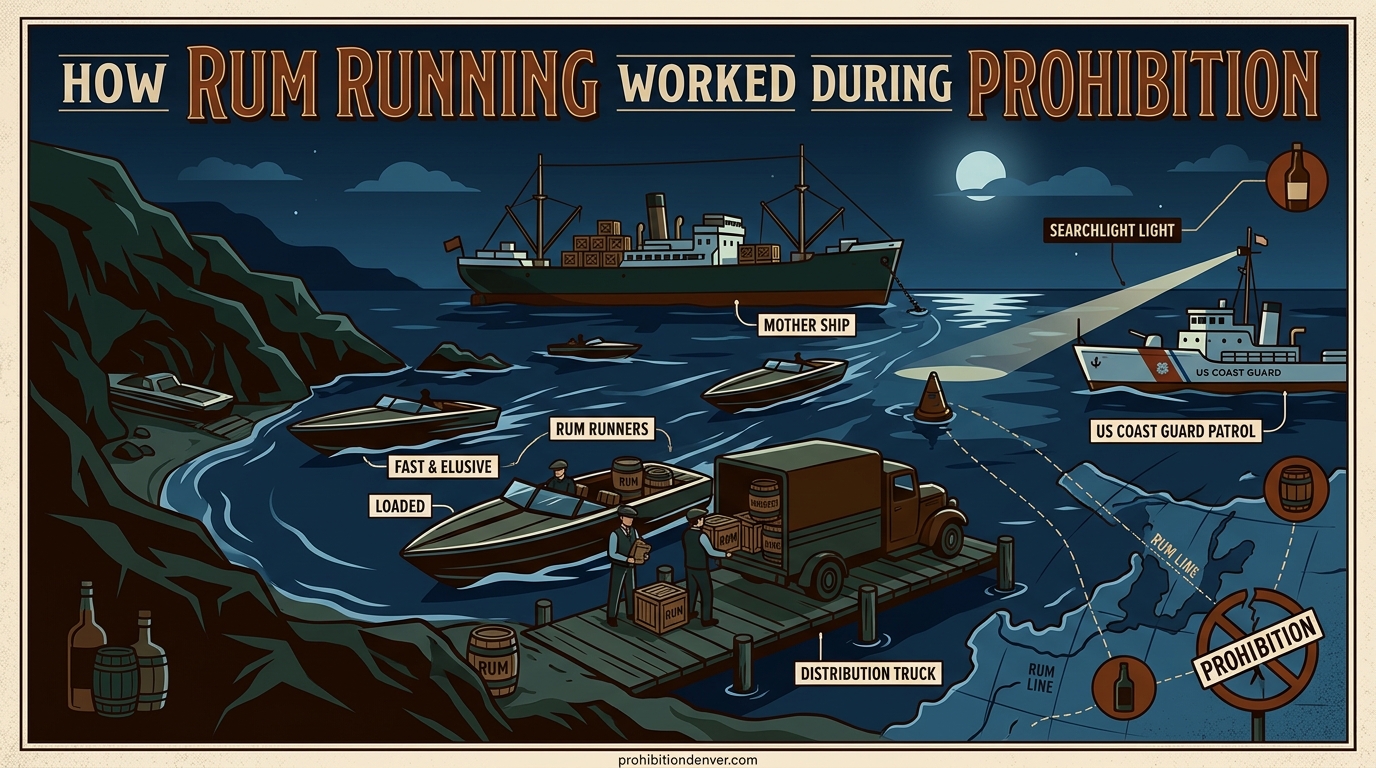
Along the Atlantic coast, the area known as “Rum Row” emerged as a crucial component of the trade. Initially located three miles offshore—the limit of American territorial waters at the time—Rum Row consisted of motherships loaded with liquor waiting to transfer their cargo to smaller “contact boats” that would complete the journey to shore. When Congress extended territorial waters to twelve miles in 1924, smugglers simply adjusted their operations accordingly, demonstrating the industry’s remarkable adaptability.
The Pacific Northwest offered alternative routes through British Columbia, where smugglers could load vessels in Canadian ports and make the relatively short run to Washington State or Oregon. This route proved particularly popular for supplying the western United States.
Land Routes
While maritime operations captured public imagination, land-based smuggling proved equally important to rum running’s success. The Canadian-American border presented obvious crossing points, with particular intensity around the Detroit River region. There, the Purple Gang controlled operations that moved staggering quantities of Canadian whiskey across the waterway.
For Denver and the Rocky Mountain region, trucking routes dominated the landscape. Unlike the coastal operations that captured headlines, inland bootlegging relied on automobiles and trucks equipped with hidden compartments. These vehicles would load alcohol in places where it remained legal—Mexico, for instance—and drive northward through Colorado’s mountain passes to distribution centers in Denver. The geography that made Colorado difficult to traverse also provided cover for bootleggers seeking to avoid detection.
Methods and Techniques of the Trade
Successful rum running required expertise in logistics, navigation, and evasion. Smugglers developed sophisticated methods that anticipated law enforcement tactics and maximized cargo capacity.
Contact Boats: The transfer of cargo from motherships to smaller vessels occurred at designated points along the coast. These “contact boats” were often fast, maneuverable craft capable of outrunning Coast Guard cutters when necessary. The coordination between vessels relied on wireless radio communication, a technological advantage that gave smugglers real-time information about patrol positions.
Hiding Compartments: Both vessels and vehicles incorporated hidden storage spaces designed to conceal cargo from inspection. False bottom compartments in trucks could hold dozens of cases of liquor beneath layers of legitimate cargo. Some ships featured clever storage solutions that required tools to access, making quick inspections nearly impossible.
Nighttime Operations: Most smuggling occurred after dark, when visibility dropped and patrol boats faced reduced effectiveness. Experienced navigators could run their vessels at high speeds through familiar waters, relying on moonlight and starlight to judge distances. The cover of darkness proved essential to the industry’s survival.
Armament: Armed encounters were considered occupational hazards in the rum running business. Many vessels carried machine guns for protection against hijackers, and firefights between rival smuggling operations occasionally erupted. The “go-through guys” who specialized in hijacking other smugglers’ cargo represented a constant threat that required careful preparation. Some operations employed former military personnel who understood both navigation and combat tactics, giving them significant advantages over less sophisticated competitors.
Speakeasies: The Destination for Smuggled Spirits
The rum running industry existed in direct service to the speakeasy—illicit establishments where alcohol was sold to patrons willing to pay premium prices for their drinks. These establishments ranged from basement bars operating with the tacit approval of local authorities to elaborate nightclubs featuring live entertainment and imported liquors. The relationship between speakeasies and rum runners was mutually dependent: without speakeasies, smuggled alcohol had nowhere to go; without rum running, speakeasies would lack the product their customers demanded.
The existence of speakeasies across America meant that rum runners always had a market. In cities like New York, Chicago, and Denver, hundreds or even thousands of speakeasies operated simultaneously, creating demand that sustained the entire smuggling infrastructure. The profits generated by this relationship transformed both industries, with some speakeasy owners becoming wealthy enough to invest in legitimate businesses once Prohibition ended.
Famous Rum Runners of the Prohibition Era
The rum running industry produced legendary figures whose stories continue to capture imagination decades later.
William “Bill” McCoy: Perhaps the most famous rum runner in American history, McCoy operated along the East Coast and became synonymous with quality liquor. Unlike many who diluted their products, McCoy maintained high standards—his slogan promised uncut, unfiltered whiskey. When authorities finally caught up with him in 1924 aboard his schooner Tomoka, the resulting trial publicity only enhanced his reputation. McCoy’s name entered common usage as an adjective; “the real McCoy” came to mean authentic, quality goods.
Roy Olmstead: In the Pacific Northwest, Roy Olmstead built one of the most sophisticated smuggling operations in the country. Beginning as a Seattle police officer before turning to bootlegging, Olmstead established a complex network involving boats, trucks, and corrupt officials. His operation reportedly moved millions of dollars worth of liquor before federal agents finally dismantled his organization in 1927.
The Purple Gang: Operating primarily out of Detroit, the Purple Gang controlled the critical Detroit River crossing that connected American demand with Canadian whiskey supplies. Originally composed of Jewish immigrants, the Gang’s ruthless efficiency and willingness to use violence made them dominant in their territory. At their peak, they reportedly supplied a substantial percentage of Detroit’s illegal alcohol.
Gertrude Lythgoe: Known as the “Queen of the Bootleggers,” Lythgoe operated out of Miami and became one of the few women to achieve prominence in the rum running industry. Her operation combined charm with business acumen, and she reportedly used her social connections to facilitate shipments arriving from the Caribbean.
The connection between rum running and organized crime figures like Al Capone deserves particular attention. While Capone himself operated primarily in Chicago, his organization relied on networks of rum runners and bootleggers to supply the speakeasies that generated his profits. The massive capital accumulated through smuggling operations funded the expansion of criminal enterprises that would influence American life for generations.
Colorado and Denver’s Bootlegging Story
While coastal operations often dominate the popular imagination, Colorado’s experience with Prohibition bootlegging offers a fascinating counterpoint that reflected the region’s unique geography and social dynamics.
Colorado had actually preceded the national ban with local prohibition laws enacted in 1916, four years before the 18th Amendment took effect. This early adoption meant that by the time national Prohibition began, Coloradoans had already developed patterns of circumventing local restrictions. When federal prohibition arrived, the infrastructure for supplying illegal alcohol was already partially in place.
Denver’s most celebrated bootlegging operation belonged to Roma, a massive illegal booze enterprise that reportedly dominated the city’s alcohol supply during the 1920s. While details of Roma’s operation remain somewhat shrouded in legend, contemporary accounts suggest an organization of considerable scale—far larger than the individual operators who populated earlier bootlegging history. The existence of such substantial operations indicates that Colorado’s demand for illicit alcohol matched or exceeded the supply infrastructure available.
Colorado’s geographic position created interesting dynamics for bootlegging operations. The state borders Mexico, where liquor remained legal, and major trucking routes passed through to supply northern markets. For Denver specifically, alcohol arrived via truck convoys that navigated mountain passes while evading law enforcement checkpoints. The same mountains that isolated Colorado communities also provided cover for smugglers willing to use secondary roads.
In 1932, Colorado made history by passing Amendment Seven, which rescinded the state’s prohibition laws ahead of national repeal. This early embrace of legalization reflected public opinion that had grown tired of both the restrictions and the criminality that accompanied them. When national Prohibition ended the following year, Colorado was already well-positioned to transition back to legal liquor sales.
Law Enforcement Challenges
The United States Coast Guard bore primary responsibility for maritime enforcement, yet the agency faced nearly impossible challenges in fulfilling its mandate. With thousands of miles of coastline to patrol and limited resources, enforcement personnel could interception only a small fraction of smuggling vessels.
The jurisdictional complications of international waters presented persistent difficulties. American law enforcement could not pursue vessels that remained in international waters, and smugglers exploited this limitation by staging transfers beyond the three-mile limit (later twelve miles). When boats did enter American waters, they often carried false registration papers or operated under cover of darkness, making identification and prosecution challenging.
Corruption within law enforcement circles compounded these difficulties. Coast Guard officers, customs officials, and local police occasionally accepted bribes to ignore smuggling operations or provide advance warning of enforcement actions. The substantial profits available in rum running made corrupt officials affordable, and the culture of omertà among smugglers made information difficult to obtain through traditional investigative means.
Despite these challenges, enforcement did achieve notable successes. The capture of Roy Olmstead’s network, for instance, demonstrated that even sophisticated operations could be penetrated given sufficient resources and time. However, each successful prosecution seemed to generate two new operations to replace those dismantled, creating a whack-a-mole dynamic that frustrated authorities.
Frequently Asked Questions
How did Prohibition lead to rum-running?
Prohibition created a massive demand for alcohol that domestic production could not satisfy. The 18th Amendment banned the sale and production of alcoholic beverages, but it did not eliminate demand. Into this void stepped rum runners, who recognized that substantial profits could be earned by importing spirits from foreign countries where alcohol remained legal. The combination of ready demand and profitable margins virtually guaranteed that smuggling operations would emerge.
What was the worst kept secret of Prohibition?
While officially a secret, the locations of many speakeasies and rum running operations were widely known to local communities. The tension between official prohibition and social reality created a kind of open secret arrangement, where authorities pretended not to know what everyone acknowledged. The scale of rum running operations made them impossible to conceal completely, and their popularity among otherwise law-abiding citizens undermined respect for the law itself.
What was rum-running and why did it happen?
Rum running was the illegal smuggling of alcoholic beverages from foreign countries into the United States during Prohibition. It happened because American demand for alcohol remained high despite the legal ban, and because substantial profits could be earned by satisfying that demand. The infrastructure of international trade provided ready supply chains for acquiring liquor abroad, and the technology of the era—fast boats, wireless communication—enabled its transport despite enforcement efforts.
Is rum-running still a thing?
While the massive industrial scale of Prohibition-era rum running has subsided, smuggling of alcohol continues in various forms around the world. Modern alcohol smuggling typically involves evading tariffs rather than outright prohibition, but the same fundamental principles of moving product across forbidden boundaries apply. In some jurisdictions with strict alcohol laws, limited smuggling operations persist.
Who were the famous Rum runners?
The most celebrated rum runners include William McCoy, whose honesty about product quality made his name legendary; Roy Olmstead, who built a sophisticated Pacific Northwest operation; the Purple Gang, who controlled the critical Detroit River crossing; and Gertrude Lythgoe, who earned the title “Queen of the Bootleggers” through her Miami-based operation. Each exemplifies different aspects of the rum running business.
Legacy of the Rum Runners
The end of national Prohibition in 1933 did not immediately eliminate smuggling operations, though it dramatically reduced their profitability. Some rum runners transitioned to other enterprises, while others continued limited operations targeting jurisdictions that maintained local prohibition. The skills, networks, and capital accumulated during the Prohibition era contributed to the rise of organized crime as a permanent feature of American life.
The cultural legacy of rum running extends beyond organized crime. The speakeasy culture that flourished during Prohibition normalized drinking in settings outside the family home, and many practices introduced during that era—cocktail culture, appreciation for quality imported spirits—persist today. The romanticization of the rum runner as a rebel challenging unjust laws reflects broader American ambivalence about government regulation.
Perhaps most significantly, Prohibition demonstrated that attempting to prohibit a widely desired substance through legal means could create consequences more troublesome than the original behavior being addressed. The lessons learned from rum running and Prohibition continue to inform debates about drug policy, regulation, and the boundaries of government authority over personal choices.
Today, as craft distilleries and wine bars proliferate across America, few consumers pause to consider the era when obtaining a glass of whiskey required navigating an underground economy of remarkable sophistication. Yet the rum runners of Prohibition left an indelible mark on American culture, business, and law—a legacy that continues to shape how the nation thinks about alcohol, regulation, and the boundaries between legal and illegal. The stories of those bold smugglers, from William McCoy to Denver’s own bootlegging pioneers, remind us that even the most determined government efforts cannot suppress a determined market.