
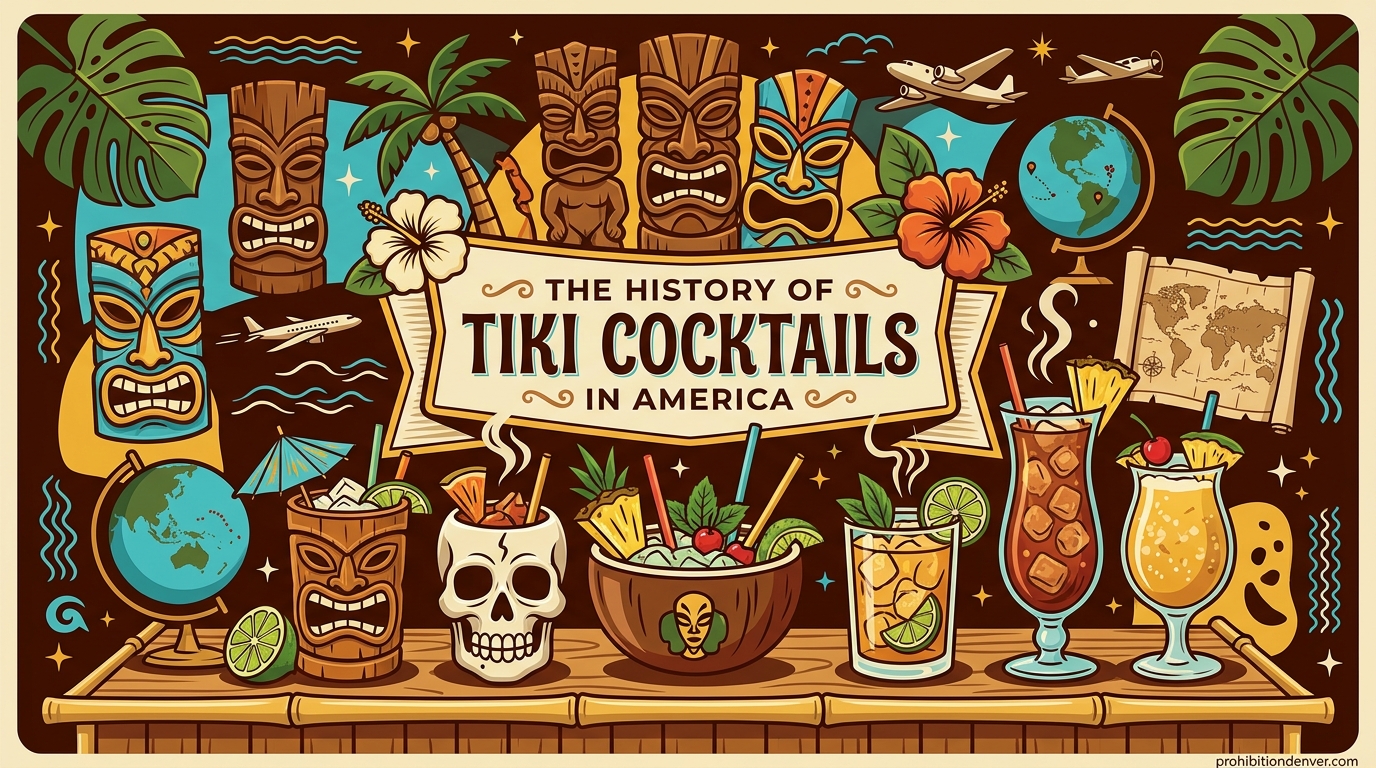
The history of tiki cocktails in America began in 1933 when Ernest Raymond Beaumont-Gantt opened Don the Beachcomber in Hollywood, California. What started as one man’s romanticized vision of Polynesia became a nationwide phenomenon that defined mid-century American drinking culture. I have spent years researching how these rum-based tropical drinks evolved from Depression-era escapism to post-war suburban obsession, then fell from grace before roaring back in the craft cocktail revival.
Tiki culture represents one of the most fascinating chapters in American bar history. It blends Caribbean rum traditions with romanticized South Pacific aesthetics, creating an entirely invented form of exoticism. The movement gave us legendary cocktails like the Mai Tai and Zombie. It also sparked ongoing debates about cultural appropriation that continue to shape how we think about themed drinking establishments today.
From Donn Beach’s original Rhum Rhapsodies to Trader Vic’s empire, from backyard luaus to modern speakeasies, tiki’s journey tells us as much about American society as it does about mixing drinks.
Table of Contents
What Does Tiki Mean?
Before diving into cocktails, we need to understand the word itself. In Polynesian mythology, particularly among the Maori people of New Zealand, Tiki refers to the first man or an ancestor spirit. Traditional tiki carvings served as religious and spiritual symbols, not decorative bar accessories.
When Americans borrowed the term in the 1930s, they stripped away these sacred meanings. They kept only the visual aesthetic – the carved wooden figures, the vaguely Pacific Island imagery, the promise of tropical escape. This disconnect between authentic Polynesian culture and American tiki pop culture sits at the heart of ongoing debates about the movement.
The word “tiki” in American usage became shorthand for an invented paradise. It represented palm trees, rum drinks, and a temporary escape from everyday life. This was fantasy, not anthropology.
Donn Beach and the Birth of Tiki (1933-1940s)
The first tiki bar in the United States opened in 1933 at 1722 North McCadden Place in Hollywood, California. Ernest Raymond Beaumont-Gantt, a young man from Texas with a knack for storytelling, had returned from traveling through the South Pacific. He brought back bamboo, thatch, and a vision.
Gantt named his establishment Don the Beachcomber. The name came from his own nickname, “Don,” combined with his self-created persona as a beach-wandering adventurer. He decorated the small bar with fishing nets, tropical artifacts, and Polynesian-inspired carvings. The atmosphere transported Depression-weary Californians to an imagined paradise.
The timing was perfect. Prohibition had just ended. Americans were eager to drink again, but they wanted something more exciting than the speakeasies of the 1920s. Gantt gave them exoticism. He served rum-based drinks with elaborate garnishes, fresh juices, and mysterious names. His cocktails were complex, layered, and deliberately opaque about their recipes.
Who invented tiki drinks? Donn Beach (as he renamed himself) created the template. His “Rhum Rhapsodies” – multi-rum blends with fresh citrus, house-made syrups, and secret spice mixes – defined what a tiki cocktail would be. The Zombie, perhaps his most famous creation, debuted in 1934. It packed such a punch that Gantt reportedly limited customers to two per visit.
Hollywood celebrities flocked to Don the Beachcomber. Bing Crosby, Howard Hughes, and Charlie Chaplin became regulars. The bar expanded from seven stools to a full restaurant. By the late 1930s, Gantt had created a template that others would copy.
World War II interrupted the party. Gantt served in the military, and his wife Sunny ran the business. She expanded aggressively, franchising the Don the Beachcomber name across the country. By the time Gantt returned, his single bar had become a chain.
Trader Vic and the Rival Who Shaped Tiki
While Donn Beach built his empire in Hollywood, another innovator was watching from Oakland. Victor Jules Bergeron opened a small bar called Hinky Dinks in 1934. After visiting Don the Beachcomber and studying its success, Bergeron transformed his establishment into Trader Vic’s in 1937.
Bergeron brought his own personality to tiki culture. Where Donn Beach cultivated mystery, Bergeron embraced showmanship. He wore an eye patch and claimed to have lost his arm to a shark (neither was true). He filled his bar with artifacts, created elaborate backstories, and developed his own cocktail menu.
The rivalry between the two men shaped tiki’s golden age. They competed for celebrity customers, for press attention, and most importantly, for cocktail supremacy. Both claimed to have invented similar drinks. Both kept their recipes secret. Both expanded into restaurant chains.
In 1944, Bergeron created his masterpiece. At Trader Vic’s in Oakland, he mixed aged Jamaican rum with lime juice, orange curacao, orgeat syrup, and simple syrup. He shook it with ice and served it over crushed ice with a sprig of mint and a lime shell. He served it to his Tahitian friends, who exclaimed “Maita’i roa a’e!” – “Out of this world!” He called it the Mai Tai.
The Mai Tai would become the most famous tiki cocktail ever created. Its success drove Trader Vic’s expansion throughout the 1950s and 1960s. Bergeron opened locations in Seattle, San Francisco, Chicago, and eventually dozens of cities worldwide. His empire would ultimately outlast Don the Beachcomber’s.
The two men never reconciled. They fought over the Mai Tai’s origin, over restaurant locations, over who was the true king of tiki. Both claimed credit. Both had valid arguments. This rivalry, however personal, pushed both to innovate and expand, spreading tiki culture across America.
The Iconic Cocktails That Defined an Era
Tiki cocktails share certain characteristics that set them apart from other drinks. They rely heavily on rum, often blending multiple styles in a single glass. They use fresh citrus juices rather than bottled mixes. They incorporate exotic syrups like orgeat (almond) and falernum (spiced lime). They are garnished elaborately, with mint, fruit, flowers, and paper umbrellas.
The Mai Tai remains the most famous. Trader Vic’s 1944 creation uses aged rum, lime, orange curacao, and orgeat. It is relatively simple by tiki standards, which helped it travel well. It became the signature drink of Hawaiian tourism in the 1950s and 1960s.
The Zombie represents Donn Beach’s style at its most extreme. Created in 1934, it originally combined three different rums, lime, pineapple, papaya, and a secret mix of spices and syrups known only as “Don’s Mix.” It was strong, complex, and mysterious. Beach claimed it could revive the dead, hence the name.
The Navy Grog connects tiki to American military history. During World War II, sailors returning from the Pacific brought stories of rum drinks. Donn Beach created the Navy Grog to honor them. It blends three rums with lime, grapefruit, and honey, topped with a signature ice cone.
The Fog Cutter, another Trader Vic creation, demonstrates tiki’s willingness to go big. It mixes rum, brandy, gin, and sherry with lemon and orange juices. It is not subtle. Neither is the Scorpion Bowl, a communal drink served in a ceramic vessel with multiple straws, designed for sharing.
These cocktails share a philosophy. They are stronger than they taste. They hide their potency behind fruit and sweetness. They create an experience, not just a drink. This was Donn Beach’s insight, and it remains the foundation of tiki mixology.
Tiki Goes Mainstream: The Post-War Explosion
The 1950s and 1960s were tiki’s golden age. What started as Hollywood novelty became suburban mainstream. Several forces drove this expansion, and Hawaiian statehood in 1959 was perhaps the most significant.
When Hawaii became the 50th state, American interest in the islands surged. Airlines added routes. Hotels opened. Tourism became accessible to middle-class families. Tiki bars capitalized on this fascination, offering a taste of “paradise” without the plane ticket.
Suburban luaus became popular. Americans built backyard tiki bars, threw Hawaiian-themed parties, and served rum punch in tiki mugs. Tiki torches lit patios across the country. The aesthetic permeated home decor, with rattan furniture, bamboo accents, and Polynesian-inspired art.
Commercialization accelerated. Restaurants like the Luau in Beverly Hills and the Kahiki in Columbus, Ohio, expanded the concept beyond the coasts. Hotel chains added tiki bars. Apartment complexes built pools with thatched-roof bars. Tiki became a mass-market phenomenon.
Hollywood embraced the aesthetic. Elvis Presley starred in “Blue Hawaii.” Movies and television shows set in tropical locations proliferated. The Rat Pack visited tiki bars. The culture of Polynesian Pop – Americanized, romanticized South Pacific imagery – dominated entertainment.
By the mid-1960s, tiki was everywhere. It had moved from sophisticated Hollywood escape to suburban party theme. This democratization brought both popularity and dilution. The complex cocktails of Donn Beach and Trader Vic were simplified for mass production. Tiki became synonymous with sweet, weak “umbrella drinks.”
The Decline: Hippies, Disco, and Changing Tastes
Why did tiki decline? The movement faded as American culture shifted in the late 1960s and 1970s. Several factors contributed to its fall from fashion.
The hippie movement rejected tiki’s artificial exoticism. Young Americans sought authentic travel experiences, not manufactured fantasies. They backpacked through actual Asia and the Pacific, returning with disdain for the sanitized version served in suburban bars. Authenticity became valued over escapism.
The Vietnam War also affected tiki’s image. Military involvement in Southeast Asia made Asian imagery politically charged. The lighthearted tropical aesthetic felt increasingly tone-deaf as Americans watched war footage from the region on the evening news.
Disco arrived in the 1970s with its own aesthetic and cocktail culture. Vodka replaced rum as the spirit of choice. Simple mixed drinks replaced elaborate tiki constructions. The energy of disco clubs clashed with the laid-back, escapist vibe of tiki bars.
By the 1980s, tiki had become a punchline. The drinks were seen as tacky, too sweet, and unsophisticated. Original locations closed. Trader Vic’s filed for bankruptcy in the 1980s. Don the Beachcomber locations shuttered. The original Don the Beachcomber in Hollywood closed in 1985, though the name would eventually be revived.
The aesthetic survived only in kitsch. Tiki mugs became collectible novelties. The occasional “retro” bar might include a tiki drink on the menu. But as a living cocktail tradition, tiki was largely dormant by 1990.
The Modern Revival: Craft Tiki Returns
Tiki’s revival began quietly in the 1990s and exploded in the 2000s. Two figures deserve particular credit for this resurrection: Jeff “Beachbum” Berry and Martin Cate.
Berry approached tiki as an archaeologist. Starting in the 1990s, he tracked down original recipes, interviewed bartenders who had worked at the golden-age bars, and researched the techniques of Donn Beach and Trader Vic. His books, beginning with “Beachbum Berry’s Grog Log” in 2026, gave home bartenders access to authentic recipes for the first time.
Berry’s research revealed how badly tiki had been degraded. The recipes he found were complex, balanced, and sophisticated – nothing like the syrupy concoctions of the 1970s tiki bars. His work inspired a new generation to take tiki seriously as a craft.
Martin Cate opened Smuggler’s Cove in San Francisco in 2009. The bar represented a new model: tiki as craft cocktail movement. Cate stocked hundreds of rums, made fresh juices daily, and researched historical accuracy. He treated tiki with the same seriousness that other bartenders applied to pre-Prohibition classics.
Smuggler’s Cove proved that tiki could be cool again. Lines formed outside the small bar. Imitators opened in cities across America. Three Dots and a Dash in Chicago, Latitude 29 in New Orleans, and countless others expanded the revival.
This new generation approaches tiki differently than the 1950s suburbanites or the 1970s disco crowd. They value authenticity of technique, if not necessarily of cultural representation. They blend multiple rums with precision. They make syrups from scratch. They study the original masters while creating their own innovations.
Cultural Context: Appreciation or Appropriation?
Are tiki bars offensive? This question has become increasingly important as the revival has matured. The answer is complicated, and the tiki community itself is grappling with it.
Tiki’s origins lie in cultural appropriation. Donn Beach and Victor Bergeron took sacred Polynesian imagery and transformed it into commercial entertainment. They blended diverse Pacific cultures into a generic “tropical” aesthetic. They created an fantasy that bore little resemblance to any actual place or people.
This occurred in an era when such appropriation was standard American practice. Mid-century America borrowed from countless cultures without acknowledgment or respect. Tiki was one example among many, from Western movies to Asian-inspired decor.
Today’s revival bars face this history directly. Many have removed or modified culturally sensitive elements. Others focus on the cocktail craft while acknowledging the problematic origins of the aesthetic. Some Polynesian Americans have embraced tiki as harmless fun; others find it offensive.
The modern tiki community generally emphasizes escapism and craft over cultural mimicry. Bars like Smuggler’s Cove focus on the drinks, not the costumes. Many have stopped using certain imagery or terminology. The conversation continues, and the culture evolves.
Whether tiki can be separated from its origins remains debated. What is clear is that today’s practitioners are more thoughtful than their predecessors. They engage with the criticism rather than ignoring it.
Frequently Asked Questions
When were tiki cocktails invented?
Tiki cocktails were invented in 1933 when Ernest Raymond Beaumont-Gantt opened Don the Beachcomber in Hollywood, California. The first tiki cocktail was likely the Rhum Rhapsody, Donn Beach’s signature style of complex rum blends with fresh juices and exotic syrups. The Zombie followed in 1934.
What was the first tiki bar in the US?
The first tiki bar in the United States was Don the Beachcomber, opened in 1933 at 1722 North McCadden Place in Hollywood, California. Ernest Gantt, who later changed his name to Donn Beach, created the template that would define tiki culture for decades.
Who invented tiki drinks?
Tiki drinks were invented by Donn Beach (Ernest Gantt) at Don the Beachcomber in 1933-1934. Victor Bergeron of Trader Vic’s expanded and popularized the genre, creating the famous Mai Tai in 1944. Both men contributed essential elements to what became tiki cocktail culture.
What were tikis originally made for?
In Polynesian mythology, particularly among the Maori people, tiki figures were sacred carvings representing ancestors or the first man. They served religious and spiritual purposes, not decorative ones. American tiki culture appropriated only the visual aesthetic in the 1930s, stripping away the sacred meaning.
Are tiki bars offensive?
This question has no simple answer. Tiki culture originated through cultural appropriation of Polynesian imagery in the 1930s. Modern revival bars generally acknowledge this history and many have modified their approach. Some find the aesthetic harmless fun; others view it as disrespectful. The modern tiki community increasingly focuses on craft cocktails rather than cultural mimicry, engaging thoughtfully with criticism rather than ignoring it.
Conclusion
The history of tiki cocktails in America spans nearly a century, from Donn Beach’s Hollywood escape room in 1933 to today’s craft cocktail revival. It is a story of innovation and appropriation, of golden ages and dark decades, of rediscovery and reinvention.
Tiki gave us the Mai Tai and the Zombie. It created an aesthetic that defined mid-century American leisure. It faded, then returned, transformed by a new generation that values the craft while wrestling with the culture’s complicated origins.
Today, you can find authentic tiki drinks in cities across America. The best bars honor the complexity that Donn Beach and Trader Vic pioneered while building something new. Whether you see tiki as guilty pleasure or serious craft, its history remains one of America’s most fascinating cocktail stories.