
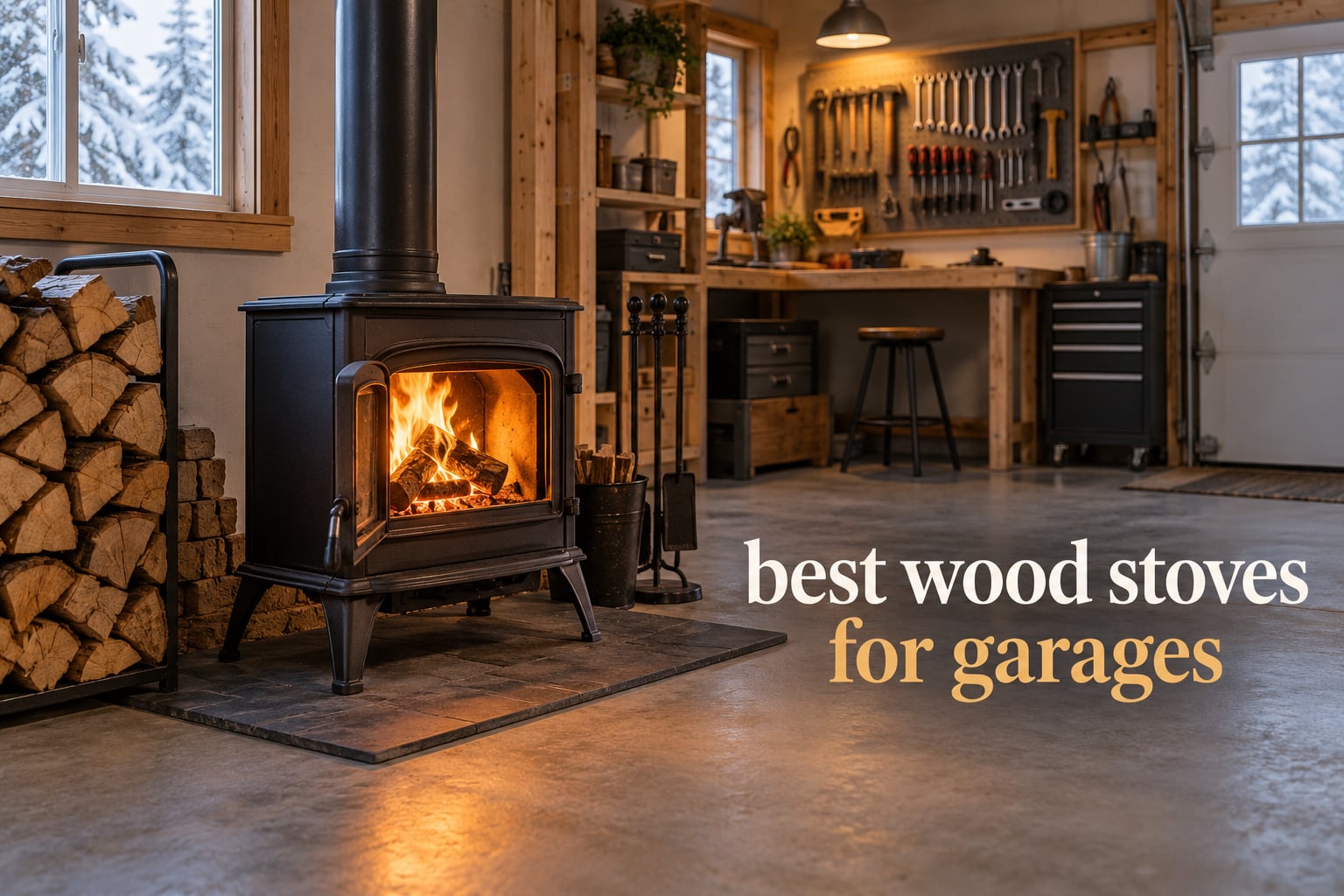
Short answer on the legal question, because it decides everything else: usually you cannot put a wood burning stove in a garage. NFPA 211 sections 13.2.3 and 13.2.4 prohibit solid fuel-burning appliances in any garage and anywhere gasoline or flammable vapors may be present, and most local building codes adopt that rule by reference. It becomes workable when the building is a shop that never stores a motor vehicle, or when the appliance is sealed inside its own room. A Michigan state inspector and a Hearth.com moderator both confirmed enforcement in their areas.
That rule pushes most buyers toward detached shops and pole barns, and the stoves below are freestanding and insert units built for that kind of space. We compared all 11 products in this roundup, 10 freestanding and 1 insert, on heat output, firebox capacity, fuel handling and the reviews owners actually wrote.
Table of Contents
Our Top 6 Wood Stoves for Garages Right Now
US Stove Company Cast Iron 900 Sq Ft – 54,000 BTU/hr for up to 900 sq ft. The most reviewed stove in this group by a wide margin and our pick for a small shop.
Cleveland Iron Works Single Burn Rate Stove – 27,000 BTU/hr, up to 900 sq ft. At 77 pounds it moves into place without a dolly.
Ashley Hearth AW2020-P – 89,000 BTU/hr, up to 2,000 sq ft. Its 1.6 cubic foot firebox eats 21 inch logs and buys you long burn times.
Ashley Hearth AW2520E-P – 112,800 BTU/hr, up to 2,500 sq ft. Runs without electricity, which matters when the shop loses power.
US Stove Company SR57E Rancher – 1,000 sq ft, coal and wood. Four lift-out cook lids turn it into a range as well as a heater.
Canyon Lodge Medium Wood Stove – up to 2,500 sq ft with 372 pounds of cast mass that stays hot long after the fire dies.
For the flue work these stoves need, our guide to chimney liners for wood stoves covers the pipe types and the thimble details.
Top 3 Wood Stoves for Garages

US Stove Cast Iron 900 Sq Ft
- 54000 BTU/hr for up to 900 sq ft
- Logs up to 19 inches
- 130 lb cast iron

Cleveland Iron Works 900 Sq Ft
- 27000 BTU/hr for up to 900 sq ft
- 77 lb cast iron
- EPA Listed and 6 in flue

Ashley AW2020-P 2000 Sq Ft
- 89000 BTU/hr for up to 2000 sq ft
- 1.6 cu ft firebox
- Logs up to 21 inches
All 11 Wood Stoves for Garages Side by Side in 2026
| Product | Specifications | Action |
|---|---|---|
| US Stove Cast Iron 900 Sq Ft |
|
Check Latest Price |
| Cleveland Iron Works 900 Sq Ft |
|
Check Latest Price |
| Ashley AW2020-P 2000 Sq Ft |
|
Check Latest Price |
 Ashley AW2520E-P 2500 Sq Ft Ashley AW2520E-P 2500 Sq Ft |
|
Check Latest Price |
 US Stove SR57E Rancher US Stove SR57E Rancher |
|
Check Latest Price |
 Canyon Lodge Medium Stove Canyon Lodge Medium Stove |
|
Check Latest Price |
 US Stove US1800E Insert US Stove US1800E Insert |
|
Check Latest Price |
 Ashley AW1120E-P 1200 Sq Ft Ashley AW1120E-P 1200 Sq Ft |
|
Check Latest Price |
 Cast Iron Stove with Oven Cast Iron Stove with Oven |
|
Check Latest Price |
 US Stove US1261E 900 Sq Ft US Stove US1261E 900 Sq Ft |
|
Check Latest Price |
 Comfort Glow CGWS2500 Comfort Glow CGWS2500 |
|
Check Latest Price |
1. US Stove Company Cast Iron Wood Stove – Best Overall for a Small Shop
US Stove Company Cast Iron Wood Stove with Cool Touch Safety Handle, Heats up to 54,000 BTUs
54,000 BTU/hr
Up to 900 sq ft
130 lb cast iron
Logs up to 19 inch
Pros
- Holds a 1700 sq ft garage at 55-64F in single-digit weather
- Cast iron stores heat after the wood is gone
- Thick top doubles as a cooking surface
- Prompt manufacturer customer service
Cons
- Front door vent is fixed
- not adjustable
- Cast hinges do not seal perfectly so the gasket needs replacing
- 130 pounds is awkward to maneuver
This is the stove I would put in a one-car shop before anything else. It runs 54,000 BTU/hr, covers up to 900 sq ft and the 130 pound cast iron body keeps radiating after the fire is out, which is exactly what a shop that gets used in bursts needs.
The single most useful owner report I read came from someone holding a 1,700 sq ft garage between 55 and 64 F in single-digit outdoor temperatures. The thick cast top also doubles as a cooking surface, so it earns its floor space twice.
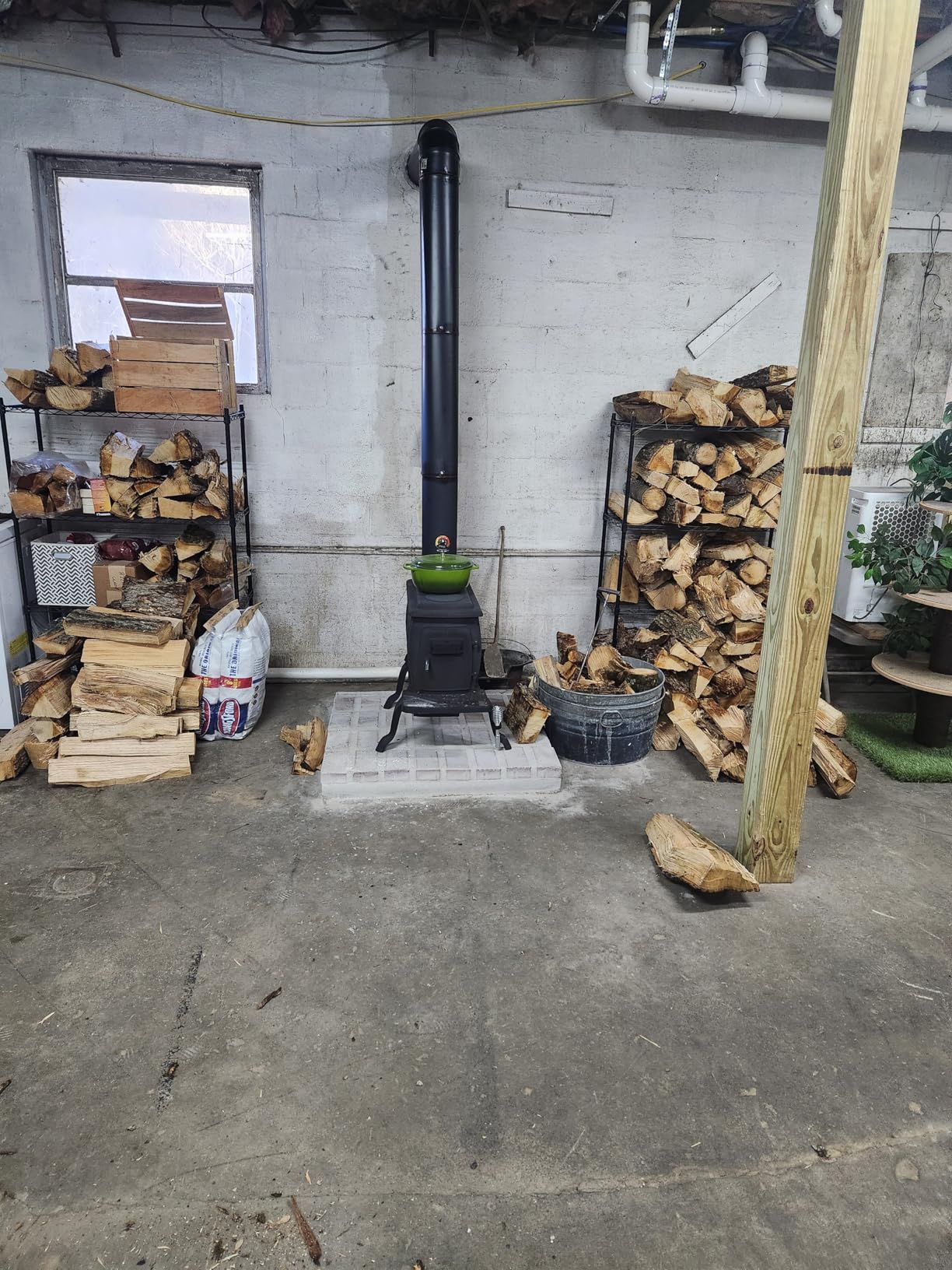
Build quality is straightforward cast iron with a two-piece safety handle that stays cool to touch while burning, and the door seals tightly once the burner is dialed in. The firebox takes logs up to 19 inches, which is longer than most stoves at this output.
Two things to plan around. The manufacturer states a single-rate burn design that is not intended to be used with a damper, so you control output by how much wood you load rather than by throttling air. It also needs a burn-off of factory protective oils before first use, so do that outdoors on a weekend.
Who the US Stove cast iron stove suits
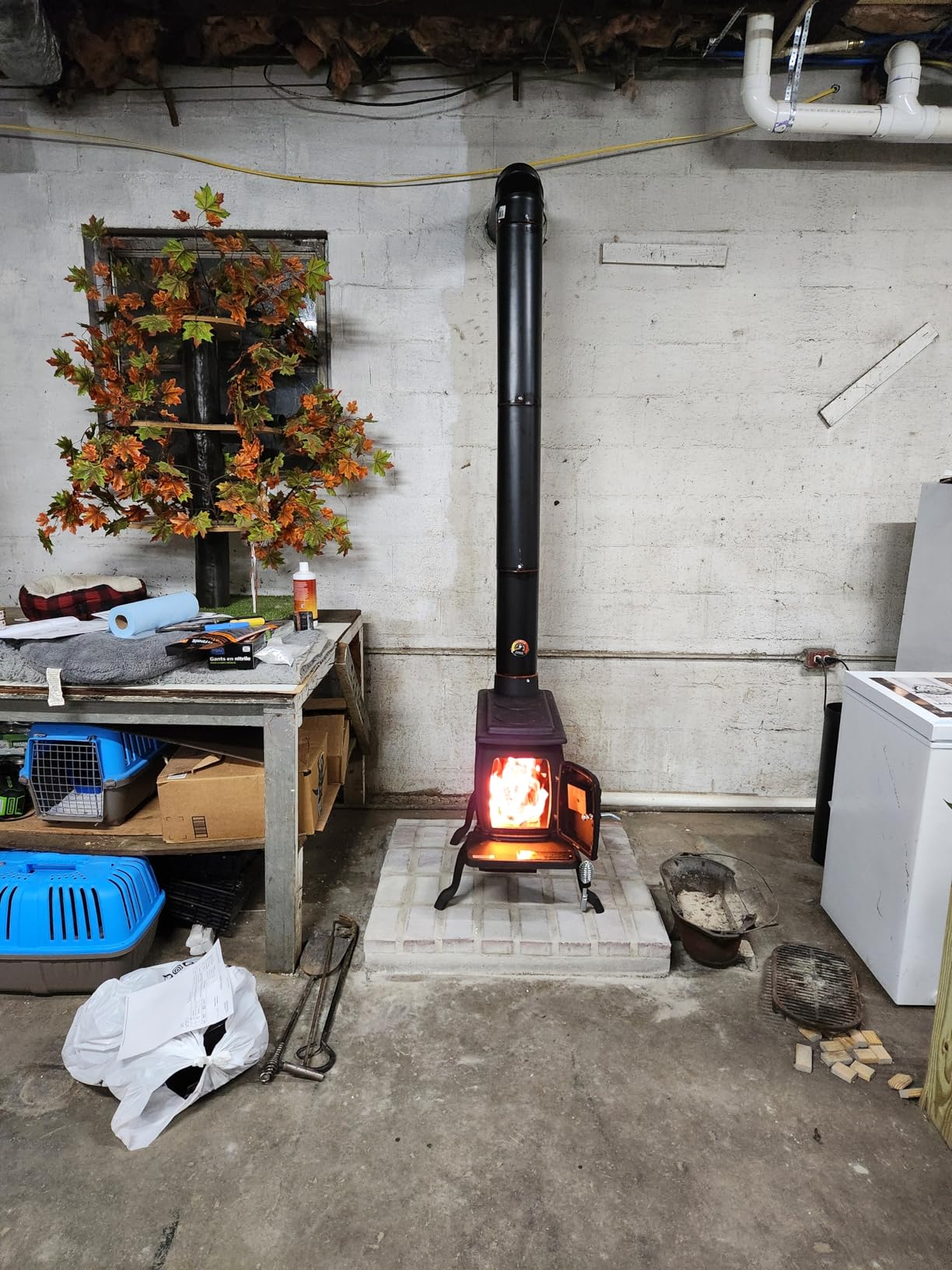
It suits a small shop heated intermittently where you want heat now rather than heat in an hour. Owners of larger spaces pair it with a heat powered stove fan to move the air across the room, and that pairing is worth budgeting for.
Where it falls short
The front vent is wide open with no adjustment, so burn control is coarse. Cast hinges never seal perfectly, the door latch is not robust, and the gasket is a consumable you should budget for every season or two.
2. Cleveland Iron Works Single Burn Rate Stove – Best Value and Lightest to Move
Cleveland Iron Works Single Burn Rate Stove
27,000 BTU/hr
Up to 900 sq ft
77 lb cast iron
EPA Listed
Pros
- Only 77 pounds so it moves without a dolly
- Ceramic rope gasket seals the door airtight
- EPA Listed and approved for compliant installs
- Cool-touch two-piece safety handle
Cons
- Single burn rate gives one combustion setting
- 27000 BTU is modest against the other cast iron units
- 6 inch flue connector sold separately
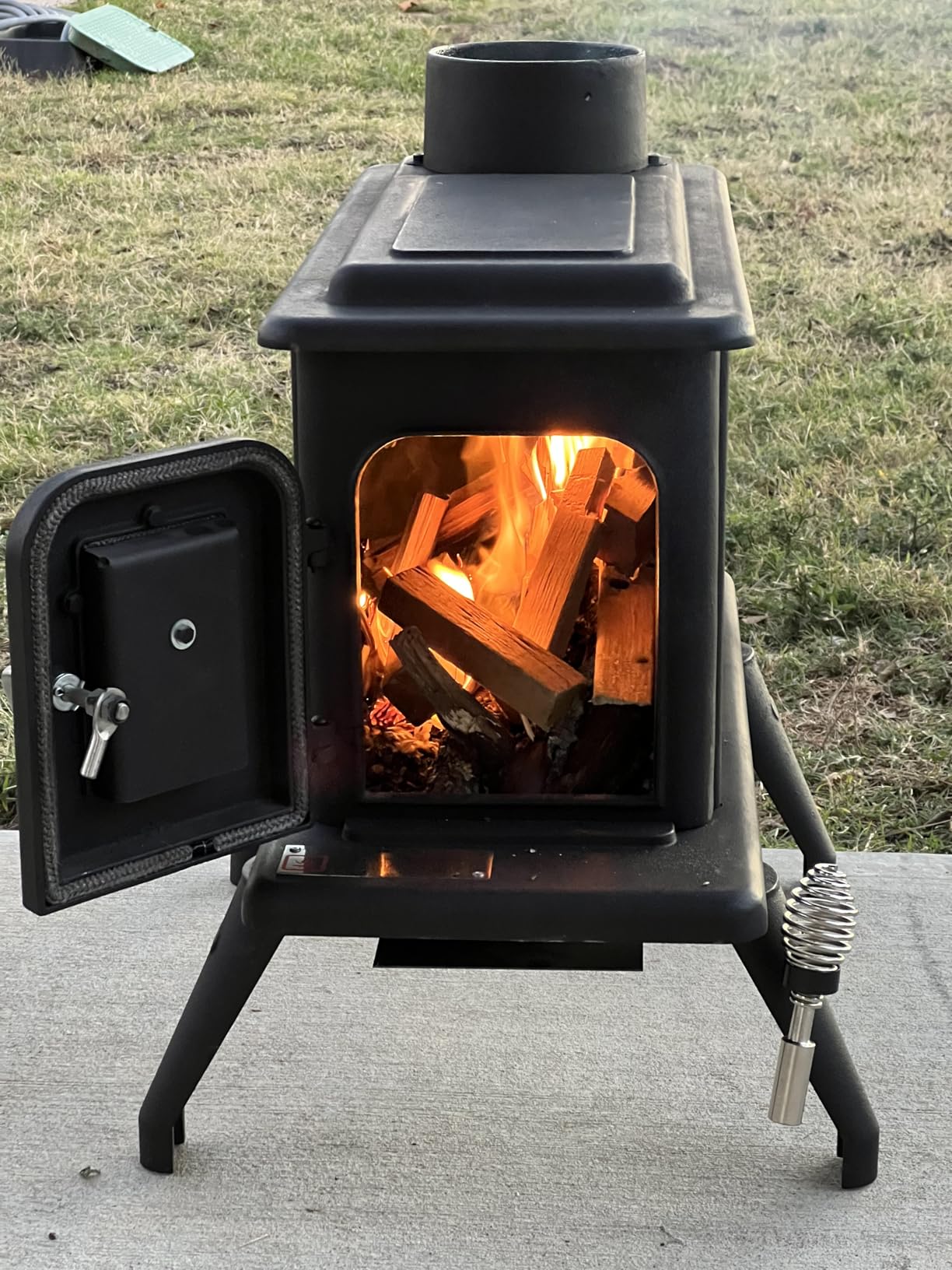
At 77 pounds this is a fraction of the heft of the pedestal stoves in this group, and in a garage where you may be moving the unit to free floor space that matters as much as raw output. It assembles quickly and carries a ceramic rope gasket on the cast iron door for an airtight seal.
It is also explicitly EPA Listed and approved, which is the single most useful thing you can have on the label in a building where a vehicle is stored.
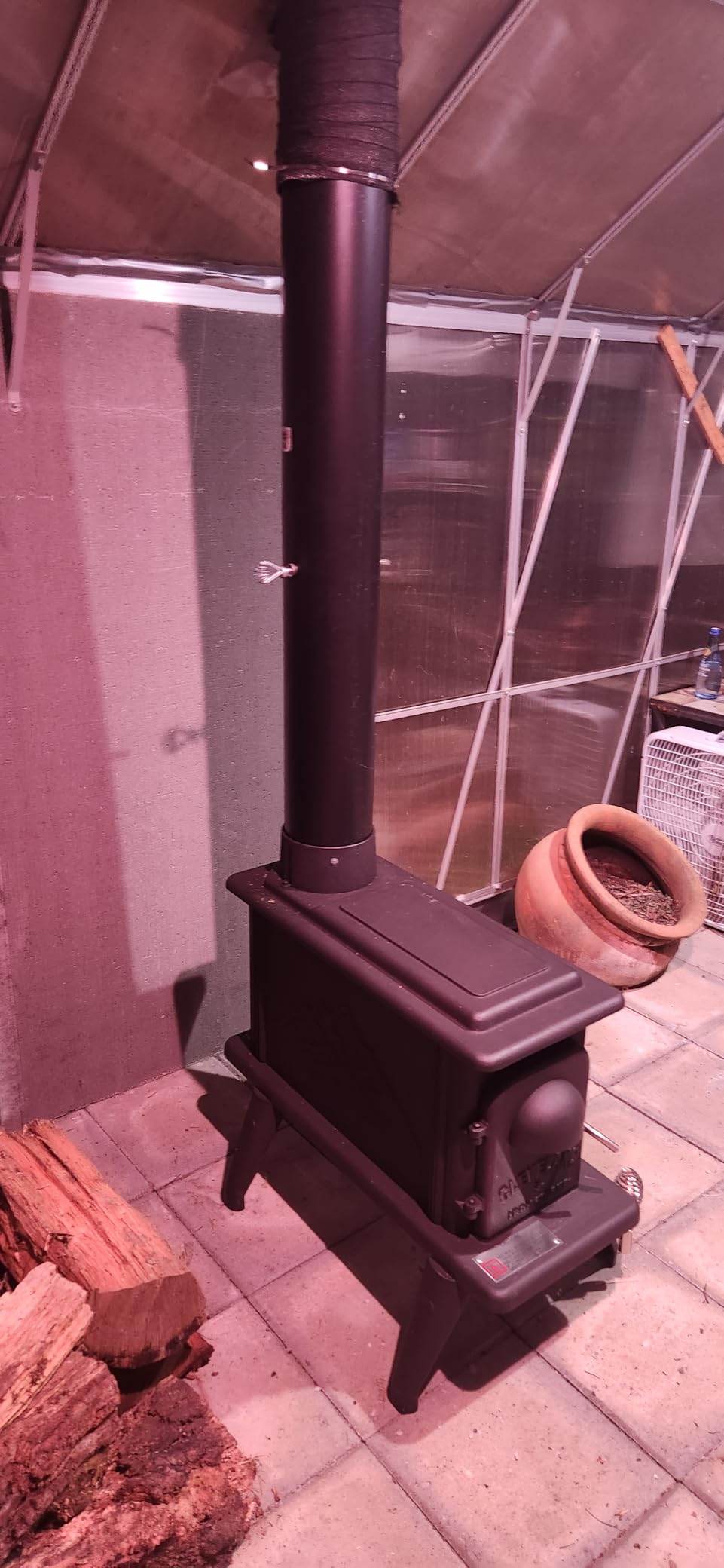
The firebox holds 18 inch firelogs and the 900 sq ft rating covers a small single-car bay comfortably. The flue is a 6 inch exhaust, so match the connector pipe to that diameter and nothing else.
Do not expect the stove to modulate. A single burn rate design gives you one combustion setting, so you manage heat by choosing how much wood goes in and how often. Owners also note the 27,000 BTU/hr output is the lowest of any stove in this roundup.
Who the Cleveland Iron Works stove suits
It suits a small garage, a mudroom or a small shop where you want a code-listed wood stove you can carry in by yourself. If the space is tight, the low weight is the deciding factor.
Where it falls short
The single burn rate rules out throttled overnight burning, which is the exact habit that produces creosote. Plan on a full load and a morning reload instead of stretching one fire across the night.
3. Ashley Hearth AW2020-P – Best for Shops Around 2,000 Sq Ft
Ashley Hearth AW2020-P 2,000 sqft Wood Stove with Legs and Pedestal
89,000 BTU/hr
Up to 2,000 sq ft
1.6 cu ft firebox
Logs up to 21 inch
Pros
- 1.6 cubic foot firebox takes full-length 21 inch logs
- Ash pan and air wash simplify upkeep
- Pedestal base and brushed nickel handle look finished
- Good fit for medium-large workshops
Cons
- Around 280-291 pounds so plan a two-person install
- Needs the optional blower for even heat in an open space
- Crated unit needs a dolly to move it
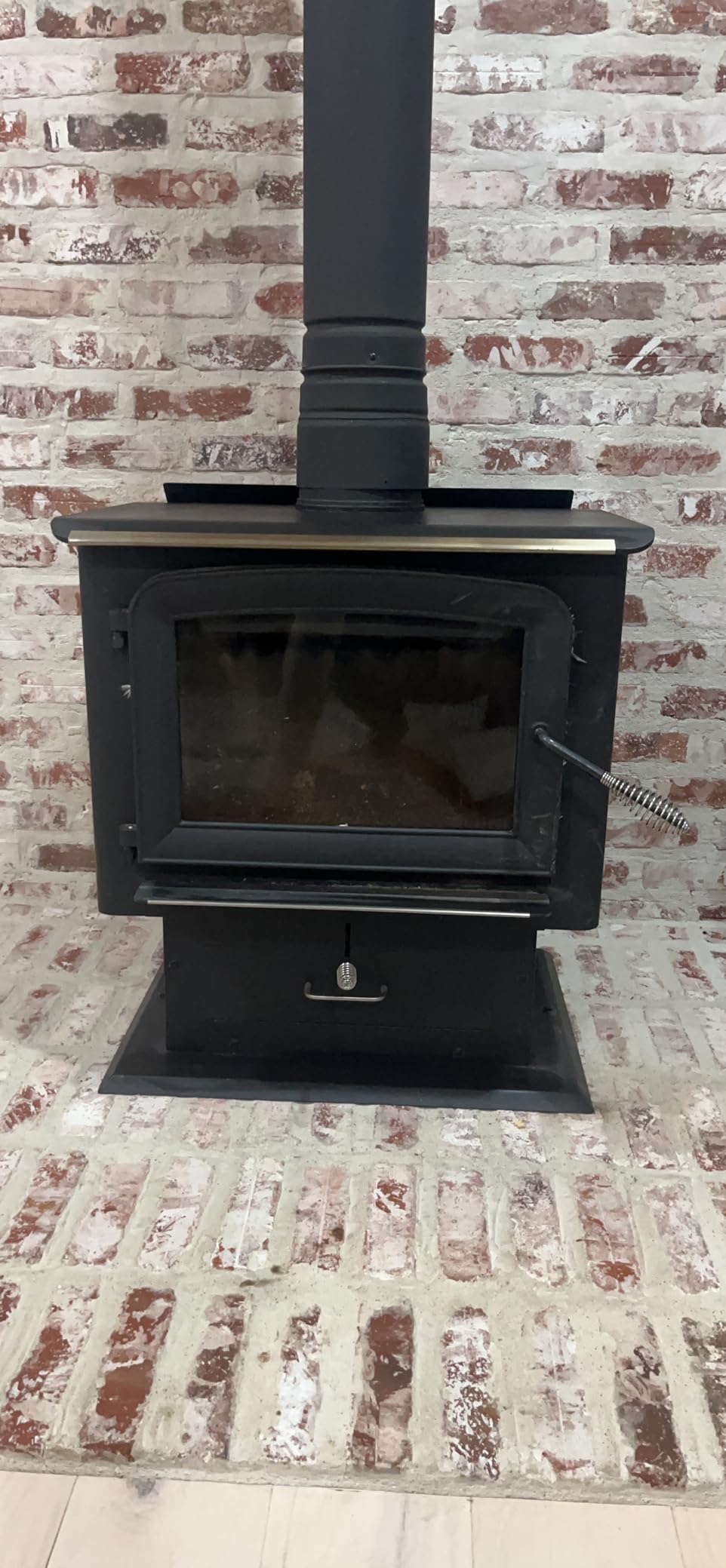
The headline here is firebox capacity. A 1.6 cubic foot box that accepts 21 inch logs means fewer refuel cycles than the smaller pedestal model, and in a shop that is the difference between an evening stove and an overnight stove.
Output is 89,000 BTU/hr across a stated 2,000 sq ft, and the brick-lined interior with air wash keeps the door glass clear through long burn cycles.
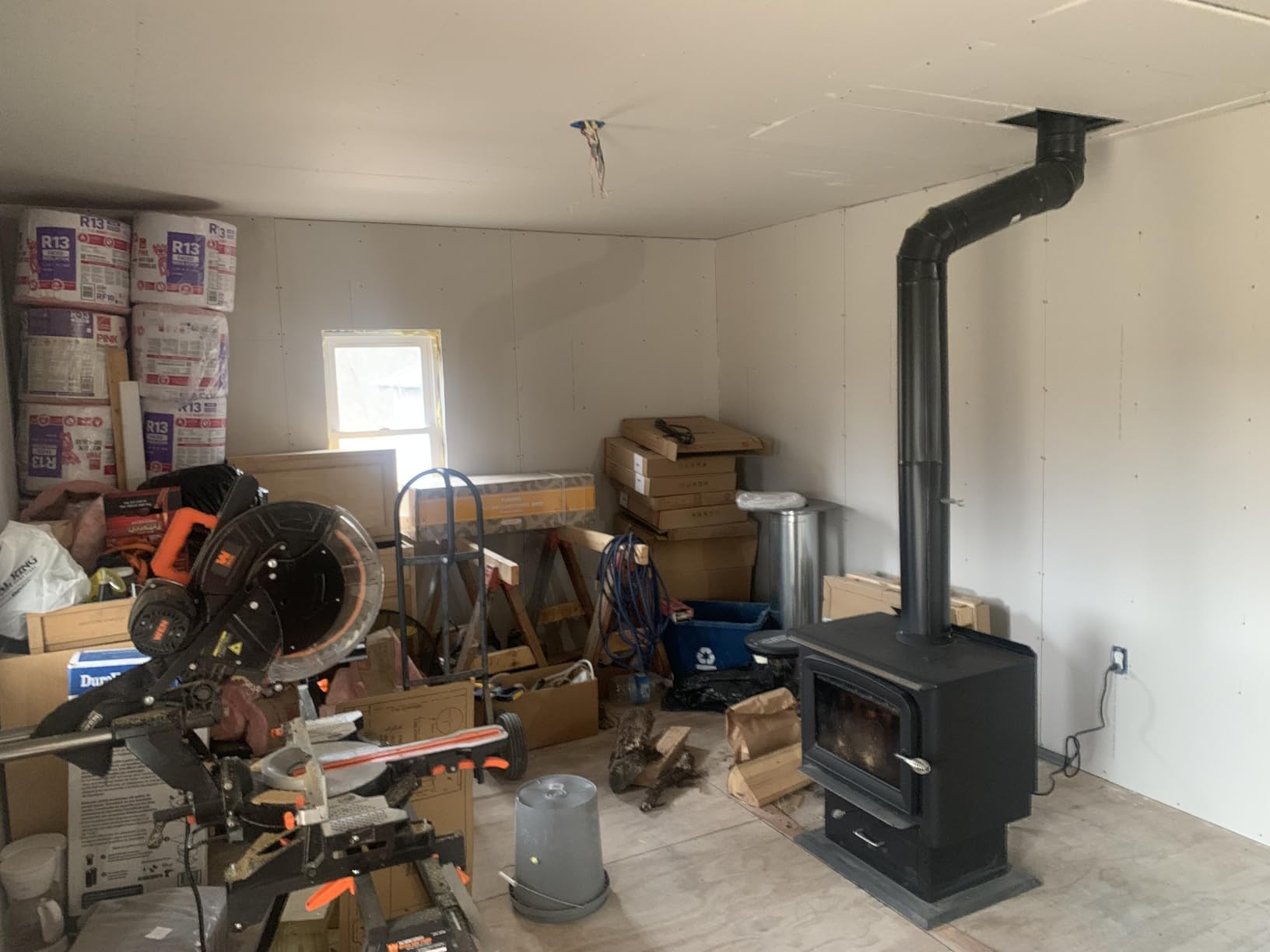
The ash pan is sized for the volume of fuel this thing consumes, which is a real consideration in a 2,000 sq ft space. Pedestal base legs give you a finished look that fits a workshop rather than a camp.
Weight is the honest drawback. At roughly 280 to 291 pounds you want a dolly and a second person to get it off the truck and into position. Without the optional blower the heat stays concentrated near the firebox, which is fine close up and less fine across an open floor.
Who the AW2020-P suits
It suits a 1,500 to 2,000 sq ft shop with normal ceiling height where you want overnight burn length. Add the blower kit and it moves air properly through the space.
Where it falls short
It is not the right pick for a small garage, where 89,000 BTU/hr would just sit there. It is also not the pick for anyone who cannot arrange help getting a near 300 pound stove into the building.
4. Ashley Hearth AW2520E-P – Best for Large Shops and Power Outages
Ashley Hearth AW2520E-P 2,500 sq ft Wood Stove with Legs and Pedestal
112,800 BTU/hr
Up to 2,500 sq ft
2.7 cu ft firebox
Runs without electricity
Pros
- 2.7 cubic foot firebox takes 21 inch logs
- Catalyst-free secondary combustion cuts wood use
- No electricity needed so outages do not stop heat
- Includes both adjustable legs and a pedestal
Cons
- Flat top vents smoke into the room when the door opens hot
- Ash cleanout hole does not line up with the ash pan
- Prone to backdraft in some installations
At 112,800 BTU/hr with a 2.7 cubic foot firebox, this is the largest firebox in the roundup and most likely to hold a big shop through a night without anyone choking the air down. Multi-season owners report it holding 72 to 74 F in a roughly 900 sq ft heated floor while the outside sat at 15 to 20 F.
The secondary combustion system is catalyst-free, so there is no catalyst to clog or replace, and the stove needs no electricity to run. That last point matters in a shop on a winter outage.
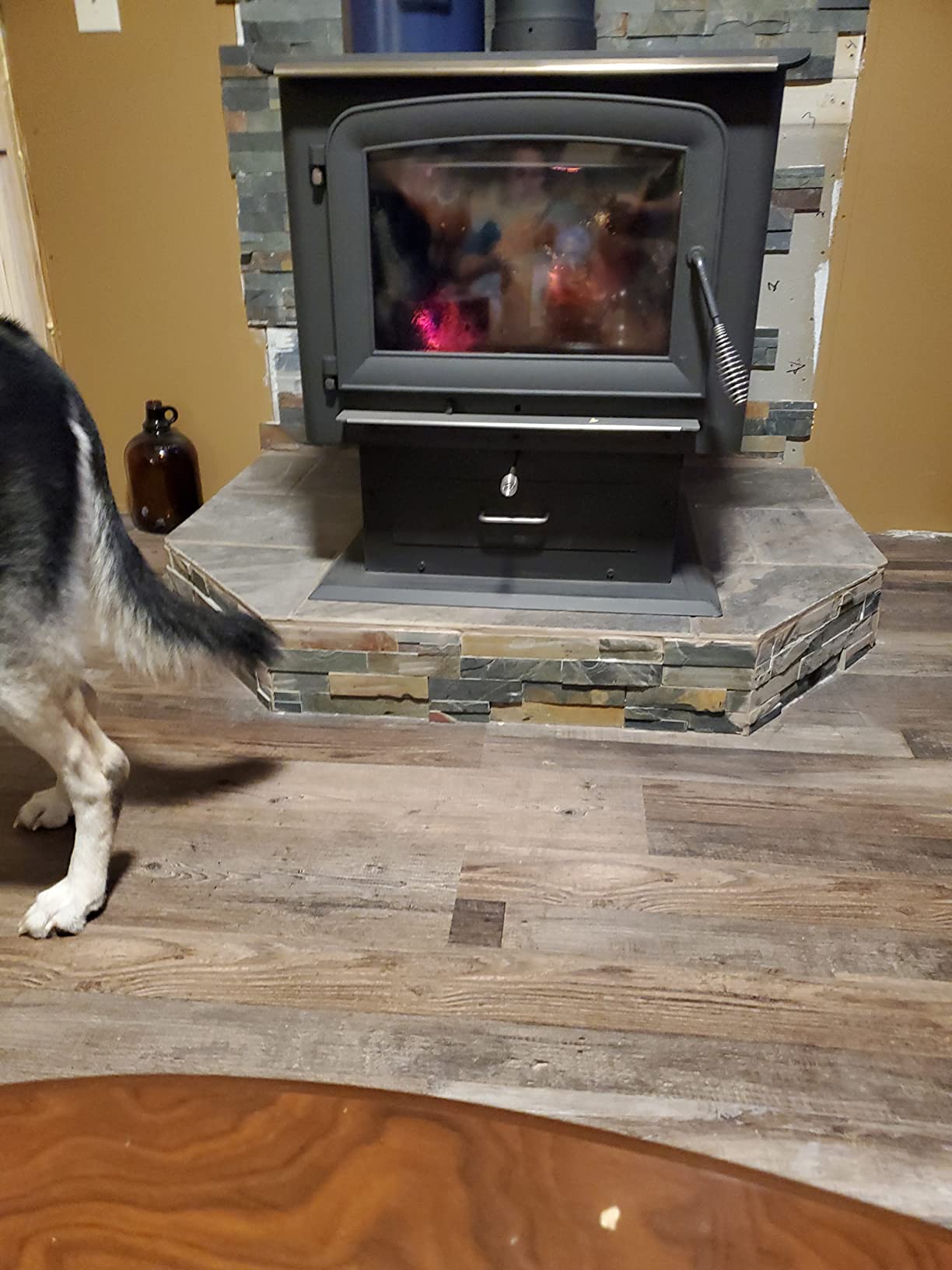
You get both adjustable legs and a pedestal base in the package, so you can set the height you want. The removable ash pan has a built-in ash port, and the interior is firebrick lined behind an air-washed ceramic glass door in a heavy cast iron frame.
Two flaws come up repeatedly in reviews. The flat top can spill smoke into the room when you crack the door while the stove is burning hard, and the ash cleanout hole does not line up with the ash pan, so ashes land on the floor. Several owners also report backdraft in some installations and had to add an outside air kit or a taller chimney.
Who the AW2520E-P suits
It suits 1,600 to 2,500 sq ft shops, garages and pole barns, especially where power is unreliable. It uses a standard 6 inch chimney connector and is mobile home approved with the 4FAK fresh air kit.
Where it falls short
At 291 pounds it is not a one-person install. And if you fire it at full tilt with the door open you will find smoke in the shop, which is the fastest way to lose friends who work in there.
5. US Stove Company SR57E Rancher – Best for Burning Coal and Wood
US Stove Company SR57E Rancher Cast Iron Stove
Up to 1,000 sq ft
160 lb cast iron
Burns coal or wood
Round 6 inch stove pipe
Pros
- Heats fast and runs very hot once loaded
- Four lift-out cook lids make it a working range
- Shaker grate and large ash pan simplify fuel handling
- Compact 6 inch pipe requirement suits tight layouts
Cons
- Does not accept oval stove pipe connections
- A barometric draft regulator is needed but not included
- Steep learning curve for first-time coal burners
This one is coal-first rather than wood-first, and that is exactly why it is worth a look if you have a coal pile or want one. It heats about 1,000 sq ft and experienced owners rate it well for output per dollar spent.
Four 8 inch lift-out cook lids across the top make it usable as a cooking range, not just a heater. The cast iron shaker grate and large ash pan keep fuel and ash handling simple.
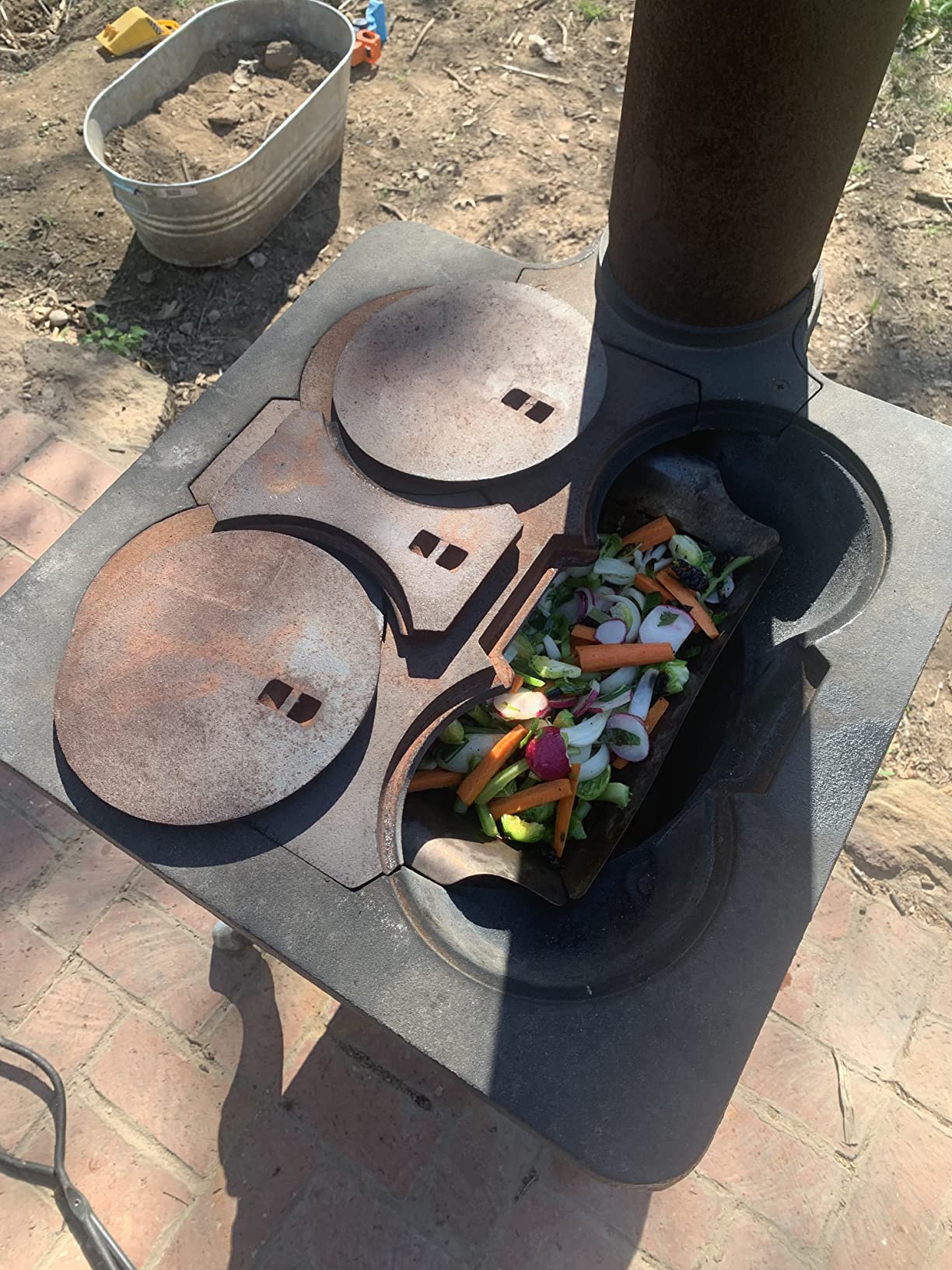
It runs standard round 6 inch stove pipe, which is the easiest connector to source and a good fit for tight garage layouts. The body is cast iron at 160 pounds with a one year limited warranty, shorter than some of the stoves here.
Setup is where most complaints land. It will not accept oval stove pipe connections, and a barometric draft regulator is strongly recommended in practice but not included in the box. If you have never burned coal expect a genuine learning curve, and the finish can arrive with surface rust that needs high-temperature paint before first fire.
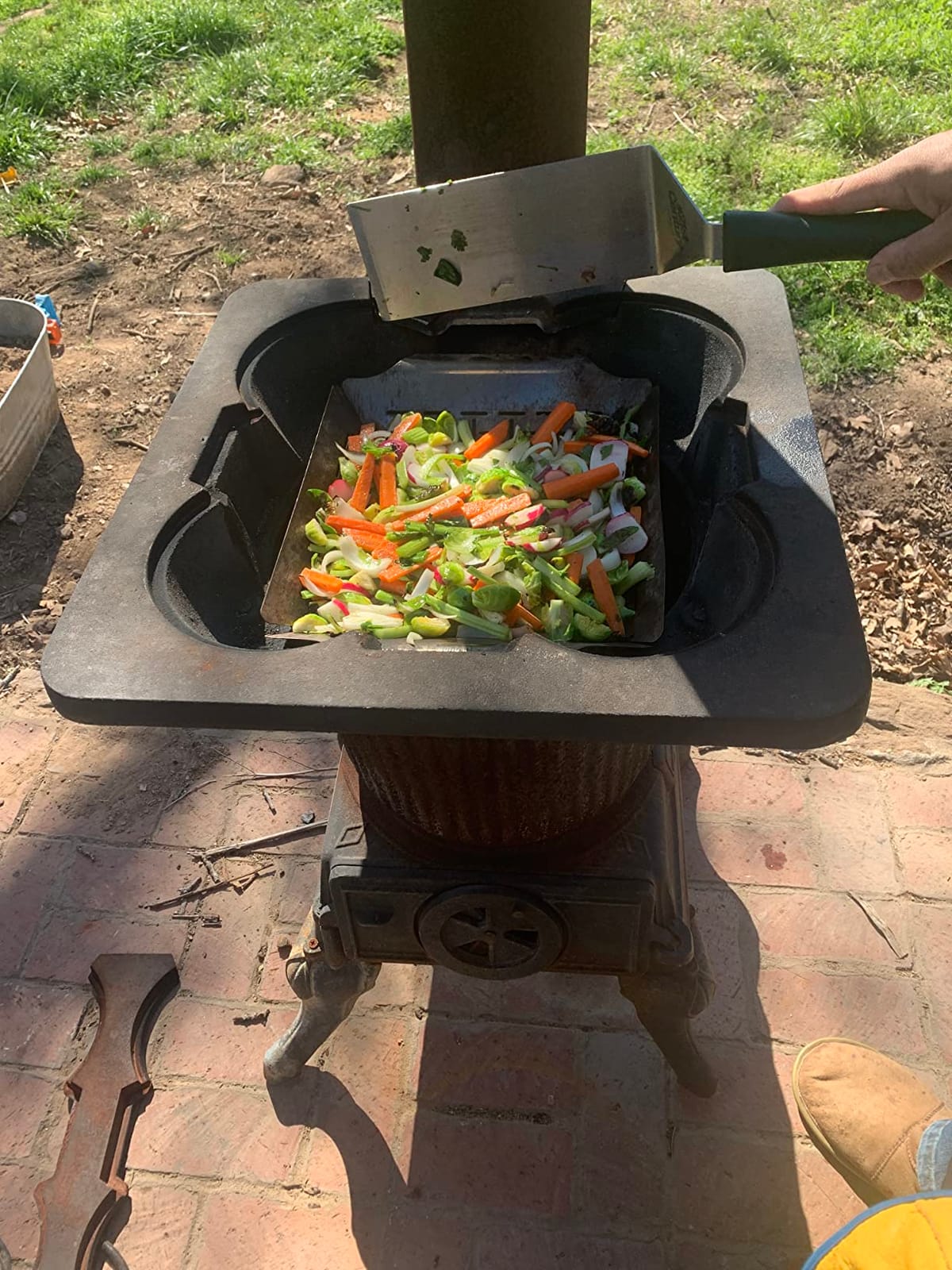
Who the SR57E Rancher suits
It suits a 1,000 sq ft shop or garage where you want cooking capability alongside heat and you are comfortable learning a coal stove. Two dampers, one spinner and one pipe damper, give you real control once you know them.
Where it falls short
Skip it if coal is not a fuel you can source, and budget separately for the draft regulator. The one year warranty also gives less long-term protection than the pedestal stoves in this roundup.
6. Canyon Lodge Medium Wood Stove – Best Thermal Mass for Big Open Spaces
Canyon Lodge Medium Wood Stove
Up to 2,500 sq ft
372.6 lb cast build
5 year warranty
6 inch flue on top
Pros
- Heavy 372.6 pound cast build
- Brick-lined firebox with viewing window
- Airwash keeps the glass clear
- Five year limited warranty on a freestanding unit
Cons
- 372.6 pounds needs two people and a dolly
- Only 18 inch log capacity for a 2500 sq ft claim
- 58030 BTU/hr is modest for the stated coverage
The case for this stove is mass. At 372.6 pounds of cast construction it absorbs heat the way a masonry heater does and keeps releasing it after the fire is out, which suits a shop you want to come back to on a cold morning.
It carries a five year limited warranty, and the brick-lined firebox, cast iron door with viewing window and airwash system are all sensible construction choices.
Measure your plan carefully. The body is 28.23 inches deep by 22.76 inches wide by 32.95 inches high, and once you add the clearance ring a garage bay can swallow quickly.
There is a real mismatch between the claims here. Coverage is stated at up to 2,500 sq ft, but the listed output is 58,030 BTU/hr and the firebox only holds 18 inch logs. That combination is fine for a well-insulated space and thin for a leaky one at 2,500 sq ft. The rating rests on 7 reviews, so treat the long-term reliability picture as thin evidence.
Who the Canyon Lodge stove suits
It suits a large insulated shop or finished garage space where you value stored heat and a five year warranty over portability. The 6 inch flue exhaust sits on top of the stove, so plan your ceiling penetration before it arrives.
Where it falls short
It is the hardest unit here to move into place, and the 18 inch log limit means more trips with a splitting bar than the 21 inch models. Seven ratings is not enough history to hang a confident long-term verdict on.
7. US Stove US1800E Insert – Best When a Blower Is Included
US Stove US1800E 1,200 sqft Wood Fireplace Insert
69,000 BTU/hr
Up to 1,200 sq ft
150 CFM blower in box
300 lb plate steel
Pros
- Adjustable 150 CFM blower included in the box
- Catalyst-free secondary combustion burns long and clean
- Owners report heating well past the rated 1200 sq ft
- Hearth surround eases installation
Cons
- Installs only in an existing residential masonry fireplace
- Crated and heavy so it needs a real crew
- Very small review pool for reliability
This is the only unit in the roundup that arrives with a blower, an adjustable 150 CFM fan that moves heat out into the room instead of leaving it stacked around the firebox. For a garage you use as a workroom, that is worth a lot.
Output is 69,000 BTU/hr for up to 1,200 sq ft from a 1.2 cubic foot firebox that takes 18 inch logs, with catalyst-free secondary combustion for long burn times and a clean chimney once up to temperature.
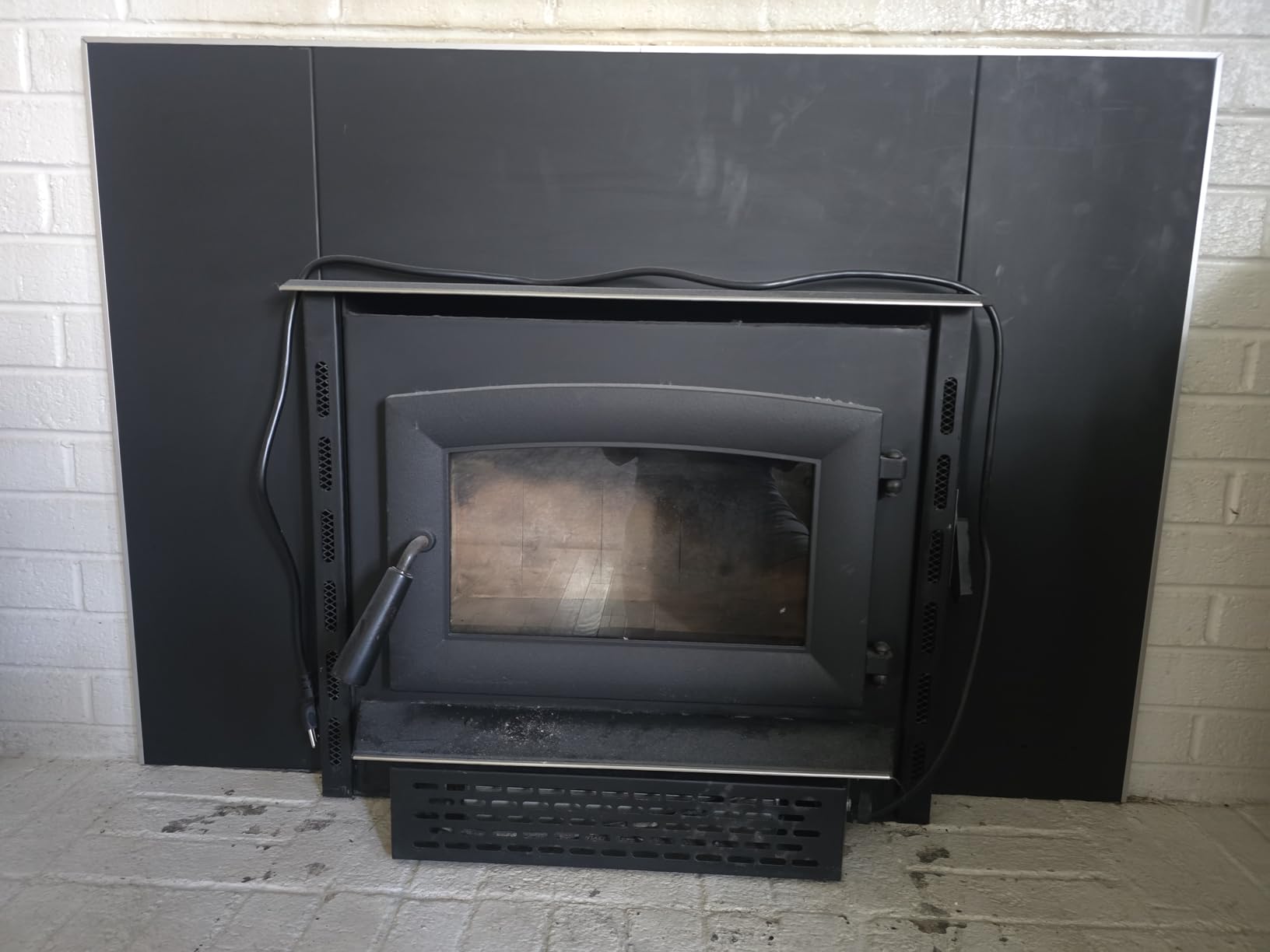
The firebox is heavy 10-gauge reinforced plate steel, firebrick lined, behind 14.5 by 8 inch air-washed ceramic glass in a cast iron door. The 31 by 44 inch hearth surround has a spring-loaded adjustment system, which takes some of the guesswork out of the install.
Now the catch: this is an insert, not a freestanding unit. It is for installation in an existing residential masonry fireplace and is not approved for mobile homes. A garage rarely has a masonry fireplace, which makes this the weakest fit here despite its perfect rating. That 5.0 average comes from 5 reviews, so weigh it accordingly.
Who the US1800E insert suits
It suits a home with an existing masonry fireplace where you want forced air heat with no separate blower purchase. Owners report it heating well beyond its rated 1,200 sq ft.
Where it falls short
In a typical detached garage there is no masonry fireplace to put it in, so cross it off the list unless your building already has one. It also uses a 6 inch chimney liner that is not included, and at 300 pounds it needs a real crew.
8. Ashley Hearth AW1120E-P – Best Small Stove for Low Fuel Use
Ashley Hearth AW1120E-P 1,200 sqft Wood Stove with Legs and Pedestal
68,000 BTU/hr
Up to 1,200 sq ft
21.5 by 22.5 by 29.8 in
Brick-lined firebox
Pros
- Compact footprint fits small garages and cabins
- Uses noticeably less wood than larger stoves
- Large glass viewing window
- Easy DIY installation
Cons
- Small firebox holds roughly one large split log
- Needs frequent refueling in deep cold
- Damper action is not smooth or always effective
This is the compact pedestal model, and owners of small workshops like it for a simple reason: it burns noticeably less wood than the big older stoves. The footprint is 21.5 by 22.5 by 29.8 inches, so it fits where the larger units will not.
It throws 68,000 BTU/hr for up to 1,200 sq ft through a brick-lined firebox that accepts logs up to 18 inches. The air wash keeps the ceramic glass clear and the integrated ash pan makes cleanup quick.
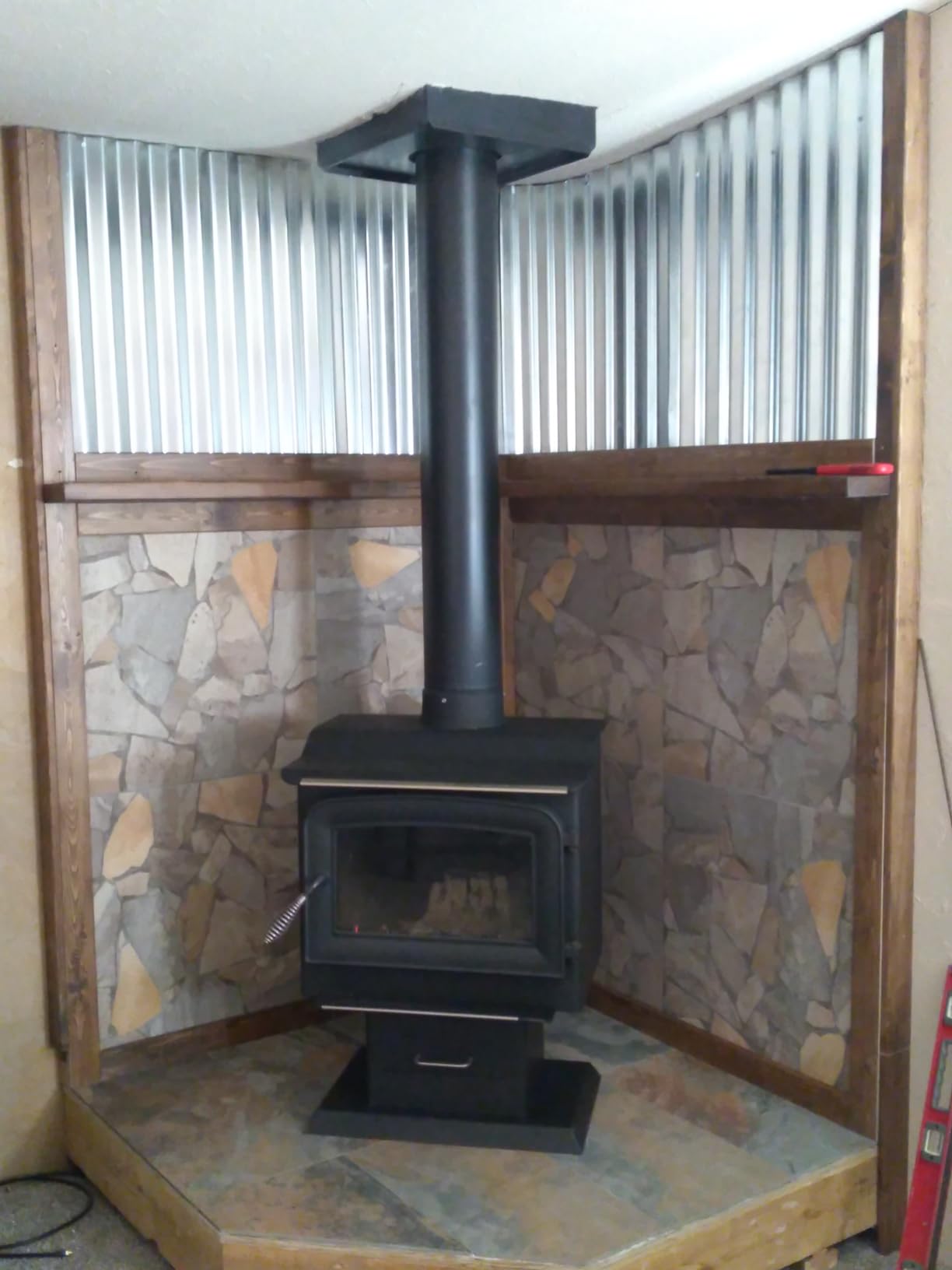
The brushed nickel door handle and pedestal base look more finished than the bare cast iron units, which matters if the garage doubles as a workspace you sit in. A CB36 or B36 blower can be added later for even distribution.
The firebox is shallow and holds roughly one large split log at a time, so you will be loading it every hour or so, and more often in single-digit weather. Damper action is reported as not smooth or always effective, and the shallow box puffs smoke each time you open the door. A few owners also received units with missing hardware.
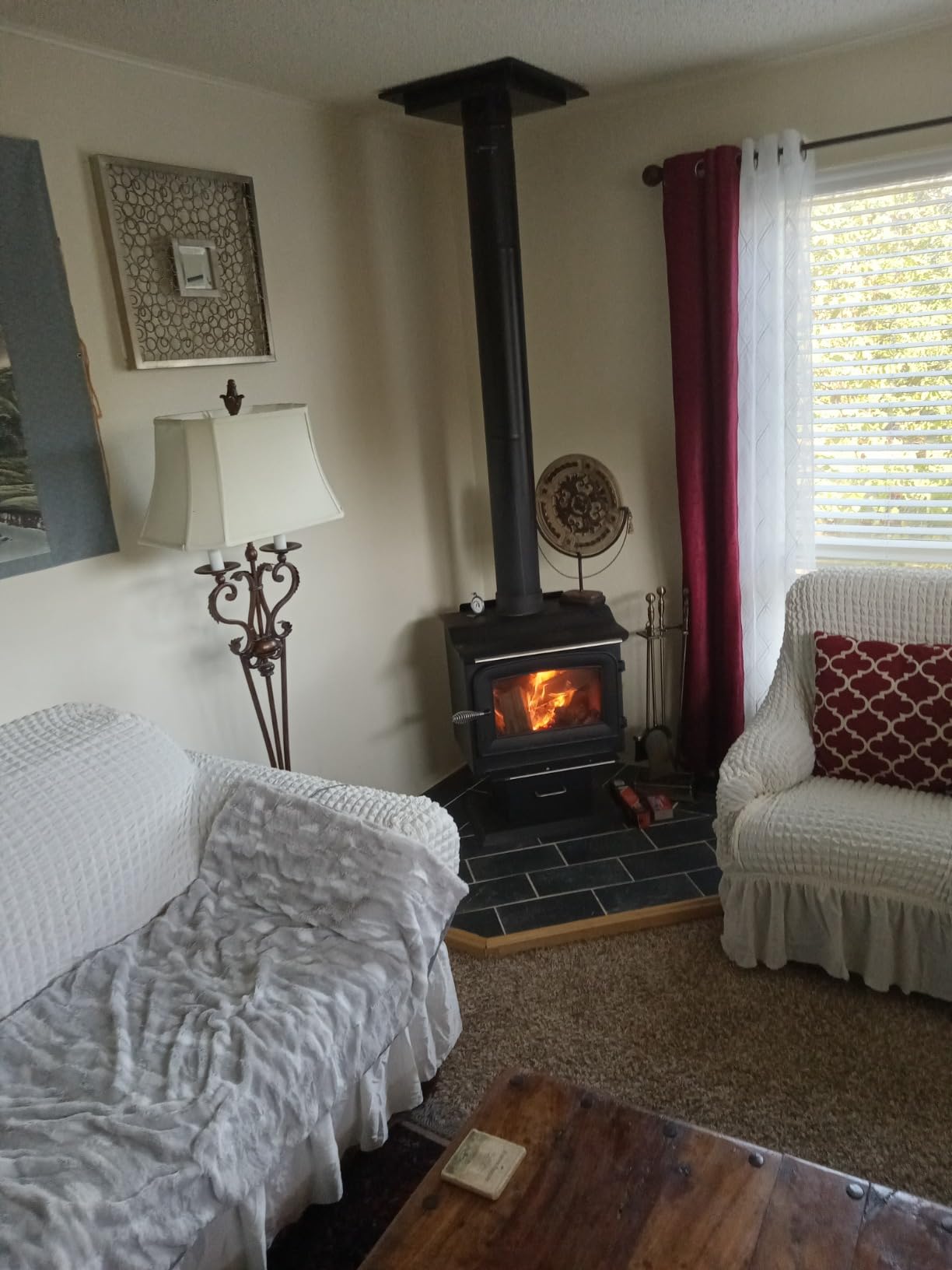
Who the AW1120E-P suits
It suits a small garage, cabin or mudroom heated during working hours rather than overnight. If you are awake and nearby, a small firebox is an efficient choice rather than a compromise.
Where it falls short
It is the wrong pick for overnight burn or for anyone who wants to load the stove once and leave it. Damper action and door sealing are the two mechanical gripes worth knowing before you buy.
9. Cast Iron Stove with Baking Oven – Best If You Bake As Well as Heat
Cast Iron Stove with Oven, Durable Cast Baking Oven, Cooker Oven by Burning Wood, Warming Heater Stove, Oven Section with Thermometer, Brick Lined Fireplace Made in Turkiye (Black-with-Window)
Up to 1,000 sq ft
92.6 lb cast iron
5.1 in flue
15.7 in cooking width
Pros
- Built-in cast iron baking oven with thermometer
- Light at 92.6 pounds so it is easy to reposition
- Brick-lined fire area rated to 1000 sq ft
- Viewing window suits a workshop setting
Cons
- Stove pipe not included with the package
- Non-standard 5.1 inch flue needs an adapter for a 5.9 inch connector
- Only 1000 sq ft of stated coverage
This is the only stove here with a real cast iron baking oven and a thermometer, with a 15.7 inch cooking width. If wood-fired baking matters to you, nothing else on this list does that job.
It weighs 92.6 pounds, which makes it one of the easier units to reposition in a garage, and the brick-lined fire area is rated to warm rooms up to 1,000 sq ft.
Who the oven stove suits
It suits a garage kitchen or small shop where bread and pizza are part of the plan. At 92.6 pounds it moves without the two-person install the pedestal stoves need.
Where it falls short
Stove pipe is not included and the flue is a non-standard 5.1 inches, convertible to 5.9 inches with an adapter, so plan the connector before you buy anything else. Four ratings is a very small sample, and the unit is imported from Turkiye with correspondingly thin review coverage.
10. US Stove US1261E 900 Sq Ft – Best for Burning Through Scrap Wood
US1261E 900 sq. ft. Cast Iron Log Wood Stove
Up to 900 sq ft
54,000 BTU/hr
1.2 cu ft firebox
No electricity needed
Pros
- Non-catalytic secondary burn needs no catalyst service
- No electricity required so it runs in an outage
- Compact 900 sq ft size suits a small workshop
- Works well for consuming property scrap wood
Cons
- 1.2 cubic foot firebox means frequent loading
- Not suited to long unattended burn times
- Only 4 ratings on record
This compact non-catalytic unit is built for a simple job: consuming the wood you have. Reviewers describe it working well on surplus timber and offcuts around the property, and it needs no electricity, so a power outage does not stop your heat.
It delivers 54,000 BTU/hr across a stated 900 sq ft from a 1.2 cubic foot firebox using non-catalytic secondary burn, which means there is no catalyst to clog or replace.
Who the US1261E suits
It suits a small garage or workshop where clearing brush and cleaning up timber is the plan. Its 4.7 star average sits at the top of the roundup, on a very small sample.
Where it falls short
A 1.2 cubic foot firebox means frequent loading and it is not suited to long unattended burns. Four recent reviews is a thin foundation, and owners commonly wish the unit were physically larger.
11. Comfort Glow CGWS2500 – High Output, Unsettled Owner Reports
Comfort Glow Wood Burning Stove, Fits 21″ Logs – CGWS2500
112,800 BTU/hr
Up to 2,500 sq ft
Logs up to 21 inch
Freestanding
Pros
- 21 inch log capacity for long burn intervals
- One owner reports plenty of heat in a 34x34 garage
- Pipe collar assembly and firebricks included
- Clean burn secondary combustion
Cons
- No ash pan which one owner cites as the main drawback
- Another reports heavy smoke from the smoke box
- Only a 2 year manufacturer defect-only warranty
The spec sheet is impressive: 112,800 BTU/hr, coverage up to 2,500 sq ft, and a firebox that takes 21 inch logs. The body is heavy-duty plate steel with a cast iron door, a firebrick lined firebox and a clear view glass window.
The owner reports are not. With only 3 ratings the split is sharp: one owner says it produced plenty of heat for a 34 by 34 garage in the northeast and calls it well built, while another is blunt that the missing ash pan and heavy smoke output make it a bad purchase.
Who the CGWS2500 suits
It suits a large open garage where you want 21 inch log capacity and a pedestal kit and flue collar assembly in the box. The clean burn secondary combustion is a sound design choice.
Where it falls short
Read the 3.5 average as a genuinely unsettled signal, not a settled verdict. The absence of an ash pan and a 2 year defect-only warranty are the two things to weigh before you commit.
How Big a Wood Stove Your Garage Actually Needs
Size by volume, not floor area. Measure length, width and ceiling height, convert to cubic metres, then divide by 14 for a leaky older building or by 20 for a well-insulated one to get kilowatts of requirement. Multiply by 3,142 to convert to BTU/hr.
A worked example makes the gap clear. A 24 by 24 shop with a 10 foot ceiling is about 163 cubic metres. Divide by 14 and you get roughly 11.6 kW, or about 36,600 BTU/hr, which is where the mid-size stoves in this roundup land. Divide by 20 for a well-insulated shop and the requirement drops to roughly 8.2 kW.
High ceilings are where buyers mis-size. A shop with 12 to 14 foot rafters holds far more volume than its floor area suggests, and that is exactly the space where a small box stove gets run at low capacity overnight and builds creosote.
The other half of sizing is firebox capacity, not just heat output. A small firebox you have to choke the air down on produces more creosote than a right-sized stove run at 70 to 80 percent. Larger fireboxes with 21 inch log capacity are the reason the AW2020-P, AW2520E-P and CGWS2500 earn their places on this list.
Our wood stoves for home heating guide covers the same sizing math for living space, which is useful context if your garage is being converted.
Clearances, Hearth Pads and the 2-10-3 Chimney Rule
For a listed stove, the listing label governs, and typical figures are about 36 inches to a side and rear and 16 inches in front onto a hearth. An unlisted stove must keep the full 36 inch clearance all around, with no exceptions.
That clearance ring is the number one planning fact nobody states. A small stove plus its mandatory 36 inch ring occupies roughly a 4 foot by 4 foot square of floor, which crowds benches and parked vehicles in a single-bay garage.
The 2-10-3 rule governs chimney height: the chimney must extend at least 3 feet above the roof penetration, rise at least 2 feet higher than anything within 10 feet horizontally, and stand at least 10 feet off the ground. Breaking it causes downdraft, smoke and creosote.
Approved wall protection lets you reduce the 36 inch requirement on an unlisted stove down to roughly 12 to 18 inches, but only as a listed system: sheet metal over a 1 inch ventilated air gap, not a bare sheet screwed to framing. Install a UL 2034 listed CO detector on every level, with one inside the heated space.
Chimney and Flue Pipe Choices for a Garage Stove
The stove pipe connector cannot pass through a wall, ceiling or roof. Single-wall connector pipe needs 18 inches of clearance to combustibles, double-wall connector 6 inches to a wall and 8 inches to a ceiling, and UL 103 HT Class A insulated chimney pipe needs only 2 inches.
That is why Class A insulated chimney pipe is the normal answer in a garage. It passes through the roof safely, and going vertical also improves draft in a building that is otherwise wide open.
On the 8 to 6 inch question, stepping a flue down from 8 inch to 6 inch restricts draft and makes creosote worse. Match the liner to the flue collar instead, or adapt up by no more than 1 to 2 inches. A flue oversized relative to the collar is a common and expensive mistake.
Get an annual inspection from a CSIA certified chimney sweep, and never route single-wall connector pipe through a wall or ceiling. More detail on liner types is in our chimney liner guide.
Wood Stove vs Propane, Electric or Mini-Split in a Garage
A wood stove wins on fuel cost when you have a wood source and on how quickly it warms a cold space. It loses on thermostat control, on installation complexity and on how much floor space it takes.
Propane and natural gas unit heaters install faster and hold temperature more evenly, but they need a fuel line or a tank, they burn a clean fuel that some local rules prefer, and the ongoing fuel cost is real. Electric garage heaters and a mini-split heat pump add nothing to a combustion risk and are far easier to regulate.
A Hearth.com moderator’s advice for garage heating is that a unit heater or two plus a mini-split is often the better answer, with the caveat that a radiant wood stove can be a pain but it is effective. For an intermittently used shop, a radiant stove fits the way people actually work.
For a garage being lived in rather than worked in, our wood stoves for cabins guide covers the comfort and air quality angle in more detail.
Firewood, Creosote and Ash Handling
Unseasoned wood above 20 percent moisture, along with resin-heavy softwoods like pine and fir, creates the most creosote. Burning them cold and damped down accelerates the buildup faster than almost anything else you can do.
The habits that pack a flue are well documented: throttling the air damper overnight to stretch a load, running a freshly loaded fire at low output, and burning resinous softwood. Keep the flue temperature above 250 F and the fire burns clean.
Handle ash carefully. Put it in a metal container with a tight lid on a non-combustible surface, away from the building, and treat it as live embers for at least 72 hours before disposal. Never dump hot ash directly onto a garage floor or into a shop bin.
Split wood burns better than round, and seasoning takes a full season or more. Storing a stack inside the garage keeps it drier, so leave clearance to the stove and off the floor. A kindling cracker speeds up processing so your fuel is actually ready in time.
Used Shop Stoves, UL Listing and the Insurance Reality
UL listing is not optional in a shop. A Garage Journal user’s insurance agent denied a claim specifically because the shop stove was not UL listed, even though the owner followed every clearance requirement and installed a heat shield. The agent’s stated reason was that the listing is what allows recourse against the manufacturer.
Home-built or improvised shop stoves, including converted oil tanks, are the deal breaker. Even if they heat well, the label is what an insurer checks, not the workmanship.
If you buy used, inspect before you buy. Confirm the UL listing plate is present and legible, look for cracks in the firebox and around the door frame, check that the original gaskets and the ceramic rope are intact, and verify the flue collar diameter so you can size the connector pipe correctly.
Raise the stove off the floor. One Garage Journal user mounts the stove 18 inches up so gasoline vapors never enter the convection path, and that inexpensive mitigation shows up repeatedly in shop builds. Confirm your local rules in writing before installing anything.
Frequently Asked Questions
Can I put a wood burning stove in a garage?
Usually not. NFPA 211 sections 13.2.3 and 13.2.4 prohibit solid fuel-burning appliances in any garage and anywhere gasoline or flammable vapors may be present, and most local building codes adopt that rule. It becomes workable when the building is a shop that never stores a motor vehicle, or when the appliance is sealed inside its own room.
What is the best wood burning stove for a garage workshop?
A UL listed, EPA certified freestanding wood stove with a large firebox and a blower kit, sized by cubic volume rather than floor area. In this roundup the safest all-round choice for a small shop is the US Stove Company cast iron unit, while the Ashley Hearth AW2520E-P handles large shops and power outages best.
How far does a wood stove need to be from combustibles?
For a listed stove the label governs, typically about 36 inches to a side and rear and 16 inches in front onto a hearth. Single-wall stovepipe needs 18 inches, a double-wall connector 6 inches to a wall, and Class A insulated chimney pipe 2 inches. An unlisted stove must keep the full 36 inches all around.
How close can a wood stove be to a wall with a heat shield?
An unlisted stove’s 36 inch requirement drops to roughly 12 to 18 inches when approved wall protection is installed. That protection must be a listed system: sheet metal over a 1 inch ventilated air gap, not a bare sheet screwed directly to the framing.
What is the 3-2-10 rule for wood stoves?
The chimney must extend at least 3 feet above the roof penetration, be at least 2 feet taller than anything within 10 feet horizontally, and itself stand at least 10 feet off the ground. Violating the rule causes downdraft, smoke and accelerated creosote buildup.
Can you go from 8 to 6 inch pipe on a wood stove?
No. Stepping a flue down from 8 inch to 6 inch restricts draft and worsens creosote. Match the liner to the flue collar instead, or adapt upward by no more than 1 to 2 inches. A flue oversized relative to the collar is one of the most common and costly installation errors.
Which firewood creates the most creosote?
Unseasoned wood above 20 percent moisture, along with resin-heavy softwoods such as pine and fir. Burning that wood cold and damped down accelerates the buildup faster than almost any other habit, which is why burning hot fires on dry hardwood keeps the flue cleaner.
Which brand of wood stove is better, Blaze King or Drolet?
Forum consensus across r/preppers and Hearth.com lists Jotul, Morso, Blaze King, Pacific Energy, Woodstock, Lopi, Drolet, Englander and Vermont Castings as the reference brands. Blaze King is consistently cited as the benchmark for large fireboxes and long burn times, while Drolet sits in the budget tier for owners who want output per dollar.
Conclusion
After reviewing all 11 of the best wood stoves for garages in this roundup, the US Stove Company cast iron unit takes our editor’s choice for one reason: 54,000 BTU/hr, a 19 inch firebox, 897 owner reviews and a limited lifetime firebox warranty. For a large shop, the Ashley Hearth AW2520E-P adds a 2.7 cubic foot firebox and no electricity requirement.
Before you buy anything, confirm with your local building department that your building is a shop and never stores a motor vehicle, and make sure the UL listing plate is on the unit. Those two checks cost you a phone call and decide whether the rest of the purchase is sound.