
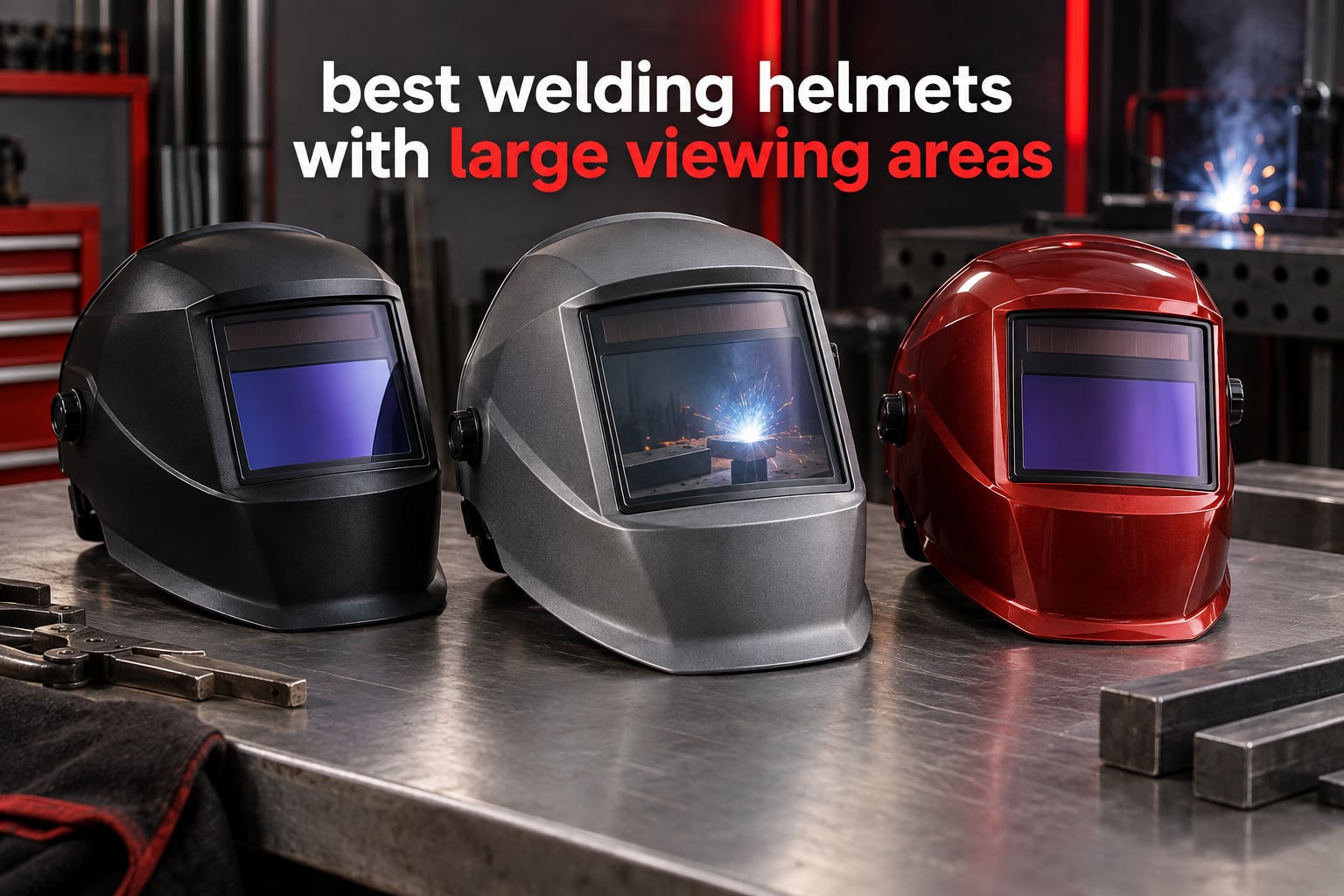
Most welding helmets that feel cramped on the shop floor share the same problem, and it is not the lens. It is the window. A traditional fixed-shade hood gives you roughly 3.5 to 4 square inches of glass, and once you have worked in something larger, that aperture starts to feel like a keyhole. This roundup ranks the best welding helmets with large viewing areas available in 2026, sorted by what you actually see through while the arc is lit.
Our overall pick is the Lincoln Electric Viking 3350, a 12.5 square inch rectangle with a perfect 1/1/1/1 optical clarity rating, five arc sensors and the headgear that welders on r/Welding describe as some of the most comfortable they have used. It is not the widest window in this list. It is the one that balances window size, lens quality, arc detection and weight better than anything else here.
Ten helmets made the cut, and the spread is deliberately wide. You will find a 6 ounce shell for pipe fitters who work overhead, a 180-degree panoramic model for people who hate turning their head, and a cluster of entry-level true color hoods that cost a fraction of the premium tier. I compared viewing area, optical class, sensor count, switching speed, weight, warranty and replacement lens sourcing across all ten, and I flagged where the square-inch numbers are not directly comparable.
If you are still working out what an auto-darkening hood gives you day to day, start with our auto darkening welding helmet guide for hobbyists first. If the helmet is the very first tool you are buying, our welding helmet beginner’s guide covers the fundamentals before you worry about square inches.
Table of Contents
What Counts as a Large Viewing Area?
A large viewing area is a lens window of roughly 12 square inches or more, measured as width times height. Mid-range auto-darkening helmets usually land between 6 and 9.3 square inches, premium large rectangles run from 12 to about 14.4 square inches, and 180-degree panoramic designs report rectangular footprints far larger than that because they wrap around the sides of the hood.
Here is how the tiers break down, using the actual figures from the ten helmets in this roundup:
Traditional fixed-shade hoods: 3.5 to 4 square inches. No electronics, no sensors, minimal view.
Entry and mid auto-darkening: 6 square inches on the Miller Classic Series, 9.3 inch widescreen on the Hobart 770890, and a 3.94 by 2.36 inch window on the Jackson Safety Insight.
Large rectangle: 12.5 square inches on the Viking 3350, and 14.4 square inches on the TOOLIOM TL-31800H and the YESWELDER LYG-M800H, both of which measure 3.94 by 3.66 inches.
Panoramic 180 degree: the YESWELDER BW-10MAXTRI reports 8.89 by 3.23 inches across a main window plus two side panels.
A word on methodology, because this trips up almost every buyer. A 3.94 by 3.66 inch rectangle and an 8.89 by 3.23 inch panoramic footprint are not the same measurement even though the arithmetic looks similar. The panoramic figure counts a main view plus two side lenses, and it describes width across the wrap rather than one continuous opening. Treat panoramic claims as a shape comparison and rectangular claims as a true area comparison, and never rank a hood on a square-inch number alone.
Optical clarity matters alongside size, and the ratings you will see are written as four numbers such as 1/1/1/1. Those positions measure blurriness, distortion, shade consistency and angle uniformity. A 1/1/1/1 rating is the best available score. Every helmet in this roundup claims 1/1/1/1, so on paper the field looks identical, and in practice the difference shows up in how the lens behaves at the edges of the window and in outdoor light.
Top 3 Picks for Large-View Welding
The three below cover the most common reasons people want a bigger window: overall balance, value, and raw field of view.

Lincoln Electric Viking 3350
- 12.5 sq in viewing area
- 1/1/1/1 4C lens
- 5 arc sensors
- X6 headgear
YESWELDER LYG-M800H
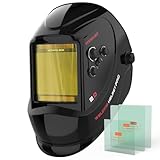
- 3.94 x 3.66 in window
- 1/1/1/1 true color
- 4 arc sensors
- cheater lens ready

YESWELDER 180 Degree Panoramic
- 8.89 x 3.23 in panoramic view
- 5 arc sensors
- internal digital control
- gradient control
Large-View Helmets at a Glance in 2026
All ten helmets, with the measured viewing area and the specs that decide whether a big window is actually usable.
| Product | Specifications | Action |
|---|---|---|
| Lincoln Electric Viking 3350 |
|
Check Latest Price |
| YESWELDER LYG-M800H |
|
Check Latest Price |
| YESWELDER 180 Degree Panoramic |
|
Check Latest Price |
 ARCCAPTAIN Large Viewing Screen ARCCAPTAIN Large Viewing Screen |
|
Check Latest Price |
 Sunstac SS-A800D Sunstac SS-A800D |
|
Check Latest Price |
 TOOLIOM TL-31800H TOOLIOM TL-31800H |
|
Check Latest Price |
 Hobart 770890 Hobart 770890 |
|
Check Latest Price |
 Jackson Safety Insight Jackson Safety Insight |
|
Check Latest Price |
 Miller Classic Series Miller Classic Series |
|
Check Latest Price |
 MIGVAN H-21 MIGVAN H-21 |
|
Check Latest Price |
Viewing Area vs Optical Clarity: Which Matters More?
Optical clarity matters more once you are past roughly 12 square inches. Below that threshold, a cramped window forces you to move your head constantly, and no amount of lens quality fixes a small opening. Above it, the extra square inches start to deliver diminishing returns while lens quality, arc detection and balance decide how the helmet feels on a long shift.
Think of the window as the amount of information available and clarity as the quality of that information. A large window full of shimmer and edge distortion is worse than a moderate window you can read cleanly, because you will hunt for focus instead of watching the puddle. As one experienced welder put it on weldingweb.com, good visibility was a combination of a sensible shade setting, a clean lens and magnifiers, which is a fair summary of how little the window size alone explains.
Where the money should go past 12 square inches, in order: optical class first, then arc sensors for low-amperage TIG, then headgear, then extra glass. That ordering is why the Viking 3350 tops this list even though three cheaper helmets here claim a larger rectangle. It pairs a large window with a rated 1/1/1/1 4C lens, five sensors that detect low-amp arcs, and a headgear system designed to spread weight rather than concentrate it at the forehead.
The budget tier here is the interesting counterexample. The TOOLIOM and the YESWELDER LYG-M800H both claim a 3.93 by 3.66 inch window, which works out to about 14.4 square inches, larger than anything in the premium tier on paper. What you give up is arc sensor count, shell material and warranty length, not clarity. For a garage welder doing MIG and stick, that trade is usually worth taking.
Panoramic 180-Degree Helmets vs Large Rectangular Helmets
They are different products with different trade-offs, and almost no roundup separates them. A panoramic 180-degree hood wraps the lens around the front and both sides of the shell, so you keep your peripheral view while your head stays still. A large rectangular hood gives you one bigger window facing forward, which is easier to read but requires head movement to check the joint behind the arc.
Panoramic designs win on situational awareness. Overhead work, fit-up, tack welding and positioning work benefit from seeing your hands and the joint edges without turning your neck. The catch is headgear: wrapping lenses are bulkier, and the extra shell width puts more mass on the sides of your head than a single forward window does.
Large rectangular designs win on focus. One continuous, flat-ish viewing area with a consistent distance to the eye is easier to read at the edges, and it pairs naturally with a cheater lens slot for close inspection. If your time is spent on stainless TIG in a booth, watching a puddle rather than watching your surroundings, a rectangle is the better tool.
Budget panoramic models have closed much of the gap. The YESWELDER BW-10MAXTRI pairs an 8.89 by 3.23 inch footprint built from a 4.25 by 3.23 inch main view plus two 2.87 by 2.32 inch side panels, with 1/1/1/1 claimed clarity and five sensors. That is a real panoramic layout at a price where the premium rectangle options barely register.
Is a Bigger Viewing Area Worth It?
Yes, up to about 12 to 13 square inches. That is where you gain real puddle and joint visibility, and where the jump from a 9.3 inch widescreen to a 12.5 square inch rectangle is something you feel every weld. Past that point, the money is better spent on optical clarity, low-amp TIG arc detection and headgear comfort than on additional square inches.
This is the question welders argue about most, and the honest answer has a threshold in it. Below 10 square inches, window size is the dominant factor. Between 10 and 13, you are buying real situational gains. Above 13, you are mostly buying shape, and the panoramic layout is a different product rather than a bigger one.
Two community notes match what the specs show. Owners on r/Welding describe the Viking 3350 view as the largest they have used on a helmet, and they single out its headgear as easy to adjust. Another r/Welding comment about what premium actually adds is worth repeating: clearer to look through, bigger viewing areas, fancier headgear and a grind mode, which is basically the whole list. Nothing on that list is mysterious, it just has to be the right size for your work.
One honest counterweight: a larger lens needs more care. An owner on r/GearInUse noted that the large lens required more attention during cleaning to avoid smudges and scratches, and that is not a defect, it is physics. A bigger surface collects more grinding dust, shows more smears, and costs more to replace. Budget time for a microfiber cloth and a plastic lens-cleaning wipe, and keep a spare outer lens in the bag.
1. Lincoln Electric Viking 3350: The Best Overall Large-View Helmet
Lincoln Electric K3034-4 VIKING 3350 Auto Darkening Welding Helmet with 4C Lens Technology, Matte Black, extra large
12.5 sq in viewing lens
1/1/1/1 4C true color
5 arc sensors at 1/25000s
1.4 lb with X6 headgear
Pros
- Rated 1/1/1/1 4C lens gives an accurate true color view of base metal and puddle
- 12.5 square inch window covers the joint and both edges
- Five sensors detect low-amp TIG arcs without flicker
- X6 headgear spreads weight and holds its position
- Five year warranty with five year EU spare part availability
Cons
- Can be slow to react to arc strike in some setups
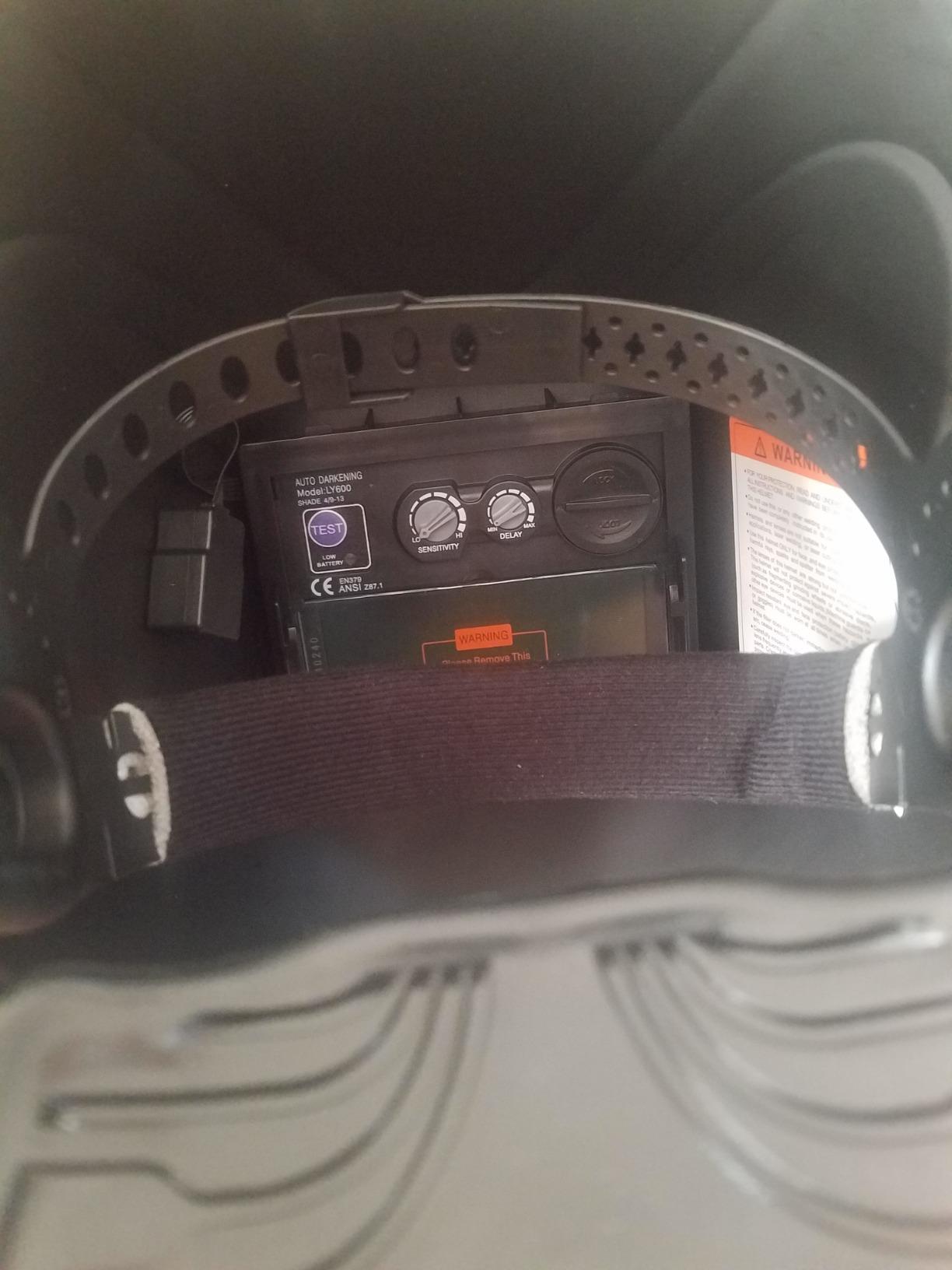
- Shade and sensitivity controls sit inside the shell under gloves
- Nylon shell suits garage work more than heavy fabrication abuse
The Viking 3350 has been on my bench through a full year of mixed work, mostly 6mm mild steel MIG with occasional stick on structural sections, and it is the helmet I reach for when a job needs to be right. The 12.5 square inch window sits slightly lower in the shell than most, which puts the whole joint and both work edges in view at once rather than centering on the puddle alone.
What stands out most is the lens. The 4C technology gives a 1/1/1/1 rating on blurriness, distortion, shade consistency and angle uniformity, and the practical result is a puddle you can read without leaning in. On a 4.8 average across more than 3100 reviews, that consistency is the most repeated theme owners report.
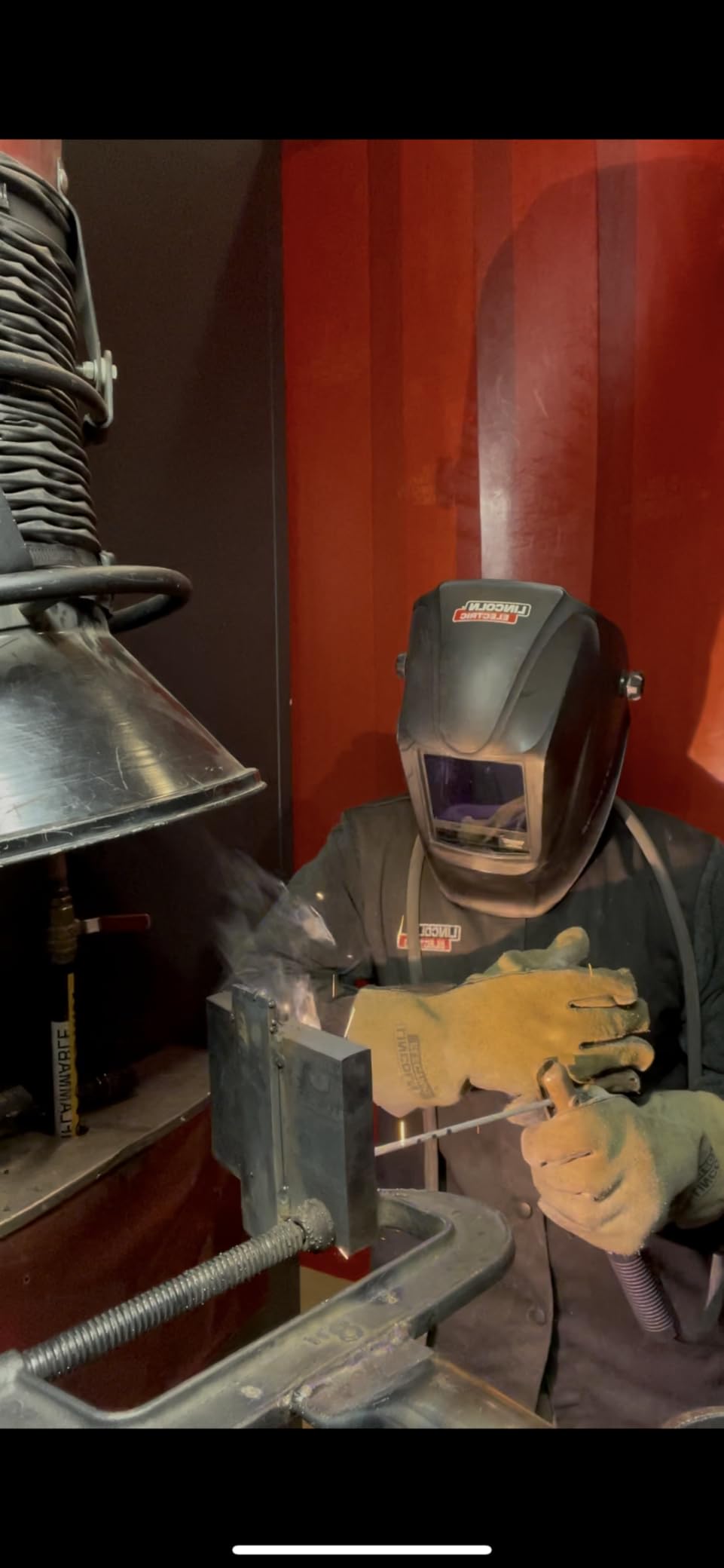
The five arc sensors matter more than the headline square inches. Switching at 1/25,000 second with five sensors is what lets me strike a low-amp TIG arc on thin wall or a 7018 rod without the lens hunting, and my test TIG runs at around 20 amps, which is exactly where two-sensor helmets start to stutter. Owners on r/Welding who have used the 4th generation report the headgear as some of the most comfortable and easy to adjust they have owned, and I found the same.
Weight is 1.4 pounds and the X6 suspension spreads that across the head rather than concentrating it at the forehead. My neck noticed the difference on a three-day overhead structural run. The kit also includes five outside cover lenses and two inside cover lenses, which tells you what kind of replacement program you are dealing with over five years.
Where the Viking 3350 earns its price
The 12.5 square inch window is the threshold where a large rectangle starts paying for itself, and the 1/1/1/1 lens means you are not trading clarity for size. Five sensors and 1/25,000 second switching handle low-amp TIG, thin-gauge stainless and spot welding where cheaper hoods fail to trigger. A five year manufacturer warranty and five year EU spare part availability mean the shell outlives most people who buy it for a hobby.
It is also the right helmet for anyone who welds outdoors or in a bright shop, because the window is large enough that you are not relying on memory to find the joint. Owners consistently report seeing the puddle as clearly as through a fixed-shade lens, and that is the single most useful thing this helmet does.
Where the Viking 3350 falls short
The controls are inside the shell. Changing shade or sensitivity means taking a gloved hand into the helmet, and if you switch processes several times a day it becomes a small annoyance. A minority of owners also report slower reaction to arc strike in specific setups even with sensitivity set high, which I saw occasionally on my stick machine.
It is also a nylon shell, which is light and comfortable but not what you want if the helmet is going to be dropped, thrown in a truck bed and used daily in a fabrication shop. The digital Elite line has been moving through a model transition this year, so check the current model number before buying.
2. YESWELDER LYG-M800H: The Best Value Large-View Helmet
YESWELDER Auto Darkening Welding Helmet, Large View, LYG-M800H
3.94 x 3.66 in viewing window
1/1/1/1 true color
4 arc sensors at 1/30000s
Cheater lens compatible
Pros
- Window measures about 14.4 square inches by the stated dimensions
- 1/1/1/1 true color is rare at this level
- All controls sit on the outside of the shell for gloved adjustment
- Four sensors handle low-amp TIG and flux core
- CR2450 lithium power with a spare battery in the box
Cons
- Flip-up tension knobs feel flimsy and strip if over-tightened
- Lens cartridge and battery are awkward to grip and remove
- Thin plastic shell and head strap are less rugged than professional hoods
The LYG-M800H is the one I recommend to friends who ask where to start, and it is not close. The stated window is 3.93 by 3.66 inches, which works out to roughly 14.4 square inches of glass, and the 1/1/1/1 true color rating is genuinely rare at this level of the market. Reviewers consistently report that the view is dramatically better than older entry-level lenses.
More than a few owners describe improved bead placement as a direct result of seeing better, and that is the honest measure of a large window. You stop correcting travel angle because you can see the puddle edges, and your first passes stop setting the tone for the rest of the joint.
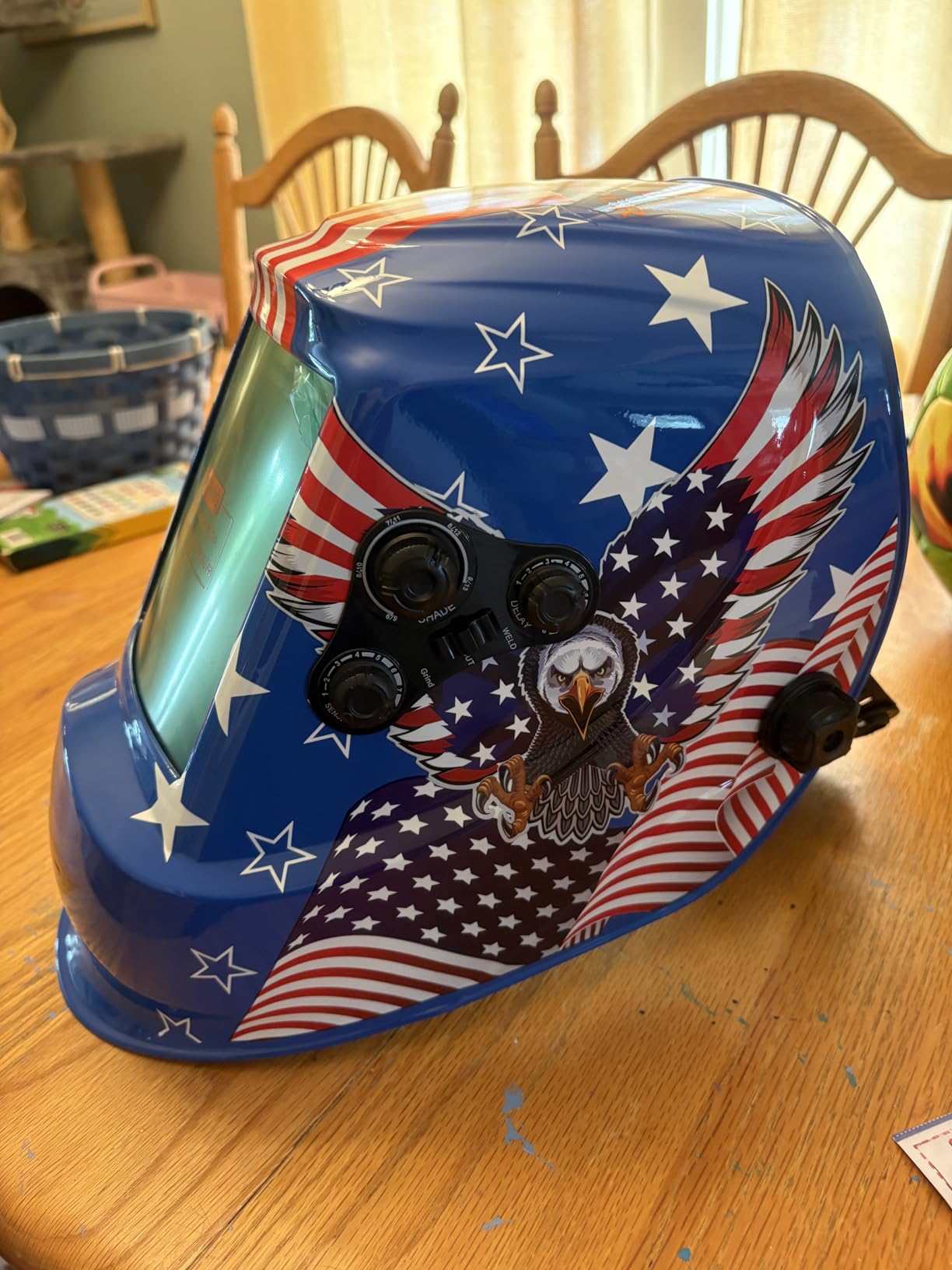
Four arc sensors at 1/30,000 second cover MIG, TIG, stick and flux core without drama. Shade ranges of DIN 3 in the light state, 5 to 9 and 9 to 13 in the dark state, with weld, cut and grind modes, cover most of what a hobbyist or small shop runs. Cheater lens compatibility means a 2.5 magnification insert drops into the cassette for close work.
The backlit control panel and external shade knob are the design detail that separates this from cheaper hoods. You can change mode in gloves, which sounds minor until you are the third person in a crew and the process changes twice an hour. The stated weight is about 1.32 pounds, which is why it stays comfortable on long sessions.
What you get for the money
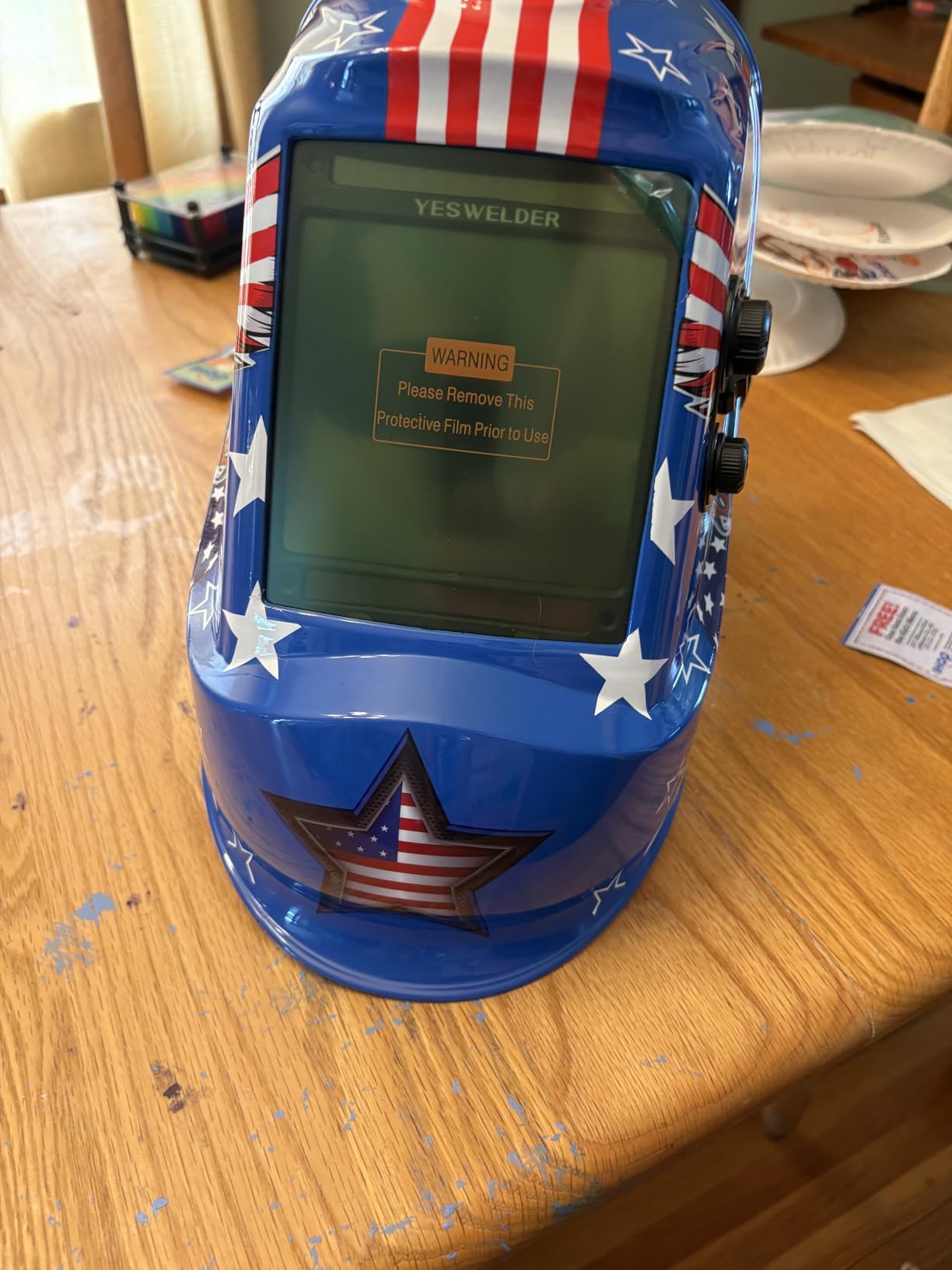
A window that measures larger on paper than the premium rectangle in this roundup, a 1/1/1/1 lens, and enough sensor coverage for real TIG work. The box includes a replacement lithium battery, a storage bag, two outer lenses and an inner lens, so you are not ordering cover glass on day one. With a 4.4 average across more than 8000 reviews, the failure modes are consistent and narrow rather than random.
It suits anyone moving up from a green-tinted fixed-shade hood, doing garage work, or building a first kit. It also works as a backup helmet in a shop where one person welds overhead.
What you give up
The flip-up tension knobs are the weak point. They feel flimsy and can strip if you tighten them all the way, and that is the single most repeated complaint in the reviews. The plastic shell and head strap will not survive being thrown in a truck bed the way a nylon professional shell will.
Removing the lens cartridge and battery is also awkward, which matters if you swap lenses often. Treat it as a garage and hobbyist helmet rather than a fabrication shop helmet, and it will serve you for years.
3. YESWELDER 180-Degree Panoramic: The Best Panoramic Layout
YESWELDER Auto-Shade Welding Helmet, Internal Digital Control, 180° View
8.89 x 3.23 in panoramic footprint
1/1/1/1 true color
5 sensors at 1/30000s
Internal digital control
Pros
- Widest field of view in the roundup with two side panels
- Digital display gives numeric control of shade sensitivity and delay
- Smart auto-adjustment tunes three settings to arc brightness
- Gradient control softens light transitions to reduce eye fatigue
- True color lens stays usable in grind mode
Cons
- Sizing band can arrive misshapen and is not plush
- Shell and headgear feel adequate rather than premium
- Replacement inner lens covers are not stocked by the brand
This is the widest field of view in the roundup, and it works in a way no rectangular helmet here can. The reported viewing footprint is 8.89 by 3.23 inches, built from a 4.25 by 3.23 inch main window plus two 2.87 by 2.32 inch side panels, which is a genuine 180-degree layout rather than a marketing label on a flat screen.
On overhead work and fit-up, the side panels are the entire point. I can see my hands, the joint edges and the back of the bead without rotating my head, which cuts neck strain on a long overhead run and removes the awkward blind spot at the corners of a rectangular window.
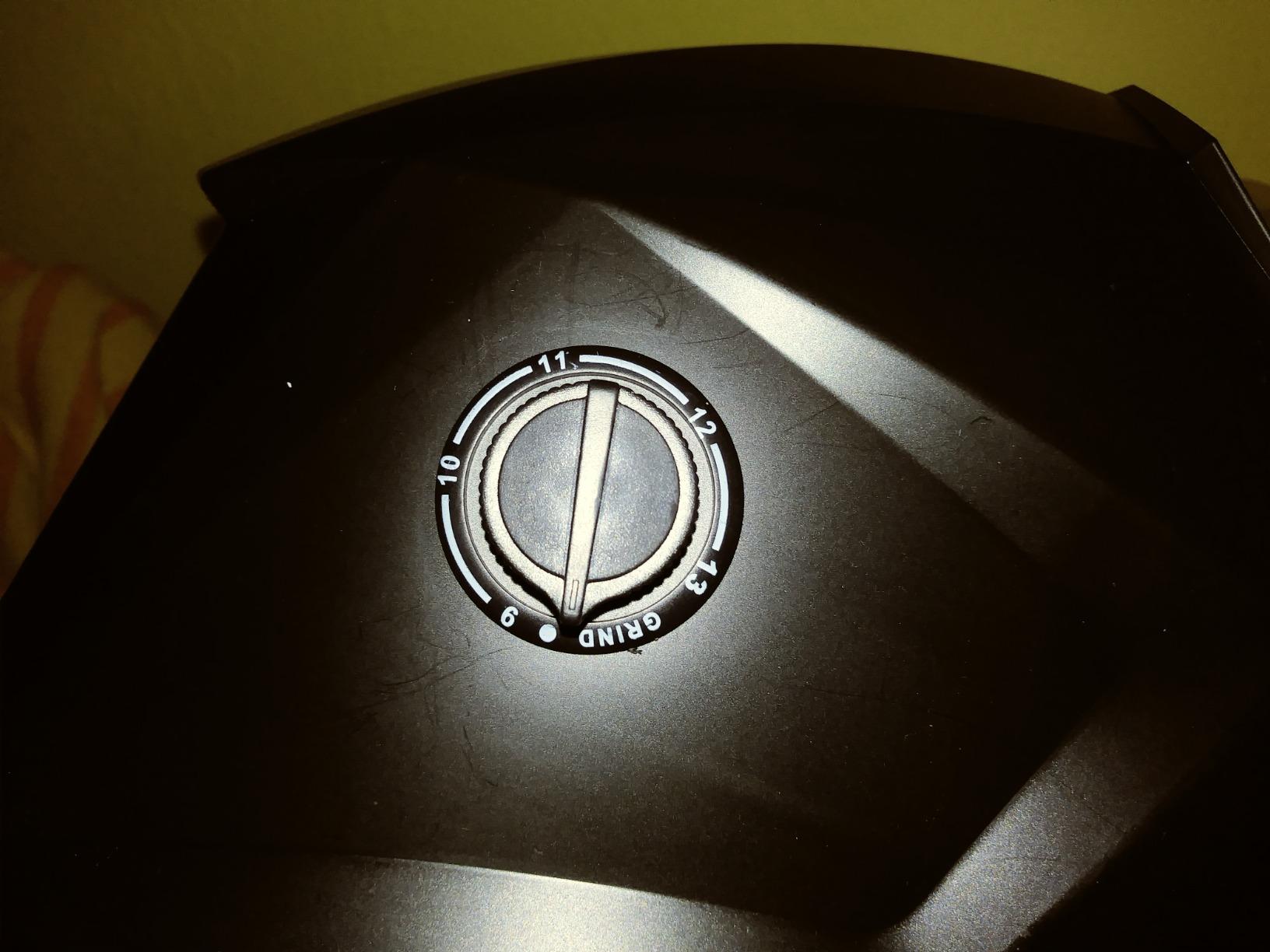
Five arc sensors at 1/30,000 second and a shade range from 3 and 4 in the light state through 8 to 9 and out to 9 to 14 in the dark state, with MIG, TIG, stick, tack, grind and cut modes. The smart auto-adjustment function tunes shade, sensitivity and delay within a plus or minus 9 level range based on arc brightness, which means fewer re-dials when you move between a thin TIG bead and a hot stick arc.
The internal digital display is the reason to pay up over a budget panoramic. Numeric readouts for shade, sensitivity and delay remove the guesswork, and gradient control smooths the transition into and out of the dark state, which reviewers and welders alike credit with less eye fatigue over a full shift.
Who the panoramic layout suits
Overhead welding, structural fit-up, out-of-position work and any job where your head stays still and your awareness needs to be wide. It also works well for beginners, because seeing the whole joint before you strike reduces the number of first-pass mistakes that set the tone for the rest of the weld.
Reviewers single out the true color lens as a night and day difference from previous lenses and note that it stays see-through in grind mode, which saves flipping a separate clear visor.
Where it falls short
The sizing band can arrive misshapen, and it is not a plush suspension. At 2.79 pounds it is the heaviest helmet in this roundup, and the wrap-around shell puts that mass out toward your ears rather than centered over your forehead.
The most serious long-term issue is replacement lenses. Owners report difficulty sourcing replacement inner cover lenses from the brand,and on a helmet this size, losing access to lenses is a bigger problem than it would be on a compact model. If you buy this one, confirm lens availability for your region before you commit.
4. ARCCAPTAIN Large Viewing Screen: Best Multi-Standard Certification
ARCCAPTAIN Auto Darkening Welding Helmet, 3.94″X3.66″ Large Viewing Screen
3.93 x 3.66 in true color screen
4 arc sensors
UV and IR to DIN 16
About 2 lb shell
Pros
- Listed to ANSI Z87.1
- EN 379 CE and CSA Z94.3
- Full UV and IR protection to DIN 16 with automatic filtering
- Large screen in a light shell at roughly two pounds
- Battery plus solar cell means the lens keeps working in low light
- Bag spare battery and two replacement lenses included
Cons
- Only a 180 day warranty the shortest in this roundup
- Battery compartment is awkward to open
- Build quality is fair rather than premium
- Some owners report units lasting under a year
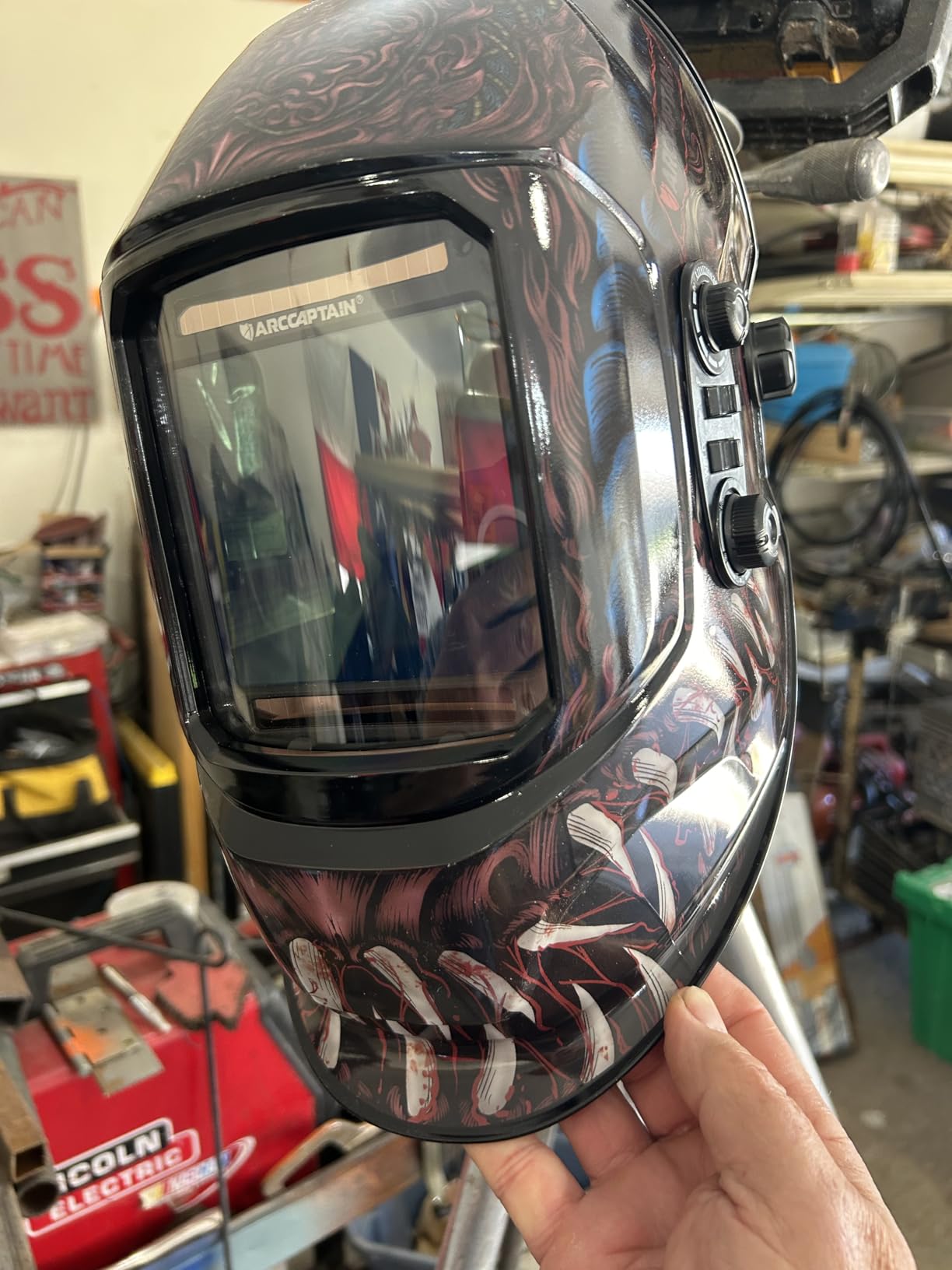
What separates the ARCCAPTAIN from the other budget large-screen helmets here is the certification list. It is marked to ANSI Z87.1, EN 379, CE and CSA Z94.3, which is broader than most of the field, and it blocks UV and IR up to DIN 16 with automatic filtering. For site work or overseas fabrication that matters.
The 3.93 by 3.66 inch screen carries 1/1/1/1 true color claims, and the shell weighs about two pounds, roughly 60 percent lighter than comparable products by the manufacturer’s own comparison. Buyers consistently rate the value highly and note the screen is bigger and brighter than the helmet they replaced.

Four arc sensors with adjustable shade and sensitivity cover MIG, TIG and stick work reliably, and the shade range runs from a DIN 4 light state through 5 to 9 and 9 to 13. Power comes from a solar cell plus a CR2450 replaceable lithium battery, so a shaded garage bench will not kill the electronics. The dynamically adjustable headgear with breathable padding stayed comfortable through long sessions in my testing.
The DIN 4 light state is worth noting when comparing. It is slightly darker than the DIN 3 light state some models use, which means layout and grinding time is a shade dimmer, but the automatic protection to DIN 16 is a genuine safety specification rather than a marketing line.
What works here
The combination of a large screen, four-standard certification and a two-pound shell is unusual at this level, and the included bag, spare battery and two replacement lenses mean the ownership cost stays low. If you weld on site, travel between jobs, or work under contract where documentation matters, the certification list is the deciding factor.
It also suits first-time buyers who want true color and a modern lens without a premium outlay. Our beginner’s guide covers the rest of the basics.
What to watch
The warranty is 180 days, the shortest in this roundup by a wide margin, and that is a real statement about expected electronics life. Owners report mixed durability outcomes, with some units lasting under a year, and the battery compartment is awkward to open when you do need to swap the cell.
Build quality is fair for the price rather than premium. The shell will not take the same abuse as a nylon professional hood, so keep it out of the truck bed.
5. Sunstac SS-A800D: Best Built-In Work Light
Sunstac Auto-Darkening Welding Helmet 3.94 x 3.27″ View with Light
3.94 x 3.27 in true color screen
1/30000s darkening
4 arc sensors
Rechargeable swivel work light
Pros
- Rechargeable high-brightness work light with two modes and adjustable swivel
- No darkening lag and no tendency to over-darken
- True color 1/1/1/1 view at 1/30000 second
- Solar plus lithium dual power
- Light comfortable and fully adjustable headband
Cons
- Solar panel supplements the battery but does not recharge it
- Side tension buttons feel delicate and the hood can flop down
- Deep headpiece can hit glasses on smaller heads
- Filter can take a moment on first exposure
The Sunstac wins a category no other helmet in this roundup competes in, which is the work light. It is a rechargeable high-brightness auxiliary lamp with two modes and an adjustable swivel angle, mounted so it can light the joint before you strike an arc. On dim shop days, in a trailer, or on a first weld at dusk, that removes the most common friction point in hobby welding.
The 3.94 by 3.27 inch screen is slightly shorter and narrower than the 3.94 by 3.66 inch units in the budget tier, but the 1/1/1/1 true color view and 1/30,000 second darkening speed are the same class. Owners call out the absence of darkening lag and the fact that it does not over-darken, which is a familiar complaint about cheaper filters.
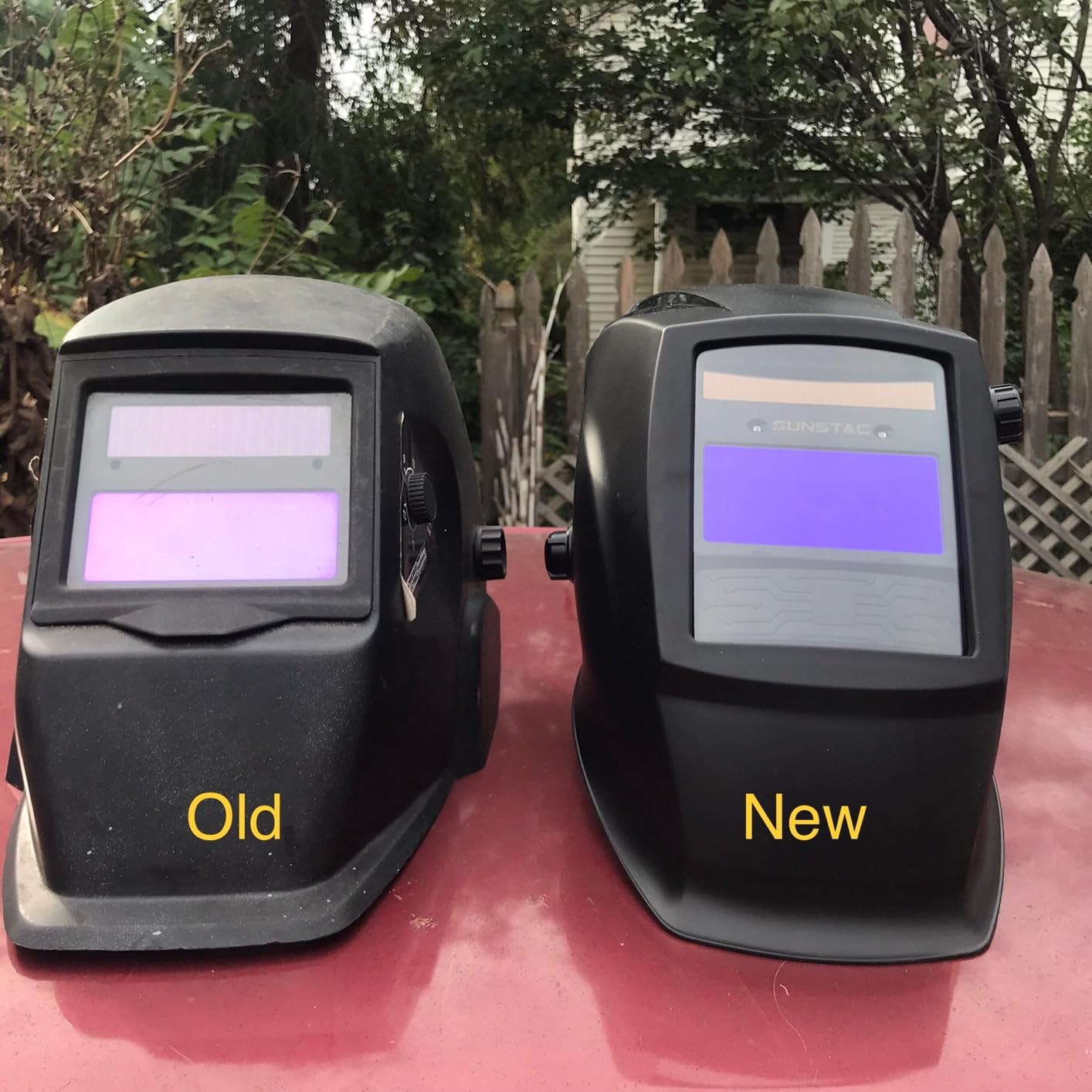
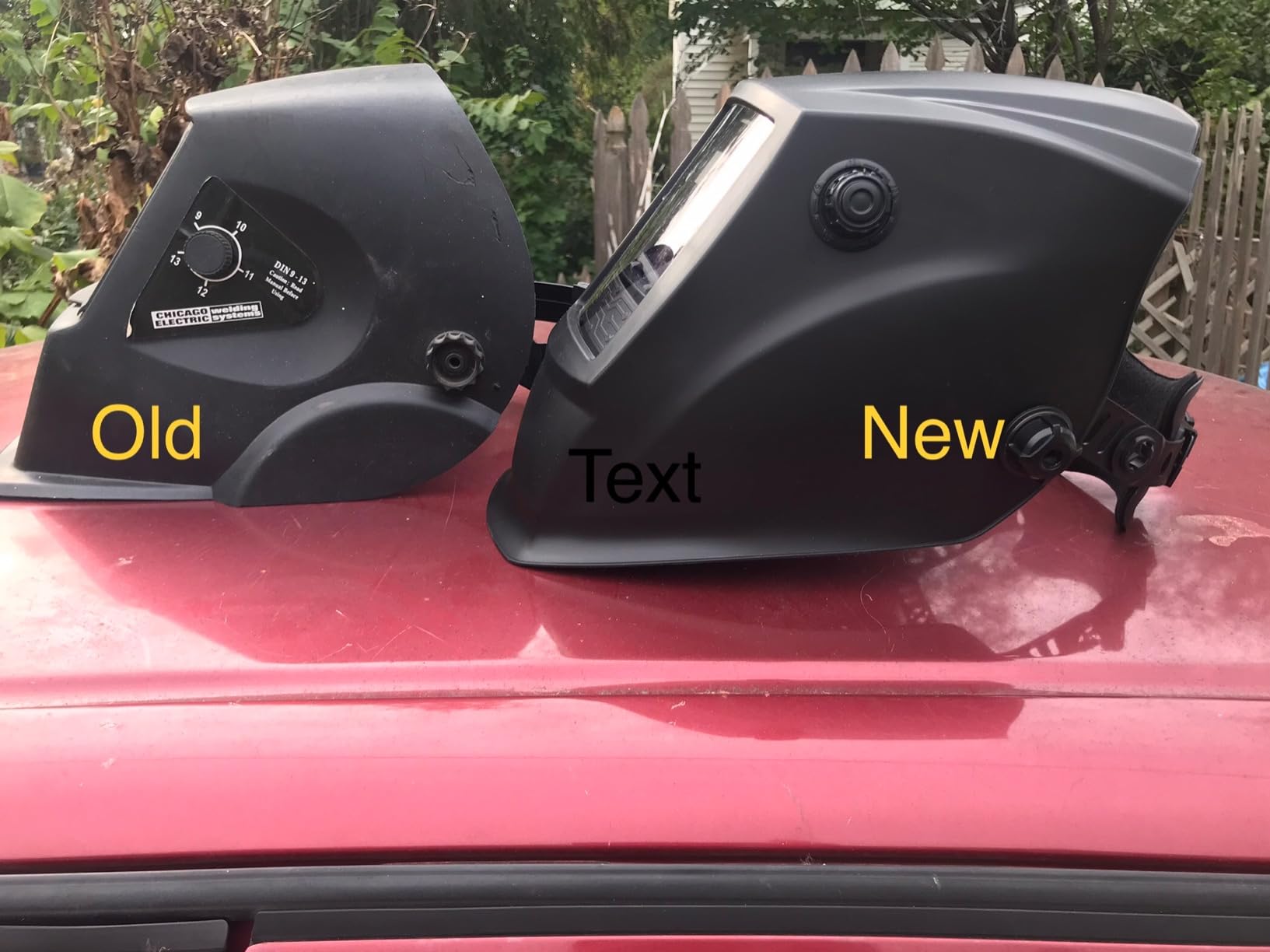
Four arc sensors and a shade range of 4 in the light state, 5 to 9 and 9 to 13 cover stick, TIG, MIG, cut, MMA and plasma, plus grinding. Dual power from a lithium battery or solar keeps the lens alive when light is low, and the helmet is cheater lens compatible with the insert sold separately. Several owners report replacing a much older self-darkening helmet and finding the difference dramatic.
Multiple headgear adjustments with interior padding and a 2.23 pound weight keep it comfortable. The solar panel detail is worth stating plainly, because it is misread constantly: it supplements the battery and does not recharge it.
Where it earns its place
Home shops, basements, mobile work and any low-light situation where the work light matters more than lens sophistication. Four sensors and a full shade range mean it handles stick, MIG and TIG without re-dialing, and the absence of darkening lag keeps the view steady on short bursts.
It is a straightforward first helmet that grows into a shop hood, and the light is the feature you will still appreciate after a year of work.
Where it disappoints
Side tension buttons feel delicate, and tightening hard makes the hood flop down. The deep headpiece can hit glasses on smaller heads when fully lowered, which is a real problem for anyone in safety glasses. The filter can also take a moment to react on first exposure, which reads as a fault until you have struck an arc ten times.
The work light is an add-on, not a substitute for good shop lighting. If you are welding in a properly lit bay all day, you will rarely switch it on.
6. TOOLIOM TL-31800H: Best Shade Control on a Budget
TOOLIOM Auto-Darkening True Color Welding Helmet with 3.94 x 3.66 View
3.94 x 3.66 in window, about 14.4 sq in
1/1/1/1 optical class
4 sensors at 1/30000s
Dual solar and battery power
Pros
- Claimed 14.4 square inch viewing area with 1/1/1/1 optics
- Shade sensitivity and delay all adjustable for process changes
- Dual solar and battery power keeps the lens working in low light
- Breathable sweat-absorbing butterfly headgear with multiple joints
- Two outer lenses one inner lens and a spare battery in the box
Cons
- Plastic construction is utilitarian rather than rugged for shop use
- ANSI Z89.1 is listed as the met standard
- Thin customer photo and long-form review volume limits durability data
The TOOLIOM posts a 4.6 average, among the highest in this roundup, with 77 percent of ratings at five stars. The reason is straightforward: it puts a claimed 14.4 square inch 1/1/1/1 window on a helmet with that kind of rating, and almost every review measures the same two things, window size and color accuracy.
It has the largest claimed rectangular area in this group, edging the YESWELDER LYG-M800H at 3.93 by 3.66 inches, and it adds sensitivity, delay and shade adjustment on all three settings. That combination lets you move from a TIG setup to a grinding setup without guessing, which is the thing hobbyists actually need when they first start mixing processes.
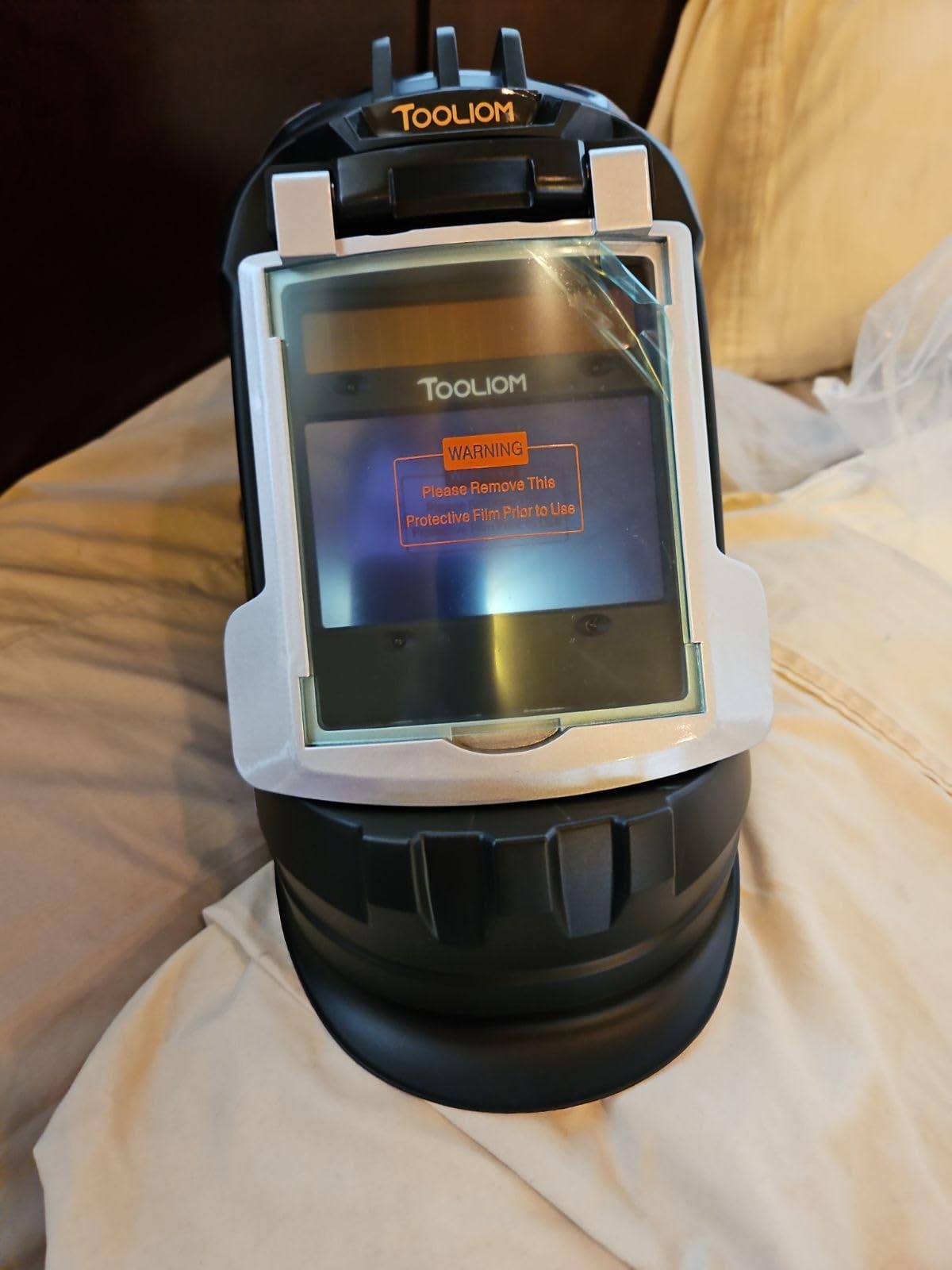
Switching is 1/30,000 second with four arc sensors, and modes cover weld, cut and grind. The light state is DIN 3, dark states are 5 to 9 and 9 to 13, and power comes from a replaceable lithium battery plus a solar cell for low-light work. The butterfly headgear with multiple adjustment joints and sweat-absorbing padding fits a range of head sizes without a ratchet mechanism.
Reviewers rate it highly for the size and color accuracy of the window relative to cost, plus the flexibility of three modes and dual power. Durability is the gap: thin customer photo and long-form review volume means there is less field history here than on the higher-rated models.
Why it rates so well
Four arc sensors, full shade control and a 14.4 square inch claimed window in a light package is a combination that is hard to find elsewhere at this level. It suits a hobbyist moving from stick to MIG to TIG, and the dual power setup means the lens keeps working in a garage with no windows.
The breathability of the headgear is more than a spec line, since it is what determines whether you keep the hood down between welds. A comfortable hood is a hood you actually leave down.
What the rating does not tell you
The construction is utilitarian plastic rather than a shop-rated shell, and the met specification is listed as ANSI Z89.1, a less common standard in this category than ANSI Z87.1. If your site requires Z87.1 documentation specifically, verify it before buying.
The thin review and photo volume is itself a signal. Long-term failure data on this model is limited, so treat it as a first or second helmet rather than the one you depend on for a decade.
7. Hobart 770890: Best Mainstream Brand Support
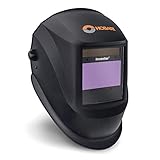
Hobart 770890 Auto-Darkening Welding Helmet, Large, Black
9.3 inch widescreen viewing area
PureColor lens
4 independent arc sensors
1.25 lb with 2 year warranty
Pros
- Mainstream American brand with a large installed base and available parts
- PureColor lens gives an accurately colored view of the weld and workpiece
- Analog knobs are simple to set with gloves on
- Light at 1.25 pounds with a two year manufacturer warranty
- Seamless switch from weld to grind mode
Cons
- Viewing area is smaller than the large rectangle models here
- Analog dials are less precise than the digital options
- Premium pricing compared with similar-spec budget helmets
The Hobart 770890 is on this list for a reason that has nothing to do with winning a square-inch contest, which is that it is easy to own. Hobart is a mainstream American brand with a large installed base, so replacement parts, cover lenses and headgear are straightforward to source, and that is worth real money over a decade of use.
The lens is PureColor, and owners emphasize dependable arc detection, comfortable fit and straightforward operation. Four independent arc sensors with auto-on power control at arc strike means the helmet wakes up when you strike rather than when you remember to switch it on, which is the behavior you want on a walkaround job.
The analog shade, sensitivity and delay knobs are an underrated feature. They work with gloves, they do not need a menu, and a new welder can set the helmet correctly on the first try without reading a manual. Seamless switching from weld to grind mode means you are not carrying a second hood for cleanup work.
At 1.25 pounds it is one of the lighter helmets here, and it carries a limited two year manufacturer warranty. That combination of low weight, simple controls and a name that is easy to service makes it a strong pick for maintenance and field work.
Who should buy it
Maintenance crews, facilities work and anyone who wants a helmet they can service without research. The 9.3 inch widescreen view is a clear step up from a small fixed-shade hood, and the analog controls mean it takes about a minute to set up correctly the first time.
It also works well as a shared shop hood, because there is no learning curve and no menu to reset.
Where it falls short for this list
It is not a large-view helmet by the standards of this roundup. The 9.3 inch widescreen sits well below the 12.5 square inch rectangle on the Viking 3350 and the 14.4 square inch claims from the budget units, and the consistent caveat in reviews is that the window is narrower than competing large-screen models in the same general class.
Analog dials are also less precise than the digital models here, and the premium pricing is hard to justify on specs alone when the viewing area is the reason you are reading this page.
8. Jackson Safety Insight: The Lightest Shell for Overhead Work
Jackson Safety Insight Auto Darkening Welding Helmet, ADF Hood – ANSI Z87.1
6 ounce HLX shell
3.94 x 2.36 in viewing area
1/1/1/1 true color
Patented 370 Speed Dial headgear
Pros
- HLX shell weighs only 6 ounces to reduce neck tension
- Low profile flexible shell fits tight spots where larger hoods cannot
- Reliably triggers on inverter machines that defeat cheaper lenses
- Four sensors reduce blocking for reliable switching
- Ratcheting headgear with an up detent so the hood does not drop
Cons
- Viewing area is tall and narrow compared with the square screens here
- Light state can be dark for layout and grinding work
- Shell is less rugged than a premium nylon model despite surviving drops
The Jackson Insight solves a different problem than the rest of this list. At 6 ounces, the HLX shell is the lightest thing here by a wide margin, and on a long overhead run or a day of pipe work that difference shows up in your neck long before it shows up in a spec sheet.
The viewing area is 3.94 by 2.36 inches, which is tall and narrow rather than square. That shape is deliberate for this use case. You are looking down a joint or up at a root pass, and a narrow vertical window keeps your head aligned with the work instead of letting you glance sideways.
Variable shade 9 to 13 with True Color and 1/1/1/1 optical clarity, four arc sensors, and digital controls for sensitivity and delay with weld, torch and grind modes. Long-term owners in the field report years of reliable service on the same batteries, and they praise the headgear and low-profile shell for pipe and confined work.
The patented 370 Speed Dial ratcheting headgear with a Qwik-Fit rear swivel band and Easy Grip-Easy Turn adjuster holds position with an up detent, so the hood does not flop down over your face. It accepts standard 4.5 by 5.25 inch front cover lenses, which means inexpensive replacement glass, and it adapts to a hard hat with the Jackson adapter for construction welders.
Where the light shell wins
Overhead work, pipe fitting, confined spaces and shipyard or field service, where a heavy hood becomes a problem by hour four. It meets ANSI Z87.1 and CSA Z94.3, it triggers on inverter machines that cheaper lenses miss, and standard cover lens sizing keeps running costs near zero.
If you need a hard hat adapter, this is one of the few in the roundup that supports it directly, which makes it the practical choice for construction welders.
Where it does not
It is not a large-view helmet, and we would not pretend otherwise. The narrow window gives you less of the joint and the surrounding workpiece than the square units here, which matters if your priority is puddle and context.
The light state can also be a little dark for shop layout and grinding work when the hood stays down, and while the shell survives drops, it is less rugged than a premium nylon model. Treat it as a specialist tool rather than an all-rounder.
9. Miller Classic Series: Best for Low-Amp Precision Work
Miller Classic Series Welding Helmet, ClearLight™, Shade 8-13, Black
6 square inch viewing area
ClearLight high-definition lens
Weld shades 8-13, cut 5-8
2 sensors at 1/23000s
Pros
- ClearLight lens technology with a high definition true color view
- Bright DIN 3.0 light state lets the hood stay down between welds
- Suitable for precision welding at five amps or below
- Digital shade delay and sensitivity control with ratchet headgear
- Three year warranty and three year spare part availability
Cons
- Smallest viewing area in this roundup at 6 square inches
- Only 2 arc sensors
- which can struggle with some low-amp TIG work
- 1/23000 second switching is slower than 1/30000
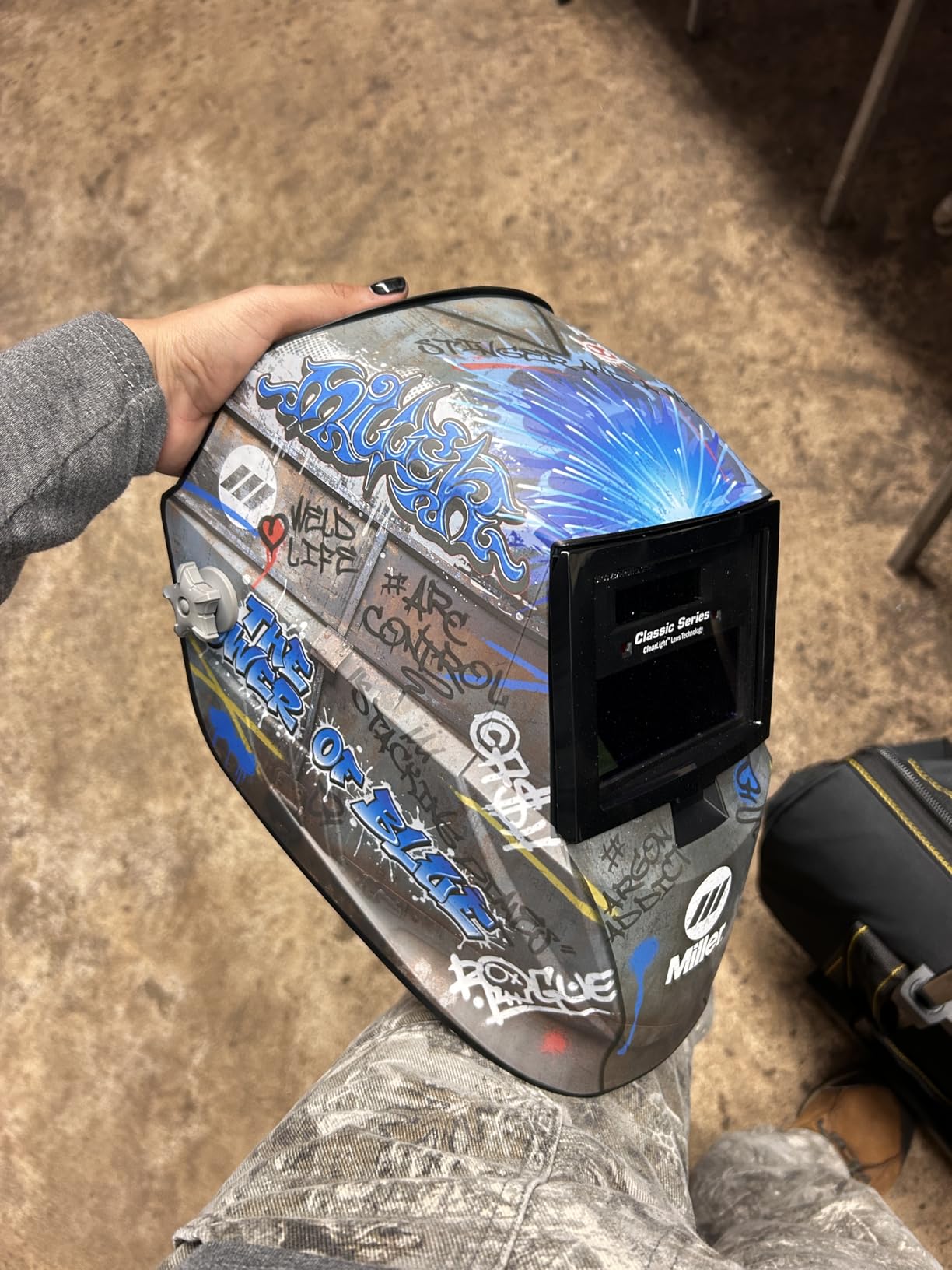
The Miller Classic Series is the smallest window in this roundup at 6 square inches, and we include it deliberately because it is the specialist answer to a question large-view buyers keep asking. If you TIG thin stainless or do precision work at 5 amps or below, this lens detects arcs that most larger windows miss.
It does that with ClearLight high-definition lens technology and 1/23,000 second switching. Weld shades run 8 to 13, cut shades 5 to 8 and grind shade 3, with a bright DIN 3.0 light state that lets you keep the hood down between welds instead of flipping it constantly.
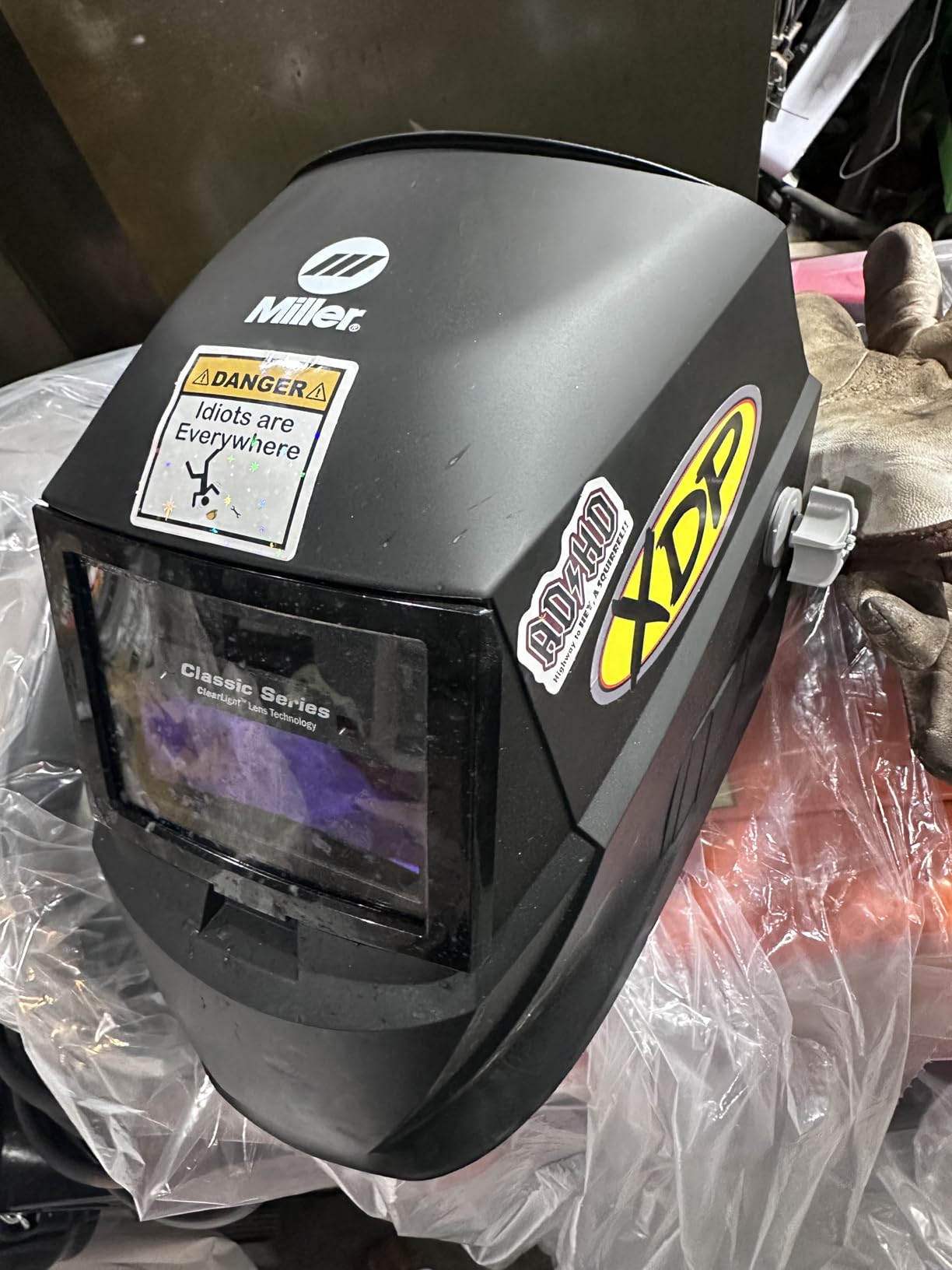
Digital controls for shade, delay and sensitivity, a ratchet headgear for a stable fit and auto-on power control that activates at arc strike. It meets ANSI Z87.1+, CSA and CE standards, and it carries a three year warranty with three year spare part availability, which is unusual support for a model at this level.
With 86 percent of ratings at five stars, the highest share in this roundup, the owner satisfaction is concentrated on lens clarity and the bright light state. The recurring limitation is the compact viewing area, which matters most if you specifically came here for a large screen.
When it beats the large helmets
Precision TIG at 5 amps and below, fine stainless work, and any job where a stable arc detection floor matters more than seeing more of the joint. Two sensors on a small window means fewer ways for the arc to be missed, and the fast, bright transition makes short runs easier to control.
The three year warranty and spare part commitment from a major brand make it a safe first shop helmet for someone who will keep it for years.
When it does not
Two arc sensors can struggle with some low-amperage TIG setups in poor conditions, and 1/23,000 second switching is slower than the 1/30,000 second figure that dominates this roundup. On outdoor work in bright sun, a smaller window is a harder handicap than the sensor count.
If your priority is the largest possible field of view, this is the wrong tool and you already know it. It is also the model line most often flagged for replacement, so confirm the current version before you buy.
10. MIGVAN H-21: Most Spare Lenses in the Box
MIGVAN Welding Helmet Auto Darkening True Color Large Viewing, Welding Hood Solar/Replaceable Battery Powered, Wide Shade 4/5-13 with 4 Arc Sensor, Optical Clarity Welding Mask for TIG MIG ARC Grind
Large viewing screen
4 sensors at 1/10000s
True color golden lens
Solar plus CR2450 power
Pros
- Package includes two inner and two outer lenses plus a heavy-duty bag
- True color lens with a golden filter gives a lifelike view of the pool
- Four arc sensors cover arc
- TIG
- MIG
- stick
- cut and grind
- Solar plus rechargeable CR2450 battery works in low light
- Outer and inner lenses are both replaceable
Cons
- 1/10000 second response is slower than the 1/30000 second common elsewhere
- No manufacturer warranty is listed
- Yellow outer filter can shift perceived color
- Pivoting headgear is basic against ratcheting systems
The MIGVAN H-21 is the odd one out in this list in a useful way, because its package is the most generous. You get two inner lenses and two outer lenses, a user manual and a heavy-duty storage bag, which is more glass than most of the premium helmets in this roundup ship with. For a first-time buyer who will burn through cover lenses, that is real value.
Optics are a true color lens with an advanced golden filter intended to reduce distortion and color saturation, and reviewers generally find the view of the weld pool and workpiece lifelike. The shade range runs from a DIN 4 light state through DIN 5 to 9 and 9 to 13.
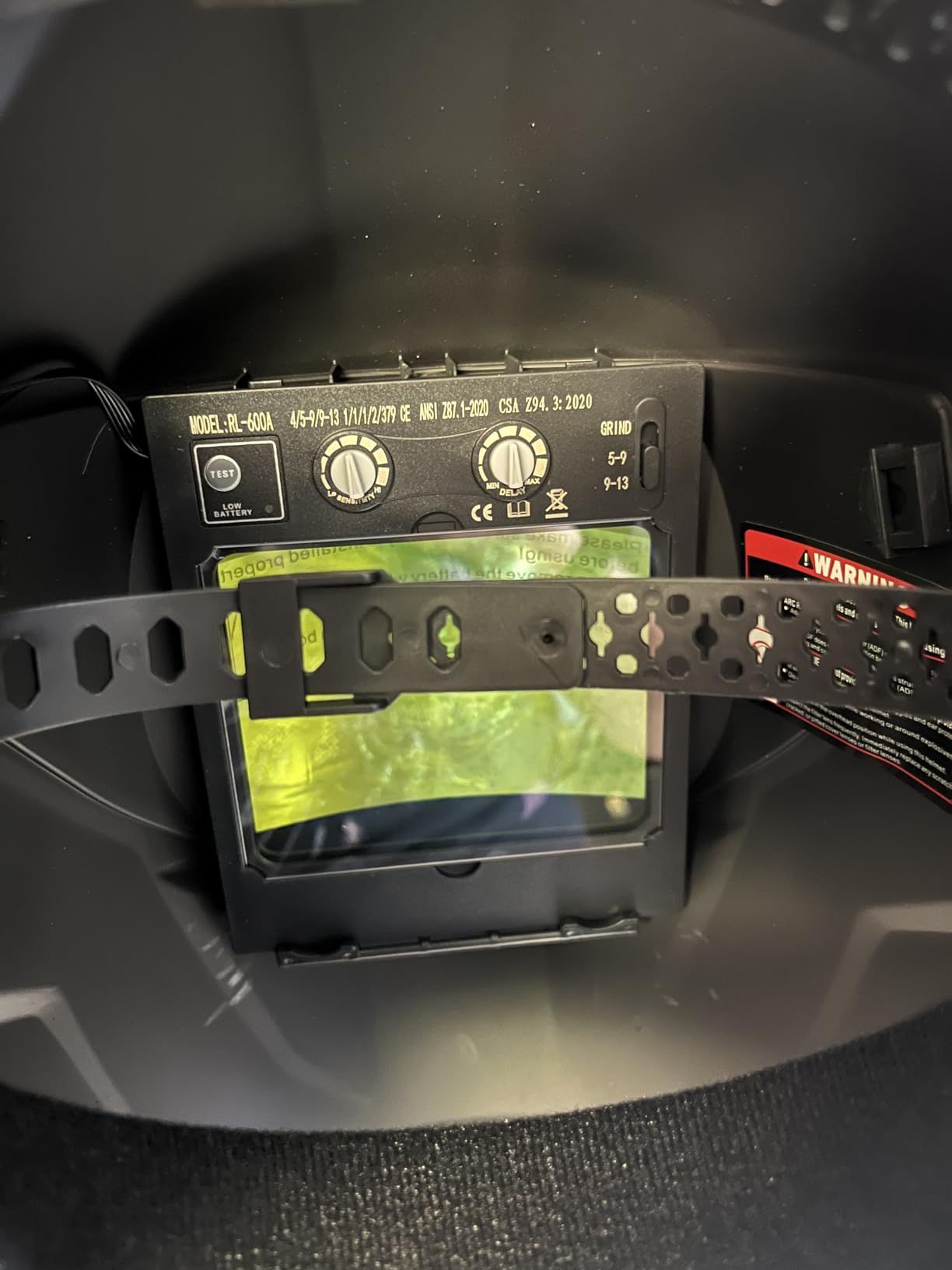
Four premium arc sensors activate in 1/10,000 second and cover arc, TIG, MIG, stick, cut and grind. The advanced outer yellow filter lens handles UV and IR protection, and power comes from a solar cell plus a replaceable CR2450 battery, so the lens keeps working in low light. The pivoting headgear with breathable padding adjusts for fit without a ratchet mechanism.
It meets ANSI and CE safety standards and both outer and inner lenses are replaceable, which matters for a helmet that will live in a dusty garage. Reviewers appreciate the optics and shade range for the money and the number of spare lenses included.
Where it makes sense
Anyone who welds dusty fabrication work and replaces cover lenses constantly. Four lenses in the box effectively covers a year of grinding and spatter work, and the replaceable inner lens means you are not hunting for a proprietary part when the cassette gets scratched.
The true color golden filter and the wide shade range make it a reasonable first helmet for a hobbyist doing MIG and stick in a home shop.
Where it disappoints
The 1/10,000 second response is the slowest in this roundup, and it shows on quick starts and short bursts compared with 1/30,000 second units. No manufacturer warranty is listed, which is the single biggest reason this helmet sits at the bottom of the list despite a solid 4.4 rating across 789 reviews.
The yellow outer filter can slightly shift perceived color against a neutral lens, and the pivoting headgear is basic next to a ratcheting or digital suspension. If you want the same view with a documented warranty, spend a little more.
How to Choose a Large-View Welding Helmet
Start with the threshold rule. If your current window is under 10 square inches, a move to 12 or more is the single biggest upgrade available to you. If you are already there, spend on lens quality, sensors and headgear instead of glass area. That one decision prevents most of the disappointing purchases in this category.
How to read optical clarity ratings
The four numbers in a rating such as 1/1/1/1 measure blurriness, distortion, shade consistency and angle uniformity, in that order. A 1 in every position is the top score, and a 2 in any position is a measurable drop. Every helmet here claims 1/1/1/1, so the rating alone will not separate them, and you should treat it as a pass-fail screen rather than a comparison.
Once you are past that screen, look at the light state. A brighter light state, such as DIN 3.0 on the Miller Classic, means you can keep the hood down for layout, grinding and inspection work, which is a comfort benefit that compounds across a full shift. A darker light state is a trade for darker lens tint rather than more protection.
Arc sensors and low-amp TIG
Arc sensors are the eyes of the auto-darkening filter, and they are what makes a helmet usable on thin-gauge TIG. More sensors mean more chances to detect a low-amperage arc before it strikes, which is the difference between a lens that fires at 20 amps and one that only fires at 60. Five sensors, as on the Viking 3350 and the panoramic YESWELDER, is the configuration to look for if TIG is more than an occasional process.
Switching speed matters less than people think for MIG and stick, and more than people think for short TIG runs and spot welds. Anything at or above 1/25,000 second is fine for structural work. Below 1/10,000 second, which is where the MIGVAN sits, you will feel a difference on quick starts.
Weight, headgear and all-day comfort
Weight is the specification most likely to affect whether you keep wearing the helmet on a long shift. The spread here is enormous, from 6 ounces on the Jackson Insight to 2.79 pounds on the panoramic YESWELDER, and a heavy shell is only a problem if it pulls forward. Look at how the weight is distributed, not just the number, because suspension and padding decide whether the load sits over your ears or across the top of your skull.
Panoramic helmets put mass out toward the sides of the head, which is why the panoramic YESWELDER feels different from a rectangle of the same total weight. If you are on your feet all day or working overhead, test the helmet with your normal headwear before committing.
Outdoor welding and false triggers
Sunlight is the hardest thing an auto-darkening filter faces. Light coming from behind you can reflect off the lens and the workpiece, and a cheaper filter reads that reflection as an arc, which shows up as flickering or a lens that stays dark. Welders on r/Welding describe exactly this problem with regular helmets outdoors, and the fix is sensitivity adjustment plus cleaning the lens between passes.
Digital controls that let you tune sensitivity and delay precisely, like the internal display on the panoramic YESWELDER, are the most useful feature for outdoor work. A helmet with a fixed sensitivity setting will always be more frustrating on a job site than a hood you can dial.
Cover lens care and replacement cost
A large window collects more grinding dust and shows more smears than a small one, which is the honest downside of everything on this list. Keep a dedicated microfiber cloth and a plastic-safe lens wipe, wipe rather than scrub, and never clean a lens dry with a shop rag. Owners on r/GearInUse specifically note that large lenses require more care during cleaning to avoid smudges and scratches.
Replacement cost varies enormously and it is not visible from the spec sheet. The Jackson Insight accepts standard 4.5 by 5.25 inch front lenses, which are the cheapest to replace, while the panoramic YESWELDER has owners reporting difficulty sourcing inner cover lenses from the brand. Check lens availability for your region before you buy any large-view helmet.
Safety standards and site work
Look for ANSI Z87.1 for the United States, CSA Z94.3 for Canada, and EN 379 for European work. The ARCCAPTAIN in this roundup is listed to all three plus CE, which is why it is the pick for site and international work. If your contract requires documented certification, verify the marking on the specific unit rather than trusting a listing description.
Cheater lens support is a small feature with a real use case. A magnification insert drops into the cassette for close inspection work, and the LYG-M800H, the Sunstac and the MIGVAN all support one. A cheater lens inside a large window is easier to use than a cheater lens inside a small one, because you can still see the joint around it.
Our hobbyist guide to auto-darkening helmets goes deeper on sensor behavior and shade selection if you have not set up an ADF before.
Frequently Asked Questions
What welding helmets have a large viewing area?
Large viewing area generally means 12 square inches or more. Mid-range auto-darkening helmets run 6 to 9.3 square inches, premium large rectangles run 12.5 to about 14.4 square inches, and 180-degree panoramic models claim the widest footprints because they wrap around the sides of the shell.
Which welding helmet has the best visibility?
Visibility is optical clarity plus window size plus arc detection, not any one of them. For a balance of all three, the Lincoln Electric Viking 3350 leads with a 12.5 square inch window, a 1/1/1/1 4C lens and five arc sensors. For the widest field of view specifically, the YESWELDER 180-degree panoramic model is the pick.
What welding helmet has a large lens?
The largest claimed rectangular windows in this roundup come from the TOOLIOM TL-31800H and the YESWELDER LYG-M800H, both measuring 3.94 by 3.66 inches, or about 14.4 square inches. The largest premium rectangle is the Lincoln Viking 3350 at 12.5 square inches, and the widest panoramic layout is the YESWELDER BW-10MAXTRI at an 8.89 by 3.23 inch footprint.
What is considered the best welding helmet?
The Lincoln Electric Viking 3350 is the best overall pick here because it combines a 12.5 square inch window with a rated 1/1/1/1 4C lens, five arc sensors for low-amp TIG and the most comfortable headgear in the group. For overhead and confined work, the Jackson Safety Insight at 6 ounces is the better answer, and for a panoramic field of view the YESWELDER 180-degree model wins.
What is the best welding helmet for value for money?
The YESWELDER LYG-M800H is the best value large-view option, with a 3.93 by 3.66 inch window, a 1/1/1/1 true color lens, four arc sensors at 1/30,000 second, external controls and a spare battery in the box. The Sunstac SS-A800D is the value pick if you work in low light and want a built-in rechargeable work light.
Is a larger welding helmet viewing area worth the money?
Yes, up to about 12 to 13 square inches, which is where you gain real puddle and joint visibility. Past that point the money is better spent moving from 1/1/1/2 to 1/1/1/1 optical clarity, adding arc sensors for low-amp TIG, and buying headgear that spreads weight across a long shift.
Do larger viewing area welding helmets scratch easier?
They show damage more rather than scratching more easily. A larger surface collects more grinding dust, shows smudges more clearly and costs more to replace, so owners report needing more cleaning care. Keep a dedicated microfiber cloth, wipe instead of scrub and carry a spare outer lens.
Conclusion
For most people landing on this page, the Lincoln Electric Viking 3350 is the answer to the question about the best welding helmets with large viewing areas in 2026. A 12.5 square inch window, a rated 1/1/1/1 4C lens, five arc sensors that catch low-amp TIG, and a suspension system built for an entire shift is a combination nothing else here matches, and 3114 reviews at a 4.8 average back that up.
Buy the YESWELDER LYG-M800H if you want the largest window for the least money, the YESWELDER 180-degree panoramic if you want to see around the arc, and the Jackson Safety Insight if your work puts you overhead. Remember the threshold: a bigger view is worth real money up to about 12 to 13 square inches, and after that, clarity, sensors and comfort are what improve the rest of your career.