

If you live in a place under 1,000 square feet, the best ductless mini splits for small homes are almost always single-zone inverter systems in the 9,000 to 12,000 BTU range. Our top pick is the Senville LETO 12,000 BTU for its 4.4-star rating across more than 2,100 reviews, 20.8 SEER efficiency, and heating that keeps running down to 5F. Below that, a 9,000 BTU head covers a typical bedroom, and 115V models skip the panel work entirely.
We spent weeks comparing ten of the highest-reviewed ductless systems currently shipping, reading the customer reviews closely and cross-checking every specification against the manufacturer listing. What came out the other end is a short list that fits small footprints, small budgets and small electrical panels.
Most mini split guides on the internet are written for 2,000 square foot homes with two floors and a dedicated mechanical room. That framing misses the questions a small-home owner actually asks: whether a 9,000 BTU head is too big for a 300 square foot bedroom, which breaker the electrician needs to run, and whether a landlord or HOA will allow a hole through the exterior wall at all. We built this roundup around those questions instead.
Two quick definitions before the picks. A ductless mini split is a heat pump with one outdoor condenser connected by a small refrigerant line to one or more wall-mounted indoor heads, so you get room-by-room control without any ductwork. And SEER2 is the current efficiency rating; since the 2023 rating change a system needs roughly 20 SEER2 to be considered efficient rather than merely adequate.
One more thing worth knowing before you shop. The federal Section 25C energy credit for heat pumps expired on December 31, 2025, so that deduction is gone from 2026 budgets. State and utility programs such as HEAR and HOMES money and utility rebates are still running in many regions, and several systems below carry an Energy Star label that some utility programs specifically require.
Top 3 Ductless Mini Splits for Small Homes in 2026
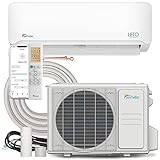
Senville LETO 12,000 BTU
- 20.8 SEER inverter
- Heating to 5F
- Alexa and app control
- 16 ft pre-charged line set


Cooper and Hunter MIA 12,000 BTU
- 21.2 SEER2
- 115V power
- 26 dB operation
- 7 year compressor warranty
All 10 Systems at a Glance in 2026
| Product | Specifications | Action |
|---|---|---|
| Senville LETO 12,000 BTU |
|
Check Latest Price |
| DELLA Vario Series 9,000 BTU |
|
Check Latest Price |
| Cooper and Hunter MIA 12,000 BTU 115V |
|
Check Latest Price |
 COSTWAY 12,000 BTU COSTWAY 12,000 BTU |
|
Check Latest Price |
 SereneLife 9,000 BTU SereneLife 9,000 BTU |
|
Check Latest Price |
 ROVSUN 9,000 BTU ROVSUN 9,000 BTU |
|
Check Latest Price |
 Mountman 9,000 BTU Mountman 9,000 BTU |
|
Check Latest Price |
 Rellytech 9,000 BTU Rellytech 9,000 BTU |
|
Check Latest Price |
 Albott 12,000 BTU Albott 12,000 BTU |
|
Check Latest Price |
 DELLA Serena Series 9,000 BTU DELLA Serena Series 9,000 BTU |
|
Check Latest Price |
1. Senville LETO 12,000 BTU – Best Overall for Small Homes
Senville LETO Mini Split Air Conditioner, Heat Pump, White, 12000 BTU
12000 BTU
Up to 700 sq ft
20.8 SEER inverter
Heating to 5F
28 dB
Pros
- Heating holds up down to 5F
- Inverter runs at 20.8 SEER
- Alexa and app control
- Pre-charged for 25 ft of line set
- Same chassis runs 9000 to 30000 BTU
Cons
- Heaviest set here at 78.3 lb
- Parts warranty is 2 years
- Professional install required
The Senville LETO is the system we keep coming back to, and the reason is simple: it is the only unit in this group that handles a small open-plan home, holds its heating capacity deep into winter, and still carries a review base large enough to trust. It is a 1-ton inverter system rated for 12,000 BTU of cooling and for rooms up to 700 square feet, which covers the majority of small homes in one zone.
Owners on r/HomeImprovement and r/hvacadvice repeatedly describe this as a set-and-forget install, and the review data backs that up. Of more than 2,100 reviews averaging 4.4 stars, buyers most often mention quiet operation on both the indoor head and the outdoor condenser, and the fact that the included 16-foot line set arrives pre-charged, so a short run does not require a refrigerant recharge.
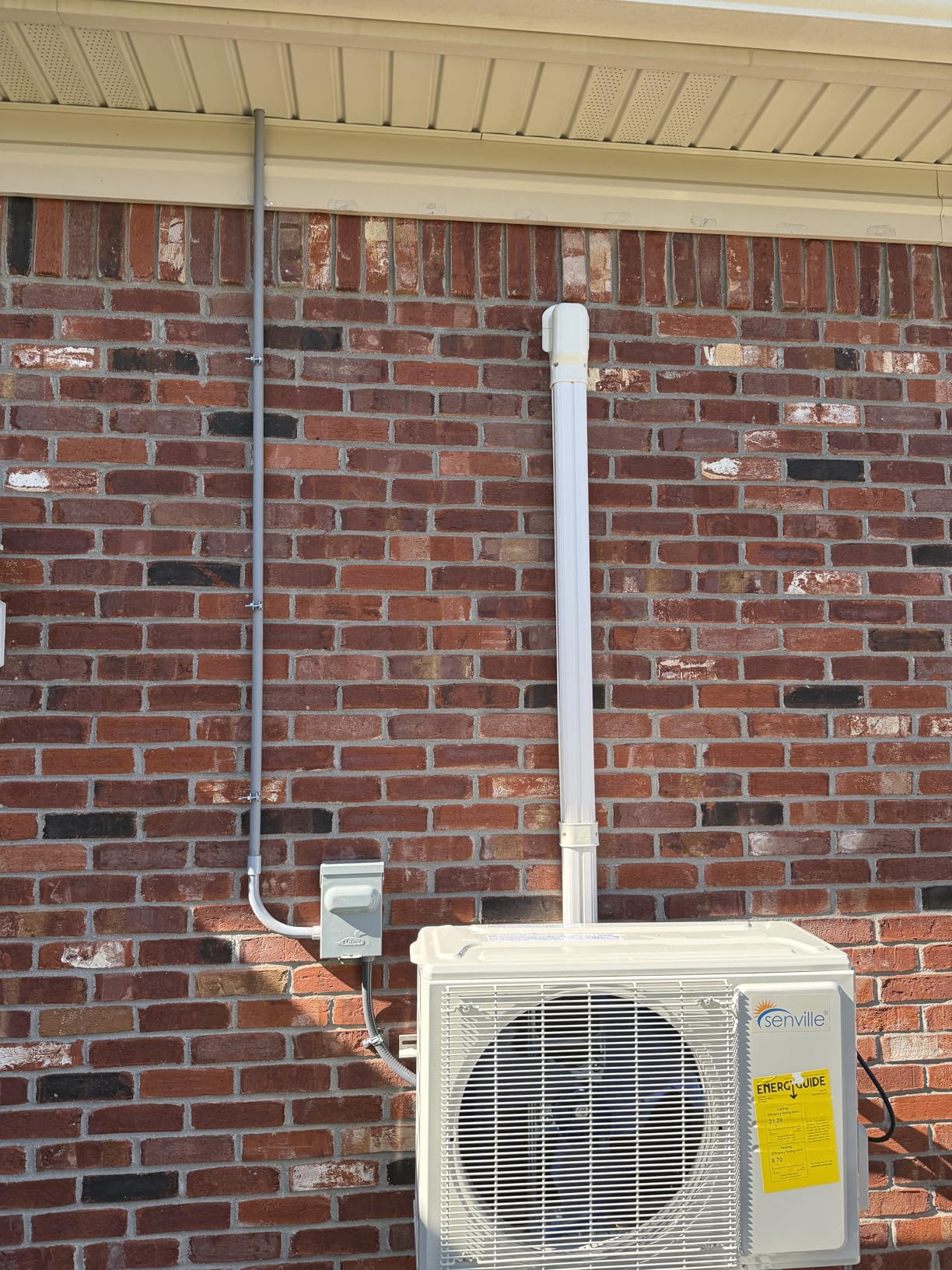
Two specifications separate it from most of the field. The first is 20.8 SEER, which is genuinely efficient for a 1-ton capacity and is well above the 20 SEER2 baseline that most of the budget units in this roundup sit on. The second is the published heating floor of 5F, meaning the heat pump keeps producing heat down to roughly 5 degrees Fahrenheit before it depends on backup resistance heat.
On the technical side, the LETO is a 4-in-1 system: cooling, heat pump heating, dehumidification and fan, with a DC inverter compressor. Refrigerant is pre-loaded R-454B, the newer low-GWP blend now appearing on most current equipment, and the included kit covers 16 feet of line set plus communication wire, factory charged for runs out to 25 feet.
The catch is weight. At 78.3 pounds for the pair, this is the heaviest single-zone system we tested in this group, and the indoor head still needs two people and proper mounting hardware. Warranty language is also worth reading carefully: the listing headlines a five-year warranty, while the specification block breaks that down as two years on parts and five years on the compressor.
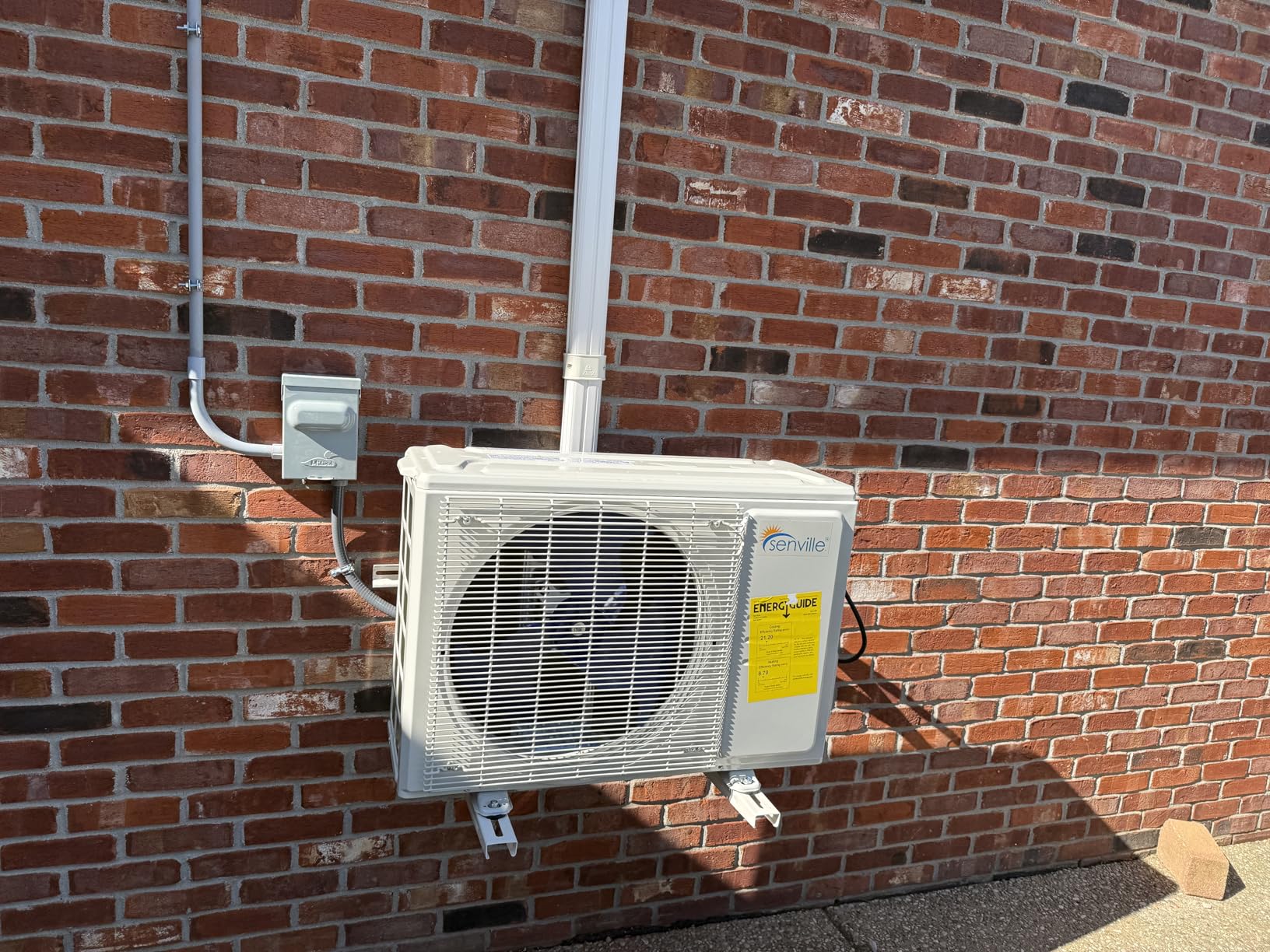
What the Senville LETO handles well in a small home
The reason this one earns the top slot is coverage per zone. A 700 square foot rating means one head can serve the main living space of a small house, a converted garage, or an ADU, and you are not forced into a multi-zone build on day one. Owners of 9000 and 12000 BTU versions of the same chassis report the line set and install are routine.
The heating floor of 5F matters more than most buyers expect. In a small home, the cost of running a single central system to heat three separate rooms is exactly the problem a multi-zone layout solves, and a heat pump that keeps working at low ambient temperature is what makes that plan pay off across a whole winter rather than four mild weeks.
Where it is the wrong choice
If your electrical panel is modern and your installer is straightforward, the R-454B refrigerant is a non-issue. If you are adding this to a property that still has an older R-410A system, though, refrigerant compatibility rules limit what a technician can do, and mixing refrigerant families is not permitted.
The other mismatch is partial loads. A 1-ton unit cooling a 250 square foot bedroom will short-cycle more than you would like. This is the right system for a main floor, not the right system for a small closed room, and the same chassis is available in a 9000 BTU version if the room is small.
2. DELLA Vario Series 9,000 BTU – Best for a Small Bedroom
DELLA Vario Series 9000 BTU Mini Split Air Conditioner, Work with Alexa and Wifi, 20 SEER2, Energy Star, 0.75 Ton, Cools Up to 400 Sq.Ft, Ductless Inverter System, Heat Pump Pre-Charged, 16.4ft Kits
9000 BTU cooling
10000 BTU heating
Up to 400 sq ft
20 SEER2
29 dBa
Pros
- Heats down to -4F
- 20 SEER2 with 5 Star BEE rating
- Alexa plus DELLA app
- iFeel remote sensor
- 16.4 ft pre-charged line set
Cons
- Requires 208-230V circuit
- Professional install with vacuum and gauges
- Icon-only remote labels
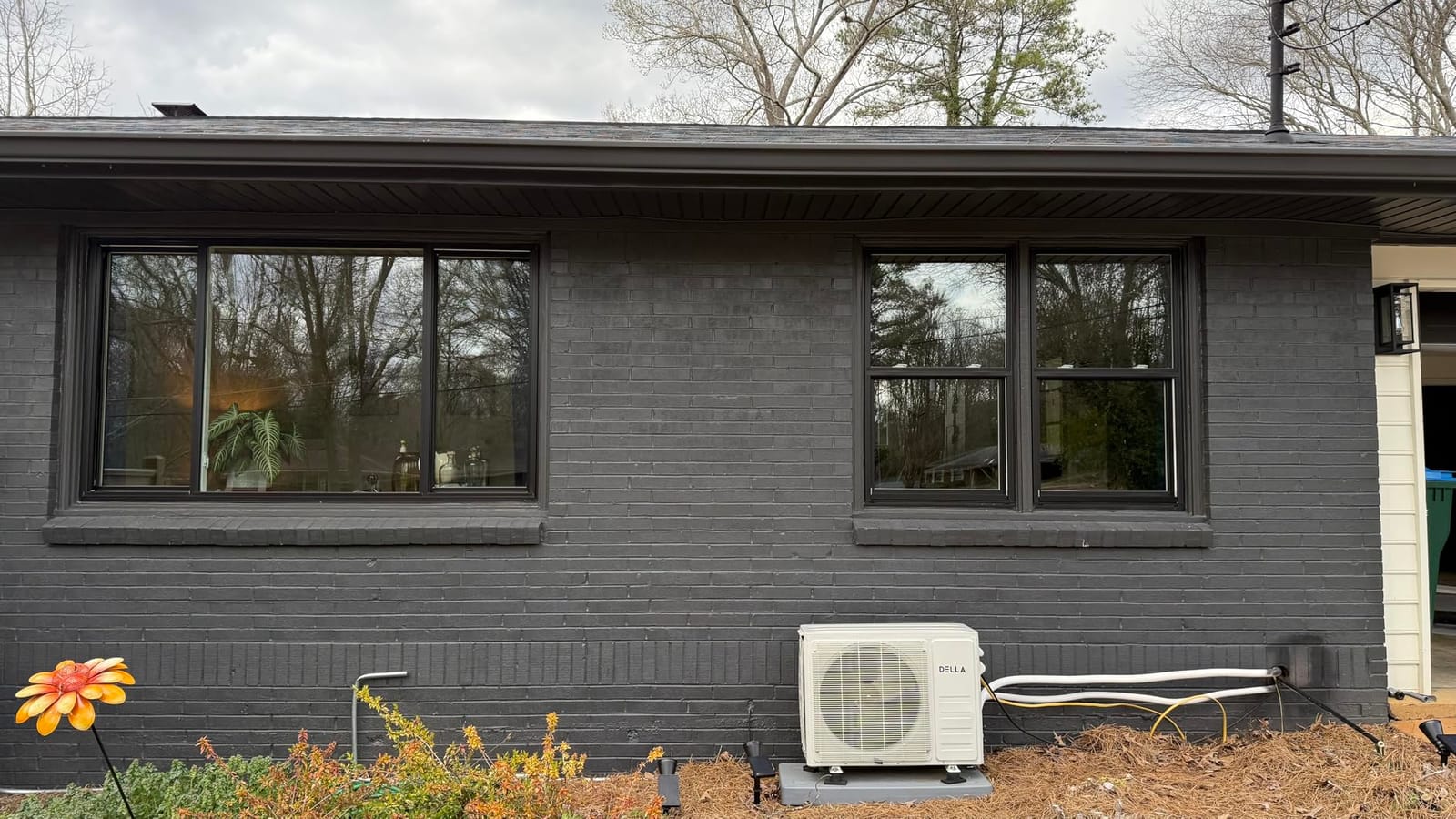
This is the answer to the most common question on the mini split forums: which system should cool a single small bedroom. A 9,000 BTU inverter head rated for up to 400 square feet, with 20 SEER2 efficiency and heating that holds to minus 4 degrees Fahrenheit, is the right starting point for the room most small-home owners want to cool first.
Users on r/DIYHeatPumps who installed this or the equivalent size repeatedly say the same thing: a 9,000 BTU head is already generous for a 300 square foot bedroom, and stepping up to 12,000 BTU in that room makes comfort worse, not better, because the system cycles on and off more. The same reviewers caution against the opposite mistake too, which is a bedroom with west-facing windows in a hot climate that genuinely needs 12,000 BTU.
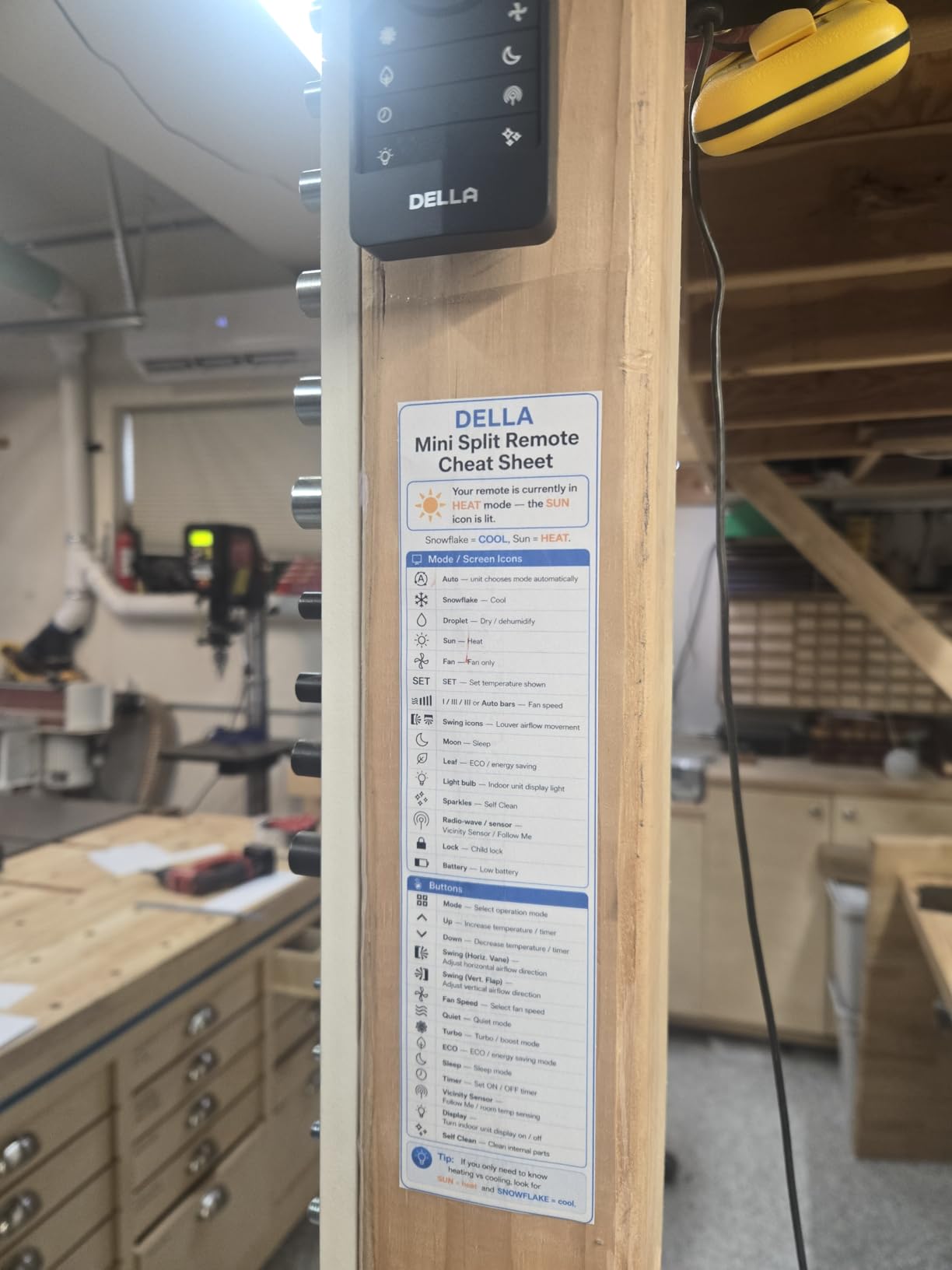
Reviewers consistently praise two things beyond raw output. The iFeel function reads temperature at the handheld remote rather than only at the indoor head, which produces noticeably steadier room temperatures, and the combination of Alexa and the DELLA app gave owners the smoothest remote pairing of any system in this roundup. About 1,456 reviews average 4.4 stars, with 78 percent at five stars.
Technically this is a 0.75-ton DC inverter system at 208-230V, rated at 20 SEER2 with a 5 Star BEE efficiency label and 750 watts of draw. Operating range on the cooling side runs from a 60 degree setpoint to a 90 degree setpoint, with 4D airflow, sleep mode, turbo, dry mode and a 24-hour timer. The full 16.4 foot pre-charged line set, quarter-inch and three-eighth-inch copper pipe, and a 78.7 inch drain pipe all come in the box.
Two install realities to plan for. First, the 230V requirement means your electrician has to run a dedicated high-voltage branch circuit, and on a 1950s or 1960s panel that can mean a subpanel. Second, this system mandates professional installation with a proper vacuum, gauges and a nitrogen pressure test, which is not optional even though the hardware is included.
When this is the right bedroom system
Pick this one for a bedroom, a home office, a nursery or a finished attic room between roughly 200 and 400 square feet with normal insulation. The minus 4 degree heating floor is the most capable in this group, so it also works in a garage workshop or a sunroom where the head has to run on a cold shoulder season night.
It is also the one to choose if you care about the thermostat experience. Owners describe scheduling, temperature readouts and geo-adjustments as reliable, and the outdoor condenser is reported by many to be nearly silent at the low end.
When it is the wrong bedroom system
It is the wrong choice for a small home with no 230V circuit available and no interest in adding one. In that situation, the 115V models further down this list are a much shorter project, and the Cooper and Hunter MIA is the stronger performer.
Some buyers also flag the line-set insulation tape, which is thin and short and can degrade in hot climates, so a separate line-set cover is a sensible add-on. A few isolated reviews report refrigerant faults on units installed in 2025, and the Alexa skill for this series launched with limited on and off control only.
3. Cooper and Hunter MIA 12,000 BTU 115V – Best for 115V Homes
Cooper & Hunter MIA 12,000 BTU 115V Wall Mount Mini Split AC, 21.2 SEER2
12000 BTU
Up to 550 sq ft
21.2 SEER2
115V
26 dB
Pros
- Highest SEER2 in the group at 21.2
- 115V works on a standard circuit
- 26 dB operation
- 7 year compressor warranty
- Heats to 5F
Cons
- Arrives by freight at the curb
- License number must be filed in 60 days
- Higher equipment cost
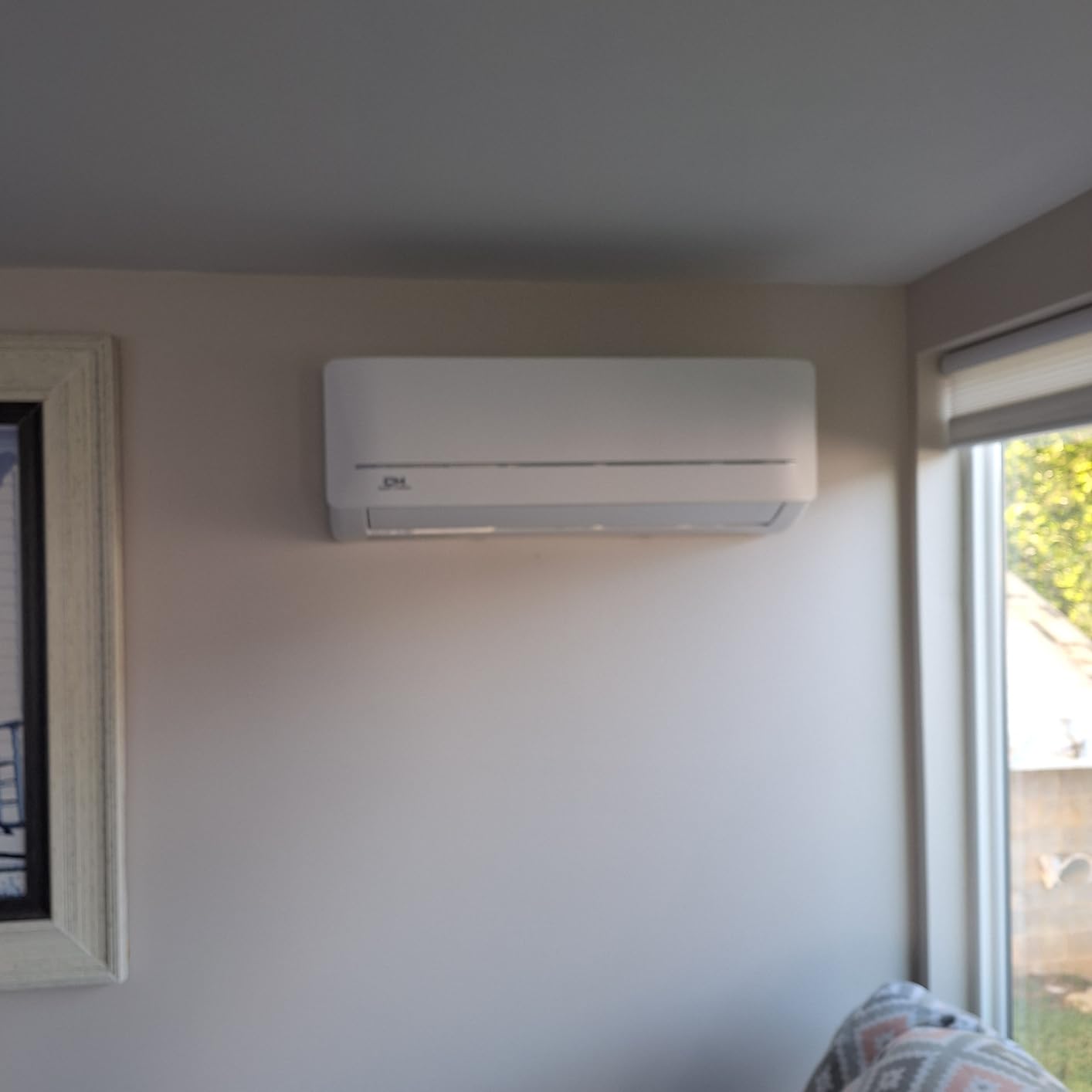
The single most useful thing about the Cooper and Hunter MIA is the one specification that keeps it out of most comparison lists: it is a full 1-ton, 12,000 BTU system that runs on 115V household power. For an older small home, a cottage, or a garage with an existing two-slot outlet, that removes the single largest cost and disruption in a mini split project.
It also posts the highest SEER2 rating in this roundup at 21.2, and owners consistently describe the condenser as effectively inaudible. Across 575 reviews averaging 4.3 stars, several buyers report installing two to four of these across their property and treating them as set-and-forget systems through multiple seasons, and several mention qualifying for a local energy rebate off the back of that efficiency.
On paper it covers up to 550 square feet, which is the right number for a small living room, a combined living and dining space, or a 900 square foot home if you zone it into two or three heads rather than trying to run one system over everything. Heating operates down to 5F, and the smart kit with app and remote gives you scheduling and temperature readouts that reviewers call more feature-rich than expected for this class.
Every head in this line is available from 6,000 BTU up to 24,000 BTU in both 115V and 230V, in 9000, 12000 and 18000 sizes, so the same installer and same panel work can scale as you add zones. The included kit is generous: 16 feet of pre-flared insulated copper line set, 16 feet of communication wire and a 16 foot drainage extension.
Warranty is the strongest published term in this group at seven years on the compressor and five years on parts, but there is a condition that catches people out. The manufacturer’s HVAC license number has to be filed within 60 days of installation to keep the coverage active, which is a real deadline, not a formality.
What works about a 115V mini split
Electricians will tell you the same thing we will: the difference between a 115V and a 230V mini split project is often the difference between one afternoon and a two-week subpanel install. On a panel with no spare two-pole breaker slots and no spare amperage, that cost can rival the equipment itself.
Owners who have run this system through a full heating season also report accurate humidity control, which matters a lot in the Southeast and the Gulf Coast where a small bedroom can be cool enough to feel clammy without being cold.
What to watch out for
This set arrives by freight and is placed at the nearest accessible point outside the home, so plan for moving both pieces indoors and up stairs yourself. One buyer reported the preinstalled drain line hose clamp arriving loose and leaking water inside the room, and another reported an outdoor fan blade failure within a day followed by a slow parts process.
It also carries the highest equipment cost in this roundup, and the effective capacity per dollar is lower than several of the 115V competitors below. It wins on warranty length and efficiency, not on entry cost.
4. COSTWAY 12,000 BTU – Best for an Open Studio or Loft
COSTWAY 12000BTU Mini Split Air Conditioner& Heater
12000 BTU cooling
12300 BTU heating
Up to 750 sq ft
Inverter
23 dB
Pros
- Largest coverage in the group at 750 sq ft
- 23 dB is among the quietest
- Inverter compressor
- Self-cleaning at 134.6F
- 5 year parts and 8 year compressor
Cons
- Licensed HVAC install required
- Remote only with no app
- 1970 watt draw needs a 20A circuit
- 68 lb set
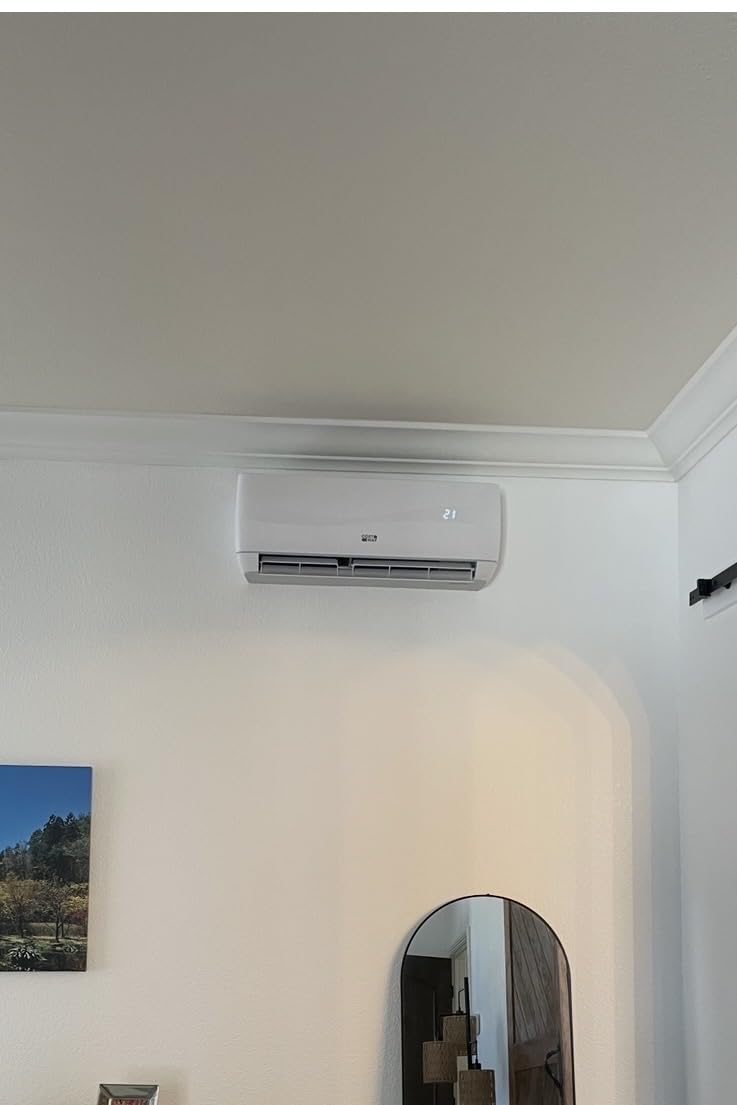
A converted attic, a loft with a sloped ceiling, a studio with a wall of glass, a shop: these are the spaces where one zone has to do a lot of work, and the COSTWAY 12,000 BTU is rated for up to 750 square feet, the broadest coverage of anything in this roundup. For a small home that is really one large open room, that is the number that matters.
The inverter compressor is the part to notice. Rather than switching fully on and off, it modulates its output frequency, which is why buyers report steadier temperatures and lower power draw at partial load. It runs on R-32 refrigerant, is AHRI certified as a pre-charged 1-ton heat pump, and carries a 5-year parts and 8-year compressor warranty as listed.
Quiet operation is the other headline. The published figure is 23 dB, which makes this one of the quietest indoor heads we reviewed, and 75 percent of its 1,661 reviews sit at five stars with an average of 4.4. Maintenance is handled by a high-temperature self-clean cycle at 134.6F plus a washable filter, and the outdoor condenser has automatic defrost.
Control is through the included remote only. There is no built-in WiFi on this model, so if you want to change the temperature from your phone or set a routine while you are out, you will need a third-party controller or a different unit. Modes cover auto, cool, dry, heat and fan, with four fan speeds, sleep mode, ECO mode, iFEEL and turbo, plus a 0.5 to 24 hour timer.
The electrical detail that catches people: this is listed as 115V but rated at 1,970 watts, so it needs a dedicated 20A branch circuit rather than a general-purpose outlet. A licensed HVAC installer is required and is not included with the system. The set weighs 68 pounds, so plan the lift before the installer arrives.
Where the 750 square foot rating earns its keep
That coverage figure is a manufacturer rating for a room of a given construction and insulation level, not a promise. It holds up best in a space with vaulted ceilings, a lot of glass and good insulation, where the volume of air to condition is high but the envelope losses are controlled.
If your open space has a flat ceiling, normal windows and a modest square footage, a 12,000 BTU system may be more than the room needs, and a 9000 BTU head would serve it better.
Where it falls short
No app control is the biggest functional gap for anyone who wants schedules that follow your day. A few owners also flag hesitation about running costs given the 1,970 watt figure, which is high on paper even though the inverter compressor moderates actual draw at part load.
And with no WiFi hardware at all, this is a system for someone who is happy with a remote on the wall. For the same 12,000 BTU capacity with smart control, the Senville LETO is the alternative in this list.
5. SereneLife 9,000 BTU – Most Versatile With a Full Install Kit
SereneLife Mini Split Air Conditioner, 4 Modes 9000 BTU 208V Ductless Air Conditioner with Heat Pump, Ultra Quiet, Works with Wi-Fi, Includes Full Installation Kit, 4-in-1 AC
9000 BTU
Up to 450 sq ft
20 SEER
WiFi app
Fixed-speed
Pros
- Indoor and outdoor set plus 5 meter copper line set in one kit
- WiFi app control
- Auto restart after power loss
- Five operating modes with timer
Cons
- Not an inverter unit so it cycles on and off
- Fixed-speed design is less efficient at part load
- Heavier indoor head than expected
The SereneLife is the most-reviewed system in this roundup by a wide margin, with 3,491 reviews averaging 4.1 stars, and that volume is worth paying attention to. When a listing has that many owners describing how it went in, the failure modes show up clearly instead of hiding behind a handful of reviews.
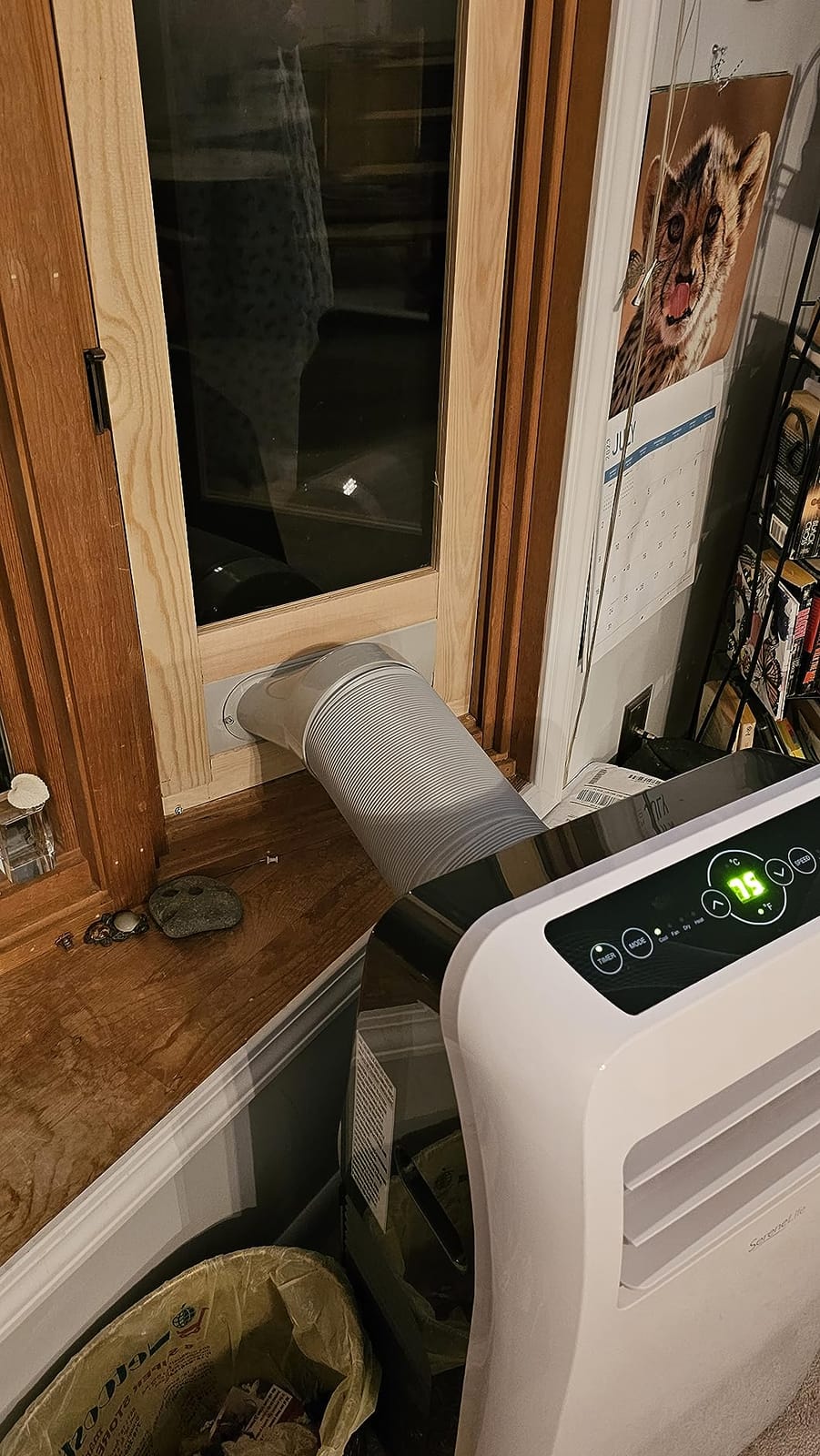
What owners like is the packaging. The kit arrives as a complete set including 5 meters of copper pipe, the remote and the AC power cord, so the parts list for a basic install is already in the box. It covers rooms up to 450 square feet, runs on 230V, and has WiFi with app control, five operating modes, adjustable fan speeds, a programmable timer and automatic restart after a power interruption.
Owners also mention the 29 dB figure from the bullet points as genuinely quiet for a fixed-speed machine, and the auto-restart function is a real convenience in areas with unreliable power. Cooling power is 9,000 BTU at 0.75 tons, and the efficiency class is listed at SEER 20.
The honest headline is that this is not an inverter system. The specification block states it plainly: inverter type, no. That means the compressor runs at full output and stops rather than modulating, which produces more on-off cycling, less precise temperature control and higher energy use during mild shoulder seasons. It is the one specification that separates this unit from most of the field.
There is also a discrepancy worth flagging before you rely on a number. The noise figure appears as 54 dB in the specification block while the bullet points cite levels as low as 29 dB, and the warranty is listed as a single year in one place and lifetime in another. Ask the manufacturer directly rather than assuming either figure.
When the SereneLife makes sense
It fits a small bedroom or home office where the budget is the deciding factor and the room is used in a fairly on-off pattern. For a room that is cooled hard for a few hours and then shut down for the day, the cycling penalty is far less noticeable than it would be in a living space that needs steady temperature all day.
The auto-restart feature also matters if you are in a home with older wiring or frequent power interruptions, because the unit returns to its previous setting instead of sitting idle until someone walks over to the remote.
When it is the wrong call
If your primary goal is lowering a power bill, skip it. Every inverter unit in this roundup will run more efficiently at partial load, and the difference shows up most in spring and autumn when the system is neither fully cooling nor fully idle.
The 230V requirement is also a real barrier on older electrical service, and mounting the indoor head requires drilling and routing the line set through the wall, which is straightforward for a pro and a genuine project for a first-timer.
6. ROVSUN 9,000 BTU – Best Value for a Bedroom or Office
ROVSUN 9000 BTU Wifi Enabled Mini Split Air Conditioner & Heater with Inverter, 20 SEER2 Energy Saving 115V Ductless Split AC Unit with Pre-Charged Condenser, Heat Pump & Installation Kit
9000 BTU
Up to 450 sq ft
20 SEER2
115V on 20A
R-32
Pros
- 115V operation on a 20A circuit
- 20 SEER2 with 4 Star BEE rating
- App plus Alexa and Google Assistant
- 28 dB mute mode
- Inverter compressor
Cons
- Instructions skip the leak test and vacuum steps
- Two boxes can arrive separately
- Line-set tape is widely replaced
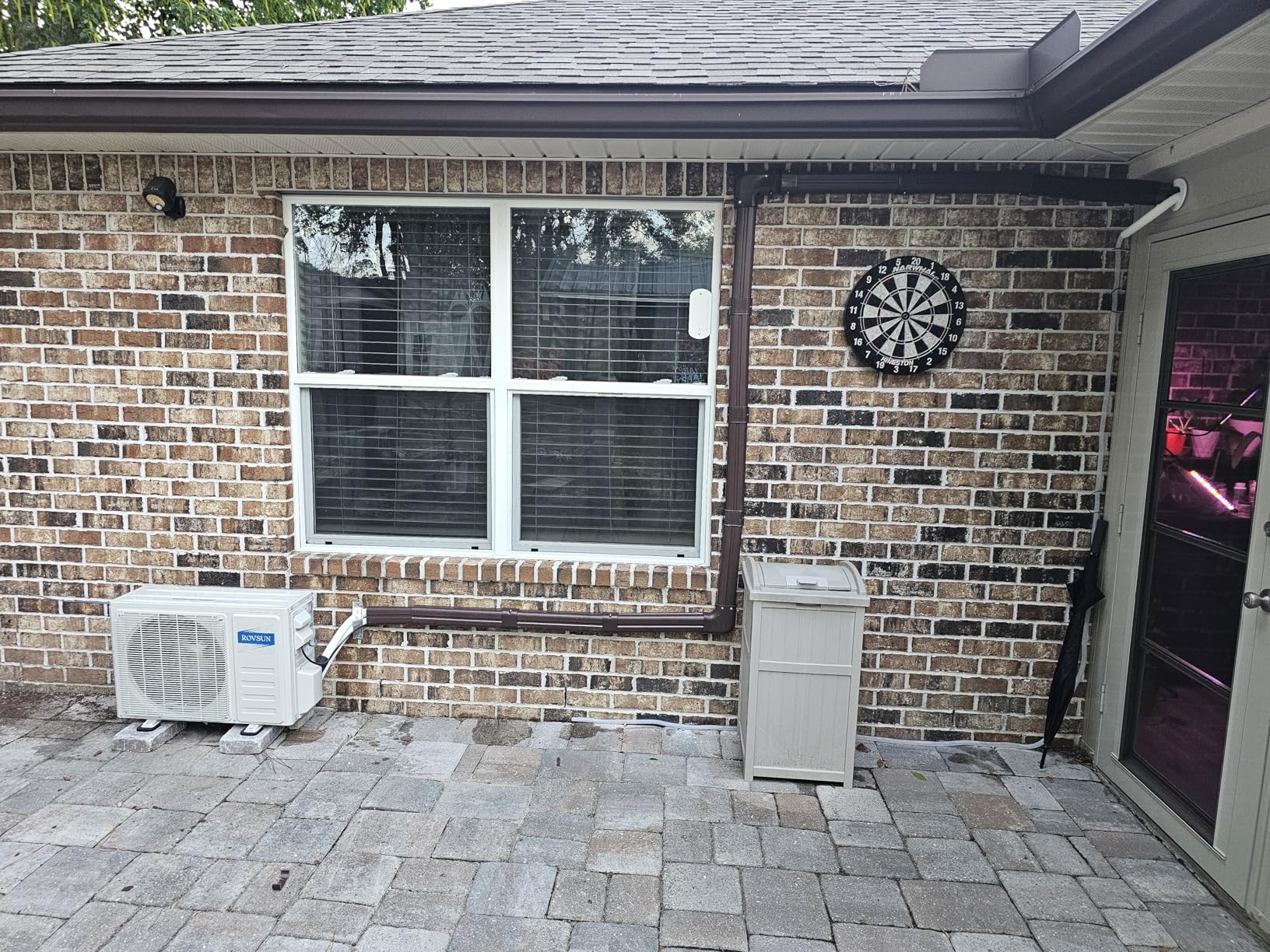
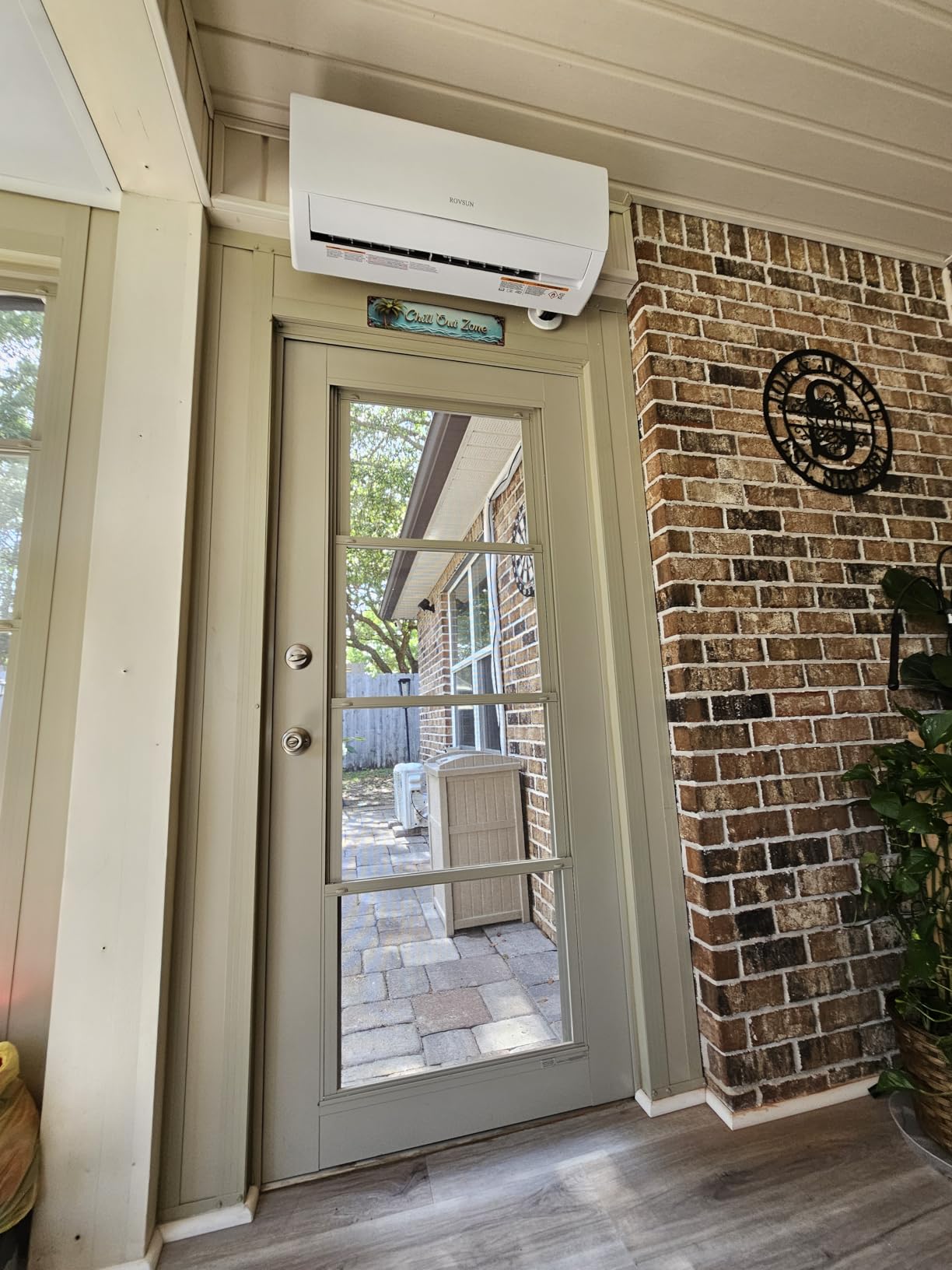
The ROVSUN is the configuration we would hand to a small-home owner who wants inverter efficiency, smart control and a 115V circuit all at once. It is a 0.75-ton inverter system rated 9,000 BTU for up to 450 square feet, at 20 SEER2 with a 4 Star BEE rating, running on 115V over a 20A branch circuit.
Owners in humid states report strong dehumidification, and one described replacing a noisy window unit and sleeping noticeably better afterward. The 28 dB mute mode is at the quiet end of the published figures in this group, and the outdoor unit is described by several buyers as effectively silent. At 875 watts, the draw is modest.
Control options are better than the price would suggest. There is a remote, a phone app and voice control through both Alexa and Google Assistant, with routine scheduling, plus four-way swing, sleep mode, ECO mode, turbo and dehumidify functions. The inverter is rated for up to 35 percent energy savings according to the manufacturer, and refrigerant is R-32 in a pre-charged condenser.
Where the caution lies is documentation. Owners repeatedly point out that the installation instructions skip the leak test and the vacuum procedure, which are the two steps a trained technician would never skip, and that the supplied line-set tape is thin enough that most buyers replace it. The set also weighs 70 pounds and must stand upright for 24 hours before installation.
A smaller but important note: the system arrives as two separate boxes, so the delivery dates can differ. Plan the install for after both have arrived rather than for the day one shows up. One owner also reported persistent dampness and mold in an enclosed windowless room, an unusual complaint that is worth taking seriously if that describes your space.
Why the 115V inverter combination matters
Most 9000 BTU systems in this class are either 115V and fixed-speed, or inverter and 230V. The ROVSUN breaks the pattern, and for a small home with an existing 20A circuit, that is the difference between a single-day install and a panel modification.
It also makes this a sensible second zone. If you already have a 230V system handling the main living area, adding a 115V 9000 BTU head for a bedroom or office avoids a second panel upgrade and gives you independent control of the space you sleep in.
Where you need to do the work yourself
Budget for a vacuum pump, gauges and a nitrogen pressure test if you are not hiring a pro, and follow a proper procedure rather than the included guide. Forum users are consistent on this point: a bad install produces bad results no matter which brand the equipment carries, and skipping the vacuum step is the most common self-inflicted fault we see described.
It is also a 1-year limited warranty, which is the shortest published term among the inverter systems here, so registering the unit and keeping the installer’s paperwork matters more than usual.
7. Mountman 9,000 BTU – Quietest Pick for Sleeping
Mountman 9000 BTU Mini Split AC/Heating System,19 SEER2 110/120V Energy Efficient Ductless Inverter System,Cools Up to 450 Sq.Ft with Pre-Charged Condenser,Heat Pump & Installation Kits
9000 BTU
Up to 450 sq ft
19 SEER2
26 dB sleep mode
120V
Pros
- Highest average rating at 4.5 stars
- 26 dB sleep mode
- ECO mode up to 30 percent savings
- Self-clean and auto-defrost
- 120V avoids a panel upgrade
Cons
- Remote only with no app or WiFi
- Coverage figure conflicts between 450 and 750 sq ft
- No published minimum heating temperature
- Smaller review base
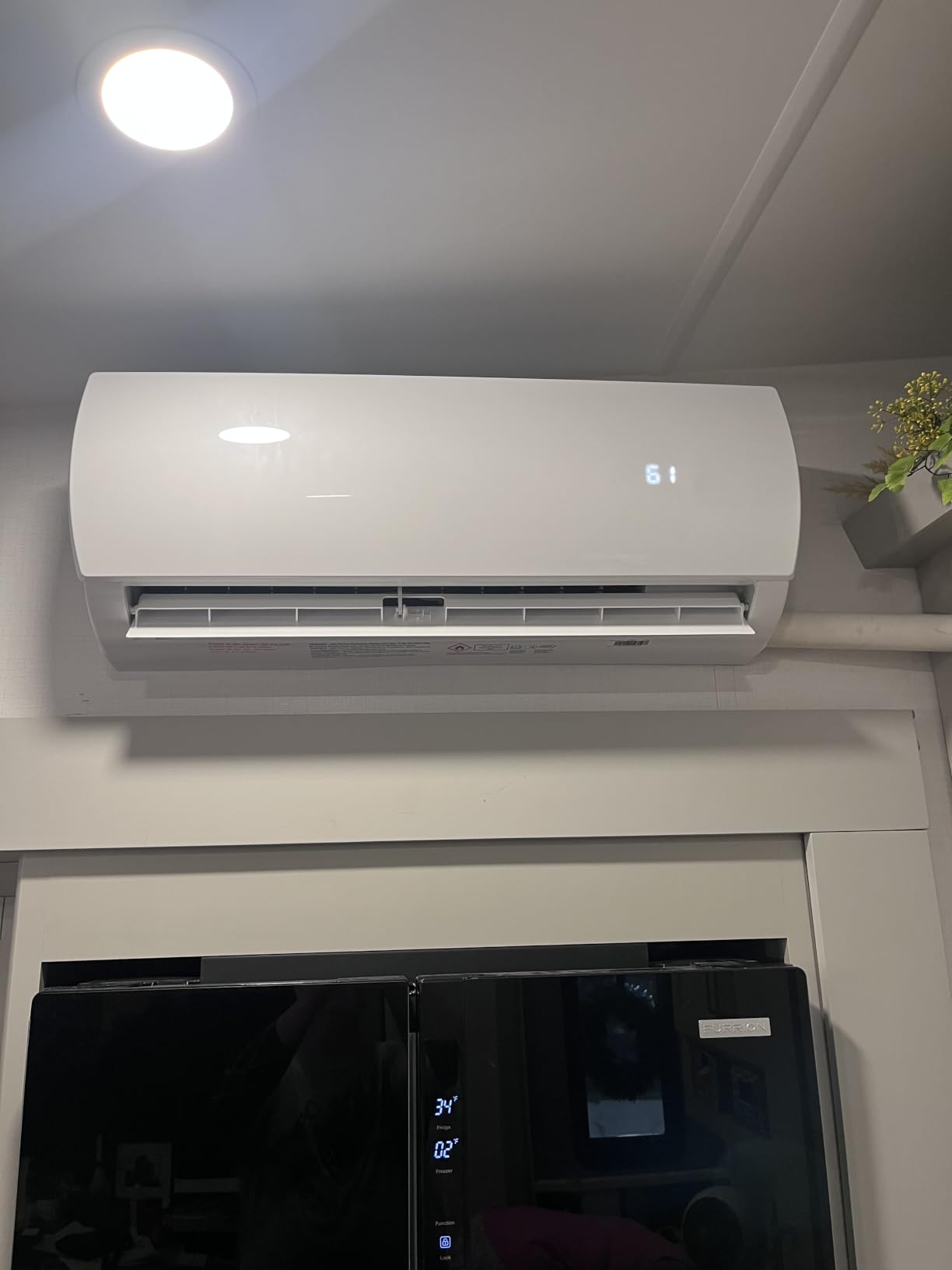
When a mini split is going into a bedroom, the published decibel figure matters more than any other number on the spec sheet, and the Mountman posts the best one here: sleep mode at 26 dB, tied with the Cooper and Hunter and well below the 42 dB published by the least expensive unit in this roundup. It also carries the highest average rating in the group at 4.5 stars.
It is a 0.75-ton inverter system rated 9,000 BTU for up to 450 square feet, at 19 SEER2, running on 110/120V. Four modes are covered, cool, heat, dry and fan, with four fan speeds, turbo boost, ECO mode with up to 30 percent energy savings, a 24-hour timer and a remote display that shuts itself off after 10 seconds.
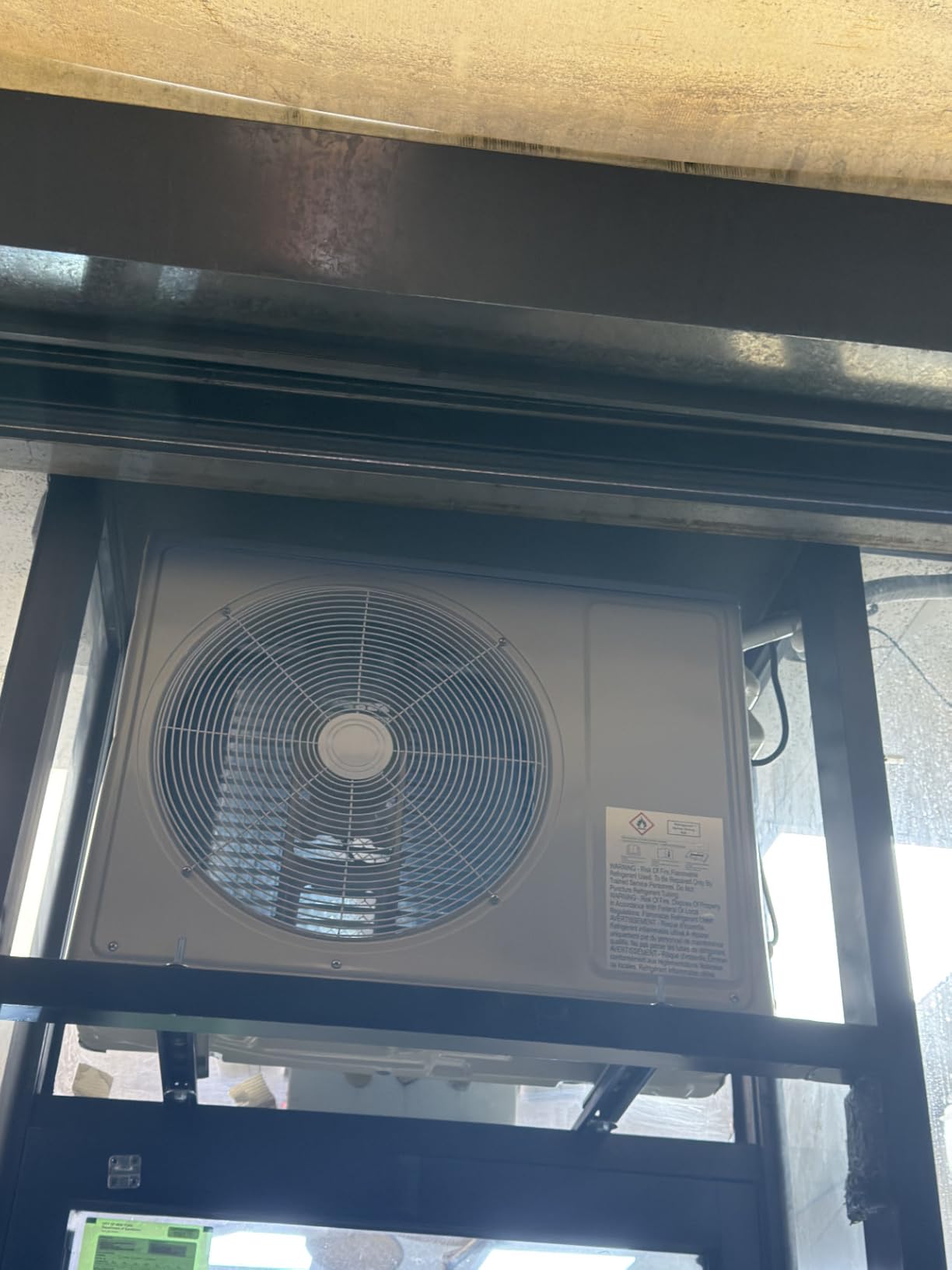
Maintenance is handled well for a bedroom application. A high-temperature self-cleaning cycle, a washable anti-dust filter and automatic defrost mean less scheduled attention, which matters in a room where you do not want to be handling filters on a ladder. The condenser uses pre-charged R-32 refrigerant, and the listing notes reduced compressor cycling for longer service life.
The honest limitation is control. This model is remote only, with no WiFi and no app integration, so there is no way to set a schedule from your phone or add it to a smart home routine. If that matters to you, the ROVSUN or either DELLA model covers it.
Two data issues to be aware of. The feature bullets claim coverage up to 750 square feet while the specification block lists 450 square feet, and the listed wattage of 2,647 W looks unusually high for a 9,000 BTU head, most likely a maximum draw figure rather than typical consumption. The listing also carries no published minimum operating temperature for heating, so cold-climate performance is undocumented.
Why the noise number drives the ranking
Sound in a bedroom is not a specification, it is the whole experience. A head running at 26 dB in sleep mode is close to the level of a quiet bedroom at night, and several owners of quieter systems in this roundup describe the difference between a 26 dB and a 42 dB head as the difference between noticing the machine and not noticing it.
The practical caution is condenser placement. Owners on HVAC forums consistently raise condenser noise near bedrooms as a real complaint, so where you mount the outdoor unit matters as much as which model you choose. Ask your installer about vibration isolation and separation distance from sleeping rooms.
Where the thinner data worries us
This listing is newer than the others here, with 352 reviews, so the long-term durability record is thinner than for the established names. That is not a reason to skip it, but it is a reason to register the warranty, keep the manual and expect that a five-year-old unit will have less field data behind it.
The undocumented heating floor also matters in northern climates. If you are heating with this system as your only heat source, pick a model with a published minimum operating temperature instead.
8. Rellytech 9,000 BTU – Best Starting Point for a First-Time Buyer
Rellytech Mini Split AC/Heating System – 19 SEER2 9000 BTU Mini Split AC Unit Inverter Heating and Cooling, 115v Energy Efficient Ductless Air Conditioner Up to 550sq.ft, 24H Timer, Installation Kit
9000 BTU cooling
9000 BTU heating
Up to 550 sq ft
19 SEER2
115V
Pros
- Lowest equipment cost in the group
- Still a 19 SEER2 inverter
- True 115V with no panel work
- ETL and AHRI certified
- Complete install kit in the box
Cons
- 42 dB is the highest published noise figure
- Remote only with no app
- Line set and power cable are short
The Rellytech is the most straightforward first system to buy, and the reason is that it removes three decisions at once. It is a true 115V system, so no panel work, it is a 19 SEER2 inverter rather than a fixed-speed machine, and it carries the lowest equipment cost among everything in this roundup. For a first-time owner in a small apartment or cottage, that combination is hard to argue with.
At 9,000 BTU for cooling and 9,000 BTU for heating, rated for up to 550 square feet, it is one of the more generously rated 9000 BTU systems on paper. It is ETL and AHRI certified with a 4 Star BEE rating, uses R-32 refrigerant, and covers cool, heat, fan and dry modes with an ECO setting, four fan speeds and a 90 degree vertical swing.
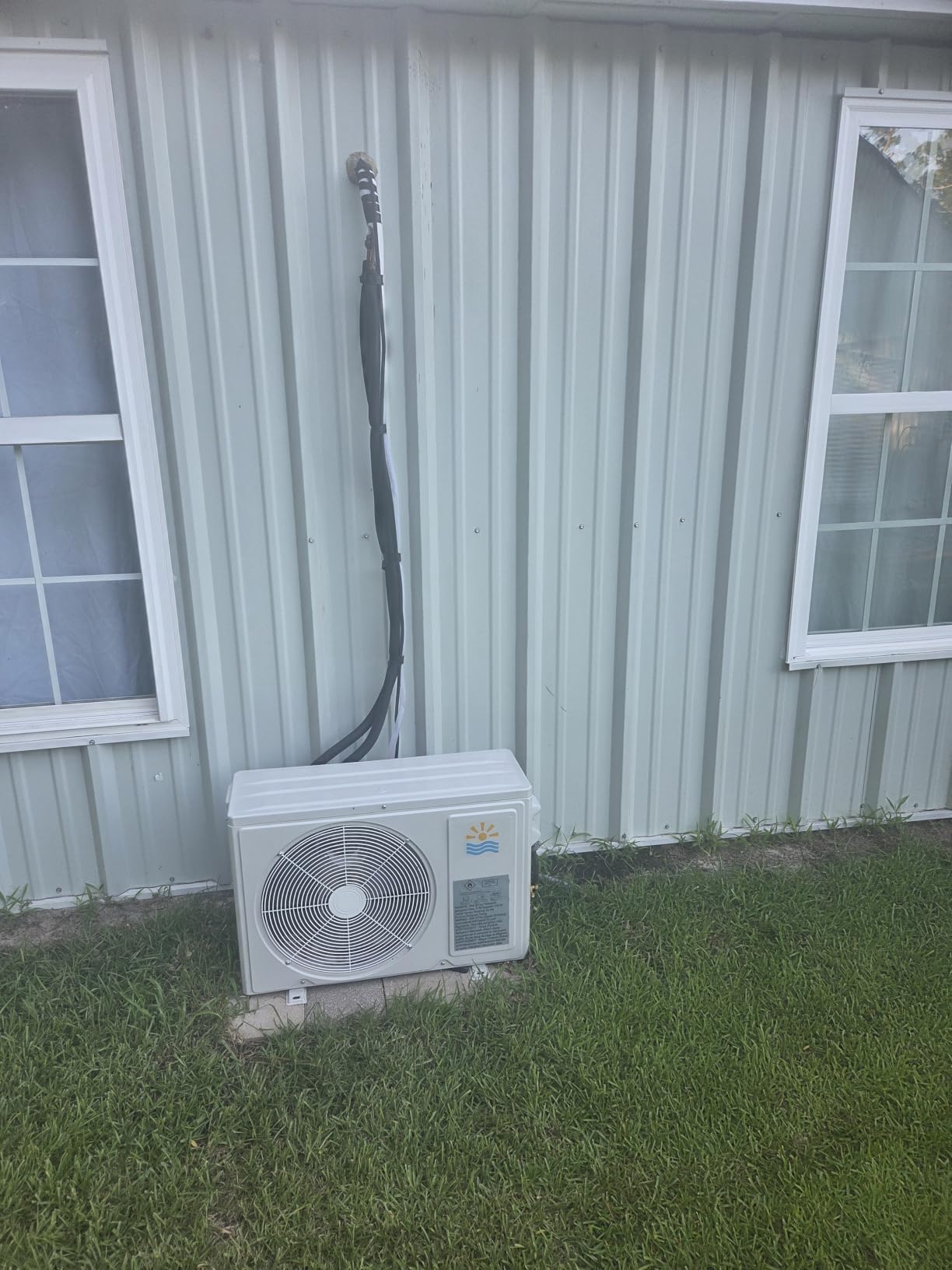
Owners in Florida specifically report strong dehumidification and roughly halved cooling electricity compared with a window unit they replaced, which is the argument most small-apartment buyers are making. At 355 reviews averaging 4.4 stars, this listing has the highest proportion of five-star ratings in the group at 80 percent, which is a meaningful signal on a unit this new.
The 42 dB published noise figure is the catch, and it is a real one. That is the highest figure in this roundup, and for a bedroom it is more than most people want under the pillow. If the head is going into a living area you occupy briefly, or a home office where you can tolerate a bit of air movement, it is fine.
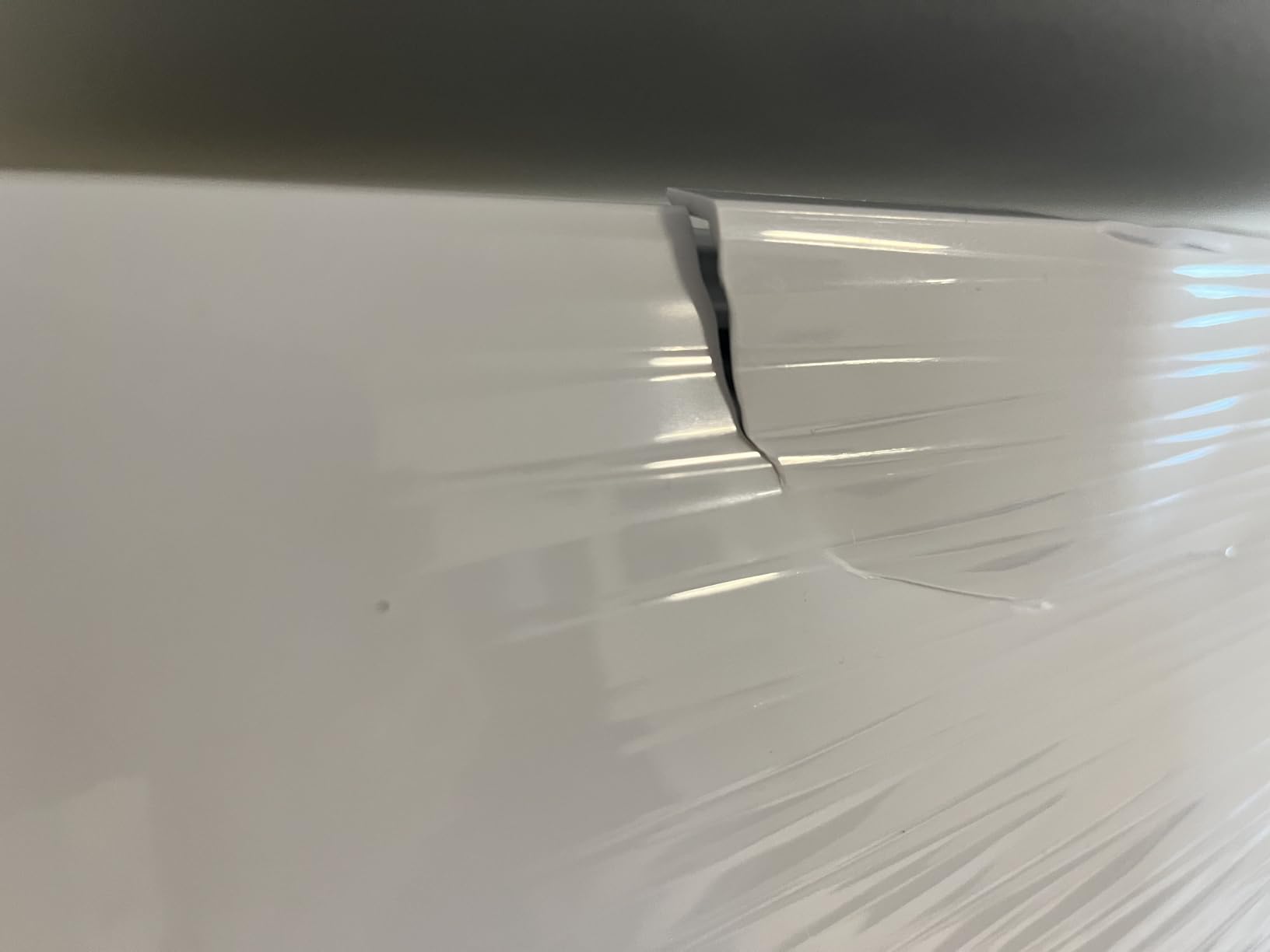
Kits are complete, including the indoor head, remote, two AAA batteries, mounting plate and template, 12.5 foot communication cable, 5.9 foot power cable, outdoor head, two connecting pipes at 9.84 feet, luting putty, a pipe protection ring, a 6.56 foot drain pipe and mounting hardware. Those line and cable lengths are short, so more wall drilling may be needed depending on where the outdoor head goes.
Why efficiency still matters at the entry point
An inverter compressor is the first thing to check on a low-cost system, because it is the part that determines your power bill. This one modulates rather than cycling, carries HSPF2 8.5 alongside 19 SEER2, and reports 907 kWh of annual consumption in the specification block.
That is a meaningful difference from the fixed-speed alternatives, and it is the reason we would rather see a first-time buyer stretch slightly than buy a cheaper non-inverter head.
Where the details need a second look
The warranty description conflicts: the specification block states 1 year manufacturer while the feature bullets claim 8 years. Get that in writing from the seller before you rely on either number, because the difference is large enough to change the calculation.
There is also no WiFi or app connectivity on this model, and professional HVAC installation is required. For a first-time buyer, budget for a vacuum pump, gauges and a nitrogen test, or budget for an installer, because those two paths produce very different results.
9. Albott 12,000 BTU – Best for Wide Temperature Swings
Albott 12,000 BTU Mini Split Air Conditioner and Heater SEER2 18, 115V
12000 BTU
Up to 750 sq ft
SEER2 18
5F to 122F
29 dB
Pros
- Works from 5F to 122F for both seasons
- 750 sq ft coverage from 12000 BTU
- Self-cleaning with removable filters
- Child lock
- App and remote
Cons
- SEER2 18 is the lowest here
- 151 lb packaged weight
- Warranty terms conflict between spec block and bullets
- Highest 1-star share
Where most small-home systems are optimized for a moderate climate, the Albott is built for a wide range. The published operating envelope runs from 5F to 122F, which is the broadest explicitly stated range in this roundup and matters if you are in a place with genuinely hot summers and cold winters rather than a mild four-season climate.
At 12,000 BTU it is rated for up to 750 square feet, matching the COSTWAY for the largest coverage figure here, and it uses an 18 SEER2 inverter heat pump on 115V. Modes cover cooling, heating, dehumidifying and fan with a 61F to 90F setpoint range, a 24-hour timer, sleep mode and a child lock, which is a small touch that matters in a nursery or a kid’s room.
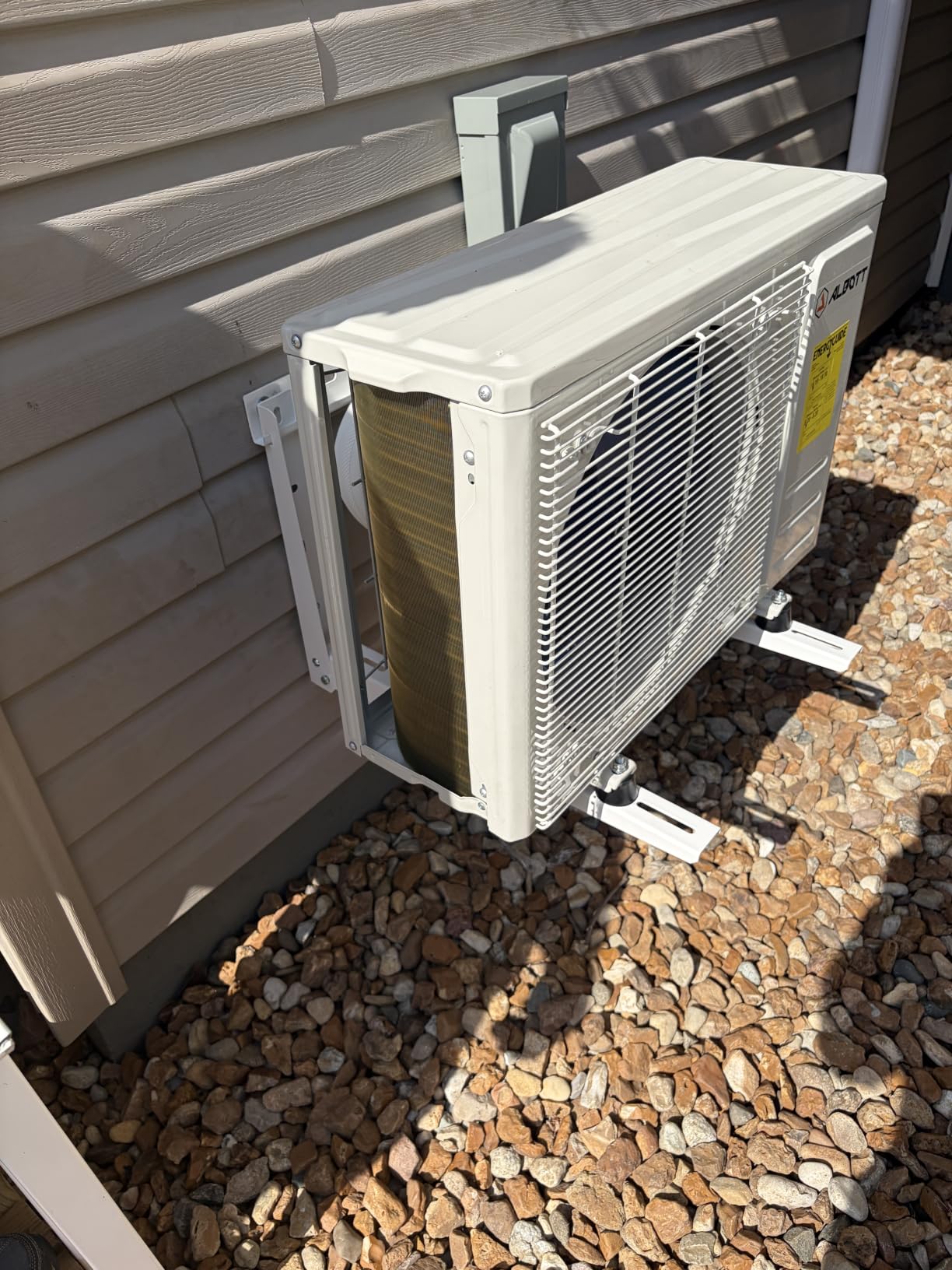
Owners generally cite the cooling reach for the 12,000 BTU size, the low noise below 29 dB, and how simple the self-cleaning function and removable mesh filter make upkeep. The specification block lists annual consumption at roughly 700 kWh, among the lower figures in this group. Just under 400 reviews at 4.1 stars, with 68 percent at five stars.
The efficiency rating is the real tradeoff. At SEER2 18, this is the lowest rating in the roundup, and it costs you money in exactly the mild conditions where a mini split is most efficient. If your utility bill is the main reason you are making this purchase, an 18 SEER2 system works against you whenever the outdoor temperature is close to the setpoint.
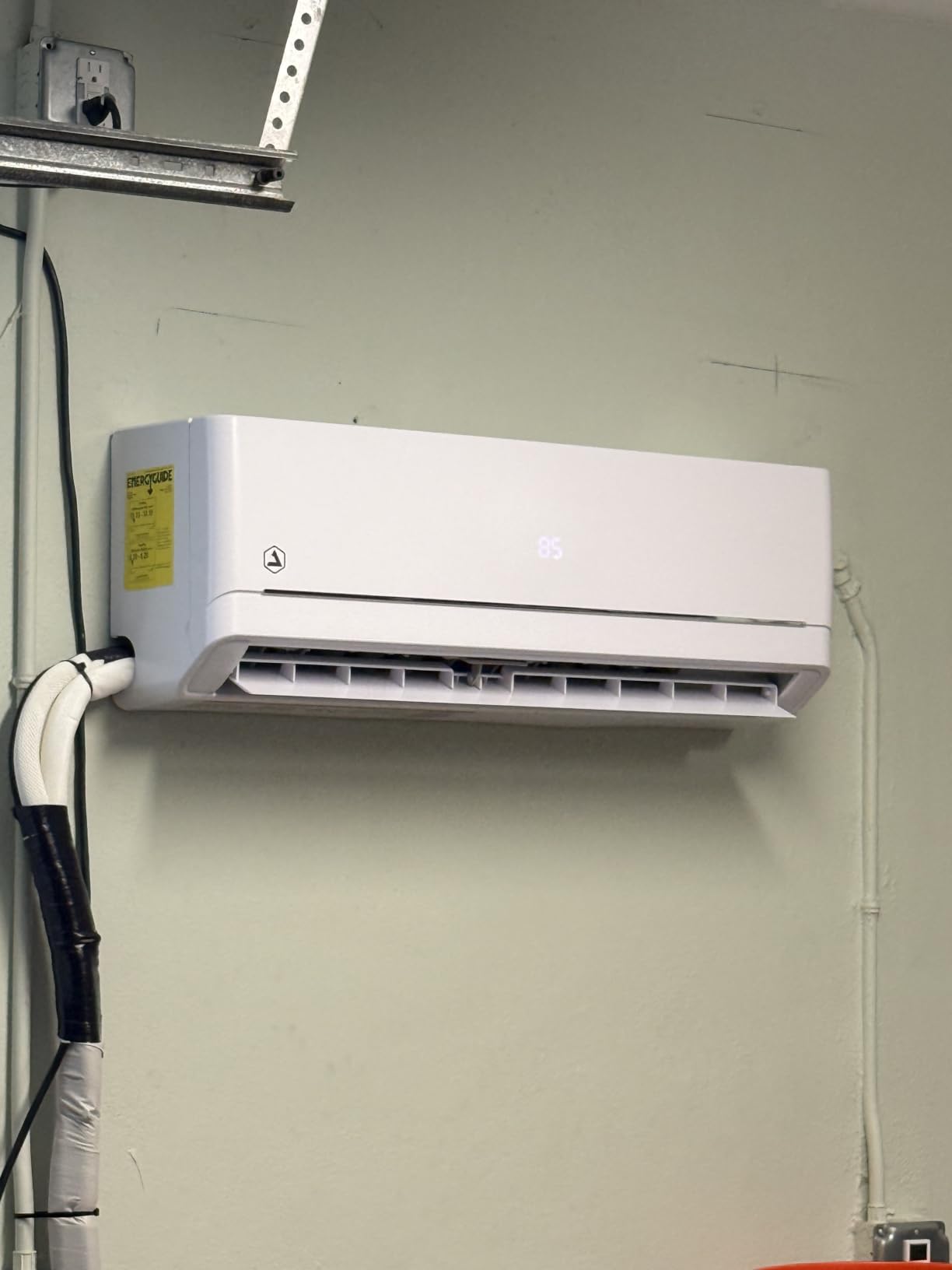
Handling is also more involved than the numbers suggest: 151 pounds is the heaviest packaged weight in this group, so the install needs at least two people with proper lifting equipment. And the listing is internally inconsistent on warranty, with a 3-year figure in the specification block against 5-year compressor and 7-year parts claims in the feature bullets, plus inconsistent brand and manufacturer naming.
When a wide operating range is the deciding factor
Indoor comfort in a small home is often about the shoulder seasons, and the shoulder season is where the extremes of a climate actually reach inside your walls. A head with a 122F ceiling and a 5F floor keeps producing useful capacity at both ends, which is a different proposition from a system that hits a wall at 95F outside and can no longer pull heat out of the house.
It is also a reasonable pick for a large sunroom, a garage workshop or a finished basement where summer heat and winter cold both have to be handled in the same room.
When to pass
If you are in a moderate climate, the 18 SEER2 rating works against you, and any of the 20 to 22 SEER2 systems in this roundup will cost you less to run over a decade even if the equipment cost is similar.
The 151-pound weight and the conflicting warranty language are the other reasons to look elsewhere. It also carries the largest 1-star share in this group at 14 percent, so read the negative reviews, not just the average.
10. DELLA Serena Series 9,000 BTU – Highest Efficiency Per Watt
DELLA Serena Series 9000 BTU Mini Split AC, Energy Star 22 SEER2 230V, 0.75 Ton Inverter Heat Pump Ductless AC System for Rooms up to 400 Sq.Ft, WiFi & Alexa Control, Pre-Charged, 16.4ft Install Kit
9000 BTU cooling
9300 BTU heating
Up to 400 sq ft
22 SEER2
24 dBa
Pros
- 22 SEER2 is the highest rating in the group
- Quietest published spec at 24 dBa
- Only 620 W rated draw
- Heats to 5F with an outdoor heating element
- Energy Star certified for rebates
Cons
- Smallest review base at 80 reviews
- 230V requires a branch circuit upgrade
- Remote and app do not sync
On paper this is the most efficient system in the roundup and the one that should cost the least to operate. A 22 SEER2 rating, 614 kWh of listed annual consumption and a 620 watt rated draw put it at the top on every efficiency measure we could verify, and 24 dBa in mute mode is the quietest published figure here.
It is also a 0.75-ton inverter heat pump rated 9,000 BTU cooling and 9,300 BTU heating for rooms up to 400 square feet, running on 230V. It is ETL listed, AHRI certified and Energy Star certified, which is the qualification several utility rebate programs require. The 2025 Red Dot design award is not a comfort specification, but on an indoor head that lives in view it is not nothing.
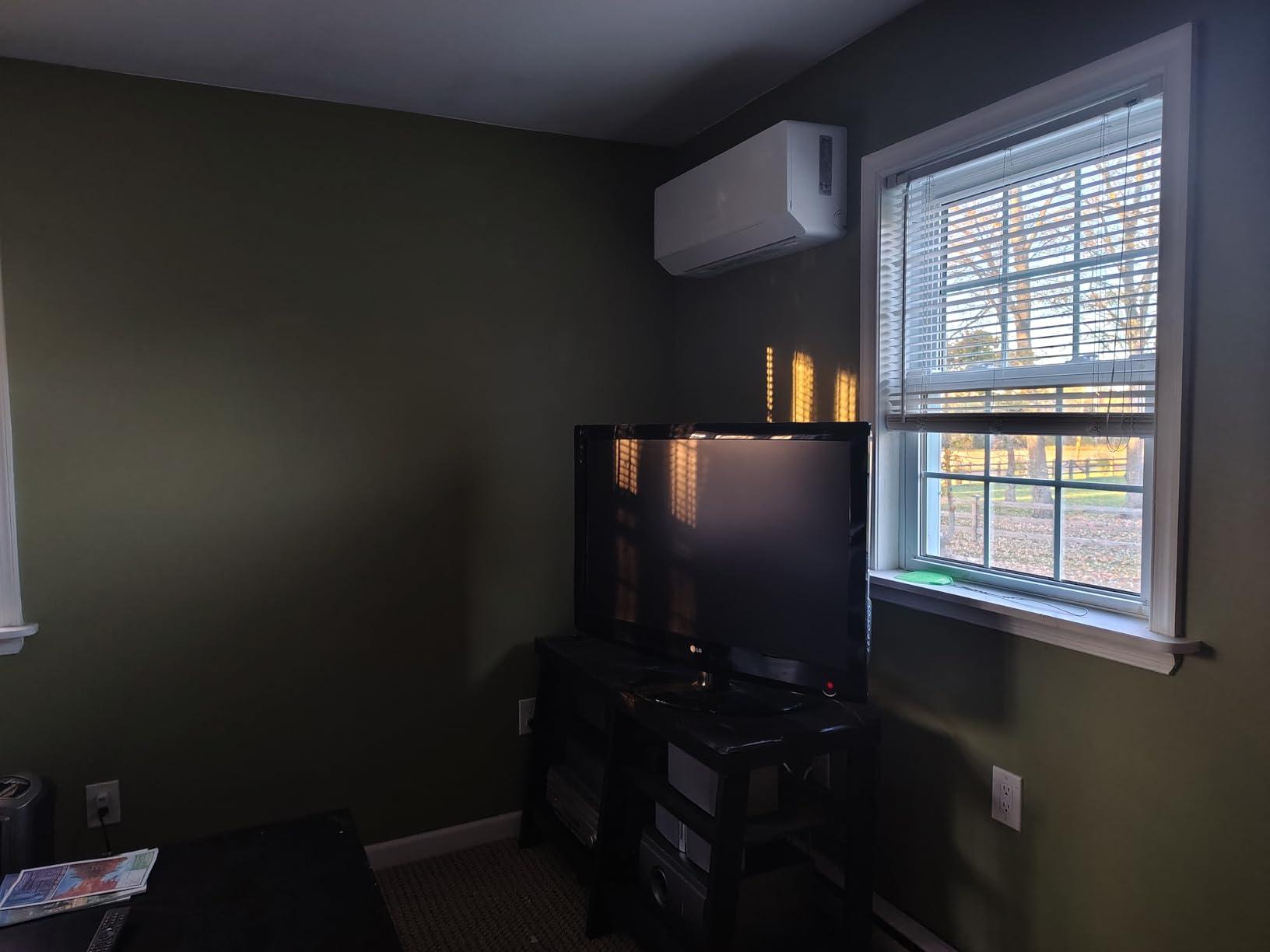
Heating runs down to 5F, and this one adds a bottom heating element on the outdoor unit to prevent ice buildup, which is a concrete cold-weather feature rather than a marketing phrase. Inside, PureClean technology defrosts the indoor head to prevent dust buildup, and the airflow is 4D with iFeel mode, a 24-hour timer, sleep mode, turbo, energy saving mode and auto and dry modes.
Control is through a remote, the DELLA app with WiFi and geo-location, plus Alexa and Google Home voice. The included kit covers 16.4 feet of quarter-inch and three-eighth-inch copper pipe, a 78.7 inch drain pipe, a 15A max fuse, and pre-loaded R-32 for runs up to 25 feet, with a lifetime warranty stated on the listing.
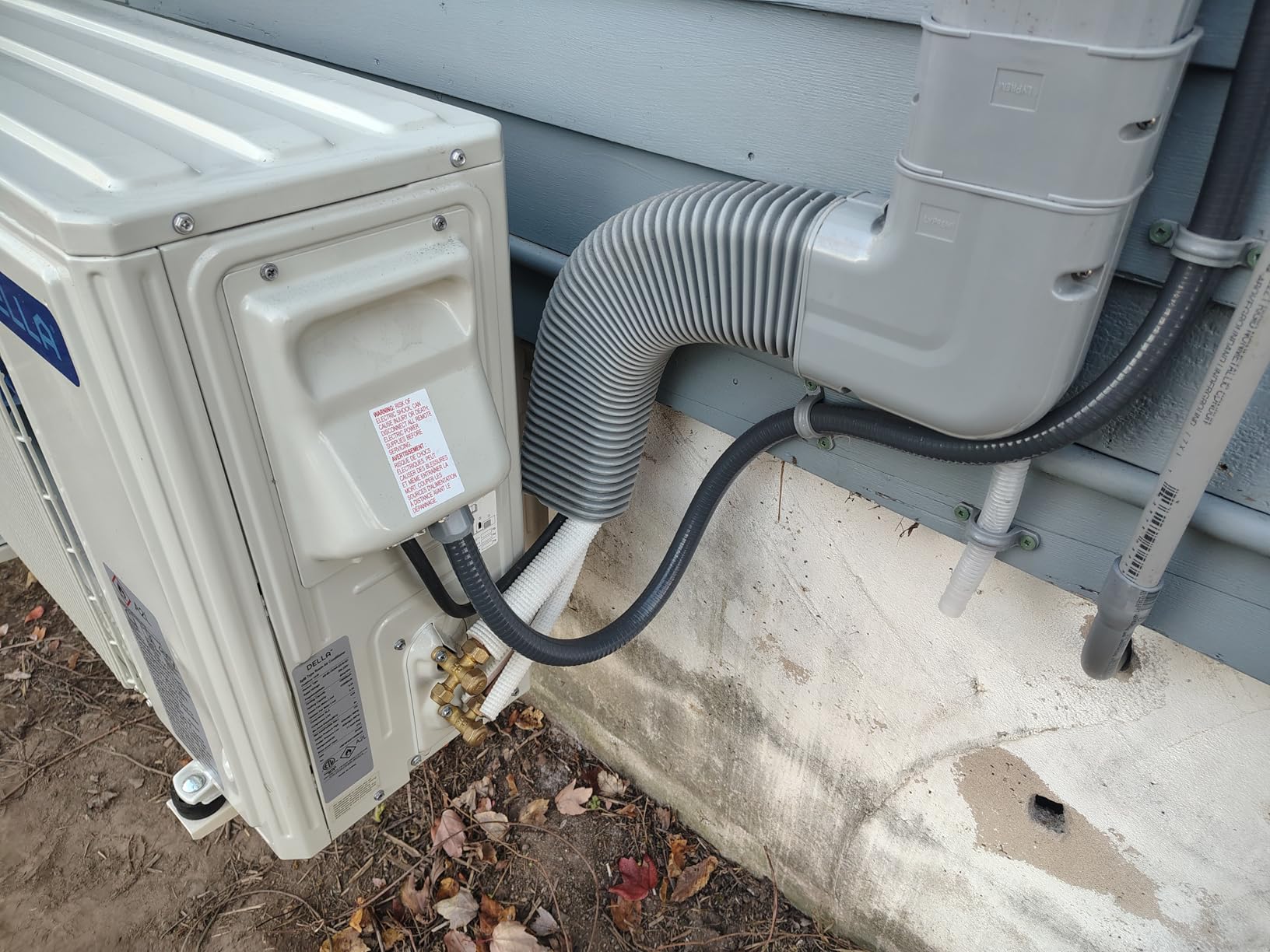
The specific flaw owners keep reporting is that the wall remote and the app do not communicate. Someone can set a schedule in the app, then silently override it from the remote with no warning, and several reviews describe the first few attempts at connecting the unit to the app as confusing. It also needs a 230V branch circuit, and at 80 reviews it has the smallest sample in the roundup, so long-term reliability data is thin.
When the efficiency rating is the whole point
If you run the system in a mild climate, or you are replacing a window unit you run for long hours every day, the operating cost difference between a 22 SEER2 inverter and a 19 SEER2 one compounds quickly. At 620 watts, this is also the easiest 9,000 BTU system here to run on a modest electrical service.
The Energy Star certification is the practical trigger for many people. Several state and utility rebate programs are only available for qualifying efficient equipment, and one of the owners in the Cooper and Hunter reviews reported qualifying for a local rebate on the strength of its rating.
Where the thin data shows
Eighty reviews is not much to judge a decade-long purchase on, and one owner reported an E4 error code on a brand-new unit. The remote and app sync conflict is a daily annoyance in a smart home and a genuine reliability gap in the control stack, so if schedules matter to you, test it during the return window.
It is also the one system here that pairs top-tier efficiency with a 230V requirement, so on an older panel the Cooper and Hunter MIA or the ROVSUN will get you into the house sooner.
How to Size a Ductless Mini Split for a Small Home
Sizing is the single biggest source of anxiety in this purchase, and the anxiety is mostly about oversizing. A mini split that is too large for the room cycles on and off, wears the compressor harder and leaves you cold before the room is comfortable. A system that is too small simply cannot keep up on the hottest day of the year.
For a small home, the room-by-room rule of thumb most contractors start with is roughly 20 BTU per square foot of floor area, adjusted for ceiling height, window area, insulation quality and sun exposure. That produces the following bands, which cover the square footage range most small homes actually occupy.
For rooms between 150 and 200 square feet with normal ceilings and insulation, a 6,000 BTU system is usually the correct starting point, and several systems in this roundup are available in that size.
For rooms from 200 to 350 square feet, a 9,000 BTU system is the standard answer. This is the range where most bedroom questions land, and it is why six of the ten systems here are 9,000 BTU units.
For rooms from 350 to 550 square feet, and for open plans where the living space combines with a kitchen or dining area, step up to 12,000 BTU. A 550 square foot main living area with a vaulted ceiling can justify it on its own.
For spaces above 600 square feet with vaulted ceilings, extensive glass or significant west-facing exposure, you are looking at 15,000 to 18,000 BTU territory or a properly designed multi-zone layout, and at that point a professional load calculation is worth the call-out fee.
Square footage is a starting point, not a substitute for a Manual J load calculation, which is an engineering method that accounts for wall and roof area, window glass, infiltration, internal heat gains from people and appliances, and the local design temperature. A contractor who quotes you purely on square footage without asking about your windows and insulation is guessing.
The 9000 versus 12,000 BTU decision comes down to one question: what is the room’s exposure, not its size alone. A 300 square foot bedroom with two west-facing windows in a hot climate can need 12,000 BTU, while a 300 square foot interior room on the shaded side of a well-insulated house can be oversized at 9,000 BTU.
One practical note on oversizing that we see repeated on the forums: an oversized head in a small closed room does not run dangerously, it just short-cycles, and a variable-speed inverter head short-cycles far less damagingly than a fixed-speed one. It still wastes electricity and still fails to dehumidify properly, so sizing correctly is worth the effort.
Single-Zone vs Multi-Zone for Homes Under 1,000 Sq Ft
A single-zone system is one head served by one condenser, and a multi-zone system is a single outdoor condenser feeding two or three indoor heads. For a small home, the decision is closer than most guides make it sound, because you rarely need more than three zones in a space under 1,000 square feet.
For a 600 square foot cottage or a one-bedroom apartment, a single zone is almost always right. One head, one install, one line set, and the lowest total cost. Adding a second head to a 600 square foot home usually means two condensers and two electrical circuits, which doubles the project cost to serve rooms that a single 12,000 BTU head already handles.
For an 800 to 1,000 square foot home with a distinct bedroom wing, two zones is the sweet spot. Pair the main living area with the kitchen on a 12,000 BTU head, and put the bedroom wing on a 9,000 BTU head. You get independent temperature control where it matters most, and both zones are separately metered by feel rather than by one thermostat in the hallway.
For a 1,000 square foot home with a finished basement, an attic bonus room or a separate office, plan for three zones. The same three-zone logic applies to a 700 square foot condo where the living space is open but the bedroom is on the opposite side of the unit, because a single head will struggle to reach both ends evenly.
The cost difference is real. A second zone typically adds the second indoor head, a second line set, extra line-set installation labor and often a second electrical circuit, and a true multi-zone condenser is a different and more expensive piece of equipment than two single-zone condensers. For small footprints, two single-zone systems are frequently the cheaper path to the same comfort.
Our general advice for under 1,000 square feet: start with one zone, live with it for a season, and add the second zone only if you can name the specific room that stays uncomfortable. Guessing at a three-zone layout before you have lived in the space is how small-home owners end up with equipment they never run.
DIY vs Professional Install: What Your Warranty Requires
This is where the largest hidden cost in a small-home mini split project lives, and it is not the equipment. A professional install in most markets runs several times the equipment cost, and that gap exists because the labor covers things that are genuinely difficult: evacuating the refrigerant, brazing the line set, pressure testing with nitrogen, pulling a proper vacuum and verifying the system holds it.
Some of the systems in this roundup are sold explicitly for homeowner installation, with the line set, drain pipe and mounting hardware in the box. The DELLA Vario and the DELLA Serena both state that professional installation is mandated, and the ROVSUN includes a kit that is closer to a genuine DIY package. The SereneLife and the Rellytech arrive as complete sets with the hardware you would need.
Where the DIY path breaks down is paperwork. The Cooper and Hunter MIA requires the installing HVAC license number to be filed within 60 days to keep warranty coverage active, and that is a requirement you cannot satisfy yourself. Other brands condition parts coverage on registration through a certified installer, which is why the twelve-year terms that Mitsubishi, Daikin, Fujitsu and LG advertise are rarely available on a self-installed job.
Beyond warranty, there is the physical work. The indoor head weighs between about 16 and 48 pounds depending on the model, the outdoor condenser in this group ranges from about 48 to 151 pounds packaged, and every system needs a hole cored through the exterior wall at a specific height and location. Forum consensus is consistent on this point: a bad install leads to poor results no matter which brand you chose.
Our read is that DIY only makes sense if you already own a vacuum pump, manifold gauges, a brazing kit and a drill, and if losing the extended warranty terms is a trade you accept. If you are renting, if the electrical panel is old, or if the line set route crosses a party wall, hire the professional.
One practical compromise: many installers will source the equipment themselves and let you supply the labor of finding a deal online. Forum users report that a contractor will sometimes commission a system you purchased at a discount for a service fee, which preserves warranty coverage. Ask directly, because the answer varies by brand and region.
What to Expect to Pay and What Drives the Quote
Because the federal 25C credit expired at the end of 2025, the installed cost of a ductless mini split in 2026 is fully out of pocket, with utility and state programs as the only meaningful offsets. That makes the line items on a quote more important than the headline number.
The equipment is the smallest part of a professionally installed system. Line sets, the condensate drain line, wall penetration and flashing, the electrical circuit, any panel work, the permit and the commissioning labor together routinely exceed the equipment cost on a first install, and the spread widens when the electrical panel is old.
Quote volatility is the most common complaint in the forum data, with homeowners describing wildly different bids for identical work. The variation almost always comes from a handful of scope items: whether the line set run is included, whether the electrical circuit is included, whether a permit is pulled, whether the condensate pump is specified, and how many hours of labor are assumed.
When you compare quotes, make sure each one itemizes the same scope. A lower bid that excludes a new circuit or a permit is not a lower bid. Ask each contractor for the same five items in writing: equipment model, line set length, electrical work, permit, and what happens to the warranty if you source the equipment elsewhere.
On the electrical side, a 9,000 BTU system on 115V typically needs a 15A to 20A dedicated branch circuit, and a 12,000 BTU system on 230V typically needs a 20A to 25A two-pole breaker. Your electrician will confirm the exact size after a load calculation, since the answer depends on your existing service. If your panel has no spare slots, add a subpanel to the estimate.
The other cost that catches people out is the condensate drain. If the indoor head sits above a finished ceiling or in an attic or closet where gravity drainage will not work, you need a condensate pump, and it needs its own power and an accessible discharge point. Skipping it is a common cause of water damage in small-home installs.
On incentives, check your utility first rather than assuming nothing is available. Many utility programs offer rebates for Energy Star qualified heat pumps, and several of the systems in this roundup carry that label specifically. State-level programs also still fund high-efficiency equipment even with the federal credit gone.
Condo and Apartment Installation: Rules Nobody Mentions
Nothing in this roundup requires a house, and small apartments are actually where a single-zone mini split makes the strongest case, since you are replacing one window unit rather than conditioning a whole floor. The complications are all about the building rather than the equipment.
Start with the association. Most condo associations regulate penetrations through exterior walls, the appearance of condenser placement on a patio or balcony, and any structural modification, and a unit mounted on a common exterior wall can breach both the architectural rules and the rights of the unit below.
Drilling is the second issue. A hole cored through an exterior wall in a concrete or brick building requires a proper core bit, a sleeve and fire-stopping caulk, and on a shared wall it may require penetration from both sides, which means access to the neighbouring unit. On a steel-framed or fire-rated building, penetrations can require a firestop assembly that only a licensed trade should install.
Refrigerant line routing is the third. Lines running through a party wall need to be sleeved, insulated to prevent condensation on the wall surface, and routed so they do not transmit vibration into the structure. Owners on the forums specifically complain about condensers that transmit noise through wall studs, and in a shared wall that becomes your neighbour’s problem.
Condenser noise and placement relative to bedrooms is a real and repeated complaint, so in an apartment the balcony location should be chosen with the neighbour’s bedroom in mind, not just with your own. Vibration isolation pads and a separation distance from the wall make a measurable difference.
Finally, confirm you are allowed to modify the electrical circuit at all. Some buildings have common-area panels that only building staff can access, and a renter will need written permission from the landlord for any wall penetration, which means getting it before you buy the equipment rather than after.
We have covered sizing and small-space equipment choices in more detail in our guide to mini split AC units for homes, which works through the larger sizes if your small home has an addition or a converted space in the plan.
How to Choose a Contractor and Which Brands to Be Careful With
Install quality determines the result more than brand does, so this is the section to spend your time on. Get three to five written quotes rather than one, insist that each is itemized to the same scope, and ask for the license number of the company that will actually do the work rather than the salesperson who quoted it.
Ask whether the installer is registered in the manufacturer’s contractor network, since that registration is what unlocks the extended parts and compressor terms. Mitsubishi runs a Diamond Contractor program, LG has Excellence Contractors, and Fujitsu has the Elite network. None of the ten systems in this roundup carry those network-backed twelve-year terms, which is worth knowing before you assume that is the standard.
Ask how they handle the load calculation and whether they will do a Manual J rather than a square-foot rule. Then ask what their warranty registration process is and how long it takes, because the Cooper and Hunter MIA requires the license number within 60 days and a contractor who does not file it for you can cost you the coverage.
Ask where the condensate drains and whether a pump is included if gravity drainage will not work, and ask what the process is if a leak appears in the first year. A contractor with a clear answer on all five has done this enough times to have a process.
On brands to be careful with, the honest answer is that the biggest risk in this category is not a bad brand, it is a listing with inconsistent specifications. Three of the ten systems here have warranty descriptions that conflict between the specification block and the marketing bullets, and two have coverage figures that differ between the specs and the features. Verify the warranty term and the coverage area in writing with the manufacturer before you order.
The other risk is parts availability over a decade. A condenser that is easy to source in 2026 may be difficult to replace in 2035, and owners on r/hvacadvice describe slow replacement processes after component failures on less common brands. If you want a repairable system with a long service life, weight the brand’s parts network and local service coverage above the entry price.
Finally, if you are doing any part of the work yourself, the tools are not optional. A vacuum pump, manifold gauges and a nitrogen cylinder are the minimum, and our guide to portable vacuum pumps for mini splits covers what to look for if you are buying one rather than borrowing one.
Frequently Asked Questions
Who makes the best ductless mini split system?
For a small home, Mitsubishi Electric is the most consistently rated brand for quietness and reliability, with the highest SEER2 in its residential range. Among the systems compared here, the Senville LETO 12,000 BTU is the strongest all-round pick at 4.4 stars across more than 2,100 reviews, and the Cooper and Hunter MIA 12,000 BTU is the strongest pick that runs on a standard 115V circuit at 21.2 SEER2. Brand matters less than installation quality, which forum owners consistently rank as the deciding factor.
What mini split brands to stay away from?
Rather than naming brands to avoid, check the specification listing before you buy. The bigger risk in this category is a listing whose own details conflict, such as a warranty described as one year in the spec block and eight years in the feature bullets, or a coverage figure that says 450 sq ft in one place and 750 sq ft in another. Confirm the warranty term, the minimum operating temperature and the actual coverage in writing with the manufacturer before you order.
What size mini split do I need for a small bedroom?
A 9,000 BTU system is the standard answer for a bedroom between roughly 200 and 350 square feet with normal ceilings and insulation. Step up to 12,000 BTU only if the room has large west-facing windows, poor insulation or a vaulted ceiling. Rule of thumb sizing is about 20 BTU per square foot, but a Manual J load calculation accounts for window glass, infiltration and internal heat gains properly.
What is the highest rated DIY mini split?
The ROVSUN 9,000 BTU is the strongest choice for a homeowner installer in this group, with a 20 SEER2 inverter compressor, 115V operation on a 20A branch circuit, WiFi app control and both Alexa and Google Assistant voice control. Note that its installation instructions skip the leak test and vacuum procedure, so follow a proper professional procedure rather than the included guide. A vacuum pump, manifold gauges and a nitrogen pressure test are required regardless.
Which mini split is better, Daikin or Mitsubishi?
Mitsubishi Electric is generally stronger for low-temperature heating, quiet operation and long-term reliability, which is why it is the most commonly recommended brand on HVAC forums. Daikin is typically stronger on value for money and offers a wider range of capacities and efficiency options. For a small home, both are usually purchased through a contractor network, so the extended warranty terms and local service availability matter more than the brand difference.
How many sq ft is a 9000 BTU mini split good for?
A 9,000 BTU mini split is generally rated for 250 to 400 square feet of living space with standard ceiling height, normal insulation and typical window area. Room shape, sun exposure and window glass area shift that number more than most people expect. A shaded interior room on the small side of that band will be oversized, while a 400 square foot room with large west-facing windows will be undersized.
Which 9000 BTU mini split system is the best?
The DELLA Vario Series 9,000 BTU is the best overall 9,000 BTU system compared here, with 20 SEER2, a 5 Star BEE rating, heating operation down to -4F, Alexa and WiFi app control and the iFeel remote sensor. For a 115V panel, the ROVSUN 9,000 BTU is the alternative, with 20 SEER2 inverter operation on a 20A circuit and voice control. For a bedroom where silence matters most, the Mountman runs sleep mode at 26 dB.
What size breaker do I need for a 9000 BTU mini split system?
A 9,000 BTU system on 115V power typically needs a dedicated 15A to 20A branch circuit, while a 12,000 BTU system on 230V typically needs a 20A to 25A two-pole breaker. A 12,000 BTU unit listed at 115V, such as the COSTWAY at 1,970 watts, still needs its own 20A circuit. Your electrician should confirm the size after checking the existing panel load, since an old panel may need a subpanel.
The Bottom Line
For most small homes, the Senville LETO 12,000 BTU is the system we would buy first, because 700 square feet of rated coverage, 20.8 SEER efficiency and heating that holds to 5F cover the widest range of layouts on a single zone. If the home is a small apartment with an older panel, the Cooper and Hunter MIA 12,000 BTU at 21.2 SEER2 on 115V power is the smarter project, and if the first room is a bedroom, the DELLA Vario 9,000 BTU handles it with the best efficiency and cold-weather heating in the group.
Whatever you choose, size the room properly, get three itemized quotes, and treat the install as the most important part of the purchase. Small homes are where a well-sized single zone beats an oversized system every time, and where the gap between a rushed job and a correct one shows up in your power bill every month.
Our guide to tankless water heaters for small homes covers the other high-impact efficiency upgrade that fits the same square footage.