
Standing in the whiskey aisle or gazing at a bourbon bar’s menu, you’ve likely spotted bottles labeled “small batch” and “single barrel” and wondered what these terms actually mean—and more importantly, how they affect what ends up in your glass. Let’s break it all down.
Table of Contents
What Does It All Mean? The Core Difference
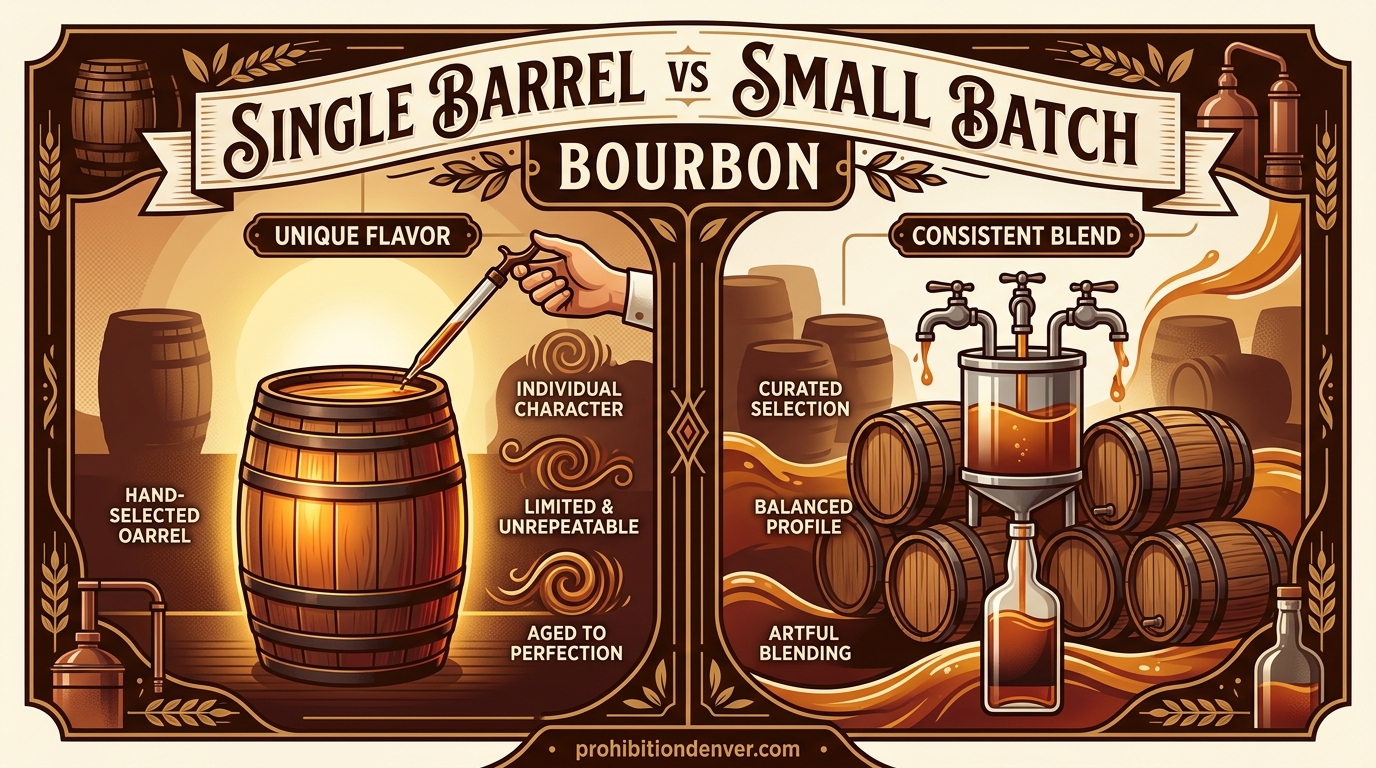
In the simplest terms, single barrel bourbon comes from one individual cask. Every bottle you pick up was filled from that exact same barrel, carrying the unique character of where that particular cask lived in the warehouse and how the years shaped it. Nothing was mixed in from any other barrel to tweak the flavor.
Small batch bourbon, on the other hand, is a blend—a thoughtful combination of multiple selected barrels chosen to create a consistent, signature flavor profile. Master tasters and blenders at the distillery carefully select barrels that complement each other, building in balance and complexity while ensuring that each bottling tastes essentially the same as the last.
The difference comes down to this: small batch offers consistency with a crafted balance of flavors. Single barrel highlights individuality, giving each bottle its own personality.
What is Single Barrel Bourbon?
Single barrel bourbon represents the purist’s approach to whiskey production. When you pour a glass of single barrel bourbon, you’re tasting exactly what that one cask produced over its years of aging—no corrections, no blending, no adjustments. The distillery simply filled bottles directly from one barrel.
The Magic (and Variance) of One Cask
Every barrel tells its own story. Where exactly it sat in the rickhouse matters enormously. Barrels on higher floors experience warmer temperatures and more aggressive evaporation. Those nestled in cooler spots lower down age more slowly, developing gentler profiles. The barrel’s position, the specific warehouse location, the char level of the oak—all of these factors create the final character of what’s inside.
This is what makes single barrel bourbon so fascinating. A bottle of Blanton’s Single Barrel from one cask might offer notes of dark cherry and leather, while the next cask leans toward honey and orange peel. Some store picks have become legendary for their unexpected flavors—pickle, Twix candy bars, Grape Kool-Aid. These aren’t flaws; they’re the unique fingerprint of individual barrels.
Brand Examples Worth Seeking
Several distilleries have built their reputations on single barrel programs:
- Blanton’s Original Single Barrel — The bourbon that started the single barrel movement, introduced in 1984. Expect rich, layered flavors with a distinctive smoothness.
- Four Roses Single Barrel — Known for its rye-forward mash bill and fruit-forward elegance. Each barrel expresses slightly different notes.
- Russell’s Reserve Single Barrel — From Wild Turkey, offering bold spice and vanilla with remarkable depth.
- Eagle Rare Single Barrel — A Buffalo Trace product with ten-year aging, delivering chocolate and orange peel notes.
Store Picks: The Hunt for Unique Expression
One of the most exciting developments in bourbon culture is the store pick program. Liquor stores, restaurants, and bars partner with distilleries to select specific barrels. These picks often showcase extreme expressions—a particular warehouse location, an unusual aging profile, or distinctive flavor notes that stand out from the standard bottling. If you see a store pick at Prohibition Denver, you’re looking at a hand-selected barrel chosen for something special.
What is Small Batch Bourbon?
Small batch bourbon is the distiller’s art of blending. Instead of relying on one cask’s personality, the master taster selects multiple barrels that, together, create something greater than any individual component. The goal is consistency—the same beloved flavor profile in every bottle, year after year.
The Blending Process
Here’s how it typically works: The distillery’s team samples dozens or hundreds of barrels, tasting and evaluating. They identify which barrels share complementary characteristics and which will balance each other in the final blend. One barrel might bring bold vanilla, another adds structure and oak spice, a third contributes fruit-forward brightness. Together, they achieve a harmonious result.
The blender’s job is to maintain the house style across every release. When you buy a bottle of Four Roses Small Batch, you’re getting a specific balance of ten distinct bourbon recipes, hand-selected to deliver the same experience every time.
Why “Small Batch” Isn’t a Legal Term
Here’s something important to understand: unlike “straight bourbon” or “bottled-in-bond,” “small batch” has no legal definition. Any distillery can use the term regardless of how many barrels they actually blend. Some might use just two or three barrels and call it small batch. Others might blend fifty. There’s no standard, which means the term is primarily a marketing descriptor.
This isn’t necessarily deceptive—it often reflects a genuine craft philosophy of careful selection rather than mass production. But it does mean you should evaluate small batch bourbons on their actual quality and reputation, not just the label.
Brand Examples Worth Knowing
- Four Roses Small Batch — A beloved blend of four recipes, offering red fruit, vanilla, and gentle spice in perfect balance.
- Russell’s Reserve Small Batch — From Wild Turkey, with rich caramel, vanilla, and a warm spice finish.
- 1792 Small Batch — Barton 1792 Distillery’s signature expression, featuring notes of toffee, orange, and baking spice.
- Maker’s Mark — Often cited as an accessible entry point to small batch bourbon, with soft wheat-forward sweetness.
Key Differences Between Single Barrel and Small Batch Bourbon
Let’s break down how these two approaches compare across the factors that matter most to bourbon lovers:
| Factor | Single Barrel Bourbon | Small Batch Bourbon |
|---|---|---|
| Number of Barrels | Exactly one cask per bottle | Multiple barrels blended (exact number varies by distillery) |
| Consistency | High variability between bottles/casks | Deliberately consistent across releases |
| Flavor Profile | Unique individual expression from one cask | Balanced, house-style profile with layered complexity |
| Typical Price | Generally higher ($50-100+) | Usually more affordable ($25-50) |
| Availability | Often limited and allocated | Generally more widely available |
| Collectibility | High — each cask is unique and numbered | Lower — focused on daily drinking rather than scarcity |
| Best For | Enthusiasts, collectors, special occasions | Daily drinking, cocktails, consistent quality |
Production Process: How Each Is Made
The production paths diverge significantly once the whiskey is ready for bottling:
For single barrel: The distillery identifies a cask that has reached optimal maturity. They bottle it directly, often with site-specific labeling noting the barrel number, warehouse location, and sometimes the exact rickhouse position. Each bottle is numbered and may carry tasting notes specific to that cask.
For small batch: The blending team conducts numerous samples from their inventory. They experiment with combinations, adjusting ratios until they achieve the target flavor profile. The selected barrels are married together in a mixing tank before bottling, ensuring every bottle carries the same character.
Flavor: What You Can Expect
Single barrel bourbons often feature more pronounced, distinctive characteristics. Without blending to smooth rough edges, you might encounter bolder oak influence, more dramatic fruit notes, or unusual spice profiles. The uniqueness is the point—some casks are transcendent, others merely good, a few disappoint. The variance is part of the thrill.
Small batch bourbons typically offer more balanced, approachable profiles. The blending process naturally creates harmony: if one barrel is too oaky, another might be fruitier and can compensate. The result is usually seamless—vanilla and caramel playing nicely with baking spice, oak present but not dominant.
Consistency vs. Individuality
This is the fundamental trade-off. Small batch bourbon is for those who find a profile they love and want to experience it again and again. Single barrel bourbon is for those who enjoy surprises—who open a bottle not knowing quite what they’ll find, and appreciate the journey of discovery.
As one reddit community member put it: “Single barrel has a higher ceiling but also a lower floor.” You might find a transcendent pour, or you might get a mediocre one. Small batch is the safer bet, but without the excitement of landing something exceptional.
Which Should You Choose?
The answer depends entirely on what you’re looking for. Here is a practical guide for different situations:
Choose Single Barrel When:
- You’re celebrating a special occasion — Single barrel pours feel event-worthy. The uniqueness of the expression matches the significance of the moment.
- You enjoy discovery and variety — If opening a new bottle is an adventure, single barrel delivers anticipation and potential surprises.
- You’re building a collection — Numbered, cask-specific bottles have inherent collectibility. Limited releases can appreciate in value.
- You’ve found a store pick you love — Trust your palate. If a particular pick resonated with you, seek out similar expressions or ask your bartender about future selections.
- You appreciate story in your pour — Single barrel bottles often come with provenance—warehouse location, age statement, production details.
Choose Small Batch When:
- You want reliable quality — Small batch takes the guesswork out. You know what you’re getting before you buy.
- You’re new to bourbon — The balanced, approachable profile of small batch is more forgiving for developing your palate.
- You’re mixing cocktails — The consistent flavor profile means your Old Fashioned or Manhattan will taste the same every time you make it.
- You’re watching your budget — Small batch typically offers excellent value without sacrificing quality.
- You drink the same style regularly — If you know you enjoy, say, Four Roses Small Batch, you can return to it confidently for years.
At the Bar: Practical Guidance
When you’re sitting at Prohibition Denver’s bar, deciding between pours, consider your mood and the company. Sharing a single barrel with friends invites conversation about the pour’s unique characteristics. Drinking small batch neat or on the rocks provides a reliable, enjoyable experience.
If you’re uncertain, ask your bartender about our current selections. Describe what you typically enjoy—they can guide you toward either a consistent small batch or an intriguing single barrel that matches your preferences. We taste through these expressions regularly and can help you find exactly what you’re looking for.
Frequently Asked Questions
What does small batch bourbon mean?
Small batch bourbon is a blend of selected barrels chosen by master tasters to create a consistent, balanced flavor profile. Unlike single barrel bourbon, which comes from one cask, small batch combines multiple barrels—typically anywhere from a handful to a couple hundred—to achieve a house style that remains reliable across bottlings.
What does single barrel bourbon mean?
Single barrel bourbon means every bottle in your hands came from exactly one specific cask. Nothing was blended to adjust the flavor. This gives each release a unique personality based on where that particular barrel aged, its position in the warehouse, and the natural variations in the aging process.
Which has more consistency – small batch or single barrel?
Small batch offers significantly more consistency. Because it’s a deliberate blend of multiple barrels, distillers can balance out variations and deliver the same flavor experience bottle after bottle. Single barrel bourbon varies with each cask—one bottle might taste noticeably different from the next, even from the same distillery.
Is single barrel always better?
Not necessarily. While single barrel bourbons often have more distinctive, unique flavor profiles and can reach exceptional heights, they also have a lower floor. A single bad barrel makes for a disappointing bottle. Small batch provides reliable quality and balanced flavor. It comes down to what you value: the consistency and craft of small batch, or the individuality and potential uniqueness of single barrel.
Which is better for cocktails?
Small batch bourbon is generally the better choice for most cocktails. Its consistent, balanced flavor profile—typically featuring vanilla, caramel, and oak notes—blends reliably with other ingredients. Single barrel bourbon can work in cocktails if you want to highlight its distinctive character, but the natural variation means your drink might taste different each time you make it.
Does small batch mean higher quality?
Not automatically. “Small batch” is a marketing term with no legal definition, so any distillery can use it regardless of how many barrels they actually blend. The quality depends on the distillery’s sourcing, aging, and blending expertise—not the batch size. Single barrel also isn’t inherently better; it’s just different.
Conclusion
The difference between single barrel and small batch bourbon ultimately comes down to philosophy: consistency versus individuality, craft versus discovery. Small batch offers the comfort of knowing exactly what you’re getting—a carefully blended expression designed to deliver the same pleasurable experience every time. Single barrel offers excitement and possibility, each bottle a unique journey into what that particular cask became over years of patient aging.
Neither is objectively better. Both have their place in a well-rounded bourbon life. At Prohibition Denver, we stock an array of both styles, and we believe every bourbon lover should explore the spectrum. Start with a reliable small batch to build your palate, then venture into single barrel territory when you’re ready for the adventure that each unique cask offers.
The next time you’re staring at that whiskey menu or standing in the bourbon aisle, you’ll know exactly what you’re choosing—and why. Come visit us at Prohibition Denver and put your knowledge to the test at our bar. We pour with purpose.