
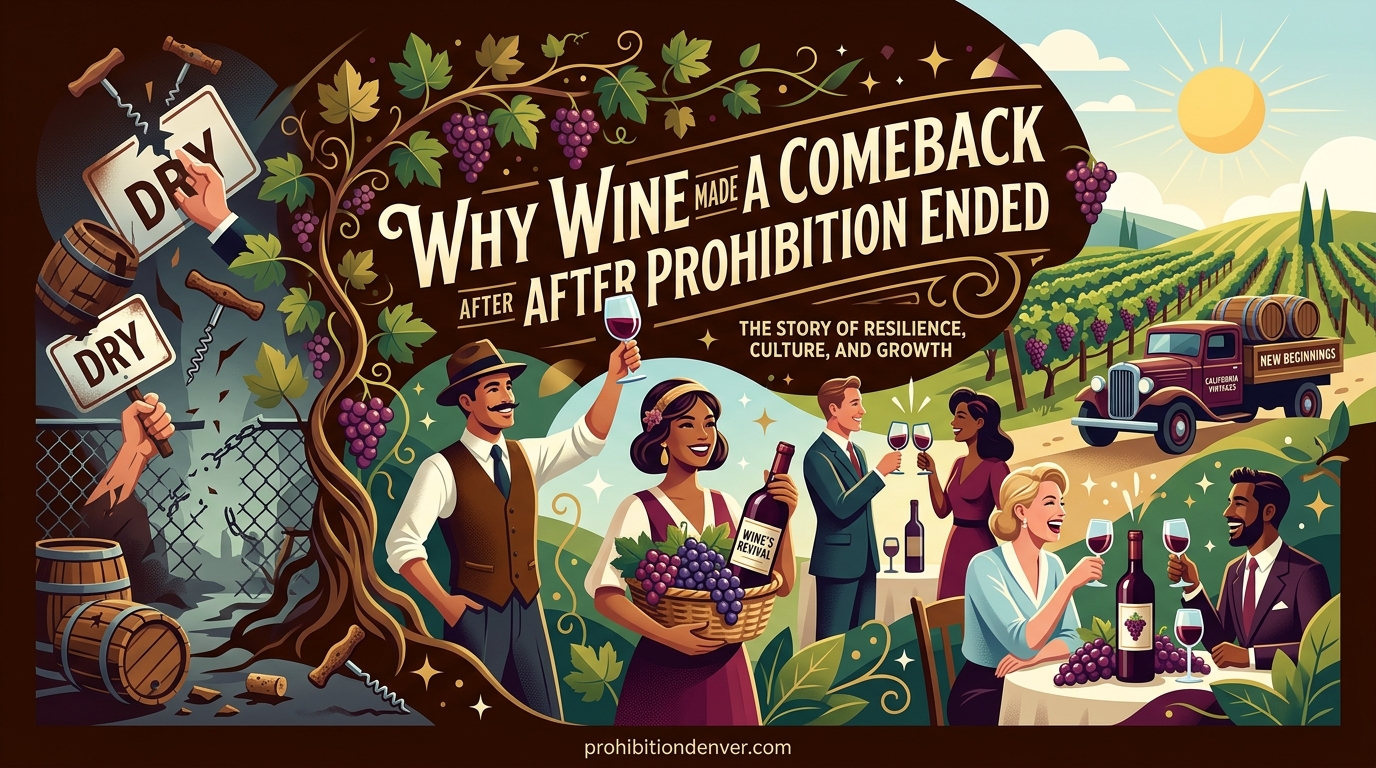
When the 18th Amendment was ratified in 1919, prohibiting the production and sale of alcoholic beverages, observers predicted the death of wine in America. Yet when Repeal Day arrived on December 5, 1933, wine emerged from the shadows faster than beer or spirits. This wasn’t luck—it was the result of legal loopholes, preserved viticultural knowledge, and a cultural perception that would reshape America’s relationship with wine forever.
To understand wine’s remarkable recovery, we must first appreciate what Prohibition nearly destroyed: an industry that had taken nearly a century to build.
Table of Contents
The Golden Age of American Wine (1800s-1919)
Before the ink dried on the 18th Amendment, America had developed a thriving wine culture. By 1919, over 2,000 wineries operated across the country, with California leading production in regions that would later become legendary: Napa Valley, Sonoma, and the Central Coast. Wine regions existed far beyond California, however—New York, Missouri, Georgia, Ohio, Illinois, and New Mexico all had established wine industries serving local markets.
American wines were gaining international recognition. The wine trade was deeply embedded in American culinary and religious traditions. Catholic churches relied on sacramental wine, Jewish communities needed wine for religious ceremonies, and a growing middle class was developing an appreciation for table wines alongside their European immigrants’ heritage.
“By the turn of the century, wine had become as American as baseball and apple pie—woven into the fabric of daily life, religious practice, and celebratory occasions.”
This flourishing industry faced complete annihilation when Prohibition began. Wineries were forced to shutter, vineyards were torn out or left untended, and generations of winemaking knowledge hung by a thread. But unlike beer and spirits, wine had something unexpected working in its favor: loopholes in the law itself.
Prohibition Arrives: The 18th Amendment’s Impact (1920-1933)
On January 17, 1920, the 18th Amendment took effect, banning the manufacture, sale, and transportation of intoxicating liquors. The Volstead Act, which enforced the amendment, created one of the most expensive federal enforcement efforts in American history—costing taxpayers approximately $300 million annually to enforce a law that, as history would prove, most Americans simply ignored.
Federal tax revenue lost due to Prohibition
The human cost was equally staggering. With commercial alcohol production banned, black market operators rushed to fill demand with dangerous substitutes. Over 1,000 Americans died annually from drinking tainted bootleg liquor—methyl alcohol-contaminated spirits that caused blindness and death. The irony was brutal: the “cure” for alcohol abuse proved more deadly than the disease it claimed to address.
The commercial wine industry was devastated. Wineries that had operated for generations either closed or pivoted to producing grape juice, wine vinegar, or sacramental wines. But beneath the official collapse, a quiet resistance took root that would save wine from extinction.
The Loopholes That Saved Wine
Prohibition’s architects made a critical oversight: they allowed personal wine production. The Volstead Act permitted individuals to make wine at home for personal consumption—up to 200 gallons annually per household. This single exemption created a lifeline that kept vineyards alive across America.
The 200-Gallon Loophole
Families across America seized this legal opportunity. Grandparents who had made wine for generations continued the tradition. Italian-American and German-American communities kept their winemaking heritage alive in basements and garages nationwide. California grape growers, facing the collapse of their commercial market, found an unexpected savior: home winemakers.
Closely related was the “grape brick” workaround. Wine authorities permitted the sale of grape concentrate—in concentrated blocks that consumers would dissolve in water and ferment at home. These grape bricks came with explicit government warnings that they should not be used to make wine (warnings that everyone ignored). Companies like Welder’s grape brick became cultural icons, their packaging showing exactly how to circumvent the law while technically complying with it.
Perhaps most importantly, the sacramental wine exception kept certain wineries operational. Wineries like Beaulieu in Napa Valley and Concannon Vineyard in Livermore survived by producing wine specifically for Catholic Masses and Jewish religious ceremonies. These operations maintained equipment, kept skilled workers employed, and preserved institutional knowledge that would prove invaluable when Repeal finally arrived.
“Churches became unlikely guardians of American winemaking knowledge, their sacramental wine production keeping centuries-old traditions alive through thirteen years of enforced darkness.”
The Slow Recovery: Why Wine Rebounded Faster
When Prohibition ended, the alcohol industry faced a fundamental question: what would Americans want to drink? Beer and spirits had been entirely wiped out—no legal production meant no industry infrastructure. Wine, however, had kept alive through those loopholes. Here’s why wine recovered faster:
Key Recovery Factors
— Home winemaking kept viticultural and winemaking skills alive across immigrant communities. Unlike spirits (which require specialized distilling equipment), wine production knowledge was passed down in family kitchens.
— Beer requires barley, hops, and large malting facilities. When Prohibition ended, brewers had to rebuild from scratch—finding barley fields now planted with other crops. Wine had kept vineyards planted because home winemakers bought grapes year after year.
— Wine retained an image of sophistication and civilization. Heavy drinking had been associated with spirits and beer—the very beverages that caused social problems. Wine, by contrast, was perceived as the drink of refinement and moderation.
— Distilleries require expensive equipment and specialized expertise. Wineries could restart with existing vineyards, basic equipment, and inherited knowledge. The capital barrier to entry was significantly lower.
— Post-Prohibition America had learned something about alcohol abuse. Wine positioned itself as a civilized alternative—enjoyed with meals, consumed slowly, associated with Mediterranean cultures known for longevity and health.
These factors combined to give wine a crucial head start. When Americans celebrated Repeal Day with toasts, wine was available to pour—grapes had been grown, basic winemaking had continued, and knowledge had been preserved in ways that beer and spirits simply could not match.
California’s Leadership in the Wine Revival
When Repeal came, California stood ready to lead America’s wine recovery. The state’s wine industry had never completely stopped—sacramental wine production, home winemaking, and grape sales had kept vineyards growing and winemakers working.
Wineries that survived Prohibition became the foundation stones of modern American wine. Beaulieu Vineyard in Napa continued producing sacramental wines throughout the 1920s and 1930s, its founder Georges de Latour working quietly to preserve premium vineyard land. Concannon Vineyard kept its Livermore Valley vineyards producing, later becoming known for its sustainable practices and entrepreneurial spirit.
The University of California’s viticulture program proved another asset. Even during Prohibition, research continued into grape cultivation, pest control, and winemaking techniques. When commercial production resumed, this institutional knowledge provided a scientific foundation that helped American wines improve rapidly.
The 1960s saw the first modern boutique wineries emerge—smaller operations focused on quality over quantity. These pioneers invested in premium grape varieties, improved winemaking techniques, and began competing directly with European traditions. Robert Mondavi, whose family had actually suffered during Prohibition (his father was forced to sell grapes for sacramental wine), led this quality revolution.
Then came the moment that transformed global perception of American wine: the Judgment of Paris. In 1976, British wine merchant Steven Spurrier organized a blind tasting in Paris where French experts judged California wines against France’s finest. The results stunned the wine world: California wines took top honors in both red and white categories, beating legendary French producers. This wasn’t just a marketing victory—it was proof that America could produce world-class wine.
Modern Wine Industry’s Roots in Post-Prohibition Era
Today’s American wine industry—over 10,000 wineries strong—directly descends from the survivors of Prohibition. The cultural shift toward quality wine consumption, the appreciation for regional distinctiveness, and the democratization of wine knowledge all trace back to the recovery era.
What began as a fight for survival became a triumph of resilience. Wine proved more adaptable than beer or spirits precisely because of how it had survived: through legal loopholes that preserved knowledge, through cultural associations that retained their appeal, and through the stubborn persistence of communities that refused to abandon their heritage.
The recovery also reshaped American drinking culture itself. Where pre-Prohibition America had been known for heavy drinking and saloon culture, post-repeal America developed a more measured relationship with alcohol. Wine played a central role in this shift—positioning itself as a complement to food, conversation, and civilization rather than an end in itself.
FAQ
What was the worst kept secret of Prohibition?
That the Volstead Act was widely flouted. Estimates suggest only 10-15% of alcohol consumption was actually stopped. Millions drank legally prohibited beverages daily through home winemaking, sacramental wine exceptions, and simple non-compliance. The law became a charade that most Americans simply ignored.
Who profited the most from Prohibition?
Organized crime networks profited enormously, earning an estimated $2 billion annually from bootlegging operations. However, some wine-related businesses also profited through grape brick sales and sacramental wine production. The legal loopholes for wine created unexpected survivors in an industry that should have been destroyed.
What alcohol brands survived Prohibition?
Several wineries survived by pivoting to legal products: Beringer kept operations through wine vinegar production; Beaulieu in Napa survived by producing sacramental wines for Catholic churches; Concannon Vineyard survived on grape juice sales. These brands now rank among the most respected in American wine.
Did Prohibition reduce alcohol consumption?
No. Per capita consumption dropped initially but quickly stabilized. By the late 1920s, alcohol consumption had returned to approximately 60-70% of pre-Prohibition levels. The policy failed its stated goal entirely, instead creating massive black markets and costing the federal government billions in tax revenue.