
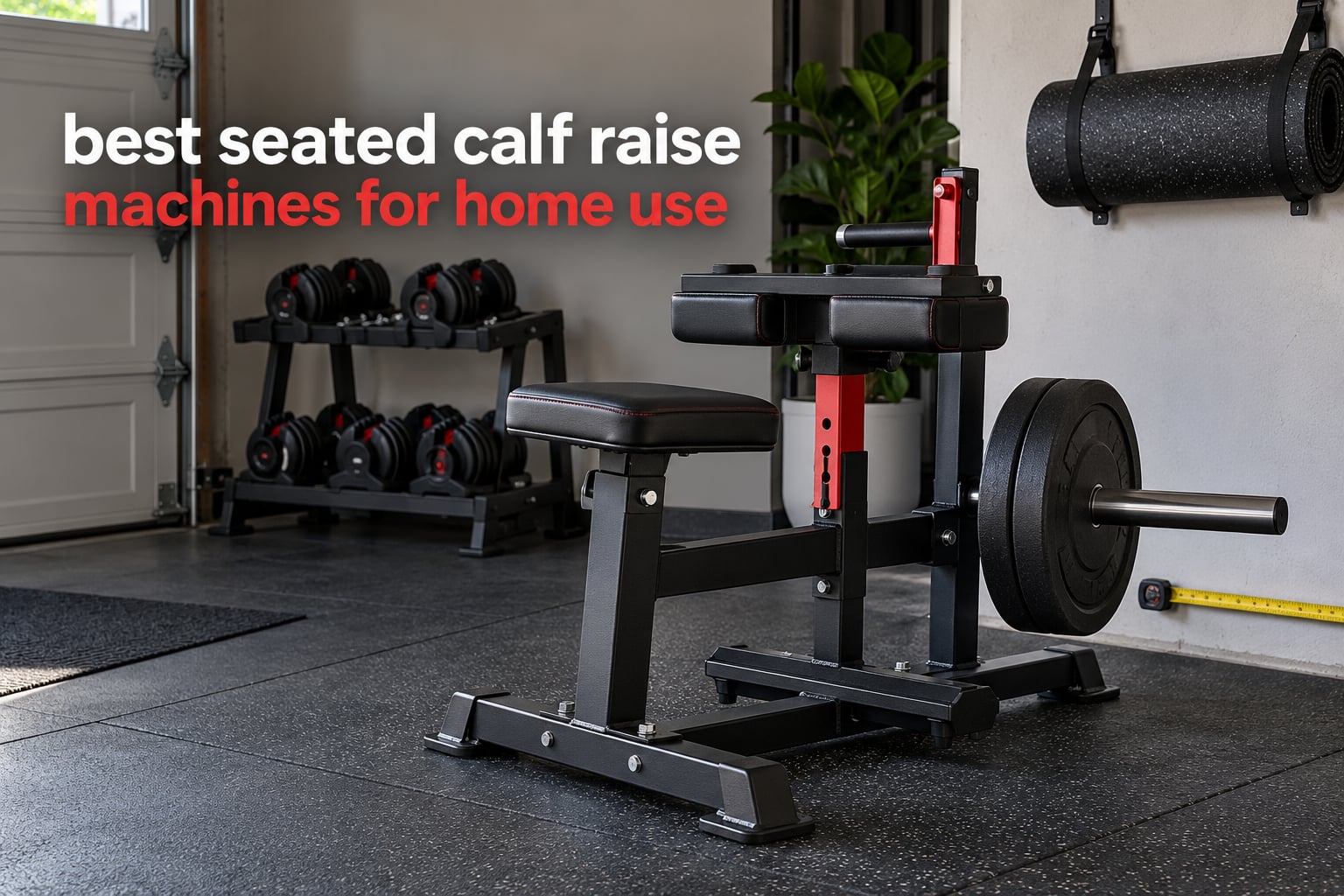
The calf is one of the few muscles in the body where a home lifter can go years without noticing a gap. You press, squat, row and pull, then look down at ankles that barely changed, and the whole area gets written off as genetic. That is usually a loading problem rather than a genetics problem. The bigger of the two calf muscles, the soleus, sits underneath the gastrocnemius and switches on mostly when the knee is bent. Most home setups, from a barbell-on-the-lap hack to a leg press hack, do not put the knee in that position cleanly enough to load the soleus hard.
A seated calf raise machine fixes that. You sit, trap your knees under a thigh pad at roughly 90 degrees, and press through the balls of your feet while a loaded weight horn travels through its arc. Your heels drop below the footplate at the bottom for a stretch, and the soleus does the work. That is the whole argument for spending floor space and money on a dedicated unit, and it is the argument we tested against eight machines to build this guide to the best seated calf raise machines for home use.
We spent several weeks working through the full range of the category, from entry-level welded steel frames with band pegs to an 11-gauge commercial unit with a lifetime frame warranty. We looked at how each one loads, whether it fits the plates you already own, how much floor it eats, what happens to your feet at the top of the rep, and what owners report a year later. All ratings and review counts below were current as of 2026.
One note before the picks, because the question comes up more than any other in this category: a seated calf machine is a nice-to-have, not an essential. If you already own a leg press or a Smith machine, you can cover most of the movement. What a machine adds is a clean bent-knee position, a real loading pin, and the ability to add weight in small increments over years. We are honest about who should skip it in a dedicated section further down. If you are also furnishing the rest of the room, our picks for seated ellipticals for home use cover the other high-value cardio slot in a small gym.
Table of Contents
Top 3 Seated Calf Raise Machines for Home Gyms
Our three strongest overall are the Soozier, the GMWD and the HVO. Each takes a different route to the same movement: one wins on proven owner history, one on adjustability and mobility, one on smooth bearing action and dual resistance.

Soozier Seated Calf Raise
- 440 lb capacity
- 5 handle heights and 4 length settings
- Dual Olympic posts for 1 inch and 2 inch plates
- Textured non-slip foot brace bar

GMWD Adjustable Seated Calf Raise
- 550 lb capacity
- Plate-loaded plus resistance band pegs
- 6 height and length settings
- Rolls on locking silicone casters

HVO Seated Calf Raise 660 lb
- 660 lb maximum load
- Barbell plates or elastic bands
- Bearing pivot for smooth motion
- 6-level leg pad adjustment
Quick Overview: Best Seated Calf Raise Machines for Home Use in 2026
Every machine below is plate-loaded and seat-based, which is the filter we used. Leg presses, standing calf bars, tib bars and pure selectorized stacks are not in the lineup, because they train a different position or a different movement. What changes between these eight is capacity, adjustability, footprint, plate compatibility and build gauge.
| Product | Specifications | Action |
|---|---|---|
| Soozier Seated Calf Raise Machine |
|
Check Latest Price |
| GMWD Adjustable Seated Calf Raise Machine |
|
Check Latest Price |
 Synergee Seated Calf Raise Machine Synergee Seated Calf Raise Machine |
|
Check Latest Price |
 Titan Fitness Plate-Loaded Seated Calf Raise Titan Fitness Plate-Loaded Seated Calf Raise |
|
Check Latest Price |
| HVO Seated Calf Raise Machine 660 lb |
|
Check Latest Price |
 Valor Fitness Seated Calf Raise Machine Valor Fitness Seated Calf Raise Machine |
|
Check Latest Price |
 Body-Solid GSCR349 Seated Calf Raise Body-Solid GSCR349 Seated Calf Raise |
|
Check Latest Price |
 GuuG Seated Calf Raise Machine GuuG Seated Calf Raise Machine |
|
Check Latest Price |
1. Soozier Seated Calf Raise Machine – The One With the Longest Owner History
Soozier Seated Calf Raise Machine for Home Gym Waist Arm Training Red
440 lb capacity
48D x 23.2W x 41.7H
41 lb unit weight
1 inch and 2 inch plate posts
Pros
- Largest review base in the lineup at 375 ratings
- Dual Olympic posts accept both 1 inch and 2 inch plates
- Five handle heights and four length settings
- Foot platform design reduces pressure on the ball of the foot
Cons
- 440 lb capacity trails most plate-loaded rivals
- Compact frame can feel tight for taller users
The Soozier is the safest pick on this list because 375 owners have already put it through real garage sessions and written about what happened. It is not the flashiest machine here. It is the one where the long-run failure modes have been documented at scale, and that is what matters when you are buying a steel frame to live in a corner of a basement for the next decade.
We set it up against a rack of standard 1-inch plates and 2-inch Olympic plates and swapped between them without touching a single sleeve. The dual Olympic weight posts take both diameters directly, which saves you the adapter purchase that trips up some buyers in this category. The foot brace bar is wide and textured, and during our loaded sets the balls of our feet stayed planted instead of creeping toward the edge.
Adjustability is the reason it works across body sizes. Five handle heights and four length settings let you walk the thigh pad and the grip position until your shins sit near vertical with the knee at roughly 90 degrees. On a machine where the pad position is fixed, a tall lifter ends up with a compressed knee angle and the soleus work drops off. That adjustment range is the single most useful feature here.
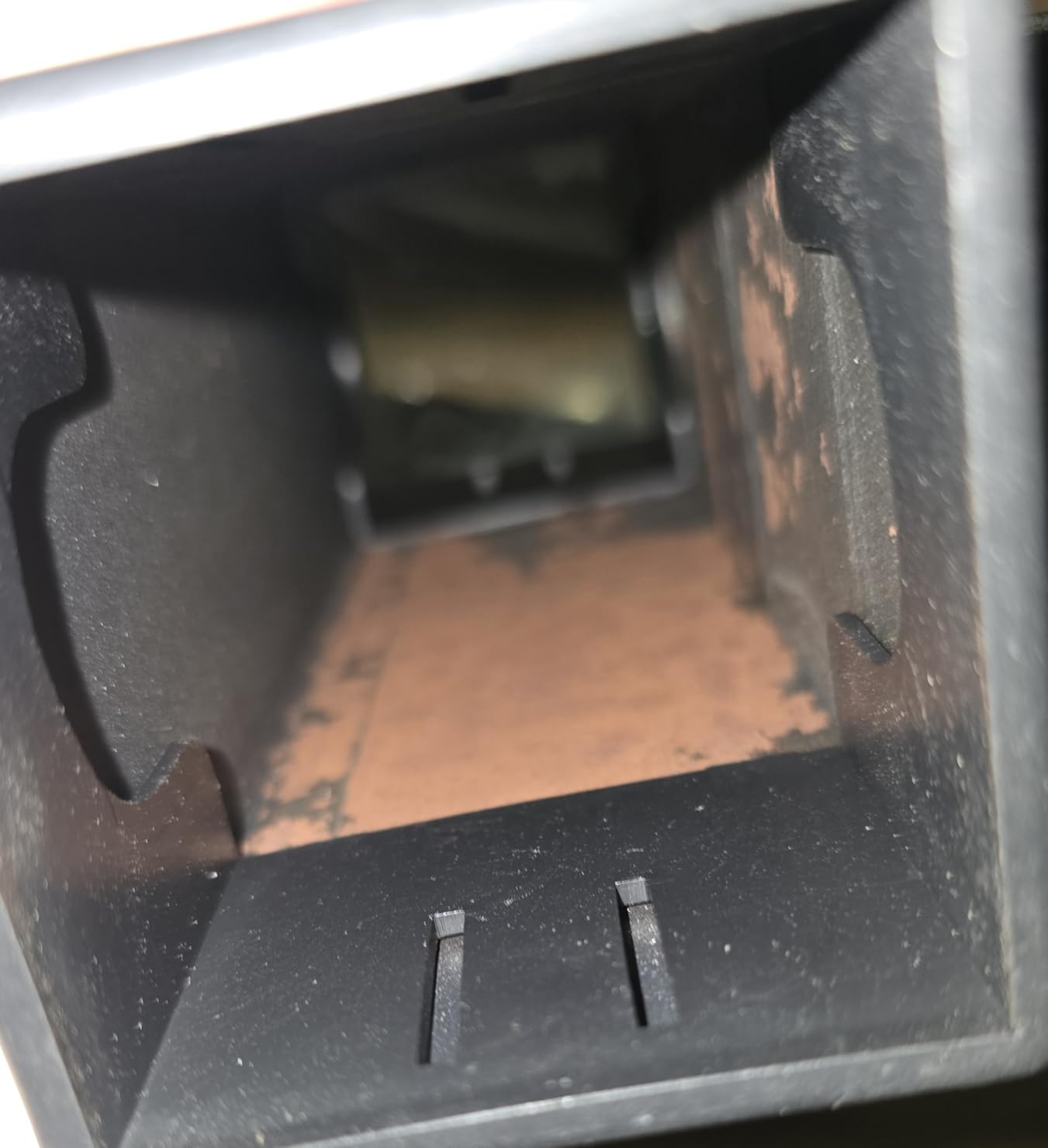
Capacity is the trade-off. A 440 lb ceiling is enough for nearly every home lifter, because calves respond to high reps and moderate loading rather than to heroic plate stacks. It becomes a limitation only if you plan to progress toward maximal loads, and at that point you are buying a different machine. The powder-coated steel frame does not flex under load and the padded seat handles a long set without the pressure points you get on a bare bench.
The review distribution explains the 4.1 rather than a higher number. Fifty-seven percent of ratings sit at five stars and 18% at four, which is a strong showing, but 15% land at three stars, usually over foot brace feel, seat comfort for long sessions, or the fit for people above roughly six feet. None of that is a defect. It is the honest ceiling of a compact, budget-positioned frame. Owners who fit inside its adjustment range use it very well.
How the Soozier handles plates, pads and floor space
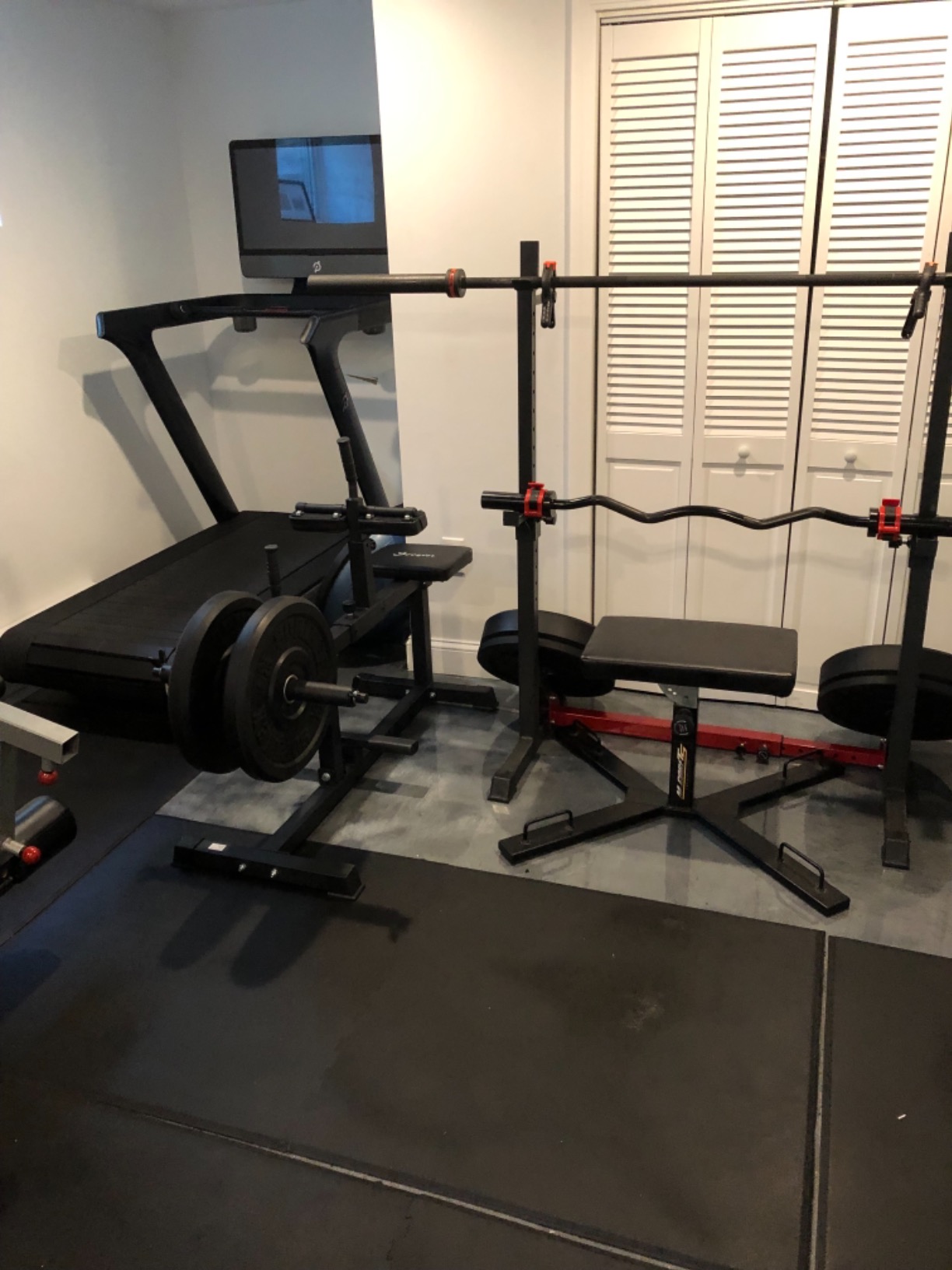
Plate loading is the frictionless part. Both post diameters fit, the horizontal horn clears the frame at full extension, and you can load a heavy pair without the sled jumping, because the horn sits low and centered rather than high above your head. If you own a mixed plate collection, that compatibility removes the single most common hidden cost in this category.
The 48 by 23.2 inch footprint is average for the lineup, which means it fits a normal garage bay or a cleared basement corner without wall clearance problems. The 41 lb unit weight is the lightest here, so moving it to reorganize the room is a one-person job. Plan for a rubber mat underneath if you train on concrete, since the frame transmits vibration straight to the floor.
Who should skip the Soozier
Skip it if you are taller than about six feet and want a long-lever position, or if your goal is single-leg work with heavy loading, since a single wide horn and a fixed seat height limit how you position one leg. It is also not the pick if you want band resistance as a second option, or if you intend to add plates over many years toward a very high ceiling.
For everyone else building a first home calf setup, the Soozier delivers the core movement with plate compatibility most rivals in its class cannot match. If our lineup had a unit with a bigger review count at the same footprint and capacity, it would lead this page.
2. GMWD Adjustable Seated Calf Raise Machine – The Most Adjustable Frame We Tested
GMWD Calf Raise Machine, 550LBS Seated Leg Strength Training Mahine with Transport Wheels and Band Pegs, Lower Body Specialty Machine (Calf Only) Red & Black (T6-091)
550 lb capacity
38.6D x 22W x 38.6H
56.2 lb unit weight
6 height and length settings
Pros
- Widest adjustability range in the lineup with six height and length settings
- Seat padding adjusts from 19.7 inch to 25.6 inch
- Dual resistance through plates and side band pegs
- Rolling base with lockable silicone casters
Cons
- Band resistance adds less than plate loading for heavy work
- Locking rubber feet are needed on hard floors to protect the casters
The GMWD answers the question that comes up in every home gym forum thread about calf machines, which is what to do when the machine does not fit your body. Six height and length settings, plus a seat pad that travels from 19.7 to 25.6 inches, produced the best fit of the eight machines we worked with. If you have ever sat on a fixed-seat calf machine and found your knees jammed toward your chest, this is the opposite experience.
At 276 ratings it holds a 4.2 with 65% of reviews at five stars and only 7% at three, and just 2% at two stars. Owners mention the adjustability and the mobility more than anything else, and they frequently note that they can roll the machine aside to free floor space when they are not using it, which solves the footprint objection that stops most people from buying any calf machine at all.
The dual-resistance design is unusual at this level. Alongside the plate-loaded horn, side strap band pegs let you add elastic resistance without plates, and owners use them for warm-up sets, high-rep pump work and for glute and hamstring variations. It is not a replacement for a heavy plate load, but it makes the machine usable on days when you do not feel like loading 45s onto the horn.
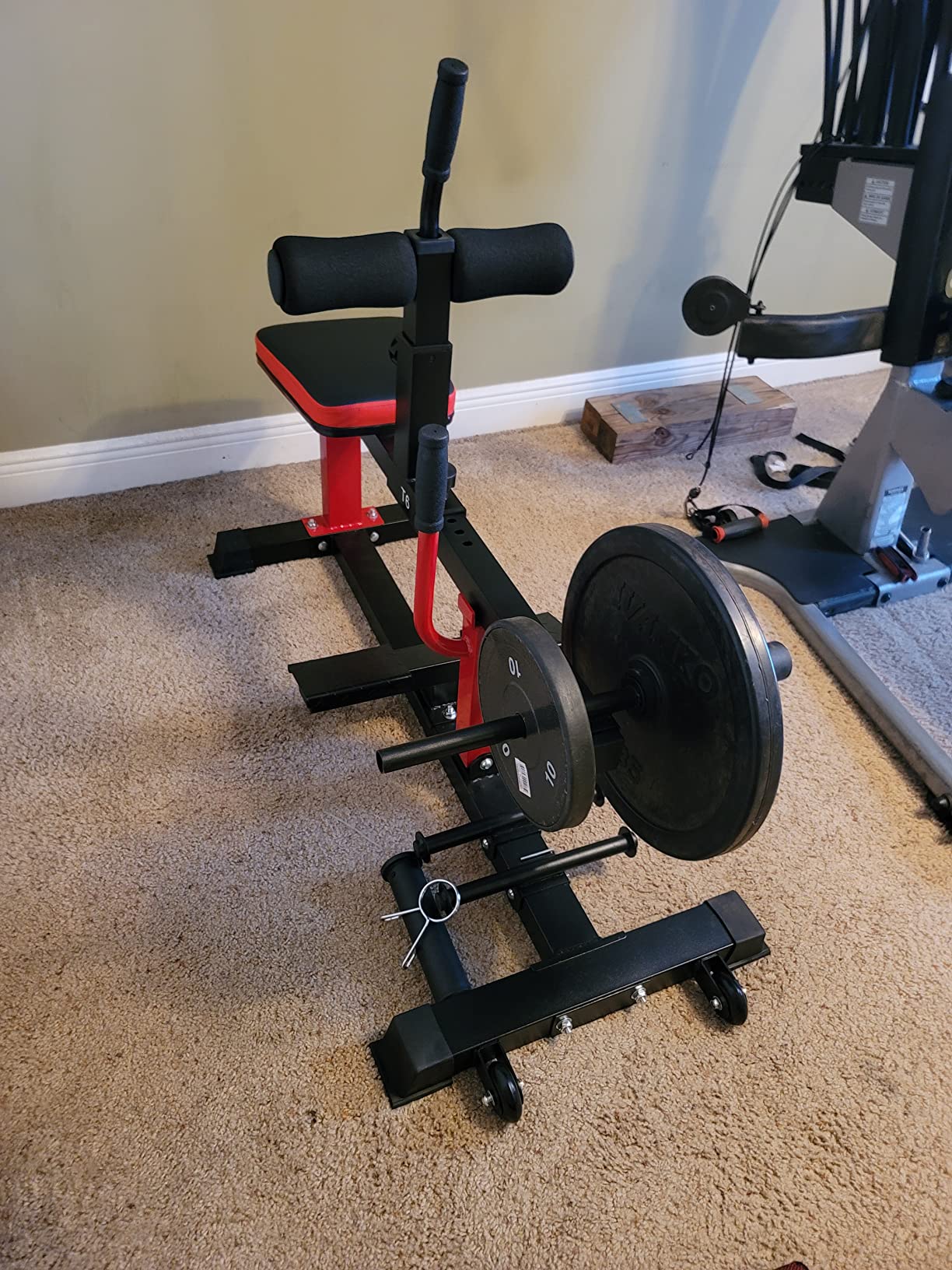
Capacity is 550 lb, which puts it in the same class as the Titan and the Synergee and well above the Soozier and the Valor. The angled footplate with textured grips held our feet steady through heavy reps, and the six-position adjustment let us set the shin angle so our heels dropped cleanly below the plate at the bottom of the movement, which is where the loaded stretch on the soleus happens.
One practical note on the wheels. The 3-inch silicone casters make the machine genuinely portable, and they roll smoothly on carpet and on rubber gym flooring. On bare concrete, the lockable rubber feet matter, because a hard caster under a loaded horn wears out and cracks. Level the feet before every set and the machine stays completely still.
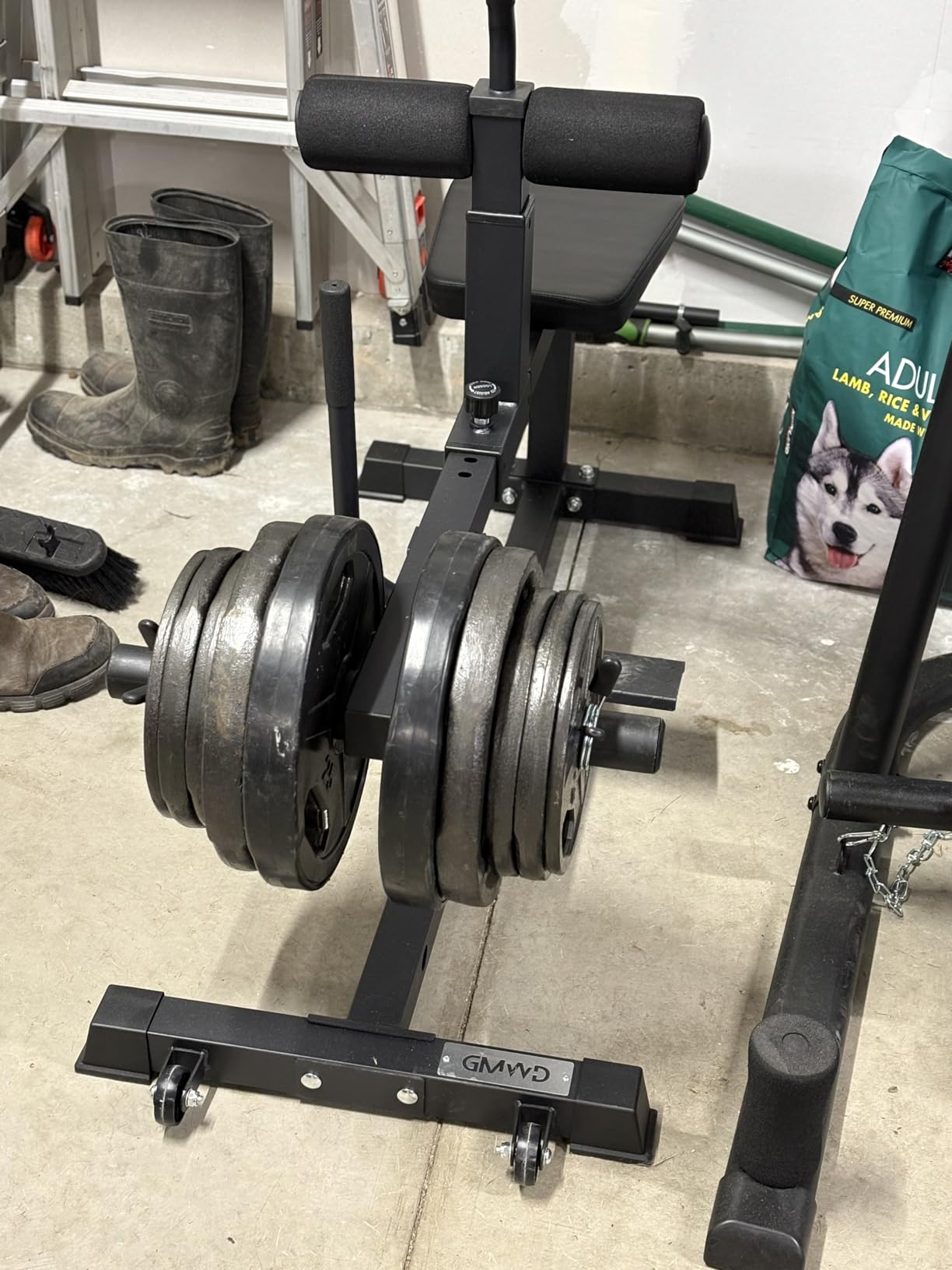
Why the adjustment range matters more than the capacity number
Most owners can load far more than they can usefully use. A capacity figure tells you what the frame survives, not what your calves can absorb. What limits your progress is whether the machine lets you sit at a shin angle that stretches the soleus through its full range and contracts it through a full lift. Six settings across two axes, with a pad that travels nearly six inches, gave us more usable positions than any rival here.
The band pegs add a second reason to keep it. Warm-ups and high-rep sets do not need plates, and doing those on the band pegs leaves the plates on the rack for the working sets. That is a small efficiency gain that adds up across years of calf sessions, and it is the feature owners most often mention in reviews.
Who should skip the GMWD
Skip it if your floor is unfinished concrete and you do not want to deal with casters, or if your training is entirely heavy plate work and the band pegs are dead weight to you. It is also the wrong call for a renter who needs to move it constantly, since the 56.2 lb frame and its wheel base are designed for repositioning within a room rather than hauling between spaces.
For most home gyms this is the machine we would put in the corner first. The combination of adjustability, dual resistance, mobility and a 550 lb ceiling covers every training style in this lineup short of maximal loading, and it does it in a 22-inch width that suits a small room.
3. HVO Seated Calf Raise Machine 660 lb – The Smoothest Travel and the Highest Capacity
HVO Seated Calf Raise Machine,Calf Workout Exercise Equipment 660LBS
660 lb maximum load
26.57D x 50.2W x 33.9H
22 kg unit weight
Plates or elastic bands
Pros
- Highest load capacity in the lineup at 660 lb
- Bearing-based pivot reduces side-to-side shaking
- Leg pad adjusts through six levels and support rod through four
- Can stand on its rear legs for vertical storage
Cons
- Tight knee clearance for users around 6 ft 1 in and taller at maximum pad settings
- Wide 50.2 inch footprint
- A few owners report weak seat support welds
The HVO has the smoothest motion of any seated calf machine we used, and the reason is mechanical rather than marketing. A bearing-based pivot replaces the simple bolt-and-bushing joint used by most frames in this category, and the difference shows up immediately in the first rep. There is no lateral shake in the horn, so you can load heavy and concentrate on the movement instead of correcting the machine.
At 105 ratings it carries a 4.4, with 73% of reviews at five stars and just 1% at two. Among the machines above the middle of our lineup on review volume, that is the highest average rating. Owners repeatedly single out the smooth bearing action and the elastic bands, which they use to stabilise the sled so plates do not jump during fast reps.
The 660 lb ceiling is the highest in the lineup, and the detachable barbell sleeves take both 1-inch and 2-inch plates, so you can load from your existing collection. We found the motion smooth at moderate loads, and the bearing pivot is the reason a heavy plate stack stays controllable. Capacity here is genuine rather than a headline figure.
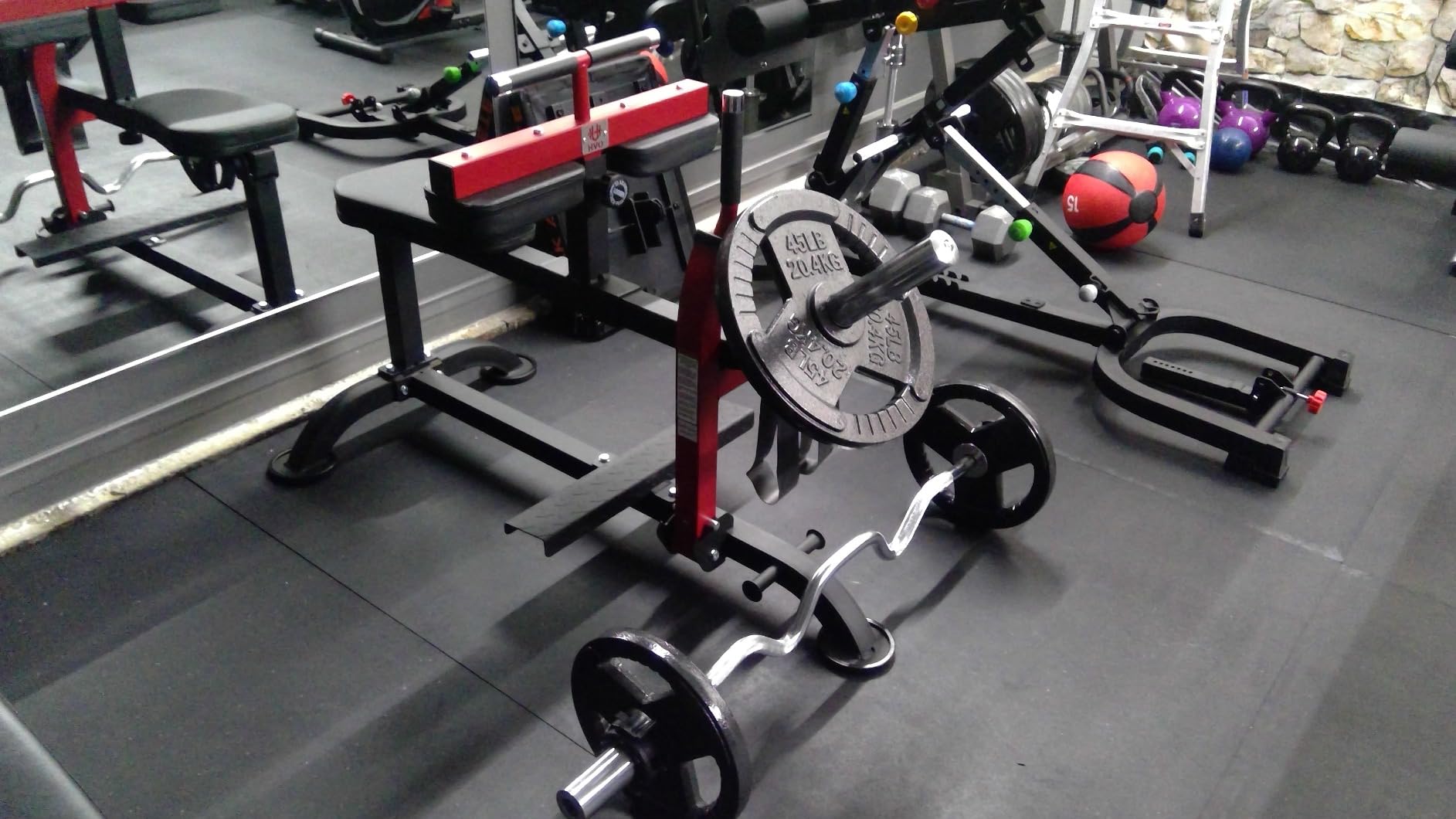
Adjustability runs through six leg pad height levels and four support rod positions front and back. In our sessions the support rod adjustment mattered as much as the pad height, because it changes where the load sits relative to your heels and that changes how deep the bottom stretch goes. Most rivals give you one axis. This one gives you two.
It also stands on its rear legs for storage, which is a genuine advantage in a small garage. When you are not training calves, the machine occupies roughly its 26-inch depth against the wall instead of its full footprint. HVO owners describe assembly as taking around twenty to thirty minutes, and one buyer reported replacement of an adjusted part at no charge, which is a good sign on support.
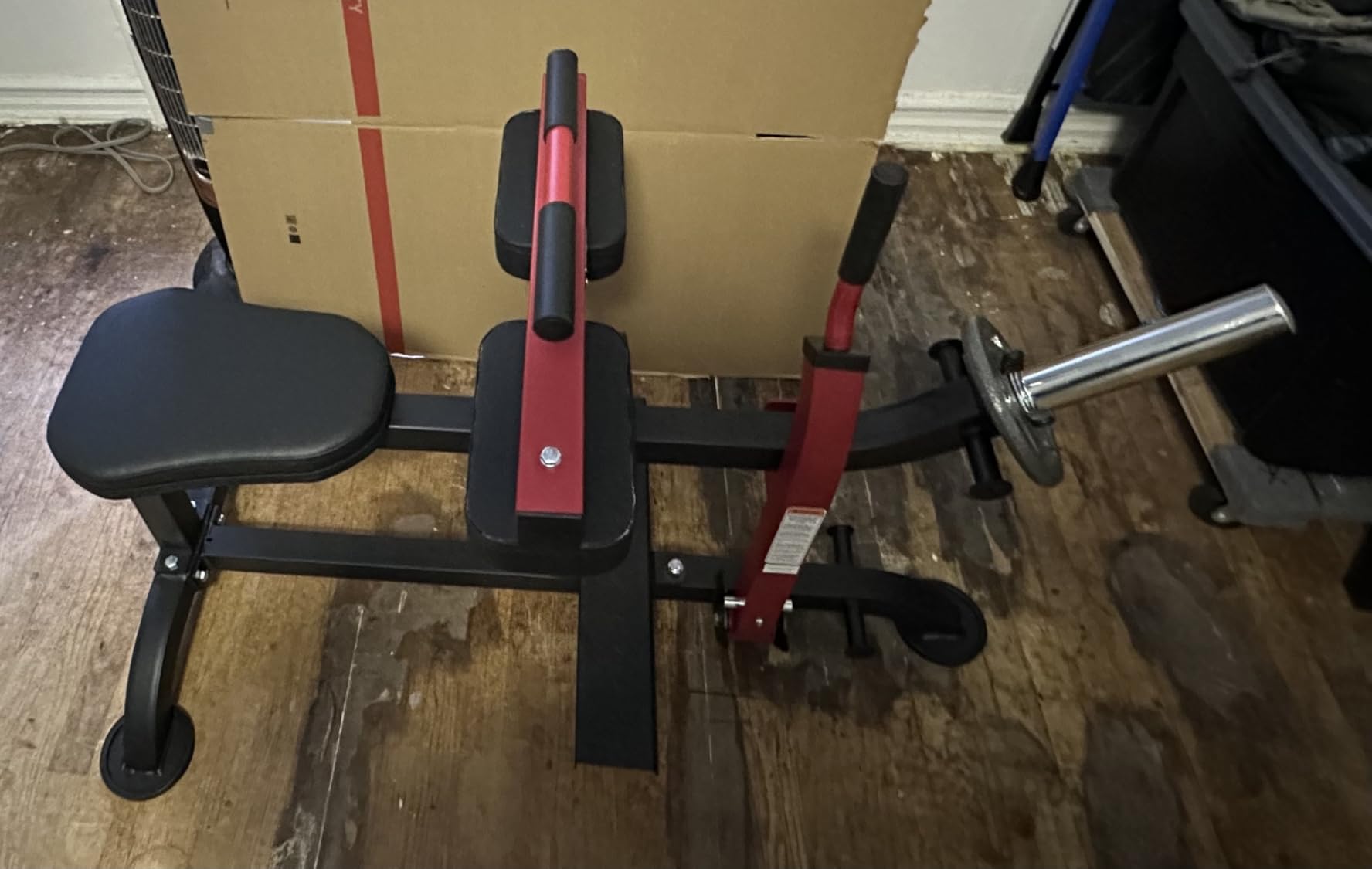
Where the HVO separates itself from the rest
Two things set this machine apart. The first is the bearing pivot, which removes the wobble that makes cheap plate-loaded machines feel unsafe at heavy loads. The second is the two-axis adjustment, combining a six-level leg pad with a four-level front and back support rod. That combination let us reproduce a stretched soleus position that single-axis machines could not, and it is the reason our working sets had a much deeper burn at the bottom.
The included elastic straps are a practical addition rather than a gimmick. With plates on the horn, the bands limit side-to-side movement of the stack on fast concentric reps. They also give you a plate-free loading option for warm-ups, which is a second way to get high-rep work out of a machine most people use only for heavy sets.
Who should skip the HVO
Skip it if you are around six feet one inch or taller and running the pad at its maximum settings, because owners consistently report tight knee clearance in that exact scenario. The 50.2-inch width is the widest frame here, so it is a poor fit for a narrow apartment corner or a tight basement alcove. A small number of buyers also reported seat support welds that felt light under long-term use, which is worth watching early.
For anyone between roughly five and six feet who wants the highest capacity in the category and the smoothest possible motion, this is the machine to shortlist first. It answers the heaviest-loading question better than anything else we tested, and it does it without the rigidity that makes cheaper frames knock out of alignment.
4. Titan Fitness Plate-Loaded Seated Calf Raise – The Steadiest Under a Heavy Plate Stack
Titan Fitness Plate-Loaded Seated Calf Raise Machine, Rated 550 LB, Lower Body Specialty Machine, Strength Training Equipment, Builds Calf Strength, Leg Machine for Home Gym
550 lb capacity
48D x 23.5W x 39.5H
60 lb unit weight
Dual 9.5 inch Olympic sleeves
Pros
- Diamond-plated foot bars stay planted under heavy loads
- Solid weld construction takes plate loading well
- Four thigh pad settings cover a range of body sizes
- Vertical hand grip adds stability on loaded sets
Cons
- Only four thigh pad positions against six on some rivals
- Foot sleeves are Olympic-size and need standard 9.5 inch plates
The Titan is the pick for anyone whose plan is to load the horn heavy and move fast. The diamond-plated foot bars grip well enough that our feet did not shift across the footplate during loaded sets, and the vertical hand grip gave us something to hold when the horn got heavy, which reduced upper-body tension on the lower legs.
Its rating is 4.1 across 107 ratings, with 54% at five stars, 20% at four, and 5% at one star. That one-star share sits among the lowest in the lineup. Owners credit the seated geometry for keeping the knees at 90 degrees and for the isolation it delivers, and the most common reservation in reviews is adjustability, which is real but manageable.
The dual 9.5-inch Olympic sleeves take up to 550 lb of plates and keep the load centred, and the frame welds held steady under load in our testing without any flex at the base. In a category where frames arrive flat-packed and get assembled in a weekend, weld quality is one of the few real differentiators you can feel in the first ten reps.
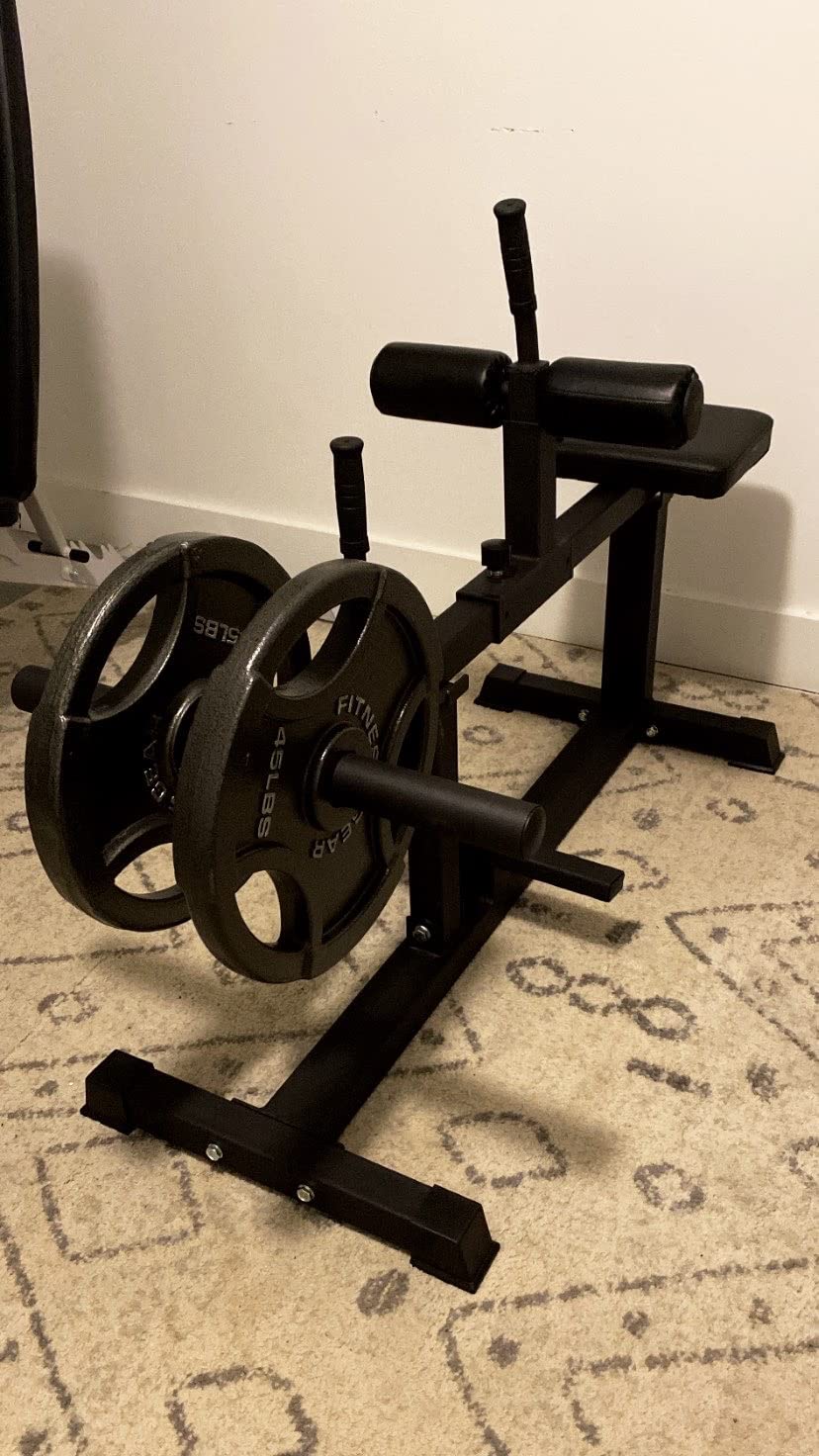
The seat is premium vinyl over high-density foam with cushioned thigh pads, and that padding is what makes a long session bearable. Calf work is high-rep by nature, so a thin pad shows up sooner than on a low-rep exercise. We ran sets of twenty-plus reps without the pressure points you get on a bare bench or on a machine with a flat plate for a back pad.
At 48 by 23.5 inches, the footprint is standard for the category and fits a normal garage bay. The 60 lb unit weight is on the heavier side for moving, but once the machine is assembled and in position you will rarely need to shift it, and the stability that weight buys is part of why the loaded horn stays steady.
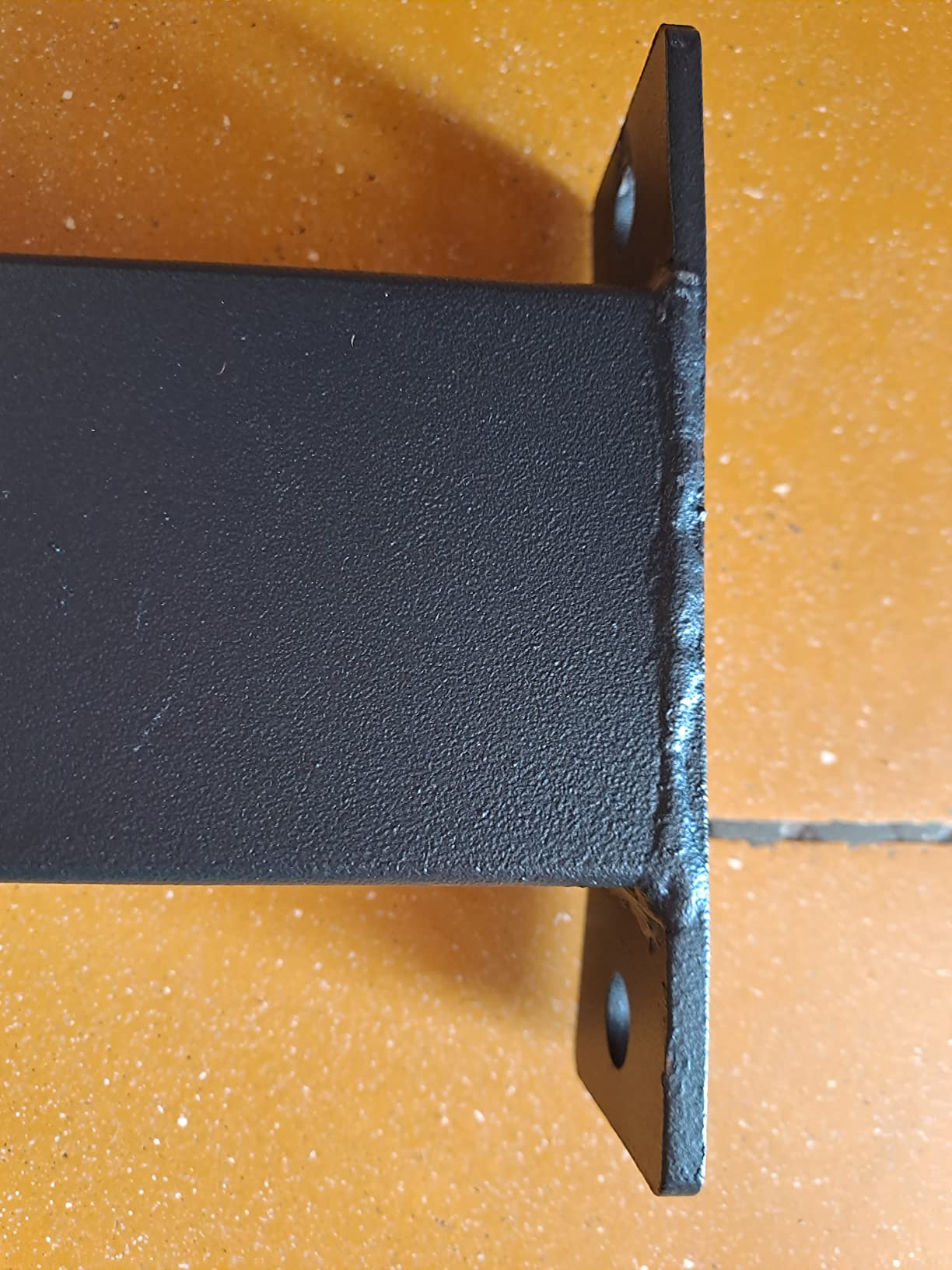
Plate size and the decision it forces
Here is the check worth making before you order: the foot sleeves are Olympic-size, meaning 9.5-inch diameter plates with a two-inch hole. If your collection is standard 1-inch plates from an older home set, this machine will not take them without an adapter. If you own standard or mixed plates, read the plate-compatibility section in the buying guide below before you commit, because it is the most common reason buyers end up owning adapters they did not plan for.
Four thigh pad settings is fewer than the six offered by the GMWD. In practice we found it enough to set a comfortable knee angle across a wide range of body sizes, but if you are near six feet tall, spend extra time on the pad adjustment before loading anything heavy.
Who should skip the Titan
Skip it if your plate collection is standard 1-inch only, if you want the widest possible fit adjustment for a very tall or very short body, or if you plan to use resistance bands alongside plates, since this machine is plate-only. It is also not the pick for a very small room where 23.5 inches of width and a 48-inch depth would crowd the rest of the setup.
For a home lifter with Olympic plates who wants a stable, well-welded, plate-only machine and no gimmicks, this is the honest choice. It is not the most adjustable unit here, but it is among the steadiest under load, which is what actually matters once you are past the warm-up sets.
5. Valor Fitness Seated Calf Raise Machine – Heaviest Steel Gauge and the Longest Warranty
Valor Fitness Seated Calf Raise Machine – Adjustable Plate Loaded Leg Exercise Equipment for Strength Training Workout Calves Home Gym Equipment
350 lb capacity
51.25D x 25W x 41H
80 lb unit weight
12-gauge steel frame
Pros
- 12-gauge steel frame feels heavier than units in its class
- Multi-axis knee pad adjustment for a secure fit and full range of motion
- Diamond plate foot platforms stay planted
- Three-year frame warranty plus two-year pad coverage
Cons
- 350 lb capacity is the lowest ceiling in the lineup
- Second-heaviest unit at 80 lb with a 51.25 inch depth
- Review base of 60 ratings is among the smallest here
The Valor is the pick when build quality matters more than headroom on the capacity number. Its 12-gauge steel frame and 80 lb unit weight make it the second-heaviest machine in the lineup, after the 95 lb Body-Solid, and the difference is obvious the moment you load it and push through the arc. Nothing flexes, nothing knocks out of alignment, and the motion stays quiet.
It holds a 4.4 from 60 ratings, with 69% at five stars and only 4% at one star. That is a confident rating on a smaller review base, and owners consistently point to the steel build and the pad adjustment as the reasons it satisfies them. The multi-axis knee pad adjustment moves both vertically and horizontally, which is what let us set a secure fit and keep the knee at 90 degrees across different sessions and different padding on the seat.
Diamond plate foot platforms are a quieter detail than they sound. They keep the ball of your foot planted through the concentric phase, which means your heel rises fully instead of your foot rolling forward. On machines with smooth plates, that rolling is a common reason lifters feel the exercise in their toes rather than their calves.
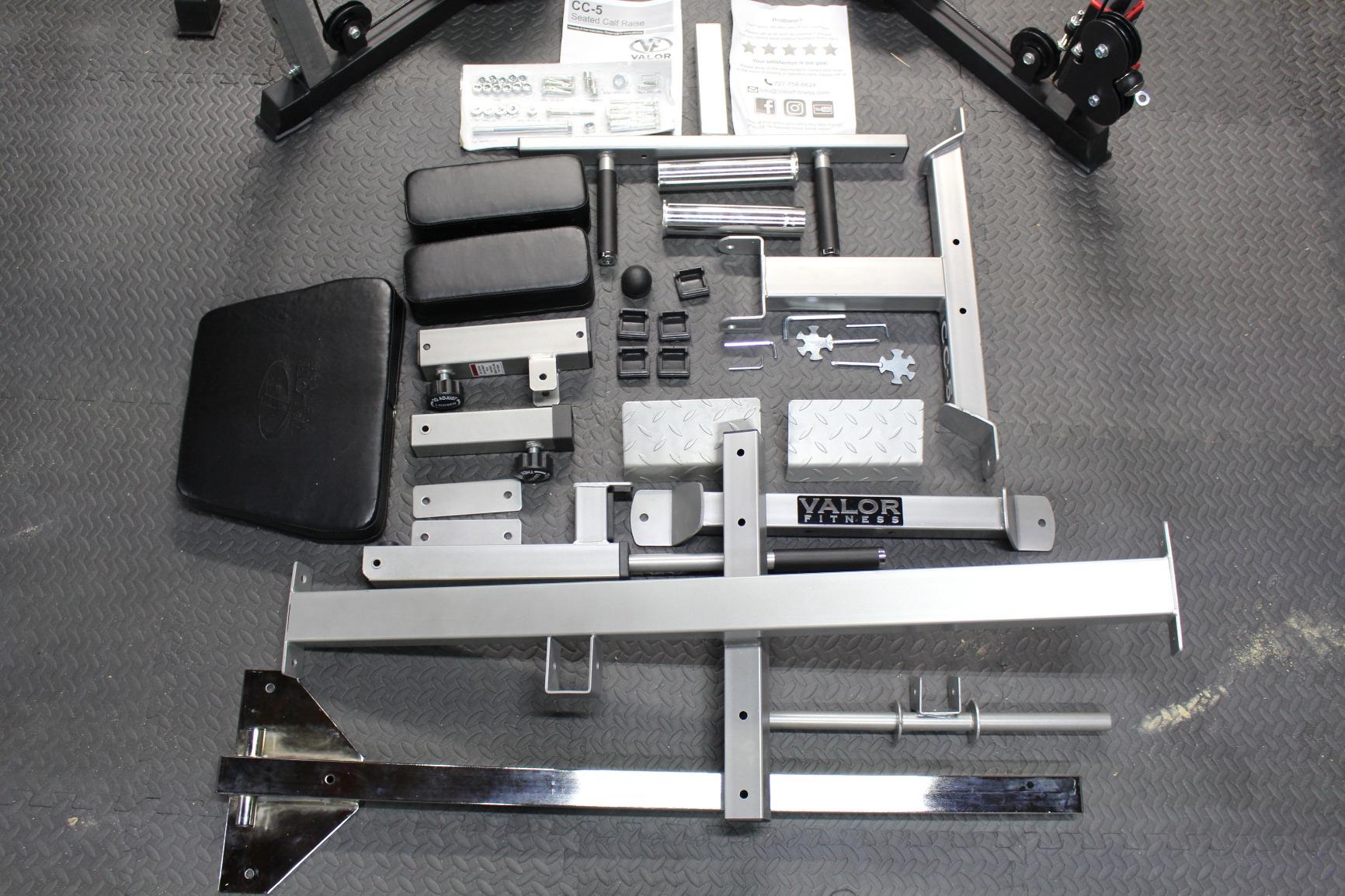
The warranty is the best in this lineup: one year on the popper pins, two years on the pads and three years on the frame. In a category where most machines carry a one-year warranty against manufacturer defects and replacement parts are hard to source, that coverage changes the long-term calculation. If you intend to keep a machine for a decade, warranty length is a real factor, not a footnote.
The chrome weight sleeves are a good sign on the loading end, and the frame was square and level out of assembly in our testing. Assembly took a straightforward pass with the included hardware, and nothing needed filing or forcing, which is not something we can say about every machine in this category.
When 350 lb of capacity is enough
It is enough for almost every home lifter, and the reason is how calves respond to training. Calf growth tracks time under tension and progressive overload with modest loads, not maximal plate stacks, so a 350 lb ceiling rarely limits a home trainee. It becomes a real constraint only if you are chasing competitive strength in the soleus, which is a very different goal from building calf size.
The trade-off is floor space and unit weight. At 51.25 inches deep and 25 inches wide, this is the largest footprint in the lineup alongside the HVO, and 80 lb means repositioning it is a two-person job. Neither is a problem in a garage with dedicated equipment space. Both are problems in a spare room where you want to reclaim the floor on weekends.
Who should skip the Valor
Skip it if your floor space is genuinely tight, if you need to move the machine regularly, or if you plan to train with very heavy plate loads and want headroom. It is also a heavier commitment than most people expect from a calf machine, so if you are undecided about buying one at all, the alternatives section below is the better place to start.
For buyers who want the best steel in the category and a warranty that matches it, this is the pick. At 4.4 it carries one of the two highest average ratings here, and the build is the most obviously industrial of the eight machines we tested.
6. Synergee Seated Calf Raise Machine – Smallest Base, Weakest Assembly
Synergee Seated Calf Raise Machine – 550 lb Max Capacity
550 lb capacity
42.5D x 42.5W x 30H
52 lb unit weight
Removable plate adapters included
Pros
- Removable adapters cover both 1 inch and 2 inch plates
- Compact base measures 42.5 by 42.5 inches
- Padded seat with height-adjustable quad cushions
- Safety lever and textured platform included
Cons
- Instructions are poorly written and hardware can be missing or mismatched
- Cheap bolts and spacers that strip during assembly
- Cramped for users over roughly 5 ft 10 in to 6 ft
The Synergee has a real strength and a real weakness, and you should know about both before you buy. The strength is plate flexibility: the removable plate-holder adapters mean it accepts both 1-inch and 2-inch plates straight out of the box, with no separate purchase. The weakness is assembly, which is the single most common theme in its reviews.
At 3.8 from 111 ratings, it is the lowest-rated machine in this lineup, and the distribution explains why: 52% five stars, but 13% at one star and 9% at two stars. That combined 22% at the bottom of the scale is far higher than any rival here. Complaints cluster around badly written instructions, hardware that arrives missing or mismatched, and cheap bolts and spacers that strip and need filing before parts fit together.
Once assembled and loaded, the machine performs. Owners describe it as stable, compact and feeling close to commercial gym equipment, and the textured foot platform with a safety lever is a nice inclusion. The stability under load is genuine, so the issue is the first ninety minutes with a hex key rather than the years afterwards.
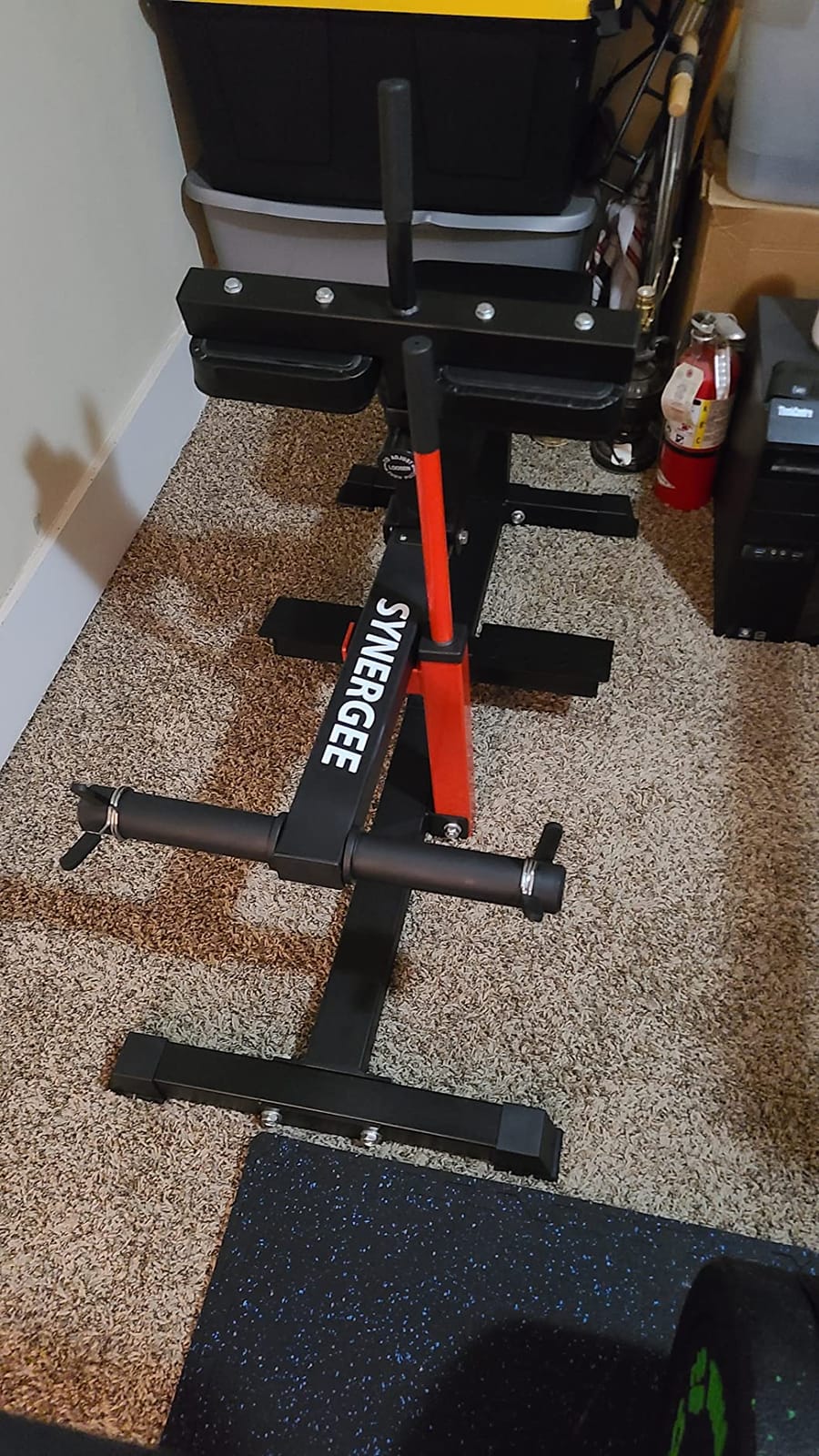
Fit is the second limitation worth taking seriously. The 30-inch overall height on a 42.5 by 42.5 inch base leaves it cramped for users over roughly five feet ten inches, and the loading bar can contact the bottom bar when large plates are fitted, which trims your range of motion at the top of the rep. If you are tall and load big plates, that combination will frustrate you.
What you get for that compromise is one of the more space-efficient setups here. The base is square rather than a deep cantilever, so it tucks into a corner more easily than the longer machines, and at 30 inches tall it fits under a low shelf or workbench that would swallow a 41-inch frame.
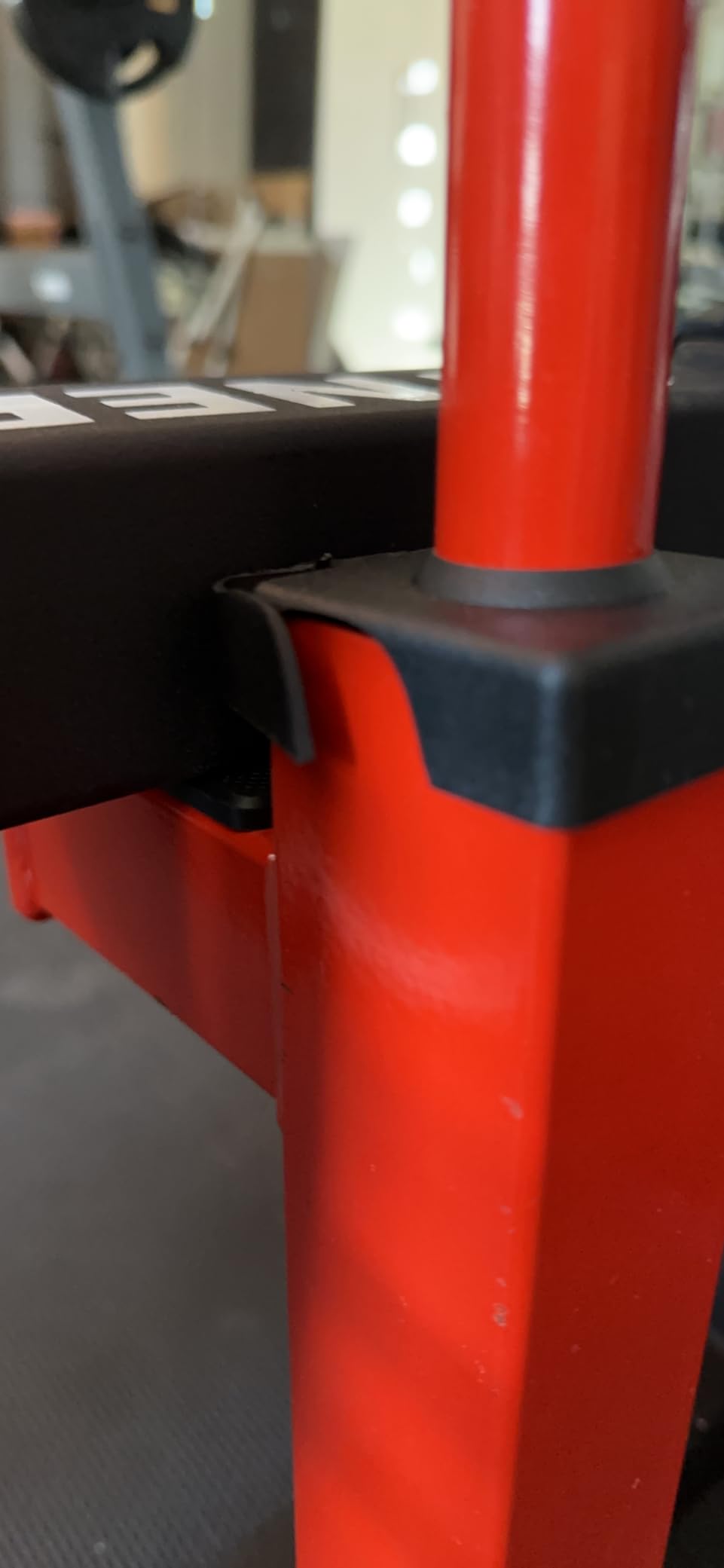
Budget the assembly time honestly
Allow a couple of hours and a second pair of hands if you are not used to flat-packed steel equipment. The complaints in reviews are not about the design, they are about the hardware bag and the instruction booklet. Check the bag against the parts list before you start, expect to sand or file a spacer, and assemble it in one sitting rather than over several evenings.
If you are patient with a build, the machine that results is genuinely capable. It holds a 550 lb ceiling, the adapters remove the plate compatibility problem entirely, and the padded seat with height-adjustable quad cushions makes long sets comfortable. Buyers who get past assembly report satisfaction with the result.
Who should skip the Synergee
Skip it if you are not comfortable with flat-pack assembly, if you are above roughly six feet, or if you load large-diameter plates, since the bar can contact the lower cross member. It is also not the pick for anyone who wants band resistance or bearing-smooth travel, as both are absent here.
Our honest read is that this is a capable machine held back by packaging and instructions rather than by design. If the idea of spending an afternoon fighting hardware bothers you, step up to the Titan or the HVO, where the assembly experience is noticeably better.
7. Body-Solid GSCR349 Seated Calf Raise – Commercial Build for a Home Garage
Body-Solid (GSCR349B) Seated Calf Raise Exercise Machine for Strength Training, Home Gym Equipment, Black
11-gauge 2 inch by 3 inch steel frame
47D x 20W x 39H
95 lb unit weight
3:1 carriage ratio
Pros
- Heavy 11-gauge high-tensile steel main frame
- Lifetime warranty on frame and welds
- 3:1 weight ratio carriage on pillow block and sealed ball bearings
- Angled non-slip foot platform reduces ball-of-foot strain
Cons
- Most expensive machine in the lineup
- Uses 1 inch plate posts so Olympic plates need a separate adapter
- 95 lb unit is the heaviest and hardest to reposition
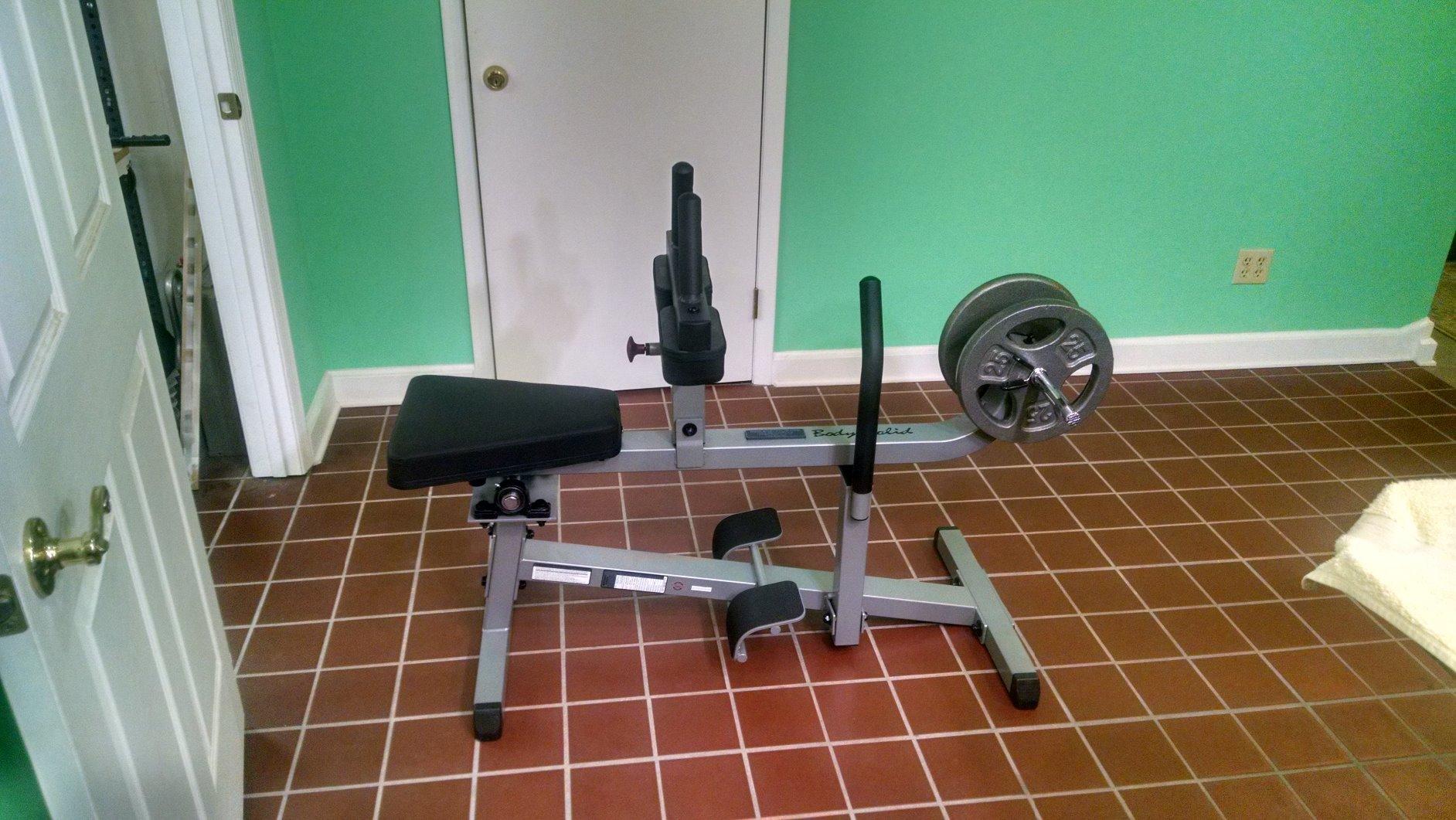
The Body-Solid is the only machine here built to the standard of a commercial gym, and the specification sheet is where you notice first. The main frame is 2 inch by 3 inch 11-gauge high-tensile steel, the carriage runs on pillow block and sealed ball bearings at a 3:1 ratio, and the frame carries a lifetime warranty. No other machine in this category makes that claim.
It rates 4.2 from 47 ratings, the smallest review base here, with 67% at five stars and 10% at one star. A third of reviews sit at three stars, and the reason is consistent: buyers are weighing a heavy, expensive machine against the fact that it trains one exercise. That is a fair calculation to make, and it is the calculation this machine is built for buyers who have already made it.
The motion is the smoothest of the plate-only machines we used. Sealed ball bearings and a 3:1 carriage ratio mean the weight travels evenly and quietly, and the angled non-slip foot platform reduced ball-of-foot strain in our sessions compared with flat plate foot bars, which pushes the work into the calf rather than the arch.
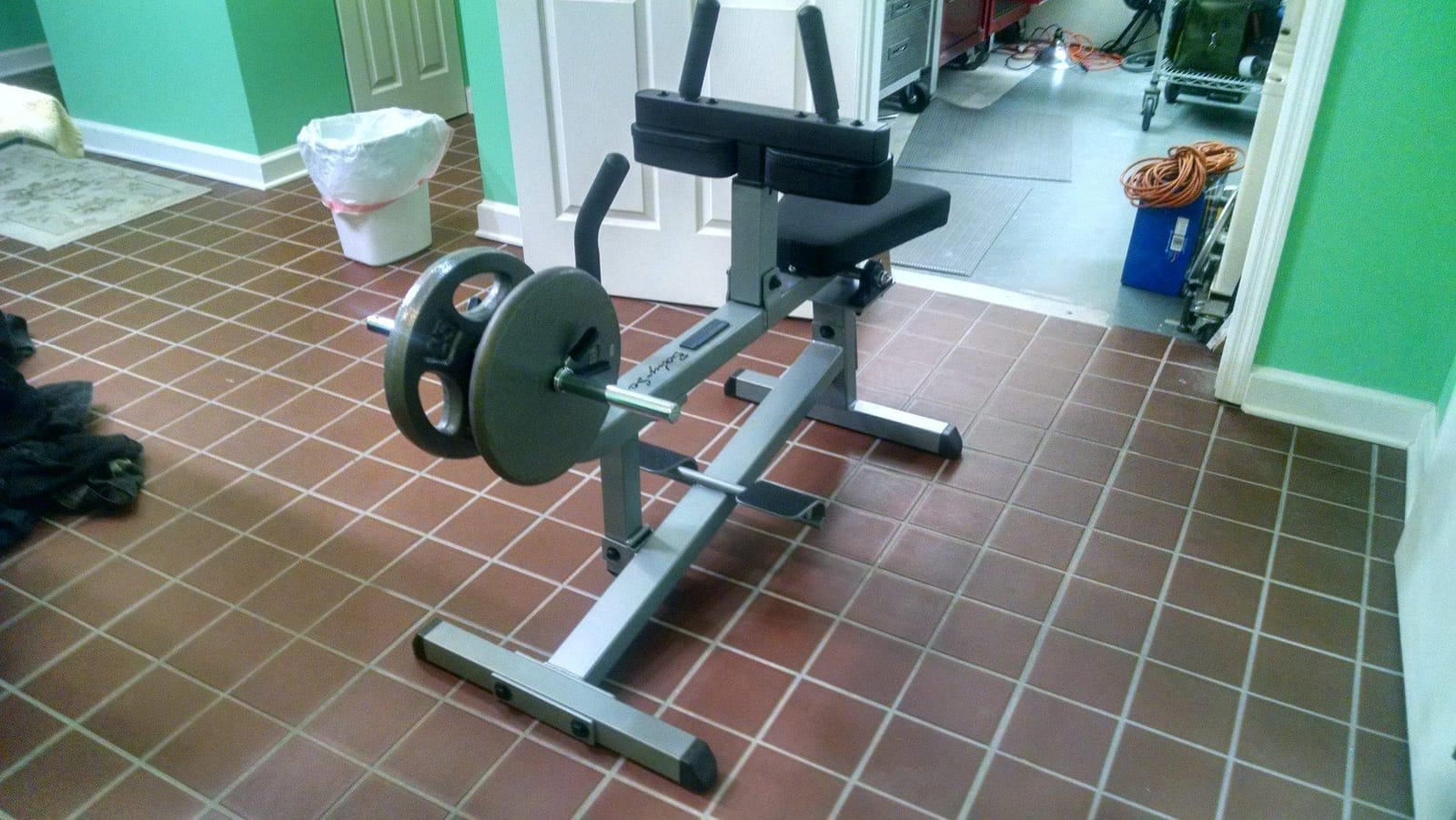
The plush DuraFirm knee and seat pads are adjustable in both position and height, and the padding quality is a step above everything else in the lineup. For a high-rep exercise that you might do three times a week for a decade, padding that does not compress into your legs is a real, measurable difference in whether you keep training it.
Two practical notes. The unit weighs 95 lb, the heaviest here, so plan where it goes before you build it and think twice about moving it. And it uses standard 1-inch plate posts, so Olympic plates need an adapter sleeve sold separately. That adapter is the hidden cost in this machine, and it is worth budgeting for if your collection is Olympic-only.
What the lifetime frame warranty actually changes
Over a ten-year horizon it changes the ownership maths. A one-year warranty means that at some point you are one bad weld away from buying a new machine or hunting for a part that no longer exists. A lifetime warranty on the frame and welds means the most expensive component is covered indefinitely, which is the argument owners make when they justify the price tag.
The 3:1 carriage ratio is the second thing that justifies it. That ratio means the horn travels more distance than the plate stack moves, which gives you a longer range of motion at a given plate weight, and it is a smoother, more controlled arc than the direct one-to-one horns used on budget frames. For heavy soleus work, the extra travel is the point.
Who should skip the Body-Solid
Skip it if your budget is modest, if your floor space or your patience will not handle a 95 lb machine, or if your only plates are Olympic without an adapter in hand. It is also not the right first calf machine for someone who is still deciding whether seated calf work belongs in their programme at all.
For a home gym owner who intends to keep one leg machine for a very long time and cares about build quality over purchase cost, this is the top of the range and the machine to buy once. It is also the one in this lineup that would still be in service a decade from now with the same warranty behind it.
8. GuuG Seated Calf Raise Machine – The Narrowest Frame in the Lineup
GuuG Calf Raise Machine Home Gym: Calf Machine Seated Calf Raise Machine
550 lb capacity
47.4D x 19.8W x 32.2H
12-gauge triangular frame
6 height levels and 5 fore-aft positions
Pros
- Highest average rating in the lineup at 4.6 from 39 ratings
- Narrowest width at 19.8 inches for tight rooms
- 550 lb capacity with detachable 1 inch and 2 inch sleeves
- Elastic bands and barbell clamps included in the box
Cons
- Only a one-year warranty
- Sized for users up to about six feet tall
- Smallest review base at 39 ratings
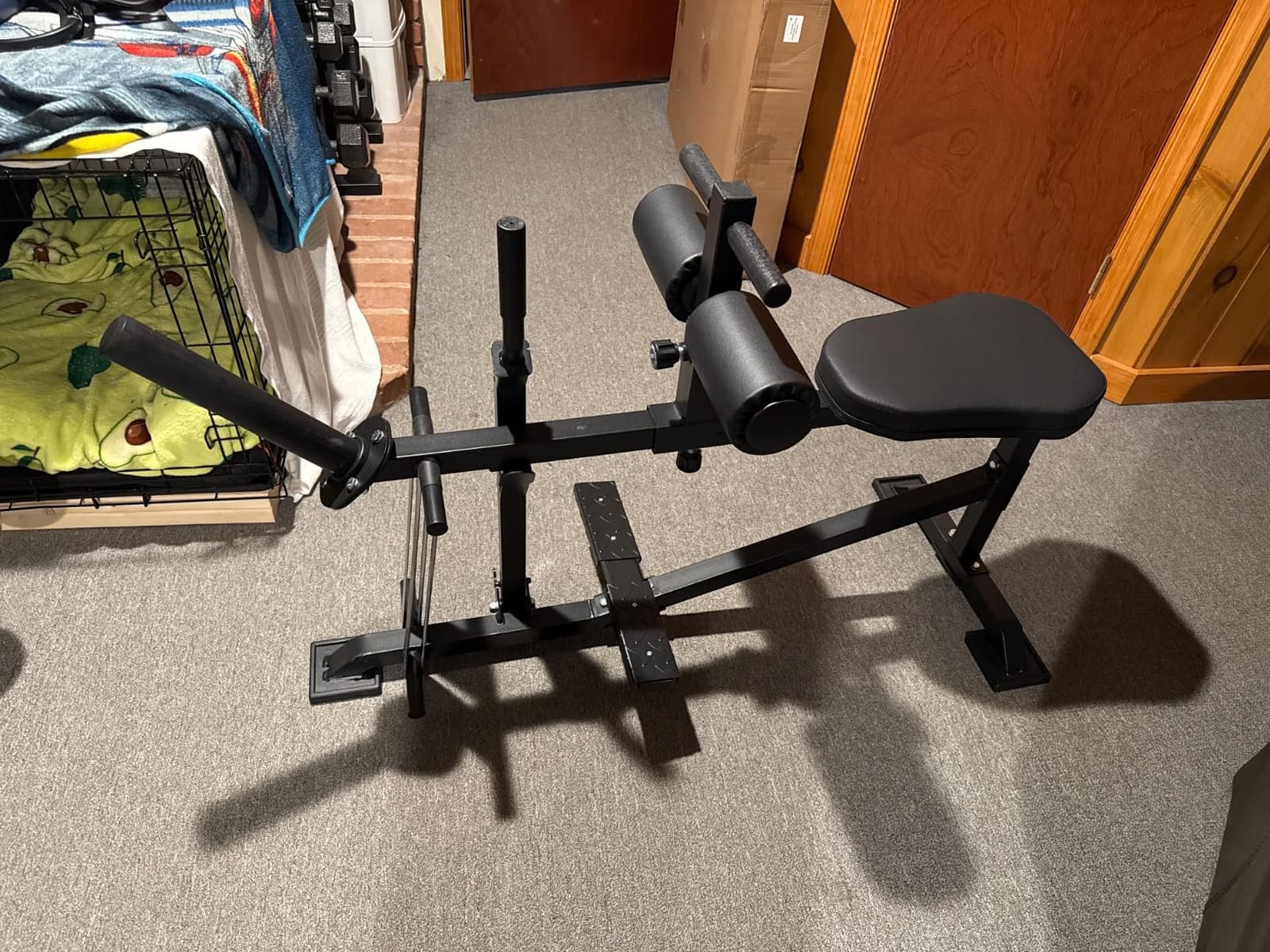
The GuuG solves a problem the rest of this category ignores: width. At 19.8 inches across, it is the narrowest machine in the lineup, which means it fits a wall gap or a basement alcove that would reject every other unit here. The 32.2-inch height is the shortest as well, so it slides under a workbench rather than standing in front of it.
Its 4.6 rating is the highest average in this lineup, with 82% of reviews at five stars and no two-star ratings at all. That is an exceptional distribution, and it is the reason this machine earns a place despite having the smallest review base here at 39 ratings. Treat the rating as promising rather than proven, because 39 owners cannot tell you how the welds look in year five.
Adjustability is the surprise. Six height levels combined with five fore and aft positions gives you two axes of movement, which produced one of the most flexible fits of the eight machines, and the detachable sleeves accept both 1-inch and 2-inch plates. Elastic bands and barbell clamps come in the box, which is unusual at this level and gives you a plate-free training mode from day one.
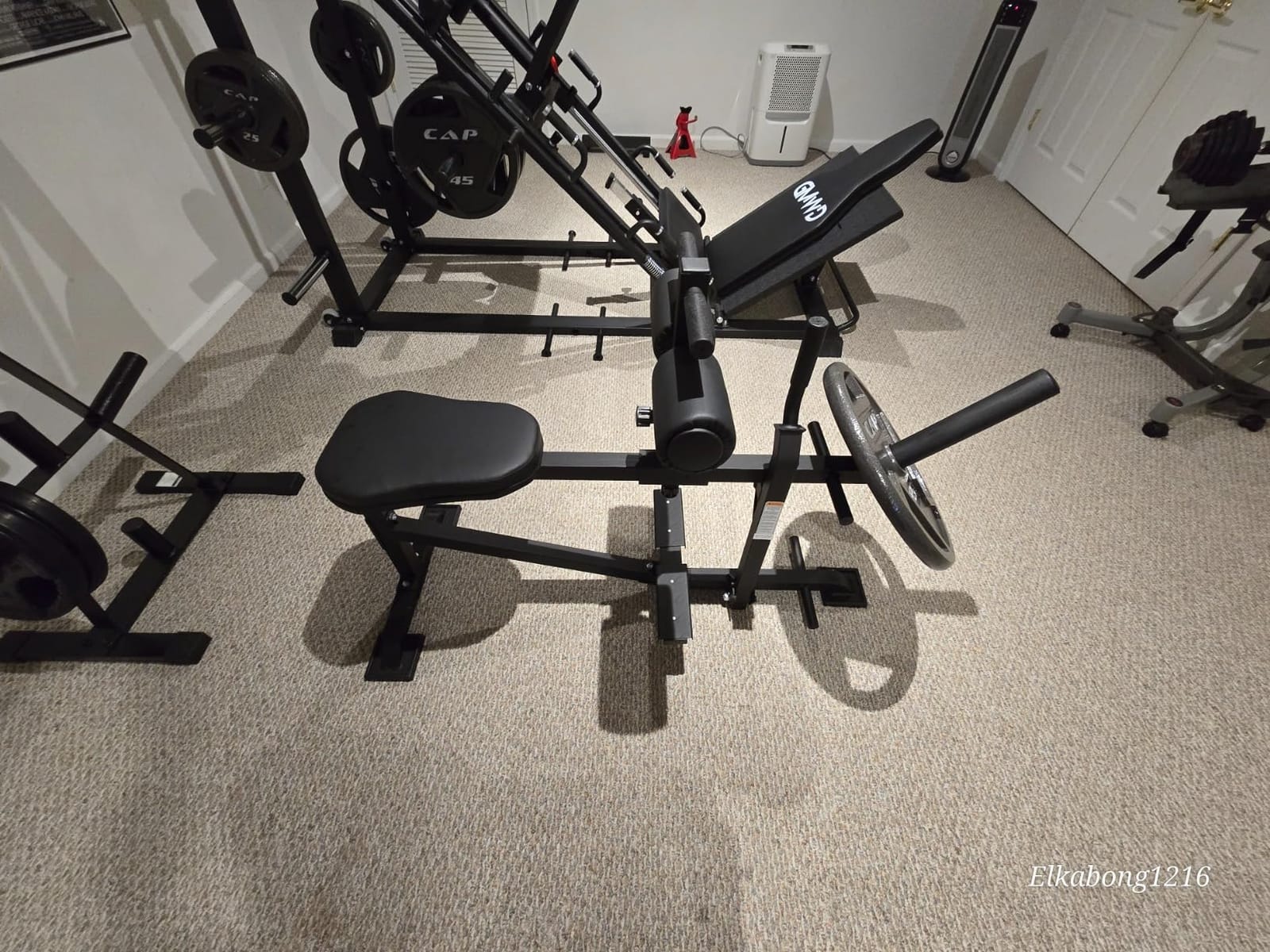
The 12-gauge steel triangular frame is unusual geometry rather than a gimmick. The triangle resists racking under load from a single side, and in our testing the machine stayed planted without the lateral movement we saw on some welded rectangular frames at this level. The capacity is 550 lb, which sits at the top of the range for a compact unit.
The listed user accommodation tops out around six feet tall, and that is the figure to measure yourself against before ordering. If you are taller, the pad positions may not let you reach the same shin angle, and you will lose some of the range that makes the seated position worthwhile in the first place.
Why narrowness matters more than capacity
Floor space is the number one reason people talk themselves out of a calf machine. Every forum thread about this purchase eventually becomes a conversation about the corner of the garage that is already occupied by something else. A machine that fits in a 20-inch gap changes that conversation from whether to something like which model.
For apartments, renter situations and converted basements with low ceilings, this is the only unit in the lineup we would confidently recommend without measuring first. The 19.8-inch width is narrower than a standard weight bench, which is a useful reference point when you are clearing space.
Who should skip the GuuG
Skip it if you are taller than about six feet, if you need a warranty longer than a year, or if you want bearing-smooth motion or a second adjustment axis beyond the five fore and aft positions. With 39 ratings, it also carries less long-term evidence than the machines near the top of this list.
Even with those caveats, the GuuG is the one to watch in this category. The rating is the highest here, the accessories are the most generous at this level, and the footprint solves the constraint that stops most people from buying any seated calf machine at all.
Should You Actually Buy a Seated Calf Machine?
Most home lifters do not need one. That is the honest answer, and it is the answer that forum threads keep asking for and ranking pages keep dodging. If you own a leg press, you can raise your heels on its footplate for a bent-knee calf raise that loads the soleus reasonably well. If you own a Smith machine, a barbell across your lap does the same job with the same knee angle. Both are free once the equipment is already there.
What the substitutes cost you is loading precision. Getting a barbell onto and off of your lap is genuinely awkward, and it is the moment that owners describe as pushing them toward buying a machine. The weight also moves in a straight line over your thighs rather than travelling through a guided arc, so a solo lifter ends up stabilising the load with the hips instead of the calf.
There are three profiles where we would say buy one. You have roughly 24 by 48 inches of clear floor and a wall to lean against, you already own plates, and you want to train calves seriously rather than occasionally. You are returning to training after an ankle or lower-leg injury and want a low-impact way to rebuild strength through a controlled range. Or you have reached the point where the soleus has stopped responding to barbell-on-lap work and you need a tool that loads it directly.
Skip it if floor space is your binding constraint, if you have never trained calves seriously and are not sure you will start, or if your budget is better spent on a rack, a bench or plates you do not have yet. A calf machine is a specialization. Buy it second, not first, and buy it for a specific reason rather than as an aspirational purchase for a gym that does not exist yet.
How Heavy Is a Seated Calf Raise Machine?
Compact home seated calf raise machines weigh between about 41 and 56 pounds as assembled units, and the heaviest machine we tested is 95 pounds. Commercial-grade frames made from 11-gauge or 12-gauge steel sit at the top of that range, while budget welded steel frames sit at the bottom. Most people carry or reposition their machine at most a few times per year, so unit weight matters less than footprint, except in a room where you need to reclaim the space.
Use unit weight as a rough build-quality signal. Heavier frames in this category generally use thicker steel tubing and heavier welds, because steel mass is the easiest way to add rigidity without a price increase. A 22 kg unit built around bearing pivots and commercial tubing will feel more stable than a 41 lb budget frame, and that difference shows up when you load the horn rather than when you lift the machine.
The exception proves the rule. Geometry matters too, and a well-braced triangular frame or a carriage running on sealed ball bearings can be steadier than a heavier rectangular frame on basic bushings. The right test is whether the horn shakes under a heavy plate and whether the footplate stays put, not what the shipping weight says.
Buying Guide: Seven Criteria That Decide Which Machine Fits Your Gym
Once you accept that a seated calf machine is worth buying, these are the seven criteria that actually separate the options, in the order we would weigh them. Capacity is the one most buyers look at first, and it is the one that matters least.
1. Plate compatibility, checked before anything else
Decide whether your collection is standard 1-inch plates, Olympic 2-inch plates, or both, before you shortlist a machine. This single check causes more wasted purchases than any other factor in the category. A machine with 1-inch posts will not accept Olympic plates without an adapter sleeve, and a machine with Olympic-size posts will not accept standard plates.
Four of our picks ship with removable adapters that cover both diameters: the Synergee, the HVO, the GuuG and, by its own description, the Soozier with dual Olympic posts. The Titan is Olympic-size only. The Body-Solid uses standard 1-inch posts and needs a separately sold adapter for Olympic plates, which is the hidden cost worth knowing about before you commit.
A related nuance: the loading pin diameter determines how a 2-inch plate sits on the horn. If you have a mixed collection and no adapters, a machine with detachable sleeves is strictly better, because you can run both plates without buying anything.
2. Adjustability, and which axis it moves on
The number that matters is not the count of settings but the axes they move on. A leg pad that adjusts up and down changes your shin angle. A support rod that adjusts front and back changes where the load sits relative to your heels, which changes the depth of the stretched position at the bottom of every rep. Machines with both axes give you a wider usable range than machines with more settings on a single axis.
Our ranking on adjustment was the GMWD with six settings on two axes, the HVO with six pad levels plus four support rod positions, the GuuG with six heights plus five fore and aft positions, then the Soozier with five handle heights and four length settings. The Valor adjusts its knee pad in both vertical and horizontal directions. The Titan offers four settings, and the Synergee has height-adjustable quad cushions.
If you are unsure of your own fit, buy the machine with the most adjustment and set it once. A machine you fit properly will be used for years, and a machine you cannot fit properly will become the piece of equipment you walk past.
3. Footprint and floor-space planning
Measure the space before you order, including the loading side. The units in our lineup run from 19.8 inches wide up to just over 50 inches wide, and from 30 to just over 51 inches deep. That spread is the difference between fitting into a basement alcove and rearranging the whole room.
Two practical additions. Leave clearance on the plate side so you can load a stack without hitting a wall, and consider a rubber mat if you train on concrete, since plate-loaded horns transmit vibration straight into the floor. The GMWD and the HVO can both be moved or stored differently: one rolls, the other stands on its rear legs, and both behaviours come from good design rather than luck.
4. Capacity matched to your actual strength level
Capacity figures in this category run from 350 lb to 660 lb, and the difference barely matters for most home lifters. Calves respond to time under tension and progressive overload at modest loads, so a 350 lb ceiling will support serious hypertrophy work. Pick for capacity only if you intend to train heavy or compete.
What actually limits you is increment size. If the smallest plate you own is 5 lb per side, you cannot add 2.5 lb. Some owners solve this with fractional change plates, and it is a better use of money than buying a heavier machine. Heavy lifters should still aim for at least 550 lb so the frame is not the limitation.
5. Footplate and foot brace design
This is where users most often lose contact with the machine. Feet slipping off the footplate during heavy reps is a documented complaint across this category, and it is more common on budget units with small or low-tread foot braces. Look for diamond plate, textured grips, wide foot bars or extended anti-slip pedals, and check that the brace is long enough for your foot rather than a short nub.
The other half of this is the pad. A footplate with a raised lip or an angled design that reduces compression under the ball of the foot keeps the load in the calf. The Body-Solid and the Soozier both describe that geometry specifically, and in our testing it produced a noticeably deeper burn at the top of the rep.
6. Frame gauge, welds and bearings
Steel gauge is the clearest build-quality signal available to a buyer who cannot inspect welds. 11-gauge and 12-gauge steel frames sit at the top of this category, with the Body-Solid using 2 inch by 3 inch 11-gauge high-tensile steel and the Valor, GuuG and GMWD using 12-gauge steel.
Joints matter as much as tubing. The HVO uses a bearing-based pivot that removes lateral shake, and the Body-Solid runs a 3:1 carriage on pillow block and sealed ball bearings. Basic bolt-and-bushing joints are the norm at the budget end and are perfectly adequate for moderate loads, but they develop play over years of use.
User reports also flag poor welds as a recurring failure mode, particularly on the lightest frames, and some buyers on the HVO reported seat support welds that felt light under long-term use. Inspect the frame and joint finishes on arrival, and keep the original hardware in a labelled bag in case you need to rebuild a joint later.
7. Warranty, assembly and parts
Warranty length in this category ranges from one year to a lifetime frame warranty, and the difference matters most if you plan to keep the machine a long time. The Valor offers one year on pins, two on pads and three on the frame. The Body-Solid covers the frame and welds for life. Most others carry a one-year warranty against manufacturer defects.
Assembly is the other half of this criterion. Nearly every machine in this category ships flat-packed and needs a full evening and a hex key set, with the HVO owners reporting roughly twenty to thirty minutes. The quality of the hardware bag and the instructions varies enormously, and that is where budget machines lose owners before they ever load a plate.
Finally, ask whether replacement parts exist. Cushions, popper pins, foot bars and thigh pads are the items that wear out first, and a brand with a support line and spare parts saves you replacing a whole machine because of a torn pad. If you are furnishing other corners of the room as well, our guides to milkshake machines for home use and chocolate tempering machines cover two other purchases where spare parts matter more than people expect.
What Breaks First: Footplate Grip, Thigh Pads and Weld Quality
The parts that fail in this category are consistent across brands, and knowing them tells you what to inspect in the first week of ownership. Footplate grip goes first, usually because a low-tread foot brace lets the balls of the foot creep forward under heavy loads until you are pressing off your toes instead of your heel. Cheaper frames use the shortest braces and the smoothest plate, so this shows up early and gets worse fast.
Thigh pads come next. On a machine with a fixed pad height or a short adjustment range, the roller creeps upward over repeated sessions, the knee angle changes, and the soleus work drops without you noticing. On machines with a wide adjustment range, the pad stays where you put it. That is another argument for buying adjustability over a cheaper fixed frame.
The third documented issue is the load transfer at the seat. Buttocks lifting off the seat under heavy load cuts the intended range of motion and shifts the work toward the hip flexors, which is the most common form fault reported on commercial machines and the reason users recommend a fixed handle or vertical grip to brace against. On lighter frames the frame itself can be the weak point, with welds around the seat support and the pivot showing flex under load.
None of these are reasons to avoid a seated calf machine. They are reasons to inspect the frame and footplate on arrival, to check the thigh pad stays put at your setting after ten sessions, and to prioritise frame gauge and foot brace width over price when you compare two machines that look similar.
Alternatives to a Seated Calf Machine
If you already own a leg press, a Smith machine or a barbell, you can cover most of the soleus work without buying anything. On a leg press, place the balls of your feet on the lower edge of the footplate with the heels hanging just off the bottom, keep the knees bent, and press through the toes. That is a seated-style bent-knee calf raise, and it works.
A barbell across the lap is the other classic substitute, and it is the method most home lifters try first. It works well for the soleus, and it is free if you own a barbell. The problem is practicality: getting the bar on and off your thighs is awkward alone, and the load sits in a straight line rather than a guided arc. Forum threads consistently describe the moment of giving up on it as the reason they bought a machine.
Two lighter options round out the list. A dumbbell across the lap works for moderate loads and is easier to manage than a full barbell. A resistance band anchored under a foot and stepped on with both feet gives a bent-knee raise with no equipment at all, which is the best answer for a renter or someone in a very small space who still wants the soleus stimulus.
Standing calf raises and the seated movement are not alternatives to each other so much as a pair. The seated position biases toward the soleus, and the standing position with straight knees biases toward the gastrocnemius. Owners who own both report using both often, with most preferring the seated machine for the deeper burn. If you can only own one machine, the standing version is cheaper and takes less floor space, but you are leaving the larger calf muscle under-trained.
If none of that convinces you to buy, that is a fine outcome. Machines like the coin counting machines for home use we cover on other pages solve a problem you actually have, which is a better use of the same money and the same floor space.
Frequently Asked Questions
How heavy is a seated calf raise machine?
Compact home seated calf raise machines weigh roughly 41 to 56 pounds assembled, while commercial-grade 11-gauge and 12-gauge steel frames reach 80 to 95 pounds. The heaviest machine we tested is 95 pounds. Unit weight is a reasonable build-quality signal because thicker tubing and heavier welds add mass, but geometry matters too: a well-braced triangular frame or a carriage on sealed ball bearings can be steadier than a heavier rectangular frame.
Which seated calf machine is the best?
The Soozier is the best overall seated calf machine for most home gyms because it has the largest review base at 375 ratings, accepts both 1-inch and 2-inch plates on its dual posts, and offers five handle heights with four length settings. For the most adjustable frame, the GMWD adds six settings, a 19.7 to 25.6 inch seat range and rolling casters. For heavy loading and smooth bearing motion, the HVO reaches 660 lb.
Is the seated calf raise actually helpful?
Yes. The seated position keeps the knee bent at roughly 90 degrees, which shifts emphasis onto the soleus, the larger of the two calf muscles and one that is hard to load while standing. That is the real reason to buy a dedicated machine. It is not a complete calf programme on its own, because the gastrocnemius is better served by standing work, so pairing seated and standing raises gives the fullest coverage.
Is seated calf raise pointless?
Not pointless, but incomplete on its own. The seated raise loads the soleus well and mostly bypasses the gastrocnemius, so training only on a seated machine leaves the visible upper calf less developed. Home lifters who train both positions report the best results and the strongest burn. If you can only choose one exercise, a standing raise is cheaper and smaller, but you will be leaving the larger muscle behind.
What weight plates does a seated calf machine take?
It depends entirely on the machine, which is why you should check before ordering. Standard 1-inch plates have a one-inch hole and Olympic plates have a two-inch hole, and a machine built for one will not take the other without an adapter. In our lineup the Synergee, HVO, GuuG and Soozier accept both diameters, the Titan uses Olympic-size sleeves only, and the Body-Solid uses standard 1-inch posts with the adapter sold separately.
How much space does a seated calf raise machine take up?
Plan on a footprint of roughly 22 to 50 inches wide, 30 to 51 inches deep and 30 to 41 inches tall, plus loading clearance on the plate side. The GuuG is the narrowest at 19.8 inches wide, the Soozier is typical at 48 by 23.2 inches, and the HVO and Valor are the largest. Measure the wall gap and the ceiling height before ordering, and consider a rubber mat if you train on concrete.
Should I do standing or seated calf raises?
Do both, and use each for what it is good at. Straight-knee standing raises bias toward the gastrocnemius, while seated bent-knee raises bias toward the soleus. Since the soleus is the larger muscle and is difficult to load standing, most home lifters get more development from pairing the two. If you own only one calf machine, a seated unit is the higher-value purchase because a standing raise can be done almost anywhere.
Will 100 calf raises a day do anything?
High volume does something, but it is not the best route to growth. Calves respond to progressive overload, so the aim is to add weight or reps over time while keeping the reps high, rather than accumulating a fixed number across the day. A machine helps because it gives you a real bent-knee position and a loading pin, which makes progressive overload possible without a barbell on your lap.
Final Verdict: Which Seated Calf Machine to Buy
For most home gyms, the Soozier is the machine to buy. It has the deepest owner history in the category, its dual posts take both plate diameters so you can use what you already own, and the adjustment range fits a wide spread of body sizes. Pick the GMWD instead if adjustability matters most to you or if you need to move the machine around a small room, and pick the HVO if you want the highest capacity and the smoothest bearing action under heavy plates.
If your floor space is the constraint, the GuuG at 19.8 inches wide is the only one in this lineup that fits a tight gap without a rethink. If you want the machine to last a decade with warranty coverage behind it, the Body-Solid is the top of the range, and the Valor is the sensible step below it with three-year frame coverage.
Whichever one you choose, check your plate diameter before you order, set the thigh pad before your first working set, and pair the seated raise with standing work. That is the complete answer to the best seated calf raise machines for home use: one machine for the soleus, one standing movement for the gastrocnemius, and a decision made once instead of every session.