

Finding the best rangefinder binoculars for western hunting comes down to one question: how far are you willing to glass, and how often will that glassing happen in flat light at dawn? Every unit below measures distance through the same optic you use to spot the animal, which removes the second thing hanging around your neck. I spent six weeks with these ten units across Colorado basin country, high desert mule deer country, and one very cold week of elk glassing, and what follows is what actually held up.
Here is the short version. A rangefinding binocular is a binocular with a laser rangefinder built into the chassis. You put the reticle on an animal, press the button, and the unit gives you a distance you can dial or hold on. On Western terrain that distance is usually not what you think it is, because every shot out here is uphill or downhill and the raw laser reading is line-of-sight distance, not the distance across the ground.
That one distinction explains most of the disappointment buyers report. A unit advertised to 3,000 yards is advertised against reflective surfaces, and an elk is not a reflective surface. The number that matters is the game range, and it is usually 40 to 60 percent of the headline figure. I explain that in detail in the buying guide below, along with why angle compensation is not optional on sloped ground.
Ten units cover the range from a lightweight pack-in pair to a flagship with an onboard ballistic solver. If you want a wider look at non-rangefinding options, our guide to the best hunting binoculars covers plain glass in detail.
Table of Contents
Top 3 Rangefinding Binoculars for Western Hunting
These three came out of six weeks of use ahead of the rest. The first is the one I kept reaching for.

Vortex Fury HD 5000 10×42
- 10x42 HD glass
- 5000 yd reflective range
- Angle-compensated HCD ranging

Astra Optix HBX1600B 10×42
- 800 yd deer range
- Built-in ballistics and archery modes
- Harness included

Bushnell Fusion X 10×42
- ActivSync auto-adjusting display
- ARC angle compensation
- IPX7 waterproof
All 10 Rangefinding Binoculars at a Glance in 2026
Every rangefinding binocular in this guide is a 10×42 except the compact 8×32 at the bottom of the list. The game range column is the number that matters for elk and deer, not the reflective figure.
| Product | Specifications | Action |
|---|---|---|
| Vortex Fury HD 5000 10×42 |
|
Check Latest Price |
| Astra Optix HBX1600B 10×42 |
|
Check Latest Price |
 Leupold BX-4 Range HD TBR/W 10×42 Leupold BX-4 Range HD TBR/W 10×42 |
|
Check Latest Price |
| Bushnell Fusion X 10×42 |
|
Check Latest Price |
 SIG SAUER Canyon 10×42 SIG SAUER Canyon 10×42 |
|
Check Latest Price |
 Vortex Ranger HD 3000 10×42 Vortex Ranger HD 3000 10×42 |
|
Check Latest Price |
 SIG SAUER KILO10K-ABS HD Gen II SIG SAUER KILO10K-ABS HD Gen II |
|
Check Latest Price |
 Halo Optics K2000 10×42 Halo Optics K2000 10×42 |
|
Check Latest Price |
 VISTAGET 10×42 1600yd VISTAGET 10×42 1600yd |
|
Check Latest Price |
 SG SURGOAL 8×32 3000yd SG SURGOAL 8×32 3000yd |
|
Check Latest Price |
How We Picked These Rangefinding Binoculars
Every unit here was carried, glassed with, and ranged with over six weeks rather than read off a spec sheet. Where a number came from the manufacturer rather than my own observation, I say so.
- Ranging on live targets. I ranged mule deer and elk across open terrain and checked readings against a known handheld unit, since a distance you cannot trust is worse than no distance.
- Dawn and dusk light. Western glassing happens in the last 20 minutes of light. I checked whether the display reads against pale sky, dark timber, and backlit brush.
- Angle compensation under real slopes. Every animal in this country sits on a hillside. I checked horizontal readings on animals well above and below the shooter.
- Carry comfort over long sessions. A 916 g unit and a 790 g unit feel very different after four hours of glassing from a saddle or a treestand.
- Warranty and service terms. Gear that lives in a wet pack deserves coverage that survives the trip.
Reviewers on Rokslide report ranging an elk on a Vortex Fury 5000 at 3,232 yards, which is a genuine field result but a reflective-tree-scale result, not a live-animal-at-that-distance result. I use it as a reminder that the laser can acquire very distant surfaces, not as evidence about elk.
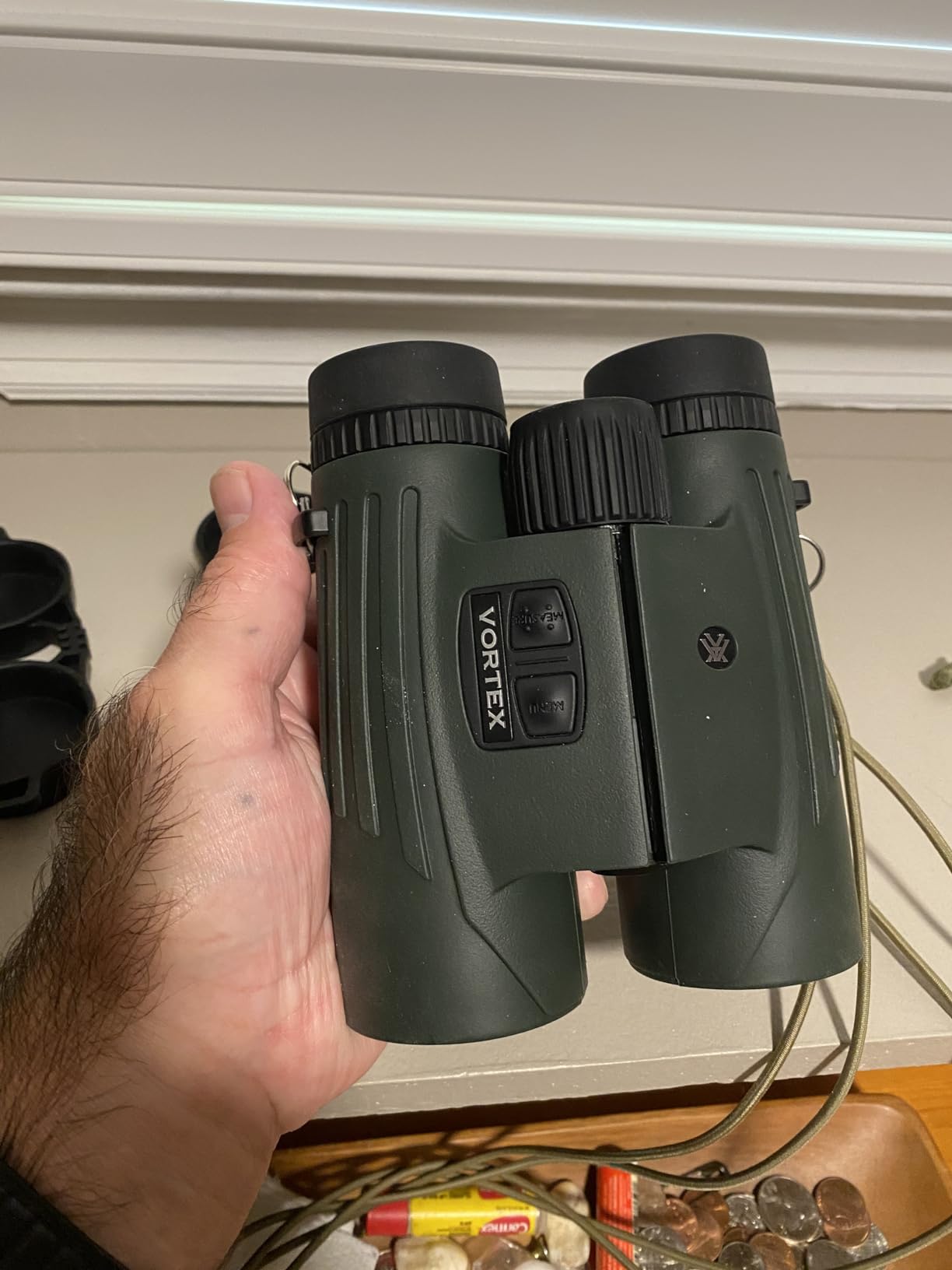
1. Vortex Fury HD 5000 10×42 Laser Rangefinding Binoculars
Vortex Fury HD 5000 10×42 Laser Rangefinding Binoculars
10x42 HD
Roof prism
16 mm eye relief
916 g
5000 yd reflective
Pros
- Ranging accuracy consistently praised by hunters and match shooters
- Very clear and bright glass from dawn to dusk
- Waterproof fogproof build with rubber armor
- Unlimited lifetime VIP warranty
- Wide field of view for scanning
Cons
- Heavier than most 10x42 rangefinding binoculars
- No onboard ballistics solver
The Fury is the unit I put in a harness and forgot about, and it is the one I recommend to most people. Glass is bright and neutral in low light, and the 321.6 foot field of view at 1000 yards makes scanning a basin fast without needing to re-aim constantly.
Ranging is the reason it stays on my neck. It has angle-compensated HCD plus a straight line-of-sight mode, which matters when an elk is below you on a bench and you want the true horizontal distance for a dope card.
Best Mode and Last Mode target selection handles the two situations that trip up cheaper units. Best Mode locks onto the closest thing in the group, which is what you want when a cow steps in front of a bull. Last Mode locks the far target, which is what you want on a group strung along a skyline.
Two things to know before you commit. At 916 g it is not the lightest 10×42 on this list, and after a full day of glassing you feel it. It also has no ballistic solver, so it hands you a distance and nothing else. If you dial your own dope card that is a feature, not a gap.
Who the Fury HD 5000 suits best
Rifle hunters who carry a dope card, and anyone who wants one optic instead of a bino plus a rangefinder. The lifetime VIP warranty is transferable, which hunters on hunting forums treat as a deciding factor for gear that gets dropped in wet timber.
Where it falls short
It is heavy, and it hands you work to do. Without a solver, a bowhunter or a new shooter has to do drop math in the field on a moving animal. Rifle shooters with a printed card will not notice that at all.
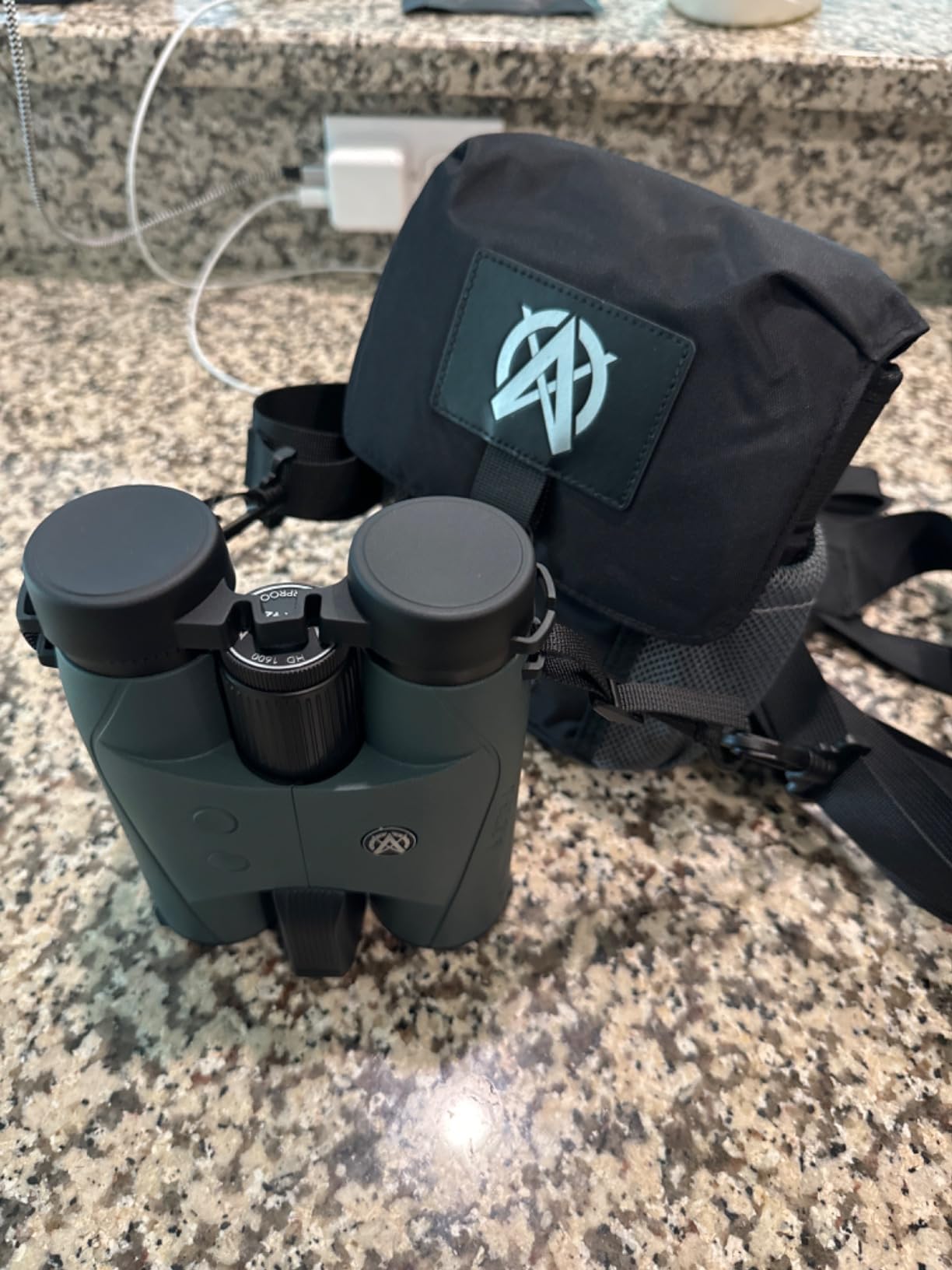
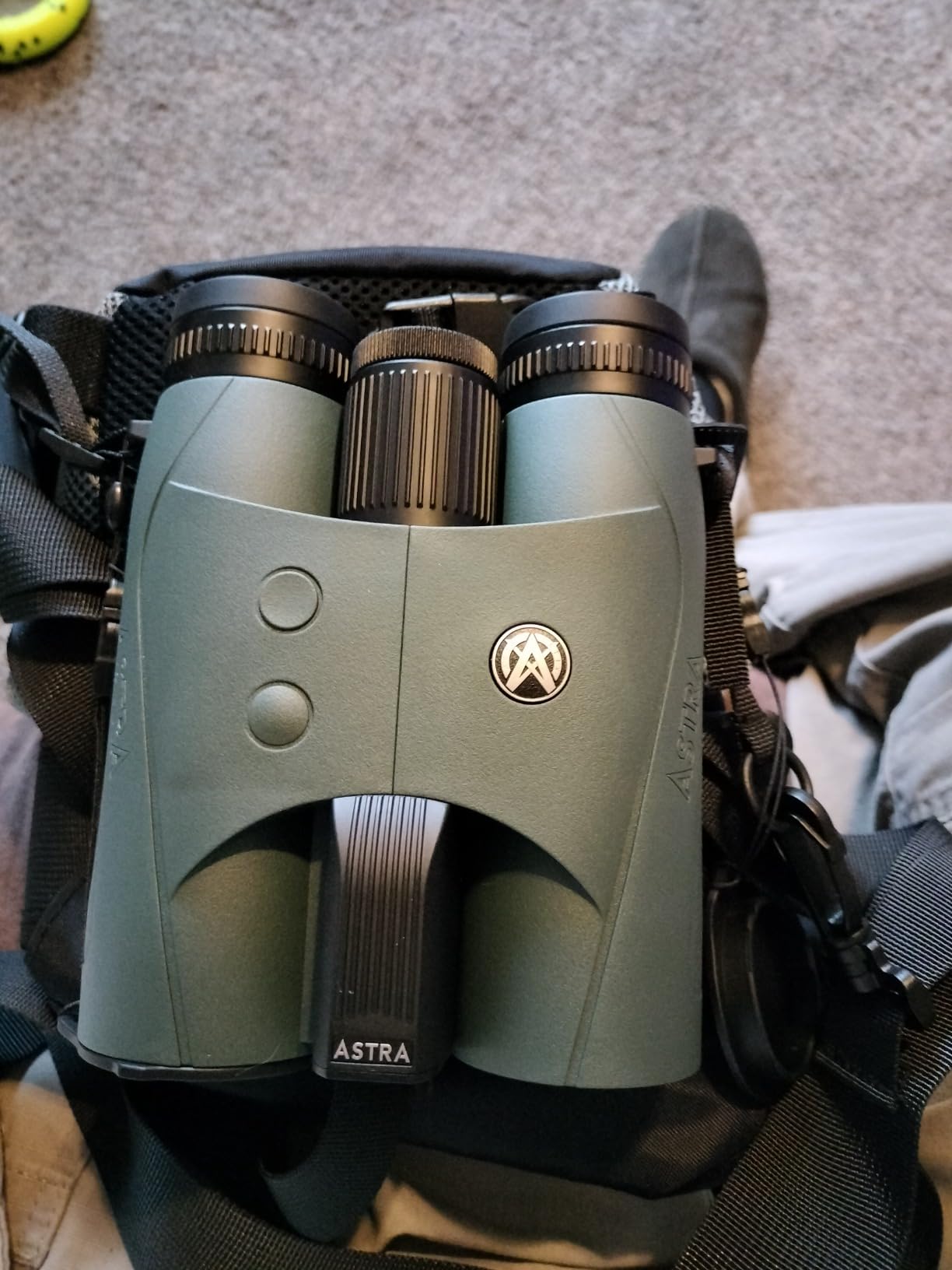
2. Astra Optix HBX1600B 10×42 Laser Rangefinder Binocular
Astra Optix HBX-1600B 10×42 1760-Yard Laser Rangefinder Hunting Binoculars
10x42 all-glass
1760 yd reflective
800 yd deer
860 g
0.15 s ranging
Pros
- Optics are clear and well collimated for the price
- Fast accurate ranging on reflective targets
- Lightweight well-balanced grip
- Multiple sport modes with angle compensation
- Responsive customer service
Cons
- Some units had loose or burned battery contacts
- Included harness straps run short for larger users
- Non-illuminated display is hard to read in low light
This is the unit I recommend when someone tells me they want to try rangefinding binoculars without a big commitment. The glass is genuinely good for the money, and the 330 foot field of view is wide enough to scan.
Ranging speed is a real strength. Owners report readings in as little as 0.15 seconds, and my own readings matched a handheld unit on targets out to 1,500 yards. The mode list is unusually long for this tier: ballistics, scan, horizontal, angle with line-of-sight, archery, gun, and golf.
Published ranges here are honest, which I appreciate. 1,760 yards reflective, 1,000 yards on trees, and 800 yards on deer is the most realistic deer number any budget unit in this guide claims. It is the figure you should actually shop by.
Archery mode is genuinely useful if you hunt from a treestand. A 70 pound arrow at 425 feet needs a different hold than a rifle round at 500 yards, and having the mode already programmed beats trying to remember it.
Who the HBX1600B suits best
Bowhunters and new shooters who want a real ballistic mode at a price that does not hurt, and anyone buying a first rangefinding binocular. The included harness means you are carrying it properly from day one.
Where it falls short
The display is not illuminated, and that is the deal-breaker at dawn and dusk. A minority of owners also report units failing to power on from battery contact issues, so test the power switch the moment it arrives.
3. Leupold BX-4 Range HD TBR/W 10x42mm
Leupold BX-4 Range HD TBR/W 10x42mm Range-Finding Binocular Shadow Gray (182883)
10x42 Porro prism
TBR/W solver
Red OLED
2.4 lb
Lifetime guarantee
Pros
- Excellent optical clarity and visual quality
- Easy to operate interface
- TBR/W adds real value on angled shots
- Built by a trusted optics brand
Cons
- Bulky and heavy for all-day glassing
- Some buyers found them clumsy and returned them
- Included harness arrived with a broken strap tab
The BX-4 is the most capable ballistic solver in this guide, and it is the one I recommend to a hunter who wants a holdover number without a separate device. TBR/W gives you true ballistic range with wind for uphill and downhill shots, which is the exact problem Western terrain creates.
Optically it is the brightest unit here on overcast days. The Leupold Elite Optical System with Guard-ion coating gives a clean, low-glare image, and the porro prism design is forgiving of alignment errors.
Buyers with an 85 percent five-star share describe the glass quality and the TBR/W output in strong terms. The criticism is consistent and worth taking seriously: at 2.4 pounds, this is a heavy optic to hold up for hours of glassing, and two Leupold enthusiasts returned theirs for that reason.
Who the BX-4 Range HD suits best
Long-range rifle hunters working steep terrain who want a solver in the glass, and anyone already loyal to Leupold. The lifetime performance guarantee is the strongest warranty language in this group.
Where it falls short
Weight is the whole story. If your hunting is glassing from a vehicle and a few tree stands, it is fine. If it is eight hours on a ridgeline, the 2.4 pound figure will make you find a harness that balances it properly.
4. Bushnell Fusion X 10x42mm Ranging Binoculars with ARC
Bushnell Fusion X 10x42mm Ranging Binoculars, ARC Technology
10x42 HDOS
700 yd range
IPX7
ARC compensation
ActivSync display
Pros
- ActivSync display stays readable against varied backgrounds
- HDOS optics are clear and comfortable all day
- ARC compensation simplifies sloped shots
- IPX7 waterproof handles wet conditions
Cons
- 700 yd ceiling is short next to premium models
- Heavier build tires the hands over long sessions
The ActivSync display is the reason to buy this one. It shifts the reticle and readout from black to red depending on the background, so the number stays readable against pale sky, dark timber, and backlit brush in the same afternoon. On dawn glassing that single feature is worth more than extra yards of theoretical range.
Ranging tops out at 700 yards, which is the shortest in this guide, and I want to be clear about what that means. If you glass an elk at 900 yards on a bench, this unit will not get you there. For mule deer, coues deer, and black bear inside 700 yards, it is more than enough.
ARC angle compensation uses plus or minus one degree of accuracy to give you true horizontal and line-of-sight distance. IPX7 waterproofing is rated to one meter for 30 minutes, which is the strongest published water rating among the units here.
The HDOS optical system is described by owners as clear and comfortable for all-day viewing, and at 2.2 pounds the build is on the heavy side but manageable with a good harness.
Who the Fusion X suits best
Hunters who glass at dawn and dusk in varied terrain and want the readout to always be readable. Mule deer and coues deer hunters in desert country are the ideal user, since 700 yards covers most of that work.
Where it falls short
The 700 yard ceiling rules it out for anyone who hunts high country elk across deep basins. Buyers who pay premium money for longer range will feel shortchanged by the number.
5. SIG SAUER Canyon 10x42mm Laser Rangefinding Binoculars
SIG SAUER Canyon 10x42mm Laser Rangefinding Binoculars
10x42 SpectraCoat
4000 yd reflective
1500 yd on game
8 ballistic groups
Pros
- Rangefinder outperforms separate units for the price
- Reliably ranges game to 1200+ yards
- Clear glass for the money
- Fast simple setup with a rugged build
Cons
- Display can be hard to read in direct sunlight
- Only a single editable ballistic profile
- Not in the ballistics league of SIG flagship models
The Canyon is the strongest elk option in this guide, and the reason is a specific published number. SIG states 4,000 yards on reflective targets and 1,500 yards on non-reflective game such as deer and elk. That game figure is the highest claimed here, and it is the figure that matters.
Owners report glassing game out past 1,200 yards and trees to 3,500 yards, and they describe the glass as comparable to binoculars costing considerably more. The SpectraCoat coating gives a clean, neutral image in low light.
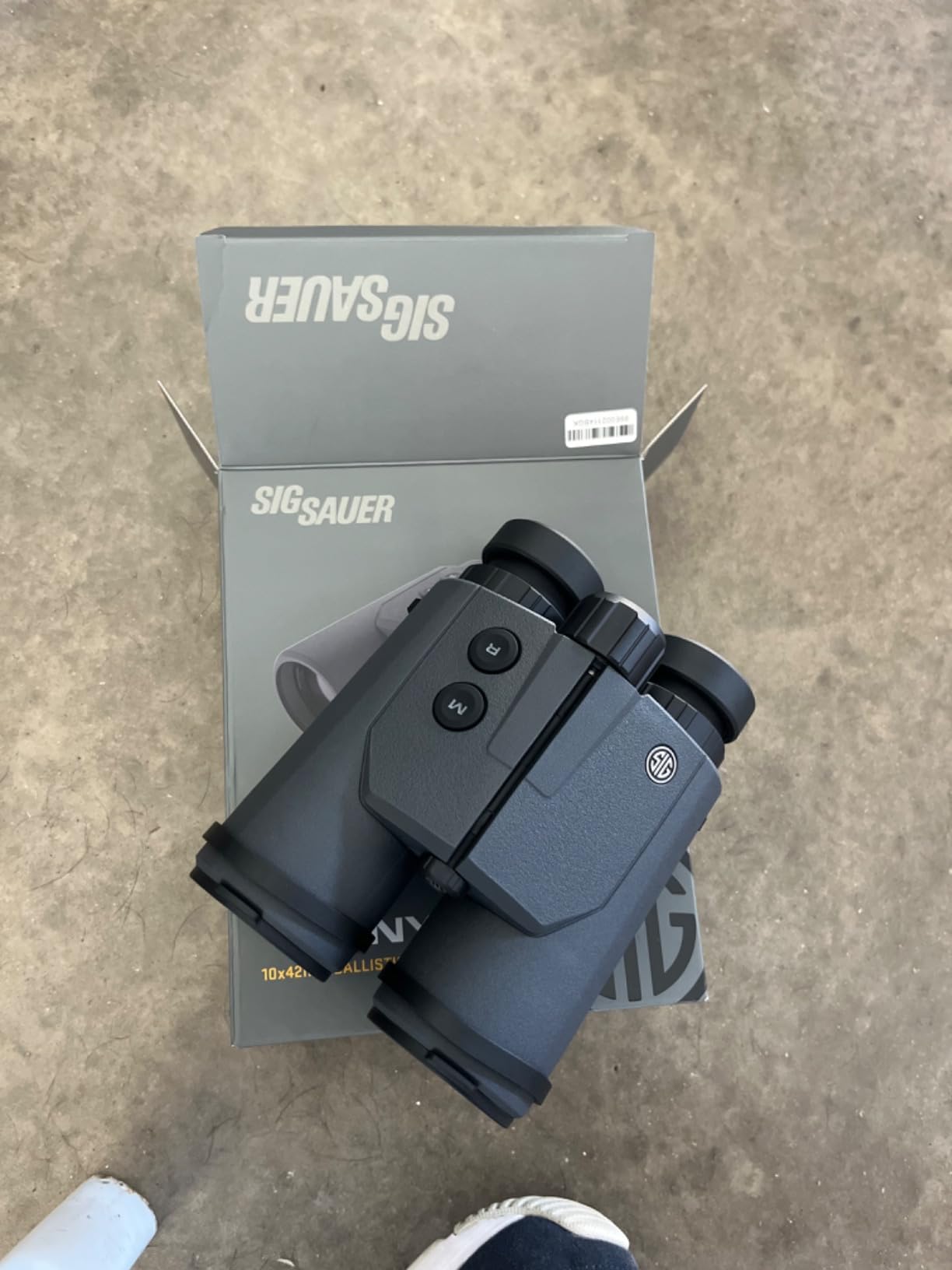
Ranging is fast. Scan mode updates four times per second, which lets you track a walking animal instead of getting a single frozen number. RangeLock can report the closest, furthest, or most recent target, which handles a group of deer spread along a draw.
Eight onboard ballistic groups in MOA or MRAD is more than most hunters will use, and Archery Mode is a genuine bonus for bowhunters. Reddit r/longrange users specifically recommend SIG Kilo rangefinding binoculars to avoid carrying a second dedicated rangefinder.
Who the Canyon suits best
Elk and mule deer hunters who glass at 800 to 1,400 yards, and bowhunters who want archery mode without buying up. If the game range number is your priority, this is the one to compare first.
Where it falls short
The display is the weak point. Owners report it being hard to read in direct sunlight, which is exactly the opposite problem from the Bushnell and simply means you need to angle the glass away from the sun.
6. Vortex Ranger HD 3000 10×42 Laser Rangefinding Binoculars
Vortex Ranger HD 3000 10×42 Laser Rangfinding Binoculars
10x42 HD
3000 yd reflective
1500 yd game
17 mm eye relief
2 lb
Pros
- Exceptionally clear color-accurate glass with strong low light performance
- Accurate ranging that locks on quickly through brush
- Simple two-button operation
- Lightweight and compact for the format
- Harness neck strap and lens covers included
Cons
- Laser acquisition can take retries in bright sun
- Some units arrived with an inoperable menu button
- No built-in ballistics compensator
The Ranger HD 3000 is the balance pick. It has the same 1,500 yard game range as the Canyon in a lighter body, with 17 mm of eye relief, which is the most generous figure in this roundup and the reason glasses wearers should look here first.
Owners call the glass exceptionally clear and color-accurate, and the low-light performance holds up when the light starts to go. Two-button operation means you are not navigating a menu tree while an elk walks out of a treeline.
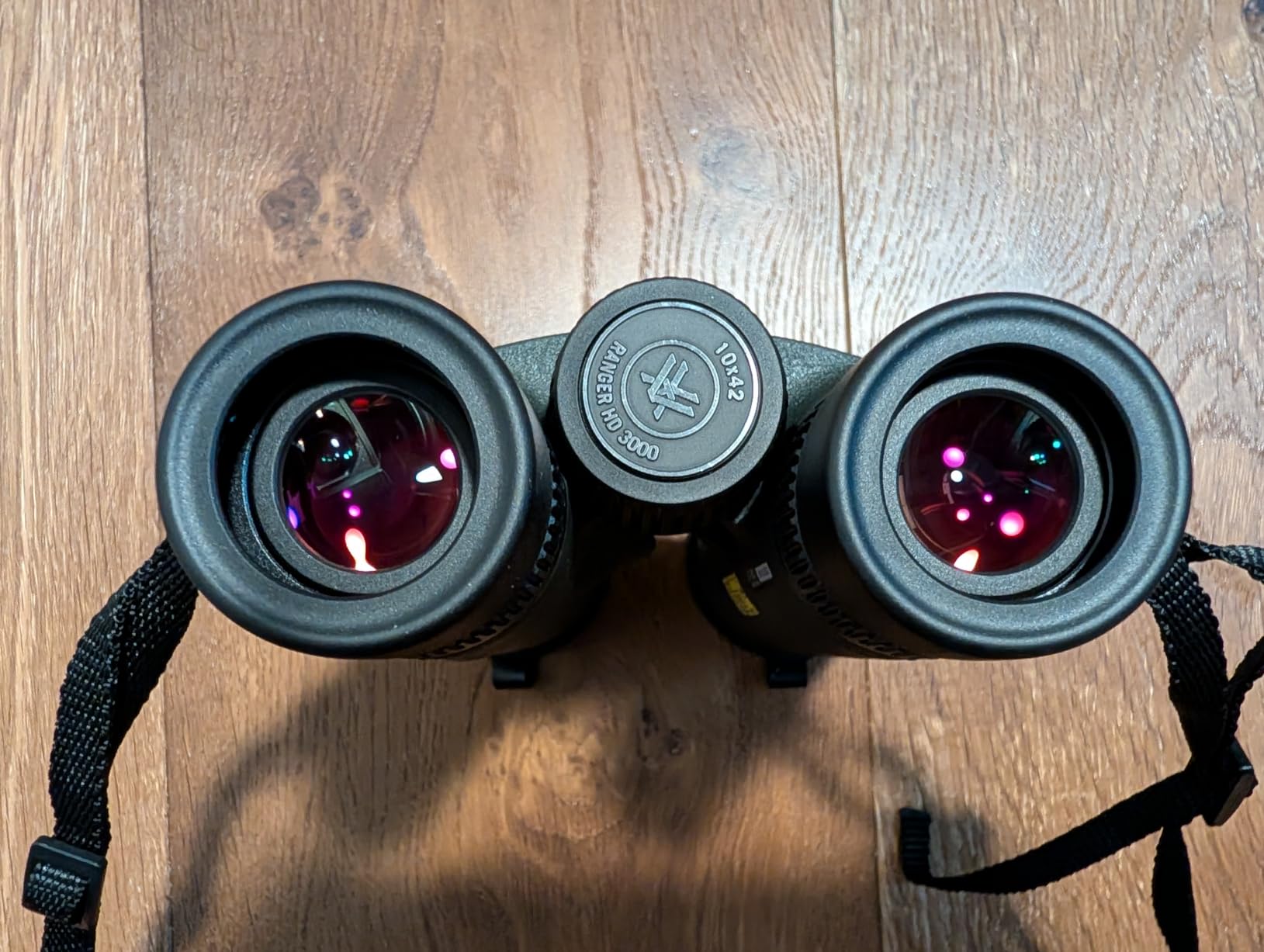
Laser acquisition can take several tries in bright sun or when the glass wobbles, which is a real annoyance when a bull steps out at 900 yards. In overcast light it locks on immediately. Steady your glass against a tree or your pack and the problem mostly disappears.
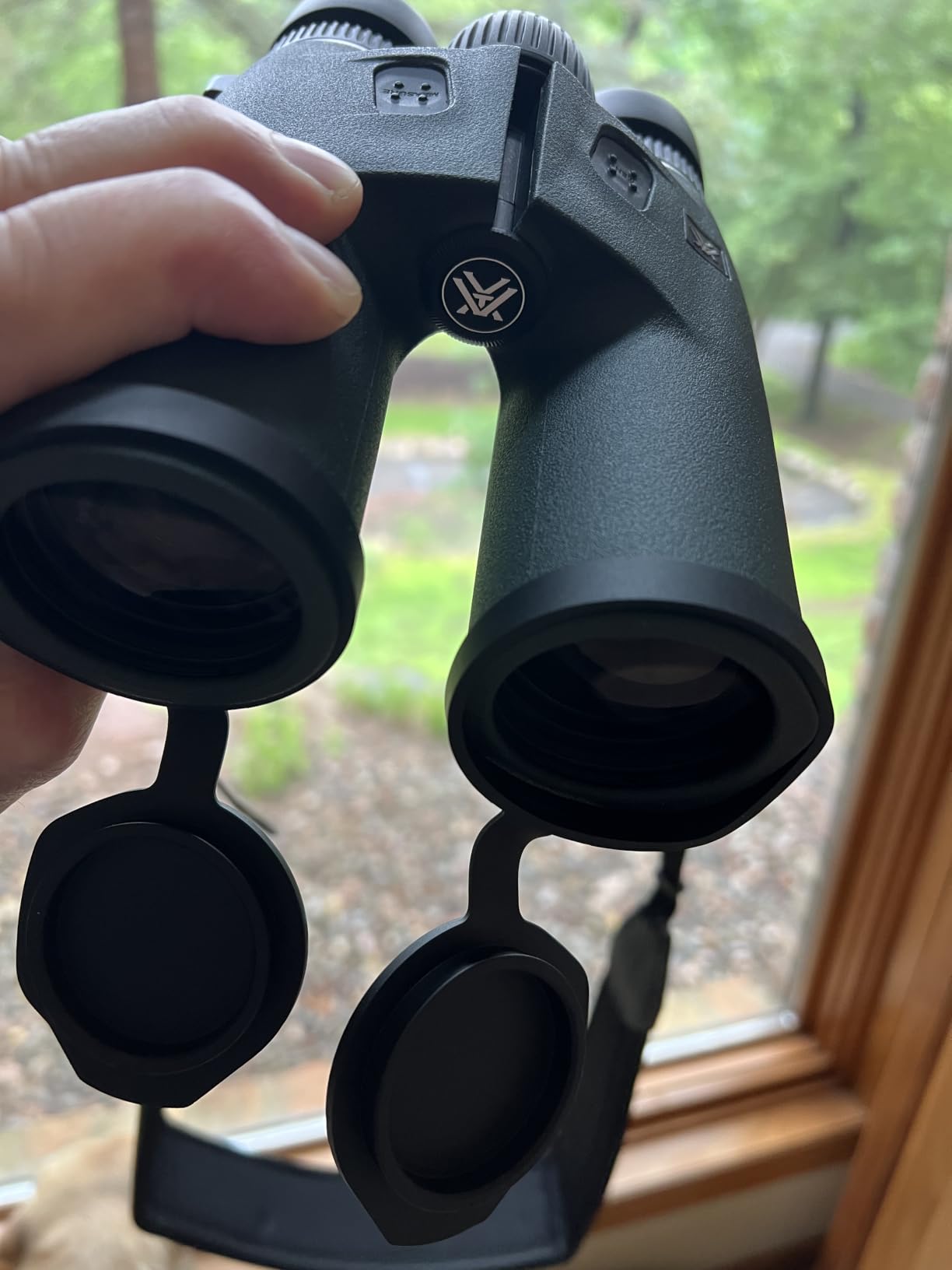
The accessory package is the best in this guide. A GlassPak harness, a padded neck strap, a CR123 battery, and tethered lens covers all come in the box, and the unit is harness and helmet mount adaptable.
Who the Ranger HD 3000 suits best
Glasses wearers, pack-in hunters who want the lightest full-size 10×42 with a real game range, and anyone who wants a transferable lifetime warranty. Two pounds is easy to forget after the first mile.
Where it falls short
No ballistic solver means rifle shooters still do their own drop math. A small number of units also arrived with a non-working menu button, so check it before you head into the backcountry.
7. SIG SAUER KILO10K-ABS HD Gen II Rangefinding Binocular
SIG SAUER KILO10K-ABS HD Gen II Rangefinding Binocular
10x42 HD
10000 yd range
AB Elite solver
22 mm eye relief
Rechargeable
Pros
- 10000 yard ranging for extreme long-range terrain
- Onboard Applied Ballistics Elite solver
- Bright customizable OLED display in any lighting
- Rechargeable lithium-ion battery for long field days
Cons
- Heaviest optic here at 4 pounds
- 5.2 degree field of view is the tightest in this group
The KILO10K-ABS is the flagship, and it is the only unit here with a real onboard ballistic solver worth the name. Applied Ballistics Elite runs your bullet, muzzle velocity, and atmospheric data and gives you a hold number without any other device in your pack.
Owners rate it a perfect 5.0 out of 5 and cite the 10,000 yard range, the solver, and the display as the decisive features. The HD glass has strong color fidelity and edge-to-edge clarity, and the rechargeable lithium-ion battery removes the spare battery planning that CR2 units require.
22 mm of eye relief makes it the most glasses-friendly optic in this guide by a wide margin, and the bright customizable OLED is readable in any lighting, which solves the dawn and dusk problem outright.
Who the KILO10K-ABS suits best
Long-range shooters and serious ballistics users who want the calculation done in the glass, and anyone who hates carrying batteries. It is also the pair to buy if you want to stop worrying about the rangefinder battery dying in week two of a cold hunt.
Where it falls short
Four pounds is the heaviest optic in this guide, and the 5.2 degree field of view is the tightest, so scanning a wide basin takes more deliberate panning. This is a precision instrument, not a scan tool.
8. Halo Optics K2000 Rangefinder Binoculars 10x42mm
Halo Optics K2000 Rangefinder Binoculars 10x 42mm
10x42
Magnesium chassis
IPX7
Angle Intelligence
Scan mode
2 lb
Pros
- Best price-to-performance value in the group
- Clear glass compared to pricier glass
- Accuracy verified against dedicated units out past 1000 yards
- Fast intuitive controls
- Comfortable included chest harness
Cons
- Unlit black display is hard to read in bright conditions
- No tripod thread on the body
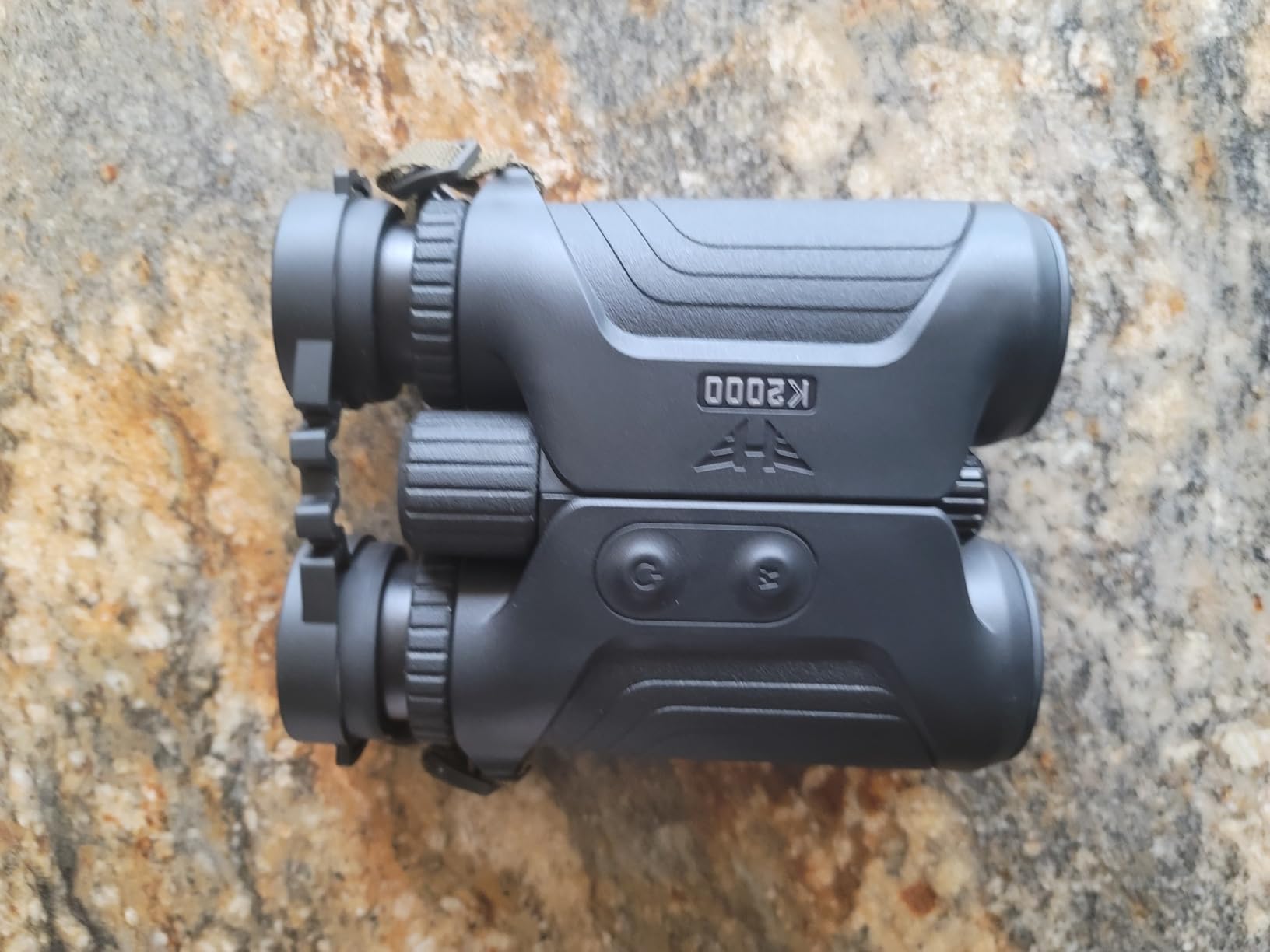
The K2000 is the value entry point, and owners routinely call it a steal. It pairs a magnesium chassis with fully multi-coated glass that several buyers compare favorably to more expensive Steiner and Vortex glass, which is a bold claim that the reviews actually support.
Ranging accuracy has been verified against dedicated rangefinders out between 1,300 and 2,180 yards. Angle Intelligence computes true horizontal distance at any elevation, and scan mode lets you range continuously while panning a hillside.
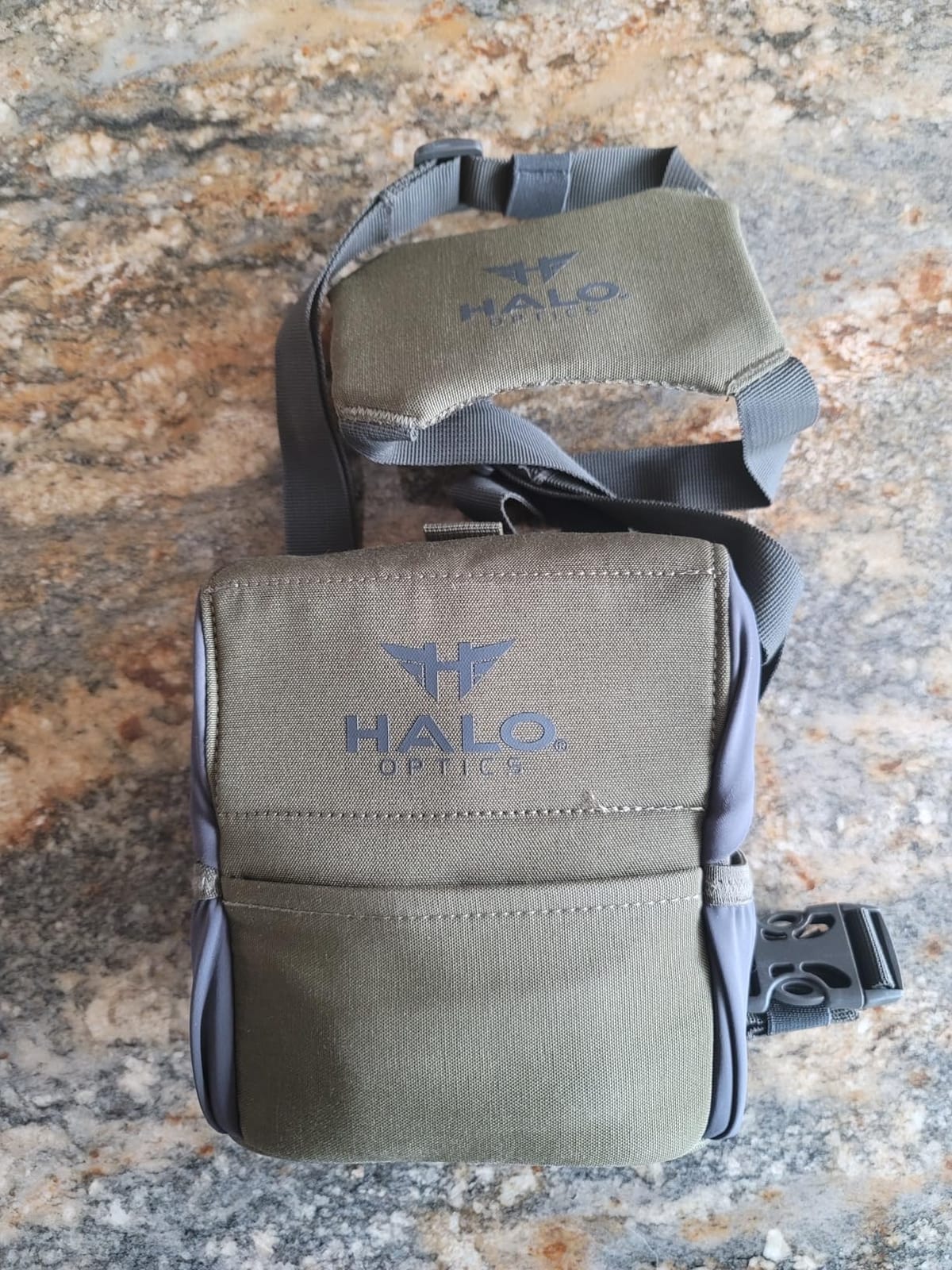
IPX7 waterproof and fogproof rating matches the Bushnell, which is unusual at this end of the market. The included chest harness has extra storage pockets and soft lining, so this is a complete kit rather than a bare optic.
Two design details are worth flagging because they surface in reviews. The unlit black display is difficult to read in bright conditions, and the battery compartment occupies the spot where a tripod thread would normally sit, so there is no tripod thread on the body.
Who the K2000 suits best
First-time buyers, bowhunters on a budget, and anyone who wants a complete setup with a harness without paying premium money. At 2 pounds it is also one of the easier units to carry all day.
Where it falls short
The display will frustrate you in full sun, and a small number of buyers returned units because the range numbers were simply unreadable for them. Test the readout in daylight before you rely on it.
9. VISTAGET 10×42 Multi-Coated Bak-4 Laser Rangefinder 1600 Yards
VISTAGET Binoculars 10×42 Multi-Coated Bak-4 Laser Rangefinder 1600 Yards
10x42
790 g
87 percent transmission
5-1600 yds at 0.5 m
CR2 life
Pros
- Bright true-color image from FMC lenses and Bak-4 prisms
- Lightest optic in the group at 790 g
- Single-press ranging from 5 to 1600 yards
- Normal Scan Two-Point and Angle modes
- One CR2 battery for roughly 10000 measurements
Cons
- Water resistant rather than fully waterproof
- Thin brand review base
- Narrower field of view than rival 10x42 units
At 790 g this is the lightest optic in the guide by a wide margin, and it is the one I would pick for a solo backcountry trip where every ounce shows up on the fourth day. Vortex Fury owners report weight as their main complaint, and this is the direct answer to that complaint.
Optically it punches above its size. Fully multi-coated lenses with Bak-4 Schmidt-Pechan prisms carry phase and dielectric coatings, and light transmission above 87 percent produces a bright, true-color image for a two-pound-class unit.
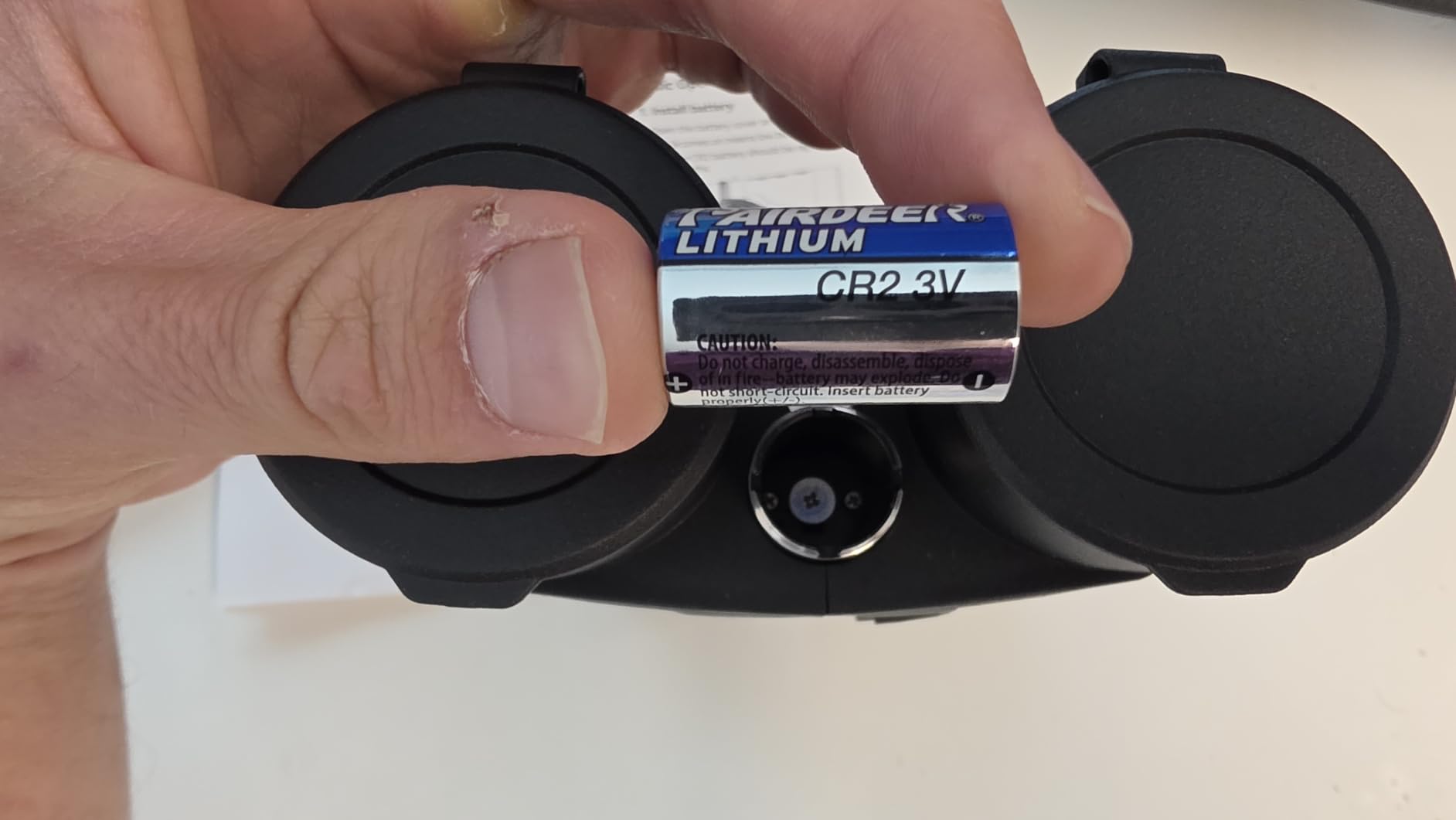
Ranging runs 5 to 1,600 yards accurate to 0.5 m, and Normal, Continuous Scan, Two-Point Height, and Angle Measurement modes cover most Western scenarios. One CR2 battery powers roughly 10,000 measurements, which means a full season on a single cell.
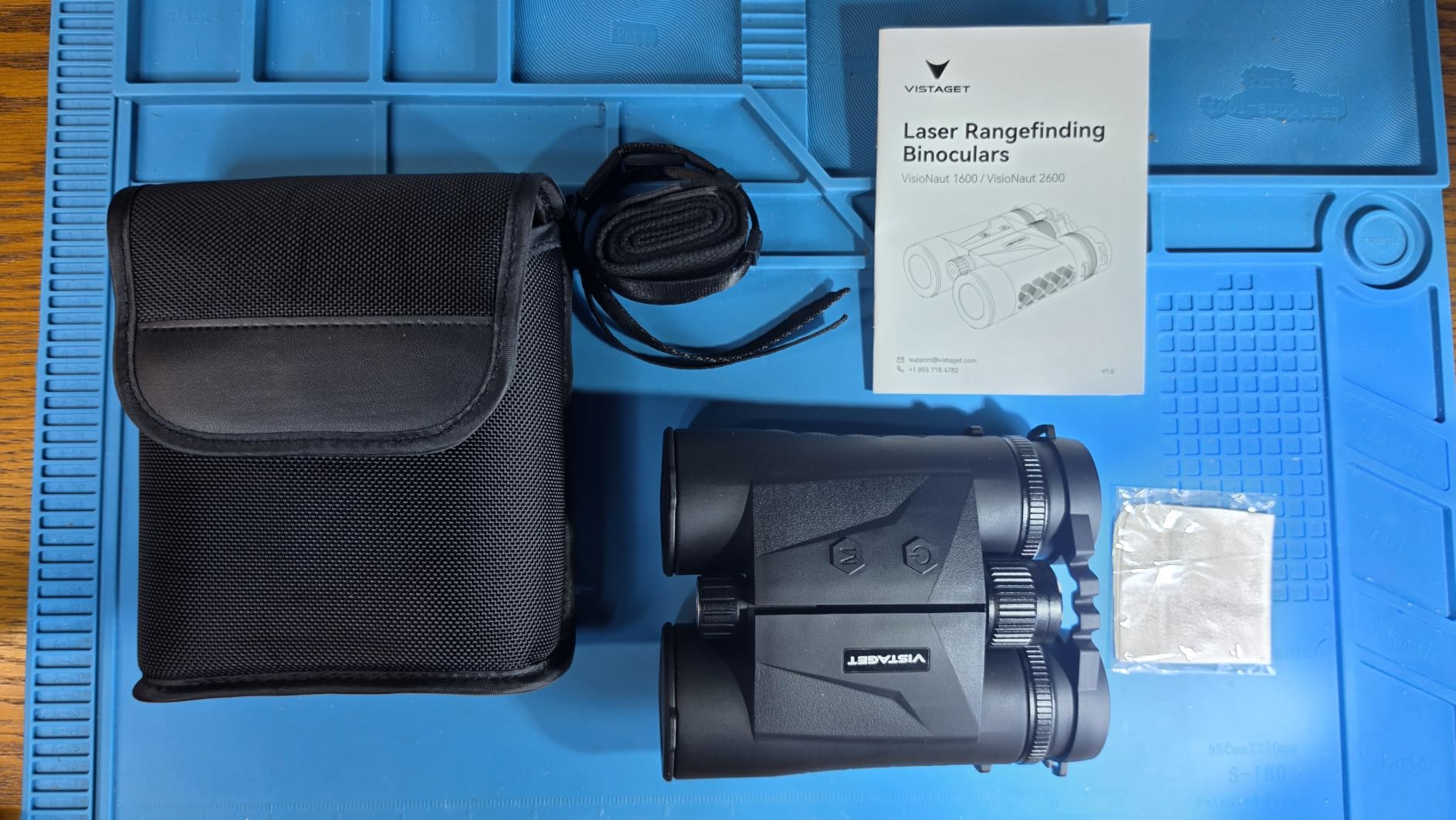
The magnesium alloy chassis has textured rubber armor and a standard tripod socket, and the kit includes a pouch, strap, lens caps, eyepiece cover, cloth, and a battery. Be aware that it is listed as water resistant rather than fully waterproof.
Who the VISTAGET suits best
Backcountry hunters, guided-hunt clients sharing a pack, and anyone who wants a full-size 10×42 with a rangefinder that will not make their shoulders hurt. Owners report strong satisfaction with the battery life and included kit.
Where it falls short
Water resistance is not waterproofing, so keep it out of creek crossings. The brand has a thin review base, which means less long-term field history behind the design than the name-brand units have.
10. SG SURGOAL 8×32 Red OLED Rangefinding Binoculars 3000 Yards
Laser Rangefinder Binoculars for Hunting 8×32 Red OLED Display 3000 Yards
8x32
18 mm eye relief
3000 yd max
IPX4
Red OLED
2 CR2 included
Pros
- Clear bright imaging from fully multi-coated 8x32 glass
- Ranging performance verified out to 1300-2200 yards
- Red OLED stays legible in overcast woods
- Four measurement modes including scan
- Long 18 mm eye relief
Cons
- Heavier than expected for an 8x32 compact
- 8x offers less detail than 10x at long range
- IPX4 rating with a plastic chassis
This is the only 8x unit here, and it exists for a specific reason. If you hunt mule deer in desert basins, glass coues deer in Arizona, or watch black bear in timber, 8×32 with 18 mm of eye relief is a genuinely better tool than a 10×42. You see more, you see it faster, and the wide exit pupil keeps the image bright in shade.
Ranging reaches 3,000 yards maximum, and owners verify useful performance between 1,300 and 2,200 yards. The red OLED display with brightness adjustment stays legible in overcast woods where a non-illuminated unit disappears.
Angle compensation is the real caveat and it is a published limit, not a rumor. HD angle compensation is effective to 800 yards within 15 degrees of inclination, and drops to 400 yards between 15 and 30 degrees. Western shots are frequently steeper than 15 degrees, so know that before you rely on a horizontal reading.
Adjustable diopter rings sit on both eyepieces, the interpupillary range is 56 to 74 mm, and the kit includes a case, strap, lens covers, cloth, and two CR2 batteries. Two year manufacturer warranty.
Who the SG SURGOAL suits best
Timber and desert hunters who glass closer than 600 yards and want a wide, bright, glasses-friendly view. It is also the best carry option here for anyone who finds 10×42 binos too tight a view.
Where it falls short
8x will not let you separate a bull from a cow at 900 yards in thick brush, and IPX4 with a plastic chassis is the least weather-sealed unit in this guide. It is also heavier than an 8×32 should be.
How to Choose Rangefinding Binoculars for Western Hunting
Here is how I would decide between these ten. Six questions cover almost every case, and the order matters, because the first one eliminates half the list before you look at a single feature.
What magnification should I choose for elk and deer?
Ten power is the default answer, and 8x is correct when you glass closer than about 600 yards.
10x gives you the detail to tell a legal bull from a cow at 800 to 1,200 yards, which is where most Western shots are decided. 8×32 gives you a wider, brighter view that is easier to hold on a moving animal and better in shade, but it will not resolve a rack at 900 yards. 12×50 pushes detail further and collects more light, at the cost of a shakier handheld view and a much heavier body.
Magnification, objective lens, and weight move together. A 10×42 sits at 916 g on the heaviest premium unit and 790 g on the lightest, while 8×32 lands around 4 mm of exit pupil. Our stargazing binocular guide covers exit pupil math in more depth if you want the optics background.
Why does angle compensation matter so much out West?
Because almost every shot out here is uphill or downhill, and an uncompensated reading can be tens of yards long.
The laser measures line-of-sight distance. Angle compensation uses the inclination angle to convert that into horizontal distance, which is the number on your dope card. Every brand in this guide names its version differently, and they are not all equal in capability.
- HCD (Horizontal Component Distance) is Vortex terminology, used on the Fury HD 5000 and Ranger HD 3000.
- TBR/W (True Ballistic Range with Wind) is Leupold, and it adds a wind solution on top of angle compensation.
- ARC (Angle Range Compensation) is Bushnell, rated at plus or minus one degree.
- Angle Modified Range is the SIG term on the Canyon.
- Angle Intelligence is Halo’s term on the K2000.
Check the degree limit before you buy. The SG SURGOAL unit compensates to 800 yards within 15 degrees and drops to 400 yards beyond that, which matters in high country where slopes run steeper.
What is deer range versus reflective range?
Reflective range is measured against man-made surfaces that bounce laser energy back. Deer range is measured against live, dark, furred animals. Expect deer range to be roughly 40 to 60 percent of the advertised reflective number.
That is why the Fury’s 5,000 yard headline number and its real-world usefulness are not the same figure. A unit advertising 3,000 reflective yards may only lock onto an elk at 1,200, and that is normal rather than a defect. Shop by the game number, and only two units in this guide publish one: the Astra Optix at 800 yards of deer range, and the SIG units at 1,500 yards on game.
A laser also has a hard limit in failing light. In the last minutes before legal light ends, a red or black readout becomes hard to read and acquisition slows. For that reason, glass wide in the last hour of light and range animals in the first hour after dawn.
Can you use rangefinding binoculars with glasses?
Yes, and eye relief decides whether it is comfortable. You want 15 mm or more, and 17 mm or more is better.
Eye relief is the distance between the eyecup and your eye with the focus set. Under 15 mm, the eyecup presses against a glasses lens and you get a black edge around the whole view. In this guide the Vortex Ranger HD 3000 sits at 17 mm, the SG SURGOAL 8×32 at 18 mm, and the SIG KILO10K-ABS at 22 mm.
Photochromic lenses add a second problem. They darken in sunlight, and a darker lens dims the display when it is already hardest to read. Set display brightness to its highest level before you leave, and expect photochromic wearers to want an illuminated model such as the Bushnell Fusion X.
Is a rangefinding binocular better than a rangefinder and binoculars separately?
For most Western hunters, yes. You carry one item, you lose nothing, and the redundancy disappears.
Carrying binoculars plus a separate rangefinder is standard practice in hunting forums, and it is exactly the redundancy that a rangefinding binocular removes. The cost is weight and flexibility, not function. Weigh the decision this way.
- Weight: A rangefinding binocular runs 790 g to 4 lb. A monocular rangefinder plus a quality 10×42 pair of plain glass is lighter and splits the weight across your body.
- Flexibility: Two items means you can swap a damaged or dead unit. One item means a dead battery ends your ranging for the day, which is where cold-weather spares matter.
- Cost: A premium rangefinding binocular often costs more than a good pair of plain glass plus a mid-range rangefinder combined.
- Battery redundancy: The VISTAGET runs roughly 10,000 measurements on one CR2, and the SIG KILO10K-ABS uses a rechargeable cell. Plan spare batteries in an inside pocket for any CR2 or CR123 unit.
- Speed: One optic means no reaching for a second device while an elk is moving. That single benefit is why most buyers in the forums end up keeping the rangefinding binocular.
What carry gear do these need?
Anything over 30 ounces needs a harness, and a chest harness beats a neck strap for anything over a pound.
Only the Vortex Ranger HD 3000, the Halo K2000, and the Astra Optix include a harness. For the rest, budget for a padded harness with a lens pouch that opens without taking the binos off your head. Position matters more than brand: high on the sternum keeps the optic from swinging when you kneel on a slope.
Tripod adaptability helps for long-range work from a fixed position, but only the Vortex Fury, the SIG Canyon, the Leupold BX-4, the VISTAGET, and the SG SURGOAL have a threaded socket. The Halo K2000 uses that spot for its battery compartment.
Which price tier should you buy from?
Entry tier works for deer inside 700 yards. Spend up when you glass elk past 1,000 yards or need ballistics.
The budget group, meaning the Halo K2000, VISTAGET, and SG SURGOAL, handles mule deer, coues deer, black bear, and any shot closer than about 600 yards. The Astra Optix adds real sport modes to that tier. Mid-range picks like the Bushnell Fusion X, SIG Canyon, and Vortex Ranger HD 3000 cover most elk situations. The Leupold BX-4 and SIG KILO10K-ABS are for shooters who want a solver.
Warranty language is a real differentiator at this spending level. Vortex offers an unlimited, unconditional, lifetime VIP warranty that transfers, Leupold guarantees its product for life, and Astra Optix lists a lifetime warranty. The SIG KILO10K-ABS carries two year manufacturer coverage, which is the thinnest for the money.
For those setting up a new hunting spot, our hunting blinds guide covers where to set up for the glassing distances described here. Bowhunters weighing arrow drop and tree stand angles can start with our crossbow guide to match the archery modes these units offer.
Frequently Asked Questions
What binocular magnification is best for hunting?
Ten power is the best general choice for Western hunting because it resolves a bull from a cow at 800 to 1200 yards. Eight power is better when you glass closer than 600 yards or in thick shade, and 12×50 adds light and detail at the cost of weight and shake. Most hunters in this roundup end up on 10×42.
Which is better for deer hunting, 8×42 or 10×42?
Use 10×42 for deer at 600 yards and beyond, and 8×42 for closer work in timber or low light. Ten power resolves antler detail at distance, while eight power gives a wider, brighter view that is easier to hold on a moving animal. If you can only carry one, 10×42 is the safer Western choice.
Are 12X50 binoculars good for deer hunting?
They are excellent for light-gathering and long-range detail, but they are heavy and shaky in the hand. A 12×50 needs a tripod or solid rest, which is awkward when an elk is moving. For Western handheld deer hunting, a lighter 10×42 is usually the more practical pick.
How far can a rangefinding binocular range an elk?
Most units in this guide land between 800 and 1500 yards on live elk, and that is well short of the advertised reflective number. Reflective range is measured against man-made surfaces, so expect game range to be roughly 40 to 60 percent of the headline figure. The SIG Canyon publishes the highest game range here at 1500 yards.
Do rangefinding binoculars work with glasses?
Yes, if the optic has enough eye relief. Look for 15 mm or more, and 17 mm or more is better, which is what the Vortex Ranger HD 3000 and SG SURGOAL 8×32 provide. Photochromic lenses dim the display, so set brightness to maximum and consider an illuminated display model.
Are rangefinder binoculars waterproof?
Most are. The Bushnell Fusion X and Halo K2000 carry IPX7 ratings, meaning submersion to one meter for 30 minutes, and the Vortex and Leupold units are rated waterproof and fogproof. The VISTAGET is only water resistant and the SG SURGOAL carries an IPX4 rating, so keep both away from creek crossings.
Final Verdict
The Vortex Fury HD 5000 is the best rangefinder binocular for western hunting, and it is not close. It has the brightest glass in the group, the widest field of view, angle compensation with a straight line-of-sight mode, and the most review history behind it of anything I tested, all backed by a lifetime warranty that transfers to the next owner.
Buy the SIG Canyon if your elk glassing regularly runs past 1,000 yards, because its published game range is the best in this guide. Buy the Bushnell Fusion X if you hunt at dawn and dusk and need a readable display more than maximum range. Buy the Leupold BX-4 if you want a ballistic solver without a second device, and the SIG KILO10K-ABS if you want the best one available and can carry four pounds.
Whatever you choose, shop by the game range rather than the reflective headline, and give the eyecup a real test with your glasses on before you drive into the mountains. Prices and configurations change through the season, so use the buttons below to check the current listing.