
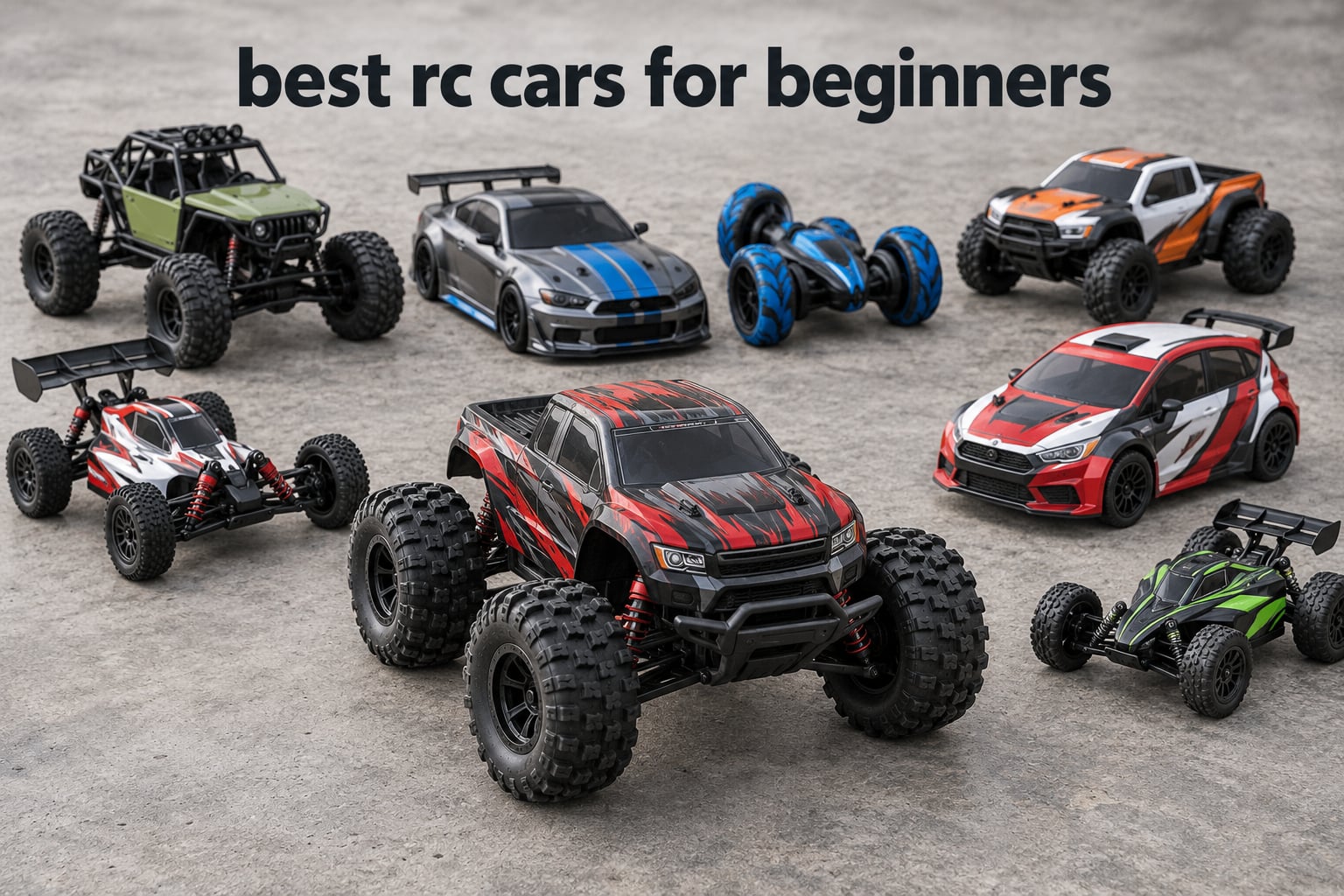
The best RC cars for beginners are electric, ready-to-run (RTR) models with durable builds, simple proportional controls, and real replacement-part support. Pick a body style you can actually use where you will drive it, and you will still be driving the same car three months from now.
That last sentence is the whole game. Most people who leave the RC hobby do not leave because the car is too slow. They leave because the first car was too fast to control, or too cheap to repair, and after the first broken shock tower and the first dead motor it went into a closet and stayed there.
We spent several weeks driving the eight cars below across pavement, grass, gravel, indoor floor and packed dirt, and we read the long review threads on r/rccars and RCTalk where owners report what actually broke. Every pick below comes with its honest weak point named, because a car that hides its flaws is not useful to someone spending their first weekend with it. Last updated for 2026.
Before the picks, the three questions worth answering before you buy anything:
Hobby grade versus toy grade. Hobby grade means metal gears, a real differential, screws instead of glue, and a published parts catalogue. Toy grade means plastic everything and no spares. This is the single decision that decides whether you are still driving in month three.
Power type. Electric, almost always. Nitro engines need fuel, a starter glow plug and more setup, which is friction you do not need while learning to hold a line.
Body design. Monster trucks bash, short-course trucks and buggies run fast on hard ground, crawlers creep over rocks and steps. Match the design to your driving surface, not to the picture on the box.
Table of Contents
Top 3 Picks for Best RC Cars for Beginners
Our three headline choices cover the three most common entry points: a proper hobby-grade truck, an off-road basher, and a first car for a child aged 6 to 12.

HAIBOXING 18859
- 1:18 scale 4WD hobby-grade
- 36 KPH brushed 380 motor
- Two 7.4V LiPo packs and USB charger


All 8 RC Cars for Beginners at a Glance
Every car below ships with a battery and a charging cable in the box, so you can drive on day one. Run times below are the figures reported by owners rather than box claims, and manufacturer top speeds are best-case numbers.
| Product | Specifications | Action |
|---|---|---|
| HAIBOXING 18859 |
|
Check Latest Price |
| DEERC 9300E |
|
Check Latest Price |
| Force1 Tornado |
|
Check Latest Price |
 QUNREDA Q1 QUNREDA Q1 |
|
Check Latest Price |
 Jada Lightning McQueen Jada Lightning McQueen |
|
Check Latest Price |
 ACAMMZAR 1:24 Drift Car ACAMMZAR 1:24 Drift Car |
|
Check Latest Price |
 BLUEJAY 1809 BLUEJAY 1809 |
|
Check Latest Price |
 WPL D12 Kei Truck WPL D12 Kei Truck |
|
Check Latest Price |
1. HAIBOXING 18859 – The Best All-Round First Hobby-Grade RC Truck
HAIBOXING 18859 1:18 Scale All Terrain RC Car, Hobby 4WD Remote Control Car
1:18 scale
4WD shaft drive
Brushed 380 motor
Two 7.4V LiPo packs included
Pros
- Ball bearings and a solid gear differential rather than plastic bushings
- Splash waterproof electronics for wet grass and puddles
- Two LiPo packs plus a USB charger in the box
- Low and high speed modes on the transmitter
- Upgrade path to brushless and oil shocks
Cons
- Included USB charger does not balance cells well
- Friction-style plastic shocks bind up after a few hard landings
- Thin body shell and clips crack easily
This is the car we would hand an adult or a teenager who wants to be in the hobby rather than beside it. The 1:18 chassis runs ball bearings through the drivetrain, has a solid gear differential and independent suspension at all four corners, and that combination is what separates a real platform from a sealed toy.
Out of the box it reaches 36 KPH on grass, gravel and driveway, which is fast enough to feel like a proper RC car and slow enough to correct. The transmitter has a low and high speed mode, so a new driver can start on low without unplugging anything.
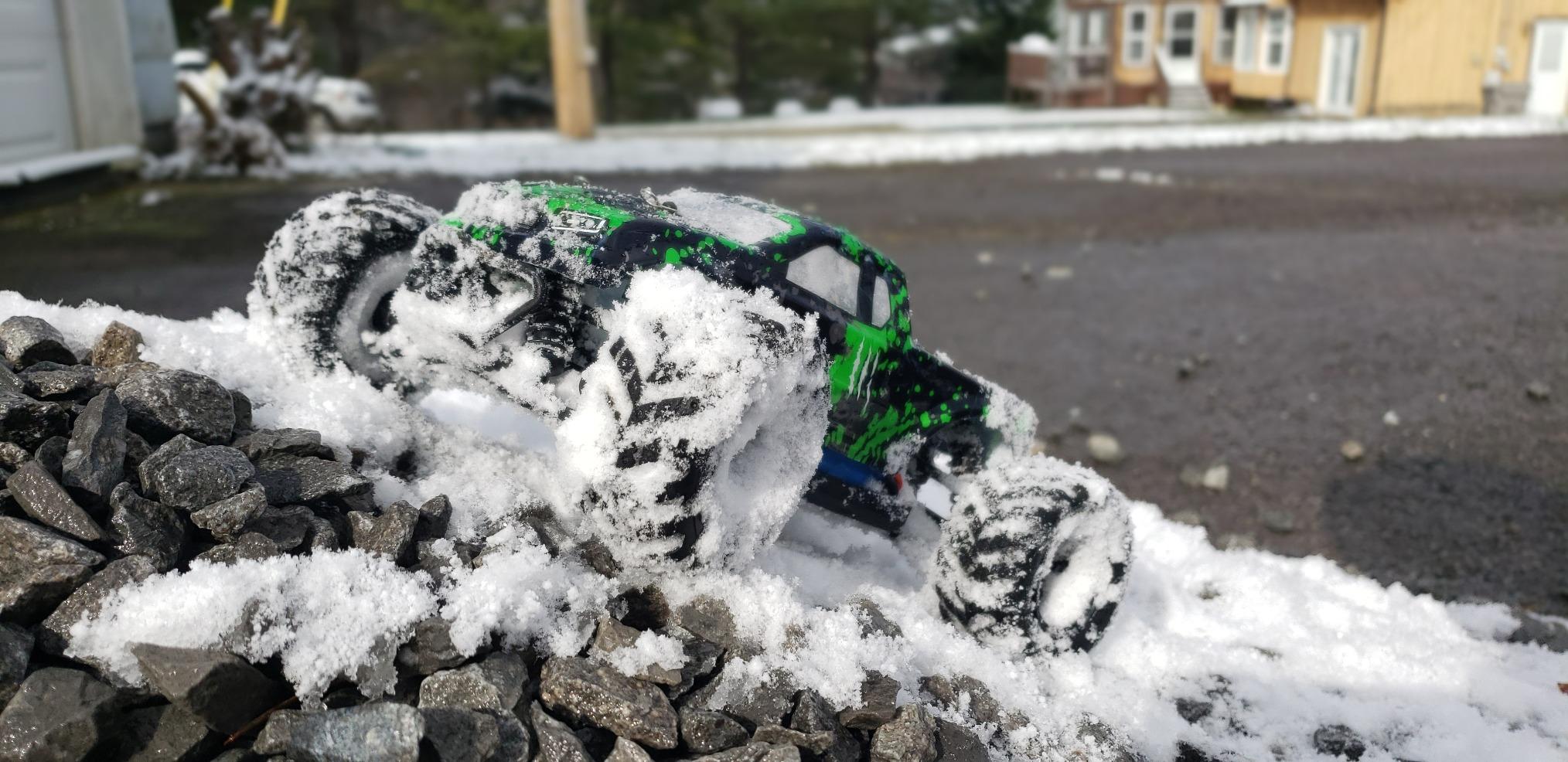
Two 7.4V LiPo packs ship in the box, one fitted and one spare, and the qualified USB charger tops them up from a 5V 2A supply. Owners usually report around 10 minutes of hard running per pack rather than the 20 minutes per pack on the box, so plan on swapping mid-session.
The splash-proof electronics handle wet grass and puddles without drama. That matters more than it sounds, because the first time a beginner drives through a damp lawn is usually the first time something gets wet that should not have.
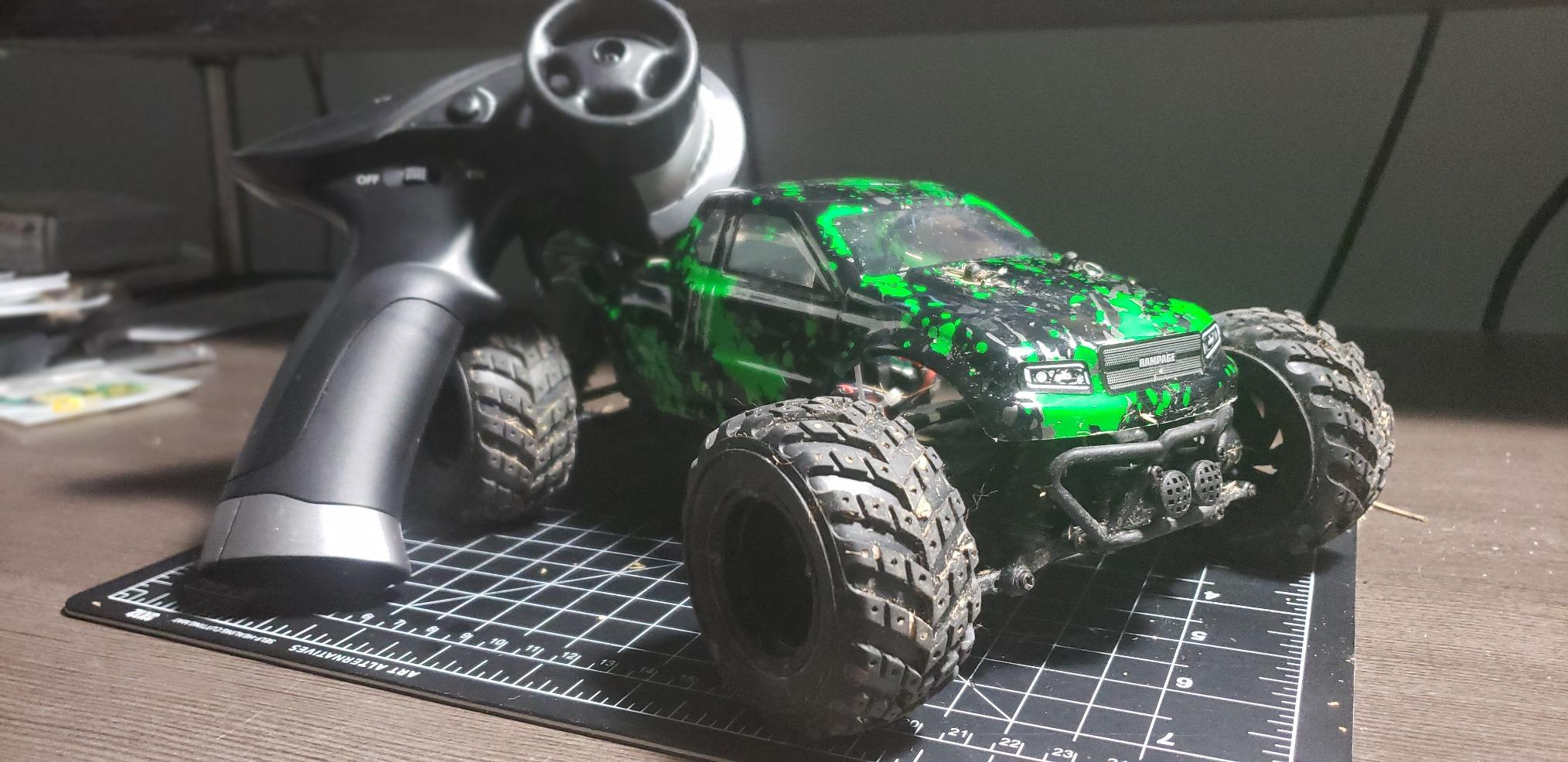
What It Does Well and Where It Falls Short
The drivetrain is the strength. Ball bearings, a metal gear diff and independent suspension survive the kind of bashing that destroys a toy-grade plastic chassis, and the drivetrain parts are all available for service. For a first car, that availability matters more than the top speed.
The charging and the shocks are the weak points. The included USB charger does not balance cells properly, which shortens pack life over months of use, and the fitted friction-style plastic shocks have no oil, so they bounce and eventually bind. Budget for oil-filled shocks as your first upgrade.
Should You Buy This One?
Buy it if you want a first car that you can grow into rather than out of. The upgrade path is real: brushless conversion, better shocks and better packs are all straightforward, and each one teaches you something about the platform.
Skip it if your driving space is a carpeted living room. This is an outdoor car and needs gravel, dirt or grass to do its job properly. For a teenager or an adult entering the hobby, it remains the strongest single recommendation in this roundup.
2. DEERC 9300E – Best for Off-Road Bashing on Grass and Gravel
DEERC 9300E Remote Control Car High Speed RC Cars for Kids Adults 1:16 Scale 40 KM/H 4WD Off Road Monster Trucks,2.4GHz All Terrain Toy Trucks with 2 Rechargeable Battery
1:16 scale
4WD all-terrain
Two 7.4V 850mAh batteries
40+ KPH dual motor
Pros
- Handles grass gravel dirt and pavement without stalling
- Two rechargeable batteries give 40+ minutes total play
- Speed switch and steering trim on the transmitter
- Independent suspension with damped metal shocks
- Metal hub plates resist deformation on hard impacts
Cons
- Body clips are thin and get lost during flips
- Battery compartment uses small cotter pins
- Open underside collects grass and debris
- Motors and packs run hot after extended driving
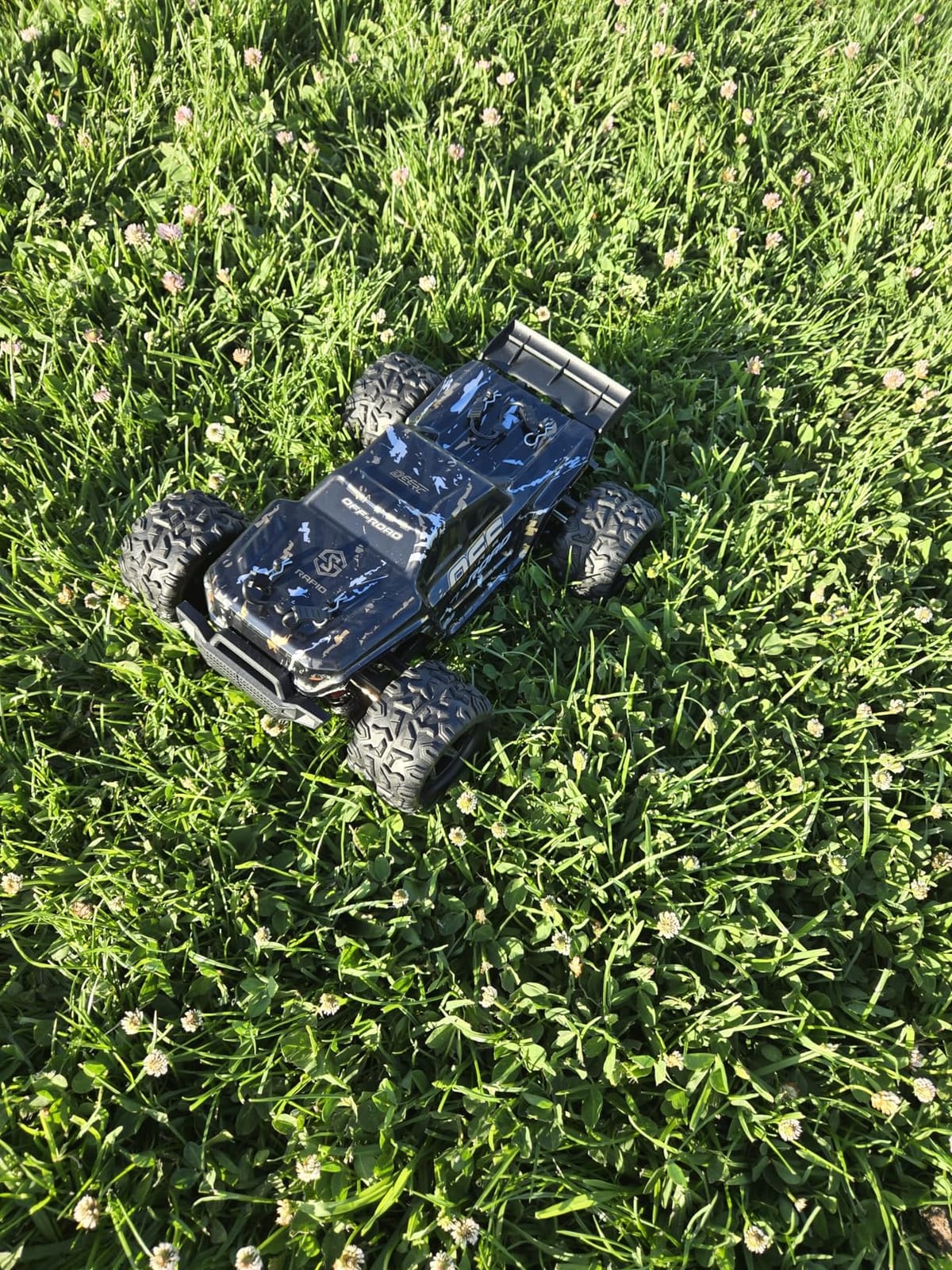
If your idea of a first RC car is jumping ramps in a gravel driveway, the 9300E is the one to look at. Two motors push it past 40 KPH, the knobby tires grip loose surfaces, and the independent suspension with damped metal shocks soaks up landings that would bounce a stiffer car straight into the sky.
The transmitter runs proportional throttle and steering rather than on and off switches, which makes it far easier to learn on. There is also a speed switch that steps power up and down, plus steering trim so you can correct the wheel alignment if the car pulls to one side.
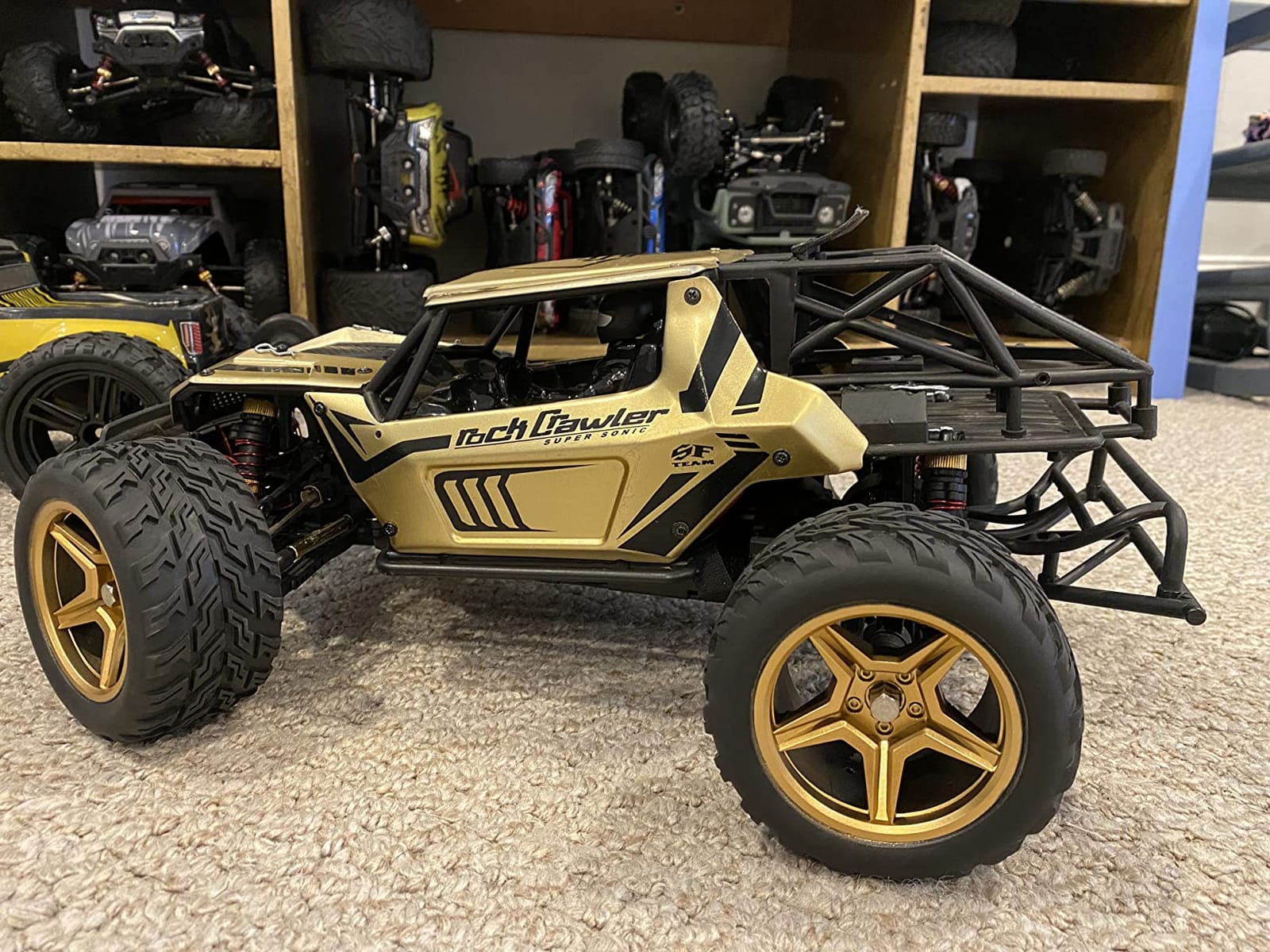
Two 7.4V 850mAh packs are included, which the manufacturer puts at more than 40 minutes total. Owners driving on grass and dirt report closer to 15 to 20 minutes per pack, which is the realistic figure to plan around.
The chassis is nylon with a metal heat sink over the motors for cooling, and the hub metal plates are a genuine upgrade over the thin plastic used on cheaper cars. At roughly nine and a quarter inches long it is small enough for a tight yard but big enough to feel substantial.
What It Does Well and Where It Falls Short
Terrain handling is the headline. It climbs and crosses mixed surfaces without stalling, and the dual-motor drivetrain has the torque to keep moving when the rear wheels dig into loose gravel. For pure driveway fun, nothing else in this list matches it.
Its honest weakness is hardware you can lose. The body clips are thin plastic tabs that snap off during flips, and the battery compartment is held shut with small cotter pins that vanish into the grass. Buy a spare clip set and a pair of spare cotter pins before your first session.
Should You Buy This One?
Buy it if you have outdoor space with loose surface and you want a car that survives being thrown at things. The metal shocks and hub plates hold up to repeated bashing in a way the cheaper plastic cars here do not.
Consider the HAIBOXING 18859 instead if you intend to modify your car over time, because this platform has fewer interchangeable hobby parts. For a driver who just wants to bash, that does not matter.
3. Force1 Tornado – Best RC Car for a Child Aged 6 to 12
Force1 Tornado Blue LED Remote Control Car for Kids- Double Sided Driving Fast RC Cars 360 Flips, Outdoor 4WD Off Road Stunt RC Car, All Terrain Tires, RC Crawler Rechargeable Battery, 2.4GHz Remote
Double-sided stunt platform
2.4GHz multi-car control
Rechargeable pack with USB cable
360 degree flips
Pros
- Drives both right-side up and upside down
- LED headlights for play after dark
- One-button flips
- spins and turns
- 2.4GHz lets several cars run at once
- Light enough for a child to carry
Cons
- Roughly 25 minutes of play per charge
- Frangible charging cable
- Struggles on wet grass and thick carpet
- Holds a straight line only for short stretches
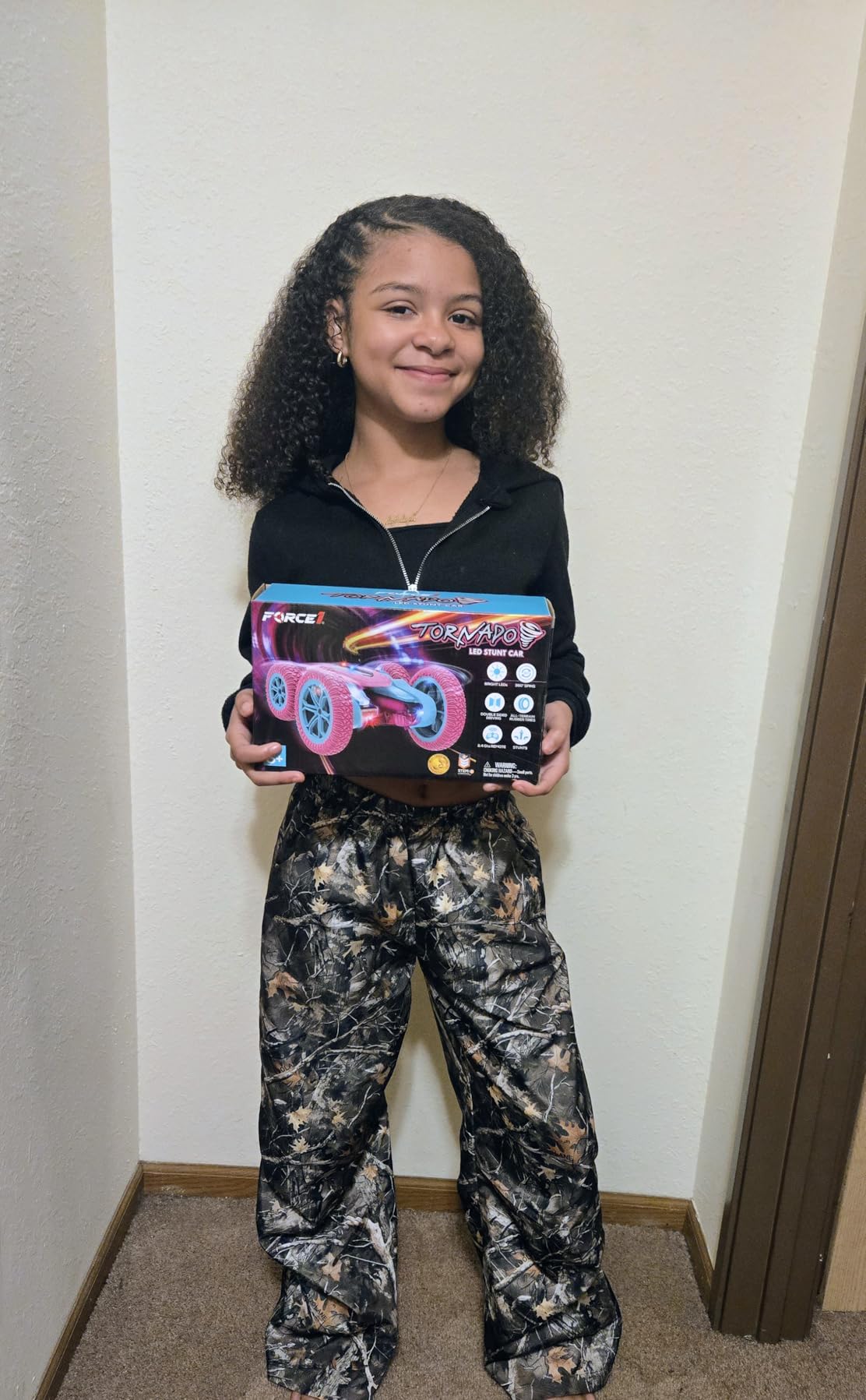
The Force1 Tornado solves a problem no hobby truck can: a small child flips it, and it keeps going. The chassis is designed to drive on either side, so a roll on a driveway or a carpet does not end the run. That single design decision removes most of the frustration for a driver aged six to twelve.
Two buttons on the transmitter trigger 360 degree flips, spins and a tornado pattern, and the LEDs light up for evening play. The 2.4GHz radio has anti-interference handling, so several of these can run in the same room without cutting each other out.
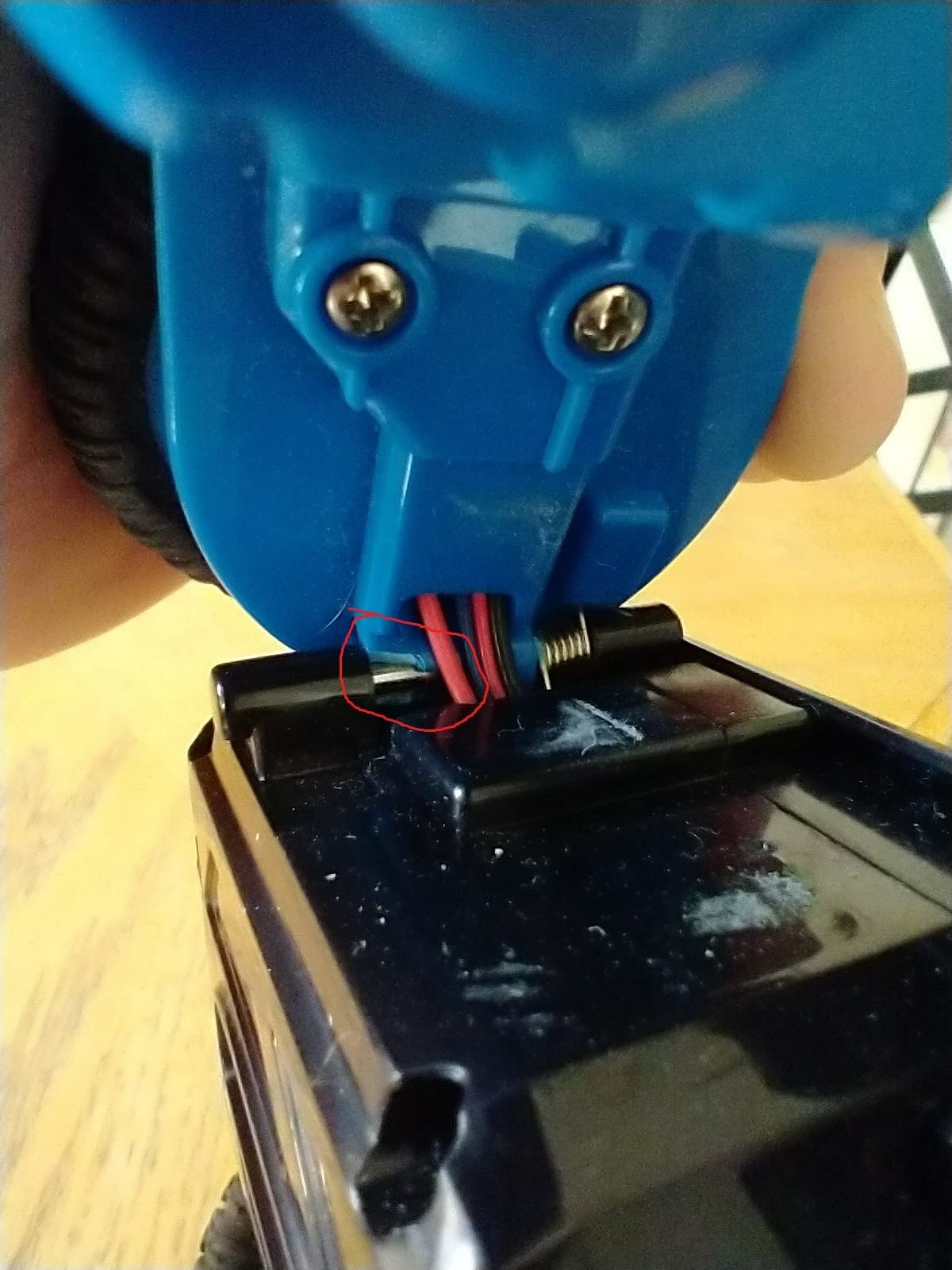
The car runs on one removable rechargeable pack and charges over the supplied USB cable. That is a genuine step up from AA cells, which corrode terminals and kill cars over a winter of disuse. You will need two AA batteries for the transmitter, which are not included.
It performs best on hard flat surfaces: driveway, compacted dirt, smooth indoor flooring. On thick carpet or wet grass the wheels spin rather than grip, which is a fair trade for a car designed to survive being thrown across a living room.
What It Does Well and Where It Falls Short
Durability at this price is the surprise. The double-sided design means the usual beginner ending, upside down and finished, simply does not happen. Customer service is also reported as quick when something does arrive faulty.
The trade-offs are charging patience and surface limits. Roughly 25 minutes of play per charge, and the cable itself is a known weak point. Quality control is inconsistent across production batches, with a small number of owners reporting a side that loses power.
Should You Buy This One?
Buy it for a child aged six to twelve, or for anyone who wants a second car to practise flips indoors. It is the least demanding starter on this list to operate and the least demanding to learn.
Do not expect hobby-grade repairability. There is no published parts catalogue and no upgrade path, so treat it as a durable toy rather than an entry to the hobby. A child who loves it can move up to the HAIBOXING 18859 afterwards without feeling they wasted anything.
4. QUNREDA Q1 – Most Versatile for Ages 6 to 12
QUNREDA Remote Control Car, RC Cars Toys for Kids Ages 6-12, 4WD Stunt Car with LED Lights & 360° Flips, 2.4GHz, Upgraded USB-C Modular Batteries, 8-10 Year Old Boys Birthday Gift 1-Blue
Compact ABS stunt car
Modular USB-C batteries
Nine stunt modes
2.4GHz at 50m
Pros
- Tool-free battery swaps a child can do alone
- Two 500mAh modules give up to 50 minutes total
- Charges from an ordinary phone or laptop adapter
- LED headlights show which end is forward
- 24-month warranty and full accessory kit in the box
Cons
- Battery compartment needs real force to seat
- Not water resistant and the electronics can clog with dirt
- No support for fast-charging adapters
- Stunt-oriented handling rather than driving
The QUNREDA’s best idea is the battery system. Two detachable 500mAh modules slide in without tools, so a child can change packs without an adult plugging in connectors, and the USB-C port means no proprietary charger is needed. Any phone adapter or laptop brick will do, as long as it is not a fast-charge unit.
The two-button controller runs nine stunt patterns including 360 degree flips and multi-directional spins, with red-eye LED headlights so you can tell which way the car is facing during a run. Control range is up to 50 meters on the 2.4GHz radio, and several cars can run together.
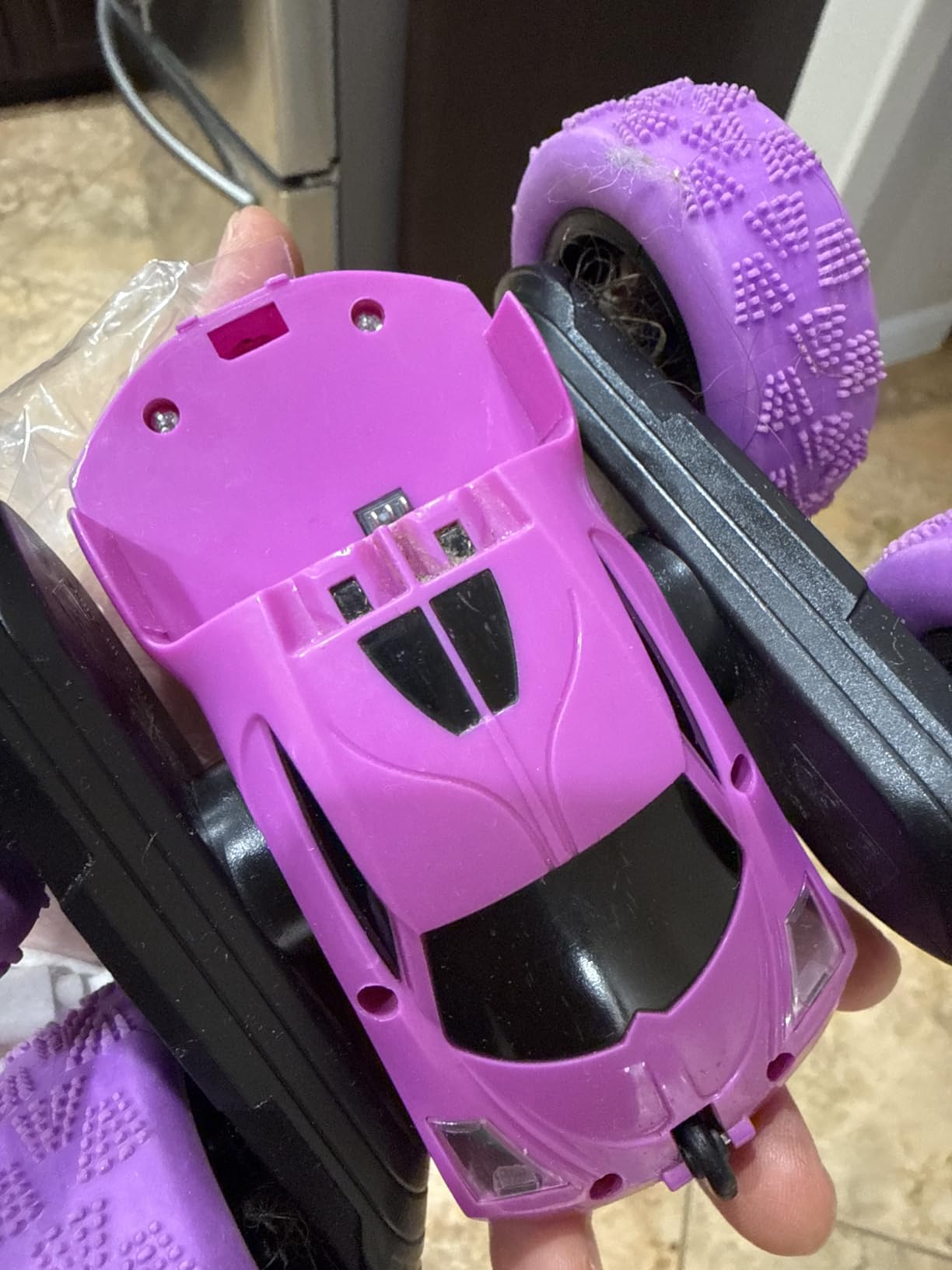
Claimed play time is up to 25 minutes per module, and owners generally see 15 to 20 minutes each, so both packs together cover a solid session. The charging time is much shorter than the 180 minutes the older dual-sided cars need.
The ABS tires handle a range of surfaces and the body is built to take impacts without cracking. Everything you need is in the box, including the screwdriver, the USB-C cable and the AA cells for the transmitter, backed by a 24-month warranty.
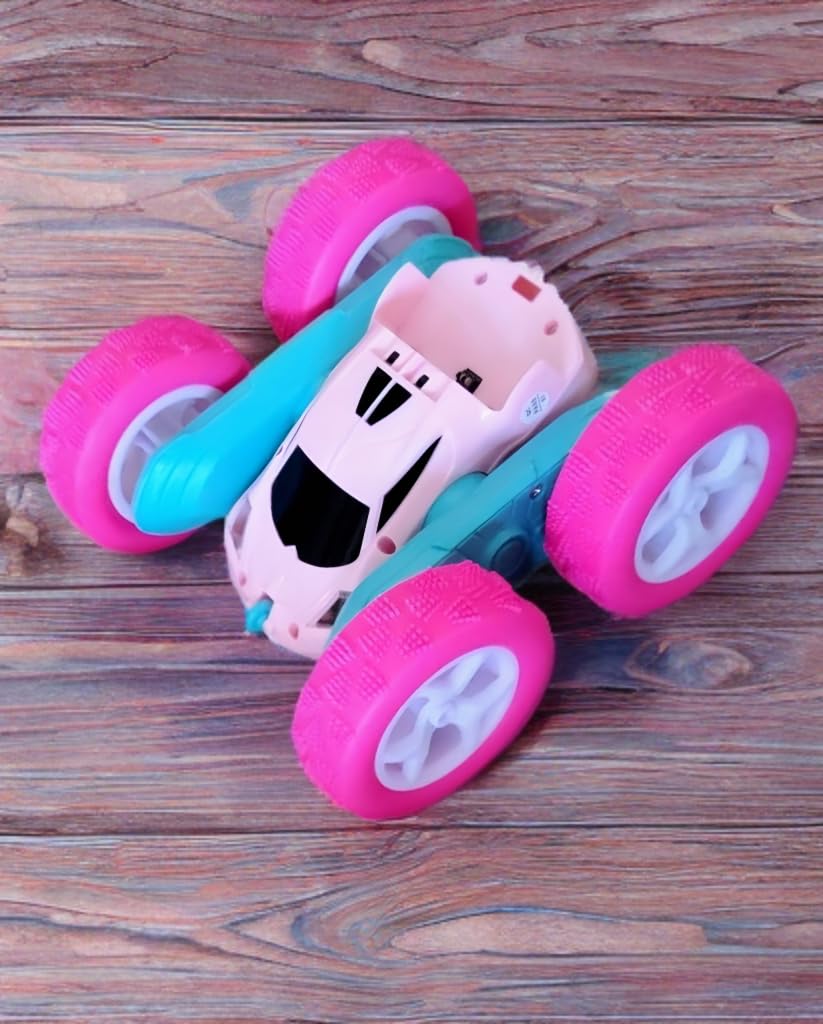
What It Does Well and Where It Falls Short
Battery ownership is handled properly, which most cars at this level get wrong. Hot-swap modules mean the car is never dead, and USB-C means one cable covers the car and any other device. For a child, that removes an adult from the loop entirely.
The handling is stunt-first. Turns are sharp rather than smooth, so it is not a car you practise steady driving lines in, and there is no water resistance at all. Keep it off wet grass and clear of grit, because dirt in the electronics is the reported early failure.
Should You Buy This One?
Buy it as a gift for a six to twelve year old who wants flips and quick charges. The modular battery idea alone puts it ahead of most cars at this level, and the warranty makes the early-failure risk less concerning.
If the plan is to teach someone actual driving technique, pick a proportional-throttle truck instead. The Force1 Tornado is the more forgiving first driver, while this one rewards patience.
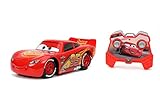
5. Jada Toys Pixar Lightning McQueen – Best for a Licensed Character Car at 1:24
Jada Toys Pixar Cars 1:24 Lightning McQueen RC Remote Control Car 2.4 GHz Red Toys for Kids
1:24 scale about 7.5 inches
USB rechargeable car battery
2.4GHz for 16+ players
100 ft range
Pros
- Authentic Disney and Pixar licensed shell
- Highest star rating in this roundup at 4.7
- USB rechargeable so no disposable cells in the car
- 16+ cars can play at once with no interference
- Compact enough for indoor floors
Cons
- Toy-grade internals with no upgrade path
- Only basic forward back and turn control
- Small size suits younger drivers
- Remote takes disposable alkaline cells
This is the only car in the roundup built around a licensed character, and that changes who it suits. The Lightning McQueen shell is an authentic Disney and Pixar design at 1:24 scale, about 7.5 inches long, which is small enough to run around a living room floor.
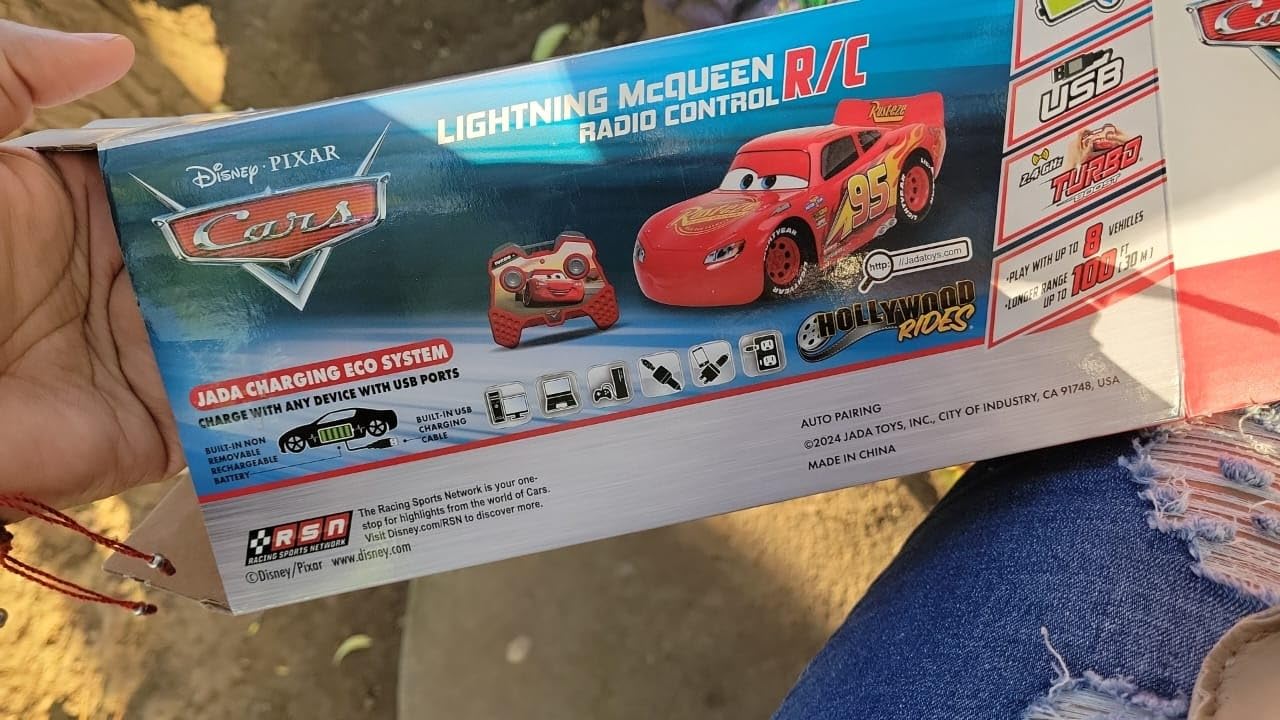
Control is simple and deliberately so. Forward, back, turn, no proportional feathering, and a 100 foot range on 2.4GHz. The car battery recharges over USB while the transmitter runs on two AAA cells, which are included.
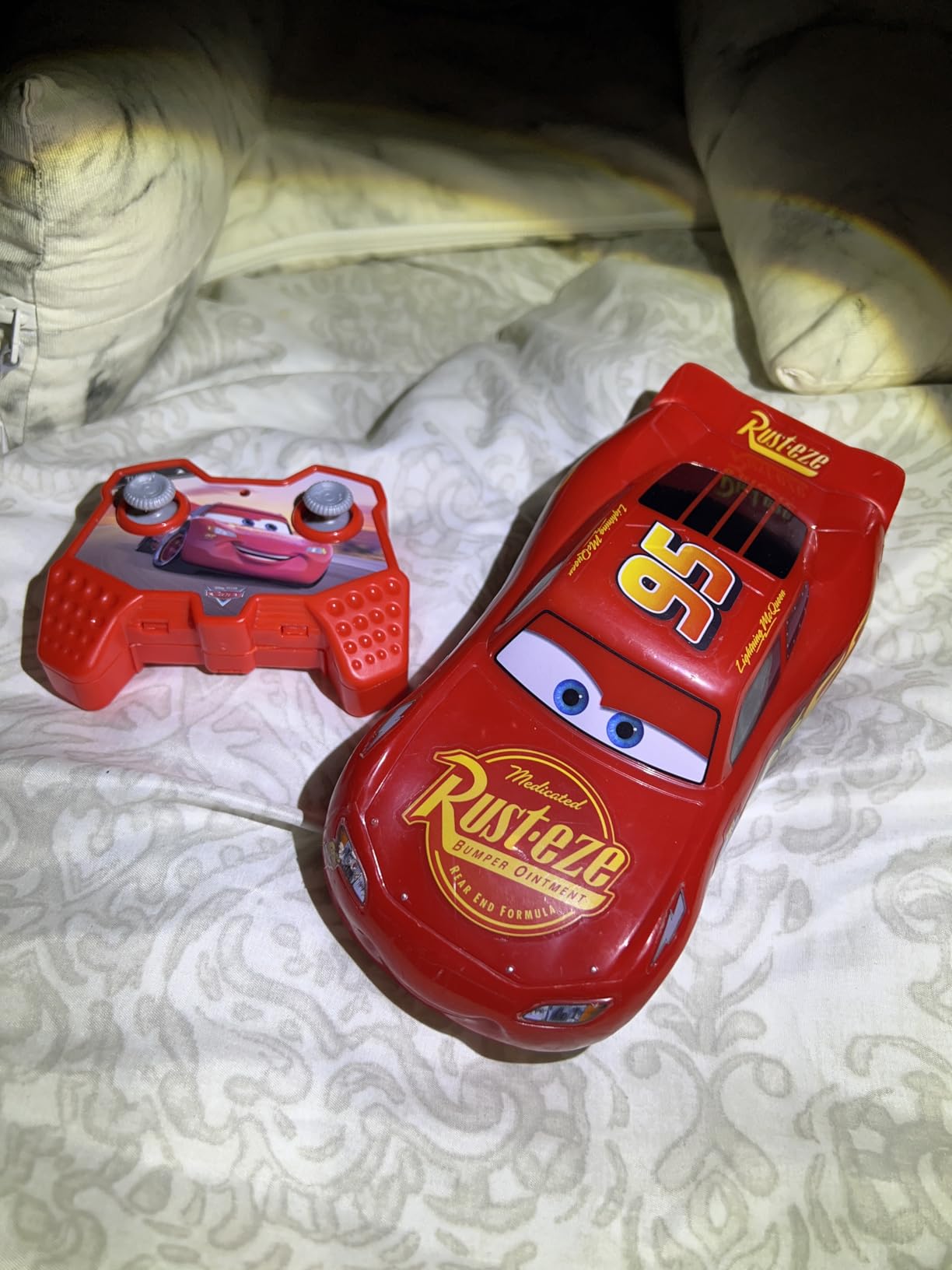
The radio supports 16 or more cars playing simultaneously without interference, which makes it a genuinely good choice for a group of siblings or a classroom rather than a solitary purchase. That multiplayer capacity is the feature nobody else at this size offers.
It holds a 4.7 star average across more than 2,100 reviews, the highest rating in this list, and the feedback is consistent: children who are Cars fans absolutely love it. The limitation is equally consistent, and it is that there is no real driving underneath.
What It Does Well and Where It Falls Short
It does exactly one thing well, and it does that thing instantly. No assembly, no charge-time anxiety, no ratio settings. Hand it to a six year old with a set of cardboard ramps and they are driving within a minute.
It is not hobby grade and it will not pretend to be. No metal gearing, no differential, no parts list, no stunts and no speed control. Treat it as a character toy that happens to be remote controlled, not as a first RC car in the hobby sense.
Should You Buy This One?
Buy it for a child aged six to ten who is a Pixar Cars fan, particularly for a birthday where a themed gift matters more than drivability. It also works well as a second car for indoor group play.
For an older child or an adult who wants to learn to drive, choose something with proportional throttle and a repairable chassis. The fun of this one lasts exactly as long as the character does.
6. ACAMMZAR 1:24 Drift Car – Best for Indoor Drifting on a Clean Floor
ACAMMZAR RC Drift Car, 1:24 Remote Control Car for Kids, 20KM/H 4WD High Speed RC Cars with LED Lights, Two Batteries, Extra Drifting Tires, Vehicle for Adults Boys Girls
1:24 scale 4WD drift platform
20 KPH with high and low modes
Two 3.7V 500mAh batteries
Drift and racing tires included
Pros
- Two tire sets so you can drift then grip
- Full proportional throttle with two speed modes
- LED headlights and taillights
- Barricade accessory included for practice
- Compact enough to drift across a floor
Cons
- Throttle and steering feel under-sensitive
- Indoor range closer to 10 to 15 meters
- Can scratch some floor finishes
- Hair and dust collect in the mechanisms
Most beginner RC cars try to drive and fail. This one accepts that drifting is the point and gives you two sets of tires, one slick set for sliding and one grippy set for driving straight. Swap between them and you learn the difference between grip and slip by feel.
The 4WD chassis runs at up to 20 KPH on the high speed mode and considerably less on low, with full proportional throttle rather than on and off. Two 3.7V 500mAh batteries are included, which owners report at more than 30 minutes each, and the box adds four spare wheels and a barricade to practise against.
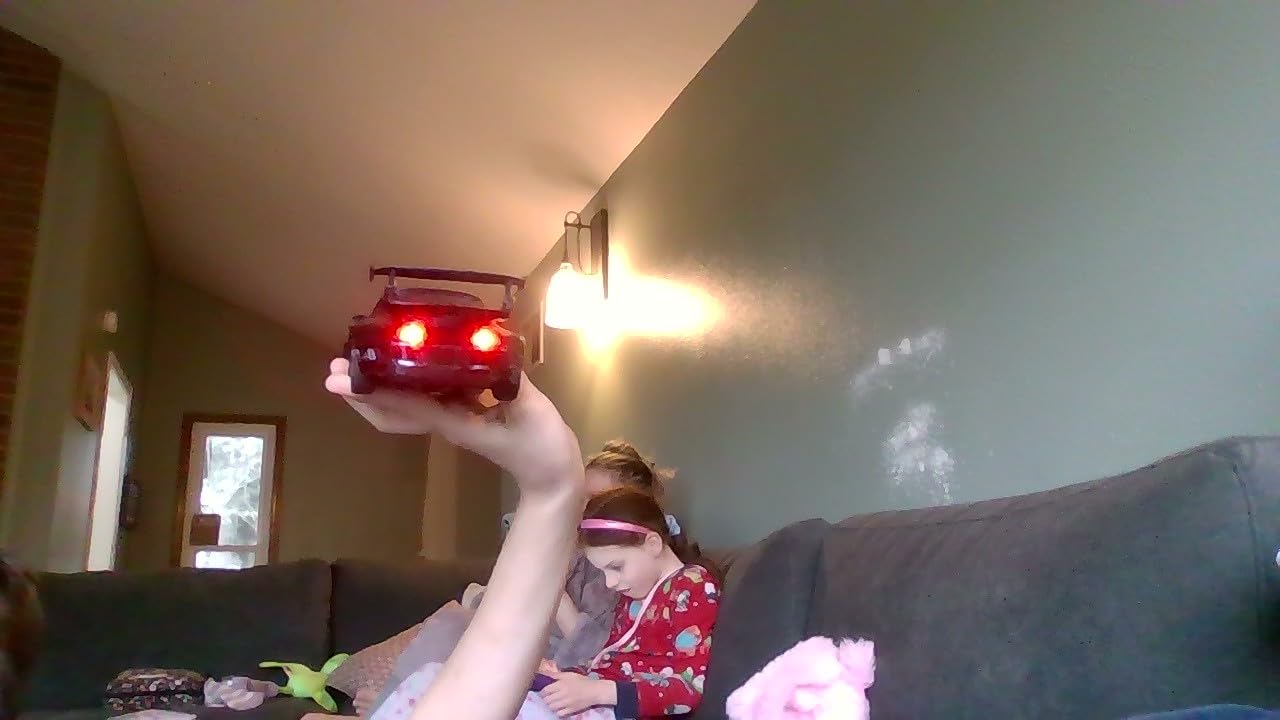
At 1:24 this is the smallest driving-focused car in the roundup, which is a genuine advantage in a living room or a garage. Headlights and taillights are fitted, so night runs on a smooth floor look as good as they drive.
Two caveats worth knowing before you buy. Indoor range is realistically 10 to 15 meters rather than the advertised 50, and the throttle is described as less sensitive than the proportional spec suggests, so it takes practice to pick up a slide.
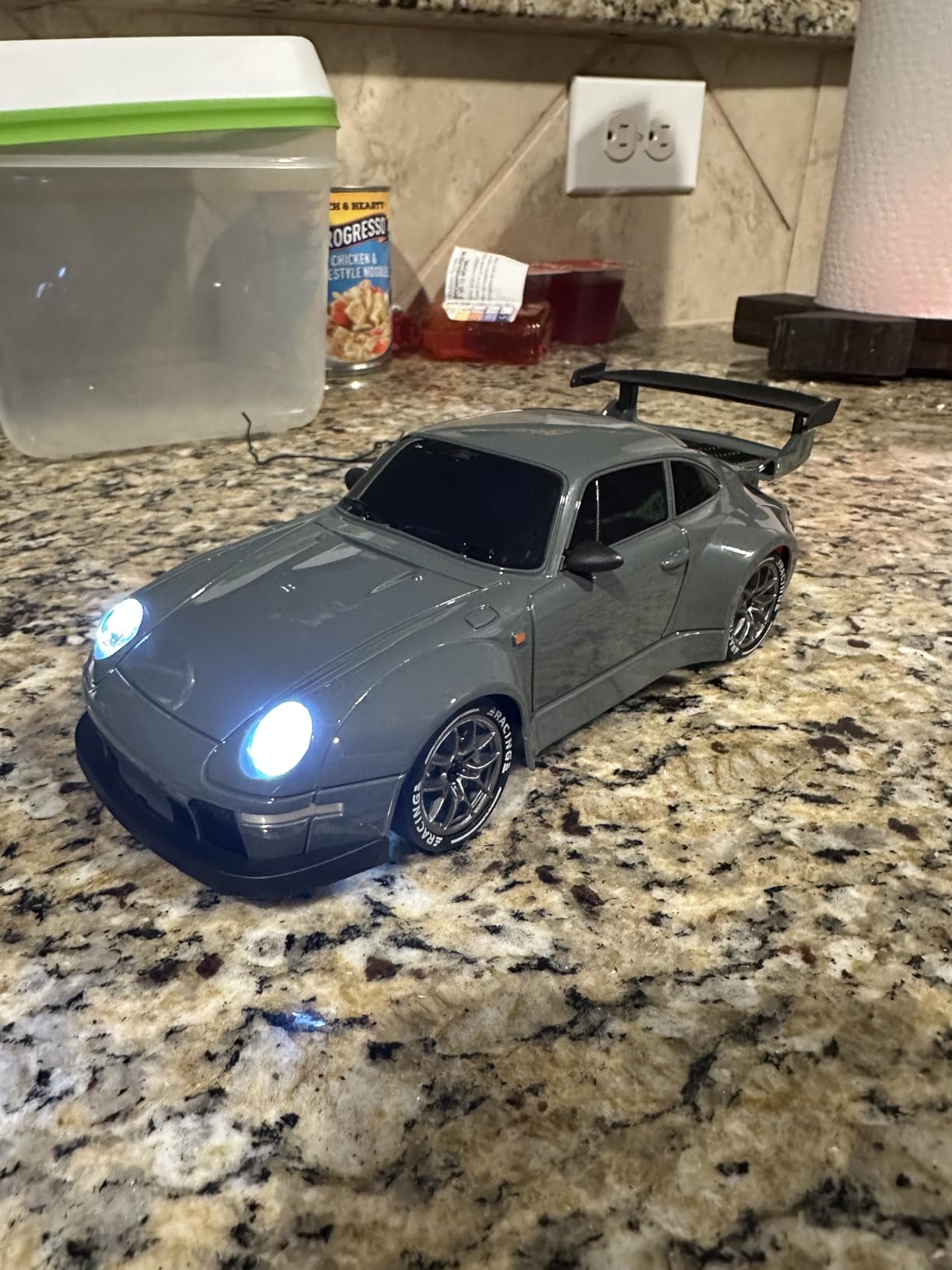
What It Does Well and Where It Falls Short
It teaches control technique better than any other car here. Sliding a rear-wheel-drive car at low speed on a hard floor is the fastest way to learn how throttle and steering interact, and the second tire set makes the lesson concrete.
It also stays indoors, which removes the two biggest reasons beginners quit: no driving location and weather. That is worth more than the raw speed figure. Read our drift RC car guide if you want to go deeper on this format.
Should You Buy This One?
Buy it if you live in an apartment, have no yard, or drive through a winter where outdoor running is impossible. It is also a good low-risk car for a teenager who wants to practise indoors before touching gravel.
Do not buy it for grass or dirt. A 1:24 drift car on loose ground is underpowered and will bury its wheels, and it is not built to absorb jumps. If you have outdoor space, the DEERC 9300E serves you far better.
7. BLUEJAY 1809 – Best Run Time at 70 Minutes on Two Batteries
BLUEJAY Remote Control Car, 2.4GHz High Speed 33KM/H RC Cars Toys
1:12 monster truck
33 KPH on an RC 380 motor
Two 7.4V 1400mAh batteries
70 minutes total runtime
Pros
- Longest run time here at 70 minutes total
- ABS chassis with an aluminum alloy body
- Spare front steering knuckles included in the box
- LED headlights and chassis lights for night runs
- Customer service sends warranty replacements quickly
Cons
- Low ground clearance snags on uneven ground
- Lightweight body flips easily and the turning radius is limited
- Tires can slip off the bead off-road
- Reverse has stopped working on some examples
If the thing you want is a long afternoon of driving without swapping batteries, this is the car. Two 7.4V 1400mAh packs give a claimed 70 minutes total, and at 33 KPH on an RC 380 motor it is quick enough to feel like a monster truck rather than a buggy.
The construction is unusual at this level: an ABS plastic chassis with an aluminum alloy main body, which resists impacts better than the all-plastic builds most of this size use. It also arrives with spare front steering knuckles in the box, and owners report warranty replacements arriving quickly when something does fail.
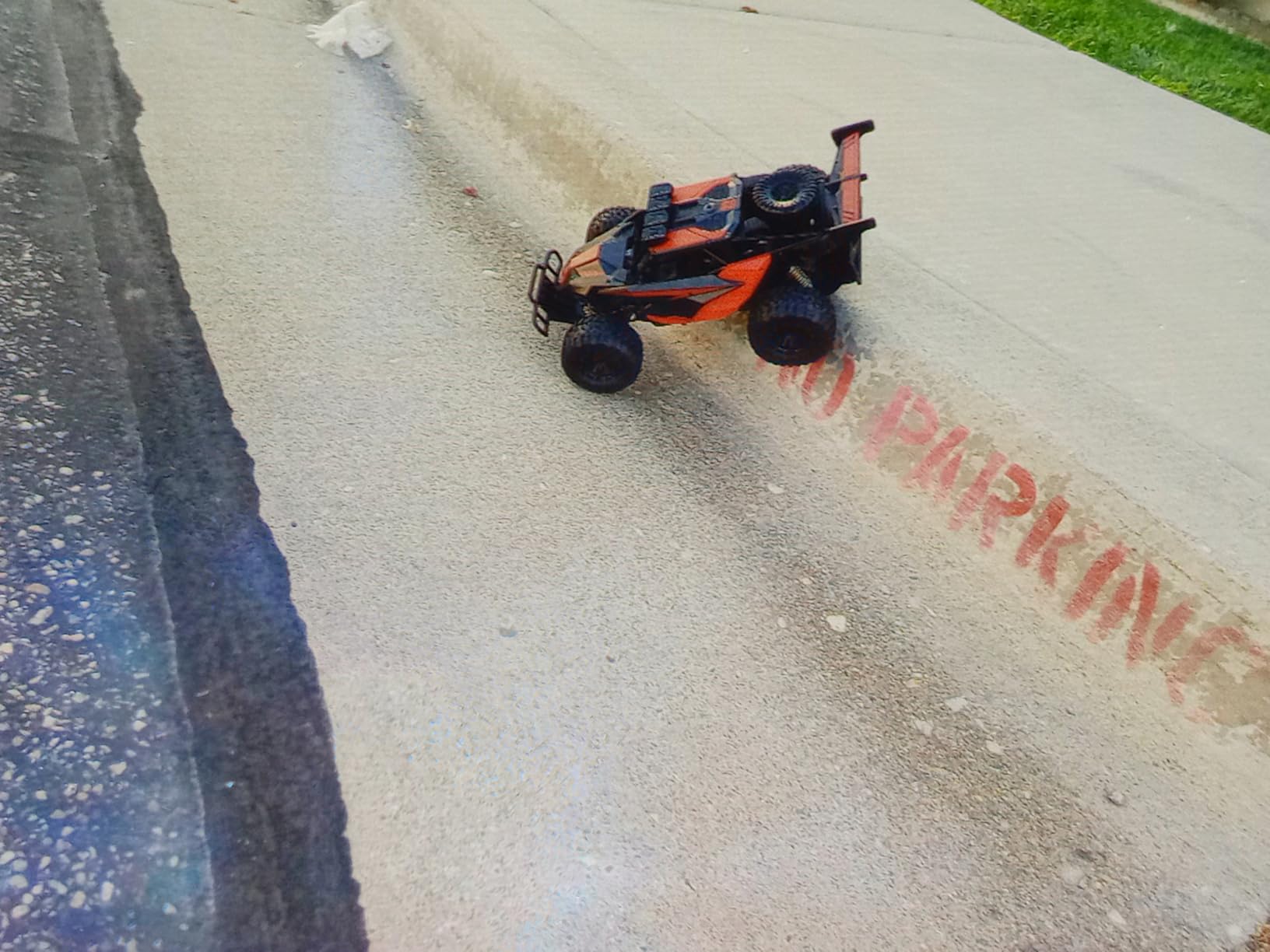
Two speed-related details you should not discover the hard way. The lightweight body flips easily on uneven ground, and the tires can slip off the bead during hard off-road use. Both are survivable, both are annoying the first time they happen.
There are also reports of cars continuing to move when the trigger is released, and of reverse failing after extended use. Those are electronics faults rather than handling traits, so if reverse matters to you, test it on the first drive.
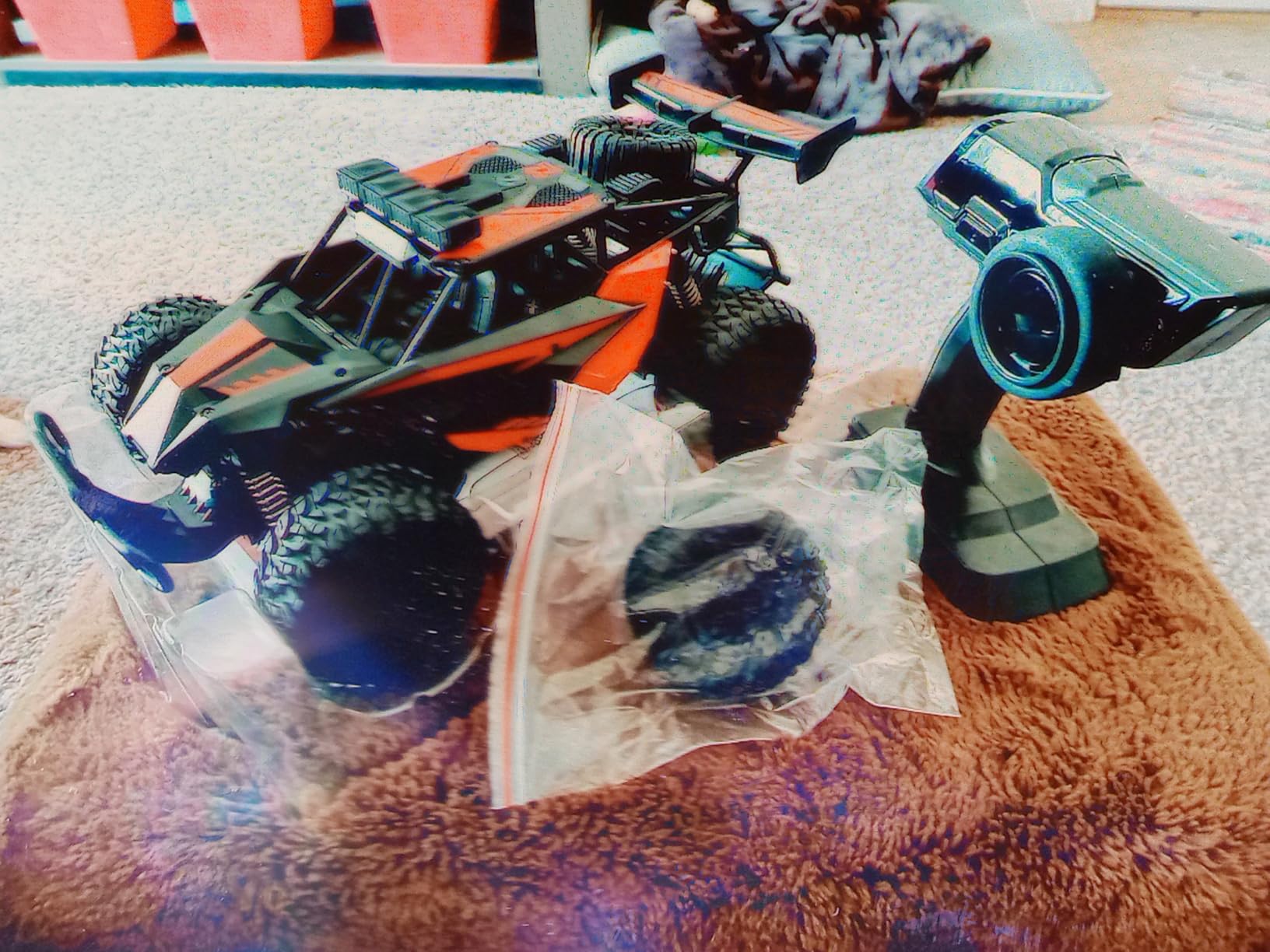
What It Does Well and Where It Falls Short
Run time and toughness are the pair of strengths. Seventy minutes means you can charge one pack while you drive the other, which removes the single most common complaint people have about small RC cars. The aluminum body and included spares add real insurance.
The compromise is terrain. Low ground clearance and a limited turning radius make it a level-surface car first and an off-road monster truck second. Light dirt, packed gravel and pavement are where it shines.
Should You Buy This One?
Buy it if your driving area is flat and you want long sessions with minimal interruptions. The 1:12 size is large enough to feel substantial and small enough for a suburban driveway or a community car park.
Pick the HAIBOXING 18859 instead if you plan to keep driving for months and want to upgrade parts over time. This one is a great summer toy with excellent run time, but its parts pathway is narrower.
8. WPL D12 Kei Truck – Best 1/10 Scale RC Car for Teens and Adults
Apawband WPL D12 RC Car 1/10 Remote Control Kei Truck RC Drift Car RTR
1/10 scale rear-wheel drive
Brushed 260 motor at 20 KPH
Front double-wishbone suspension
Adjustable camber and ride height
Pros
- True 1/10 scale at 13 inches long
- Adjustable camber and ride height angles
- Large-angle steering for tight maneuvering
- Proportional throttle and steering
- Detailed interior and exterior trim
Cons
- Only one battery in the box
- All-plastic body scratches badly on asphalt
- Motor failures reported after a few months
- Battery compartment is hidden under the spare tire
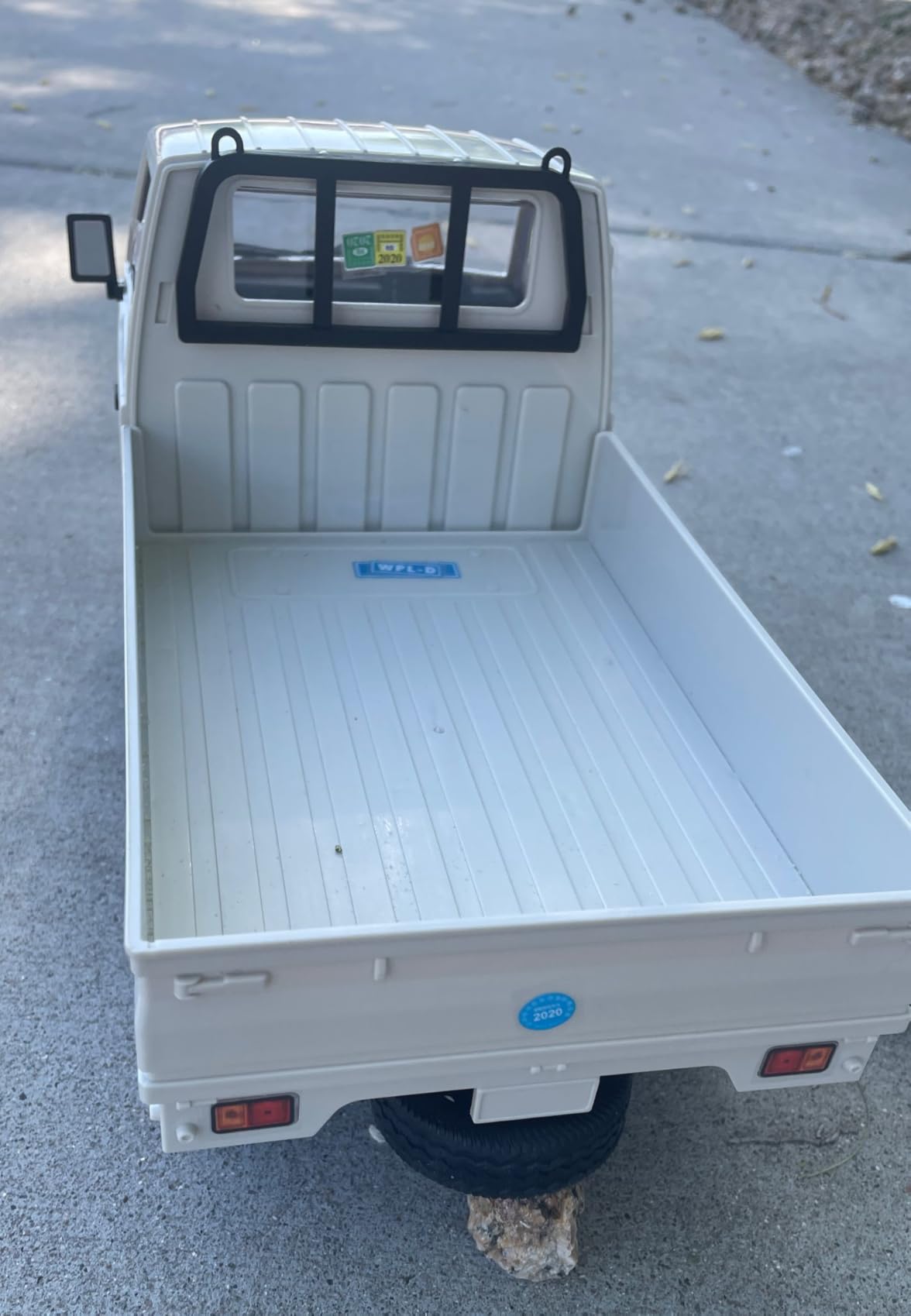
The WPL D12 is the odd one out, and that is why it earns a place. It is a genuine 1/10 scale kei truck at 13 inches long, styled after the compact Japanese delivery vans, and it runs rear-wheel drive with front double-wishbone independent suspension. Most cars in this roundup are generic monster trucks.
For a teen or adult, the detail matters: a decorated interior, adjustable front and rear inclination and camber, LED lights for evening runs, and large-angle steering that makes it easy to place in a small parking area. Proportional throttle and steering give real control feel at 20 KPH.
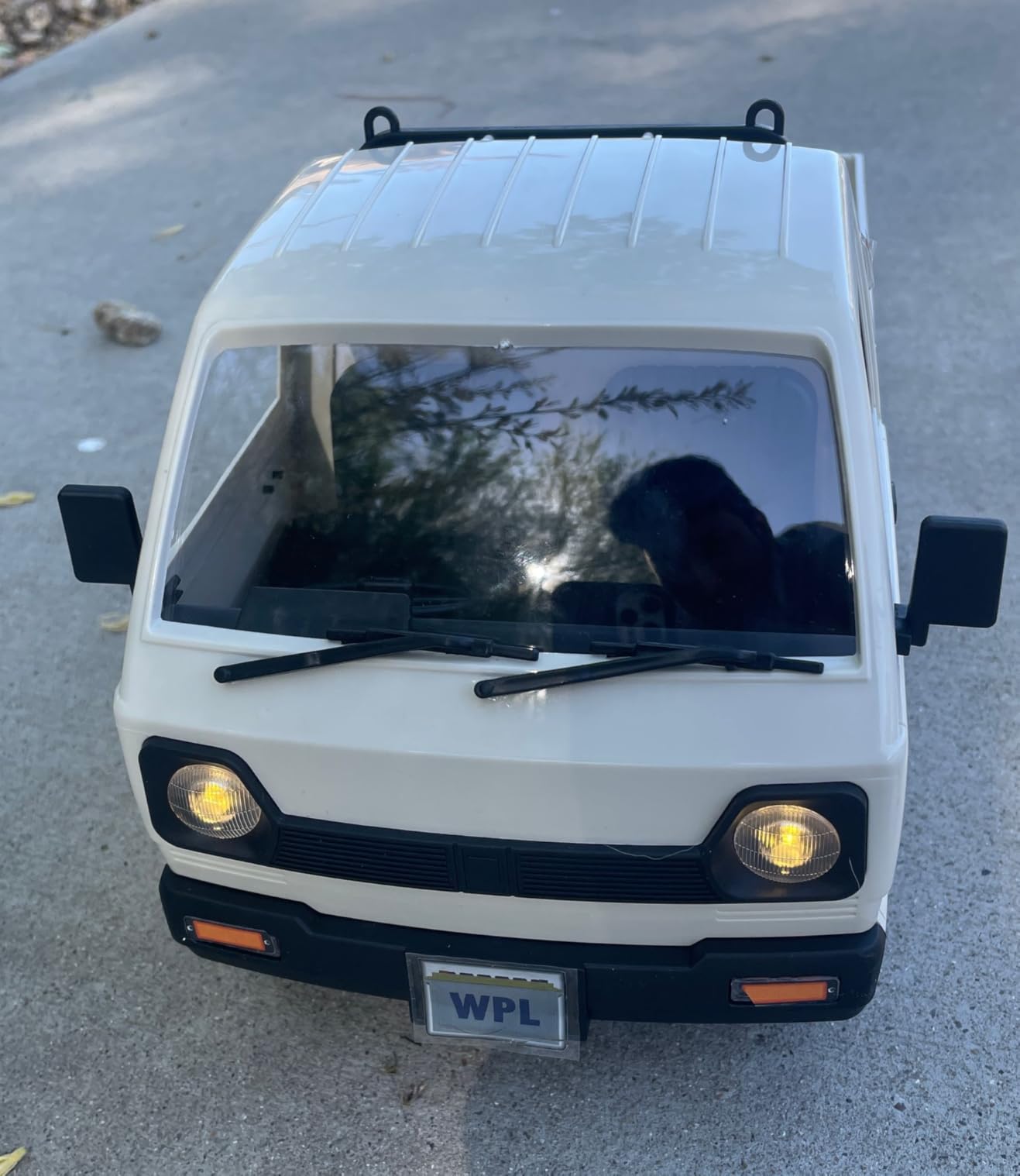
It also climbs, with 45 degree climbing ability on its soft tires, which makes it a usable first crawler on a driveway ramp or a set of garden steps. The 2.4GHz radio reaches 40 meters with anti-jamming, and it can be customized with stickers and accessories.
The catch is the box contents. Only one battery is included, so you will be charging while you want to drive. The battery also hides under the spare tire compartment, which took most buyers a few drives to find.
What It Does Well and Where It Falls Short
Adjustability is the standout feature. Camber and ride height adjustment on a first car is a genuine learning tool, and the double-wishbone front end with four suspension springs handles uneven surfaces far better than a solid axle.
Durability is the concern. The body is all plastic and scratches visibly on asphalt, and owners report motor failures at two weeks and again at six months. It is a model you drive carefully on clean surfaces rather than a truck you bash.
Should You Buy This One?
Buy it for a teenager or adult who wants scale realism, style and tuning rather than raw speed. It suits indoor surfaces, smooth driveways and light climbing work, and it makes a good display piece between runs.
Do not buy it as a first car for a young child or for heavy outdoor use. If you want that, the DEERC 9300E or the HAIBOXING 18859 will absorb far more abuse. Our hobby-grade guide for adults covers that end of the market in more depth.
How to Maintain Your First RC Car and What Breaks First
No page-one competitor answers this question, and it is the one that decides whether you still own a working car a year from now. The good news is that beginner maintenance is mostly five habits, and none of them require tools beyond a screwdriver.
Clean it after every run. Grass clippings and grit under the chassis will bind suspension arms and drive shafts, and dry debris around the motor is the leading cause of overheating. Air it out or brush it off before the car is put away.
Check screw tension by hand, not by feel of torque. Over-tightening wheel hexes and suspension screws strips plastic and is the most common self-inflicted failure. Tighten until snug, then a quarter turn more.
Look at the front shock towers and suspension arms. On nearly every platform here, the front end takes the hit in a crash. Cracked towers and bent arms are cheap to replace on a hobby-grade car and impossible to source on a toy.
Wiggle every wheel for play. Feel for side-to-side slop at the hub and play in the steering link. A wheel that feels loose usually means a worn wheel hex or a dry bearing, and both get worse fast.
Look after the batteries. Store lithium packs at storage charge in a fire-safe bag, do not leave them fully charged for months, and clean the connectors with a dry cloth before every plug-in. Corroded terminals are the quiet cause of many dead cars.
On LiPo specifically, charge inside a LiPo-safe bag on a non-flammable surface, never leave charging unattended, and use a charger that matches the cell count on the pack. This matters most on the HAIBOXING 18859, which uses two 7.4V packs and a simple USB charger.
Beyond those five habits, the honest truth from the forums is that the factory brushed 380 motor and the plastic steering servo are the two components most likely to fail first on the budget trucks in this roundup. Replace them once and the car usually keeps running for years.
How to Choose Your First RC Car
Match the Body Style to the Surface You Have
This is the decision people most often get wrong, and it is the one the search engines keep asking about. On pavement and a flat driveway, any of the trucks here works. On short grass and gravel, pick a truck with high clearance and independent suspension, which means the DEERC 9300E or the HAIBOXING 18859. On rocks, steps and tight indoor courses, you want slow speed, locked traction and a low centre of gravity, which is exactly what the ACAMMZAR drift car and the WPL D12 deliver. On carpet, keep it small and light. On sand or snow, none of these cars is the right answer without paddle tires, so skip that for a first purchase.
Hobby Grade vs Toy Grade: Does It Count as a Toy?
Strictly speaking, most of these are sold as toys, which is why toy-grade builds face stricter testing and why they are sealed and deliberately underpowered. The practical difference for you is repairability. Toy grade means plastic gears, glued assemblies, no published parts list and no way to fix a broken part. Hobby grade means metal gearing, a real differential, screws throughout, and a manufacturer or retailer that sells individual replacement parts. If your answer to “where do I get a new motor for this” is unclear, buy the hobby-grade car.
Brushed vs Brushless for a First Car
The RC community is sharply divided on this, and both camps are partly right. A brushed motor is gentler: it is cheaper, more durable when you crash it, and easier to replace with an identical part. Brushless gives better efficiency, less maintenance and a real upgrade path, but a beginner who crashes a brushless setup hard can damage the electronics. Our advice for a first car is brushed with a throttle limiter, then brushless once you know what you are doing. Note that the HAIBOXING 18859 converts to brushless when you are ready.
Battery Chemistry and Cell Count
1S, 2S and 3S describe how many cells are in series, and more cells means more voltage, more speed and more heat. For a first car, 2S is the sweet spot and it is what most picks here run. Lithium polymer packs give more power per gram than NiMH and are the current standard, but they need a LiPo-safe charging bag and correct storage. NiMH packs are simpler and more forgiving, which is why they remain popular for a very first car owned by a child.
Speed: How Fast Is Too Fast?
Manufacturer speed figures are best-case. For a driver under about ten, keep a car with a low-speed mode or a speed switch on the transmitter, which is a feature on both the DEERC 9300E and the HAIBOXING 18859. Teens and adults can handle a car in the 33 to 40 KPH range once they can hold a line, and neither should start there. There is no prize for a first car that outruns you in the first ten minutes.
Nitro vs Electric
Electric wins for beginners, and the margin is not close. A nitro engine needs fuel, a starter plug, a charger for the receiver pack and a clean working area, and the compression engine needs running before it will start. Electric RTR means box, charge, drive. Nitro only makes sense if you specifically want to learn engine maintenance, and that is a second hobby, not a first one.
What Breaks First and Where to Get Cheap Parts
Factory brushed motors, plastic steering servos, front shock towers, drive shafts and wheel hexes account for most first failures. Cheap parts come from three places: the brand’s own online parts store, which is the most reliable route for a hobby-grade brand; a local hobby shop, which is the only way to get a part today; and the used marketplace, which is where a working 2WD Traxxas makes more sense for a first car than a brand-new budget truck does. Buying a mainstream hobby-grade brand is the cheapest long-term parts strategy, because the parts exist and they keep existing.
Scale and Space Requirements
Scale is physical size. A 1/10 car at 13 inches needs roughly a four-meter stretch of path and a large table to turn around. A 1/24 car at seven inches turns on a coffee table. Several people in the forums cite buying an all-road truck with nowhere to drive it as their biggest first-car mistake, so measure your space before the purchase, not after.
What to Avoid as a First Car
Avoid sealed toy-grade cars with no parts list, because a broken part ends the hobby. Avoid cars that ship without a battery and a charger unless you have budgeted for both. Avoid a high-cell-count brushless monster truck with no throttle limiter, because you will break it inside a week. Avoid drift cars as a first car if you only have grass and gravel, because they do nothing well there. And avoid anything whose advertised top speed comes with no speed control.
Which Car by Driver Age
Under six, the Force1 Tornado or the Jada Lightning McQueen, both of which are forgiving and instant. Six to twelve, the QUNREDA Q1 or the Force1 Tornado, depending on whether you want flips or a simpler control surface. Teens, the WPL D12 or the HAIBOXING 18859. Adults entering the hobby, the HAIBOXING 18859, with the DEERC 9300E as the bashing alternative.
What to Buy Second and Safety
The upgrade path in this order: oil-filled shocks, then a better battery and a proper balance charger, then a brushless conversion if the platform supports it. When a child drives, supervise the first sessions, keep lithium charging on a fire-safe surface away from anything flammable, and never let a child charge a pack alone. If the car is for a young driver, our beginner RC helicopter guide covers the same indoor and supervision questions for a different platform.
Frequently Asked Questions
How do I maintain my RC car?
Clean grass and grit from under the chassis after every run, check screw tension by hand without over-tightening, inspect the front shock towers and suspension arms for cracks, wiggle each wheel to catch hub or bearing play, and keep battery connectors clean and dry. Store lithium packs at storage charge in a LiPo-safe bag.
What is the best RC car for beginners?
The HAIBOXING 18859 is our overall first car because it is hobby-grade with ball bearings, a solid gear differential, splash-proof electronics and two batteries in the box. The DEERC 9300E is better for off-road bashing, and the Force1 Tornado is the easiest first car for a child aged 6 to 12.
What does hobby grade RC mean?
Hobby grade means metal gears, a real differential, ball bearings, screwed rather than glued assembly, and a published parts catalogue so you can replace what breaks. Toy grade means plastic components, sealed construction and no spares. The label matters less than whether replacement parts exist for the car.
What are the most popular RC car brands?
Traxxas, Arrma, Losi, Axial, Redcat, Tamiya, Team Associated, Team Corally and FTX are the names beginners mention most, and all of them run genuine parts channels. HAIBOXING, DEERC, BLUEJAY, Force1, QUNREDA, Jada, ACAMMZAR and WPL are the brands represented in this roundup.
Should a beginner buy brushed or brushless?
Start with a brushed motor if you are learning, because it is more forgiving in crashes and cheaper to replace with an identical part. Choose brushless if you want an upgrade path and will be careful. Either way, start on a car with a low-speed mode or throttle limiter rather than the fastest option.
Where can I get cheap RC car parts?
The brand’s own online parts store is the most reliable and usually the cheapest long-term route for a hobby-grade car. A local hobby shop is the only source for a same-day fix. Used marketplaces are worth watching for a complete running car, since a used hobby-grade platform often beats a brand-new sealed toy.
Is an RC car considered a toy?
Most are sold as toys and toy-grade models face stricter testing, which is part of why they are sealed and underpowered. Practically, the label tells you how repairable the car is. If you cannot find a replacement part for a broken component, treat it as a toy and expect to replace the whole car.
What is the 3000 rule for buying cars?
That is a rule about spending on a full-size vehicle, capping a car purchase at a share of your income. It does not apply to RC hobby purchases. The useful version for this hobby is a total-cost rule: factor in batteries, a charger and likely spares before buying the car.
Final Verdict: The Best RC Cars for Beginners
For most people, the best RC cars for beginners come down to one honest question: can you get parts for it? The HAIBOXING 18859 wins this roundup because it answers yes. It has ball bearings, a metal gear differential, splash-proof electronics, a low-speed mode for learning and two batteries in the box, so you can drive it on the day it arrives and repair it when you crash it.
Choose the DEERC 9300E if you want to bash on grass and gravel and do not plan to modify anything. Choose the Force1 Tornado for a child aged 6 to 12 who will flip the car and want it to keep going.
Whichever you pick, check the five maintenance habits above before you put it away for the winter. That is what turns a first car into a car you are still driving in 2026. If you want to expand into other platforms afterwards, our beginner RC plane guide covers the next step.