
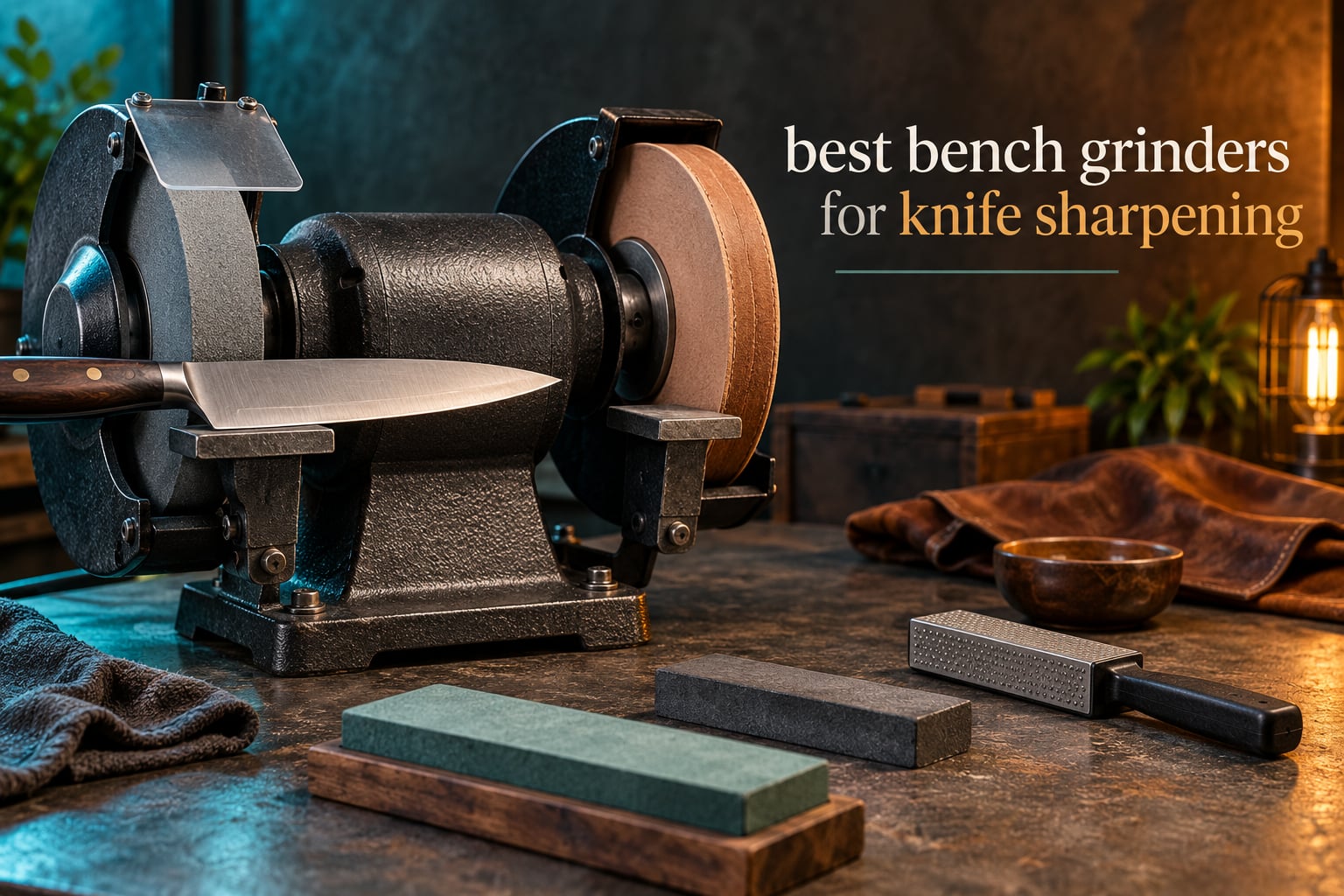
The fastest way to put a cutting edge back on a dull knife is also the fastest way to ruin it. A bench grinder strips steel in seconds, and those same seconds generate enough friction heat to walk a hardened stainless blade straight past the point where the temper survives. That is the tension running through every recommendation on this page.
We compared ten bench-mounted grinders side by side for the best bench grinders for knife sharpening, from slow-speed 1750 RPM shop grinders to wet stone systems and belt-and-wheel combos. Each entry below lists the wheel size, no-load speed, motor output, the wheels that come in the box, and an honest note on where that machine falls short.
Our advice does not start with a machine, it starts with the steel in front of you. A production grinder running dry wheels at 3600 RPM and a bench grinder running 1750 RPM are two entirely different tools that happen to share a name, and picking the wrong one is how good knives end up with blue edges and soft steel. If you want the wider picture first, our bench grinder guide for sharpening tools covers chisels, lathe tools and drill bits alongside knives.
Last updated for 2026. Every spec quoted below comes from the manufacturer’s listing, and every rating is the current verified average from buyer reviews.
Table of Contents
Can a Bench Grinder Sharpen Knives Without Ruining Them?
Yes, a bench grinder can sharpen a knife without ruining it, but only if you match wheel speed to the steel. Dry wheels above 3000 RPM on hardened stainless generate heat fast enough to ruin a factory edge in a few careless seconds, while a low-speed machine at 1750 RPM or a water-cooled stone removes the same steel with the heat still under control.
Here is what actually happens when a knife goes wrong on a wheel. Hardened stainless such as A2 or 154CM is heat-treated to a specific hardness, and that treatment is called the temper. Friction heat travelling into the blade changes the steel’s structure, and the result shows up as a blue or straw-coloured band along the edge. That band is not cosmetic. It is steel that has been over-tempered and is now softer than it was, so the edge dulls faster and chips more readily than before you touched it.
The practical rules that keep this from happening are unglamorous. Let the wheel pull the blade rather than pushing it down into the abrasive, keep passes short and lift often, use the coarser wheel only to set a bevel and move to finer grit to finish, and never clamp a knife in a vice while grinding. Forums like r/sharpening repeat one line more than any other, which is that a lower speed grinder around 1750 RPM is the single best answer to heat risk.
Speed is the first lever and grit is the second. A 36-grit wheel at high speed will take steel off in a way that leaves a deep wire edge you then spend an hour removing. A 120-grit wheel at slow speed with light pressure removes a fraction as much material and finishes an edge much closer to finished. If your sharpening is going to be regular, buy a machine that is built for it rather than adapting a metalworking grinder, and if you want the heat question settled entirely, look at the wet option later in this roundup.
One more habit matters more than the machine. A diamond dresser is not a luxury accessory. A wheel that has been used becomes glazed and loaded, and a glazed wheel needs more pressure to cut, which means more heat. Ten seconds of dressing restores the cut and drops the temperature of every pass that follows.
Top 3 Picks: The Best Bench Grinders for Knife Sharpening

DEWALT DW758 8-Inch Bench Grinder
- 0.75 hp induction motor
- 3600 rpm
- 8 inch wheels
- 36 and 60 grit included
RIKON 80-805 8-Inch Slow-Speed Grinder
- 1750 rpm
- 0.5 hp
- 60 and 120 grit aluminum oxide
- five year warranty

BUCKTOOL 8-Inch 3/4 HP Low-Speed Grinder
- 1750 rpm
- wide 1-1/2 inch face for CBN wheels
- 80 and 120 grit
- LED
The DEWALT DW758 takes the top slot because of what it delivers under load: a 0.75 hp induction motor, a cast iron base that will not walk across the bench, and the widest body of owner feedback in this group. The RIKON 80-805 takes the premium slot because it is the machine that most sharpeners actually name when they talk about knife work, and at 1750 RPM it is the most forgiving wheel speed in this roundup.
The BUCKTOOL 8-inch fills a gap no other machine here covers. One wheel on it is 1-1/2 inches wide, which is wide enough to run a 1-1/2 inch CBN wheel, and that combination is the highest-end sharpening workflow we found being used in practice on forums. If you intend to move past bonded abrasive eventually, this is the machine that is already set up for it.
All 10 Bench Grinders Compared in 2026
Everything below is a genuine bench-mounted grinding machine, with one deliberate exception we have labelled clearly. The WEN BG4108 is a water-cooled wet sharpening system rather than an abrasive wheel grinder, and it earns its place because the question of whether a wheel can burn an edge is answered differently when water is involved.
| Product | Specifications | Action |
|---|---|---|
| DEWALT DW758 8-Inch Bench Grinder |
|
Check Latest Price |
 WEN BG4276 6-Inch Single Speed Bench Grinder WEN BG4276 6-Inch Single Speed Bench Grinder |
|
Check Latest Price |
| RIKON 80-805 8-Inch Slow-Speed Bench Grinder |
|
Check Latest Price |
 VEVOR 8-Inch Grinder and 2 x 28-Inch Belt Sander Combo VEVOR 8-Inch Grinder and 2 x 28-Inch Belt Sander Combo |
|
Check Latest Price |
| BUCKTOOL 8-Inch 3/4 HP Low-Speed Bench Grinder |
|
Check Latest Price |
 WEN BG4282 4.8-Amp 8-Inch Bench Grinder WEN BG4282 4.8-Amp 8-Inch Bench Grinder |
|
Check Latest Price |
 WEN BG4108 Water-Cooled Wet/Dry Sharpening System WEN BG4108 Water-Cooled Wet/Dry Sharpening System |
|
Check Latest Price |
 Genesis GBG800L 8-Inch Bench Grinder Genesis GBG800L 8-Inch Bench Grinder |
|
Check Latest Price |
 BUCKTOOL 6-Inch 1/3 HP Low-Speed Bench Grinder BUCKTOOL 6-Inch 1/3 HP Low-Speed Bench Grinder |
|
Check Latest Price |
 Woodskil 6-Inch 1/2 HP High-Speed Bench Grinder Woodskil 6-Inch 1/2 HP High-Speed Bench Grinder |
|
Check Latest Price |
Two columns in that comparison matter more than the rest for knife work. Wheel diameter sets how much contact area you have, and no-load speed sets how much heat that contact area produces. Motor horsepower is third, and it only starts to matter when you are taking off serious metal rather than refining an edge.
1. DEWALT DW758 8-Inch Bench Grinder – Power and Cast Iron Stability
DEWALT DW758 8-Inch Bench Grinder
0.75 hp induction motor
3600 rpm
8 inch wheels, 12-1/2 inch spacing
36 and 60 grit
Pros
- 0.75 hp induction motor holds speed under load
- cast iron base and housing
- precision-machined aluminum tool rests
- 12-1/2 inch between-wheel spacing fits longer blades
- rear exhaust ports in the guards
Cons
- Factory wheels frequently arrive out of balance
- assembly documentation is unclear
- tool rests are narrow with sharp machining burrs
The DW758 is the one we keep coming back to, and the reason is not the motor alone. A 0.75 hp induction motor delivers steady power without the speed sag you get from a universal motor, which matters because a wheel that slows under pressure is a wheel that heats up. Induction motors also run quieter, and quiet is worth more than most people expect when a machine sits a few feet from your ear.
The build is the quiet hero here. A cast iron base and cast iron motor housing give the machine roughly the mass it needs to stay put, and with 12-1/2 inches between the wheels there is room to lay a full chef’s knife or a long chisel flat across the tool rest without fighting for space. The tool rests themselves are precision-machined aluminum, which is the part most cheap grinders get wrong.
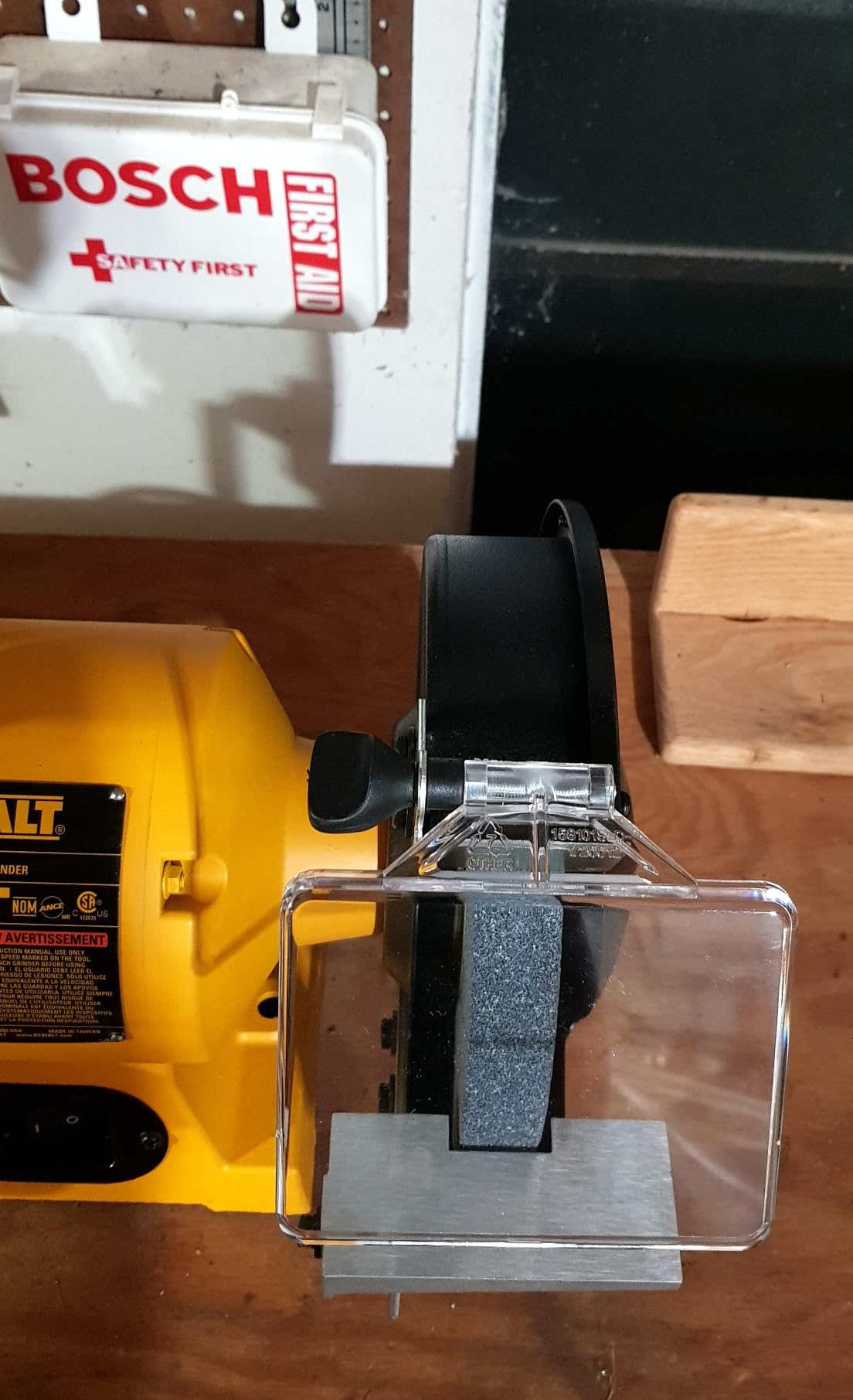
The honest weakness is the wheel balance on arrival. Buyers report out-of-balance factory wheels often enough that it is worth assuming yours will need checking before first use, and returning it for a better unit is a common outcome rather than an exception. The assembly documentation is genuinely poor, with poorly labelled parts and small print, so budget an extra evening for setup.
The 3600 RPM speed is a real consideration for knife work. This is a metalworking grinder that will happily sharpen a knife, and at 3600 RPM on a dry wheel with a hardened blade you need short passes and a light hand. For most knife jobs we would fit a 120-grit wheel on the wide side and treat the 36-grit as a bevel-setting wheel only.
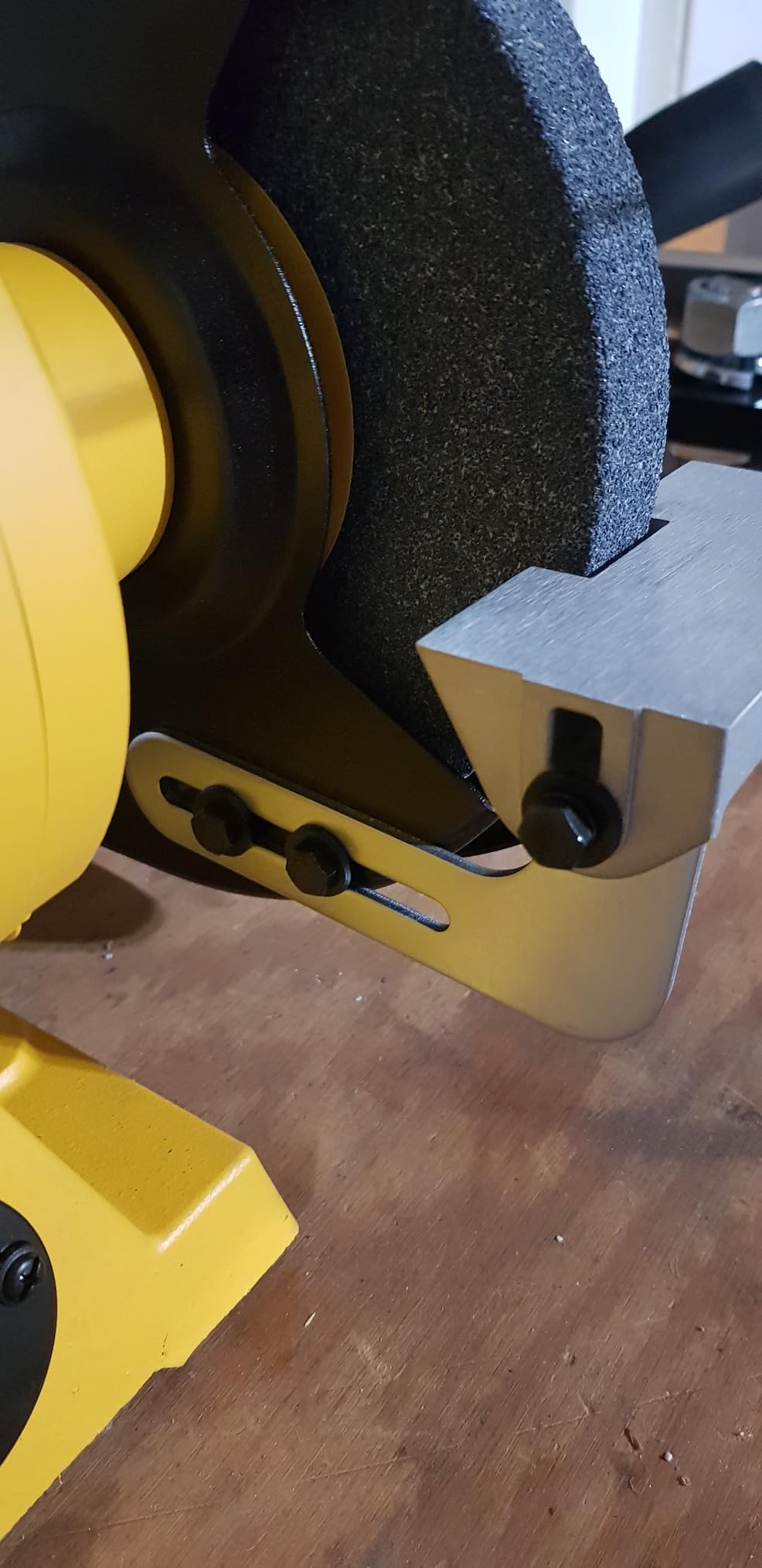
What the wider tool rest spacing changes for knife work
Wheel spacing sounds like a spec-sheet curiosity until you try to sharpen a 10-inch knife on a machine where the wheels are crowded together. The DW758 gives you 12-1/2 inches of clearance, which means the whole length of the blade can be supported on the rest at once. That support is what keeps the angle consistent from heel to tip.
The rear exhaust ports cut into the wheel guards are a smaller feature that pays off in a closed shop. Sparks and fine grinding dust get pulled away from the work area rather than settling on your bench and into your bearings.
Where the DW758 falls short for sharpening specifically
It is a high-speed machine, and if your sharpening is the primary task rather than an occasional one, the heat budget is tighter than you would like. There is no water option and no variable speed control, so heat management is entirely in your technique.
The included wheels are the weak link in the package. Many owners replace them early with better-balanced 60 and 120 grit aluminum oxide wheels, and that single change fixes most of the reported vibration problems.
2. WEN BG4276 6-Inch Bench Grinder – the Small-Bench Favourite
WEN BG4276 2.1-Amp 6-Inch Single Speed Bench Grinder with Flexible Work Light, Black,orange
2.1 amp motor
3450 rpm no-load speed
6 by 3/4 inch wheels
36 and 60 grit wheels included
Pros
- Very affordable entry point for knife and tool sharpening
- smooth bearings with minimal vibration on most examples
- flexible work light bends to reach the work
- rubber feet let it sit unbolted
- tool rests adjust close to the wheel
Cons
- Factory grinding wheel quality is inconsistent and can be out of balance
- no light bulb included with the work lamp
- mounting holes sit mid-plate so bench bolting is awkward
This is the machine most people end up owning first, and after spending time with it we understand why. For a kitchen knife collection, a set of chisels and a set of drill bits, it handles all of that without any planning around the budget. The 2.1-amp motor turns 6 by 3/4 inch wheels and has more than enough power for a dull chef’s knife or a mower blade.
Noise is the pleasant surprise. The bearings are smooth and the vibration on most examples is minimal, which makes this far easier to live with in a shared space than the reputation for cheap grinders suggests. Reviewers consistently single out the low noise and the ease of assembly as the reasons they recommend it to friends.
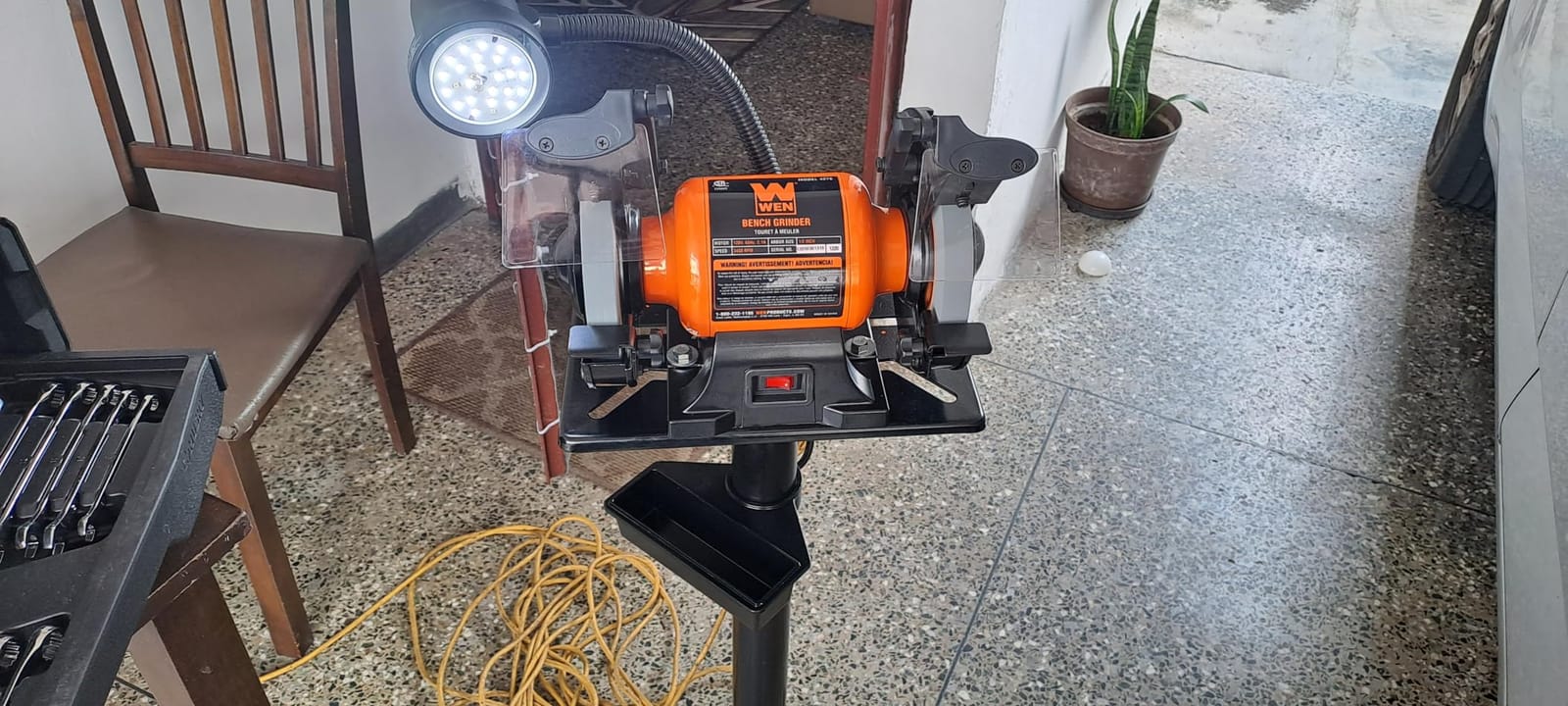
Two practical details catch new owners out. The work light is a genuine asset for seeing the point of contact on a narrow edge, but no bulb is included, so add one to the box before you start. The mounting holes are located in the middle of the base plate rather than at the corners, which makes bolting the machine to a bench genuinely awkward. The rubber feet are fine if the machine is not being leaned on.
There is no brake, and it takes roughly 25 to 30 seconds to reach full speed. That is a long time to stand there waiting when you only want a few passes on a knife edge, and it is the most annoying part of the ownership experience.
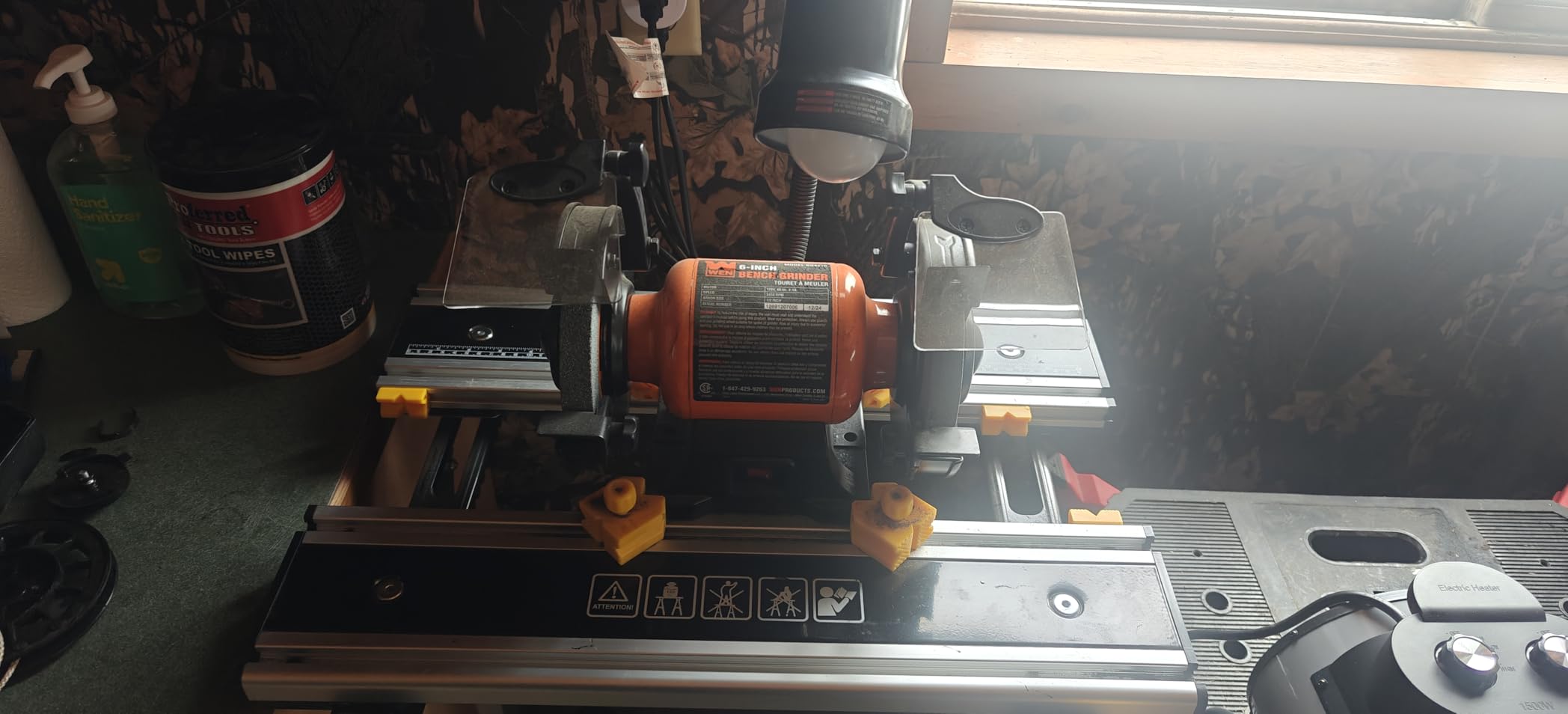
What the flexible work light actually does for sharpening
The point of contact between a blade edge and a wheel is a line about a quarter inch long, and you cannot see it well in a dim shop. The bendable lamp on this machine is aimed at that line directly, which makes it far easier to keep the blade flat and to notice the moment a wire edge starts to form and fold over.
That visibility is what lets a beginner get good results from a high-speed machine. You keep the passes light because you can see the sparks, and you stop when the sparks change, rather than grinding to a guessed count of seconds.
Where the 6-inch format becomes a limitation
Six-inch wheels mean less contact area than an 8-inch wheel, so a given pressure translates into more force per square inch on the edge. That is where heat comes from, and it is why several experienced sharpeners treat 6-inch machines as the wrong tool for fine edge work.
The factory wheels are also the most common complaint, with owners reporting inconsistent quality and out-of-balance units. Budget for a replacement pair before you judge the machine, because a large share of the negative feedback traces back to the wheel that came in the box rather than to the grinder itself.
3. RIKON 80-805 8-Inch Slow-Speed Grinder – the Sharpening Specialist
RIKON 80-805 Professional 8-Inch Low Speed Bench Grinder, 1/2 HP, 1750 RPM
0.5 hp motor
1750 rpm
8 inch 60 and 120 grit aluminum oxide wheels
Five year warranty
Pros
- Low 1750 RPM speed is forgiving for controlled knife sharpening
- cast iron base with anti-vibration rubber feet
- adjustable eye shield and spark deflectors
- built-in groove for sharpening drill bits
- diamond wheel sharpener included to reduce heat build-up
Cons
- Low wheel speed means slower metal removal than high-speed models
- no wet stone or honing system included so finishing is done separately
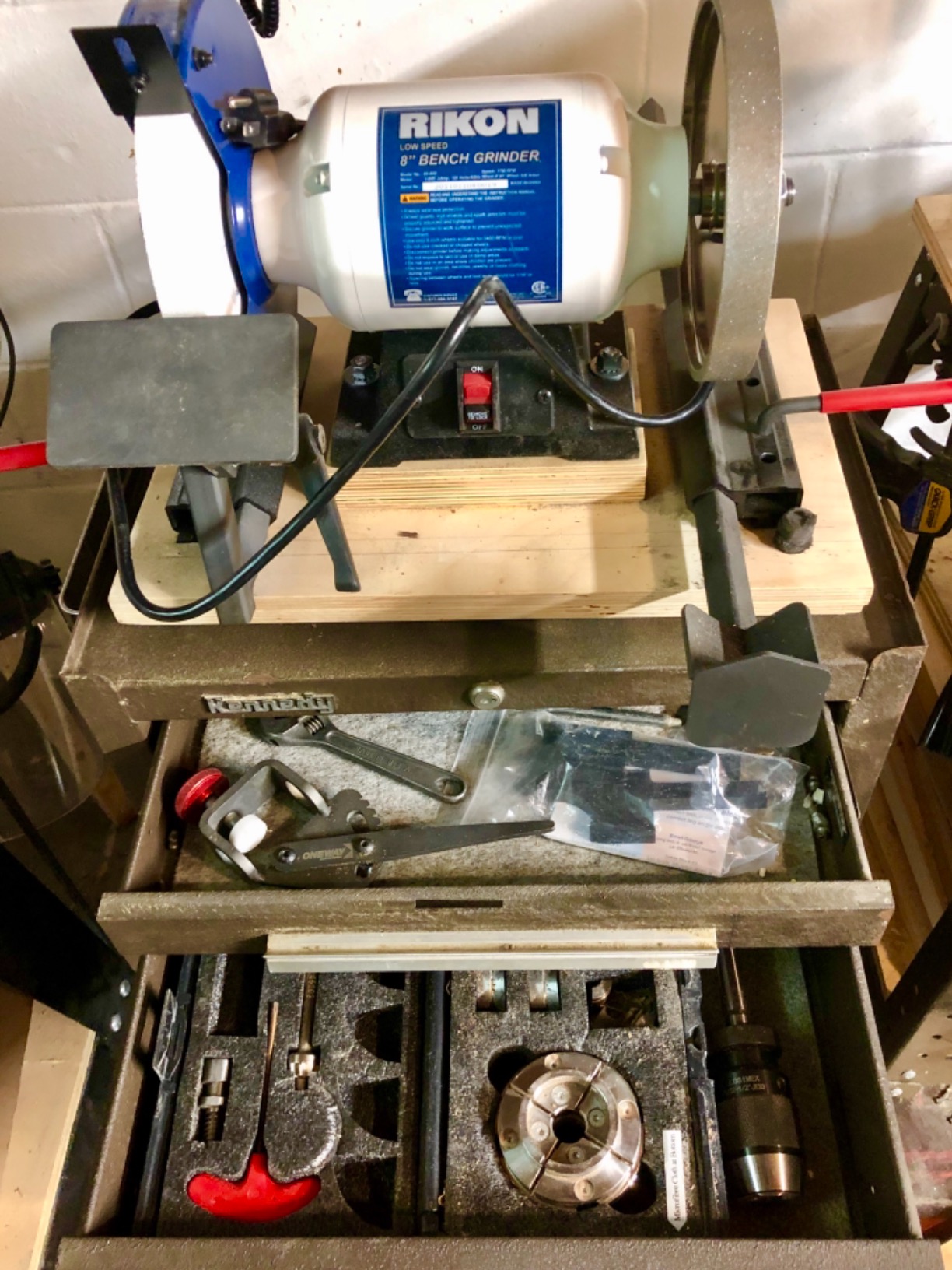
The RIKON 80-805 is the answer to the heat question, and it is the machine that keeps coming up when sharpeners describe their setup. At 1750 RPM the wheel is running at roughly half the speed of a typical metalworking grinder, which means less heat per pass and a wheel that pulls the blade rather than fighting it. Users on r/sharpening describe it as forgiving, and that word comes up more than any other in the owner reviews.
What separates it from a general-purpose grinder is the wheel package. It arrives with 1 inch by 8 inch 60 grit and 120 grit white aluminum oxide wheels rather than the 36 and 60 grit pairing you get on most machines. Both of those are sharpening grits, so the machine is ready to refine an edge on day one instead of coming with a coarse wheel you have to replace.
The cast iron base with anti-vibration rubber feet is a detail that matters more than it sounds. A grinder that walks across the bench mid-pass changes the pressure on the edge without warning, and the rubber feet plus the mass of the base are what keep the contact point where you put it. The five year warranty is the longest in this roundup by a wide margin.
Two limits are worth stating plainly. Material removal is slow by design, so this is not the machine to hog out a damaged bevel on in two minutes. And there is no wet stone or honing system included, which means the final deburring step still needs a leather wheel, a stone or a strop somewhere else in your setup.
Why 1750 RPM is the number that matters most
Roughly half speed means roughly a quarter of the heat generation for the same pass, and it changes the feel of the work entirely. At 1750 RPM the wheel has time to cut rather than burn, so a light pass removes metal cleanly and leaves a manageable wire edge instead of a deep rolled one.
It also changes how forgiving the machine is of a beginner. A high-speed wheel punishes a heavy hand immediately with a blue edge, while a slow wheel gives you time to feel what the abrasive is doing before too much steel has moved.
Where the slow-speed trade-off shows up
Anything beyond edge work, you will feel the difference. Thinning a badly chipped tip, resetting a badly mistrained bevel, or shaping a tool profile all take proportionally longer here than on a 3600 RPM machine, and the 0.5 hp motor will not hurry along.
Because it is a sharpening-first tool, the second wheel is an open slot. Most owners end up fitting a leather stropping wheel or a buffing wheel on that side, which turns the 80-805 into a two-stage system rather than a two-grit grinder.
4. VEVOR 8-Inch Grinder and 2 x 28-Inch Belt Sander Combo – Two Machines in One
VEVOR 8″ Bench Grinder & 2″ x 28″ Belt Sander Combo, 350W Professional Grinding Sanding Machine with LED Work Light & Protective Eye Shield for Metalworking, Woodworking, Knife Sharpening
350W motor
Grinding wheel at 3450 rpm, belt at 1500 rpm
Belt arm adjusts 0 to 90 degrees
Pros
- Combines a bench grinder and a 2 x 28 inch belt sander in one machine
- belt arm adjusts from 0 to 90 degrees for varied sanding angles
- steel base and rubber feet keep vibration low
- LED work light and clear eye shield aid visibility
Cons
- Lowest average rating in this group with a notable share of 1-star reviews
- combined 350W output is modest against dedicated 1/2 to 3/4 hp grinders
- eye shield viewing window is hard to replace once scratched
This machine is interesting because the belt is the part that matters most for knives, and the wheel is the part that is included for general metalworking. A 2 x 28 inch belt is a short, narrow belt, which is closer to the wheel geometry than a proper 1 x 30 or 2 x 42 knifemaker belt grinder, but it still gives you a sanding contact patch that a wheel cannot match when you are trying to avoid a flat grind.
The belt arm adjusts from 0 to 90 degrees, so you can work the blade at different angles without rearranging the machine. The included grinding wheel runs at 3450 RPM and the belt at 1500 RPM, and owners commonly use the slow belt for finishing passes and the faster wheel for coarse work.
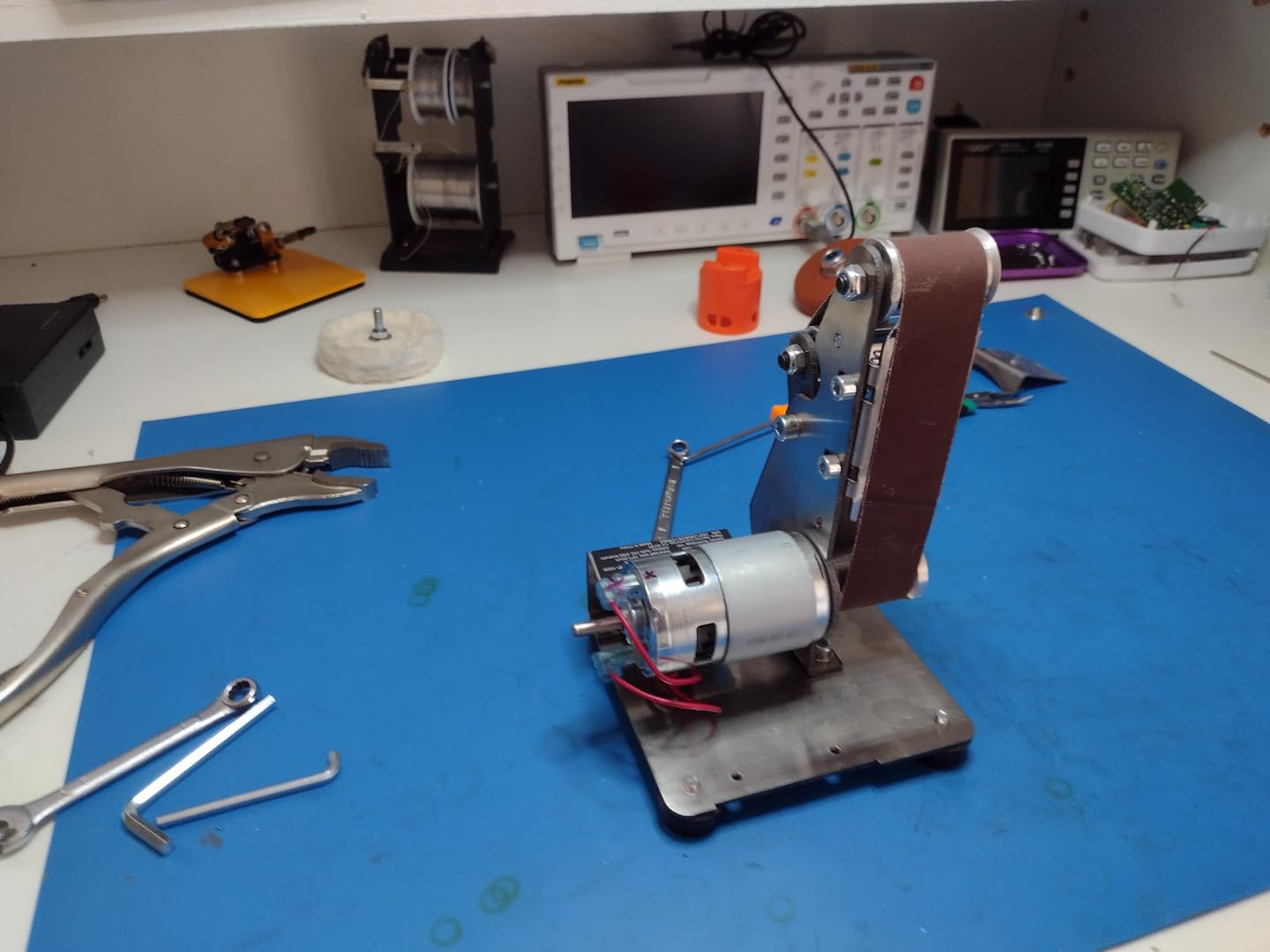
The rating on this one is the lowest in the group at 4.1, and we would rather explain that than hide it. The complaints cluster around stalling under load and assembly, which tracks with a 350W motor being asked to do the work of a half horsepower machine. For knife edges and light sanding jobs that is fine. For serious metal removal it is not, and the wider spread of reviews reflects that split.
Keep the eye shield on at all times, and note that the viewing window is not easy to replace once scratched, which matters more than it sounds when you are leaning in close to watch a wire edge form.
What the belt changes about how you sharpen
A belt gives you a narrow, flexible contact point rather than a flat disc, and that is exactly what you want when reprofiling a knife. You approach at the angle, take a pass, and lift. There is no wide face to accidentally bury the heel of the blade in, so the risk of grinding the entire bevel flat by accident drops sharply.
Because belts come in graded grit and are cheap, you can move from coarse to fine in seconds by changing the belt rather than truing a wheel. That is the part of the format experienced knife makers value most, and it is the reason a short-belt combo can be a reasonable first step even though it is not a full knifemaker machine.
Where the combo format is a compromise
A 2 x 28 inch belt is short. It cannot take a long workpiece, and it will not handle the profile grinding that a 1 x 30 or 2 x 42 machine exists for. If your interest is making knives rather than maintaining them, this is a stepping stone rather than a destination.
The 350W motor is the other limit. Owners report the machine stalling when pushed hard, and a stalled wheel that resumes at speed is a more dangerous event than a slow one. Use it for edges and light finishing, not for hogging out steel.
5. BUCKTOOL 8-Inch 3/4 HP Low-Speed Grinder – Built for CBN Wheels
BUCKTOOL 8″ 3/4HP Low Speed Bench Grinder fit CBN Wheel,Wobble Free Wheels
0.75 hp, 1-1/4 hp peak
1750 rpm induction motor
1-1/2 inch CBN wheel face
80 and 120 grit
Pros
- Wide 1-1/2 inch wheel face accepts 1-1/2 inch CBN wheels for finer sharpening
- low 1750 RPM induction motor runs cool and smoothly
- 3-watt LED with individual switch is good for detail work
- angle-adjustable eye shield includes 3x magnification
- cast iron base with rubber feet and a keyed safety switch
Cons
- Priced above most other 8-inch grinders in this group
- tool rests adjust only from 0 to 45 degrees which limits some setups
The BUCKTOOL 8-inch is the most interesting machine in this roundup for anyone who has already tried bonded abrasive and found the heat or the cleanup unsatisfying. Its distinguishing feature is wheel width. The wide side is 1-1/2 inches across, which is wide enough to mount a 1-1/2 inch CBN wheel, and CBN is a completely different sharpening experience from a bonded grit wheel.
CBN wheels are resin-bonded cubic boron nitride, a material that stays sharp far longer than aluminum oxide and cuts hardened steel with less pressure. A user on r/sharpening described running an 8 by 1 inch CBN wheel on a RIKON slow-speed machine, taking two passes per side and then two passes per side on leather to finish an edge. That is the highest-end workflow we found being used in practice, and this machine is built to accommodate it.
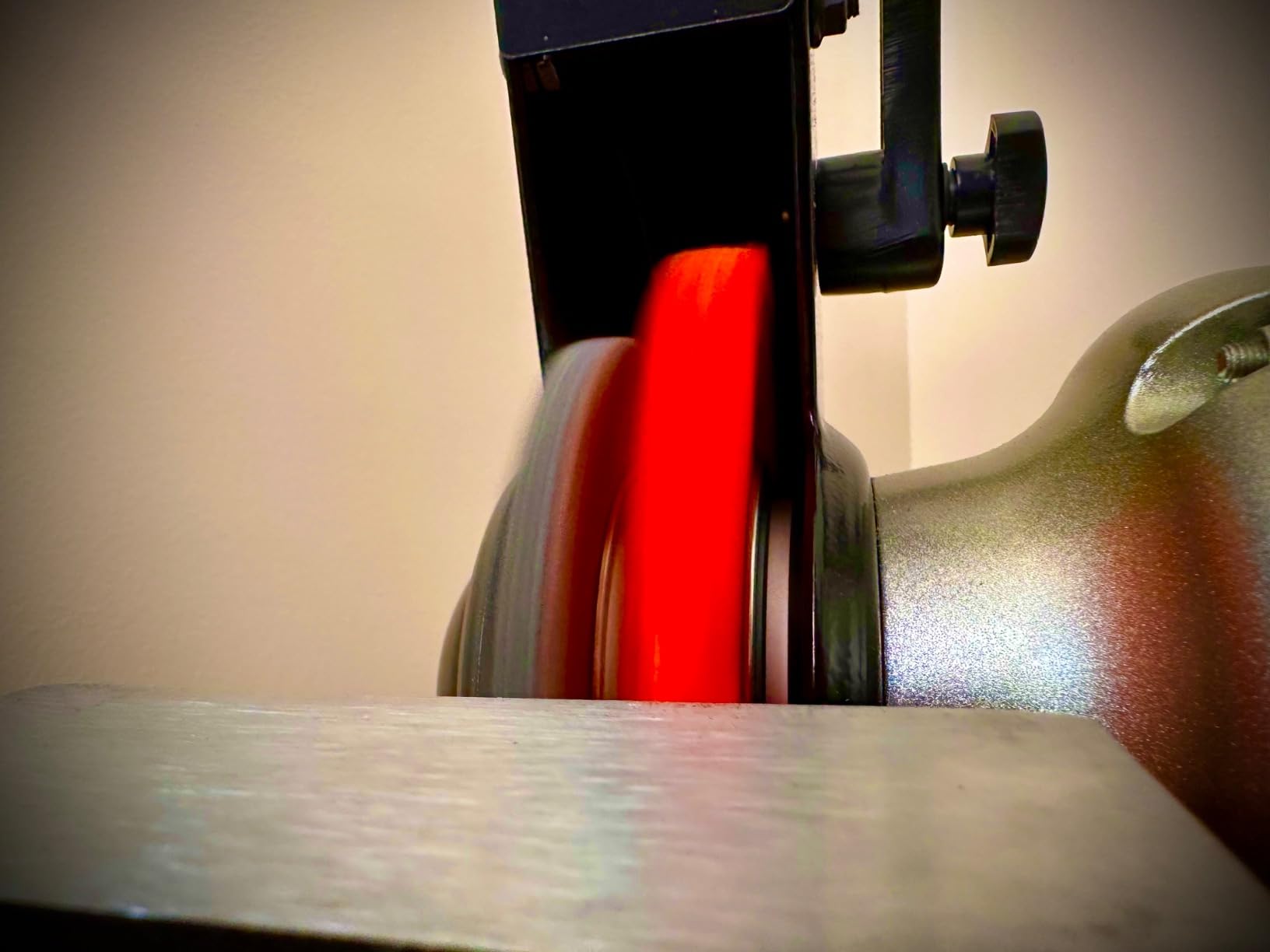
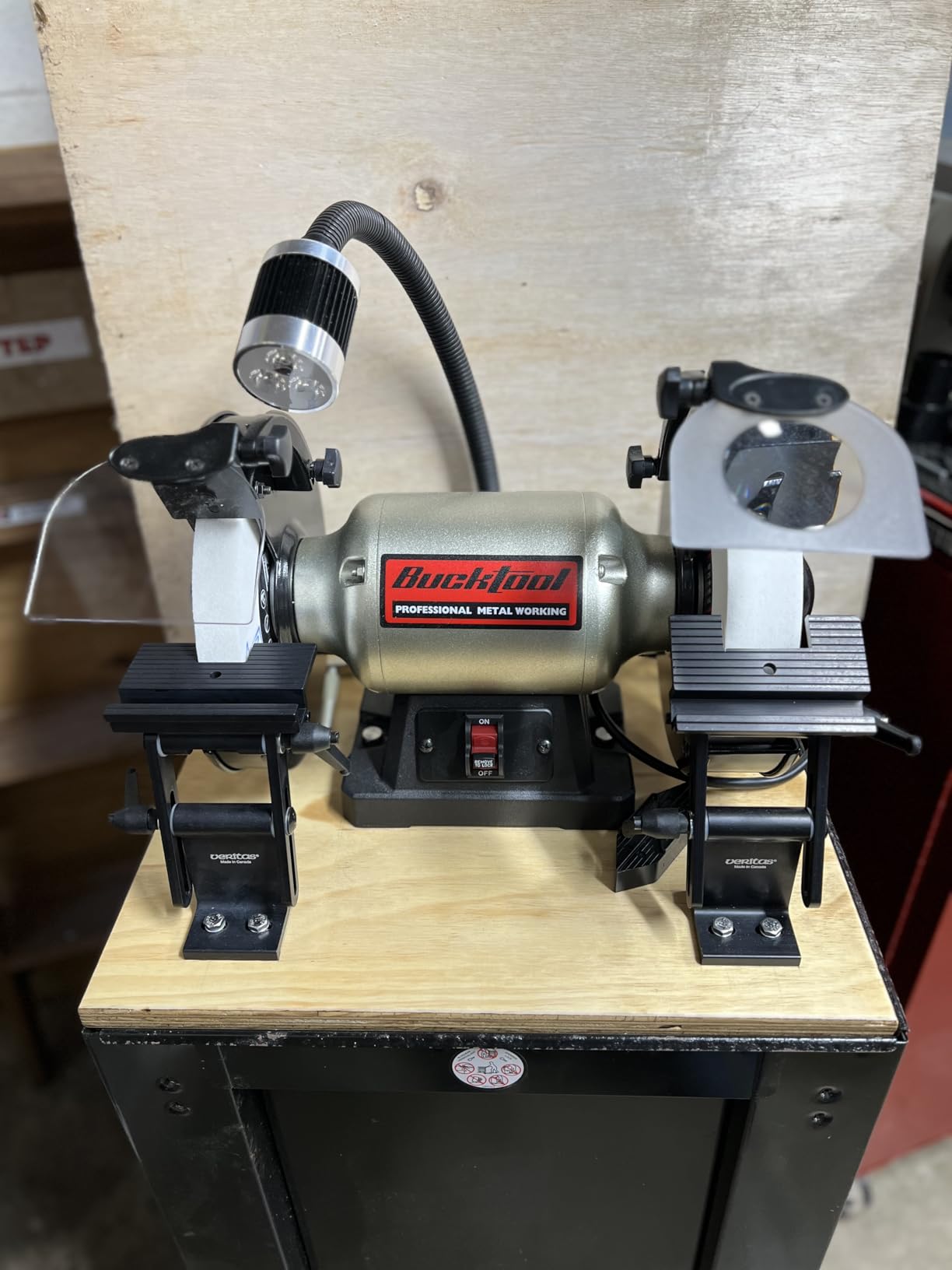
The motor specification is a 4.8A low-speed induction motor rated at 0.75 hp with peak power of 1-1/4 hp. Low speed and induction means it runs cool and smoothly, which is exactly the combination you want for long sharpening sessions. The 3-watt LED with its own switch is a small detail that turns out to matter, because you can light just the working area without glare off the wheel face.
It comes with an 80 grit and a 120 grit wheel, so both sides are usable for sharpening out of the box. It also includes a wheel dresser in the box, which is more than most machines here manage.
Why wheel width is the spec to pay attention to
A wider wheel face gives you a longer contact zone, which spreads the same hand pressure over more surface. That lowers the force per square inch on the edge, and force per square inch is what converts into heat. Wider also means more room to work a bevel without the heel running off the side of the wheel.
The practical benefit shows up in how little cleanup the edge needs. Two light passes per side on a CBN wheel leaves a much smaller wire edge than a coarse bonded wheel does, which means less time on the leather and a cleaner result.
Where this machine asks more of you
It is priced above most other 8-inch grinders in this group, so you are paying for the motor quality and the wide face rather than for raw horsepower. If you are never going to run a CBN wheel, that premium is harder to justify.
The cast aluminum tool rest adjusts from 0 to 45 degrees, which covers a lot of setups but not every angle a knife maker might want. Very shallow reprofiling angles at the far end of that range can be awkward to set up accurately.
6. WEN BG4282 4.8-Amp 8-Inch Grinder – Best for Restoring Old Tools
WEN BG4282 4.8-Amp 8-Inch Single Speed Bench Grinder with LED Work Lights, 14 x 10 x 11.75 inches, Black and Orange
4.8 amp motor
3450 rpm no-load speed
8 by 1 inch wheels
Quenching tray and LED eye guards
Pros
- 4.8 amp motor has enough power for lawnmower blades and chisels
- onboard quenching tray cools workpieces during long sessions
- LED lights built into the eye guards illuminate the work
- reaches full speed in under 10 seconds and runs smoothly
Cons
- Tool rests are cast and not parallel to the wheels which limits chisel angle setup
- LED lights are dim and take batteries
- a minority of units reported excessive wheel vibration or heat build-up
The BG4282 is the one to buy when the job list is longer than the knife collection. That means mower blades, rusted chisels, plane irons, shovel bits and the accumulated clutter of a garage bench. A 4.8-amp motor gives it the power to take that material off quickly, and unlike the smaller units in this roundup it reaches full speed in under ten seconds, which is what makes repeated short jobs bearable.
The onboard quenching tray is the feature that separates it from a plain bench grinder. During a long restoration session you can set a hot workpiece down in water instead of leaving it on the steel plate to cook, and that is a meaningful difference when you are doing several pieces in a row.
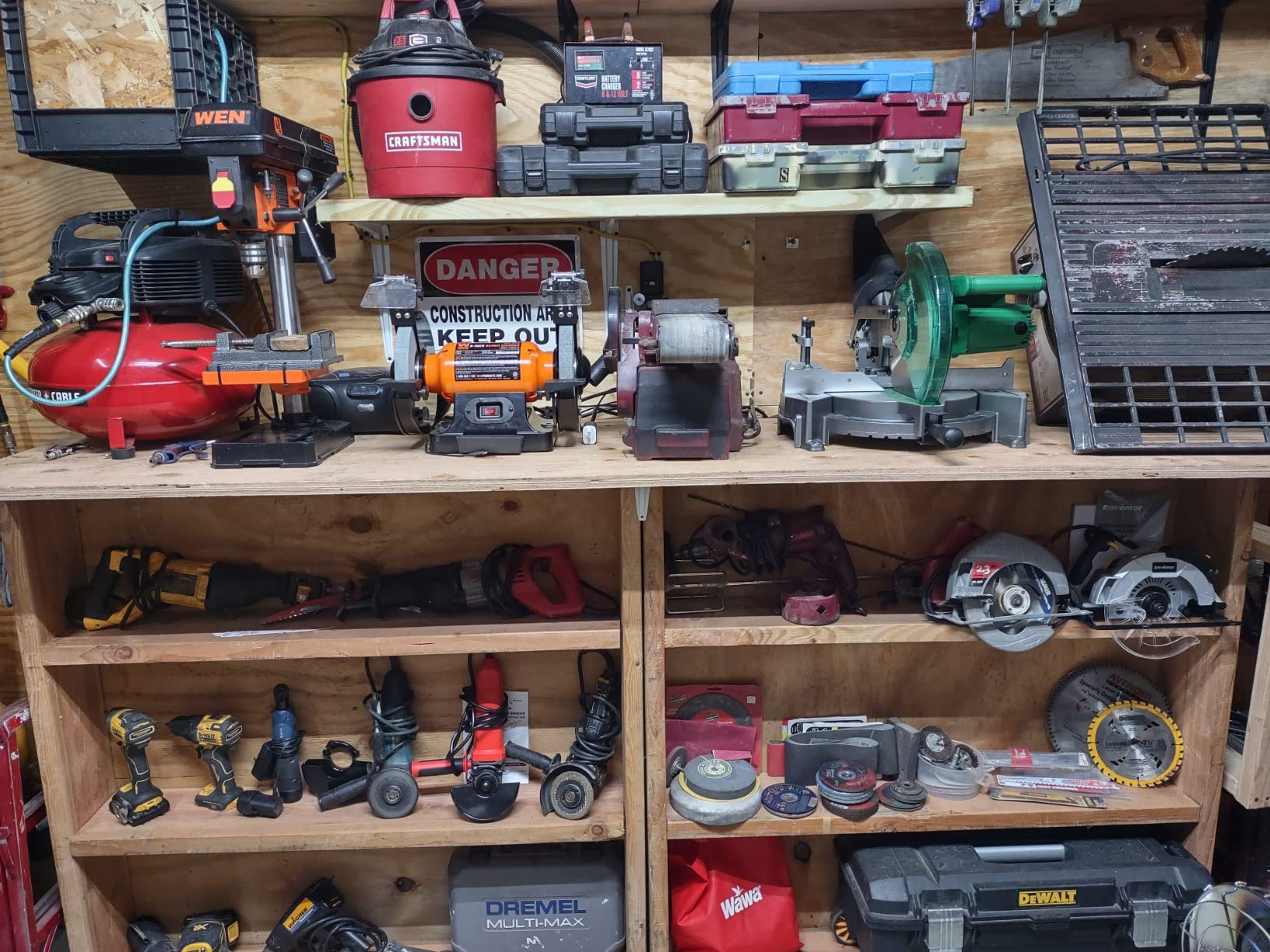
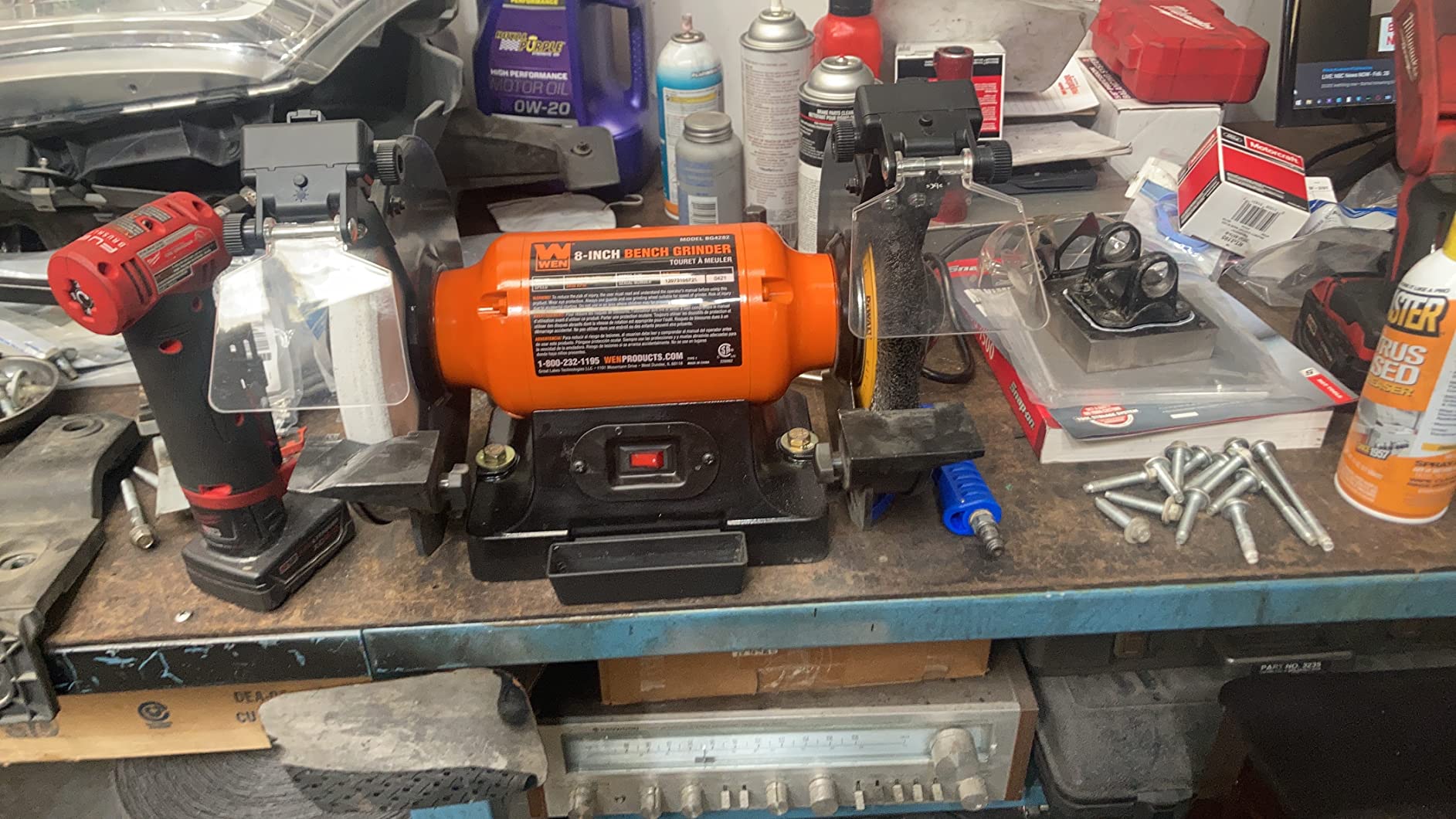
Reviewers rate it as strong value with the quench tray and the lit eye shields standing out for restoration work. It includes a 60 grit and a 36 grit wheel, pivoting tool rests, adjustable eye guards with built-in LED lights, and a two year warranty, which is a complete package for the money.
There is a small share of units reporting excessive wheel vibration and heat build-up during use. That is worth checking on yours in the first ten minutes, because a machine with a bad wheel should go back rather than be worked around.
How the quenching tray changes a long session
Heat does not stop the moment the blade leaves the wheel. A workpiece that was at a damaging temperature keeps dissipating into whatever it is resting on, and a steel tool plate is a poor heat sink compared with water. The tray lets you interrupt the cycle properly rather than pushing through to the end of a pass while the steel cools at its own pace.
For knives specifically, this makes the machine much more comfortable to use on a big batch of edge work, because you are not accumulating heat build-up in the tool or the workpiece between passes.
Where the tool rest geometry holds it back
The tool rests are cast rather than machined, and reviewers specifically report that they are not parallel to the wheels. That matters most for chisel work, where a fixed angle across the width of the rest is the whole point. Knife edges are more forgiving because you control the angle with your wrist, so this is a chisels-versus-knives limitation rather than a general one.
The LED lights in the eye guards are dim and take batteries, which is an odd choice in a machine this size. If fine knife work is a regular task, budget for a better light rather than relying on the built-in one.
7. WEN BG4108 Water-Cooled Wet/Dry System – Zero Burn Risk
WEN 8-Inch Water-Cooled Wet/Dry Sharpening System (BG4108)
8 inch 220 grit water-cooled stone
120 RPM
8-3/4 inch leather stropping wheel
Pros
- Water-cooled 220 grit stone avoids burning the edge while sharpening
- very slow 120 RPM gives high precision and control
- adjustable-height reservoir repositions as the stone wears down
- includes angle guide
- honing compound and a jig for chisels and plane blades
Cons
- Not a bench grinder with abrasive wheels so there is no general grinding capability
- lowest average rating in this group with a wide spread of critical reviews
- slower cycle times suit hand-tool finishing rather than quick metal removal
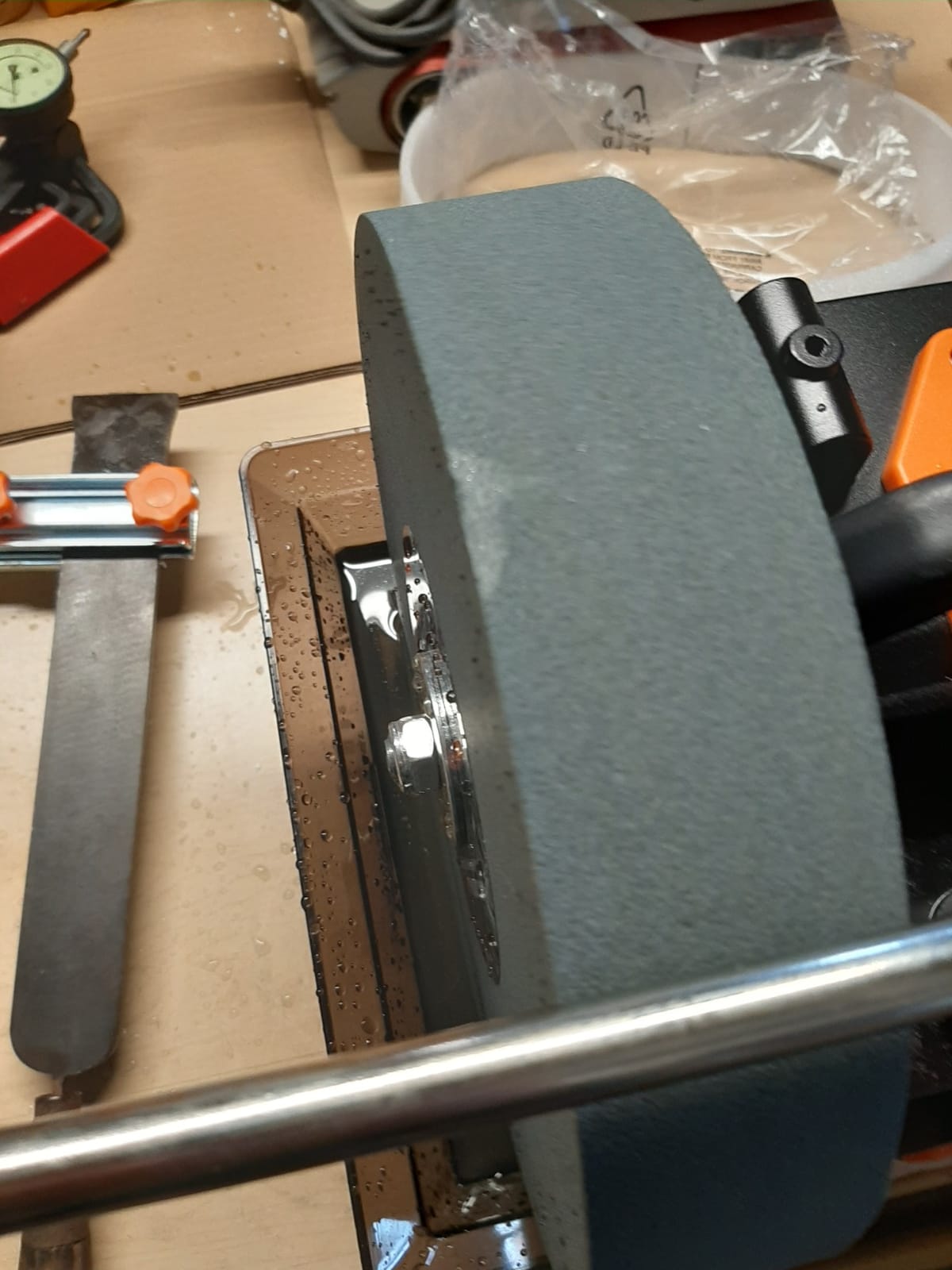
If the single thing stopping you from sharpening knives is fear of ruining them, this is the machine that removes the fear entirely. The BG4108 is a water-cooled 8 inch 220 grit stone turning at 120 RPM, with a reservoir that keeps the cutting surface wet. A wet stone cannot burn an edge because the water carries the heat away faster than friction can generate it, and that is not a technique, it is a physical property.
The 120 RPM speed is roughly a fifteenth of what a standard bench grinder wheel turns at. It is slower than a hand stone, and that is the point. The stone stays flat, the cut stays cool, and the bevel angle is easy to hold steady because nothing is trying to pull the blade out of your hands.
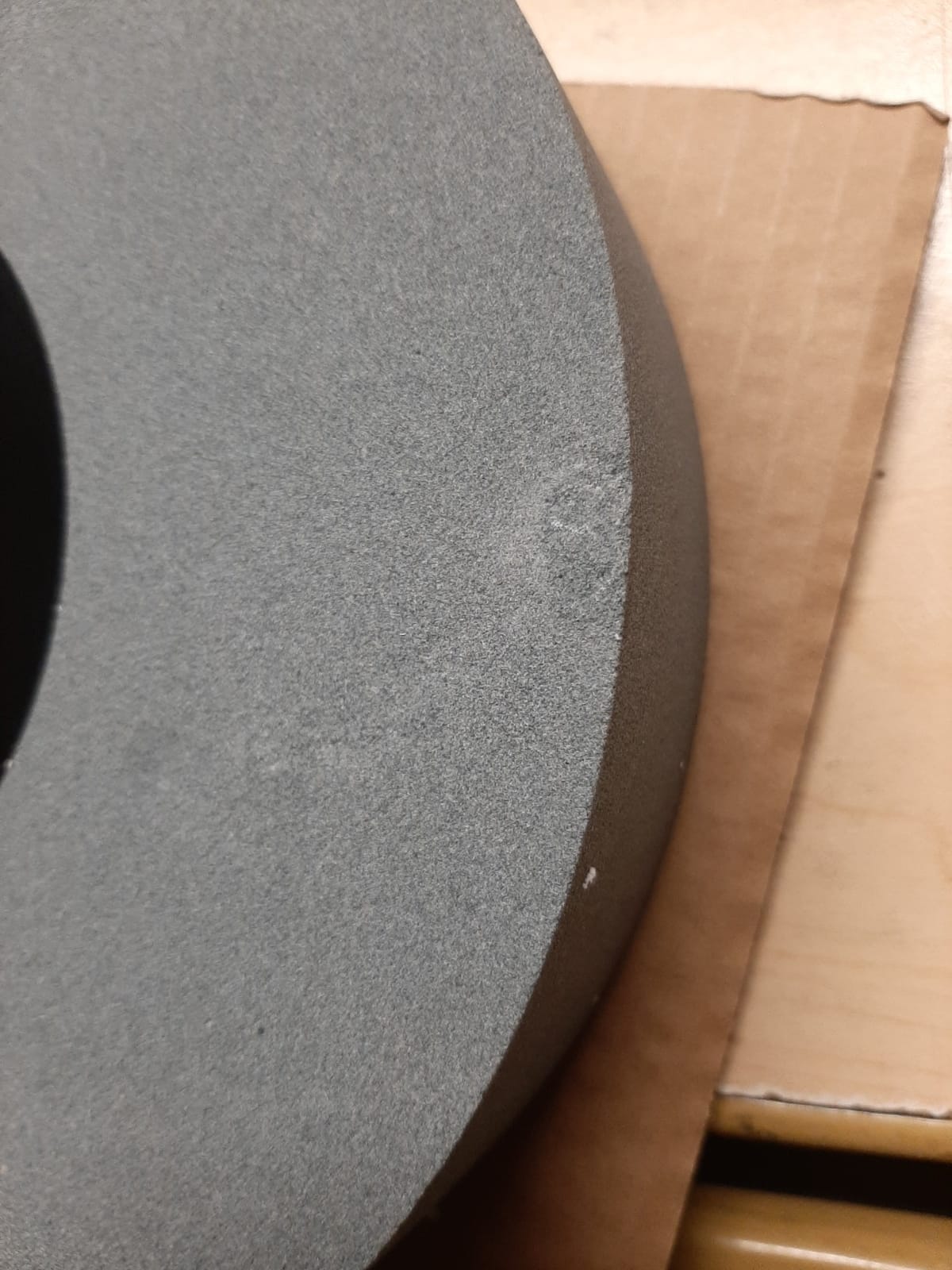
The rest of the package is unusually complete for a sharpening system. You get an 8-3/4 inch leather stropping wheel on the other side, an angle guide, honing compound, and a jig that fits both chisels and plane blades. The reservoir adjusts in height as the stone wears down, which keeps the working surface aligned with the rest and the jig. The universal jig support also accepts the WEN 42704B and 42703 sharpening kits if you want to add to the system later.
It sits at 4.1 stars, the joint lowest rating here, and the reviews explain why. People restoring plane irons and chisels love it, while others find the 120 RPM cycle too slow compared with a conventional wheel grinder. That split is the product, not a defect.
What a water-cooled stone changes about edge quality
Two things happen when the abrasive stays wet. The wheel or stone does not glaze, because the swarf is carried away instead of being pressed into the surface, and the steel being cut stays close to room temperature, so you can grind a full bevel without any part of the blade being affected above it.
Because the stone does not load, the cut stays consistent from the first pass to the last. On a dry bonded wheel the abrasive dulls as you work, which means the pressure needed to keep cutting rises steadily through a session, and rising pressure is rising heat.
Where this system cannot follow you
There is no general grinding capability here. This machine cannot hog out a rusty bolt, thin a bevel, or shape a tool profile, and the 220 grit stone is a refining surface rather than a removal surface. If your work is half shaping and half sharpening, you need a second machine.
The rating spread also reflects the learning curve. A system this slow rewards patience, and buyers who expected a bench grinder’s pace tend to be disappointed in the first week before they settle into it.
8. Genesis GBG800L 8-Inch Grinder – Lighting Where You Need It
Genesis 8″ Bench Grinder with Dual Flexible Lights and Eye Shield, 36G and 60G Wheels Included GBG800L
800 watt induction motor
3550 rpm
8 inch wheels, 36 and 60 grit
Two gooseneck lights, cast iron base
Pros
- Two flexible gooseneck lights let you aim light at any angle
- pre-drilled heavy-duty cast iron base is rigid and stable
- adjustable tool rests and eye shields are included
- 36 grit and 60 grit wheels cover coarse and finer sharpening
Cons
- Gooseneck lights use bulbs that are not always included and can be hard to source
- some units reported wheel balance and vibration issues
- below-average rating compared with the rest of this group
The Genesis GBG800L is defined by its lighting, and that is not a throwaway feature. Two flexible gooseneck lamps let you put light exactly on the point of contact, from whatever angle your bench and your head are arranged. For knife work that means you can watch the wire edge form and fold without leaning into the sparks, and for anyone working in a garage with a single overhead bulb it is the difference between seeing your edge and guessing at it.
The base is a pre-drilled heavy-duty cast iron casting, which is the second thing worth paying attention to. Pre-drilled means the mounting holes are already positioned for bolting down, and cast iron means the machine stays where you put it. The adjustable tool rests and eye shields are included, so there is nothing to buy before the first session.
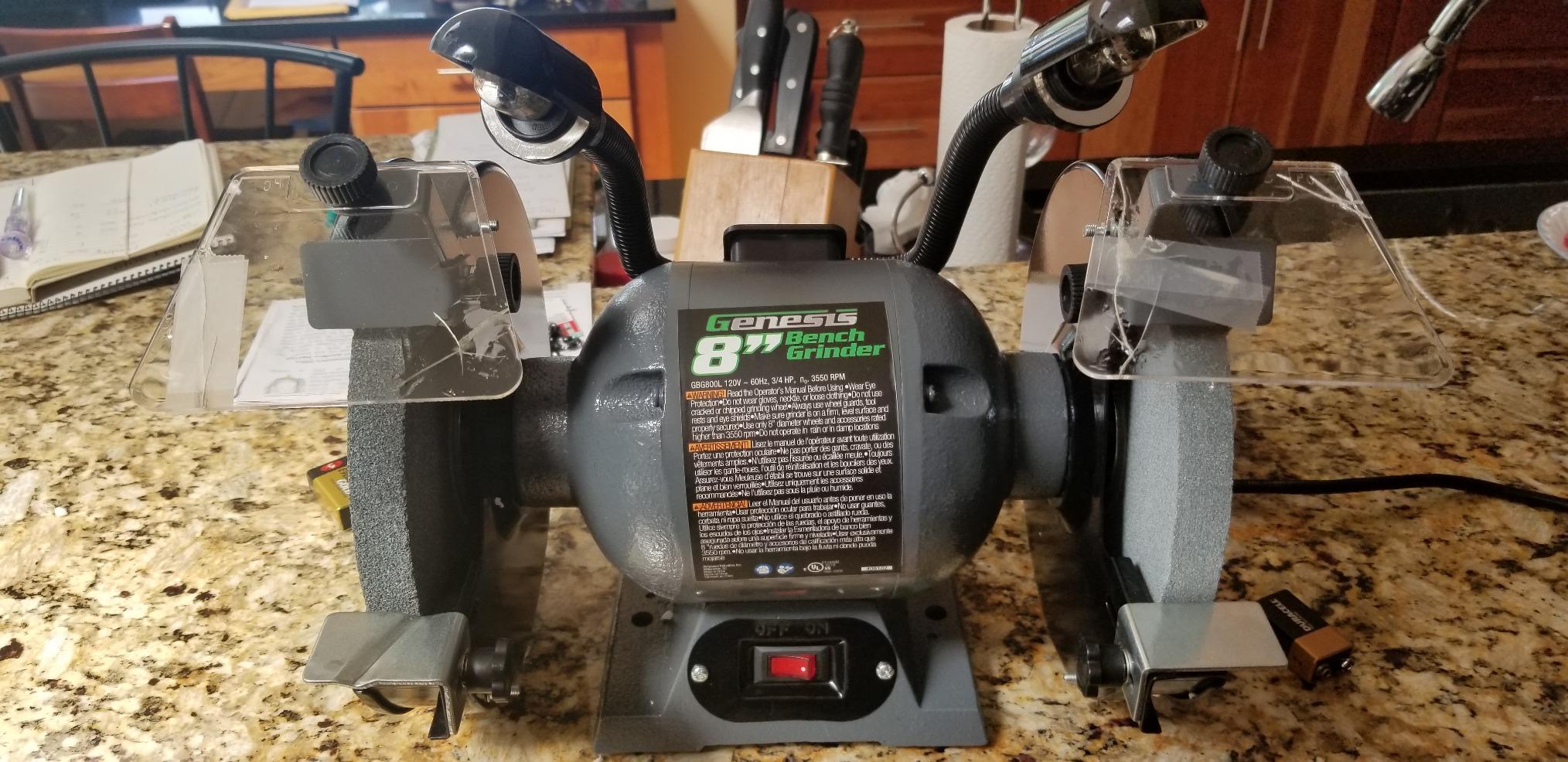
The wheels are 36 grit and 60 grit aluminum oxide, which covers coarse shaping and finer sharpening in the box. The 8 inch diameter at 3550 RPM puts it in the same speed class as the other high-RPM machines here, so the same heat caution applies for hardened knife edges.
Buyer sentiment is mixed on wheel balance, and several reviewers note that the light fixtures are the weak point compared with LED-equipped models. The gooseneck lamps take bulbs that are not always included and that can be difficult to source, which is annoying for a machine whose main selling point is the lights.
What aimed lighting does for consistency
Angle repeatability depends on seeing the bevel, and a bevel you cannot see is a bevel you are feeling rather than controlling. Aimed light lets you confirm that the blade is flat on the rest and that the wire edge is forming along the full length rather than only in the middle where you happened to look.
It also helps with wheel dressing, because you can see the wear pattern across the face of the wheel and dress only where it is needed instead of working the whole face blind.
Where this grinder loses ground
The rating of 4.2 is the second lowest here, and it comes down to two things: reported wheel balance issues on some units, and the bulb situation on the lights. Neither is a dealbreaker if you check the wheel on arrival and source a replacement bulb.
At 3550 RPM with no water option, this is a general workshop machine rather than a sharpening-first one. If fine edge work is the majority of what you will do, a slow-speed machine in this price bracket serves you better.
9. BUCKTOOL 6-Inch 1/3 HP Low-Speed Grinder – the Sharpening Starter
BUCKTOOL 6″ 1/3HP Low Speed Bench Grinder,High Precision Wobble Free Wheels
1/3 hp motor
1750 rpm
6 inch 60 and 80 grit aluminum oxide
Tool-free adjustable work rest
Pros
- Highest average rating in this group at 4.7 stars
- low 1750 RPM is well suited to controlled knife and chisel sharpening
- wheels are reported as well balanced with no wobble
- tool-free adjustable work rest and rubber-footed base reduce vibration
- includes eye shields spark arrestor and a two-year warranty
Cons
- 6-inch wheels limit the length of blade that can be sharpened
- 1/3 HP motor is the least powerful here for heavy metal removal
This is the low-speed grinder we would hand to a first-time knife owner without hesitation. It carries a 4.7 star average, which is the highest rating of any machine in this roundup, and the reason shows up consistently in the reviews: owners describe smooth low-speed operation, minimal vibration and easy rest adjustment, and they characterise it as strong value for knife and hand-tool sharpening.
At 1750 RPM it behaves like the RIKON and nothing like the high-speed machines, and for a beginner that is the entire point. The wheel pulls the blade instead of fighting it, mistakes cost less, and the 60 grit and 80 grit aluminum oxide wheels that come in the box are both sharpening grits rather than a coarse shaping wheel.
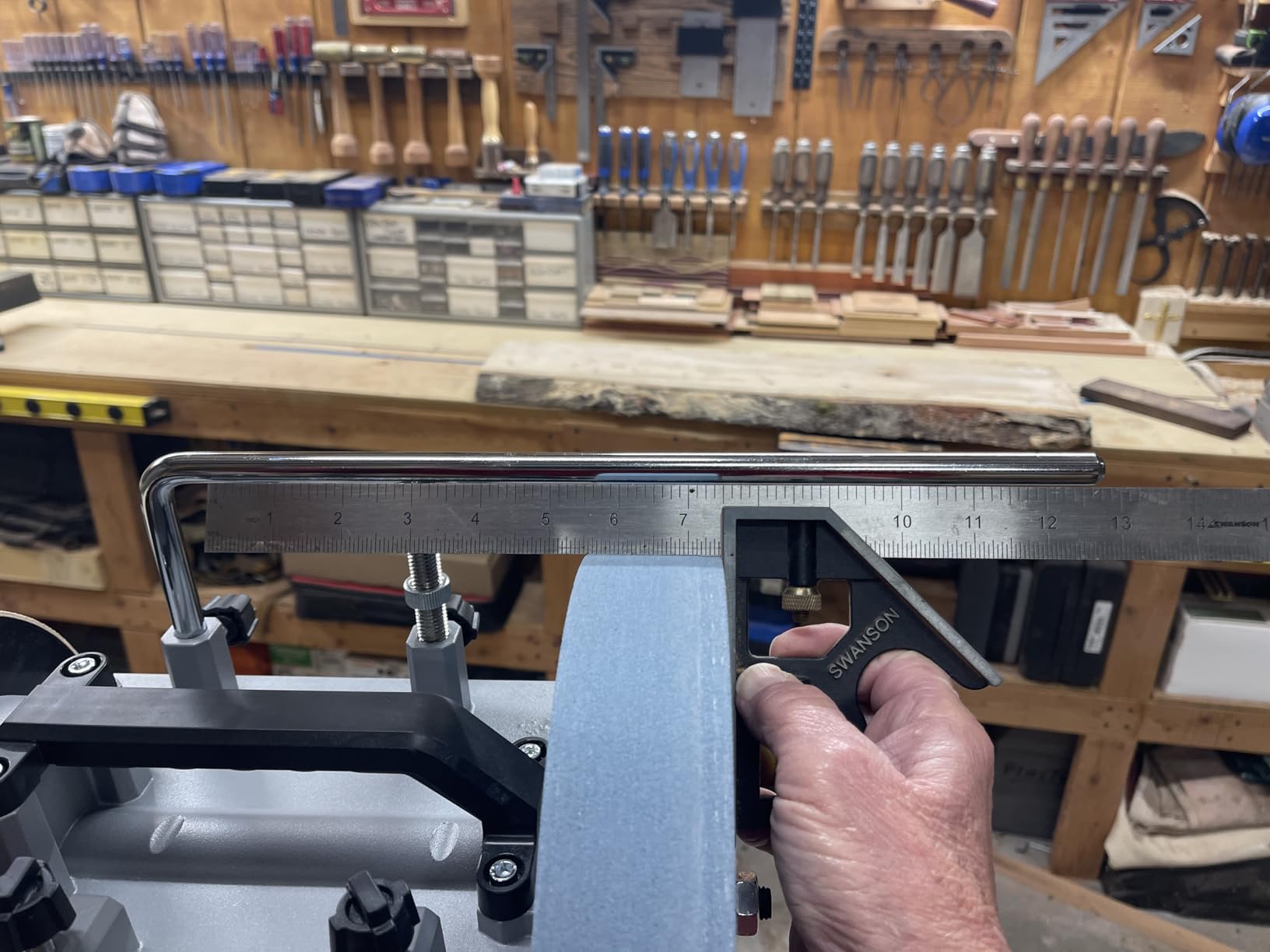
The tool-free adjustable work rest is a genuine convenience. You can move the rest into position without hunting for a wrench, which makes it far more likely that you will actually set the gap correctly before each session rather than working around it. The rubber-footed cast aluminum base keeps the machine steady, and the package includes two eye shields and a spark arrestor plus a two year warranty.
Balanced wheels out of the box are the thing owners mention most warmly, and that is not a small detail. A grinder that arrives with a true wheel is a grinder you can trust with an expensive blade on the first afternoon.
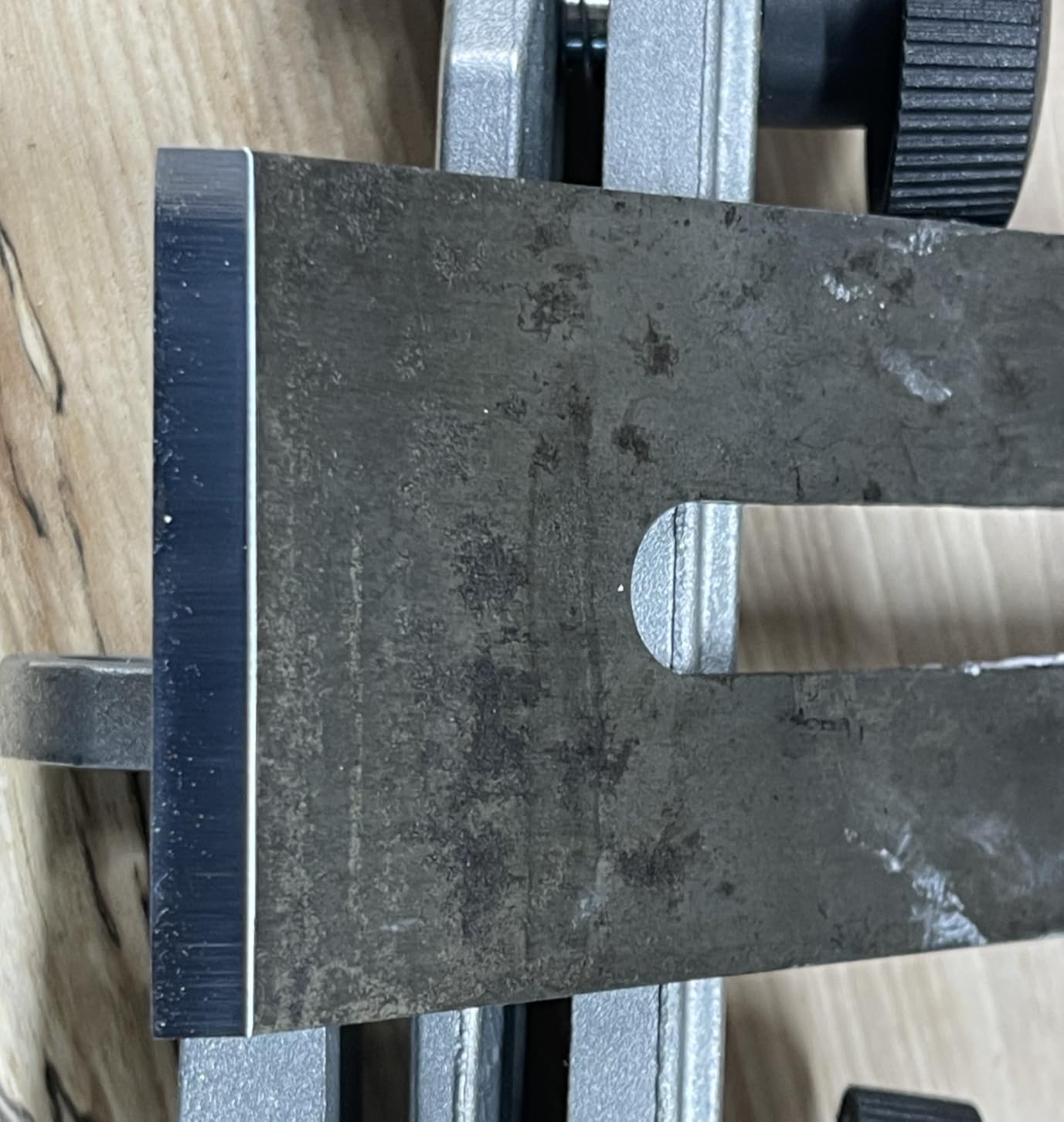
Why 6 inches is workable at 1750 RPM
Contact area and speed trade off against each other, and this machine is a good example of that. A 6 inch wheel gives you less contact than an 8 inch wheel, but half speed gives you a large reduction in heat, and the combination lands in a place where light passes on a hardened knife are uneventful.
That is why the forum complaint about 6 inch grinders for knife work tends to focus on fast machines. Slow down the wheel and the small diameter becomes a much smaller problem than it first appears.
Where the limits sit
Six-inch wheels do limit the length of blade you can work in one pass, and a long chef’s knife or a full-width chisel will need repositioning. For a pocket knife, a paring knife or a short chef’s knife, that is rarely a problem.
The 1/3 hp motor is the least powerful in this roundup. That is fine for sharpening and light hand-tool work, and it is not fine for heavy metal removal where you would rather not sit and wait.
10. Woodskil 6-Inch 1/2 HP Grinder – High-Speed Metal Removal
Woodskil 6″ 1/2HP High Speed Bench Grinder for sharpening,CSA Listed
0.5 hp, 2.8 amp motor
3450 rpm
6 inch 36 and 60 grit aluminum oxide
CSA certified
Pros
- 1/2 hp 3450 rpm motor gives fast metal removal for sharpening and shaping
- both 36 grit and 60 grit aluminum oxide wheels included
- pre-drilled heavy-duty steel base keeps operation wobble-free
- CSA certified with eye shield and spark arrestor
- under 20 pounds so it is easy to reposition
Cons
- High speed generates more heat than low-speed grinders during fine sharpening
- wheels are 1/2 inch wide which is narrow for wide bevels
- no LED work light so dark benches need extra lighting
The Woodskil is the fastest metal removal per dollar in this roundup, and that is a real use case rather than a compromise. A 0.5 hp motor at 3450 RPM with 36 grit and 60 grit aluminum oxide wheels will reset a damaged bevel or clean up a rusty edge in a way that none of the slow-speed machines here can, and owners rate it as powerful for its size with good value.
It is also the easiest machine here to move. At under 20 pounds it can be carried to a different bench, set up temporarily where the work is rather than where the outlet is, or taken outside for a cleanup job. The pre-drilled heavy-duty steel base keeps it stable in use, and the mounting holes are already positioned for bolting down.
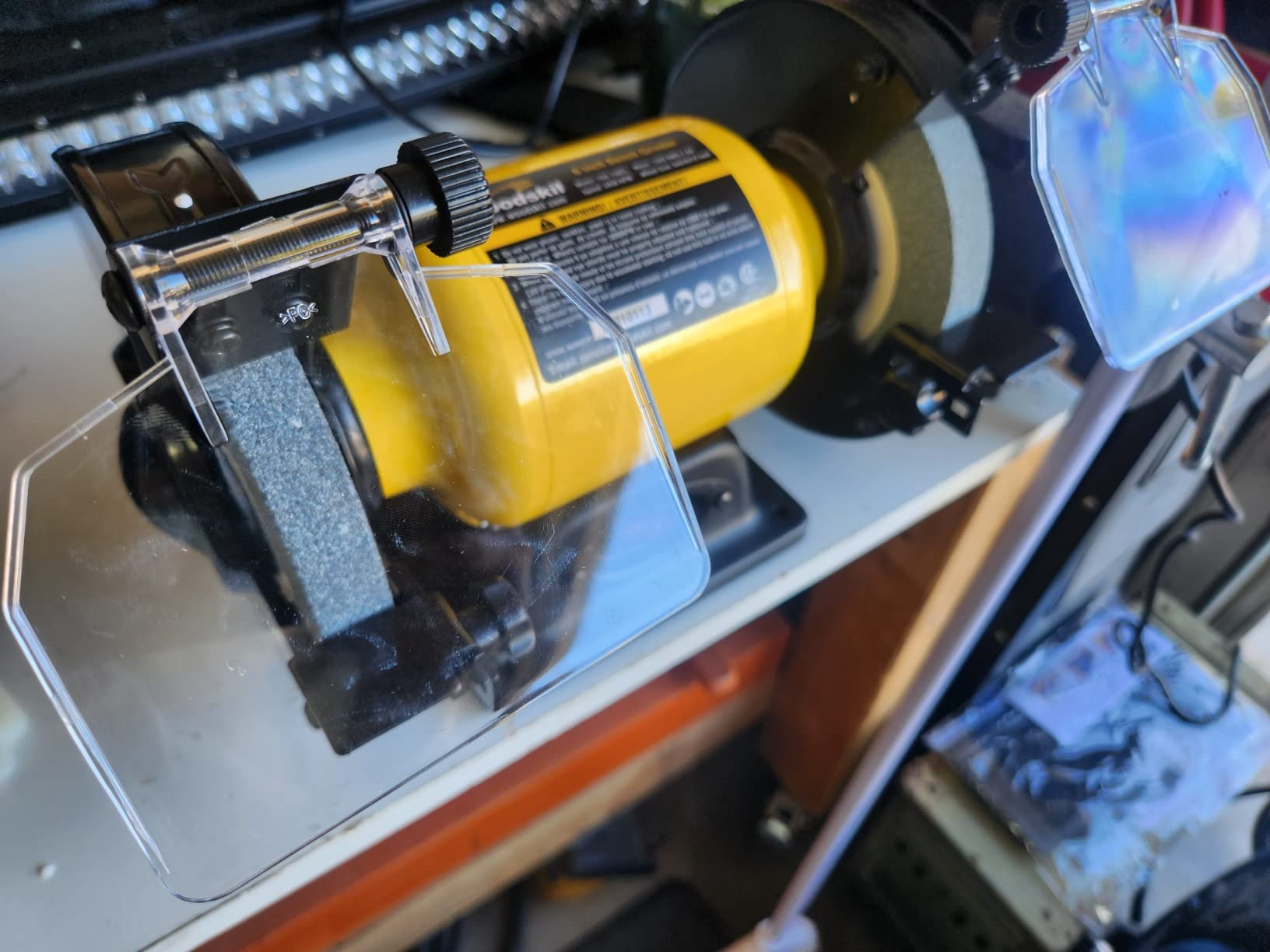
The CSA certification and the included transparent eye shield and spark arrestor are worth noting for a machine that runs this fast. A spark arrestor that blocks most of the output is a real safety improvement, not a checkbox, and the certification means the electrical design has been independently assessed.
Owners draw positive mentions for the rigid steel base and the certification, and the main caveat in the reviews is the one you would expect: 3450 RPM produces more heat than slow-speed machines, which matters most for delicate blade edges.
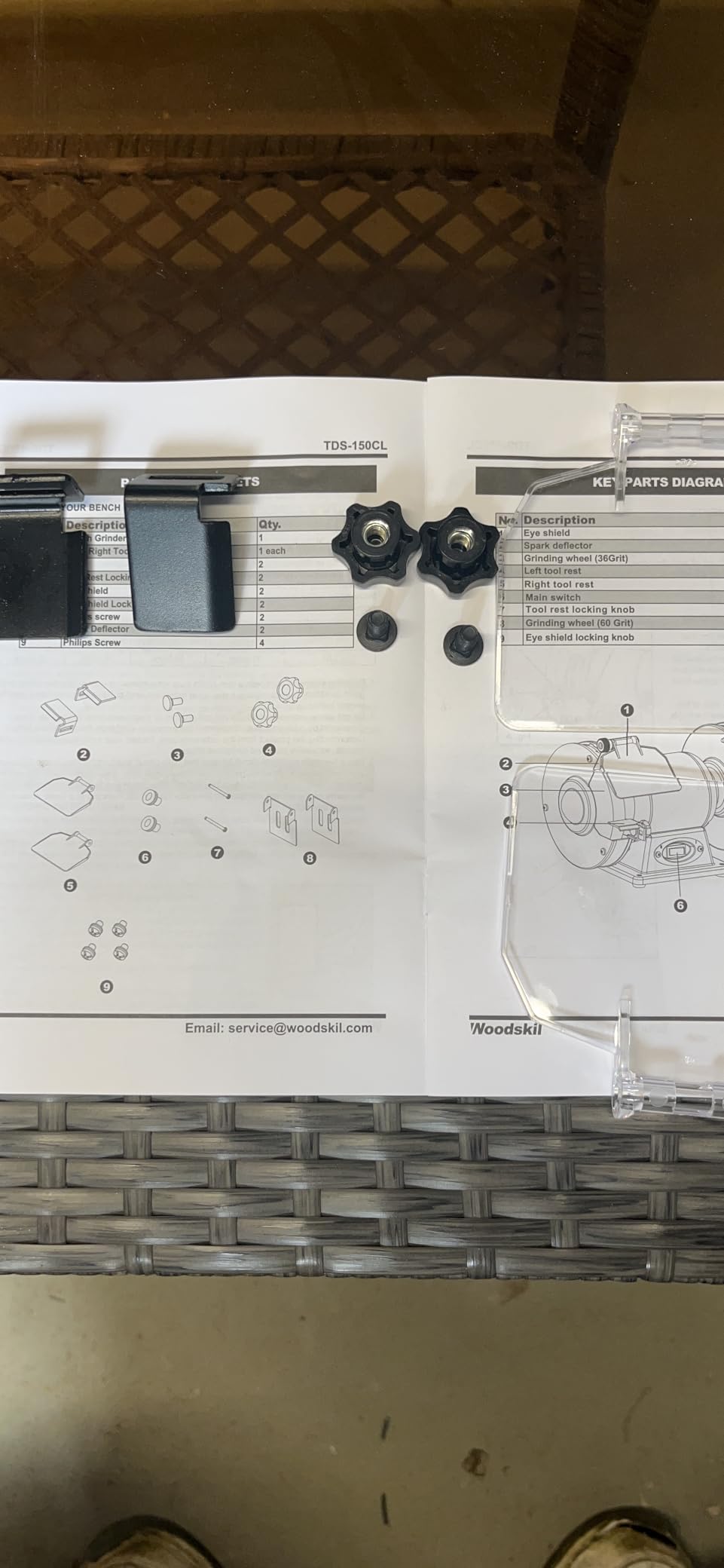
Where high speed genuinely wins
There are sharpening jobs where time is the point. Taking down a deeply chipped tip, cutting back a bevel that someone has ground to 30 degrees, or cleaning up a blade that has been used as a screwdriver all finish in seconds here and in minutes on a 1750 RPM machine.
It is also a better machine for blending and shaping, because the coarse wheel has enough authority to take material off cleanly rather than bouncing off it. If sharpening is only part of what you do, that capability has real value.
Where high speed costs you
Heat is the honest trade. The reviewers’ own summary is that the 3450 RPM speed produces more heat than low-speed models, and on a thin hardened blade with a dry wheel that heat goes straight into the steel you were trying to protect.
The 1/2 inch wide wheels are another limit for knife work specifically. A wider face gives a longer contact patch and lets you work a wide bevel in one pass, and half an inch is narrow. There is also no LED work light, so on a dim bench you will be adding lighting anyway.
Is a 6-Inch or 8-Inch Bench Grinder Better for Sharpening?
An 8-inch wheel is the better choice for knife sharpening, because it gives you roughly twice the contact area of a 6-inch wheel, which spreads the same hand pressure over more surface and cuts both the force per square inch and the resulting heat. A 6-inch wheel only makes sense when bench space, cost or portability dominates your decision.
The pressure argument is the whole argument. When you push a blade against a wheel, the load is spread across the contact patch, and a larger patch means each square inch of the edge is taking less of it. Less force per square inch means less friction per square inch, which means less heat, and heat is the thing that ruins edges. A 6 inch wheel also gives you a shorter contact line, so a long blade has less of the edge supported at any one moment.
That said, wheel size is not a veto on a 6-inch machine. Slow speed compensates. A 6-inch grinder running at 1750 RPM behaves far more gently on a blade than an 8-inch grinder running at 3600 RPM, which is why the BUCKTOOL 6-inch in this roundup carries the joint highest rating even though its wheels are the smallest. The variable that matters most is not diameter on its own, it is the combination of diameter and speed.
One documented failure report is worth knowing about. On BladeForums, a user who had a 6-inch variable-speed grinder described it as useless for knifemaking, and replaced the grinding wheels with 8-inch paper sharpening wheels instead. Variable speed is not the same thing as low speed, and a dial that bottoms out near 2000 RPM is not a slow-speed machine.
There is a practical constraint nobody mentions until it arrives. The 8 x 1 inch wheel is the industry default, and a wide 8 x 1-1/2 inch wheel gives even more contact area for CBN work. Check what wheel width and bore your chosen machine takes before you plan an abrasive purchase, because an 8-inch wheel from a different machine will not necessarily fit. If you want a broader look at the options, our knife sharpening system guide covers the non-grinder alternatives in more depth.
Bench Grinder vs Belt Grinder vs Tormek: Which Should You Buy?
For maintaining an existing knife collection, a bench grinder is the right answer; for making knives or reprofiling edges from scratch, a belt grinder is better; for repeatability and finishing, a Tormek-style water-cooled wheel system is better. Professionals overwhelmingly use a belt grinder or an angle-controlled wet system rather than a plain bench grinder, and saying so plainly is more useful than pretending otherwise.
A belt grinder wins on geometry. The belt is a narrow, flexible contact point, so you can approach a blade at exactly the angle you want without burying the heel in a wide face. That is why knife makers use them, and why a user on r/knifemaking said a large-wheel bench grinder is basically a motorised whetstone that depends entirely on your skill. Belt sanders also change grit in seconds, and a box of graded belts plus a leather strop belt costs less than most buyers expect. Forum recommendations converge on a 1 x 30 machine as the value entry, with a 2 x 42 as the step up.
A Tormek-style system wins on angle repeatability and on cooling. The water-cooled stone cannot burn an edge, and the jigs hold the bevel angle consistently every time, which is the entire reason the system exists. The trade-off is maintenance, which came up in a user’s account of the ownership experience on r/handtools: excellent reference for angle control and flexibility, followed by the headache of maintaining and aligning the jigs. Our WEN BG4108 in this roundup is the same idea in a simpler single-stone form.
A bench grinder wins on raw speed and on price. It takes steel off faster than anything else in the shop, it is the cheapest way to cover chisels, mower blades and turning tools, and it needs no consumables beyond the occasional wheel. The cost is control. You are managing angle by hand, heat by technique, and finish by adding a third step somewhere else.
What professionals actually use, in plain terms, is a two-stage system. A belt or wheel grinder for the first stage where steel comes off, and a stone, strop or angle-controlled system for the second stage where the edge is finished and deburred. Whichever bench grinder you buy, budget for a leather stropping wheel on the second side so you can complete the cycle at the machine. If you would rather stay away from powered abrasives entirely, our whetstone sharpening kit guide covers the hand-sharpening route end to end.
Which Wheel and Grit Should You Use?
Start at 36 grit only to set a bevel, move to 60 grit to refine it, and finish at 120 grit or finer before deburring on leather. For hardened stainless kitchen knives, 60 grit and 120 grit aluminum oxide are the two wheels you will actually use most, and everything coarser is for shaping work rather than edge refinement.
The progression is short on purpose, and skipping steps is what creates a deep wire edge that takes forever to remove.
36 grit removes steel quickly and is for resetting a geometry mistake, thinning a bevel, or cutting back an edge that someone ground too far. 60 grit is the general-purpose refinement wheel and the single most useful grit on the machine. 120 grit produces a much smaller wire edge and is where most edge work should finish. Above 120 you are into polishing territory, and a strop or a finer wheel is a better use of the same effort.
Wheel material matters as much as the number. Aluminum oxide is the general-purpose workhorse and is what comes with most machines here, including the RIKON 80-805, the BUCKTOOL 6-inch and the Woodskil. Silicon carbide cuts faster and softer, which makes it a better choice for non-ferrous metals and for low-damage work on hardened steel, at the cost of wearing faster. Diamond dressing tools are a maintenance item rather than a sharpening abrasive, and using one regularly is what keeps a wheel from glazing. CBN is the upgrade path, and it stays sharp far longer than any bonded grit, which is why a user on r/sharpening runs an 8 by 1 inch CBN wheel on a slow-speed RIKON to take an edge from stone to strop in a handful of passes.
Two hardware details stop wheel buying dead. The arbor bore is usually 1/2 inch on smaller machines and 5/8 inch on larger ones, and a wheel that does not match the bore will not mount, so check the bore before you order. Wheel width is the second one, because a machine that takes a 1-1/2 inch face can accept 1 inch wheels as well, and the wide face is what makes a CBN wheel possible on the BUCKTOOL 8-inch.
Dress the wheel before every sharpening session and again whenever it starts to look glazed, and a diamond dresser is the only tool that does it properly. For a low-cost finishing trick, one user on r/turning reported honing on a bench grinder fitted with an MDF wheel running backwards with white polishing compound as the abrasive, which is a cheap way to add a polishing stage to a machine that has no third wheel.
How to Choose a Bench Grinder for Knife Sharpening
Choose wheel speed first, wheel diameter second, and motor horsepower last. If knife sharpening is the main job, anything at or below 1750 RPM will protect your edges far better than a 3450 RPM machine with a bigger motor, and a machine that cannot heat a blade is worth more than one that can grind faster.
Fixed slow speed versus variable speed. A fixed 1750 RPM machine does one thing and does it predictably. A variable speed dial sounds more useful than it is on a bonded abrasive wheel, because the useful variable on a wheel is grit rather than speed, and the point of americanbladesmith.org’s argument is that variable speed really pays off when you change wheel or belt type. On a single bonded wheel, the dial often just gives you a slightly slower slightly less consistent version of the same aggressive cut. Variable speed becomes genuinely valuable on a belt grinder, where you can slow the belt down for finishing passes.
Wet versus dry. A water-cooled stone removes the heat question entirely, and it is the safest choice for expensive hardened steel. A dry wheel is faster and more versatile, and the heat is manageable with light passes and regular dressing. If you have ever had a blade discolour on a grinder before, a wet system will suit you better than any amount of technique.
Wheel hardness. A soft wheel wears and sheds quickly but cuts gently, which is the behaviour you want on hardened stainless where heat is the risk. A hard wheel stays flat and takes a fine finish, which is what you want on carbon steel and on precision work. Neither is universally right, which is why a machine with two different wheels is more useful than one with two of the same.
Tool rest and angle repeatability. The rest is what holds your angle, and machined aluminum rests hold an angle better than cast ones. Check the gap setting too, roughly the thickness of a coin, because a rest set too close is a real source of the gouged-wheel injuries that experienced sharpeners warn about.
Base and mounting. A pre-drilled cast iron base that bolts to the bench is the most stable arrangement, and stability is what keeps the pressure on the edge constant. Rubber feet are a reasonable second choice. Mid-plate mounting holes, as found on the WEN BG4276, are the least convenient.
Noise and safety hardware. Induction motors are quieter than universal motors, and several users note that budget grinders are loud enough to require hearing protection. Look for a polycarbonate spark arrestor, a keyed safety switch if the machine is shared, and eye shields that are actually included rather than sold separately.
Total system cost. Budget for a diamond dresser, a leather stropping wheel, and a set of sharpening-grade abrasive wheels, because the factory wheels on most machines in this roundup are a 36 and 60 grit pairing built for general work, and a 120 grit sharpening wheel is the single most useful addition you can make.
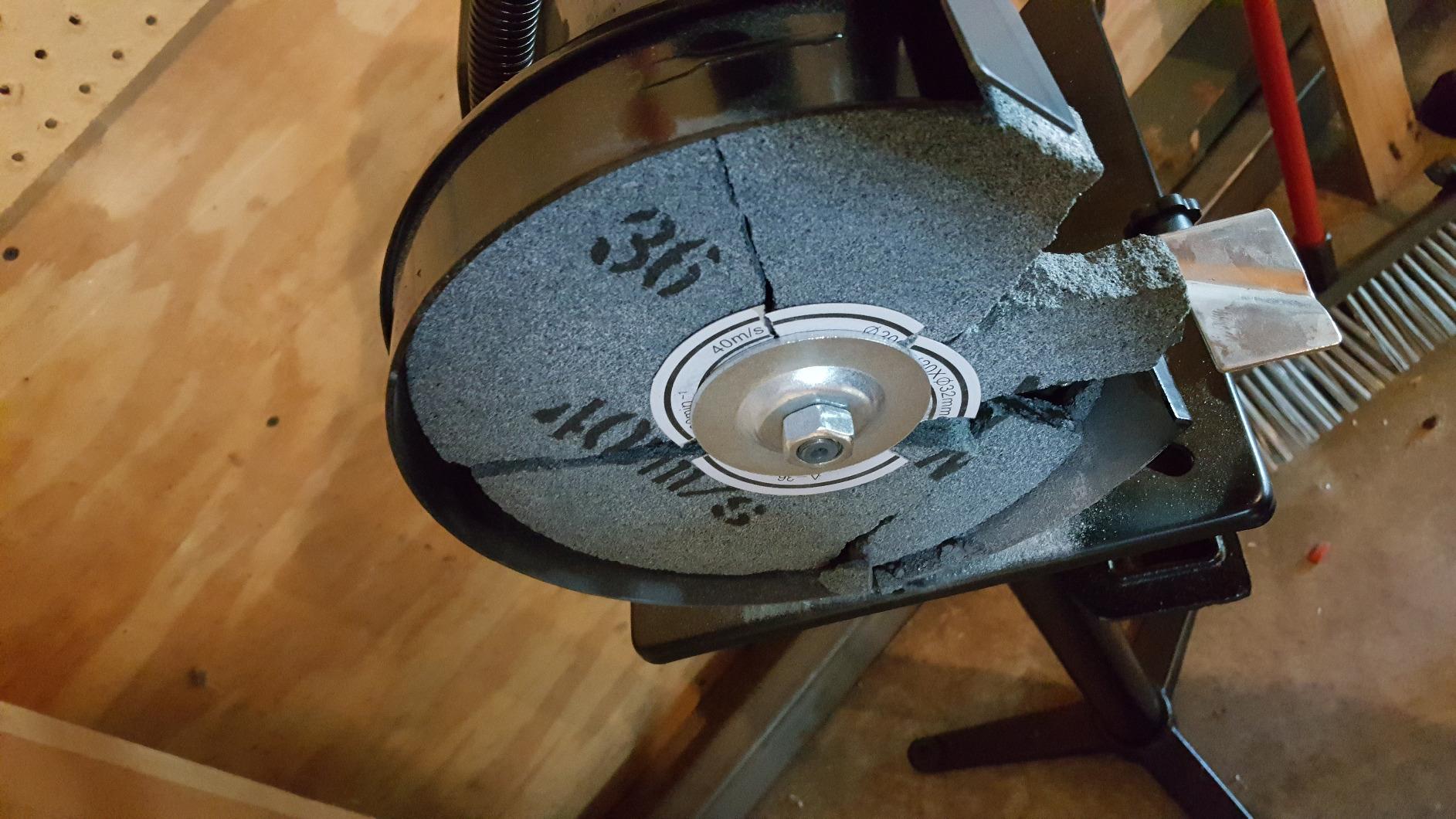
Finally, a simple maintenance routine. Check wheel integrity before every start, because a cracked wheel at 3450 RPM is the most serious hazard on this list. Dress the wheel, keep the spark guard positioned, wear eye protection and hearing protection, and let the wheel do the work rather than pressing the blade into it. Clamping a knife in a vice is the behaviour that causes gut reactions and gouges, and it has no place in a sharpening workflow.
When You Should NOT Buy a Bench Grinder
Do not buy a bench grinder if you own a small set of good kitchen knives and no other hand tools, if you are not willing to learn angle control by hand, or if your sharpening needs are occasional. A belt grinder, an angle-controlled wet system, or a good set of stones will serve you better and cost less in ruined edges.
The main disadvantage of a bench grinder is that it has no angle control built in. You are managing three things at once, which is the angle by hand, the heat by technique, and the finish by adding a separate stropping step somewhere else. A system with a jig holds the angle for you, and a water-cooled system removes the heat from the equation entirely. That is not a small advantage when the thing you are sharpening is a good knife.
There is a second, quieter reason to skip it. A bench grinder is fast, and speed is dangerous when you are new. The dominant fear among owners is the one r/sharpening and r/knifemaking repeat constantly, which is burning the temper off modern hardened stainless, and that fear is well founded on a dry 3600 RPM wheel. If you are not confident with the technique, a slower or wetter tool is the cheaper insurance.
It also does not help you if you make knives. Bevel grinding, profile shaping and metal removal on a blade blank are belt grinder jobs, and no bench grinder in this roundup substitutes for one. The forums are clear on this point and we would rather repeat the consensus than sell you the wrong machine. If you are still deciding, our magnetic knife strip guide covers the passive storage option that suits knives you sharpen only a couple of times a year.
Frequently Asked Questions
Can a bench grinder be used to sharpen knives?
Yes, but speed and cooling decide whether it is safe. Dry wheels above 3000 RPM can generate enough friction heat in a few seconds to walk the temper on hardened stainless and leave a blue edge that is softer than the original. A low-speed machine at 1750 RPM, or any water-cooled system, removes steel at a temperature that leaves the heat treatment untouched.
Is a 6 or 8 inch bench grinder better for sharpening knives?
An 8-inch wheel is better for knife sharpening. It offers roughly twice the contact area, spreading the same hand pressure across more surface so the force per square inch, and therefore the heat, is lower. A 6-inch wheel only wins when speed is low, the bench is small, or the machine is chosen mainly for chisels and turning tools rather than edges.
Which brand of bench grinder is considered the best?
The RIKON 80-805 is the most consistently recommended brand for knife work, because its 1750 RPM speed is the most forgiving and it comes with 60 and 120 grit aluminum oxide sharpening wheels rather than coarse general-purpose wheels. DEWALT leads on power and build quality with the DW758, and JET and other premium brands lead on motor capacity for heavy grinding.
What grit should I use for sharpening knives on a bench grinder?
Use 36 grit only to set or reset a bevel, 60 grit to refine it, and 120 grit to finish before deburring on leather or a stone. For hardened stainless kitchen knives, 60 and 120 grit aluminum oxide cover almost all of the work. Skipping steps is what creates a deep wire edge that then takes far longer to remove.
What do professionals use to sharpen their knives?
Most professionals use a two-stage system rather than a plain bench grinder. A belt grinder or a powered wheel handles the first stage where steel comes off, and a Tormek-style water-cooled wheel, a stone, or a strop handles the second stage where the edge is finished and deburred. The angle-controlled wet systems win on repeatability and on never generating heat.
The Best Bench Grinder for Knife Sharpening in 2026: Final Verdict
The best bench grinders for knife sharpening split cleanly by how much of your work is knife work. The DEWALT DW758 8-Inch Bench Grinder is our pick overall, because the 0.75 hp induction motor, the cast iron base and the widest owner feedback in this group make it the machine least likely to disappoint you. The RIKON 80-805 is the pick for pure sharpening, because 1750 RPM and factory 60 and 120 grit wheels protect edges better than anything else here. The BUCKTOOL 8-inch 3/4 HP is the pick for anyone planning to move to CBN wheels, because its 1-1/2 inch face is built for them.
For a small bench and a beginner, the BUCKTOOL 6-inch at 4.7 stars is the gentlest place to start. For a workshop full of chisels, mower blades and turning tools, the WEN BG4282 with its 4.8-amp motor and quenching tray does more per minute than anything in this list.
Whichever one you choose, the rule that matters most is simple. Slow speed, light passes, a dressed wheel, and no vices. A grinder that cannot heat your blade is worth more than one that can grind faster, and that is the whole reason the best bench grinders for knife sharpening are not the most powerful machines on the market.