
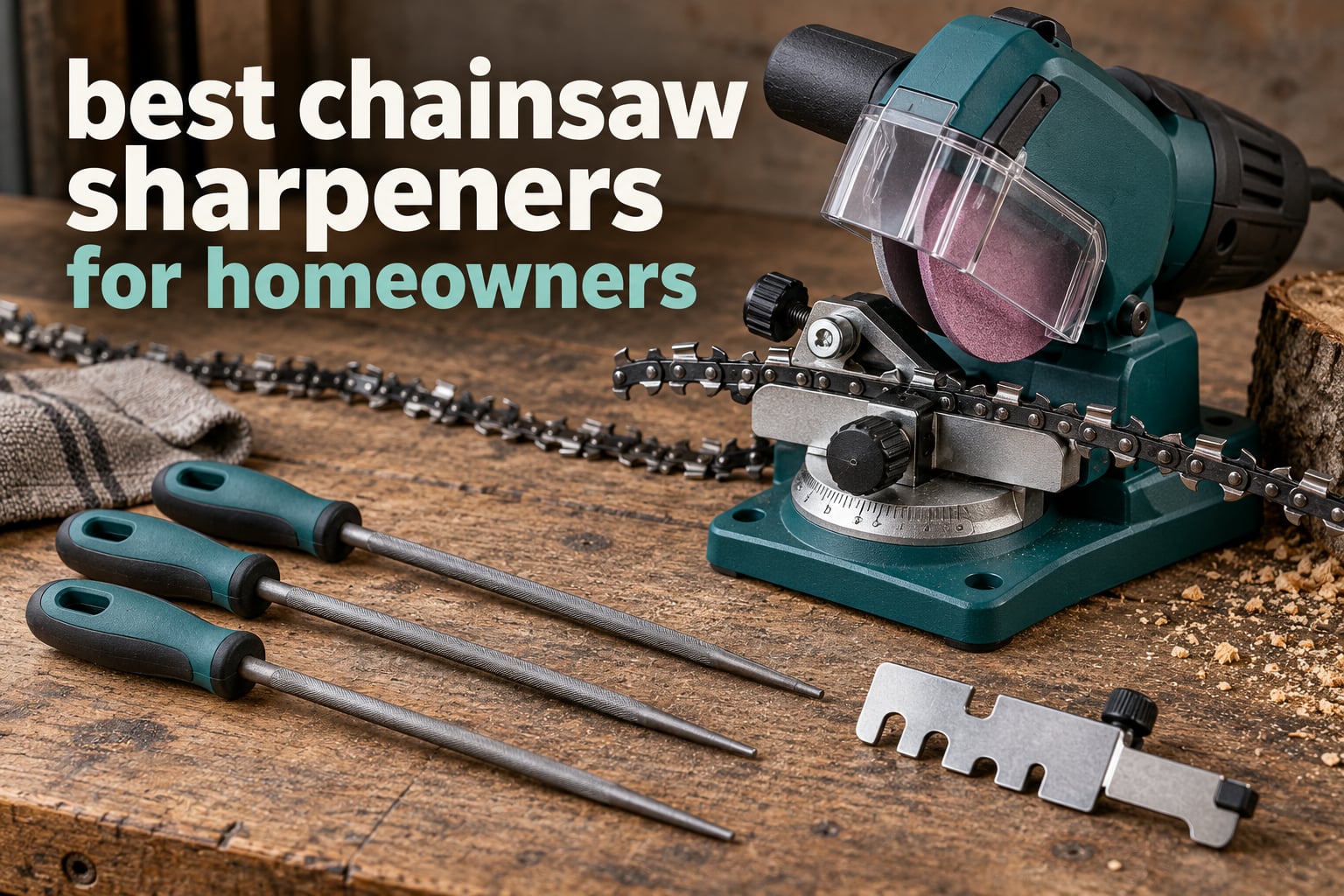
You know the moment your chain has gone dull. The saw starts producing fine powder instead of fat wood chips, the engine note climbs, and suddenly you are leaning into the bar to get through a log you should have sliced. That dull-chain diagnostic is the reason most homeowners end up looking for a sharpener in the first place, and it is exactly where this guide starts.
A dull chain is not just slow. It runs hotter, which wears the chain and the bar faster than you have any right to make them wear, and it throws more fine dust into the air.
A chain that will not bite cleanly is a chain that binds, which is the trigger condition for kickback. Keeping an edge on your chain is the cheapest safety and fuel upgrade available to anyone who owns a saw.
A manual file kit with a guide is slower but produces the most consistent edge and puts you in control of the depth gauge. A handheld electric sharpener is two to three times faster and easier on hands and joints, at the cost of some angle consistency.
A bar-mounted file guide is the most precise of the three and takes real practice to set up. Our picks below cover all three families, ranked on the attributes that actually decide the purchase: pitch coverage, whether the tool can set the depth gauge, build quality, and how the owners who bought it rate the result.
If you have not chosen your saw yet, our guide to the 12 best chainsaws for homeowners covers the models most of these kits are built around.
Table of Contents
Top 3 Chainsaw Sharpeners for Homeowners
The Oregon Universal Field Kit takes the top slot because it covers the three most common chain pitches, holds the filing angle, and works with almost no learning curve. The Stihl 2-in-1 wins for owners of one saw who want a single tool that does everything. The EzzDoo leads the electric picks for anyone who would rather not make hundreds of repetitive strokes.
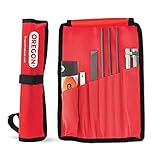
Oregon Universal 7-Piece Field Kit
- 5/32 3/16 and 7/32 inch round files
- 6 inch flat file
- Metal file guide and travel pouch
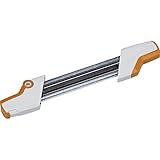
Stihl 2-in-1 Easy File
- Built for .325 inch low profile chain
- Files and sets the depth gauge in one tool
- Compact two-in-one jig

EzzDoo Electric Sharpener Kit
- Sharpens with the chain still on the bar
- Six titanium-coated diamond bits
- Angle guide attachment
Best Chainsaw Sharpeners for Homeowners in 2026
The table below covers all twelve picks. Every entry lists the type, the file or stone sizes it ships with, and the single feature most likely to decide your purchase.
| Product | Specifications | Action |
|---|---|---|
| Oregon Universal Chainsaw Field 7-Piece Sharpening Kit |
|
Check Latest Price |
| Stihl 2-in-1 Easy File Chainsaw Chain Sharpener |
|
Check Latest Price |
| EzzDoo Electric Chainsaw Sharpener Kit |
|
Check Latest Price |
 Sharp Pebble Electric Chainsaw Sharpener Kit Sharp Pebble Electric Chainsaw Sharpener Kit |
|
Check Latest Price |
 Oregon 12 Pack 7/32 Inch Saw Chain Files Oregon 12 Pack 7/32 Inch Saw Chain Files |
|
Check Latest Price |
 Granberg G106B File-N-Joint Bar Mounted Guide Granberg G106B File-N-Joint Bar Mounted Guide |
|
Check Latest Price |
 Husqvarna File Kit for 3/8 Inch Pitch Chains Husqvarna File Kit for 3/8 Inch Pitch Chains |
|
Check Latest Price |
 Oregon 12V Sure Sharp Electric Chain Sharpener Oregon 12V Sure Sharp Electric Chain Sharpener |
|
Check Latest Price |
 Hipa 12 Pack Universal Chainsaw File Kit Hipa 12 Pack Universal Chainsaw File Kit |
|
Check Latest Price |
 Honoson 3 Piece Chainsaw File Set Honoson 3 Piece Chainsaw File Set |
|
Check Latest Price |
 TARIST 6 Piece Chainsaw File Set TARIST 6 Piece Chainsaw File Set |
|
Check Latest Price |
 KAKEI 8 Pack Chainsaw Sharpening File Kit KAKEI 8 Pack Chainsaw Sharpening File Kit |
|
Check Latest Price |
1. Oregon Universal 7-Piece Field Sharpening Kit – Best Overall
Oregon Universal Chainsaw Field 7 PIece Sharpening Kit
Manual universal kit
5/32, 3/16 and 7/32 inch files
6 inch flat file
File guide and pouch
Pros
- Covers the three most common chain pitches in one kit
- Files are straight and need only a few passes per tooth on a maintained chain
- Metal file guide holds a consistent depth gauge setting
- Roll-up canvas pouch keeps the set together in a truck bed
Cons
- Instruction sheet is thin on technique
- Only one handle supplied so the flat file has none
- Canvas pouch is not waterproof
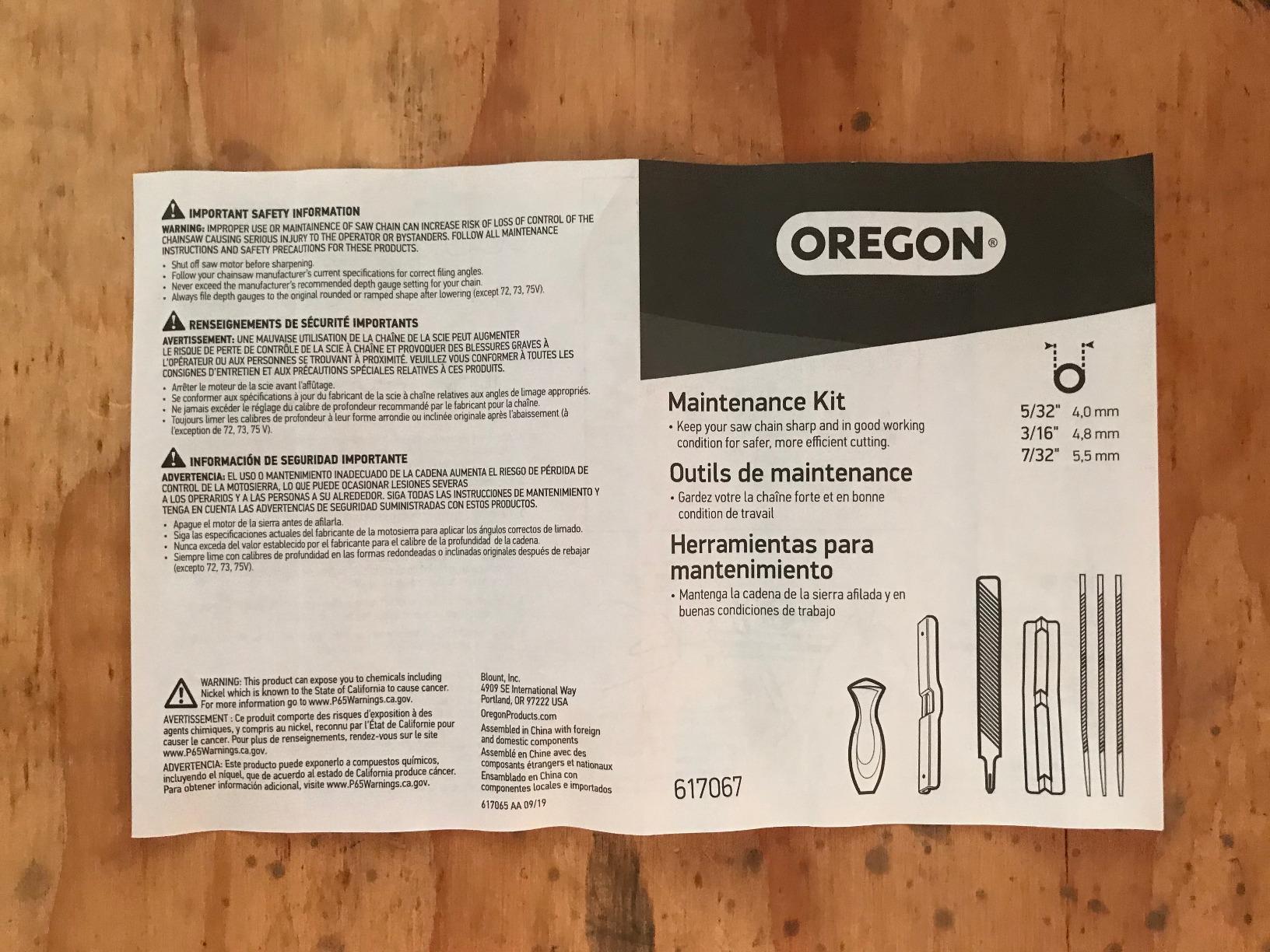
The Oregon Universal Field Kit is the best chainsaw sharpener for homeowners who own more than one saw or are not certain what chain pitch they will end up running. It ships with 5/32, 3/16 and 7/32 inch round files plus a 6 inch flat file, which together cover the overwhelming majority of homeowner chains.
What earns it the top spot is the metal file guide. A guide holds the correct 25 to 35 degree angle against every tooth and doubles as a depth gauge tool, which is the part beginners struggle with most. Owners report needing only three or four passes per tooth on a routinely maintained chain, so a full bar takes minutes rather than an evening.
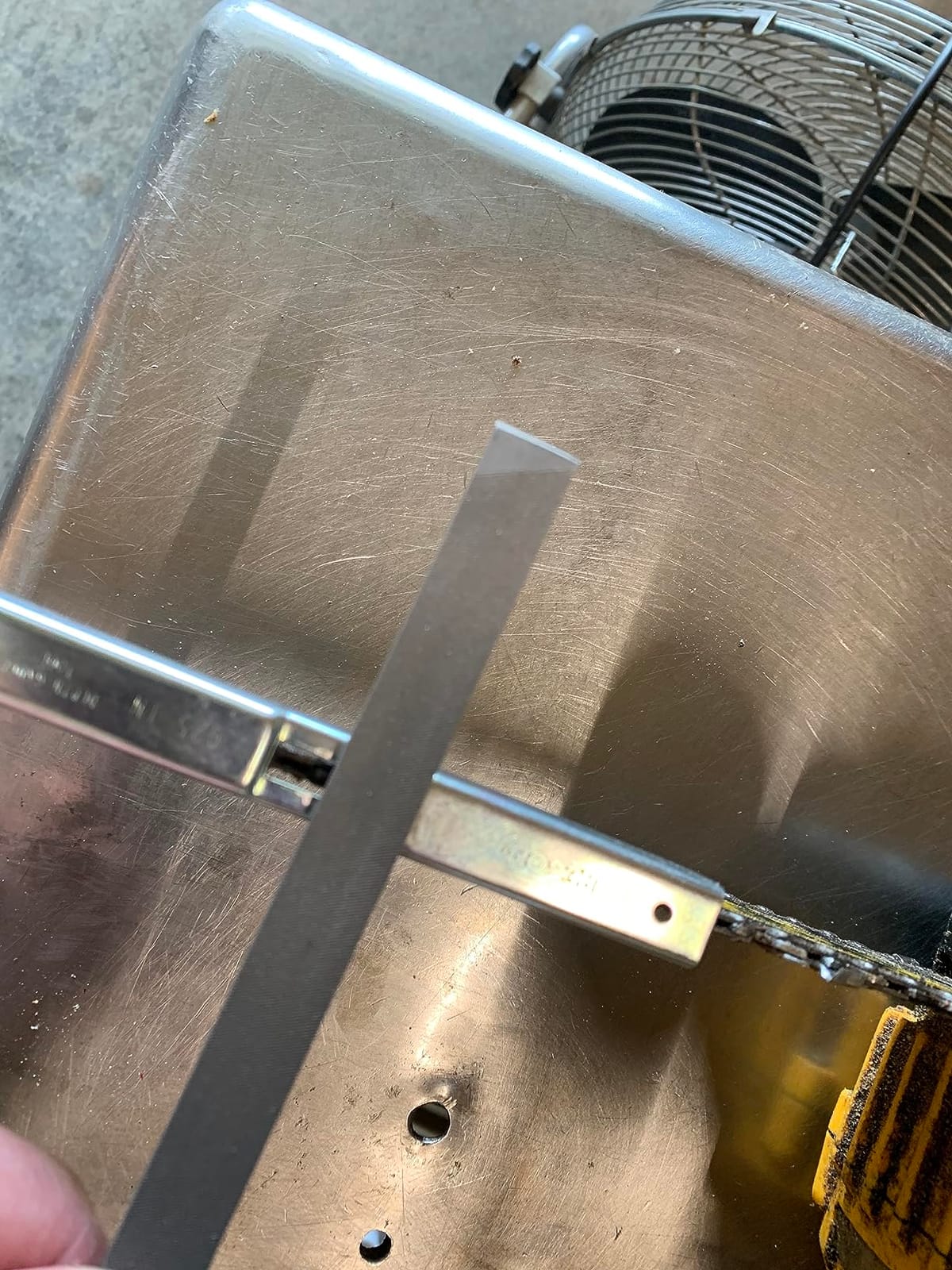
The kit is rated 4.7 out of 5 across 7914 reviews, and the volume matters here. This is not a product with a thin handful of testers, it is one that thousands of owners have put through real duty cycles. Reviewers frequently note it produces a more consistent result than a Stihl-style jig they used before.
Two flaws are worth knowing before you buy. Only one handle is included, so the flat file for tidying rakers has no handle of its own, and the canvas pouch is not rubberized, which means it should live in a dry place between uses.
When this kit is the right buy
Buy it if you have a gas saw in the 16 to 20 inch range plus a pole saw or a second bar, or if you simply do not want to check the pitch marking on your bar before every sharpening session. The three included files remove the single most common beginner mistake, which is using the wrong diameter and damaging the cutters.
It is also the best choice for anyone who sharpens in the field, since the pouch holds the whole set rather than a loose file rolling around a truck bed.
When to pick something else
If you have arthritis in your hands or shoulders, hundreds of repetitive strokes are a genuine problem, and a handheld electric sharpener will get you there faster with less fatigue.
If you cut once or twice a year, the twelve-piece kits further down this list cost less and cover the same ground.
2. Stihl 2-in-1 Easy File – Best Premium Manual Jig
Stihl 2 IN 1 EASY FILE CHAINSAW CHAIN SHARPENER .325″
Manual filing jig
Built for .325 inch chain
8.26 mm pitch, 0.33 inch gauge
72 drive link chains
Pros
- Brand-name Stihl engineering in a compact all-in-one jig
- Two-in-one design files cutters and lowers depth gauges together
- Chain geometry matched to low profile .325 saws
Cons
- Only works on .325 inch low profile chain
- Shorter platform than a bar-mounted guide on longer bars
The Stihl 2-in-1 Easy File is the best chainsaw sharpener for a homeowner who owns one specific saw and wants a single tool that does the whole job. Its ratings cluster hard at five stars, with 83 percent of 4119 reviews at the top mark and only a thin tail of one-star feedback.
The design is the point. A single compact platform files the cutting edges and then slides forward to lower the depth gauges, so the two jobs that beginners routinely get wrong are handled by the same tool with the same reference geometry. The listed pitch is 8.26 millimeters with a 0.33 inch gauge.
Forums that lean on Stihl hardware tend to treat this as the reference manual jig, largely because the built-in angle guides are stamped into the tool rather than stamped onto a plastic housing. That reference geometry is the reason the file comes out consistent from tooth to tooth.
The limitation is simple and unavoidable. This is not a universal sharpener, it is built for .325 inch low profile chain, so if your bar is marked with a different pitch you need a different tool.
When this jig is the right buy
Buy it if your bar is stamped .325 inch and you cut regularly enough to want a filing tool that never needs adjusting. A Husqvarna 455 Rancher or a Stihl MS 250 in its common configurations run low profile chain, which makes this a natural fit.
It is a small tool that lives in a shed and comes out when the firewood season starts.
When to pick something else
If you own a full-compact or mini saw running 3/8 low profile or quarter-inch chain, this jig will not touch it. If you split your time between a saw and a pole saw, the Oregon Universal kit at number one covers more configurations for a similar outlay.
3. EzzDoo Electric Sharpener Kit – Best Budget Electric
EzzDoo Electric Chainsaw Sharpener Kit with 6 Titanium-Coated Diamond Bits – Handheld Chain Saw Sharpener Tool for All Chains – No Removal Required, Easy and Fast Chainsaw Sharpening Kit
Handheld electric
6 titanium-coated diamond bits
Sharpens with chain on the bar
Variable speed
Pros
- Sharpens in place with no chain removal
- Angle guide keeps the same angle on every tooth
- Diamond bits grind more evenly than rotary stones
- Spares for brushes and collet are included in the case
Cons
- Motor runs warm during extended use
- Diamond bits wear through a full session
- Angle guide can obstruct a user who already knows the angle
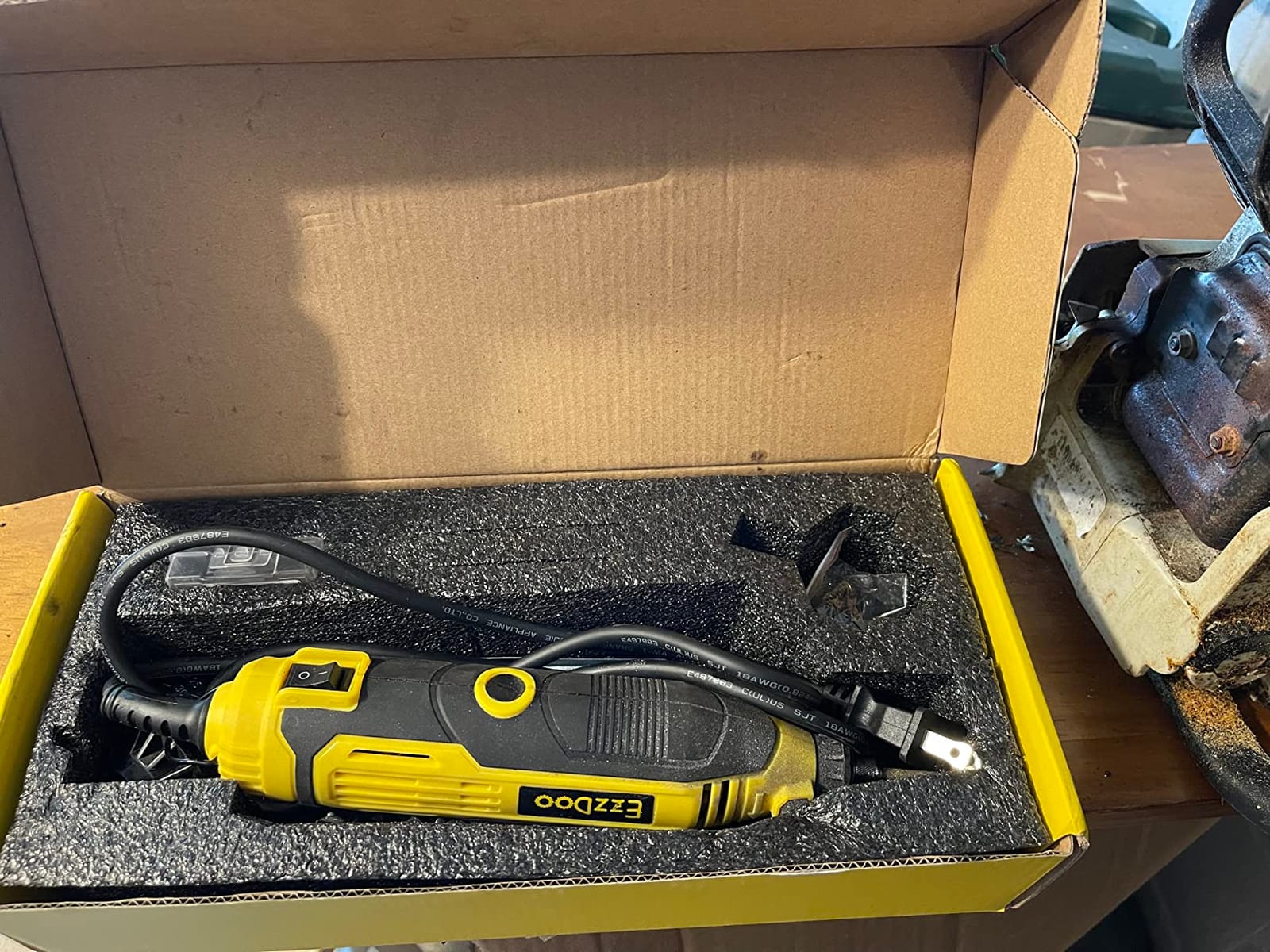
The EzzDoo Electric Sharpener Kit is the best electric chainsaw sharpener for homeowners who want speed without giving up angle consistency. It holds 4.4 stars across 4002 reviews, and those reviews are overwhelmingly about the same two things, speed and evenness.
The design sharpens the chain while it is still mounted on the bar. That removes the two most tedious parts of the job, loosening the bar nut and re-threading the chain, and owners report cutting the total job time by roughly two thirds compared with hand filing.
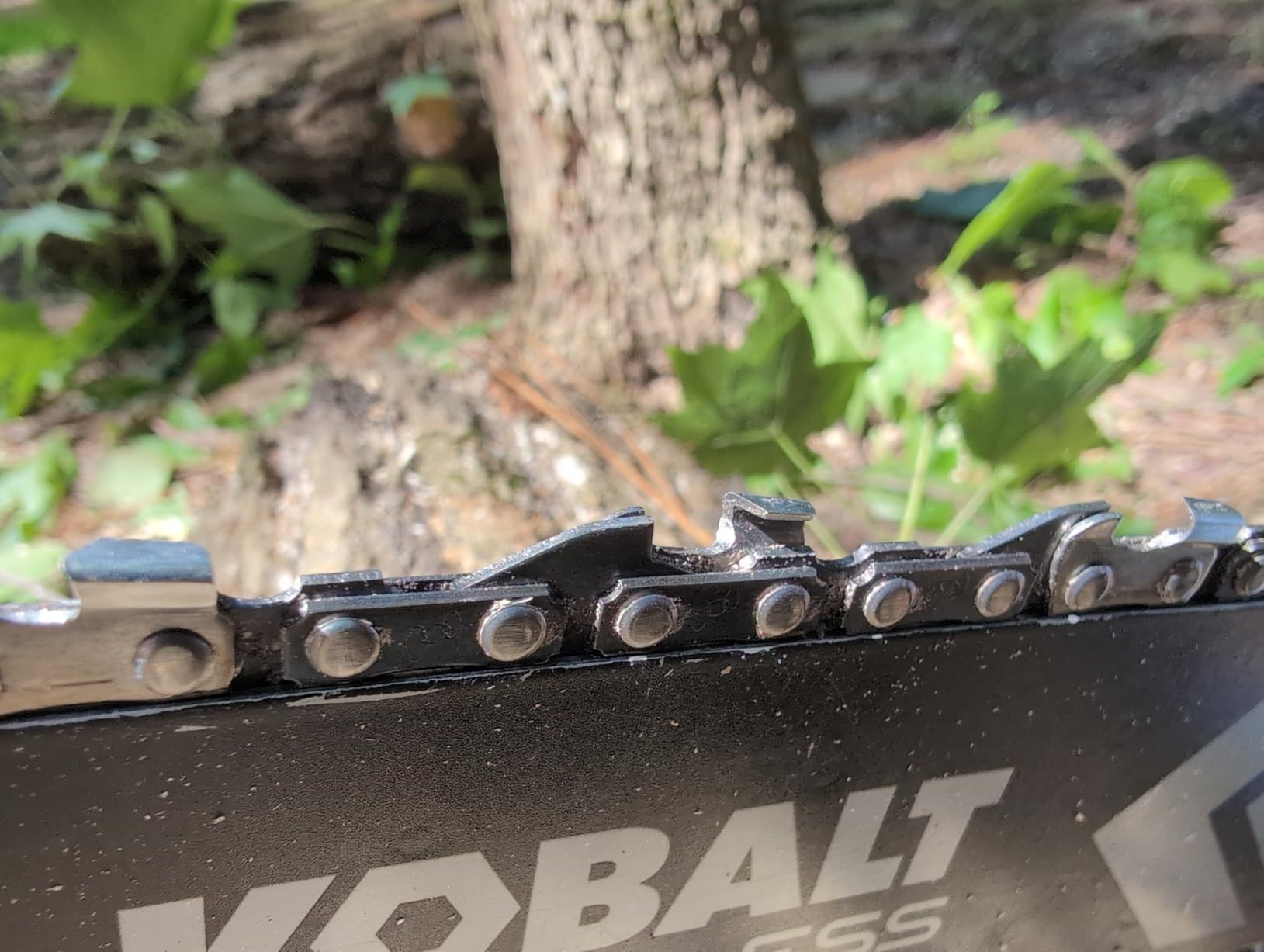
Six titanium-coated diamond bits in three common sizes cover the pitches most homeowner saws run. The angle guide attachment carries markings for either direction of stroke, so the tool can be used the same way whether you file toward the bar or away from it, and the variable speed control lets you dial down for the bits as the manufacturer recommends.
It is also a genuinely useful option for anyone whose hands or joints make repetitive filing painful. The claimed bit life is five or more chains under normal use, and the case includes spare carbon brushes, a spare collet and both wrench sizes.
Real complaints cluster around heat and consumables. The motor runs warm during extended sessions, and the diamond bits wear down over a full sharpening pass, so keep the spares close. The included instructions are thin, though a QR code links to fuller documentation.
When this sharpener is the right buy
Choose it if you cut regularly, if filing by hand tires your hands, or if you sharpen chains without wanting to remove them from the bar. The angle guide does the hard part of the job for a beginner, and the dual-direction markings mean it works whether you are left- or right-handed.
It also pairs well with a battery mini chainsaw if that is your only saw, since the whole point is that nothing has to come apart.
When to pick something else
If you care about edge consistency above all else, forums are near-unanimous that a properly used hand file and guide produces a better, more repeatable edge than any grinder, because heat and speed work against you. If your joints are the issue but you want a machine, a manual jig with a longer platform may be easier on you than any powered tool.
Note also that it does not adjust the depth gauges, which is the reason some owners move away from electric units entirely.
4. Sharp Pebble Electric Sharpener Kit – Best Plug-In Setup
Sharp Pebble Electric Chainsaw Sharpener Kit – Chain Saw Sharpening Tool
120V plug-in sharpener
4 grinding wheel sizes
Angle guide and wrench
Adjustable speed settings
Pros
- Angle guide makes a consistent angle across the whole chain
- Four wheel sizes cover the most common chain pitches
- Adjustable speeds match the bit types
- Light enough to keep in a truck or carry to the wood lot
Cons
- Grinding wheels wear and need replacing during use
- Wheel consumables cost more to keep stocked than a plain file
- Mains power only with no battery or 12V option
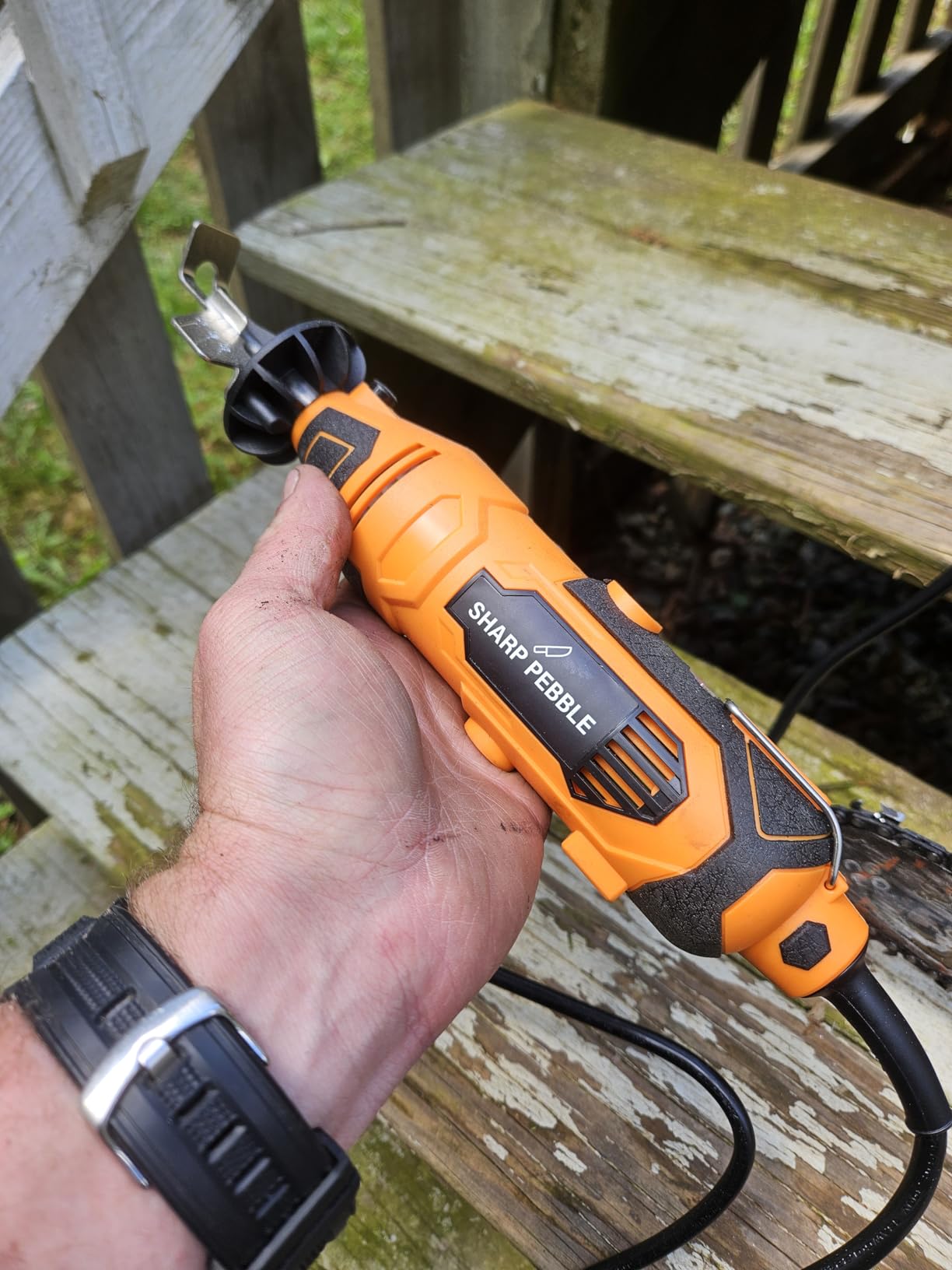
The Sharp Pebble kit is the best chainsaw sharpener for a homeowner with a proper bench and a wall outlet, because it assumes you are stationary. It plugs into 120V mains, weighs 16 ounces, and at 7.99 inches long it takes up almost no bench space.
What makes it useful is the way the angle guide and the speed settings work together. You dial the grinding angle in once, then walk the chain through tooth by tooth on a repeatable path, which is exactly what a beginner needs and the reason buyers credit it with cutting their learning curve.
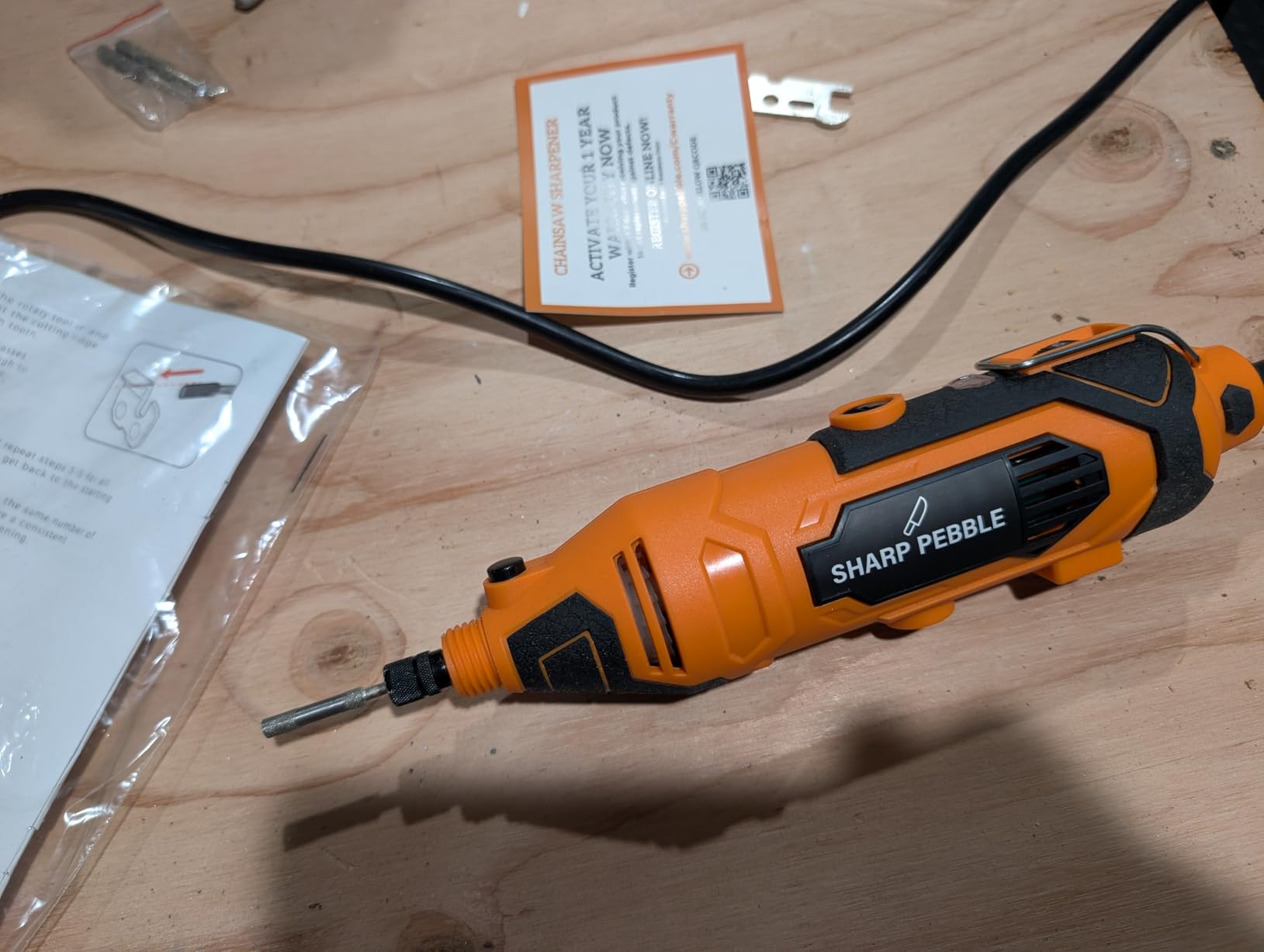
Four grinding wheel bits ship in the box, covering 5/32, 3/16 and 7/32 inch diameters plus a duplicate 7/32, and adjustable speed settings let you match the rotation to the bit material. The bearings are described as quality-grade for stable disc rotation, which matters because a wobbling wheel is what gouges cutting links.
It holds 4.4 stars across 3813 reviews with 68 percent at five stars. The negative feedback is not about performance, it is about running costs and the plug.
The unit needs a mains outlet, so it is not a field tool, and the wheels are consumables that cost more to keep stocked than a plain round file. If you cut in the woods on a weekend, that trade is not worth it.
When this sharpener is the right buy
Pick it if you have a workbench and an outlet within reach, and you want an electric without a battery platform to maintain.
Four sizes in one box also means it covers a mixed saw fleet without extra purchases, and it suits anyone who has never sharpened a chain and wants the angle set for them rather than judged by eye.
When to pick something else
If your sharpening happens at the stump, in a truck bed, or anywhere without power, this is the wrong category. A 12V unit with a long cable is the correct answer for field work.
And if you are on a strict consumables budget, a round file costs a fraction of a diamond wheel and lasts through many more touch-ups.
5. Oregon 12-Pack 7/32 Inch Saw Chain Files – Best for 3/8 and .404 Chains
“Oregon 12 Pack Chainsaw File Pack 7/32″” # 70502 Works On All Chainsaw Models With 3/8 And .404 Pitch Chains”
12 pack of 7/32 inch files
Part 70502
Double-cut teeth
10 inch files
Pros
- Double-cut teeth stay sharp longer and resist clogging
- Twelve files means many sharpenings per purchase
- Even tooth height removes metal faster and more smoothly
- Works with standard and Sure Sharp bar-mounted guides
Cons
- One file may not fully resharpen a badly dull chain
- Single diameter only so it will not fit 5/32 or 3/16 chains
- No handle or guide included
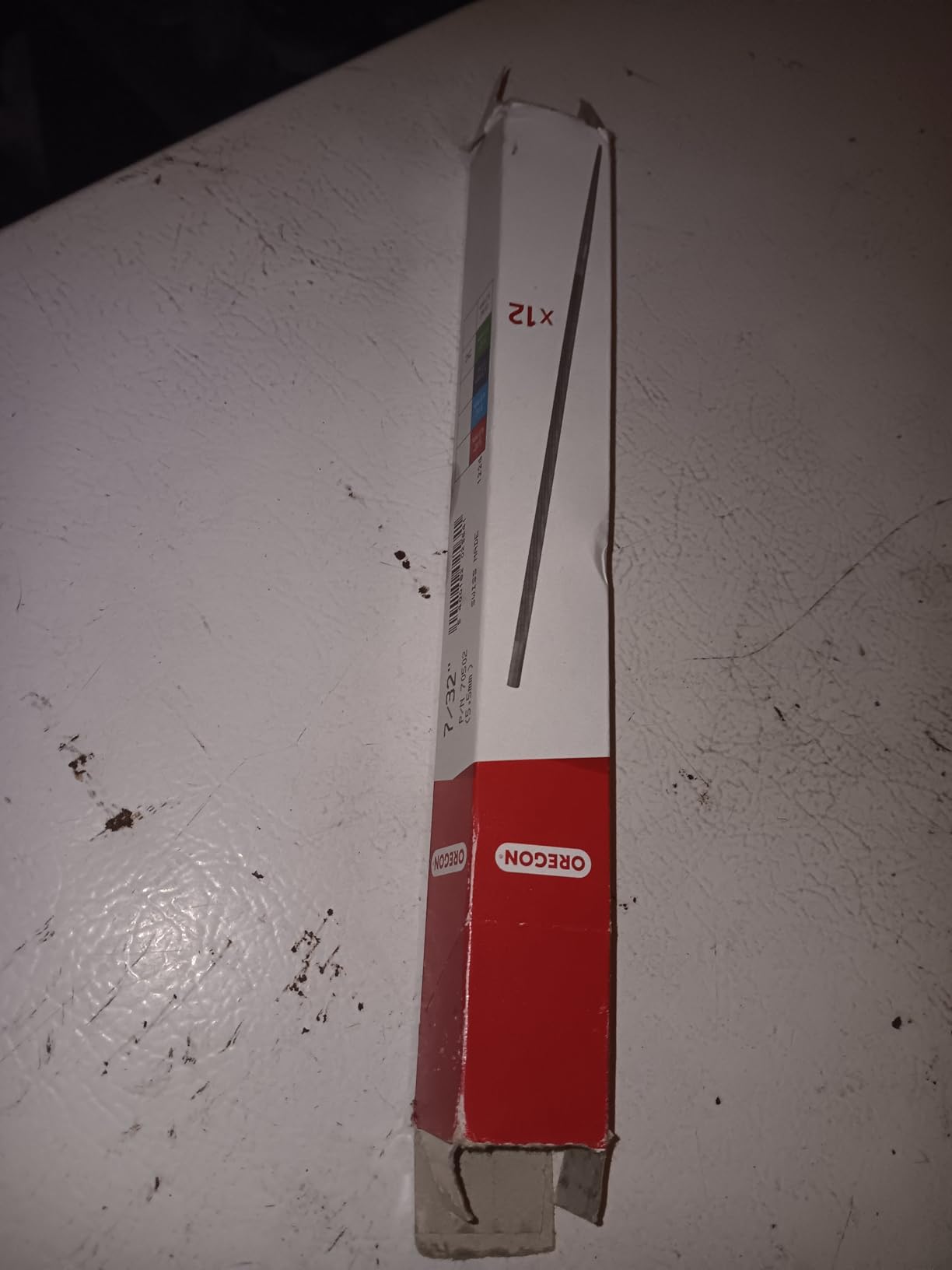
The Oregon 12-pack of 7/32 inch files is the best value pick for anyone running 3/8 inch or .404 pitch chain, which covers a lot of older full-compact saws and a good share of firewood setups. Each file is 10 inches long with a part number of 70502.
The reason to buy Oregon files over generic ones is the tooth geometry. These are double-cut, and owners consistently report that the cut stays clean and the file resists clogging, which matters because sap and pitch gum up a single-cut file fast.
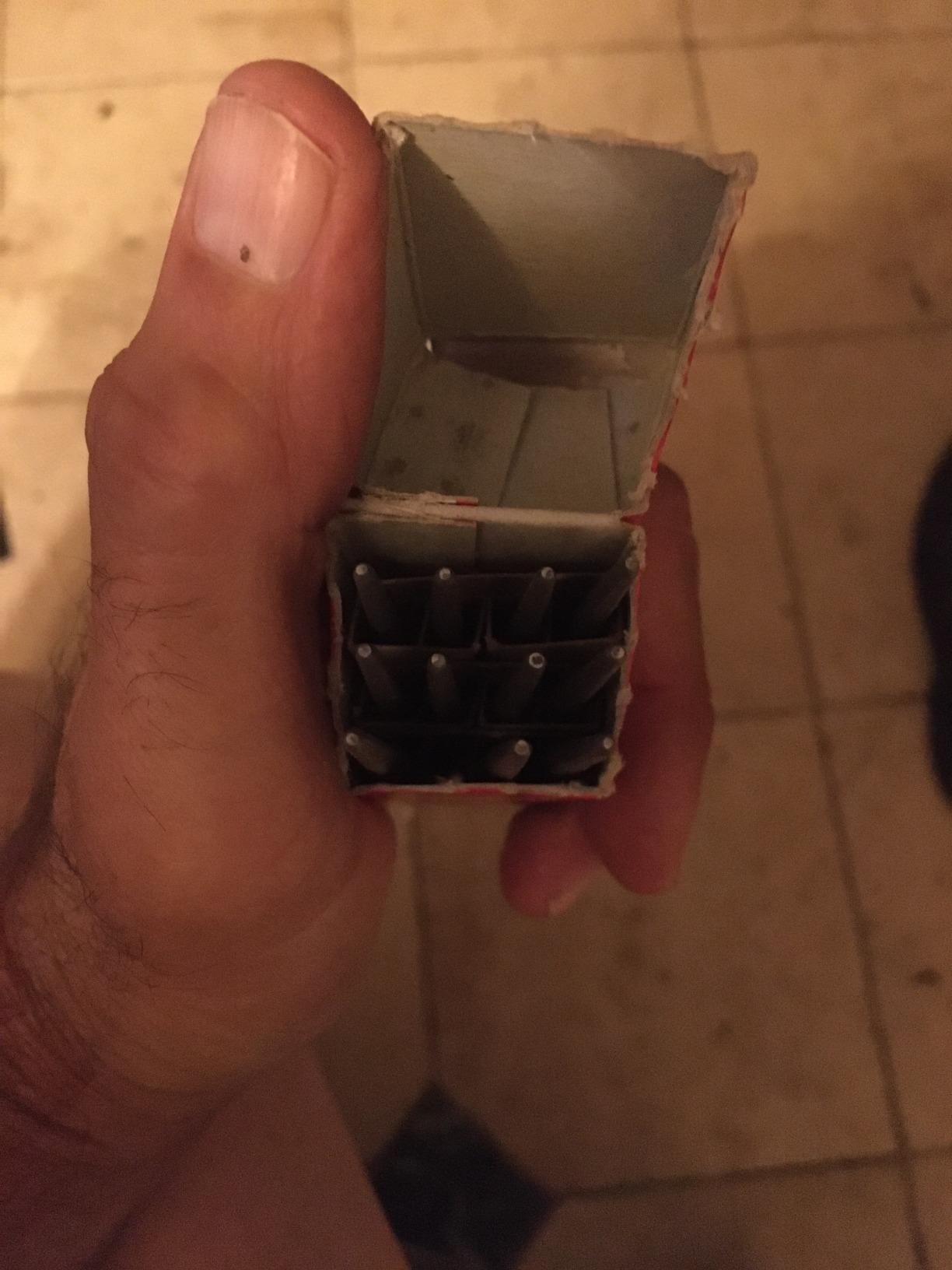
At 4.7 stars across 1700 reviews, the pack is rated above the electric units here, and the review volume is substantial enough to be meaningful. Buyers highlight the cut quality and the fact that a dozen files covers years of routine maintenance.
It is a consumable, not a system. There is no handle, no guide and no depth gauge in the box, so you need those separately, and if your bar is not 3/8 or .404 pitch the diameter is wrong from the start.
The one recurring complaint is that a single file can lose bite partway through a long chain, which makes this a better buy for routine touch-ups than for rescuing a badly neglected bar.
When this file pack is the right buy
Buy it if your bar is marked 3/8 or .404 pitch and you already own a guide, or if you want a stock of consumables that will not rust on a shelf for a year between uses.
It also fits the Sure Sharp style bar-mounted guides, so it pairs with a guide system rather than replacing one. Owners with several chains of the same pitch will find the twelve-pack beats buying singles repeatedly.
When to pick something else
If you are starting from nothing, you want a kit with a handle and a guide rather than bare files. If you own a low profile or quarter pitch saw, the diameter is simply wrong and the file will not enter the cutter properly.
And if your chain is badly dull rather than just untended, budget for more than one file per bar.
6. Granberg G106B File-N-Joint Bar Mounted Guide – Best Bar-Mounted System
Granberg Chainsaw Sharpener, G106B, File-N-Joint Bar Mounted Guide System
Bar-mounted filing guide
Cast aluminum body
Sets angle and lowers rakers
Files not included
Pros
- Bar-mounted design indexes the next tooth for even tooth length
- Cuts filing time noticeably on longer bars
- Handles angle and depth gauge in the same pass
- Cast aluminum body is rigid and does not flex during strokes
Cons
- Files are not included so it is an add-on to a file kit
- Mounting and adjusting the jig takes practice
- Highest priced manual guide in this roundup
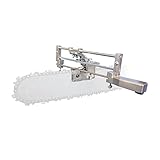
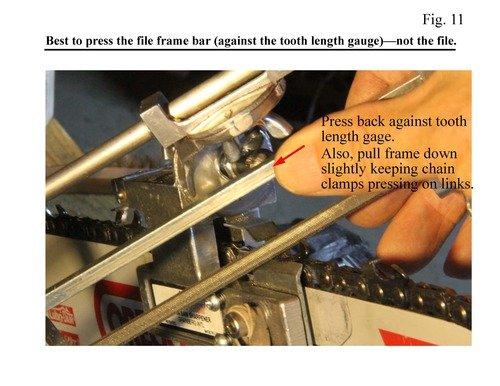
The Granberg G106B is the most precise manual system here and the right choice for a homeowner who already files but wants every tooth identical. It clamps to the bar itself, so the guide moves tooth by tooth instead of relying on your stroke count.
That single design decision is the whole story. A bar-mounted guide indexes the chain, sets the filing angle and lowers the depth gauges in one pass, and the cast aluminum body with zinc-plated steel hardware does not flex as you push a file through it.
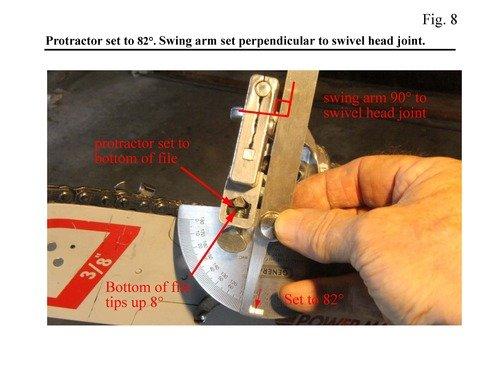
The 4.3 average across 1429 reviews reflects real enthusiasm and real friction. Users who have worked with bar-mounted systems rate the approach as proven and repeatable, particularly on longer bars where freehand filing is slow and tiring. The friction is in the setup, which takes practice.
Be clear about what you are buying. This is the guide only. It is made in the USA, it fits standard chain pitches, and files are not included, so you need a separate file kit to pair with it. That adds cost on top of an already higher-priced guide.
Because it mounts to the bar, the bar has to come off the saw, which partly defeats the convenience of the handheld electric units earlier in this list.
When this system is the right buy
Choose it if you already have the file-filing habit and want the output to be measurably more even, or if your bar is long enough that freehand filing is genuinely tiring. It is a strong second-stage tool that pairs naturally with a portable kit for touch-ups in the field.
It also suits anyone who has sharpened before by eye and was not confident the result was correct.
When to pick something else
If you are a beginner, the learning curve is real, and a simple guide in a complete kit will get you a good edge faster. If you want to sharpen without removing the chain, this is the wrong design.
It is also the most expensive manual entry here before you add files, so for occasional use the economics favor a file kit alone.
7. Husqvarna File Kit for 3/8 Inch Pitch Chains – Best for Husqvarna Owners
Husqvarna Chainsaw File Kit for 3/8″ Pitch H Chainsaw Chains, Sharpening Kit Includes Handle, Combination Guide, Flat and Round Files
OEM file kit for 3/8 inch chains
Part 531300081
Handle and combination guide
2 round files plus a flat file
Pros
- OEM brand kit matched to common Husqvarna 3/8 inch H-series chains
- Combination guide doubles as a roller file guide and depth gauge
- Separate round and flat files cover cutters and rakers
- Comfortable handle gives good control
Cons
- Targeted at 3/8 inch pitch so other pitch sizes need additional files
- No travel pouch so parts scatter easily
The Husqvarna file kit is the natural pick if your saw is a 3/8 inch pitch model and you would rather use the file sizes the manufacturer specified. The part number is 531300081, and it covers the H42, H45, H46, H47, H47S, H48, H48S, H50, H51, H54, H80 and H81 chains.
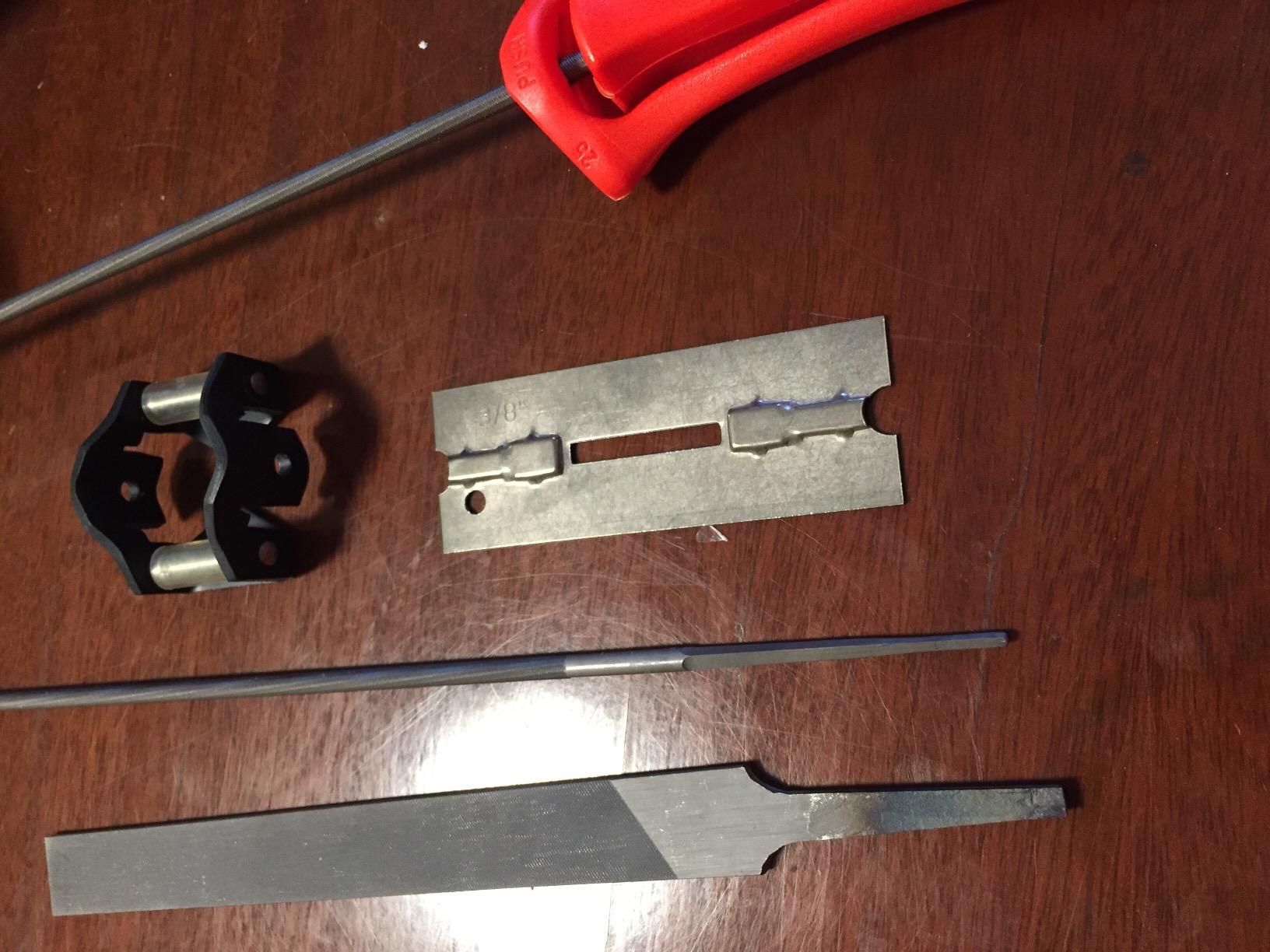
What makes it more than a bag of files is the combination guide. It works as a 2-in-1 roller file guide and a depth gauge, so the same part handles the filing angle and the raker height, which is the pairing most novices need to get right.
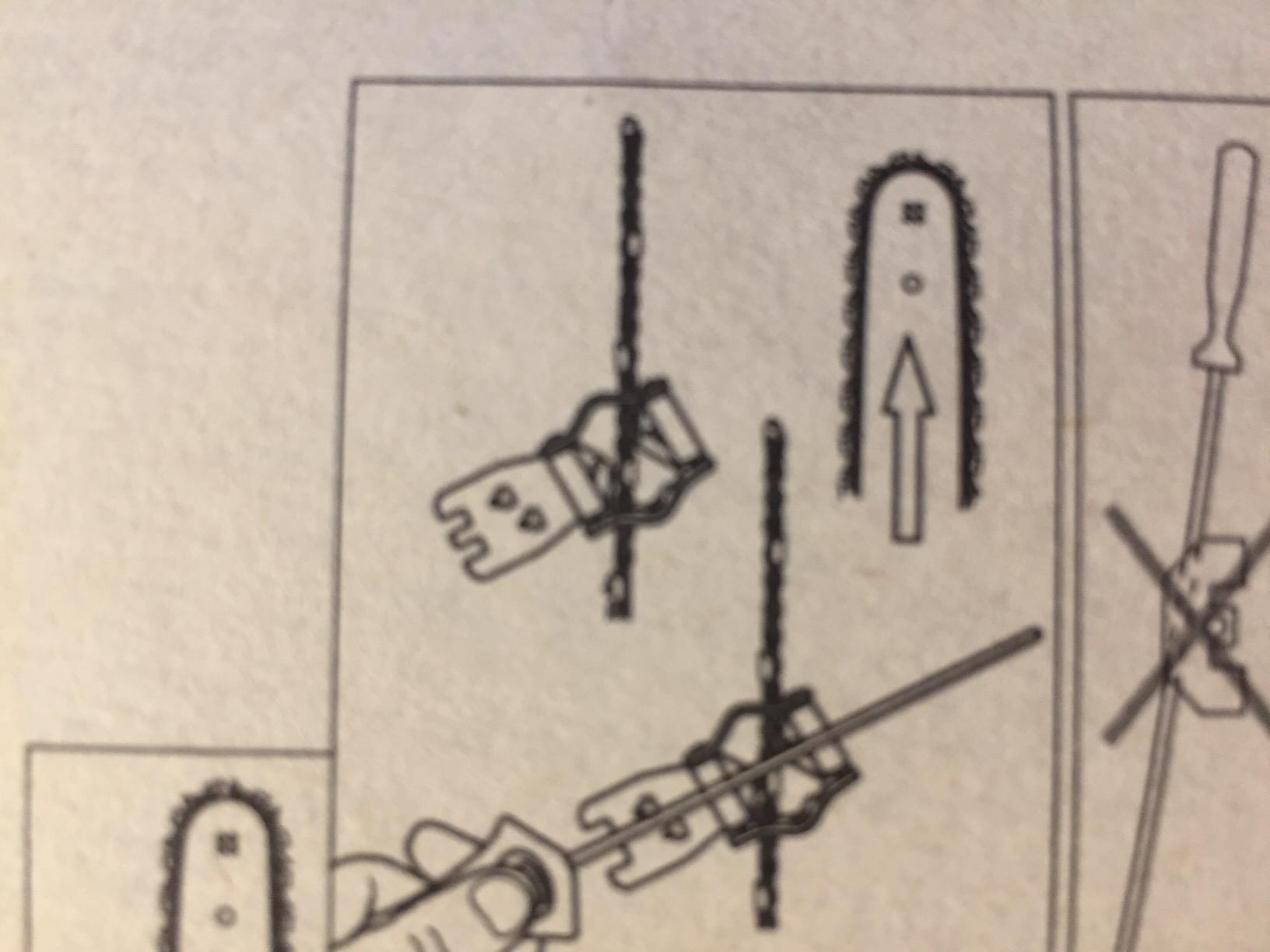
The kit includes one file handle, the combination guide, two round files and a flat file, and the handle is comfortable enough to use on both. Owners rate it 4.6 across 1311 reviews with 77 percent at five stars, and the criticism is unusually narrow, mostly about pitches the kit does not cover and the lack of a pouch.
At 4.5 ounces and 14.35 by 3.92 by 3.52 inches, it is small enough to live in a toolbox rather than on a bench.
The limitation is scope. This kit is for one pitch family, so anyone running a mix of chains should look at a universal kit instead.
When this kit is the right buy
Buy it if you own a 3/8 inch H-series Husqvarna and want OEM-specified file sizes with a guide that handles both the angle and the rakers.
If your saw is a 455 Rancher, check the pitch marking on the bar before ordering, because the common configurations differ.
It is a good second kit for a household that has settled on one brand and one pitch.
When to pick something else
If you own a mini saw, a pole saw, or a full-compact running a different pitch, the files will not enter the cutters correctly. For those setups, a multi-pitch kit is a better investment than a second single-pitch one.
It also ships without a pouch, so keep it in a bag to avoid leaving small parts behind at the wood lot.
8. Oregon 12V Sure Sharp Electric Sharpener – Best for Field Sharpening
Oregon 12V Sure Sharp Electric Chain Sharpener
12V handheld electric
16 foot cable
Covers 1/4, 3/8 LP, .325 and 3/8 pitch
3 stones included
Pros
- Cordless 12V power lets you sharpen away from an outlet
- Angle adjustment guide simplifies matching the factory angle
- Three stone sizes cover the most common pitches
- Runs up to 25000 rpm for fast tooth touches
Cons
- Stones wear and must be replaced over time
- 12V output is weaker with a drained vehicle battery
- 16 foot cord is still a lead to manage
The Oregon 12V Sure Sharp is the sharpener to pick for anyone who sharpens away from a wall outlet. It runs from a car adapter or from battery clips over a 16-foot cable, which means the chain can be sharpened on the saw at the stump instead of in the garage.
Pitch coverage is broad here. It sharpens round-ground quarter inch, 3/8 low profile, .325, 3/8 and .404 chain, and the box includes 5/32, 3/16 and 7/32 inch sharpening stones plus a collet wrench.
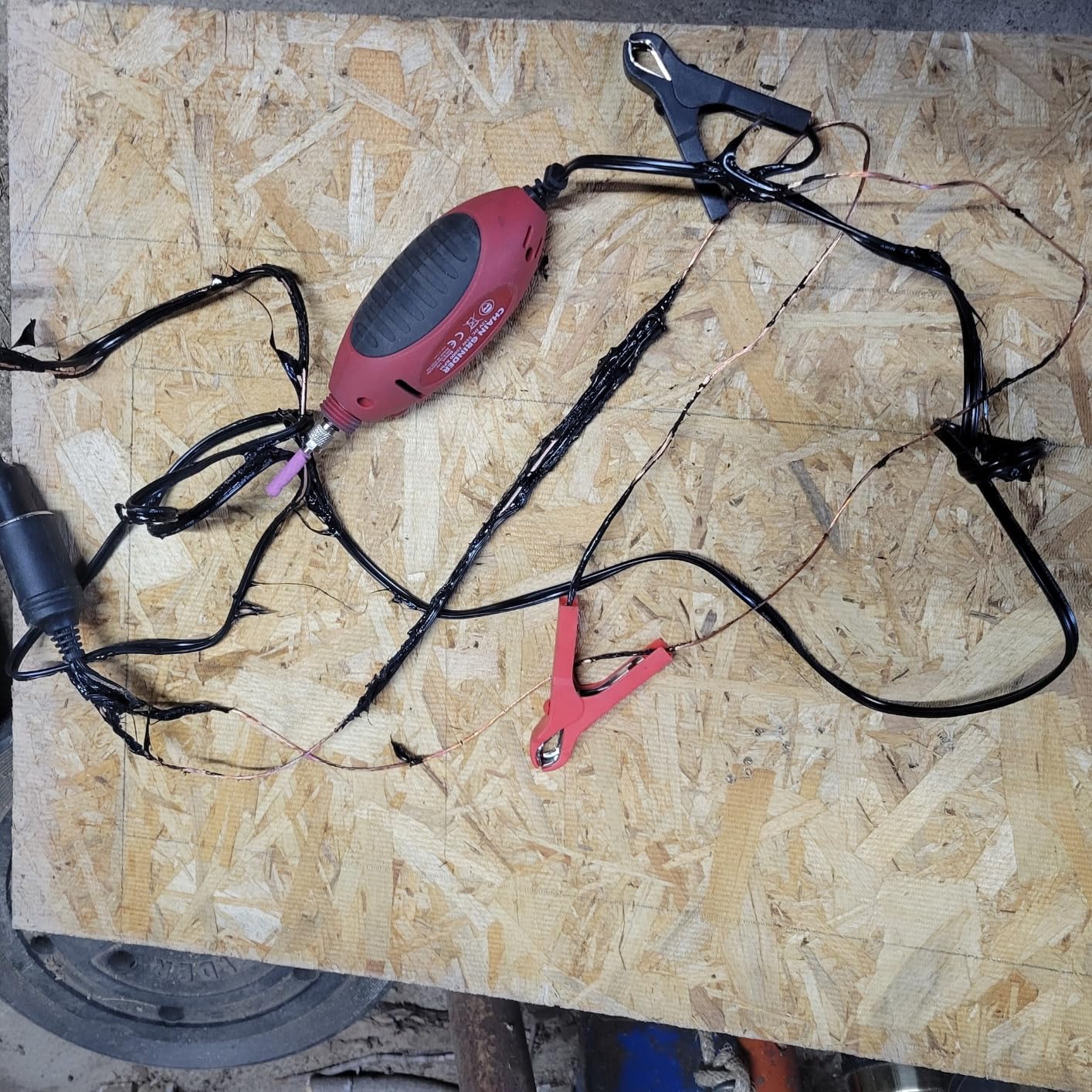
Owners consistently credit the angle adjustment guide with making a repeatable edge easier, and the 25000 rpm motor gives quick, clean passes. The 4.6 rating across 1331 reviews reflects a tool that does one job well.
There is a caveat in the forums worth hearing. The on-tool angle guide is a stamped reference line rather than a machined fixture, so it is less precise than a mounted bar guide. That is the trade for the portability.
Consumables are the other running theme. The stones wear and need replacing, and a 16-foot cable is still a lead to keep out of the chain and out of your feet while you work.
When this sharpener is the right buy
Choose it if you cut away from power, or if you keep a saw in the truck for storm cleanup and want it sharp on arrival rather than sharp next Saturday. The wide pitch coverage also makes it the safer single-tool bet for a household with mixed saws.
If you already own a vehicle with a working battery, the clips make the whole thing self-contained.
When to pick something else
If you have a bench and an outlet, a plug-in unit gives you steadier power and no cable to manage. And if the very highest level of angle consistency is what you are after, a file and guide is still the community consensus.
Replacement stones are sold separately, so treat this as a tool with a running cost rather than a one-time purchase.
9. Hipa 12-Pack Universal File Kit – Best for Mixed Pitches
Hipa 12 Pack Chainsaw File, Chainsaw Sharpener Kit, 5/32″, 3/16″, 7/32″, 1/8″, 11/64″, 13/64″ Round Chainsaw Sharpening, 6 Inch Flat File,Depth Gauge,Quick Check Gauge, Chain Saw Sharpener
12 piece universal kit
6 round files plus flat file
Quick check gauge and depth gauge tool
Pros
- Widest file size coverage including rarer 11/64 and 13/64 inch chains
- Multi-function quick gauge checks pitch angle tooth length and raker height
- Depth gauge tool plus flat file handle the full job
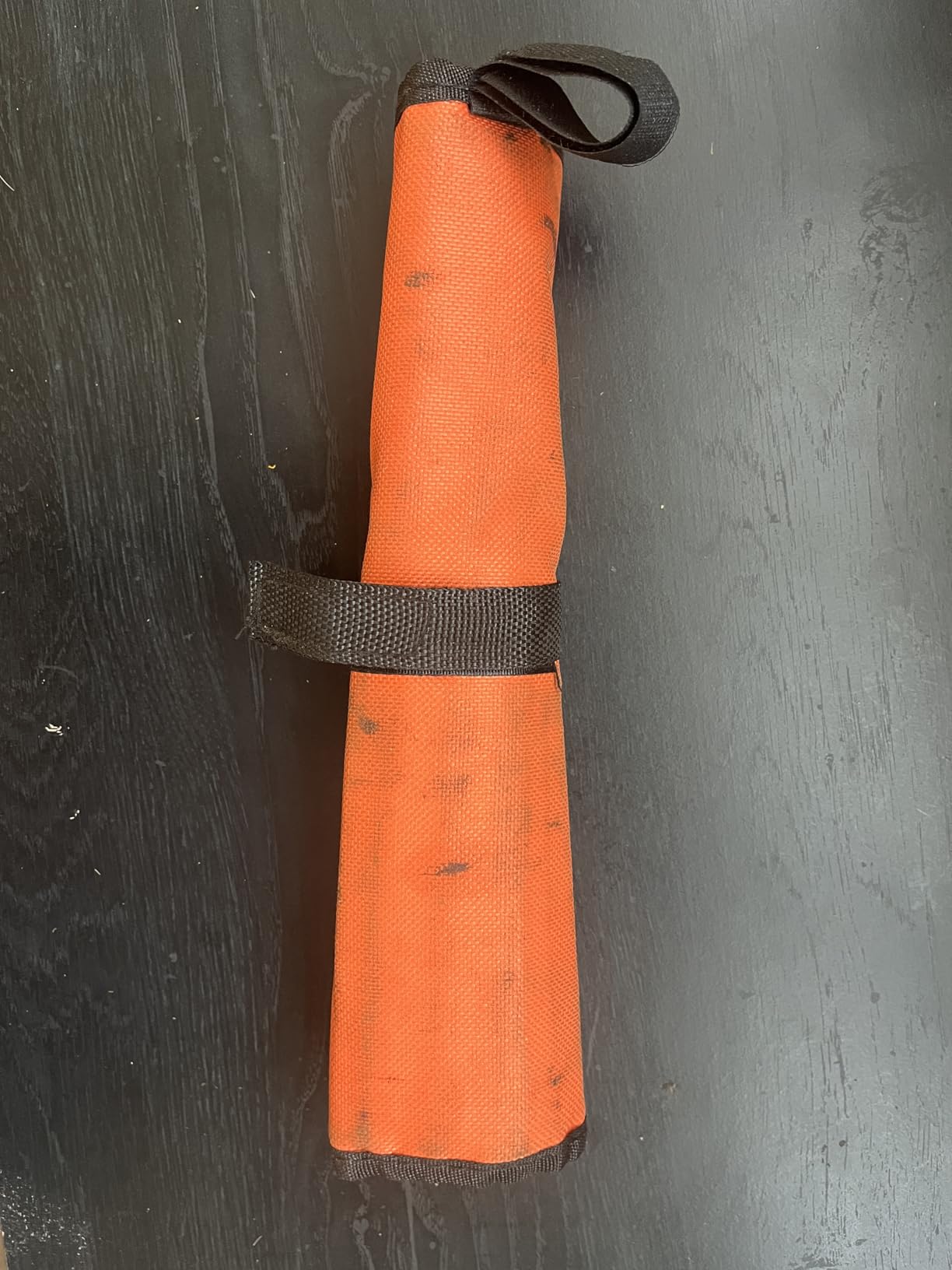
- High-visibility orange pouch is easy to find at the base of a tree
Cons
- Handle is sized for the round files so the flat file is awkward
- No metal file guide so raker setting relies on the plastic tool
- Wooden handle and pouch add bulk
The Hipa 12-pack is the widest-coverage kit in this roundup and the best choice for a household that runs several chains of different pitches. Six round files cover 5/32, 3/16, 7/32, 11/64, 1/8 and 13/64 inch, with the size carved into each file so you cannot mix them up.
The kit claims compatibility from quarter inch through 1/2 inch pitch, which includes .325, 3/8, 3/8 low profile, .404, 7/16 and .354 chains. For a homeowner with a mini saw, a full-compact and a pole saw, that removes the guesswork entirely.
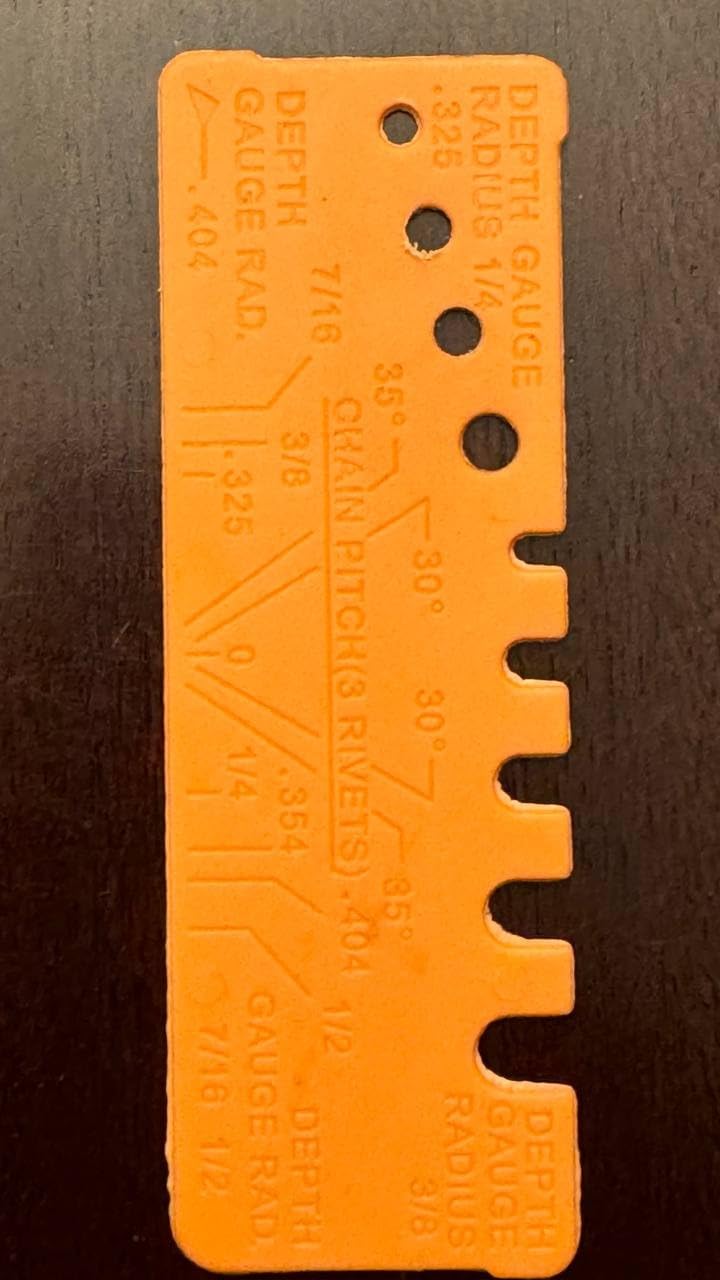
What impressed us most is the tooling around the files. The multi-function quick gauge checks pitch size, filing angle, cutter tooth length, depth gauge size and grinding wheel thickness, and a separate 2-in-1 depth gauge tool covers .025 and .030 inch settings. There is even a bar groove and oil hole cleaner.
At 4.6 across 1152 reviews, owners with mixed saws specifically call out the breadth, and beginners credit the gauge and the instructions for making the technique easier to learn.
Two things to weigh. The ergonomic wooden handle is shaped for the round files, so the flat file is less comfortable, and there is no rigid metal file guide, which means depth gauge setting depends on the plastic tool rather than a fixed reference.
When this kit is the right buy
Buy it if you own two or more saws with different pitch markings, or if you have inherited a saw and are not sure what chain it takes. The quick gauge alone can save you from buying the wrong file.
The orange pouch is a small thing that matters more than it sounds like when you are on the ground looking for your tools.
When to pick something else
If you own one saw and know its pitch, this is more kit than you need, and a metal guide would serve you better than a plastic gauge. If your priority is a repeatable angle, look for a kit with a rigid filing guide instead.
The bar groove cleaner is a nice bonus but not a reason to choose this over a better guide.
10. Honoson 3-Piece File Set – Best Simple File Set
Honoson 3 Pieces Chainsaw File 5/32, 7/32, 3/16 Inch
3 round files in 5/32, 7/32 and 3/16 inch
Quenched steel files
Molded handles with hang holes
Pros
- Covers the three most common chain pitches
- Quenched steel files cut well and resist abrasion
- Molded handles improve control and reduce fatigue
- Hanging holes make storage simple
Cons
- No filing guide or depth gauge so angle is set by eye
- No flat file for tidying rakers
- No case and files dull with use
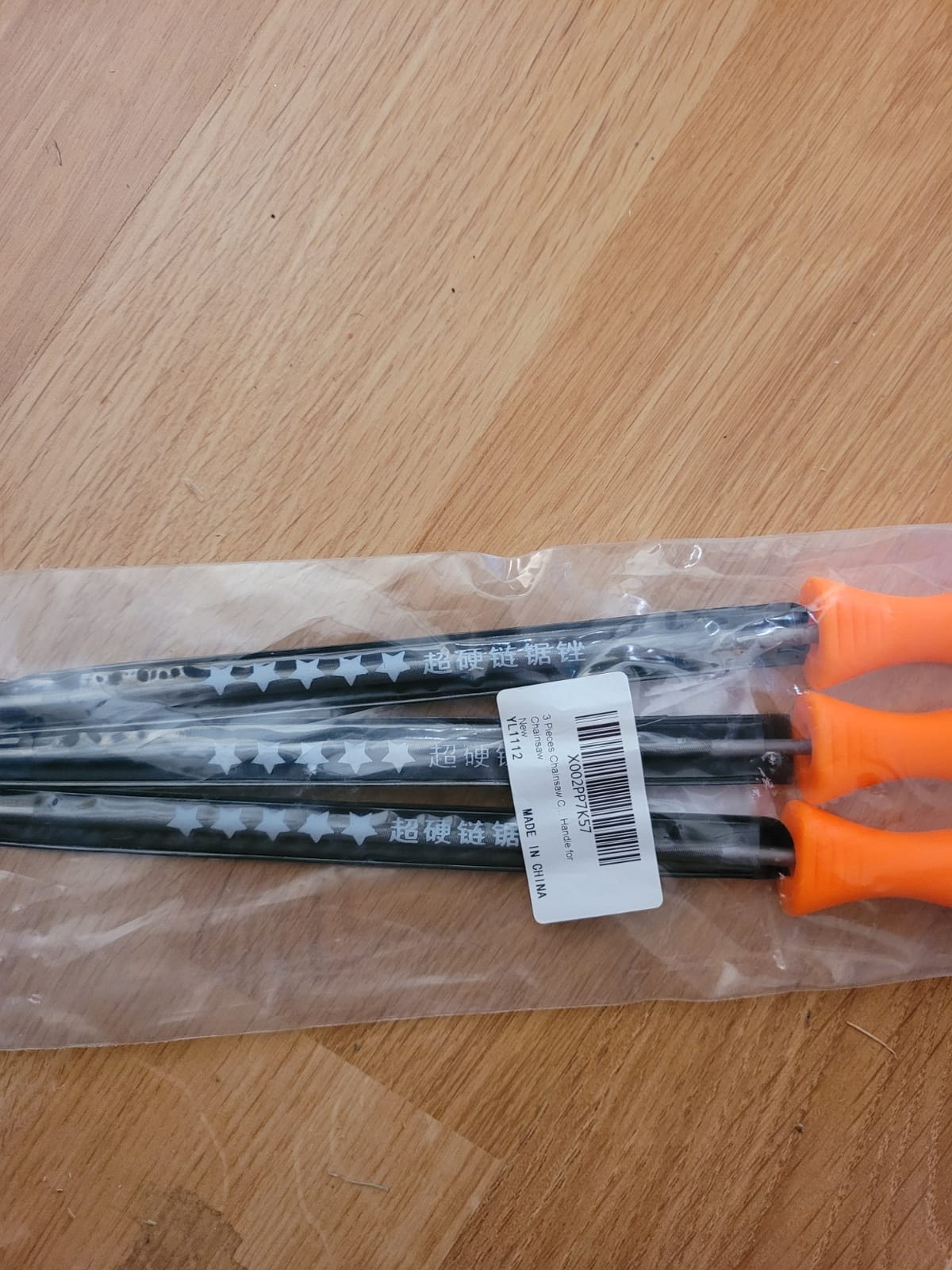
The Honoson 3-piece set is the simplest useful answer here and the least expensive way to keep a chain cutting properly. Three round files in 5/32, 7/32 and 3/16 inch cover what most homeowners actually own.
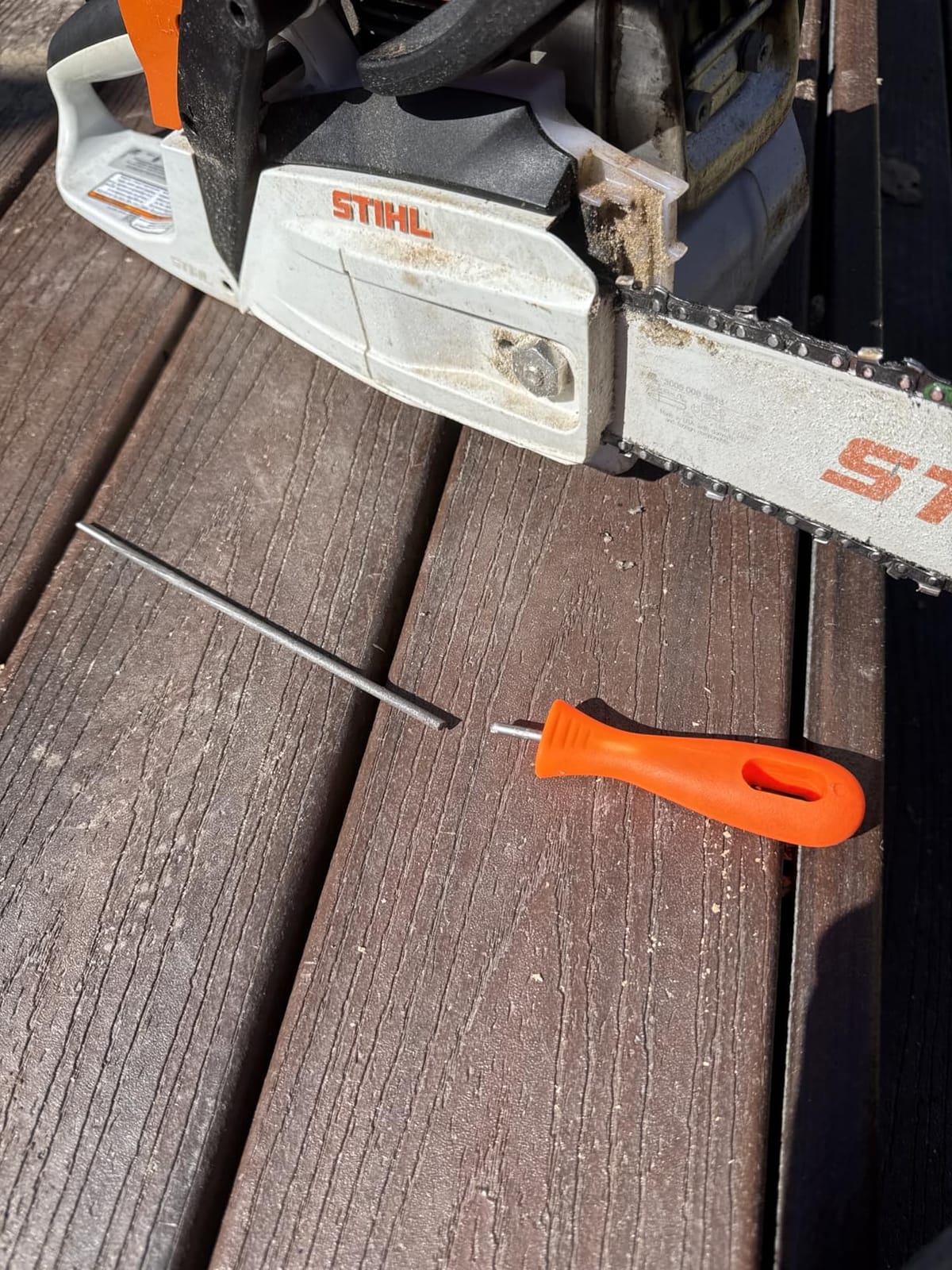
The files are described as high-strength steel with surface high-temperature quenching, and owners single out the cut quality. The molded plastic handles are sized for controlled, low-fatigue strokes, and each has a large hanging hole for storage on a nail or a hook.
It rates 4.6 across 1046 reviews with 72 percent at five stars, which is a strong result for a set with no accessories at all. Buyers treat it as a no-frills three-file set and rate the files above generic alternatives for the money.
Now the honest part. There is no filing guide and no depth gauge tool, so the angle and the raker height are set by eye, which is exactly the place beginners go wrong. There is also no flat file for tidying up the depth gauges once they have been filed.
At 5.3 ounces and 11.81 by 2.76 by 0.87 inches, it is a glove-friendly tool that goes in a pocket or a glove box.
When this set is the right buy
Pick it if you cut a few loads a year, you already know how to file a chain, and you want a spare set of quality files in a truck or a shed. It is also a good backup companion to a bar-mounted system, since those guides need files.
For anyone who wants to spend almost nothing and still sharpen correctly, this is the entry point.
When to pick something else
If you have never sharpened a chain, do not start here. Without a guide, the odds of getting the angle and the raker height right on the first try are poor, and a bad raker setting dulls the chain faster than a dull chain does.
It also cannot service carbide-tipped chain, which is worth knowing before you buy.
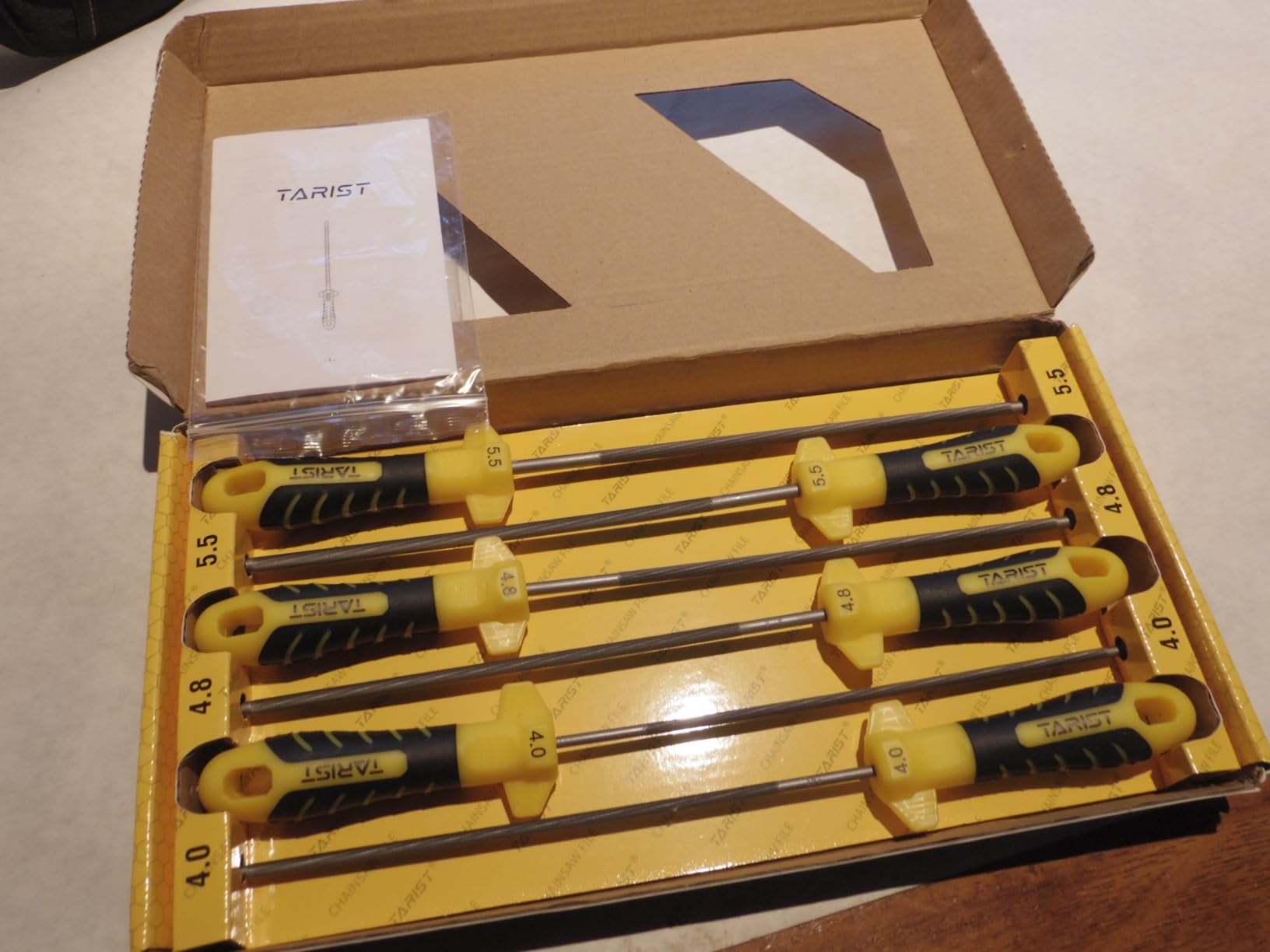
11. TARIST 6-Piece File Set – Best for Steel Durability
TARIST 6PCS Chainsaw File with Handle – Includes 5/32″, 3/16″, 7/32″ Round Files, Professional Chain Saw Sharpening Files
6 round files
Two each of 5/32, 3/16 and 7/32 inch
T12 carbon steel
Anti-slip rubber handle
Pros
- Two files in each of the three common pitches so spares are included
- T12 carbon steel with deep quenching holds its edge longer
- Anti-slip rubber handle reduces fatigue on longer sessions
- Instruction sheet explains file choice and technique
Cons
- No flat file
- filing guide or depth gauge included
- Handle fits the round files only
- Heavier than plastic-handled three-file sets
The TARIST 6-piece set is the pick if you care more about how the steel holds its edge than about accessories. You get two files in each of the three common sizes, so a worn file can be swapped without a second purchase.
The steel is T12 carbon with deep-quenched, coated teeth, and that is the whole argument. Owners highlight cut quality and the fact that duplicate sizes solve the consumable problem neatly, and the rubber handle is genuinely anti-slip for longer sessions.
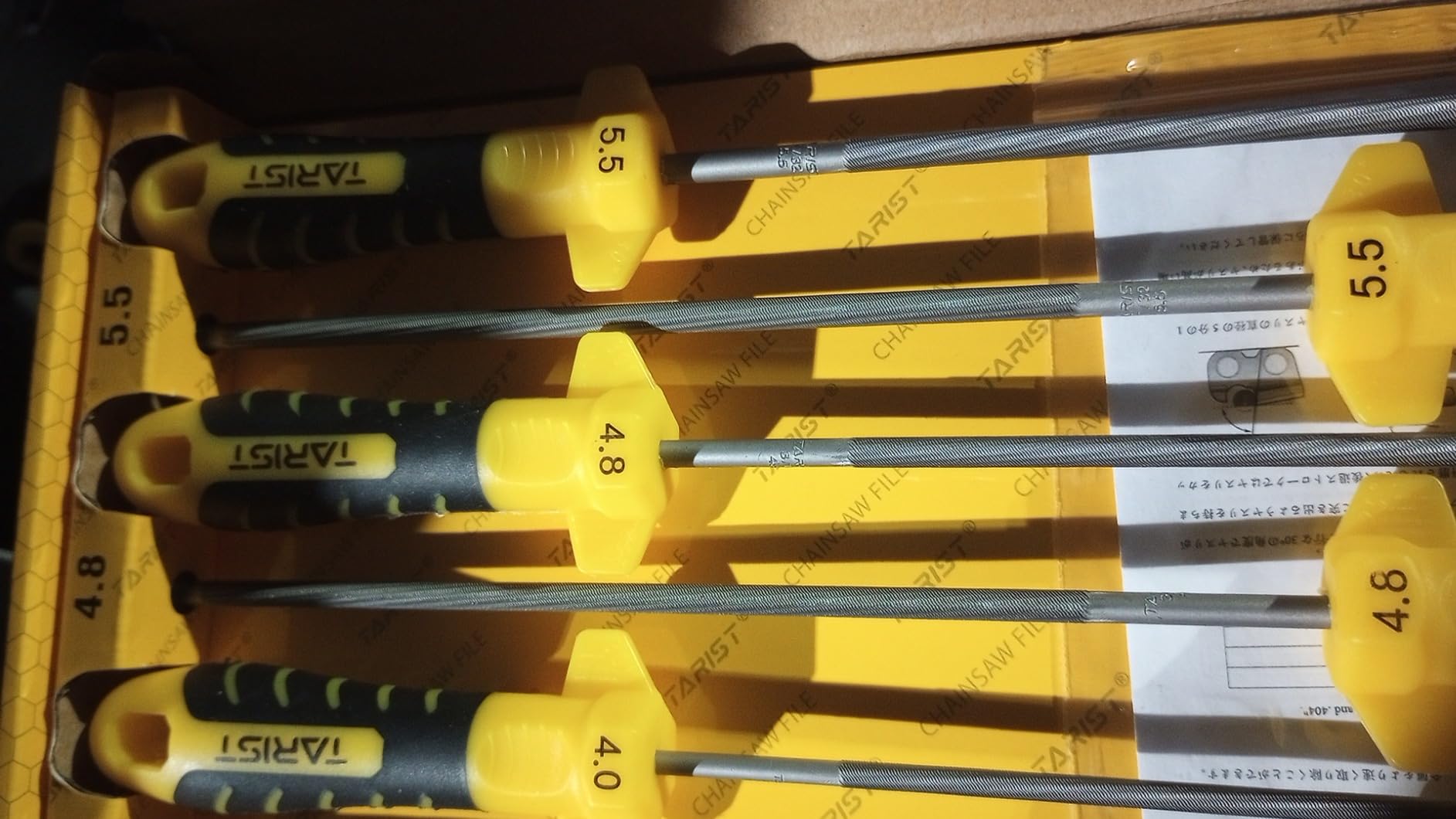
It rates 4.6 across 357 reviews, a smaller base than the kits above, but the feedback is consistent and narrow. Dissatisfaction is mostly about what is not in the box rather than what is.
There is no flat file, no filing guide and no depth gauge, and the handle is shaped for the round files only. At a listed 1.08 pounds it is heavier than a plastic-handled three-file set, which matters if you are carrying it to the wood lot.
The included instruction sheet covers product introduction, how to choose a file, and how to use it, which is more help than most kits of this price offer.
When this set is the right buy
Choose it if you cut hard wood, work resinous species like pine, or simply want files that will not clog in the first twenty minutes. Two of each size makes it a good working set rather than a starter set.
It pairs well with a guide you already own, and the hanging weight of a rubber handle is often preferred by people doing a full bar at a time.
When to pick something else
If you have no guide, this does not solve the depth gauge problem, and you will be back to buying one. If you want a flat file for tidying rakers, look at a kit that includes one.
For a light occasional user, three files in a lighter package would serve better.
12. KAKEI 8-Pack Sharpening File Kit – Best Starter Kit
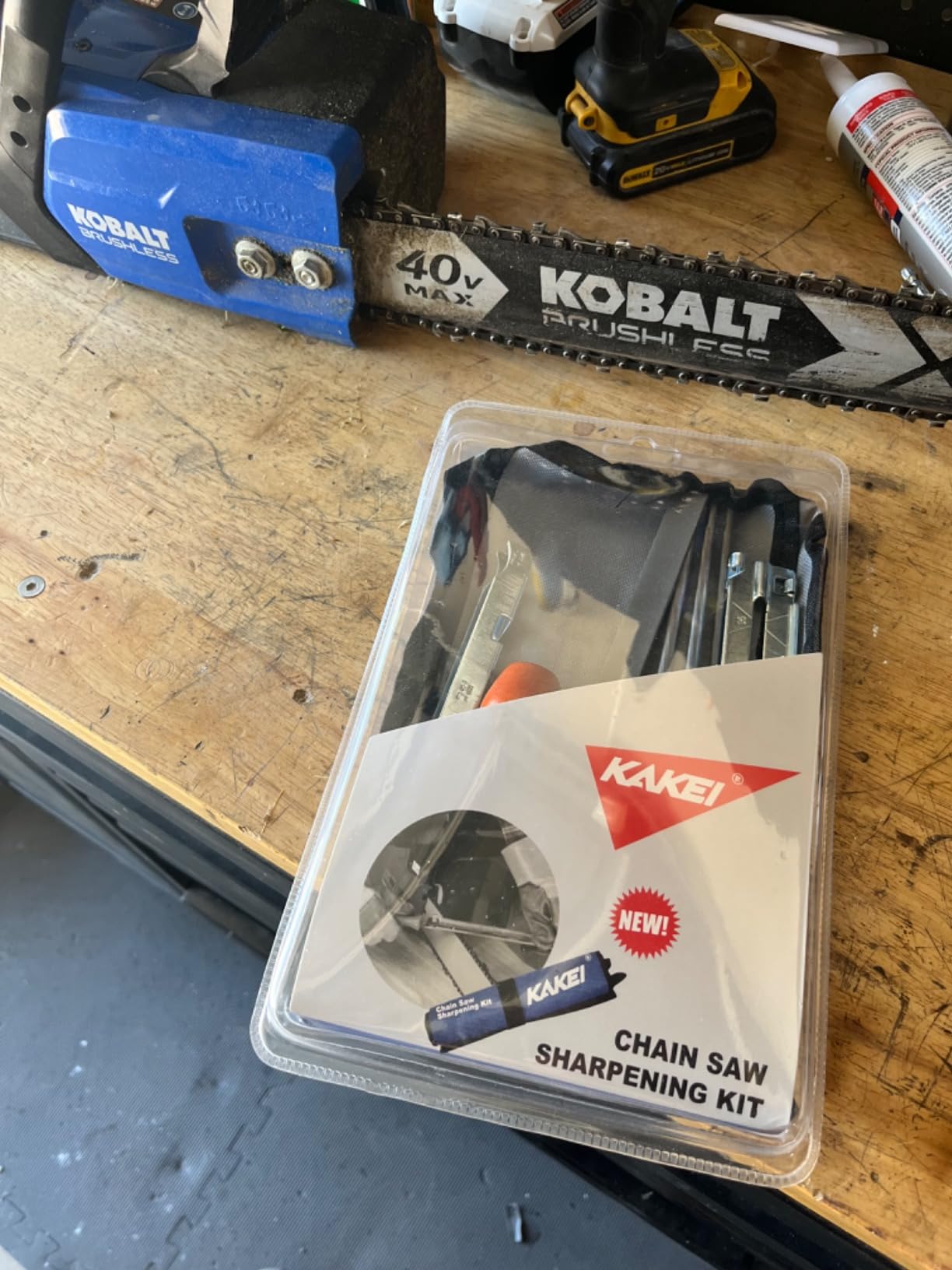
Chainsaw Sharpening File Kit, Chainsaw Chain Sharpener – 8 Packs – 3 Round Files(5/32-Inch, 3/16-Inch, 7/32-Inch), Flat File, Depth Gauge Tool, Filing Guide, Wood Handle, Travel Pouch
8 piece manual kit
3 round files plus 6 inch flat file
Hardwood handle, guide and depth gauge
Roll-up travel pouch
Pros
- Complete eight-piece kit at a low entry cost
- Includes both a filing guide and a depth gauge tool
- Hardwood handle is comfortable for longer sessions
- Roll-up pouch keeps the set portable
Cons
- Files can spot-rust in storage without a light oil
- Removes less metal than heavier files on badly dull chains
- Hardwood handle is bulkier to store
The KAKEI 8-pack is the best starter kit if you are buying your first sharpener and want everything a beginner actually needs in one pouch. Three round files in 5/32, 3/16 and 7/32 inch, a 6 inch flat file, a hardwood handle, a filing guide and a depth gauge tool.
At this price it is unusual to get both a guide and a separate depth gauge. Cheaper three-file sets skip both, which is precisely where beginners go wrong, so this kit closes the gap between the cheapest option and a proper system.
It holds 4.4 stars across 196 reviews, which is a small base, but the feedback is consistent. Owners call it a good toolbox addition and rate it highly for completeness given what it costs.
Two recurring negatives are worth planning around. The files can spot-rust if stored unused, and a light coat of oil prevents that entirely. And on a badly neglected chain these files remove less metal than heavier-duty ones, so expect a second pass.
The hardwood handle is comfortable for long sessions but bulkier to stow than a molded plastic grip, and the roll-up pouch handles the portability question reasonably well.
When this kit is the right buy
Buy it if you are starting from nothing, cutting once or twice a year, and want a correct result on the first attempt without paying for a full system. The guide and depth gauge tool are the reason it beats a bare three-file set for a beginner.
It is also a decent backup kit for a second saw or a second property.
When to pick something else
If you cut weekly, upgrade to a metal-guide kit or a bar-mounted system, because the files here are not the limiting factor, your technique and consistency are. If your chain is severely dull, plan on multiple passes or a heavier file.
And store them dry, with a light oil on the steel, or you will find rust when you next reach for them.
How to Choose a Chainsaw Sharpener for Your Saw
Four questions decide nearly every purchase, and they are all answerable before you spend anything. What pitch is your chain, how often do you actually cut, can the tool set the depth gauge, and where will you do the work.
Match the file to your chain pitch first
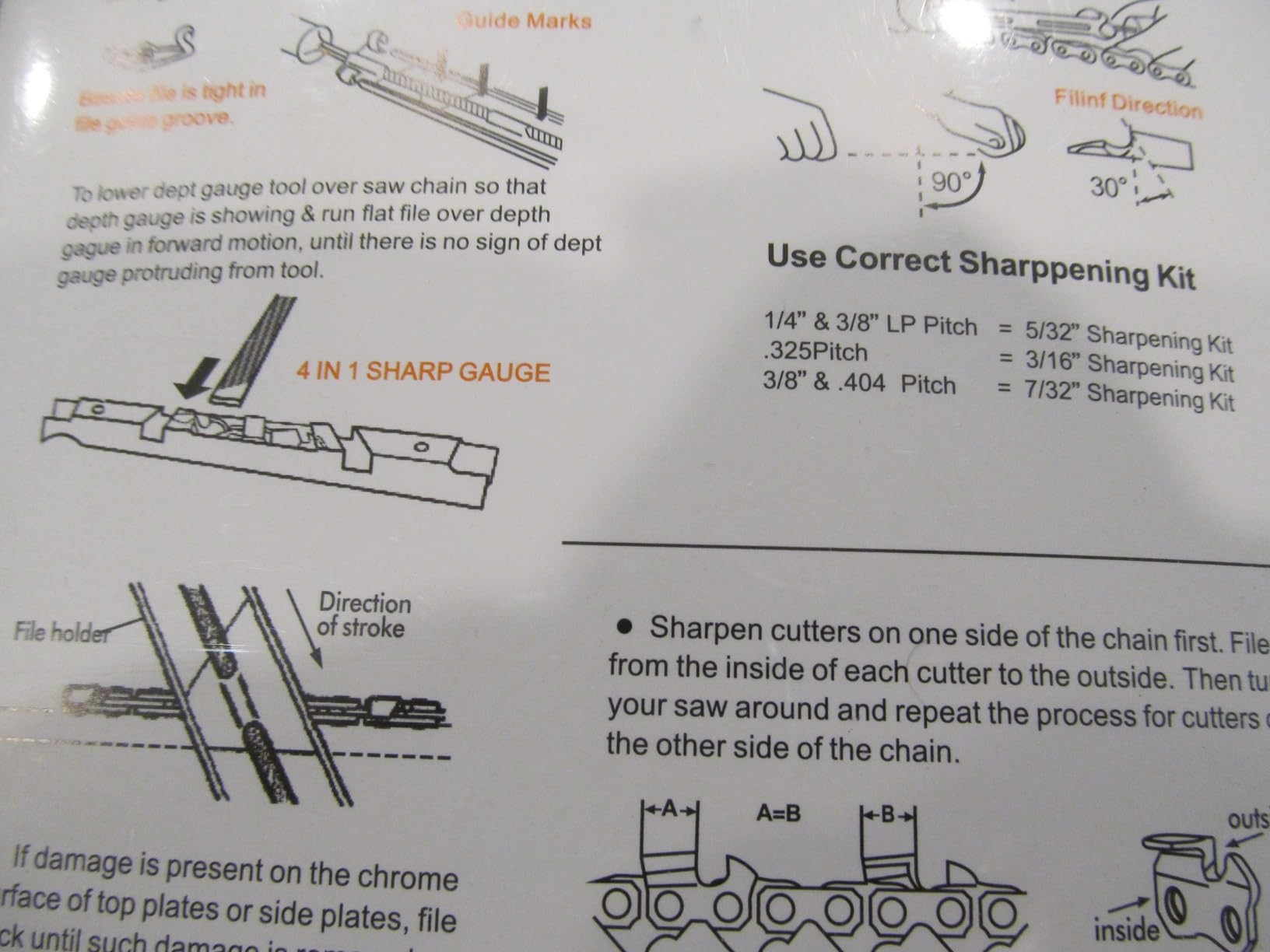
Chain pitch is the distance between three consecutive rivets, halved, and it is stamped on the bar near the clutch cover and printed on the box the chain came in. File diameter must match that pitch or the file will not enter the cutter properly. Using the wrong diameter is the most common beginner mistake there is, and it damages cutters rather than sharpening them.
5/32 inch round file (4.0mm) suits quarter inch pitch and 3/8 low profile chain. Common on mini saws and many battery chainsaws.
3/16 inch round file (4.8mm) suits .325 inch pitch chains, which is the most common homeowner chain in North America. This includes many Stihl MS 170 and MS 250 configurations and Husqvarna 455 Rancher models.
7/32 inch round file (5.5mm) suits 3/8 inch and .404 pitch chains, which covers many Echo CS-300 class saws and older full-compacts.
If you own more than one chain, buying a kit that includes all three diameters removes the entire question, which is why the Oregon Universal kit takes the top spot here.
How often do you actually cut?
Usage is the strongest predictor of what you should buy, and it is the question most roundups skip. Cut a few loads of firewood a year and a file kit is the right answer, full stop.
Cut weekly or run a small property and an electric sharpener earns its place. Sharpen several bars every week and a bar-mounted guide is where consistency comes from.
Do the arithmetic honestly. A hardware store or saw shop will sharpen a chain for a small fee, and if that fee times your annual number of chains is less than a sharpener costs, the shop is the cheaper answer and there is no reason to buy a tool. Bench grinders and quality guides only pay for themselves when you are past that point.
Does it adjust the depth gauge (raker)?
The depth gauge, or raker, is the small bumper in front of each cutting edge that sets how deep the chain bites. If the raker sits level with or above the cutter, the chain will not cut, it will just rub. Correct filing leaves the raker slightly below the cutter, roughly 0.025 to 0.030 inch.
Ask this before you buy. Most budget electric sharpeners cannot lower rakers at all, and that is a top reason owners move away from them. A file guide that doubles as a depth gauge, such as the one in the Husqvarna kit or the Oregon Universal kit, solves it for a few dollars.
Also ask whether the tool works on carbide-tipped chain. Many affordable electric sharpeners will not, and carbide chain needs a diamond wheel or carbide file rather than a standard round file.
Electric or manual: the honest trade-off
Forums and professional practice broadly agree that a properly used hand file produces a more consistent edge than a grinder. The reason is heat. Electric grinders spin fast enough to raise the temperature of the chain steel, and owners on multiple chainsaw forums report chains that dull far faster after grinding because the temper has been damaged.
Grinders still win on one metric, which is speed on a badly dull chain, where an experienced filer needs about five minutes and a bench grinder needs two to three minutes once setup and adjustment time is included. If you have filed by hand before, you already know the technique and the edge difference narrows further.
For most homeowners the practical system is two tools: a portable file kit for touch-ups, and a powered sharpener for the full bar when the edge is truly gone.
How to Sharpen a Chainsaw Chain Without Ruining It
Whichever tool you use, the principles are the same. Match the diameter, hold the angle, use equal effort on every tooth, and treat the depth gauge as carefully as the cutter.
With a file and guide
First, mark the chain so you know when you are finished. The master cutter is the cutter that sits slightly proud of the rest and rides closest to the bar; once it is level with the others, stop.
Experienced filers treat this as standard practice, and it prevents the over-filing that ruins chains.
Set the bar on a bench with the chain side up and brake the saw so the chain cannot move.
Clamp the guide over the chain with the correct file seated in it.
File the first cutter with strokes in the direction of the cutting edge, then move to the matching cutter on the opposite side of the link and file it the same number of times.
Advance and repeat, keeping the same stroke count on every tooth so tooth length stays even.
Push the guide forward to the depth gauge position and lightly file each raker, stopping as soon as it is just below the cutter.
Use the flat file to remove any burrs and check the pitch with a gauge before you refit the chain.
The target angle falls between 25 and 35 degrees, and the guide handles it for you. Thirty degrees is the common default.
With an electric sharpener
Clean the chain before you start, so pitch and sap are not ground into the teeth.
Seat the wheel or stone of the correct diameter in the collet and tighten firmly.
Set the chain on a firm surface with the bar away from you, or mount it in a vise if your sharpener has a clamp.
Set the angle once using the tool guide, then do not change it mid-chain.
Touch each cutter briefly, keeping the wheel moving and the pressure light so the steel does not heat.
Dress the stone with a dressing stone periodically, because a glazed stone removes metal badly and causes heat.
Check the first master cutter and one of the smallest cutters with a depth gauge before you finish.
The single most important habit is to keep the wheel moving. Dwelling on one tooth is what overheats the steel and dulls the chain faster than leaving it alone.
Six mistakes that ruin chains
These come straight from recurring complaints across chainsaw forums, and every one of them is avoidable.
Using the wrong file diameter. A 3/16 inch file on a 7/32 inch chain will not enter the cutter properly and can gouge it.
Over-filing the rakers. Depth gauges set too low make the chain grab and dull faster, and can make it bind in the cut.
Uneven stroke counts. Filing the inside cutter harder than the outside one produces a chain that cuts crooked and pulls to one side.
Skipping the master cutter. Without a reference mark you will happily file a chain far past the point where it needs sharpening.
Dwelling on a spinning wheel. Holding the grinder in one spot generates the heat that damages chain temper.
Never dressing the stone. A glazed wheel glazes faster, produces more heat and leaves a rougher edge than a dressed one.
If your chain keeps going dull shortly after a sharpening session, the cause is almost always one of these six rather than the tool you bought.
Worth noting alongside this: if you are still deciding on a saw rather than maintaining one, our best chainsaws for homeowners roundup covers the models these kits are sized for. For slab work, our guide to the best Alaskan chainsaw mills for slabs covers the cutting end of the job.
Frequently Asked Questions
Are chainsaw chain sharpeners worth it?
Yes, for almost any homeowner who owns a saw. A sharpener costs less than a single replacement chain and pays back within a few cutting sessions. The savings come from fuel, bar and chain wear, and reduced kickback risk. If you only cut once or two loads a year, a file kit is the sensible spend.
Is an electric chainsaw sharpener worth it?
It is worth it if you cut weekly or more, or if repetitive filing strains your hands and joints. Electric sharpeners are two to three times faster and sharpen without removing the chain. They are less worthwhile for occasional use, and fast grinding can overheat chain steel, which is the most common complaint from owners.
What is the best electric chainsaw chain sharpener?
Among the picks in this guide, the EzzDoo kit leads because it sharpens with the chain still on the bar and includes an angle guide for consistent tooth-to-tooth results. The Sharp Pebble is the choice for a bench with an outlet, and the Oregon 12V Sure Sharp is the one for sharpening away from power.
What is the best hand file for sharpening chainsaw chain?
The Oregon Universal Field Kit is the most complete manual answer, covering 5/32, 3/16 and 7/32 inch files plus a flat file, a metal guide and a pouch. If you run a single pitch, a brand-matched kit such as the Husqvarna 3/8 inch set gives you OEM-specified sizes and a combination guide.
Is a 3/16 inch file suitable for .325 chains?
Yes. A 3/16 inch round file, which measures 4.8mm, is the correct diameter for .325 inch pitch chain and is the most common homeowner chain size in North America. Using a smaller 5/32 inch file on a .325 chain leaves the tooth profile wrong and can gouge the cutters.
Should chainsaw chains be sharpened at 30 or 35 degrees?
Both fall inside the normal 25 to 35 degree range, and most quality filing guides are set to 30 degrees. Match the factory angle as closely as you can rather than chasing a specific number. A file guide or angle guide attachment is the simplest way to hold a consistent angle across every tooth.
What are the common chainsaw sharpening mistakes?
The most common are using the wrong file diameter, over-filing the depth gauges, using a different number of strokes on each cutter, skipping the master cutter as a reference, dwelling on a spinning grinding wheel until the steel overheats, and never dressing the stone. Each of these shortens chain life rather than extending it.
Are Harbor Freight chainsaw sharpeners any good?
For occasional use on a single saw they do the job at the lowest entry cost. The trade-offs are real: most budget electric sharpeners cannot lower the depth gauges, and fast grinding on inexpensive wheels generates the heat that owners in chainsaw forums report dulling chains faster. Check that it suits your pitch first.
The Bottom Line for Homeowners
The Oregon Universal 7-Piece Field Sharpening Kit is the best chainsaw sharpener for homeowners because it covers the three pitches most people actually own, holds the angle with a proper metal guide, and sets the depth gauge at the same time. It is rated 4.7 out of 5 across 7914 reviews, and that combination of coverage and consistency is what nothing else in this roundup matches.
For one saw and one pitch, the Stihl 2-in-1 is the cleaner answer. For hands that tire easily, the EzzDoo is the fastest route.
If your work happens away from an outlet, take the Oregon 12V Sure Sharp with its 16-foot cable. And if you already file well and want every tooth identical, mount the Granberg G106B to the bar.
Match the file diameter to your chain pitch before anything else, and check that your tool can lower the rakers. Those two decisions prevent most of the disappointment owners report in the first month.
Whatever you pick, keep the chain sharp and your bar, your fuel and your chain will all last longer for it. If you are still choosing your saw, our best chainsaws for homeowners roundup and the chainsaw mills for woodworkers guide cover the rest of the setup.