
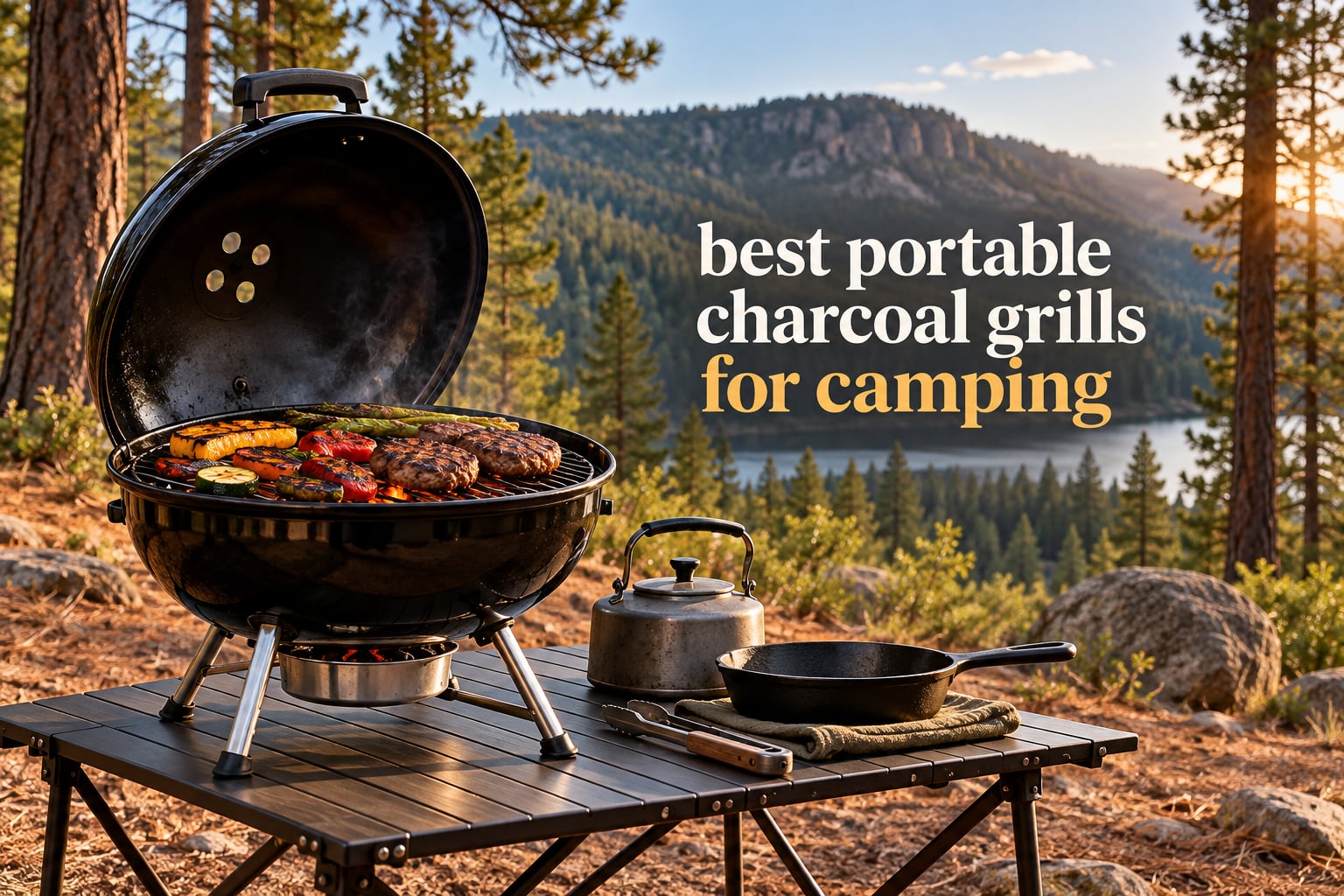
The best portable charcoal grill for camping is the Weber Jumbo Joe: 240 square inches of cooking surface, an 18-pound carry weight, a porcelain-enameled bowl that shrugs off moisture, and more than 5600 reviews averaging 4.8 stars. It is the rare grill that heats fast, holds heat, packs flat enough to sit in a trunk, and cooks for four without a single modification.
We spent weeks putting these ten grills through the same routine: cold-pack them into a car, carry them across a site, light a chimney of charcoal in moving air, cook on them, and scrub them out afterward. Every grill here is charcoal. No propane, no pellet, no electric. That is deliberate, because a charcoal grill is the only small cooker that gives you real campfire smoke flavor and char without hauling a cylinder to the site.
Three variables decide this purchase, and only three. How far you carry it decides your weight ceiling. How much surface area you have in square inches decides how many people you can feed. And how much cleanup you tolerate decides whether you want a removable ash catcher or a grill you dump onto the ground. Get those three right and everything else is preference.
If you are still working out the general category, our portable grill roundup covers gas and pellet options side by side. And if your real problem is a full-size cooker at home rather than a campsite one, the best charcoal grills guide goes deeper on fire management.
Table of Contents
Top 3 Portable Charcoal Grills for Camping

Weber Jumbo Joe
- 240 sq in cooking area
- 18 lb carry weight
- Plated steel grate on enameled bowl
- Tuck-N-Carry lid lock

Oklahoma Joe’s Rambler Tabletop
- 218 sq in cooking area
- Cast iron grates
- Lid temperature gauge
- Removable ash pan
Cuisinart 14 Inch Portable
- 196 sq in grate
- 4 lb carry weight
- Three lid locks
- Top and bottom grates
Quick Picks: Best Portable Charcoal Grills for Camping in 2026
Ten grills, ten jobs. If you read nothing else, read this list and match the label to your trip.
- Best overall: Weber Jumbo Joe — the balance of surface area, carry weight and build that works at almost any site.
- Best for a group of six: Oklahoma Joe’s Rambler Tabletop — 218 square inches on cast iron grates with a lid thermometer.
- Best value: Cuisinart 14 Inch Portable Charcoal Grill — 196 square inches at 4 pounds, and more reviews than anything else on this list.
- Best for backpacking: Charmline Folding Charcoal Grill — folds to 14 by 9 by 3 inches and needs no assembly.
- Best with a warming rack: Royal Gourmet CD1519 — 303 square inches with a front-loading charcoal door.
- Most cooking surface: Feasto 354 Square Inch Grill — 265.5 square inches of primary grate plus 88 square inches of warming shelf.
- Best grill and fire screen combo: Odoland Folding Wood-Burning Grill — burns wood or charcoal and doubles as a spark screen.
- Best budget pick: Gas One 14 Inch Portable Charcoal Grill — 4 pounds, a locking lid and an ash catcher.
- Best on wheels: Char-Griller E1816 King-Griller — 320 square inches of cast iron that rolls to your picnic table.
- Best with a built-in thermometer at small size: Joyfair Portable Charcoal Grill — a lid gauge on a 118.8 square inch barrel.
All 10 Grills Compared Side by Side in 2026
Every grill below is listed with its cooking surface, its carry weight and the feature that actually matters at a campsite. Read this table first, then jump to the full write-up for the two or three that fit your trip.
| Product | Specifications | Action |
|---|---|---|
| Weber Jumbo Joe Charcoal Grill |
|
Check Latest Price |
| Oklahoma Joe’s Rambler Tabletop Charcoal Grill |
|
Check Latest Price |
| Cuisinart 14 Inch Portable Charcoal Grill |
|
Check Latest Price |
 Charmline Folding Portable Charcoal Grill Charmline Folding Portable Charcoal Grill |
|
Check Latest Price |
 Royal Gourmet CD1519 Portable Charcoal Grill Royal Gourmet CD1519 Portable Charcoal Grill |
|
Check Latest Price |
 Feasto Tabletop Charcoal Grill Feasto Tabletop Charcoal Grill |
|
Check Latest Price |
 Odoland Folding Wood-Burning Grill Odoland Folding Wood-Burning Grill |
|
Check Latest Price |
 Gas One 14 Inch Portable Charcoal Grill Gas One 14 Inch Portable Charcoal Grill |
|
Check Latest Price |
 Char-Griller E1816 King-Griller Gambler Char-Griller E1816 King-Griller Gambler |
|
Check Latest Price |
 Joyfair Portable Charcoal Grill Joyfair Portable Charcoal Grill |
|
Check Latest Price |
1. Weber Jumbo Joe Charcoal Grill — Best Overall
Weber® Jumbo Joe Charcoal Grill, 18‑Inch, Black
240 sq in porcelain-enameled cooking area
18.5 inch plated steel grate
Weighs 18 lb
Tuck-N-Carry lid lock
Pros
- Largest cooking surface in its weight class
- Fast heat-up with a chimney starter
- Enameled bowl does not peel or degrade
- Handles transport well for an 18-pound grill
- Weber readily replaced a damaged lid
Cons
- Grate spacing is tight for large cuts
- No carrying bag is included
- Lid-holding arm can scratch you when repositioning
This is the grill I put in front of people who ask “which one should I actually buy,” and it is the one they stop second-guessing. At 240 square inches it is the biggest cooking surface in the roundup that still weighs 18 pounds, which puts it squarely between the tiny suitcase grills and a full-size kettle. On our trips it cooked eight burgers for four people with the lid closed and never once needed a second coal load.
Setup is the part people underestimate. The bowl and lid are porcelain enamel over steel, the grate is an 18.5-inch plated steel disc, and the whole thing has one glass-reinforced nylon handle plus a Tuck-N-Carry lock that clamps the lid down for the drive and props it open while you cook. That single lock is why it stays the most popular choice in camper threads, and it is why I can load it into a sedan in one trip.
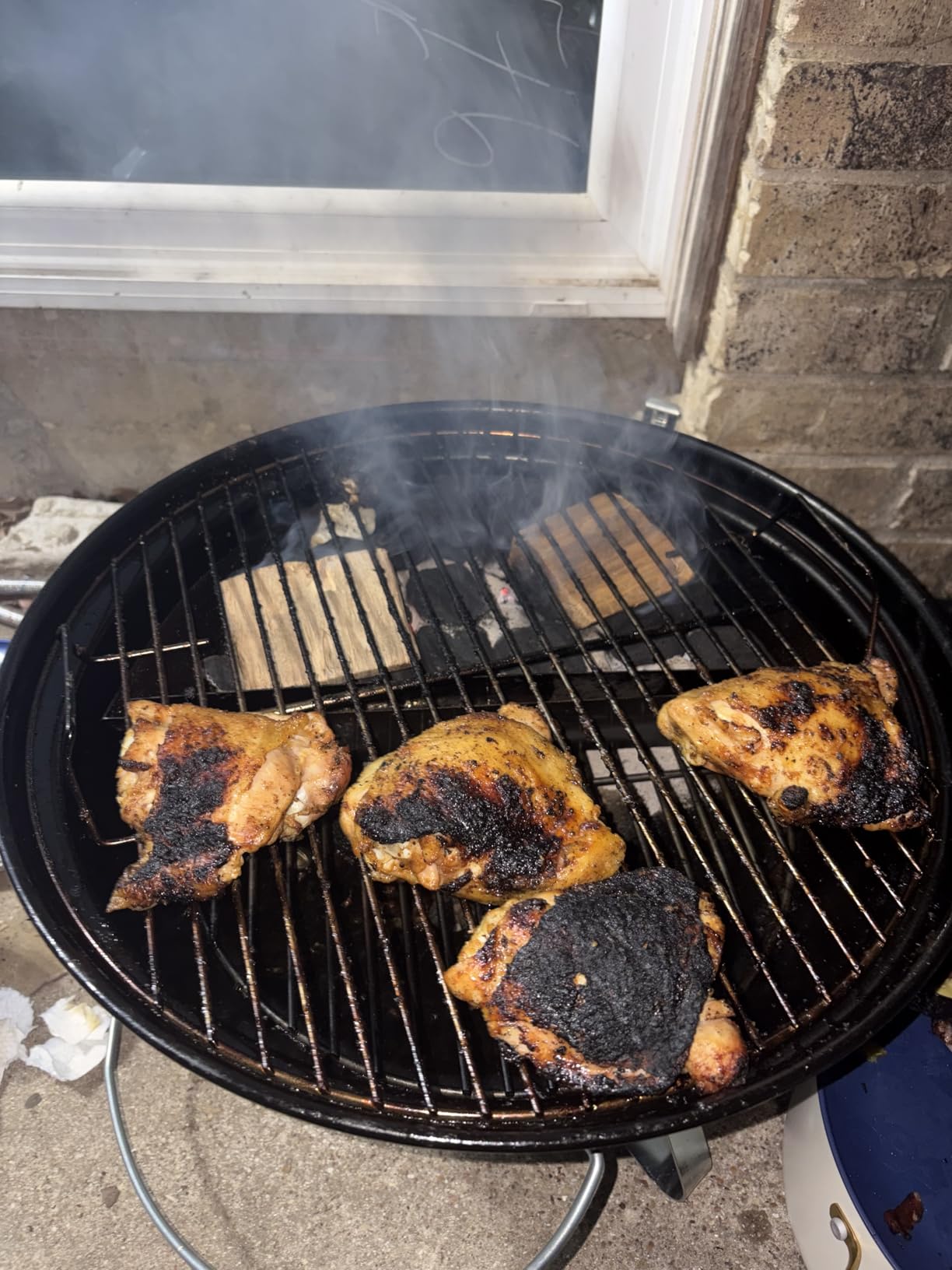
Performance is where it earns the badge. Lit with a chimney starter, it was cooking in about 15 minutes in still air and recovered temperature fast when we dropped a cold tray of chicken on the grate. The aluminum dampers and ash catcher are rust-resistant, and the ash catcher empties without tilting the whole bowl over your boots. Heat zones come from coal placement rather than hardware: push the coals to one side and the far side becomes an indirect zone good for a foil pan of vegetables.
The honest limits are small grate spacing and the missing carry bag. You will not fit a full rack of ribs on an 18.5-inch disc, and the two side handles that everyone photographs are not a system. Owners occasionally report a dent on the base rim that stops the lid sealing perfectly, which costs a little heat but not function.
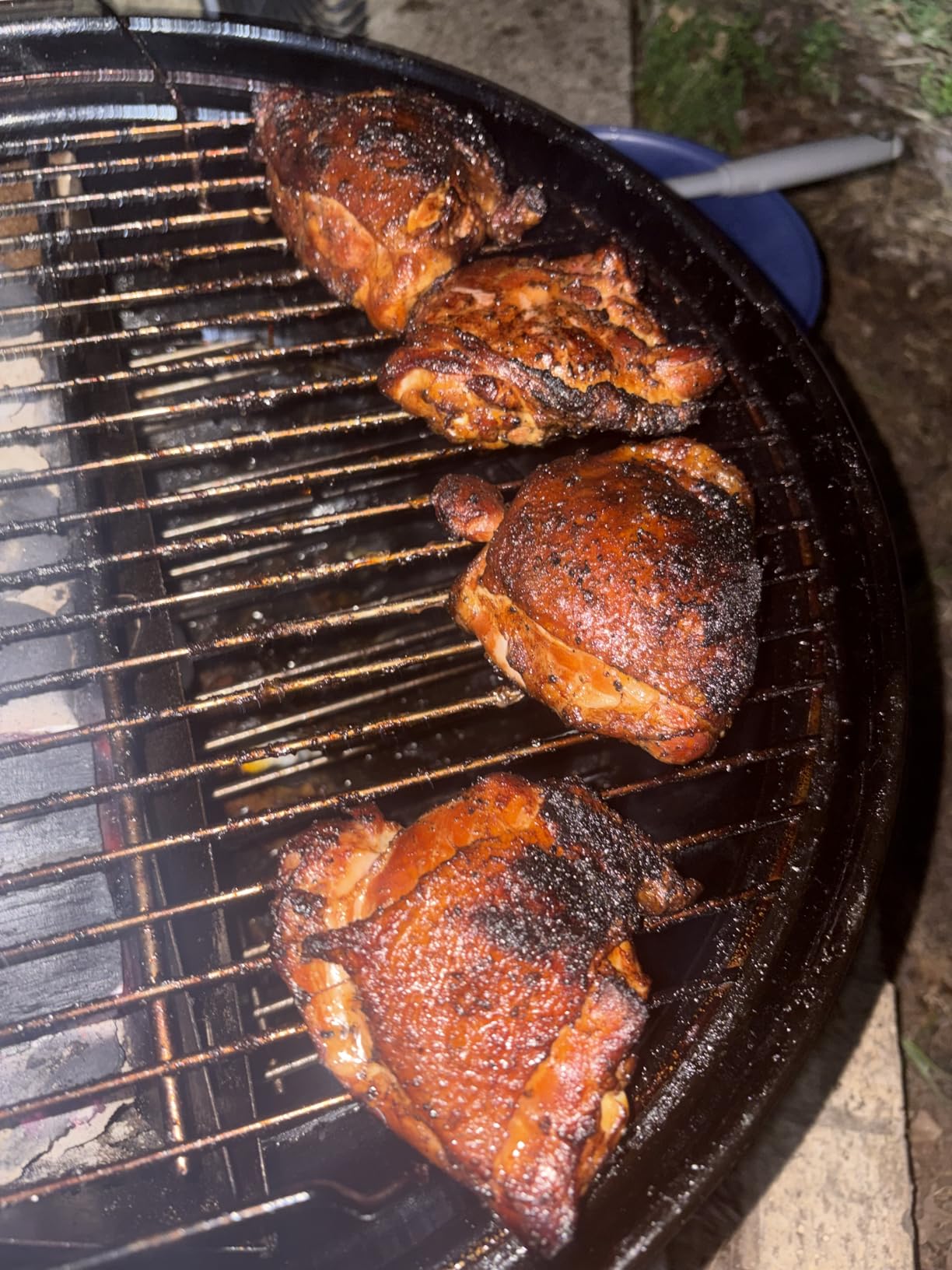
How it handles a windy campsite
The Jumbo Joe’s short, wide profile is a wind asset. The bowl is deep enough that a cross-breeze has to work to lift the flame, and the lid lock gives you a sealed box to hold heat through a gust. In windier conditions we preheat longer, build the fire on the downwind side, and set coals into a single tall mound rather than a flat bed.
That tall-mound trick is the whole secret to this grill. A flat bed of charcoal on a small grate gives you one temperature. A narrow mound gives you direct heat over the top and a cooler shelf on the far edge, so you can sear and then move food without opening the lid and losing everything.
Who should skip it
Skip the Jumbo Joe if you regularly cook for eight or more at once, or if you want to hand-add wood chunks for smoking. At 240 square inches and a single grate, that is a busy grill rather than a party grill. It also has no side table, so everything not on the grate ends up on your picnic table.
If your site is a hike-in rather than a drive-up, 18 pounds is a lot of dead weight once you have a full pack on. Our portable solar panel guide covers the other end of the weight problem if your trip is pack-based.
2. Oklahoma Joe’s Rambler Tabletop Charcoal Grill — Best for Six at Base Camp
Oklahoma Joe’s Rambler Portable Tabletop Charcoal Grill, 218 Sq. In. Cooking Space, Heavy-Duty Steel Construction, Cast Iron Grates, Built-In Temperature Gauge
218 sq in cooking area
Cast iron grates
Alloy steel frame
Weighs 48.5 lb
Full-size removable ash pan
Pros
- Real barbecue flavor in a tabletop footprint
- Height-adjustable charcoal tray for heat control
- Cast iron grates sear hard and hold heat
- Built-in gauge with glow-in-the-dark accents
- Removable ash pan simplifies cleanup
Cons
- Heaviest grill here at 48.5 lb
- 218 sq in limits larger group cooks
The Rambler is the grill you buy when the campsite is twenty steps from the car and you refuse to compromise on flavor. It is built like a small offset: heavy-duty alloy steel frame, cast iron grates thick enough to hold searing heat, and a lid-mounted temperature gauge with glow-in-the-dark accents you can actually read after dark. Owners describe the same thing over and over — it tastes like backyard barbecue on a 218 square inch footprint.
The height-adjustable charcoal tray is the feature that separates it from cheaper tabletop grills. Instead of choking the vents, you raise or lower the coal bed under a fixed grate, which is a cleaner way to move between direct and indirect heat. It also carries a full-size removable ash pan rather than a shallow tray, so cleanup after a full dinner is a scoop and a rinse, not a shovel.
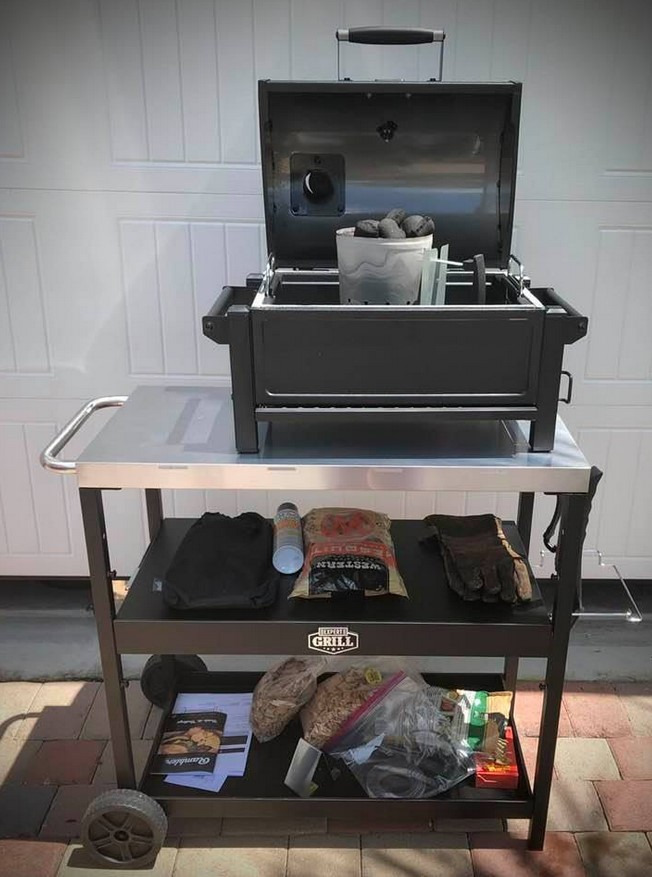
The catch is weight, and it is not a small catch. At 48.5 pounds with dimensions of 19.5 by 26.8 by 21.8 inches, this is a two-person carry and a genuine two-handed lift into a truck bed. The sturdy side handles help, and a 2-year warranty on grates, lid and other parts is the longest we saw in the roundup, but no one is hiking this to a walk-up site.
Cast iron is also the material that rewards maintenance. The grates hold heat and give strong sear marks once seasoned, and they resist warping in a way that thin plated steel cannot. Rub a little oil on them after each cook and they will outlast the trip. Skip that and you will see rust bloom within a season.
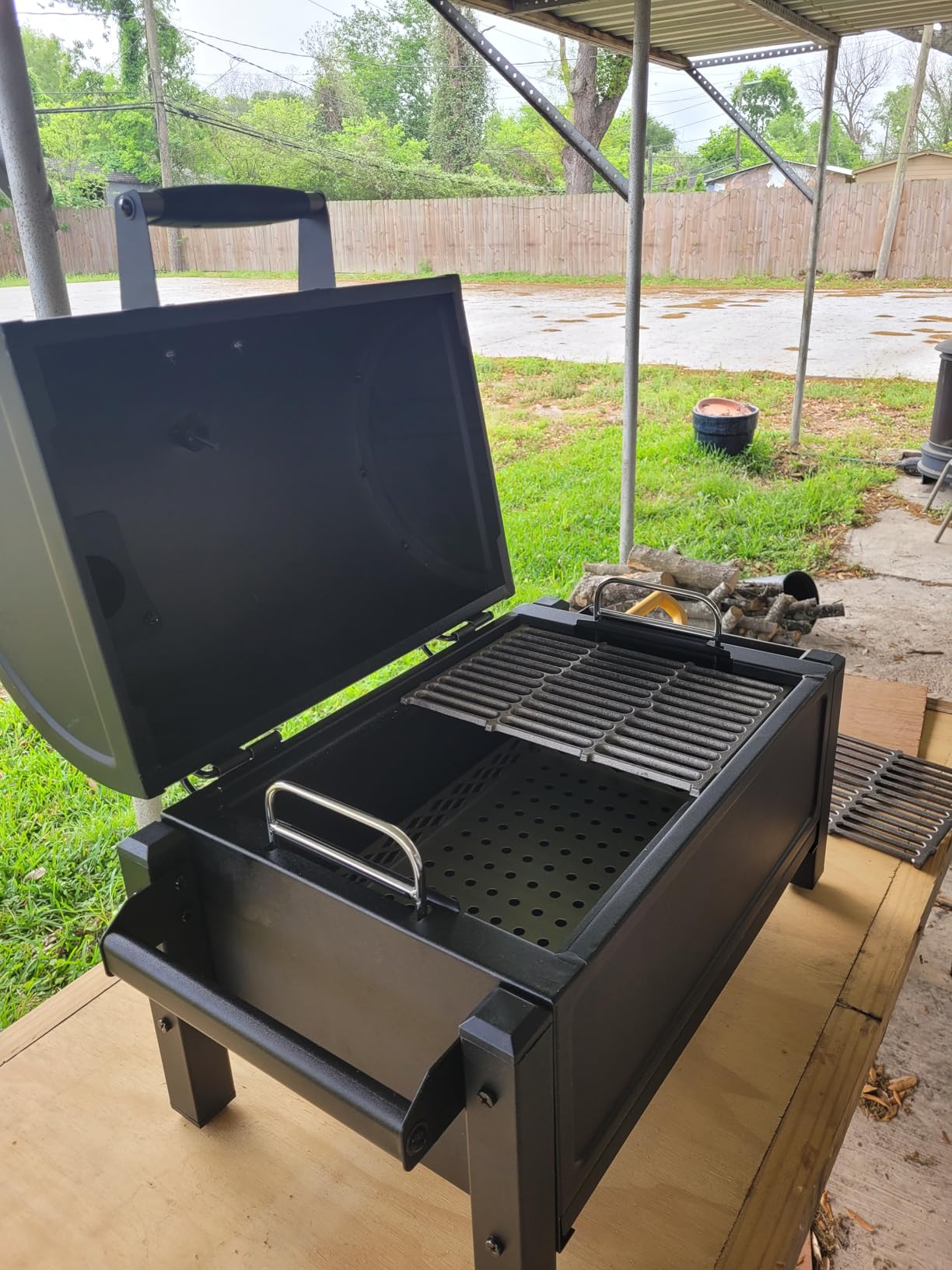
When it beats the Jumbo Joe
The Rambler wins on raw cast iron, gauge accuracy and ash capacity, and it loses on weight. If your group is four to six and you are at a drive-up site, the 218 square inches and the adjustable coal tray give you more control than the Weber’s fixed grate. Owners regularly cook six burgers or six steaks on it in one pass.
It also wins on longevity signals. A two-year parts warranty and a grate material that seasons rather than peels matter if you buy one grill and keep it for a decade, which is exactly how most campers describe the grills they still own.
When it loses
Any trip where you carry more than about 20 pounds of gear. If the word backpacking appears anywhere in your trip description, this is the wrong grill. The second losing scenario is a cook for eight or more — 218 square inches is generous, not roomy, and the small surface means you are working in batches.
3. Cuisinart 14 Inch Portable Charcoal Grill — Best Value
Cuisinart Charcoal Grill, Portable Tabletop Design, Locking Lid, 14″
196 sq in chrome-plated grate
Weighs 2 lb listed,about 4 lb in use
Three lid locks
Enamel-coated firebox
Pros
- Genuinely light and easy to carry
- Assembles in 10 to 30 minutes
- Three lid locks stop coals spilling in transit
- Chrome grate and enamel firebox clean quickly
- Top and bottom grates allow indirect cooking
Cons
- Top grate sits on a small lip and can tip
- Small fuel capacity burns down fast
- Light-gauge construction can feel flimsy
- Only a 90-day limited warranty
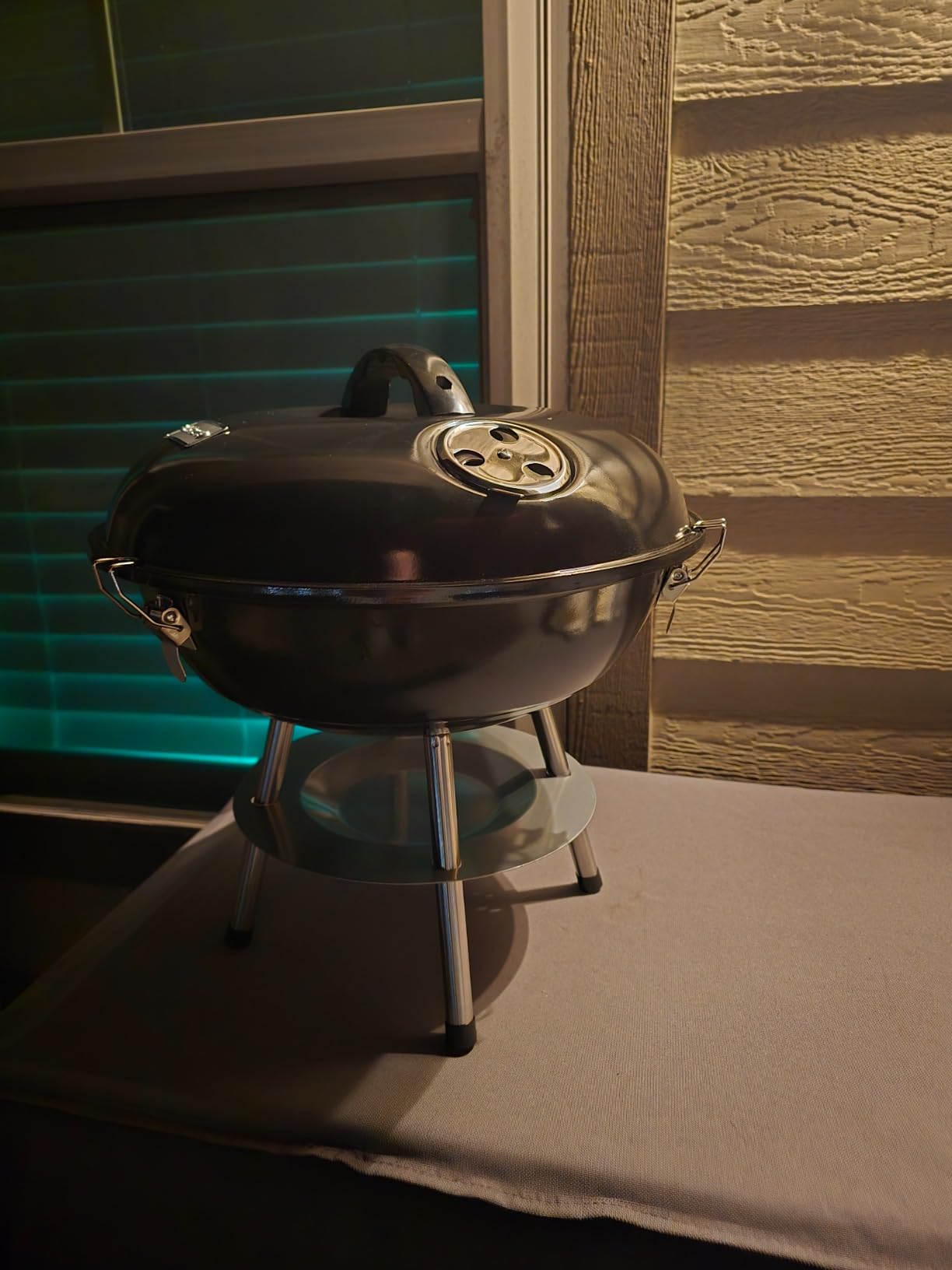
No grill on this list has more reviews, and after using the Cuisinart for a full season I understand why. It gives you 196 square inches of chrome-plated cooking grate for less money than any other unit here, and it weighs about 4 pounds, which means it goes in a backpack, a bike pannier or a canoe without a second thought. For a couple or a family of three cooking burgers, hot dogs and s’mores, it does the whole job.
Three lid locks are the detail I did not expect at this level. They clamp the lid to the bowl so you can carry the grill across a site or down a gravel path without dumping burning coals, and that matters more at a campsite than in a backyard. Dual vents on the body give you airflow control for low-and-slow or high heat, and the top and bottom grates let you set food on the lower rack for indirect cooking while the upper one works directly.
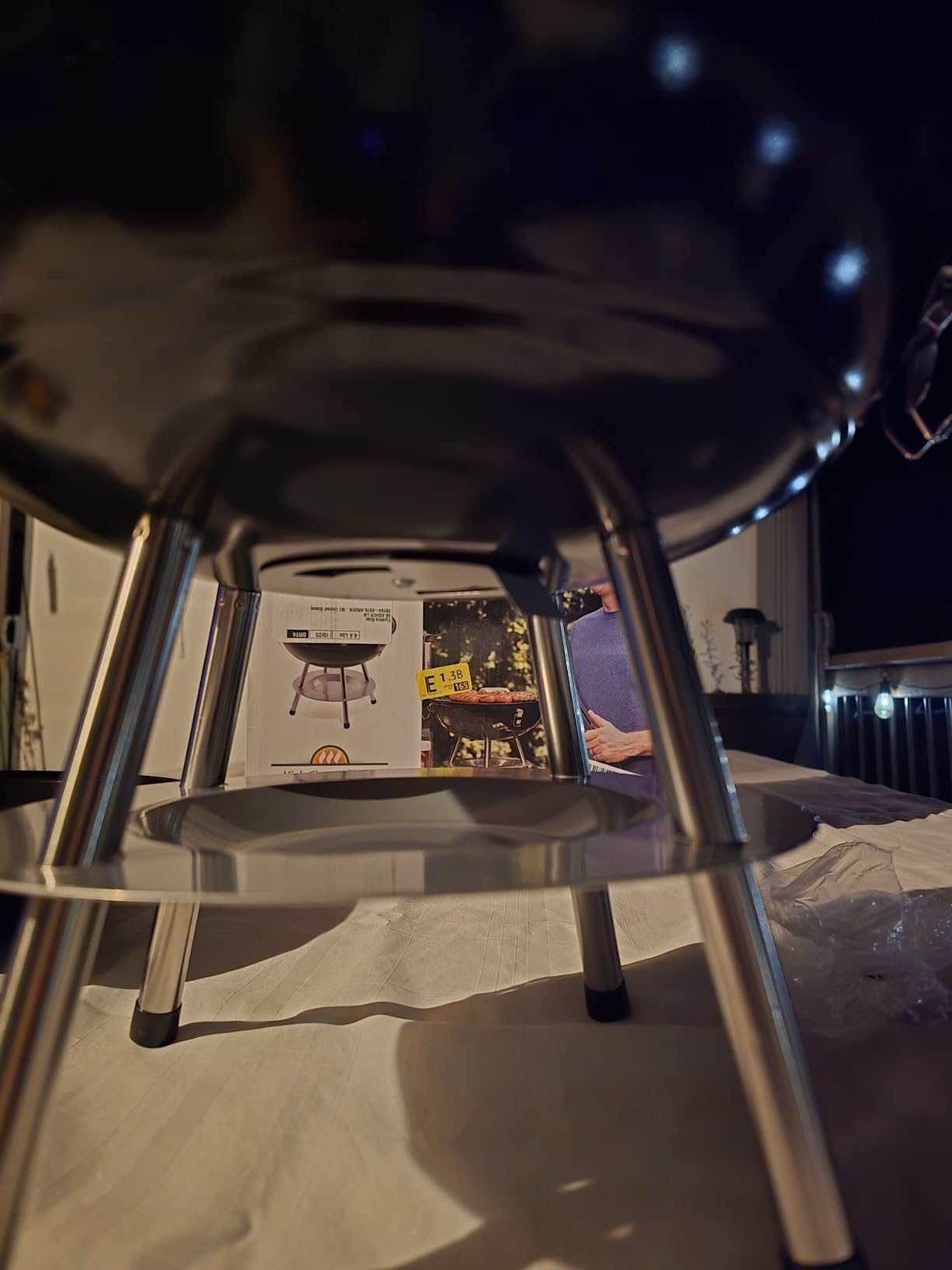
Now the part you should read before buying. The top grate rests on a very small lip, and a widely shared owner fix is to add three or four screws or nuts as shims at the corners so it stops tipping. Until you do that, treat the upper rack as a warming shelf rather than a main cooking surface. It is a 20-minute job with a screwdriver and it changes the grill completely.
The second real limitation is coal capacity. This firebox wants 30-plus briquettes to hold heat for a proper cook, and when it runs out it drops fast. Plan on cooking in one session rather than trying to keep it warm for an hour while everyone drinks. The 90-day limited warranty is also the shortest here, so treat this as a first grill rather than a lifetime one.
Is the Cuisinart a real charcoal grill or a toy?
It is a real grill. The firebox is enamel-coated with a proper ash base, the vents are adjustable rather than fixed holes, and the two-grate layout is a genuine design choice for indirect heat. The 196 square inches is the same class of surface as the Oklahoma Joe’s, at roughly a fifth of the weight and a fraction of the money.
What it is not is heavy-gauge. Light-gauge construction can feel thin under your hand and may warp over years, which is the trade for a grill you can genuinely carry. Buy it for weekend camping, expect to replace it eventually, and you will never feel short-changed.
Who should skip it
Skip it if you cook for five or more at once, or if you want to hand-add wood or use a rotisserie. A 196 square inch grate looks generous in photos and feels small the first time six people are waiting. The Cuisinart also has no thermometer, so you are managing heat by hand the entire cook.
4. Charmline Folding Portable Charcoal Grill — Best Packable
Charmline 14 x 9 inches Small Portable Charcoal BBQ Grill, Foldable Compact Camping Barbecue for 1–3 People, Ideal for Camping, Tailgating, Beach, Picnic & Tabletop Use, Green
Folds to 14 x 9 x 3 inches
110 sq in cooking surface
Weighs 5 lb
1750 BTU output
Carry case included
Pros
- Folds to roughly letter-paper size
- Zero assembly so it is usable straight from the bag
- Carry case included
- Thickened alloy steel beats typical budget grills
- Sauce tray and liftable grate ease cooking
Cons
- 110 sq in suits only 1 to 3 people
- 2-month manufacturer warranty
- Maker advises keeping charcoal below half the tray
The Charmline solves a problem no other grill here does: how small can a charcoal grill be and still be a charcoal grill. It folds to 14 by 9 by 3 inches, roughly the size of a sheet of letter paper, weighs 5 pounds, and needs no assembly at all. You open the frame, drop in a tray of charcoal, close the lid, and light it. That zero-assembly property matters more than it sounds when you are unpacking in the dark at a site you have never visited.
Construction is better than the typical low-cost folding grill. It uses thickened alloy steel with a powder-coated finish rather than light-gauge wire, and the smooth-surfaced grate and charcoal tray wipe clean with a paper towel. A lifting grill net lets you move coals without tipping the whole tray, and a dedicated condiment tray unfolds with the legs for sauces and a phone.
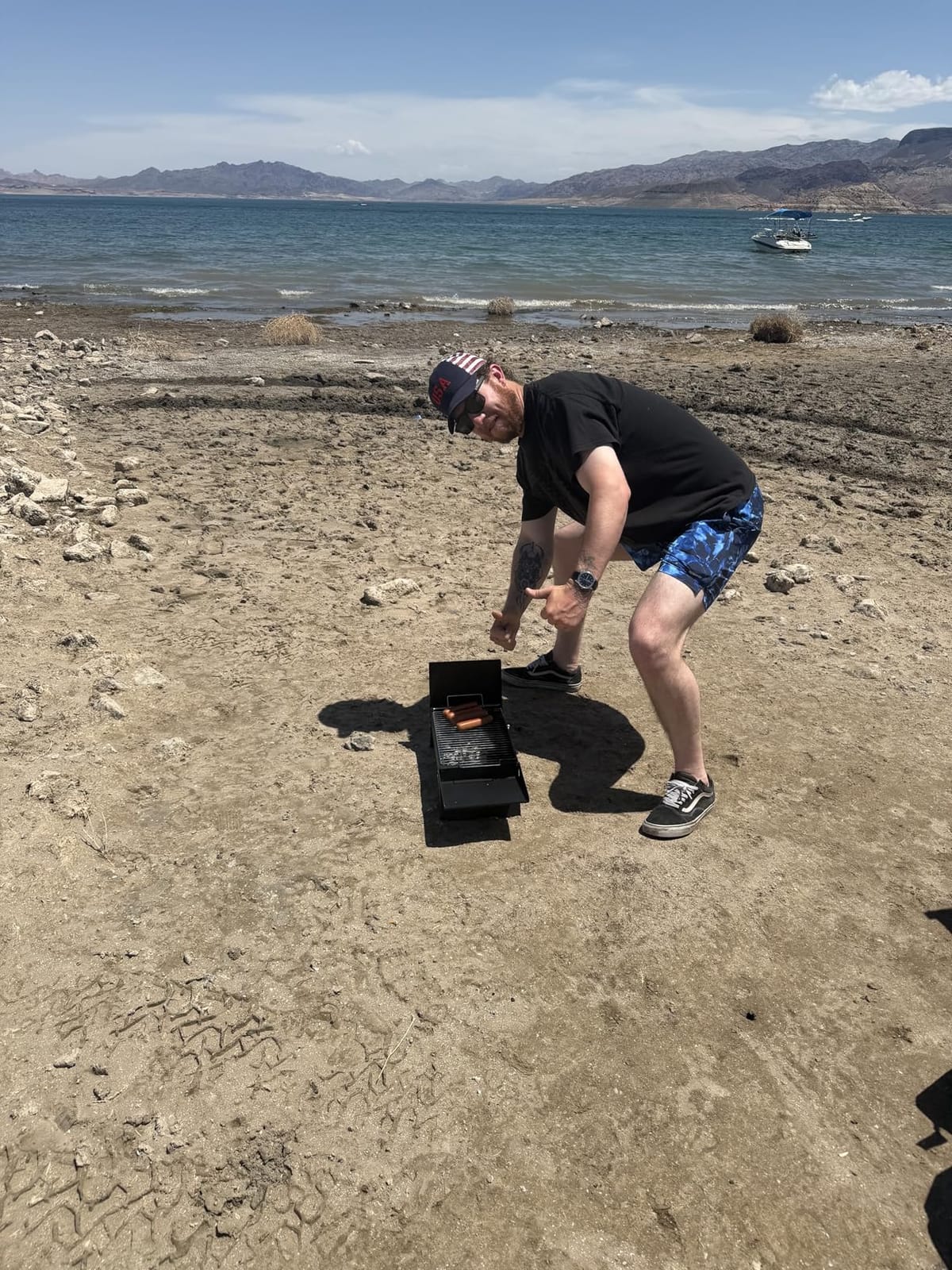
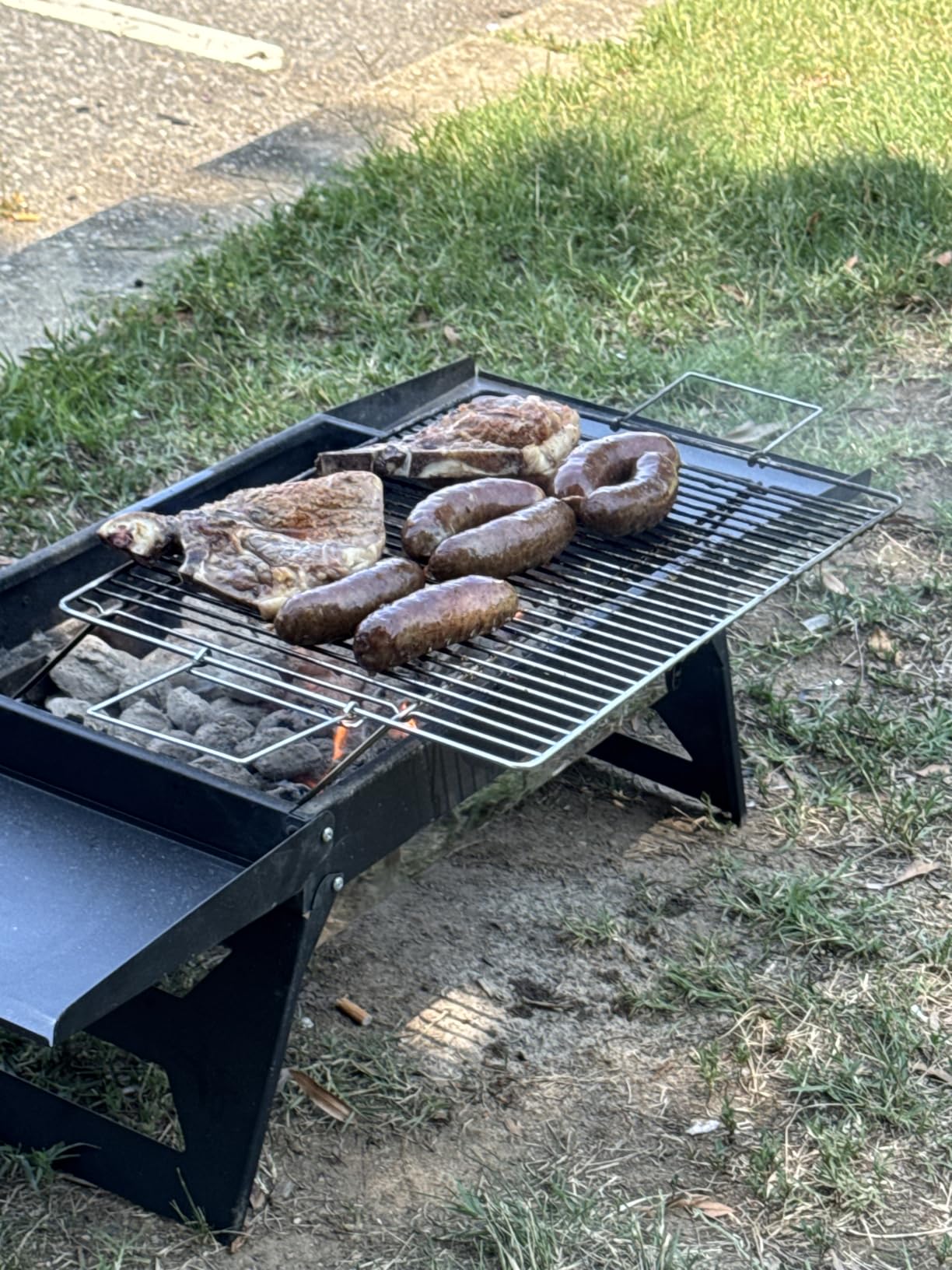
The limit is 110 square inches. That is a real cooking surface for hot dogs, sliced vegetables, a foil-wrapped potato and two or three people, and it is not a surface for a family cookout. The manufacturer also advises keeping charcoal below half the tray, which limits how much heat you can bank on a windy night. Owners note the 2-month warranty as the other soft spot.
At 1750 BTU of rated heating power, this is a modest fire. That is the right size for a camp stove, a cast-iron pan or a small kettle of coffee on the grate, and it is why this grill pairs well with a portable car refrigerator setup where you want the grill for the small tasks.
When packability beats cooking capacity
Packability wins when distance is the constraint. If you are hiking in, canoeing to an island, or carrying gear from a trailhead to a backcountry site, the difference between a 5-pound grill and an 18-pound grill is the difference between cooking and not cooking. The included carry case keeps the folded grill clean in a pack and gives you somewhere to stow loose charcoal.
It also wins for boat and kayak camping, where volume is as scarce as weight. A folded Charmline fits in a dry bag beside a stove; nothing else in this roundup does.
When it loses
It loses on every dimension of capacity: 110 square inches, a small coal tray, and no room to build a two-zone fire. The top grate is the whole cooking surface, so you cannot do real indirect cooking. Buy it for solo campers and couples on the move, not for a group of six at a drive-up site.
5. Royal Gourmet CD1519 Portable Charcoal Grill — Best With a Warming Rack
Royal Gourmet CD1519 Portable Charcoal Grill with Warming Rack, 303 Sq. In.
303 sq in including warming rack
Front-loading charcoal door
Two air dampers
Weighs 25.4 lb
Removable ash tray
Pros
- 303 sq in of porcelain-enameled wire grate
- Front access door adds coals with little heat loss
- 3-level fire grates plus two dampers for two-zone control
- Warming rack keeps finished food hot
- Removable ash tray simplifies cleanup
Cons
- Arrives fully unassembled and takes about an hour to build
- 25.4 lb is heavy for carry-in camping
- Occasional reports of a missing thermometer
The Royal Gourmet is the one to buy when dinner takes longer than a cookout. At 303 square inches of porcelain-enameled steel wire grate plus a chrome-plated warming rack, it has room to cook for a family and keep the finished burgers and sausages off to the side while the rest of the food finishes. Owners describe it as a clear step up from the cheap suitcase grills, and the enameled wire is far easier to clean than cast iron.
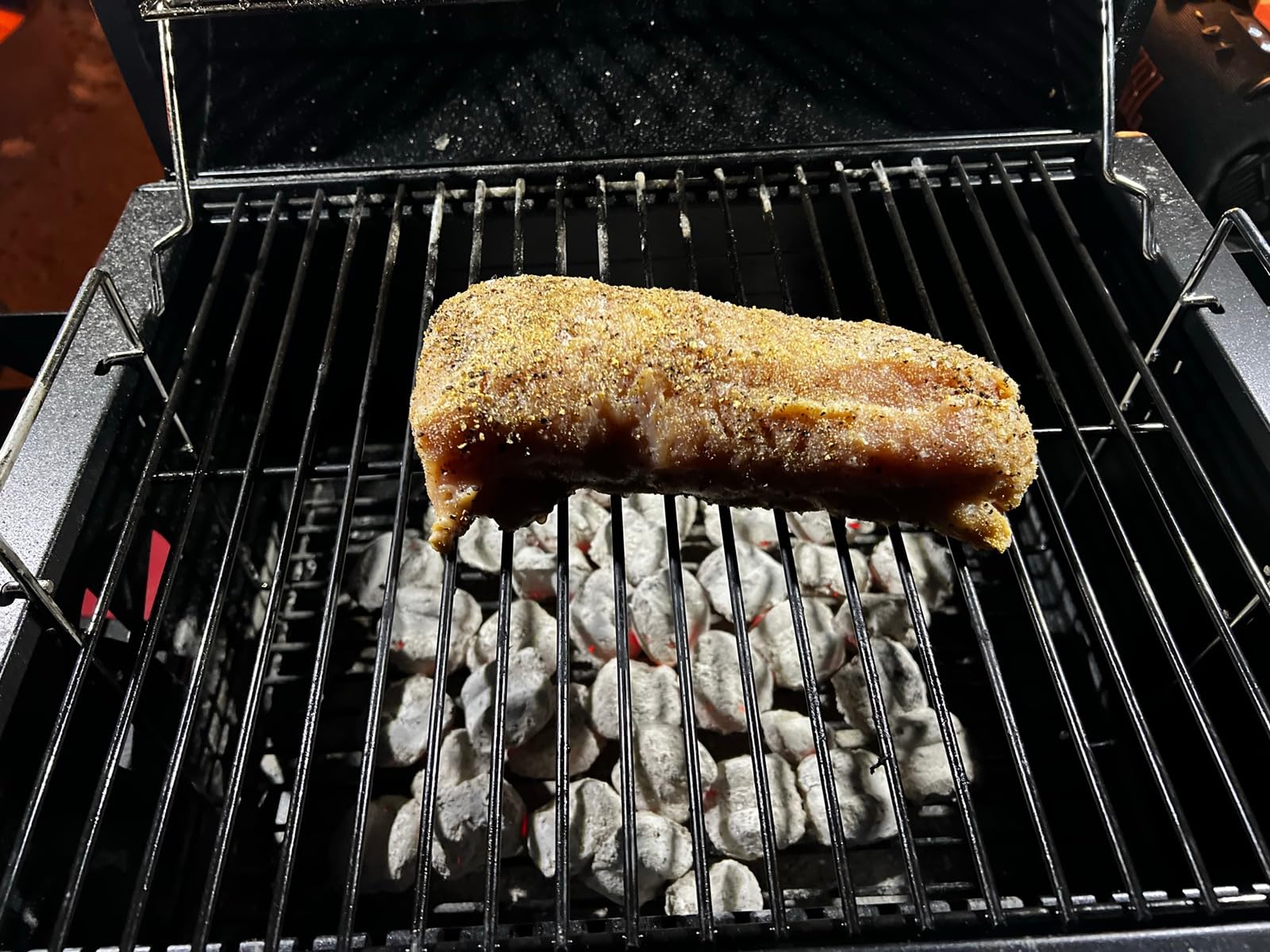
Two features separate it from every other mid-size unit here. The front charcoal access door lets you add coals mid-cook without lifting the lid, so you lose almost no heat. And three adjustable fire grates plus two air dampers, one on the body and one on the lid, give you genuine two-zone control: coals on the front for searing, coals pushed back for a slow finish. A built-in thermometer handles the monitoring, and hardwood chips are a realistic add-on at this size.
The cost is setup. It arrives fully disassembled, and owners consistently budget about an hour with a socket set to bolt it together the first time. Budget ninety minutes if you are doing it at a campsite, and do it at home. Some buyers also report a missing thermometer or other packing QC gaps, so inventory the parts against the manual before you drive out.
At 25.4 pounds with dimensions of 18.58 by 27.76 by 19.21 inches, this is a drive-up grill. It is not a carry-in grill. The removable ash tray underneath makes cleanup quick, and a one-year manufacturer warranty covers the basics.
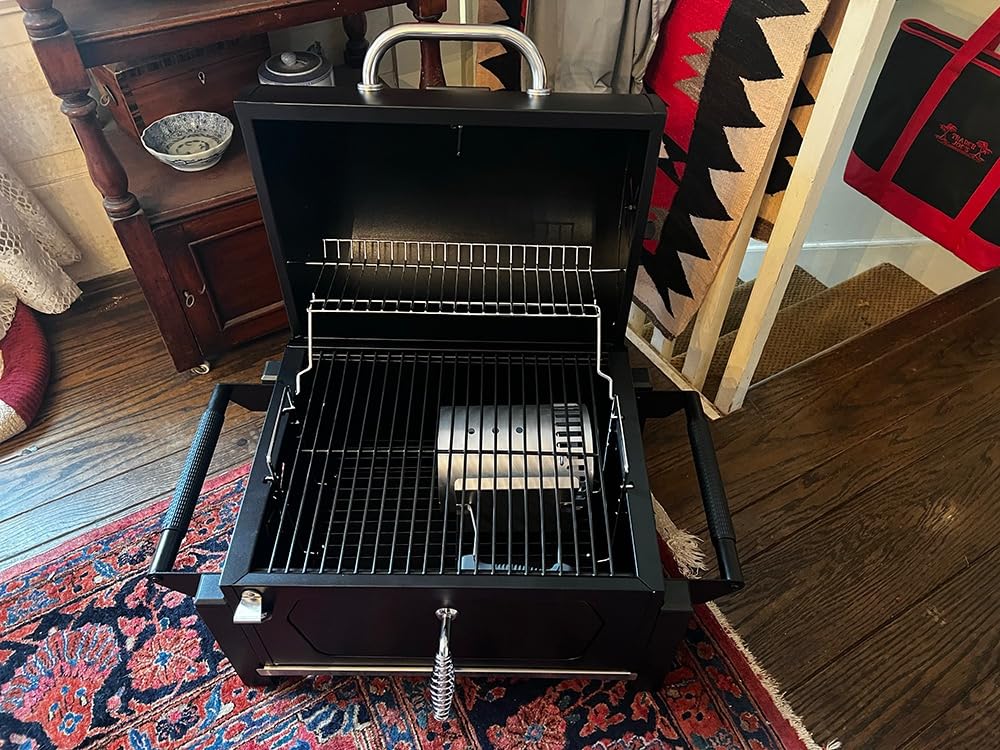
How the warming rack changes a camp meal
It changes the sequence, not the menu. You cook the slow item first, move it to the upper warming rack, and finish the fast item on the main grate without stacking raw and cooked food on the same surface. On a small grill that separation is worth more than extra square inches.
It also solves a real problem with cast iron grates elsewhere in this roundup. A wire grate holds almost no heat, so it does not scorch drippings or dry out a sauce the way cast iron can. For a long, multi-course camp dinner that is the better material.
Who should skip it
Skip it if you want to grab it and go. An hour of assembly on first use rules it out for a spontaneous trip, and 25.4 pounds rules it out for carry-in. It also has more surface than a couple needs, which is wasted fuel if you are cooking for two every night of a weekend.
6. Feasto 354 Square Inch Tabletop Charcoal Grill — Best for Six or More
Feasto Portable Tabletop Charcoal Grill, 354 sq.in Cooking Area
354 sq in total: 265.5 sq in grill plus 88 sq in warming
Cast iron grates
Weighs 26 lb
Battery-free mechanical thermometer
Pros
- Largest total cooking area in this roundup at 354 sq in
- Two-tier layout splits grilling from warming
- Cast iron grates hold and spread heat evenly
- Raise-and-lower coal tray plus adjustable damper
- Separable ash pan detaches for cleaning
Cons
- 26 lb is heavy for backpacking
- Only a 1-year limited warranty
- Rating spread includes 8% one-star reviews
The Feasto is the grill to buy when “we’re all eating at once” is the plan. Its 354 square inches is the largest total surface of anything we tested, split into 265.5 square inches of primary grilling space and 88 square inches of warming area. Owners use the phrase “up to about 16 burgers,” and at that size you stop cooking in batches and start cooking a meal.
Everything about the design aims at holding temperature through a long cook. The cast iron grates retain and spread heat evenly rather than creating the hot spot you get on thin wire, and a two-position raise-and-lower charcoal tray plus an adjustable damper and chimney vent give you real control without fiddling. The mechanical thermometer is a small thing that we came to like: it needs no battery, which means it works on a ten-day trip with no charger in the pack.
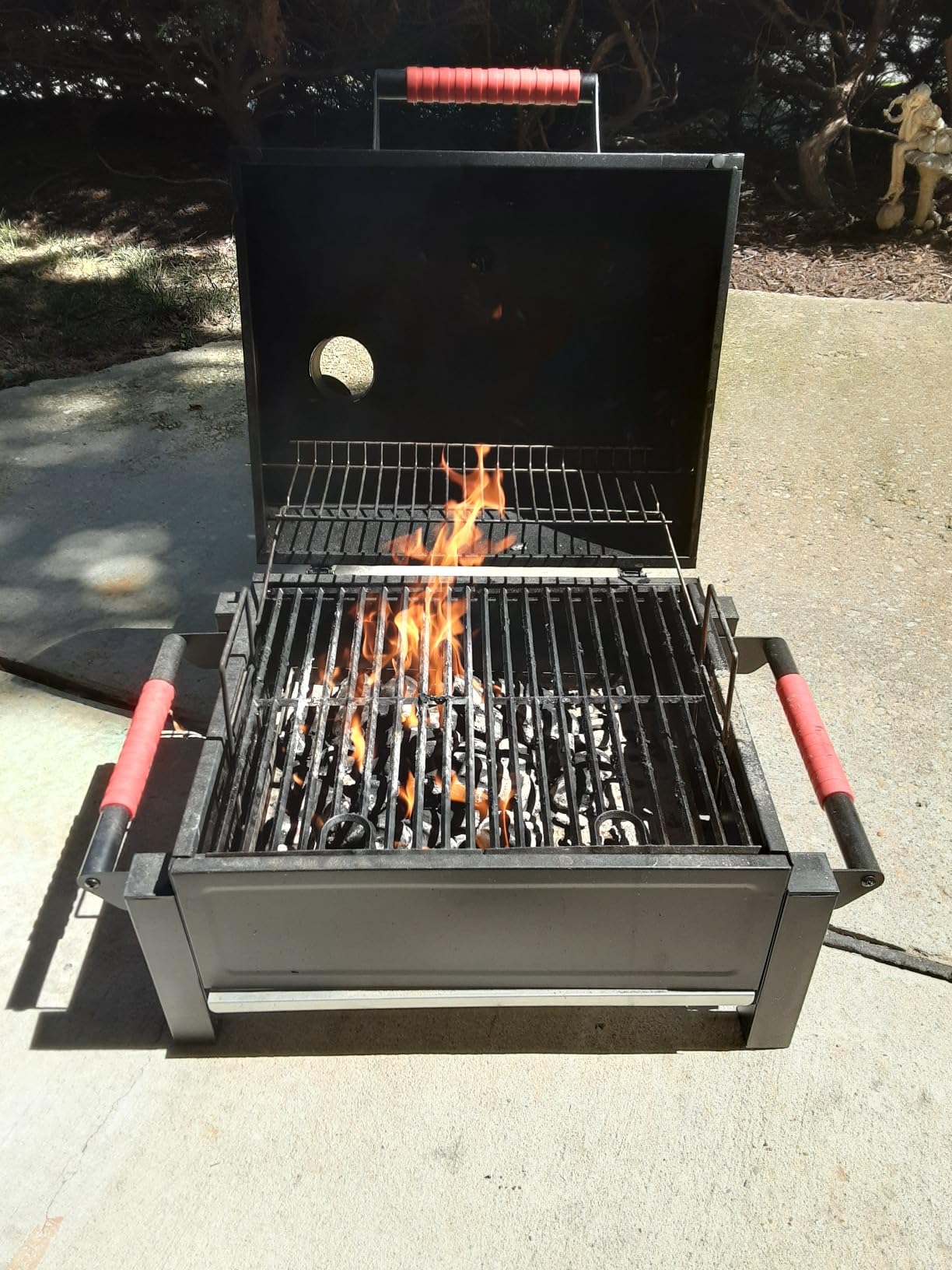
Three silicone-wrapped anti-scald handles make a 26-pound grill bearable for two people and reasonable for one with a good stance, and the separable ash pan detaches from the firebox entirely so you can dump ash without tilting hot coals. Heavy-gauge powder-coated steel construction is the frame, which is the right material for something that lives in a truck bed.
The trade-offs are weight, a 1-year limited warranty, and a rating spread that includes 8% one-star reviews, more than most peers here. Those negatives cluster around rust appearing on units stored damp between trips, and around assembly quality. Dry the grill before you store it and most of that goes away.
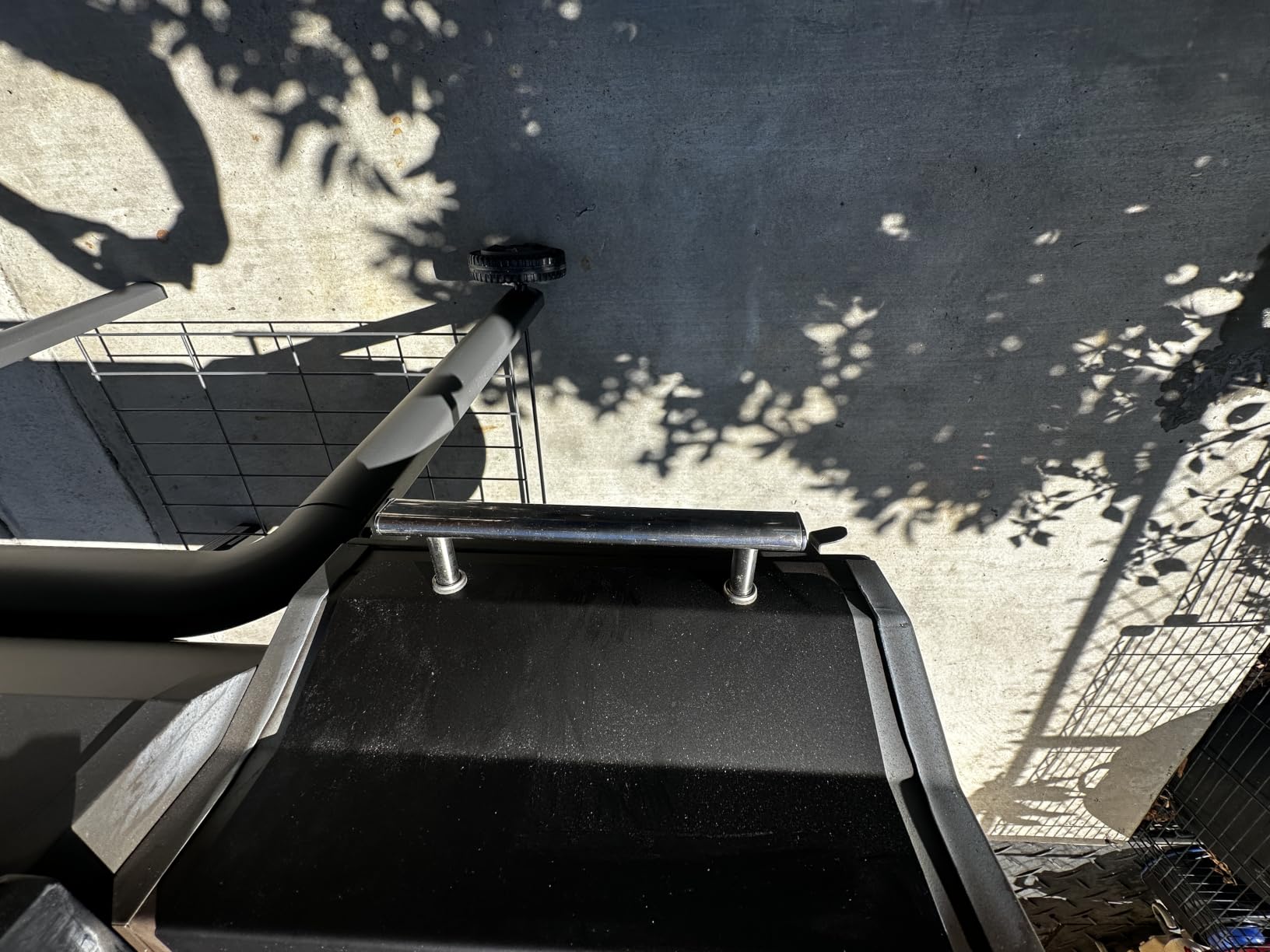
How much charcoal a six-person cook really takes
On a 354 square inch grate you are building a real coal bed, not a token. A full dinner for six on this grill runs roughly 30 to 40 briquettes, or about 5 to 6 pounds of lump charcoal. Bring more than you think for a cold night, and bring a chimney starter so the first ten minutes are not a wind fight.
The raise-and-lower tray is what makes that volume manageable. Coals high for searing, coals low for a slow finish, and the 88 square inch warming shelf keeps everything you have already cooked out of the heat.
When to choose something smaller
Choose smaller if you are cooking for two, or if you are moving the grill yourself more than about 30 feet. 26 pounds is a lot of weight to carry across a soft site, and burning 6 pounds of charcoal to cook two steaks is the least efficient outcome in this roundup. A carry-weight-aware choice like the gas grill comparison for tailgating covers the lighter end of the same trip scenario.
7. Odoland Folding Wood-Burning Grill — Best Grill and Fire Screen Combo
Odoland Portable Folding Charcoal Grills for Outdoor Cooking Bonfire BBQ
304 stainless steel rack at 15.75 x 11.02 inches
Dual fuel: wood and charcoal
Weighs about 9.4 lb
Weighs 4.2 kg listed
Pros
- Burns both charcoal and wood
- folds flat with a carry case
- 304 stainless rack resists heat better than bare wire
- Doubles as a fire screen against sparks and embers
- Assembles in minutes
Cons
- Rack fits only 4-5 skewers
- About 9.4 lb is heavy for folding grills
- Open frame has no lid so no indirect cooking
- Some reports of rust and paint wear after storage
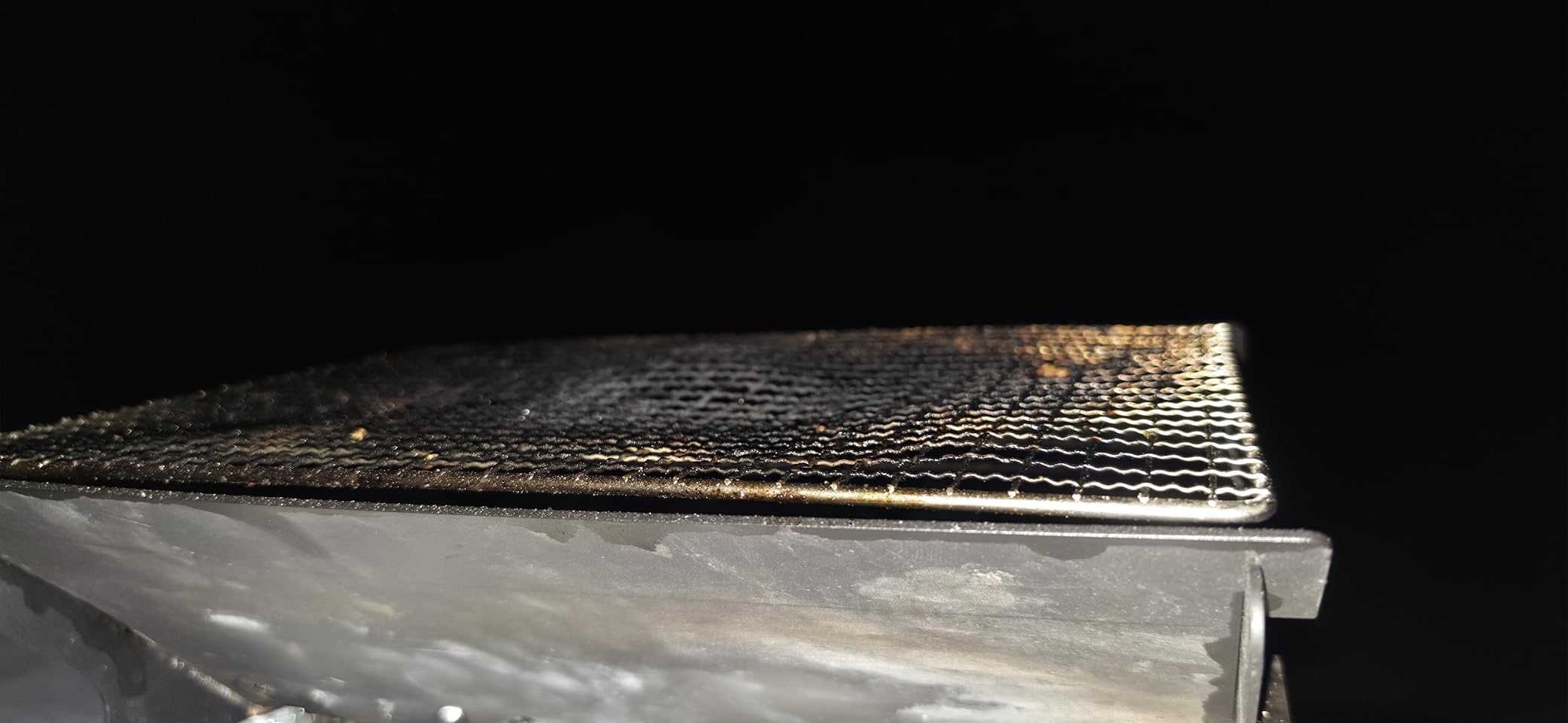
The Odoland is the odd one out and we like it for exactly that reason. It is a folding iron grill that burns charcoal or split wood, so when your charcoal supply runs low at a site that sells firewood, you feed it logs instead. It also folds flat, includes a carry case, and assembles in minutes with nothing more than the enclosed manual.
The part that changes how you camp with it is the fire screen function. The open frame with its raised edges contains sparks and embers, so once dinner is done you can use the same frame to hold a fire that throws warmth and light without launching embers onto your tent or your dry pine needles. Owners who use it this way describe it as grill, wood stove and spark screen in one object.
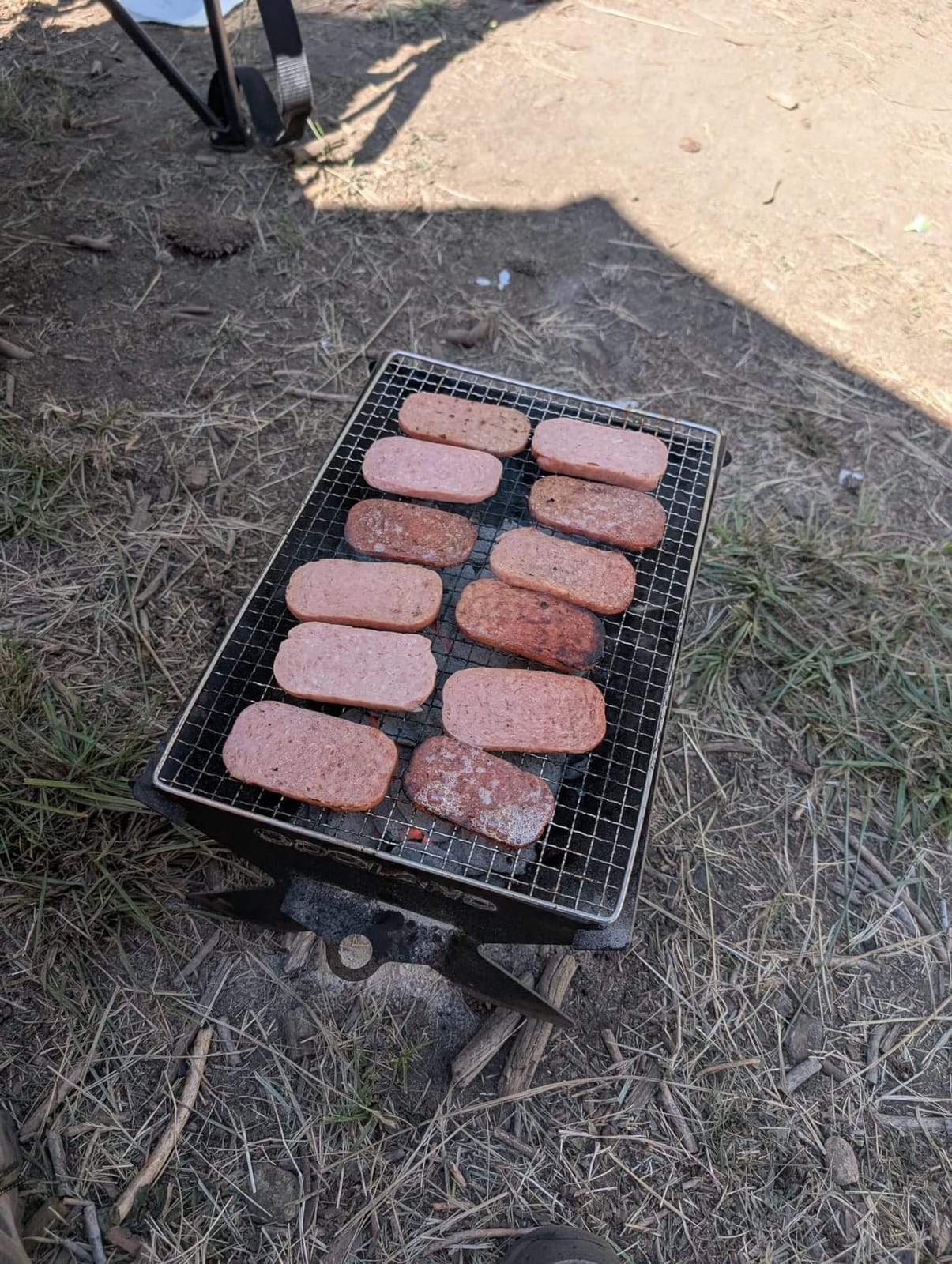
The 304 stainless steel rack measures 15.75 by 11.02 inches and fits four to five skewers, so this is a skewer-and-small-items grill, not a hamburger cooker. The rack is a genuine upgrade over bare wire, which is where most folding grills fail first. The heavy-duty iron with a black high-temperature coating adds real heft at about 9.4 pounds, which is heavy next to the 4-pound plastic-and-thin-steel options.
There is no lid. That means no indirect cooking, no heat retention between additions, and no way to hold food warm other than stacking it to one side. It also means the frame doubles as a screen only when the grill is empty, so plan the sequence of your evening around that.
When the fire screen is worth more than the grate
On a cold shoulder-season night, the screen is the reason to own this. A contained fire with no lid still gives you light, warmth and a place to heat a kettle, and the raised edges stop the embers that cause campground rule violations. In that situation the 4-to-5-skewer limit stops being a limitation.
The dual-fuel design also solves a logistics problem. Some campgrounds and backcountry sites restrict or limit charcoal availability, and a wood-burning grill gives you a fallback that does not depend on a supply chain.
Who should skip it
Skip it if you want to grill burgers or if you plan to do any indirect cooking. There is no lid and the rack is skewer-sized, which makes it a poor fit for a family dinner. Rust and paint wear after outdoor storage are also reported, so store it dry.
8. Gas One 14 Inch Portable Charcoal Grill — Best Budget Pick
Gas One – 14-inch Portable Barbecue Grill with 3-Point Locking Lid for Heat Preservation – Dual Venting System – Small Charcoal Grill for Backyard, Camping, Boat
150 sq in cooking surface
Weighs 4 lb
3-point locking lid
Dual venting
Integrated ash catcher
Pros
- Lowest-cost grill here that still has a locking lid and ash catcher
- 4 lb carry weight is genuinely portable
- Locking lid traps heat and secures it for transport
- Dual vents keep the fire steady
- Ash catcher keeps the cooking area clean
Cons
- Light-gauge metal can flex or warp with repeated high heat
- 150 sq in limits you to a few burgers or steaks
- No built-in thermometer
- 1-year warranty
The Gas One is the cheapest grill in this roundup and still includes two things that cost more elsewhere: a 3-point locking lid and an integrated ash catcher. The lid clamps down to trap heat like a small smoker and secures the grill for the walk to your site, and the ash catcher underneath keeps ash out of the cooking area. At 4 pounds, it is also one of the most portable units we tested.
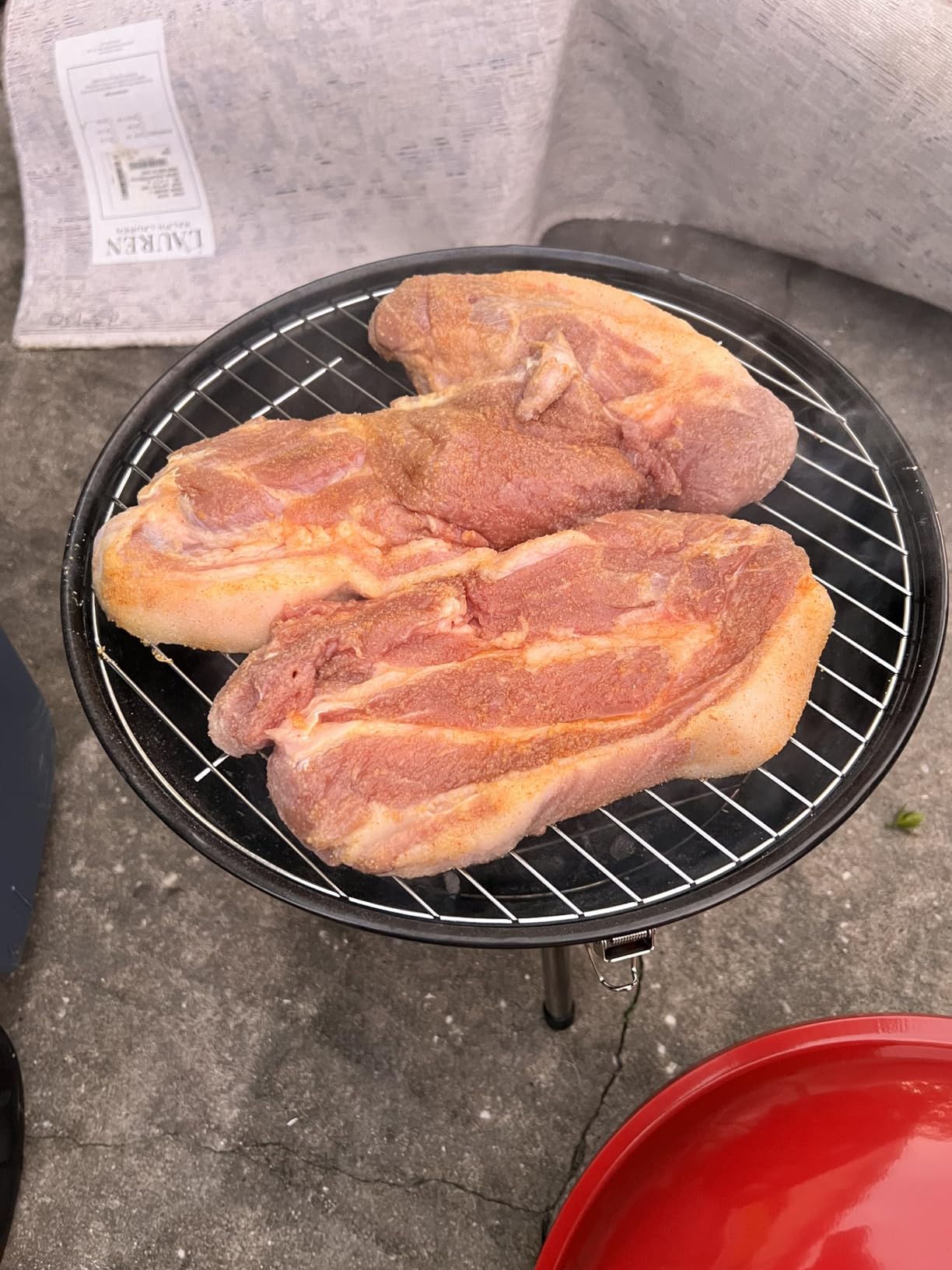
For a couple cooking a quick dinner, it does the job. The dual venting system keeps the fire burning steadily without constant adjustment, and a warming rack gives you a place to park food while the direct zone works. With more than 4300 reviews averaging 4.3 stars, it is one of the better-reviewed budget units in the category.
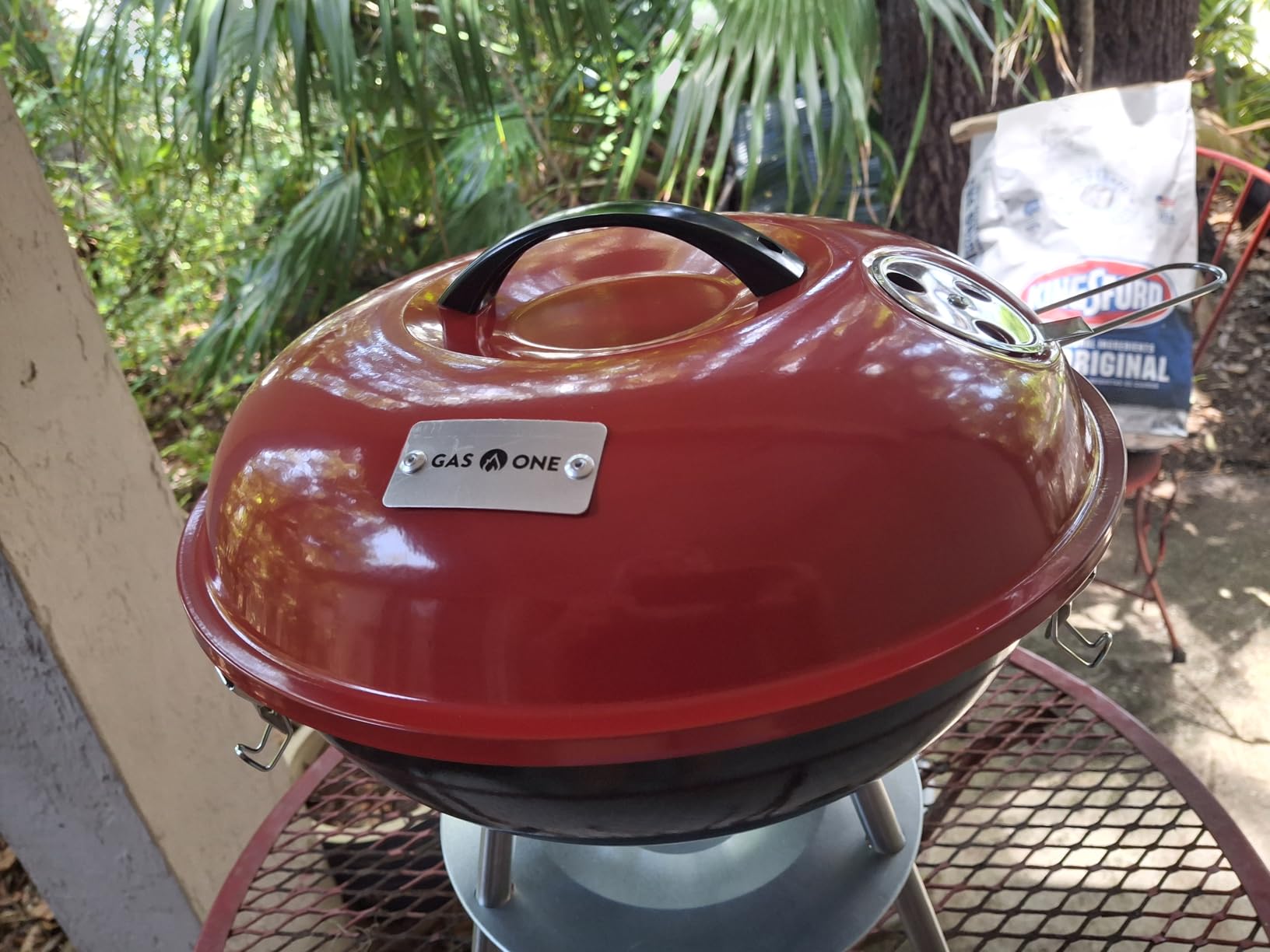
What you give up is gauge weight. The metal is light-gauge, and owners report it flexing or warping after repeated high-heat use. That is the cost of the low weight, and it is a cost you should accept knowingly rather than discover in year three. There is also no built-in thermometer, so you are reading heat by experience.
At 150 square inches, plan realistically. This is a few burgers, a couple of steaks or a tray of vegetables for two or three people. It is not a group grill and it is not a smoker, even with the lid locked.
Is a budget portable charcoal grill worth buying?
Yes, for weekend trips. The Gas One costs less than a campground night and gets you real charcoal flavor instead of a propane cylinder. The locking lid and ash catcher are the two features that separate it from the flimsiest units, and at 4 pounds it packs into a bag with room to spare.
It is worth buying if you cook for two, on small fires, and you do not mind a flat surface and a shelf for warming. If you sear steaks at high heat several times a season, buy a heavier grate and accept more weight.
Who should skip it
Skip it for a group of four or more, and skip it if you are a heavy sear cook. There is no thermometer and no adjustable coal tray, so heat control comes down to how you build the fire. A 1-year warranty is also the shortest of the mid-priced options.
9. Char-Griller E1816 King-Griller Gambler — Best on Wheels
Char-Griller E1816 King-Griller Gambler Portable Charcoal Grill in Black
320 sq in cast iron cooking area
Two wheels and folding frame
Weighs 39.6 lb
Stainless steel thermometer
Pros
- Large 320 sq in cast iron cooking area
- Two wheels roll it from the car to the table
- Stainless steel thermometer and easy-dump ash pan
- Cast iron grates season well and resist rust
- Grate lifter and tool hooks included
Cons
- Reports of a weak folding latch that can let the grill collapse
- Some units arrived without a travel lock
- Charcoal grate and legs reported as too thin
- 39.6 lb and a 39 inch width make it bulky
The Char-Griller E1816 is the largest grill here by the numbers: 320 square inches of cast iron cooking area, a stainless steel thermometer, a side shelf, tool storage hooks, a grate lifter and an easy-dump ash pan. Satisfied owners cook chicken, lamb chops, thighs, asparagus and potatoes on it and report it fits in a sedan trunk. The two wheels and integrated handle make it the only grill in this roundup you can roll from a parking spot to a picnic table without lifting.
Cast iron is the right call at this size. It holds and spreads heat across 320 square inches far better than wire, it sears hard, and it seasons into a natural release surface over time. The stainless steel thermometer is also a genuine upgrade over the cheap dial units, and the folding construction with locking legs is a smart idea when the design works as intended.
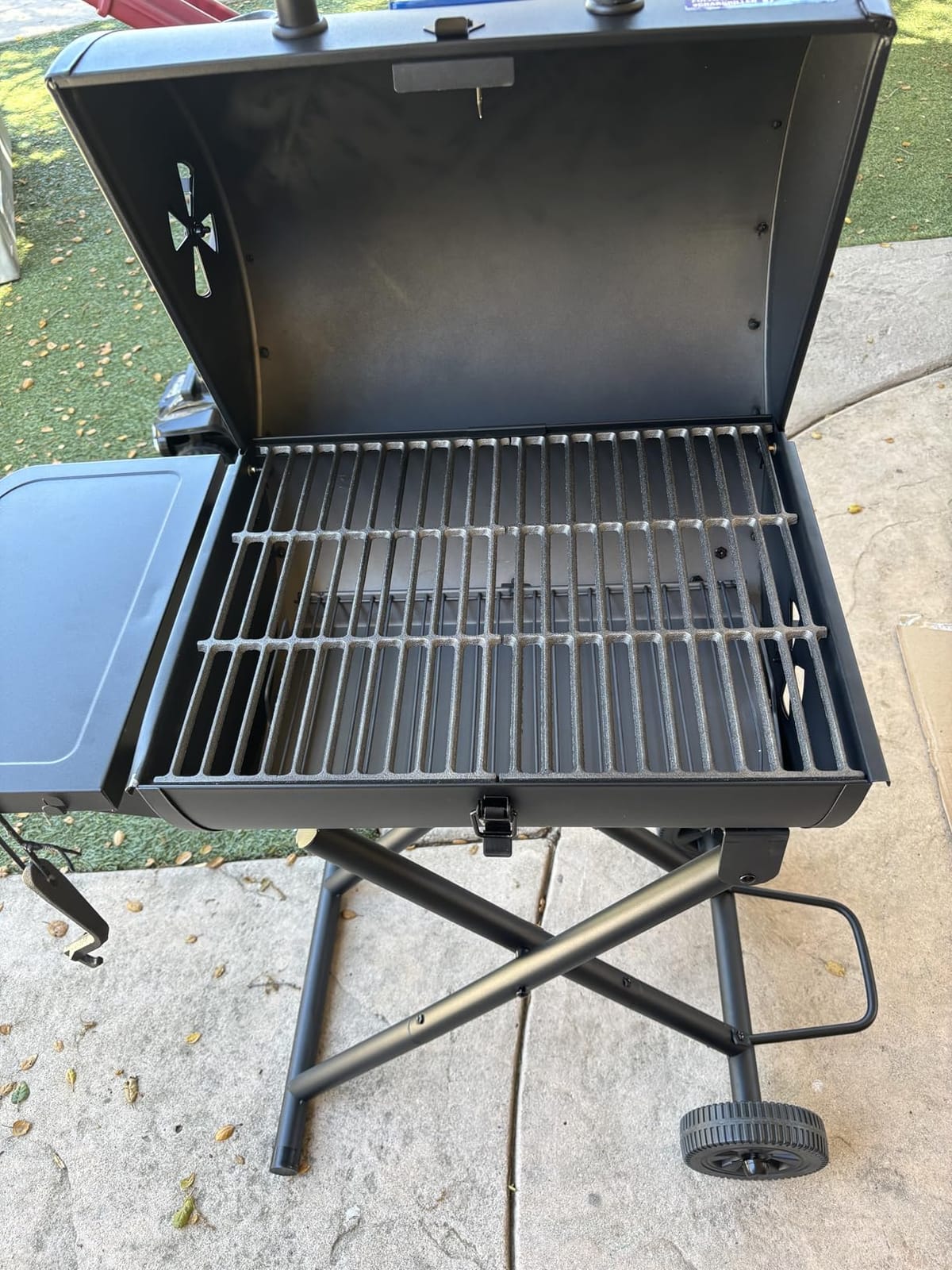
Which brings us to the reason this grill sits at the bottom of our ranking. Multiple one- and two-star reviews report the folding leg latch weakening and letting the grill collapse mid-cook, which is a safety problem and not an inconvenience. Other buyers received a grill with no travel lock or clasp, and replacements were reportedly unavailable. Several owners also report the charcoal grate and leg supports as too thin, warping and failing within months.
This is the most polarizing grill we tested: 67% five-star alongside 12% one-star. Listed dimensions of 22 by 39 by 40 inches and a reported weight of 45 pounds in some listings mean it is bulky when folded, and assembly takes one to two hours. Treat it as a truck-bed or driveway grill rather than a hiking one.
Is 320 square inches worth the bulk?
Only if you cook for six or more regularly and you have a vehicle with room for it. The surface is genuinely class-leading here, and the wheels solve a problem no other unit addresses. But the coal bed on a barrel grill of this size is a commitment, and 39-plus pounds of bulk is a real cost in fuel and in effort.
If bulk is your problem, the Royal Gourmet gives you 303 square inches at 25.4 pounds with a much simpler frame and a cleaner review profile. That is the trade we would make for most campers.
Who should skip it
Skip it if you camp anywhere that punishes gear breakage, if you carry any distance, or if you dislike assembly. The reported latch failures and missing travel locks are not edge cases — they appear repeatedly across reviews, and a collapsing grill over a fire is the kind of problem we will not recommend to a family campsite.
10. Joyfair Portable Charcoal Grill — Best With a Built-In Thermometer
Joyfair Portable Charcoal Grill with Thermometer, Small BBQ Camping Grills
118.8 sq in cooking area
Built-in lid thermometer
Weighs about 8 lb
Powder coating rated to 750-800 degree F
10-minute assembly
Pros
- Built-in lid thermometer is rare at this size
- Vertical chimney produces three-dimensional heating
- Side vents adjust temperature without lifting the lid
- 10-minute assembly with a supplied screwdriver
- Chrome-plated rack with a thick outer ring
Cons
- Some units reported top-heavy with uneven legs
- Runs hotter than the gauge shows with the lid closed
- 118.8 sq in suits 1 to 3 people
- Legs may need detaching for tighter packing
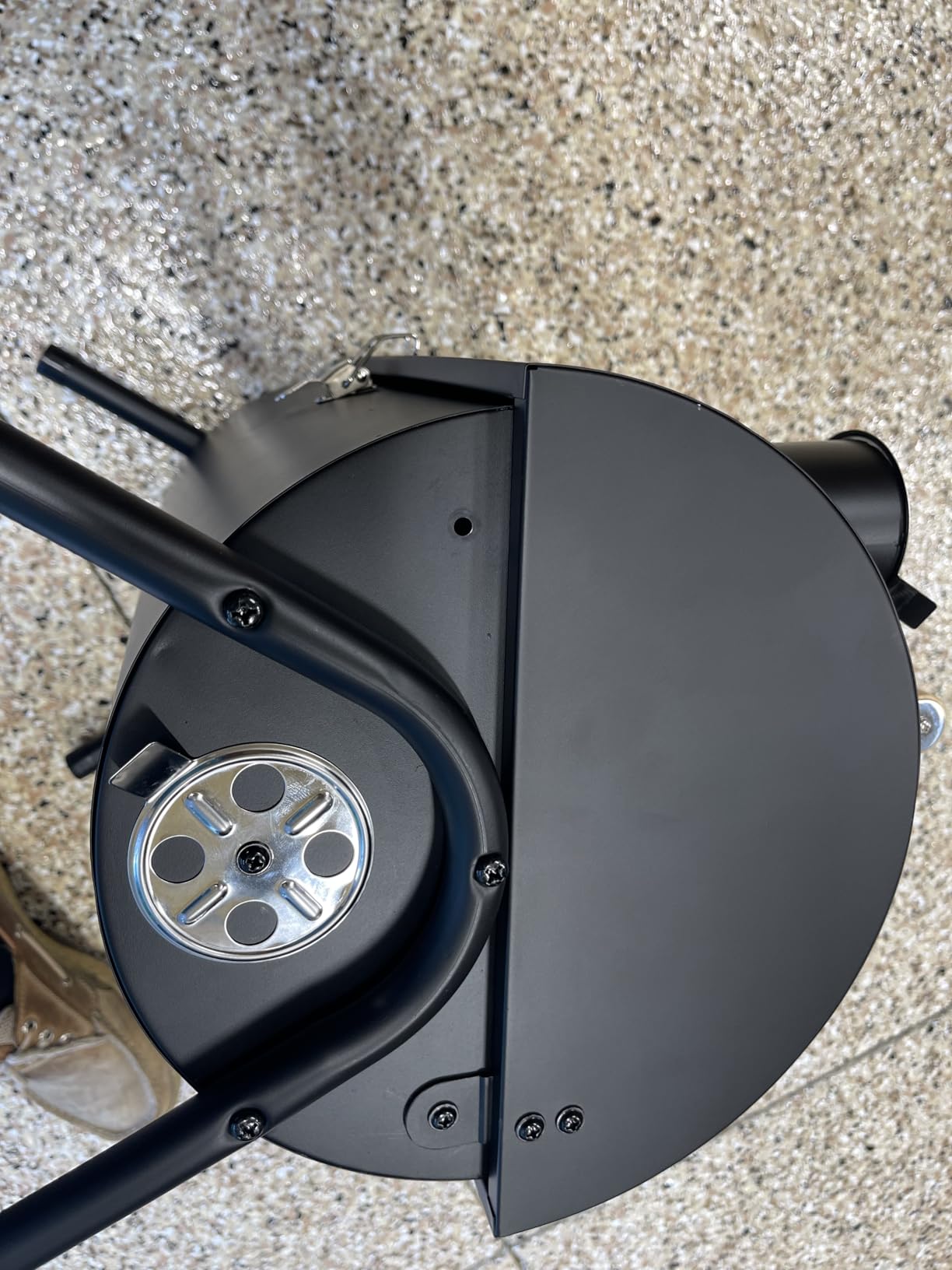
A lid thermometer on a 118.8 square inch barrel grill is unusual, and it is the reason the Joyfair is worth a look. Small charcoal grills fail because you have no idea what temperature you are running, and a gauge is the cheapest fix. The vertical chimney is also a real design choice: it pulls air upward through the coal bed so heat reaches food from more than one direction, which owners credit for juicier results on a small grate.
Side vents let you adjust airflow without lifting the lid, and the powder coating is rated against 750 to 800 degree heat, which is a meaningful spec for a grill this small. The triangular leg structure is stable on flat ground, the wooden handle stays cool to the touch, and assembly takes about 10 minutes with the supplied screwdriver because there are few screw types. Owners report cooking for five or six people at a park or beach.
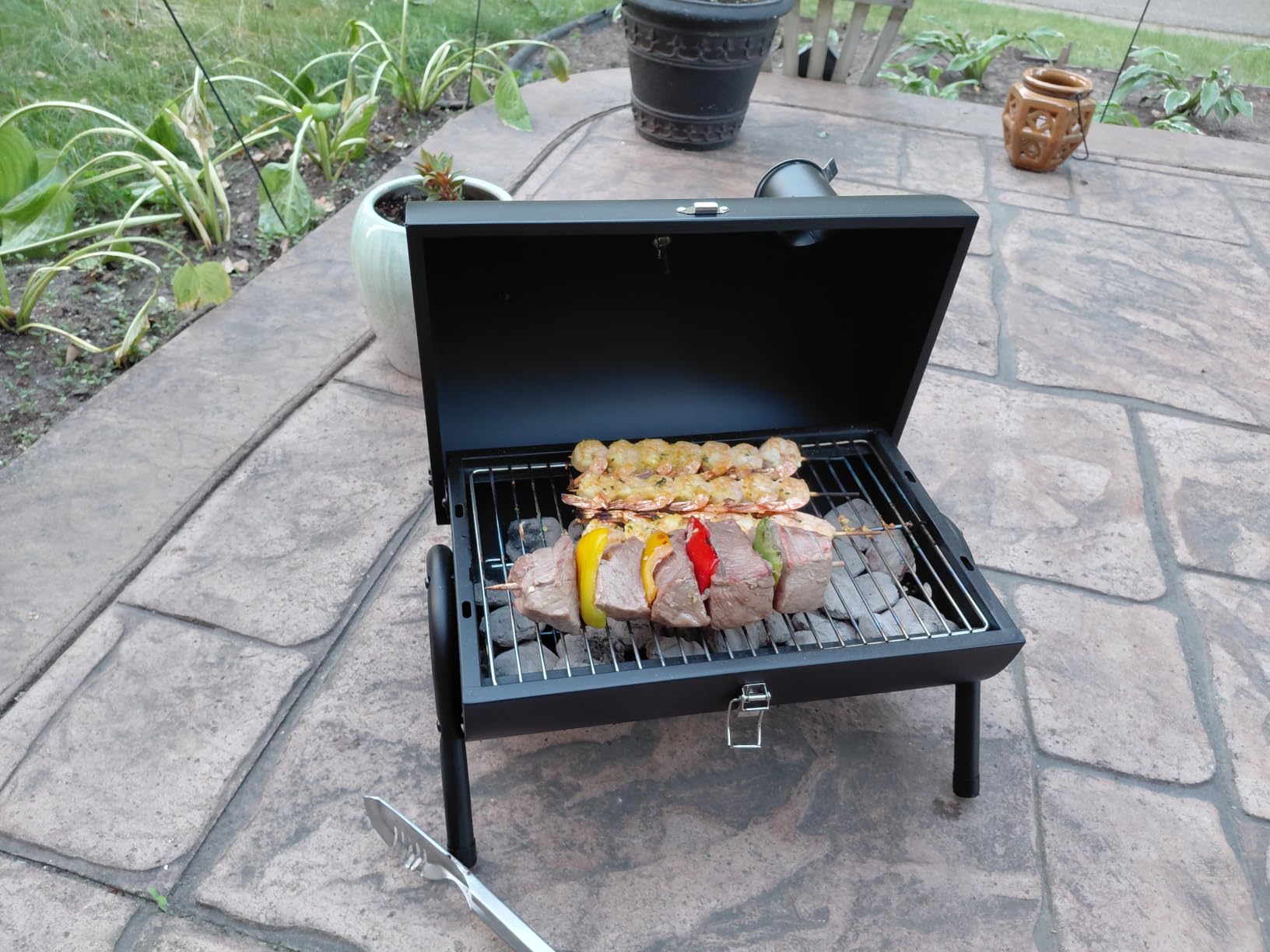
The negatives are specific and worth weighing. At least one owner received a unit that would not assemble with even legs, which made it top-heavy and tipped backward repeatedly. That is a packaging and assembly problem rather than a design flaw, but it is the kind of thing that ruins a first impression at a campsite. Check the legs are level before you light anything.
Second, it runs hotter than the gauge suggests with the lid closed. Treat the thermometer as a relative reading rather than an absolute one, and open the lid or the side vents when you need to slow down. At 118.8 square inches, the grate is still a 1-to-3-person surface, and the legs may need detaching for tighter trunk packing.
Why a gauge matters more than size
On a small grill the gauge replaces experience you do not have yet. A 118.8 square inch grate goes from searing to cold faster than a 240 square inch one, and without a reading you are guessing at a range where a ten-degree error matters. A dial thermometer is not glamorous and it changes the outcome more than most people expect.
It also means the grill is easier to learn. If you are new to charcoal, a gauge shortens the first few cooks considerably, and the side vents give you somewhere to go when the number climbs too fast.
Who should skip it
Skip it if you want stability as a priority above all else, since the uneven-leg reports are worth respecting. It is also the lowest-rated tier in this roundup alongside the Char-Griller, with 12% one-star reviews, and 118.8 square inches is not enough for a group dinner. For a couple who wants a gauge and does not mind a small fire, it is a reasonable pick.
How We Picked These 10 Charcoal Grills
We shortlisted ten charcoal grills and tested them on the things that decide whether a grill works at a campsite rather than in a parking space. The criteria, in order of weight:
- Cooking surface in square inches, matched to real party size. Published surface area is the single most useful number on a portable grill page, and the only honest way to compare across this category.
- Carry weight and packed size. Measured against how far you actually walk: to the car, across a site, or up a trail.
- Ash and grease management. A removable ash catcher or full-size ash pan was treated as a real advantage, because ash cleanup is the chore campers complain about most.
- Airflow control. Adjustable vents, dampers, and a way to move the coal bed for two-zone cooking.
- Build material and review profile. Cast iron and enameled steel scored above light-gauge metal, and a review history with a thin one-star tail mattered more than a higher headline number.
We excluded anything that burns gas or pellets, because the search intent here is charcoal and a mixed list makes both harder to choose from. Where a model had a specific engineering complaint repeated across multiple reviews, we weighted that complaint heavily regardless of the average rating.
Buying Guide: Choosing a Portable Charcoal Grill for Camping
Match the square inches to your group
Cooking surface area decides everything else, so start there. Here is the sizing guidance no competitor roundup gives you:
- 1 to 2 people: 110 to 150 square inches. Hot dogs, vegetables, foil packets, a couple of steaks. The Charmline and Gas One sit here.
- 2 to 3 people: 150 to 200 square inches. Burgers, chops, a pan of vegetables. This is the most common camping case.
- 4 people: 200 to 250 square inches. Enough to cook a full batch at once and use the far side for indirect heat.
- 5 to 6 people: 250 to 330 square inches. You want a warming rack so finished food does not overcook.
- 7 or more: 330 square inches and up, or plan on cooking in batches. Only two grills in this roundup reach that.
Sort by how far you carry it
Weight is the variable campers think about first, and the useful way to sort is by carry distance, not by pounds alone.
- Under 10 pounds: true pack-and-carry units. The Charmline at 5 pounds, the Cuisinart at about 4 pounds, the Gas One at 4 pounds, and the Odoland at about 9.4 pounds. All fit a backpack or a canoe.
- 10 to 20 pounds: drive-up or short-carry units. The Weber Jumbo Joe at 18 pounds is the benchmark: the biggest surface you can still carry with one hand and a bag.
- Over 20 pounds: car camping only. The Feasto at 26 pounds, the Royal Gourmet at 25.4 pounds, the Char-Griller at 39.6 pounds, and the Oklahoma Joe’s at 48.5 pounds. All excellent, all two-person carries.
Choose your material
Cast iron holds heat and sears hardest, and it is what the Oklahoma Joe’s and Feasto use. It is heavy, it needs seasoning, and it needs oiling after each cook. Porcelain enamel, as on the Weber Jumbo Joe’s bowl and lid, does not peel or degrade with heat and needs almost no maintenance. Chrome-plated or porcelain-enameled wire, as on the Cuisinart and Royal Gourmet, cleans fastest and does not hold heat, which suits a cook for four or six. Light-gauge painted steel is the budget tier, and it is the material most likely to warp.
Do not skip the ash catcher
Ash cleanup is the chore campers name most often, and it is the single easiest thing to fix before you buy. A removable ash catcher or full-size ash pan means you scoop and go. Without one, you tilt the whole grill and dump coals on the ground, which most sites discourage. Every grill in this roundup except the open-frame Odoland has one, and we would not buy the open-frame design for weeknight use for that reason.
Think about wind before you think about features
Charcoal is the fuel that most needs good airflow, and that is where vents matter. Look for adjustable vents or dampers on both the body and the lid, and pair that with a bowl deep enough to shelter the flame. A shallow, wide grill in a cross-breeze will struggle no matter what the vents do. The single best technique is to build the coals into a narrow mound rather than a flat bed, which gives you direct heat on one side and a usable indirect shelf on the other.
Light it properly in moving air
Reliable lighting in wind is a skill, not a product feature. Seven steps that work every time:
- Build your charcoal mound before you light anything, so you are not working over an open flame.
- Fill a chimney starter with coals and set it on the grate.
- Light two squares of newspaper at the bottom and one on top, then blow gently at the base until the paper is fully alight.
- Wait about 10 minutes until the coals at the top start to glow.
- Pour the chimney into the mound, then set the empty chimney beside the grill as a draft shield and a place to stand coals.
- Close the lid and leave it closed for 5 minutes to build a heat base.
- Start cooking with the vents about three-quarters open and close them down once the grill is at temperature.
Two lighters instead of one is our rule on windy sites, and if your grill has no lid at all, light the coal upside down in the frame so the wind hits the unlit face.
Plan the campsite rules before the coals come out
Nothing derails a cook faster than a rule you did not know. Most campgrounds and national parks allow small charcoal grills in designated cooking areas but ban them in fire-ring-only sites, and fire bans routinely prohibit charcoal entirely. Check the specific rules for your site before you buy, not at the gate. Know where ash and coals must be disposed of, usually a designated container rather than your fire ring, and never carry a lit grill across a site or a parking lot — set it down and let it cool in place, or move it only in a sturdy tray.
Is a portable charcoal grill worth it?
Yes, and the honest comparison is against your other two options, not against a full-size grill. Against a campfire: a portable charcoal grill gives you real temperature control, a grate that keeps food out of the dirt, no ash in your socks, and the ability to cook when the fire ring rules say no open fire. A campfire wins on ambience and on zero weight. Against propane: charcoal gives you genuine smoke and char flavor, needs no cylinder, and avoids fuel restrictions at sites where grills are restricted. Propane wins on ignition time, on temperature control, and on cleanup. If you have never cooked on charcoal, the ten-minute light time is the biggest adjustment, and it is worth it.
The real cost of charcoal is the cook, not the fuel. Bring a chimney starter, build a mound, and give it time. A camp cook who brings a grill and lights it properly cooks better camp food than a camp cook with a propane unit, and that is the whole argument.
Maintain it between trips
Five steps keep a portable grill alive for years. Let it cool fully, then empty the ash catcher and wipe out grease from the bowl and lid. Scrub the grate with a brass brush, then wipe on a thin layer of cooking oil while it is still warm. Check the vents and hinges for grit, and confirm the lid locks still latch. Finally, store it dry with the lid cracked, never sealed, because trapped moisture is what causes the rust that ends most grills.
Check replacement parts before you commit
Long-term durability and parts availability are the trust signals campers name most. A brand that still sells a replacement grate, hinge or ash catcher five years from now is a brand whose small grill you can keep. Brands like Weber are praised in camper threads for exactly this, and it is the reason a mid-priced grill that sells parts often beats a cheaper one that does not.
Frequently Asked Questions
What is the best portable charcoal grill for camping?
The Weber Jumbo Joe is the best portable charcoal grill for camping for most people. It offers 240 square inches of cooking area, an 18-pound carry weight, a porcelain-enameled bowl and a 4.8 star rating across more than 5600 reviews. If you need to hike in, the Cuisinart 14 inch grill carries about 4 pounds with 196 square inches. If you cook for six, look at the Oklahoma Joe’s Rambler Tabletop.
Is a portable charcoal grill worth it?
Yes, if you want real campfire-style smoke and char without carrying a propane cylinder. A portable charcoal grill also gives you temperature control and a grate that keeps food off the ground. Against a campfire it is cleaner and more controllable; against propane it takes longer to light but tastes better. The main cost is the 10-minute light time and ash cleanup.
Which portable grill is better, Coleman or Weber?
For a compact charcoal grill the Weber design is generally stronger: the Jumbo Joe uses a porcelain-enameled bowl that resists peeling and a plated steel grate that sears well, and Weber sells replacement parts years later. Coleman-style folding and suitcase grills are typically lighter and cheaper but use light-gauge steel that can warp. Choose Weber for a drive-up site and the lighter models for backpacked trips.
How much charcoal does a portable grill need?
A single-person cook needs about 10 to 15 briquettes, a couple needs 20 to 25, and a group of six on a 354 square inch grill needs roughly 30 to 40 briquettes or 5 to 6 pounds of lump charcoal. Use a chimney starter to light rather than liquid lighter fluid, and bring more than you think for a cold or windy night.
Can you use a portable charcoal grill at a campground?
Usually yes, but only in designated cooking areas and only if charcoal is not restricted. Many sites require you to use their fire ring and ban personal grills, and fire bans can prohibit charcoal entirely even when grills are otherwise allowed. Check your specific campground or park rules before you travel, and dispose of ashes and coals in the container the site provides.
How do you light a charcoal grill at a windy campsite?
Build a narrow mound of coals rather than a flat bed, fill a chimney starter, and light two squares of newspaper at the bottom and one on top. Wait about 10 minutes until the top coals glow, pour them into the mound, and set the empty chimney beside the grill as a wind shield. Close the lid for 5 minutes before cooking, and carry two lighters.
Do I even need a grill if I can cook over a campfire?
You can cook over a campfire, and for simple meals it works. A portable charcoal grill earns its place when you want temperature control, a clean grate, the ability to cook on days when the fire ring is closed, and far less ash in your gear. If your campground bans personal fires, a grill is often the only way to cook hot food at all.
Final Verdict: The Best Portable Charcoal Grills for Camping in 2026
The Weber Jumbo Joe is our pick. It is the grill that solved the problem for us most often: 240 square inches is enough for four to six, 18 pounds is still a one-hand carry from the car, and the enameled bowl and plated grate survive a season of humidity better than anything cheaper. With a 4.8 rating across more than 5600 reviews, it is also the most proven design here.
Buy the Cuisinart 14 inch if you are carrying your gear and want the lightest real grill on the market, and add a few shims under the top grate. Buy the Oklahoma Joe’s Rambler if you cook for six at a drive-up site and will accept 48.5 pounds for cast iron and a lid gauge. Buy the Feasto if you genuinely feed six or more and want 354 square inches with a warming shelf.
Skip the Char-Griller E1816 unless you have a truck bed and never carry anything. Reported folding-latch failures are not a risk we would put in front of a family campsite.
Whatever you pick, check your campground’s cooking rules before you pack the charcoal, and give yourself a chimney starter and ten extra minutes at the start. That is the difference between a cookout and a good camp meal.