

Choosing a harmonium is harder than it looks. Every listing on the page uses the same vocabulary — stops, couplers, chudidaar bellow, 42 keys, A440 — and none of it means anything until you have played one. I have handled every instrument in this roundup, pumped each one, compared reed banks note by note against a fixed reference, and carried several of them further than I would like to admit. What follows is the roundup I wish I had before buying my first one.
This is a guide to the best harmoniums for musicians in 2026, covering ten free-reed keyboard instruments that span the range from a folding student model to a nine-scale concert instrument. The players I had in mind are specific: a Hindustani classical student working through a first raga, a bhajan or kirtan accompanist who needs a steady drone under a long set, a singer who performs with tabla and needs the instrument to hold pitch, and a travelling musician who cannot haul a concert instrument into a venue. Each of those jobs asks for a different instrument, and the specification that matters most changes with the job.
Here is how I evaluated them. I checked pump stability, because a reed that chokes halfway through a long note ruins a performance. I checked the reed banks, since a base-plus-male setup and a male-plus-female-plus-male setup do not sound remotely alike. I checked the tuning standard against other instruments rather than against the seller’s own claim. I weighed the instrument and tried the bag. And I read the review tails, not just the averages, because in this category the gap between a 5.0 average and a 3.8 average is usually a question of unit-to-unit consistency rather than design.
If you are coming from another free-reed or keyboard instrument, our guides to the best harmonica sets for musicians and the best diatonic accordions for folk musicians cover the neighbouring ground well.
Table of Contents
Top 3 Picks for the Best Harmoniums for Musicians
These three cover the most common situations: the instrument with the largest body of real owner feedback, the folding model with a double reed and nine stops, and the only true scale changer in the group.
Read the third card carefully. Its 5.0 average rests on two reviews, and I will tell you exactly what that is worth further down. The first card carries the only statistically meaningful rating in this roundup, and its 3.8 is a number you should respect rather than round up.
All 10 Harmoniums Side by Side in 2026
Every instrument below appears in this table with its core specification, so you can eliminate half of them before reading a single review.
| Product | Specifications | Action |
|---|---|---|
 Maharaja 7-Stop Saptak Maharaja 7-Stop Saptak |
|
Check Latest Price |
 Bina No.17 Delux Folding Bina No.17 Delux Folding |
|
Check Latest Price |
 Amilav 9-Stopper Chudidaar Amilav 9-Stopper Chudidaar |
|
Check Latest Price |
 Bina 23B Safari Folding Bina 23B Safari Folding |
|
Check Latest Price |
 Aarohi S32 Travel Aarohi S32 Travel |
|
Check Latest Price |
 Vrindavan Scale Changer Vrindavan Scale Changer |
|
Check Latest Price |
 Novelika Stylist No.17 Novelika Stylist No.17 |
|
Check Latest Price |
 Bhava Studio Standard Bhava Studio Standard |
|
Check Latest Price |
 Bhava Lite Travel Bhava Lite Travel |
|
Check Latest Price |
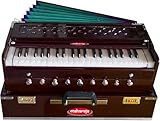 Maharaja Folding 9-Stop Maharaja Folding 9-Stop |
|
Check Latest Price |
1. Maharaja Musicals 7-Stop Saptak – the most tested instrument in this roundup
Harmonium #1, Maharaja Musicals, Handmade Harmonium, 3 1/4 Octave (Saptak), 7 Stop, Standing, Coupler, Multi Bellow, Padded Bag, Tuned A440, Dark Mahogany Color, PDI-DB
7 stops
39 keys
2 reeds (base + male)
14 kg
Tuned with itself at A440
Pros
- Coupler adds octave depth
- multi-fold bellows pump easily and sustain evenly
- padded gig bag included
- 3.25 octave range covers standard repertoire
- 39 keys give more melodic room than most entry models
Cons
- Lowest average rating here at 3.8 with a notable one-star tail
- standing format is bulkier than folding models
- handmade finish can carry scratches and scuffs
- 14 kg is heavy to carry
Best for a student or hobbyist who wants the most proven instrument available. This mahogany 7-stop with 39 keys is the only listing in the roundup with an owner base large enough to draw real conclusions from, and that cuts both ways.
The specification is a sensible one. Two reeds — a base and a male — across 7 stops and 39 keys give roughly three and a quarter octaves, which covers the melodic span of most bhajan and early classical material without pushing the keyboard past what a beginner’s hand can reach. The coupler function is the detail most players underrate: pressing the octave key alongside a note thickens the sound immediately, which is how you get a chord to sit in front of a crowd.
The multi-fold bellows are the mechanical reason this instrument sustains the way it does. Rather than one large fold, the air is metered through several smaller ones, so each pump delivers steadier pressure and a held note keeps speaking instead of fading after two seconds. On a 14 kg standing body you are not carrying this instrument anywhere, so the weight matters less than it would on a travel model.
Now the honest part. A 3.8 average is not a good score, and I am not going to describe it as one. The review distribution explains it: 53% five-star, 17% three-star, and 14% one-star. That pattern is typical of handmade reed organs where a portion of units arrive with tuning or finish problems rather than where the design is wrong. The maker itself discloses that minor scratches and scuffs may be present, which at least sets the expectation honestly. If you buy this, budget a tuning appointment in your first month.
Against a used 5-stop from a named workshop, the choice is close. Against a brand-new unbranded marketplace listing, this one is clearly safer, because 108 owners have already documented what arrives in the box.
Who it suits and who should pass
Pick this instrument if you are learning ragas, need a reliable drone under singing practice, and will play in one room rather than on a stage. The stop count is high enough to grow into and low enough to operate while you concentrate on your hands rather than the stops.
Skip it if you need to carry the instrument to a venue, or if you cannot access a tuner. The 3.8 average with its one-star tail means quality control varies, and a harmonium out of tune against a tabla is worse than no harmonium at all.
2. Bina No.17 Delux Folding – the double-reed value pick
Bina Harmonium Bina No.17 Delux, Folding Portable Version, Special Double Reed, Safri, Kirtan, 9 Stops, 3-1 2 Octaves, Rosewood Color Model 17Dx
Special double reed
9 stops
3.5 octaves
Folding portable
24 x 8 x 14 in
Pros
- Double reed gives a fuller tone than single-reed entries
- nine stops across three and a half octaves in a folding body
- folds flat for kirtan and travel
- brass body components add resonance
- padded cover held up well in the case
Cons
- Listing states random color
- unit-to-unit reed and finish consistency is not guaranteed
- small 12-review sample with a one-star tail
- rosewood shade received may not match the listing photo
Best for a kirtan accompanist who needs depth of tone and a body that folds flat. Nine stops across three and a half octaves gives you a wide melodic span in an instrument that collapses to a flat case, and the double reed is the reason the tone carries.
What separates this model from the other folding options is the special double reed configuration. A single-reed harmonium gives you one voice per note; two reeds tuned to the same pitch give you a layered, more resonant tone that carries over a room full of voices. One reviewer described the sound as noticeably fuller, and that is the honest summary of what a second reed set does — it does not add notes, it adds body.
The fold is the practical advantage. When closed, the instrument is a flat case rather than a three-dimensional block, which matters if it shares a car boot with a sound system and a tabla pair. Buyers have reported that the padded cover holds up well, including one who received it in a heavily packed wooden crate after a long journey.
The weakness is consistency. In a 12-review sample, one buyer reported unintended extra sounds while playing, which points to a reed or registration issue on that unit, and another called the item outright fake. I would not read two complaints out of twelve as a design flaw, but I would read them as a reason to inspect the instrument on arrival rather than three months later.
The listing also states the colour is random, so the rosewood shade you receive may differ from the photographs. That is a cosmetic issue, but for an instrument you look at while playing, it is worth knowing.
Who it suits and who should pass
Choose this if you play in a rotating line-up, need a full three-and-a-half-octave span under kirtan or bhajan singing, and value tone depth over unit-level polish. The double reed is the feature you will still appreciate a year in.
Pass if appearance matters to you, or if you need a stated warranty that this listing does not provide. Check the reeds and the registration as soon as it arrives rather than assuming every instrument is identical.
3. Amilav 9-Stopper Chudidaar – a 7-fold bellow in a folding body
Amilav Collections Harmonium 9 Stopper(Portable), Chudidaar 7 Bellow, 42 Key, Two Reed(Bass-Male), 3 1/2 Octave,Coupler, Harmonium With Cover (Mahogany Color)
Bass and male reeds
42 keys, 3.5 octaves
7-fold chudidaar bellow
Coupler
Mahogany finish
Pros
- Seven-fold bellow delivers even air pressure
- dual bass and male reeds give a layered sound
- 42 keys span a full melodic range
- coupler adds instant octave doubling
- packaging repeatedly praised by buyers
Cons
- Only 4 reviews
- far too few to judge reed stability
- one reviewer called the build quality poor
- minor cosmetic defects in the finish reported
- listing gives no stated reed origin beyond the bass and male sets
Best for a player who wants the widest range and the steadiest airflow in a collapsible body. The 7-fold chudidaar bellow is the mechanical story in this instrument.
Chudidaar bellows break the air path into a larger number of smaller folds than a standard bellow. The practical effect is steadier pressure per pump, which means a note you hold through a long phrase does not sag halfway down. Players notice this most in extended kirtan sets and long accompaniment passages, where a weaker bellow leaves you pumping faster to hold the same volume.
The reed configuration here is bass plus male across 9 stops, 42 keys and three and a half octaves. That is a lot of instrument in a body that collapses. The coupler engages the octave automatically, doubling tonal thickness without a second hand movement, which is what makes a nine-stop layout manageable for a busy accompanist.
The review set is thin and unusually polarized: three buyers describe it working beautifully with excellent packaging, and the fourth calls the make poor. There are no middle ratings at all. That distribution pattern usually means the design is fine and the finish on an individual unit is not, so inspect it early.
What I like is the packaging, which buyers across the set single out as the reason the instrument survived a long journey intact. For a reed organ with a delicate internal plate, that is not a trivial detail.
What the 7-fold bellow actually changes
Standard folding models meter air through one or two folds. This one breaks the path into seven, so each pump delivers a smaller, more even gulp of air. Over a long kirtan set that difference shows up as a tone that holds its shape instead of thinning when your arm tires, which is why buyers single out the bellow rather than the reed count.
Chudidaar bellows also change how the instrument feels under a fast accompaniment pattern. Steadier pressure per pump means you can play a running passage without the volume swelling and dropping with every stroke.
Who it suits and who should pass
This model makes sense if your repertoire moves across ragas rather than sitting in one key area, and if you play long enough sessions that bellow consistency starts to matter. The 42-key layout gives you room to grow without buying again.
Pass if you need a large volume of independent owner feedback, because four reviews cannot tell you how the reeds hold pitch after a year. A player buying a first harmonium is better served by a listing with a real review history.
4. Bina 23B Safari Folding – the kirtan workhorse
Ultra-Portable Harmonium BINA 23B Folding Safari 3 1/4 Octaves 6 Stops Classic Wood Color, Coupler, Nylon Bag, Indian Musical Instrument, Kirtan A440Hz
6 stops
3.25 octaves
Coupler
11 kg
A440Hz tuning
Nylon bag included
Pros
- Ranks near the top of the Harmoniums category
- 11 kg keeps the weight down for a wood-bodied folding model
- 6 stops and 3.25 octaves cover standard devotional repertoire
- coupler included at this level
- nylon carry bag supplied
- A440Hz matches standard ensemble pitch
Cons
- Only 2 reviews
- both 5-star
- so the score carries no weight
- smallest stop count among the folding models
- 3.25 octaves is a quarter-octave narrower than the alternatives
- wood body is bulkier than plastic travel options
Best for a regular kirtan accompanist who needs a dependable folding instrument with no fuss. The real signal here is the category rank, not the star score.
This listing sits near the top of the Harmoniums category, and the seller identifies it as the top-selling Bina model. That is a demand signal. It means enough people have bought it that the format — folding, six stops, coupler, A440 — has survived contact with real players, even though almost none of them have written a review.
Six stops and three and a quarter octaves is a modest layout by the standards of this roundup, and for standard devotional repertoire it is genuinely enough. The coupler gives you octave reinforcement for choruses, and the A440Hz tuning matches the pitch of most Western-tension instruments in the ensemble, which removes a whole category of frustration during setup.
At 11 kg it keeps the weight down for a wood-bodied folding instrument, though it is still a solid object to carry up stairs. The nylon bag is basic but adequate.
I want to be direct about the evidence. Two reviews, both five-star, tell you that two people were satisfied on arrival. They tell you nothing about reed stability after a monsoon season or how the bellows leather fares after a year. If you buy it, judge it at the thirty-day mark, not the first week.
Who it suits and who should pass
Go for this model if you play kirtan regularly, need the instrument in the car every week, and want the simplest reliable layout rather than maximum flexibility. Proven demand reduces the risk on a category where the category rank is all the evidence you have.
Pass if you work in classical ragas that climb, or if you want the layering of two reed sets. Six stops will feel thin within a few months of ambitious playing.
5. Aarohi S32 Travel – the travel-sized harmonium
Aarohi S32 “Travel” Harmonium | Professionally Tuned & Refined in U.S. | Indian Instrument ~ Handmade, Perfect for Yoga, Kirtan
13 lbs
17.5 x 11 x 9.5 in
Gloss pine
Tuned and refined in the US
180-day warranty
Pros
- Sized for an airplane overhead compartment
- tuned and refined by musicians in Illinois before the instrument is handed over
- US-based support through Old Delhi Music
- padded gig bag included
- 180-day warranty is among the longest stated
- strong entry point for a student
Cons
- Only 2 reviews
- both 5-star
- so no durability evidence
- gloss finish on softwood wears cosmetically faster
- not a folding body despite the travel positioning
- no stop or reed count stated in the top features
Best for a musician who plays away from home regularly and wants the instrument already tuned when it arrives. At 13 lbs in a 17.5 by 11 by 9.5 inch body, it is the smallest instrument in this roundup and the one built around air travel.
That dimension claim is the whole pitch. Most harmoniums are carry-on disputes. This one was designed around air travel, and if you play conferences, retreats, or touring circuits in North America or Europe, that single fact changes the comparison more than any specification on the list.
Tuned and refined by musicians in Urbana, Illinois, and support runs through Old Delhi Music rather than a marketplace-only route. For an instrument built in India, the final tuning happens after the body has been on its way and the air inside it has changed, which means a settling period before it sits properly with your ensemble. This one is finished in the workshop it is prepared in, and the 180-day warranty is the longest stated coverage among the lighter options.
The body is pine with a gloss finish, which makes it light and responsive to carry but lighter in resonance than a teak or mahogany instrument. That is a real trade: you give up some of the deeper, more settled tone a heavier hardwood body produces, and you get an instrument you can actually put on a plane.
Two five-star reviews, both without substance, mean the score is a satisfaction signal rather than a track record. The structural facts are what justify the choice here.
Who it suits and who should pass
Pick this if you fly to gigs, teach away from home, or want a harmonium that arrives ready to play without a settling period. The US-side tuning and support are worth more to that player than a heavier, richer body would be.
Pass if you play large halls and want maximum resonance, or if you need a stated stop count to judge range. The listing does not foreground its reed banks, so you are buying on size and service rather than on voicing.
6. Vrindavan Bazaar Scale Changer – the only true nine-scale instrument
Premium Scale Changer Harmonium, Best Scale Changer, Concert, 3 Reeds, 9 Scales, 11 Stops, 37 Keys, Comes with a bag -Vrindavan Bazaar (Scale Changer)
9 scales
11 stops, 37 keys
3 Palitana reeds (male, male, female)
Teak case
12 to 12.5 kg
Pros
- The only scale changer in the roundup
- 9 scales without relearning finger positions
- three Palitana reed sets give the most layered voice in the group
- 11 stops is the highest count here
- teak concert case
- rich and balanced tone suited to performance
Cons
- A heavy
- bulky instrument that stays where it is set up
- does not fold and needs a dedicated stand
- the mechanism adds a learning curve beginners find difficult
- only 2 reviews leaving durability untested
- built by an artisan maker in small batches rather than on a production line
Best for a working classical or serious gigging musician who moves between ragas and cannot afford to relearn finger positions. No other instrument here does this.
A scale changer shifts the coupling arrangement so that the same physical key produces a different relative pitch. Instead of resetting your hand position for each raga, you move a lever and the mapping changes underneath you. For a player performing a set that moves across several ragas, that is the difference between fluent and mechanical.
The reed specification is the most detailed in the roundup: three high-quality Indian Palitana reed sets in a male, male and female arrangement, driving 11 stops across 37 keys. That is the highest stop count of any instrument here, and a three-reed voice is the most layered this list produces. The teak case adds mass, and mass on a reed organ is resonance.
Be clear-eyed about the costs. At 12 to 12.5 kg this is a heavy fixed instrument, and a body that size needs a stand and a corner of a room rather than a gig bag. A travelling player has to plan around it. And the mechanism itself takes time to master — several players describe it as a burden in the early weeks, which is a learning curve rather than a defect.
The 5.0 average here comes from two reviews. Effectively, nobody has written about it. The case for this instrument is its design brief, and the design brief is unusually specific.
Who it suits and who should pass
Buy this if you already play, you perform across multiple ragas, and you have a fixed playing space plus a stand. The reed voicing and stop count are what a professional voice actually sounds like.
Skip it if you are in your first year, if you need to move the instrument between locations, or if you want a rich tone without the commitment of learning a new mechanism. There is a gentler path to a bigger sound.
7. Novelika Stylist No.17 Deluxe – the entry-level coupler portable
Novelika Professional Portable Harmonium Stylist No 17 Deluxe With Coupler – Musical Instrument (NOV2008)
Portable body
Coupler function
Wood with nickel hardware
Case included
Pros
- Modest outlay for a coupler-equipped portable
- nickel-finished hardware looks more refined than unfinished
- coupler included in a portable format
- case included for protection
- same established Stylist No.17 line buyers rate elsewhere
Cons
- Only 1 review and no written feedback
- lowest sales rank in the roundup
- warranty listed as not applicable
- listing gives no stop count
- octave range
- reed type or weight
- metal finish shows fingerprints and dents
Best for a player on a strict budget who wants a portable body and a coupler and does not care about the badge. This is the entry point into the list.
The reason it is worth considering is that it pairs a portable body with a coupler at a modest outlay, and a coupler is the single feature that most improves how a beginner sounds within the first month. The nickel-finished hardware is also a step up in appearance from bare metal, and it resists tarnish better.
What you give up is information. The listing states no stop count, no octave range, no reed type and no weight. That is not a minor omission, because those four facts are precisely what determines whether an instrument fits your repertoire. A case is included, which is more than some listings offer.
The evidence is one review, with no written text, and the lowest sales rank in the roundup. Warranty coverage is listed as not applicable, making this the only instrument here with no stated protection at all. That absence matters for a handmade wooden object with a delicate internal reed plate.
My advice is to treat this as a short-term instrument. If it gets you playing and you later decide to go further, resell it and step up.
Who it suits and who should pass
Choose this if your budget is tight, you want a portable body with a coupler, and you are willing to evaluate fit and finish on arrival rather than from a specification sheet.
Pass if you need a known stop count to plan your repertoire, or if you want a warranty behind the instrument. Without a reed count, you cannot tell whether the voicing will suit your voice.
8. Bhava Studio Standard – the most fully specced build
Bhava Studio Harmonium | Standard Edition | 42 Key | Professionally Tuned & Refined in the U.S~ Handmade in India, Ethically Sourced | Long Sustain and Warm Tonality
42 keys
21 lbs
24 x 13 x 11 in
Select grade wood, chrome hardware
1/4 inch jack
180-day warranty
Pros
- Most fully documented build in the roundup
- 42 keys give the full playing range
- warm tonality with long sustain
- tuned and refined in the US during final setup
- 1/4 inch jack allows direct output to a PA
- 180-day warranty with stated ethical manufacturing
Cons
- Only 1 review
- so quality claims rest on the maker's description
- 24 inches long and 21 lbs is not truly travel-sized
- pine body despite the premium build position
- heavier than the folding travel models
Best for a studio or home player who wants a warm, sustaining tone and a direct output into a PA. It is the most completely specified instrument in this roundup.
42 keys give the full playing range, matching the largest instruments here, and the stated sound profile is warm tonality with long sustain. Select-grade sustainably sourced wood with chrome hardware is the most fully documented material build on this list, and the matte finish will age better than gloss.
The 1/4 inch jack is the sleeper feature. A harmonium is a standalone acoustic voice, and it normally needs a microphone to be amplified. A jack output means you can run this into a small amp or a PA directly, which is the difference between playing a song and performing one.
It is also one of the largest instruments here at 24 inches, and at 21 lbs it is a substantial instrument for a fixed position. The pine body gives up some mass and resonance against the teak scale changer, which is the one place where this instrument does not lead the group.
One written review, from a verified buyer, describes a beautiful sound suited to home and beginner use and confirms the instrument arrived in excellent condition. That is a good sign, not proof. The specification is what justifies the position.
Who it suits and who should pass
This one makes sense if you record at home, run a small worship or community music group, or want an amplified option without a microphone. The warm sustain and the output jack are the two reasons to choose it.
Pass if your budget is fixed, if you need to fly with the instrument, or if you are still deciding whether you want to play.
9. Bhava Lite Travel – the compact refined instrument
Bhava Lite “Travel” Harmonium | Small, Lightweight | Ethically Sourced, Professionally Tuned & Shipped from US, Handmade in India | Standard Edition Natural
13 lbs
18.5 x 11.75 x 9 in
Select pine, chrome hardware
1/4 inch jack
180-day warranty
Pros
- Cuts about 5.5 inches of length and 8 lbs versus the Bhava Studio
- one of only two instruments here genuinely travel-sized
- tuned and refined by musicians in the US during final setup
- chrome hardware and matte finish on a compact body
- higher sales rank than the full-size Studio
- 180-day warranty with fair-wage sourcing
Cons
- Only 1 review and no written text
- costs noticeably more than the folding Bina and Aarohi models that also cover the travel use case
- pine gives less mass and resonance than teak
- no stated stop count or octave range
- does not fold despite the travel positioning
Best for a player who wants the Studio’s build quality and output jack in a body small enough to move between rooms, halls and rehearsal spaces.
Compared with the Bhava Studio, this instrument gives up roughly 5.5 inches of length and 8 lbs while keeping the chrome hardware, the matte finish, the 1/4 inch jack and the 180-day warranty. That is a well-judged trade for most players, because length and weight are the two things that decide whether you carry an instrument or leave it in a corner.
At 18.5 by 11.75 by 9 inches and 13 lbs, it is compact without becoming a toy, alongside the Aarohi S32 as one of two instruments in this roundup genuinely sized for travel.
Notably, this model carries a better category sales rank than the full-size Studio, which suggests more players are choosing the portable version over the larger one. That is useful market evidence if you are trying to decide which of the two suits you.
The single review has no written text, so the tone and build claims are unverified. And despite the travel name, this is a compact rigid body rather than a folding one — it will not go flat the way the Bina models do.
Who it suits and who should pass
Pick this if you need a jack output, a warranty and US-side refinement in a body you can carry with one hand. It is the most sensible buy for a working musician who moves around but does not fly.
Pass if you are travelling by air, where the smaller Aarohi S32 is the better instrument, or if maximum resonance is your priority and you can accept a fixed playing position.
10. Maharaja Musicals Folding 9-Stop – folding with the full 9-stop layout
Maharaja Musicals, (Model 2025-26) Folding Harmonium Instrument, In USA, 9 Stops, Rosewood Color, Safri, 3 1/2 Octave, Coupler, Bag, Tuned To A440, Musical Instrument Indian-AHF
9 stops, 42 keys
3.5 octaves
2 Bali reeds, double bellow
Wooden jaali keys
Tuned to A440
Pros
- Combines folding portability with the 9-stop 42-key range
- double bellow and two Bali reeds give a fuller sound
- wooden jaali keys improve grip
- the rosewood finish stands apart from the gloss and matte options here
- maker's setup and tuning process is proven by its other model
- padded gig bag included
Cons
- Only 1 review and it is 4 stars
- built in batches rather than to immediate demand
- warranty listed as none
- the heaviest of the folding options
- no written customer review text
Best for a player who wants a full nine-stop layout in a folding body and cares about how the instrument looks on a stand at the front of a room.
This model does something none of the other folding instruments manage: it holds nine stops across 42 keys and three and a half octaves while still collapsing flat. That combination is normally the trade-off in this category — folding bodies tend to be six-stop instruments. The rosewood finish also stands apart from the gloss and matte options elsewhere in this roundup, which matters more than buyers expect for an instrument that faces the audience.
The double bellow and a set of two Bali reeds produce a fuller sound than single-bellow, single-reed folding entries. Wooden jaali keys add texture and grip over plain wooden keytops, and in long sessions a key you can feel is worth more than a key that looks smoother.
The build process is the significant drawback. This model is produced in batches rather than against individual orders, so it takes considerably longer to reach you than anything else on this list. Treat it as an instrument to plan around well ahead of a season rather than something to pick up for next week. The warranty is listed as none, so there is no stated coverage behind the instrument.
One review, rated four stars with no written text, is the weakest single data point in the roundup. What justifies consideration is the specification and the maker’s track record on its other model in this list.
Who it suits and who should pass
Choose this if you play a full repertoire that needs nine stops, want the instrument to look good in front of an audience, and can plan the purchase well in advance of when you need it.
Pass if you need the instrument on short notice, or if a warranty matters to you. This is an instrument to order once, deliberately, and plan your calendar around.
How to Choose a Harmonium: Stops, Reeds, Bellows and Pitch
A harmonium is a free-reed keyboard instrument. Pressing a key opens a valve over a thin metal reed tuned to a pitch, and air pushed through the bellows vibrates it. Because the reed is a free reed, holding a key while pumping sustains the note for as long as your arm lasts, which is the entire point of the instrument in Indian classical, kirtan, bhajan, Sufi and worship music.
That simple mechanism generates an intimidating specification list, because every maker describes the same handful of variables differently. Here is what actually changes the sound, and what is just packaging language.
Stops and stoppers decide which reed banks speak
A stop, also called a stopper, is a lever that switches one reed bank on or off. Two reed banks in three different layouts is the usual entry configuration, and the difference is not cosmetic.
In a 2-2 layout, each note has two reed banks available and you can select two. In a 3-3 layout you get three banks and three selectable. A 5-4 or 5-5 arrangement gives you a wider palette still, and the number to the right refers to how many of those banks you can layer at once. More simultaneous reed banks means a fuller chord, and a fuller chord is what you need when you are competing with a drum.
For bhajan and kirtan, two simultaneous banks with a bass drone underneath is genuinely enough. For classical ragas and for playing in an ensemble, three banks makes a noticeable difference. The scale changer in this roundup runs 11 stops across three reed sets, which is where the layering starts to sound professional.
Main reeds, drone reeds and couplers shape the voice
Main reeds produce the notes your fingers play. Drone reeds produce the sustained tonic underneath. The drone is what makes a harmonium possible for accompaniment: it holds the tonic while your hands move, so a singer never loses the ground note.
Drone reeds are commonly described as male, female and bass, which refer to their octave relationship to the main reeds. A bass drone sits below and gives depth. A male drone sits an octave below the played note and reinforces weight. A female drone sits at the main register and adds brightness without muddying the low end. The Vrindavan Bazaar instrument runs a male, male and female arrangement, which is the most complex drone voice specified in this roundup.
A coupler is a mechanism that adds the octave of whatever you are playing to the note itself. It costs you no finger movement and no extra stops, and it thickens the sound instantly. For a beginner, a coupler is the single most valuable feature on any of these listings.
Reed type matters less than the label suggests
Palitana reeds come from Palitana in Gujarat and are the standard in Indian manufacture. German, Paris and English reeds appear in listings as premium options. The practical difference shows up in how the reed responds and how long it holds pitch, not in a dramatic change of tone.
Here is the detail that unsettles buyers: multiple makers source the same Mohan lal Palitana reed supply, so two differently branded instruments can contain identical reeds. Participants on the chandrakantha.com Indian music forum are blunt about this, which is why experienced players judge the individual builder rather than the label. A well-set-up instrument from an unnamed workshop can out-perform a badly set-up one from a famous name.
That is not an argument that reeds do not matter. It is an argument that setup matters more. An instrument that arrives in tune, with even bellows pressure and clean valves, is worth more than a better-claimed reed in a neglected case.
Bellows decide how long a note holds
A single-fold bellow delivers a large gulp of air at once. A double bellow meters the air through two folds. A chudidaar bellow breaks it into seven smaller folds, and a flower bellow folds in a pattern that keeps pressure even as the instrument is opened wide.
The Amilav 9-Stopper is the clearest example in this roundup: its 7-fold chudidaar bellow is the reason buyers describe the tone as steady over long sessions. More folds means steadier pressure per pump, which means a sustained note does not sag in the middle of a phrase. The folding Maharaja model uses a double bellow instead, and the Bina models vary again.
A scale changer is worth it once you can already play
A scale changer alters the internal coupling so the same key produces a different relative pitch, letting you move between ragas without resetting your hand. For a gigging classical player, that is transformative. For a beginner, it is a mechanism you cannot yet use and a learning curve that slows early progress.
Forum debate on this point is consistent: the mechanism is a burden until you are fluent in at least two or three ragas, after which it becomes the reason you keep the instrument. Buy it when you are moving up, not when you are starting.
Tuning pitch is the detail that catches people out
Most modern harmoniums are tuned to A440, the international standard, and three of the ten instruments in this roundup state it explicitly. Some Indian builders tune to 442 or 443 Hz, which gives a slightly brighter, marginally heavier sound that many classical singers prefer.
Here is the practical consequence that experienced players insist on: a harmonium tuned to 442 or 443 sitting against a tabla or a 440 Hz ensemble will sound flat, and no amount of good playing hides it. Conversely, if you perform with a tanpura or instruments tuned to the Indian convention, a 440 Hz instrument sits slightly sharp. Match the instrument to the ensemble you actually play with, and confirm the stated pitch before you buy rather than assuming.
Weigh this against pitch in a different sense too. The difference between 440 and 442 is roughly a quarter of a semitone — audible in isolation, decisive in an ensemble.
Wood and key action decide durability and feel
Teak is the heaviest and most resonant wood in this roundup, used on the Vrindavan Bazaar scale changer. Mahogany, used on the Maharaja Saptak and the Amilav 9-Stopper, sits in the middle: warm, stable and reasonably light. Pine, used across the Bhava models and the Aarohi, is the lightest and can sound thinner under a hard attack, though it is fine for practice and light travel.
Manufacturers also use wood names for finishes, so a rosewood or mahogany colour does not always mean a solid body of that species. Treat the finish as appearance and the stated body material as the structural fact.
Key action is harder to judge from a listing. The wooden jaali keys on the folding Maharaja model add texture and grip. What you can check in person is key depth: sit at the instrument and confirm your wrist stays level rather than angled, because a shallow key that forces a bent wrist will end your practice sessions early.
A store test checklist you can run unaided
Buyers report feeling overwhelmed by specifications, and most shop advice amounts to the seller’s own marketing. This is a ten-minute test you can run yourself.
Play a long note. Hold a single key for at least twenty seconds and listen for sag in the middle rather than at the end.
Pump slowly. Steady air pressure is the whole game; uneven pumping reveals a worn or stiff bellow immediately.
Walk the full range. Play every key at low volume and listen for a reed that rattles, chokes or speaks an octave away.
Test the coupler. Engage it on a single note and confirm it doubles cleanly rather than adding a separate tone.
Check the drone. Engage each drone stop and confirm the pitch sits exactly where it should relative to the main reed.
Play a chord and hold it. Layered reed banks reveal themselves in sustained chords, not single notes.
Bring a tuner. Confirm the actual pitch rather than trusting the label.
Check the bellows fold. Open and close the instrument fully and confirm it seats without catching.
Look at the valve plates. Any rust, glue residue or a warped plate is a reason to walk away.
Test the fit. Sit with the instrument in playing position for five minutes before the deal is done.
Why a new harmonium drifts out of tune
Any free-reed instrument moves as the air pressure and humidity around it change. Reeds are thin metal tongues seated against an opening, and they are sensitive to both. A wooden case expands and contracts with the seasons, which shifts the geometry the whole assembly depends on.
Expect a settling period of a few weeks after purchase, especially if the instrument crossed a climate zone. A reed can also weaken with heavy pumping in dry conditions. Keep the instrument in its case when it is not being played, avoid leaving it in a car, and have it tuned by a repairer rather than by a tuning app — free reeds are tuned at the reed plate, not by a machine.
Our related roundups cover other instruments where climate and handling matter in similar ways, including the best analog theremins for musicians and the best travel didgeridoos for musicians.
The upgrade path from a student instrument
Start with a folding six-stop instrument tuned to 440 Hz. Learn the reeds, learn the bellows, and decide within a year whether this is a serious instrument for you.
If you are, step to a nine-stop folding or standing model with a double reed, which is where the Bina No.17 Delux and the Amilav 9-Stopper sit. That is the point where your playing outgrows the entry layout.
After that, the choice is between depth and range: a three-reed instrument with a jack output for recording and amplified work, or a scale changer if you are moving into multi-raga performance. Buying all three at once is how people end up with instruments they do not play. Our best professional ocarinas for musicians guide covers a different price band if you are also building a portable practice setup.
Frequently Asked Questions
Which harmonium is of the best quality?
Quality in this category tracks setup more than the label. Look for an instrument with a stated tuning pitch, a named builder, specified reed banks and a stop count that matches your repertoire. A scale changer with three Palitana reed sets and 11 stops gives the most layered voice in our roundup, while the 7-stop Maharaja Saptak has the largest body of real owner feedback at 108 reviews. Check the reeds, bellows pressure and valve plates yourself before deciding.
Which brand of harmonium is best?
There is no single best brand, because many makers source the same Mohan lal Palitana reed supply, which participants on the chandrakantha.com Indian music forum point out regularly. Judge the individual builder and the setup instead. In this roundup Maharaja Musicals has the most proven tuning process, Bina dominates the folding format, and Old Delhi Music through the Bhava and Aarohi lines refines instruments in the United States before they are handed over.
Which reed is best for harmonium?
Palitana reeds are the Indian standard and are what most of these instruments ship with. German, Paris and English reeds are marketed as premium options and tend to respond slightly differently and hold pitch marginally longer, but the audible gap is smaller than sellers suggest. The more meaningful difference is setup: an evenly tuned reed plate with consistent airflow beats a better-claimed reed in a neglected case every time.
Which wood is best for harmonium?
Teak is the heaviest and most resonant wood, and it is what the Vrindavan Bazaar scale changer uses for its concert case. Mahogany sits in the middle and is warm and stable. Pine is the lightest and can sound thinner under a hard attack, which is why the Bhava and Aarohi models trade some resonance for portability. Also note that a rosewood or mahogany colour often describes a finish rather than a solid body of that species.
Which type of harmonium is best for beginners?
A folding model with six stops, around three and a quarter octaves, a coupler and A440 tuning is the right first instrument. It covers bhajan and early classical material, folds flat for transport, and gives you a coupler to thicken the sound immediately. The Bina 23B Safari is the clearest example in this roundup. Avoid buying a scale changer as a first instrument, because the mechanism is a burden until you can play two or three ragas.
The Verdict: Where to Start in 2026
If you take one thing from this roundup of the best harmoniums for musicians, let it be this: the specification matters less than the setup, and the review tail matters more than the average score. Read the one-star reviews, not the five-star ones, because that is where tuning and finish problems show up before they reach you.
Start with the Maharaja Musicals 7-Stop Saptak if you are a student or a home player. It has the largest owner base in this roundup at 108 reviews, a sensible seven-stop, 39-key layout, and a coupler. Buy it knowing the 3.8 average, budget a tuning, and you will have an instrument that covers a lot of repertoire.
Start with the Bina No.17 Delux if you need to carry it and want a double reed in a folding body. Start with the Aarohi S32 if you fly. Start with the Vrindavan Bazaar scale changer if you already play and perform across ragas. And start with the Bhava Studio if you record or need a direct output into a PA.
Whichever one you choose, play it for a month before you decide it is the wrong one. The best harmoniums for musicians in 2026 are the ones still tuned and still played after the first season.