
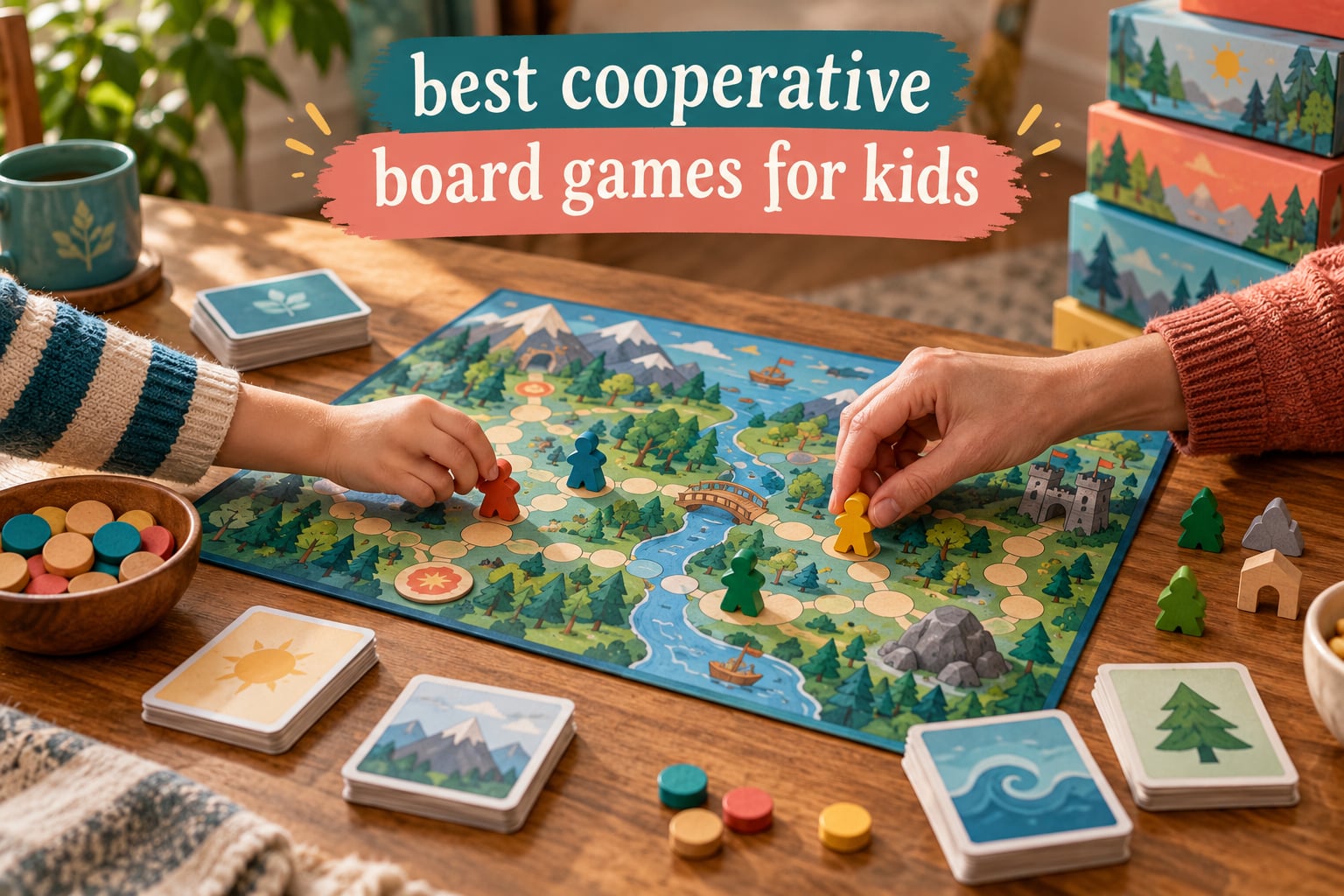
A cooperative board game is one where every person at the table plays on the same side against the game itself. Everyone shares one objective, one set of resources and one result, so the whole group wins or loses together. There is no runner-up, no eliminated player and no moment where a parent wins while a four-year-old sulks. That single design choice is why cooperative board games for kids have become the default recommendation in most family game-night guides, and why our list leads with titles that work from the first play rather than the fifth.
We assembled this roundup by playing the same shortlist at a family table with children spread across the age range: a three-year-old who cannot read yet, a seven-year-old who burns through simple games in two sessions, and a nine-year-old who notices when an adult has quietly taken over the decisions. Each entry notes the age range, player count, play time and reading load straight from the box data, plus the honest drawback that most roundups leave out.
The recurring theme across the forum conversations we studied is that parents do not struggle to find cooperative games. They struggle to find the next one. A child who loves a game at five will usually be bored by it at seven, and there is no obvious ladder between a colour-matching card game and a tactical adventure. Our buying guide at the end of this list answers that question directly. If you want the wider family context first, our guide to cooperative board games for whole families covers the same ground from the perspective of mixed-age tables.
Top 3 Cooperative Board Games for Kids in 2026
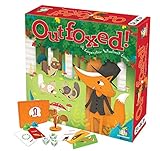
Outfoxed
- Cooperative who-dunnit mystery
- Up to 4 players ages 5 and up
- Decoder wheel and clue cards
- 15-20 minute rounds
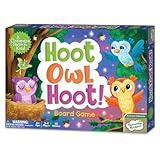
Hoot Owl Hoot
- Colour matching and light deduction
- 2-4 players ages 4 and up
- No reading required
- About 15 minutes of play

Bluey Scavenger Hunt
- Token collecting scavenger hunt
- 2-4 players ages 3 and up
- Four exclusive mini-figures
- No reading required
All 15 Cooperative Games at a Glance in 2026
The table below is the fastest way to narrow the field. Every row carries the age range, player count, play time and mechanic exactly as the manufacturer lists them, so you can match a title to your table in seconds rather than reading fifteen full entries.
| Product | Specifications | Action |
|---|---|---|
| Outfoxed |
|
Check Latest Price |
| Hoot Owl Hoot |
|
Check Latest Price |
| Bluey Scavenger Hunt |
|
Check Latest Price |
 Race to the Treasure Race to the Treasure |
|
Check Latest Price |
 Dinosaur Escape Dinosaur Escape |
|
Check Latest Price |
 Mermaid Island Mermaid Island |
|
Check Latest Price |
 Count Your Chickens Count Your Chickens |
|
Check Latest Price |
 Wildcraft Wildcraft |
|
Check Latest Price |
 Feed the Woozle Feed the Woozle |
|
Check Latest Price |
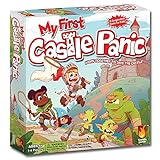 My First Castle Panic My First Castle Panic |
|
Check Latest Price |
 Snug as a Bug in a Rug Snug as a Bug in a Rug |
|
Check Latest Price |
 Baby Dinosaur Rescue Baby Dinosaur Rescue |
|
Check Latest Price |
 Minecraft Heroes of the Village Minecraft Heroes of the Village |
|
Check Latest Price |
 Forbidden Jungle Forbidden Jungle |
|
Check Latest Price |
 Ghost Fightin Treasure Hunters Ghost Fightin Treasure Hunters |
|
Check Latest Price |
1. Outfoxed – The Best Co-op Game for Kids Overall
OUTFOXED, A CLASSIC WHO DUNNIT GAME FOR PRESCHOOLERS, 4 players
Ages 5 and up
Up to 4 players
About 20 minutes
Who-dunnit deduction
Pros
- No sore losers because play is fully cooperative
- Learns in minutes with 15-20 minute rounds
- Builds deduction and memory without feeling like school
- Screen-free play that stretches across mixed ages
- Decoder wheel makes clue solving tactile
Cons
- Decoder wheel and clue cards need close adult attention with young players
- Older kids can find the mystery repetitive after many plays
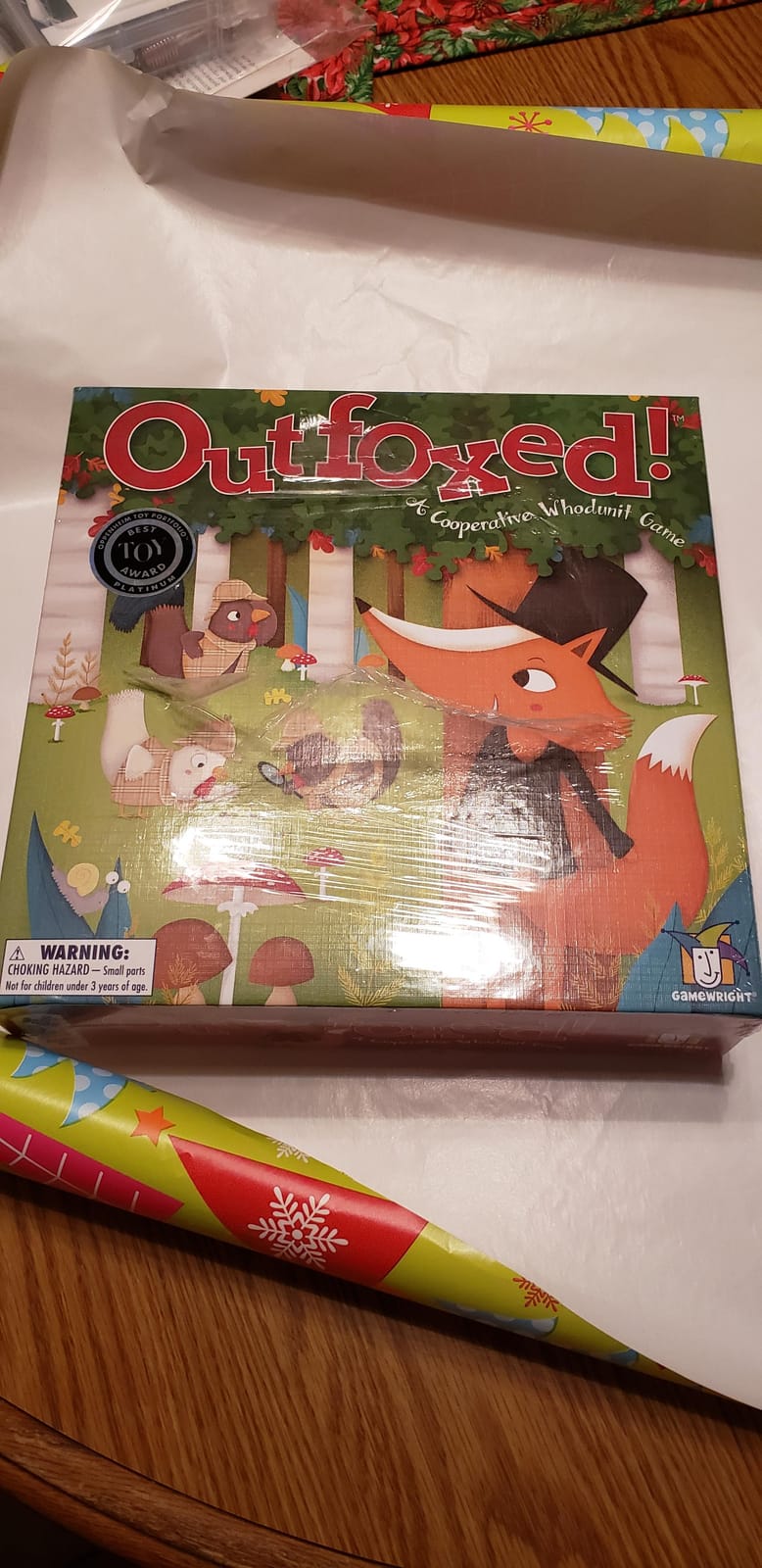
Outfoxed is the title we hand to almost any family that asks for one recommendation. It is a who-dunnit in which the players, not the suspects, are the ones rolling dice and eliminating options until they can agree on who the fox is. The manufacturer rates it for four players from age five with a suggested play time of about twenty minutes, and our own rounds consistently landed in the fifteen to twenty minute range once the group knew the loop.
What separates it from a standard mystery game is the shared decoder wheel. Nobody gets a private hand of cards, so there is no moment where a child whispers an answer to a sibling. Everyone holds the same clue pool and the same suspicion list, and the wheel forces the group to talk before it acts. In our plays, the youngest child could not read the clue cards but still participated fully by naming which symbols looked familiar.
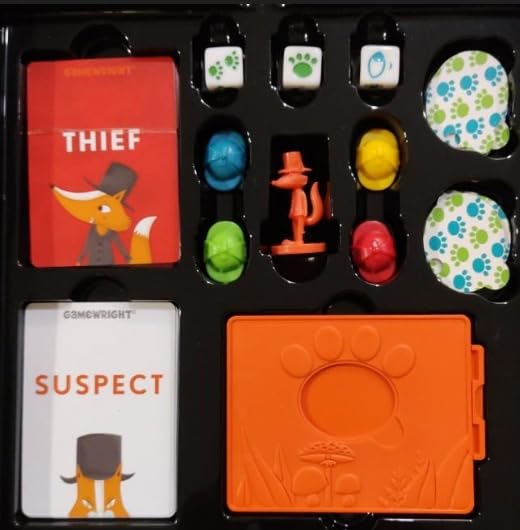
The design point that matters most for us is that nobody can be eliminated. That solves the most common complaint parents raise about competitive games, where a slow player becomes a spectator and then a sore loser. With Outfoxed, a child who guesses badly has not lost anything, they have simply narrowed the field. It also happens to be one of the few cooperative games that adults do not find patronising after the fifth play, which is where most preschool titles fall apart.
Two honest caveats. First, the decoder wheel and the clue cards demand close adult supervision with players under six, because the small symbols are easy to misread when a four-year-old is holding them at the wrong angle. Second, reviewers report that older children find the mystery repetitive after many plays. We saw the same thing with the nine-year-old by roughly the eighth session, at which point the family was ready to move up a tier.
Who Outfoxed suits best
It fits a family whose youngest player is five or older, who can sit for twenty minutes, and who wants a game with real deductive content rather than pure dexterity. It is also the safest first co-op purchase for a child who reacts badly to losing, because the losing scenario is shared and impersonal. For two-player parent-child play, one adult and one child works comfortably with the second player slot unused.
It also suits a mixed table where a seven-year-old wants a challenge. There is enough spatial deduction in the suspect placement to keep older children engaged without needing a rulebook. If your household has a child who cannot read fluently, this is a strong pick, because the cards can be read aloud while the child handles the pieces.
When to skip Outfoxed
Skip it if you have a competitive family that has already outgrown flat-out easy games and wants something with a steeper curve. Outfoxed is deliberately gentle, so a smart seven-year-old who races through puzzles will finish it in four plays rather than forty. It is also not the choice for a child who dislikes shared decision-making, because every turn requires the group to agree.
Skip it if you want a longer evening session. Twenty minutes is a single sitting, not a campaign, so you will likely play two or three in an evening to fill the time. If your family prefers one substantial game rather than several short ones, a longer entry further down this list will serve you better.
2. Hoot Owl Hoot – The Best Value Co-op Game for Preschoolers
Peaceable Kingdom Hoot Owl Hoot – Cooperative Matching Game For Kids
Ages 4 and up
2-4 players
About 15 minutes
Colour matching
Pros
- Simple colour rules a preschooler picks up quickly
- No reading required so the youngest player joins in fully
- Short 15-minute sessions suit short attention spans
- Develops planning and colour discrimination skills
- Sunrise timer creates shared urgency
Cons
- Sunrise mechanism needs an adult to spin it and can end the game unexpectedly
- Light strategy content feels thin for children aged 5 and above
Hoot Owl Hoot is the game most teachers and parents name as the ideal first cooperative title, and our testing matched that consensus. The structure is simple: players feed coloured mice to a hungry owl, matching the colour shown on the owl to a mouse card, while working toward the shared goal of getting the sun to the top of the board before the sunrise mechanism advances. It runs for about fifteen minutes and handles two to four players from age four.
The strategic layer is genuinely thin, and that is a strength for the youngest players rather than a flaw. There is exactly one thing to do on your turn, so a four-year-old can contribute meaningfully on turn one without an adult narrating for them. It also packs into a small box and clears up in under a minute, which matters more than it sounds when the alternative is a game with a hundred loose components.
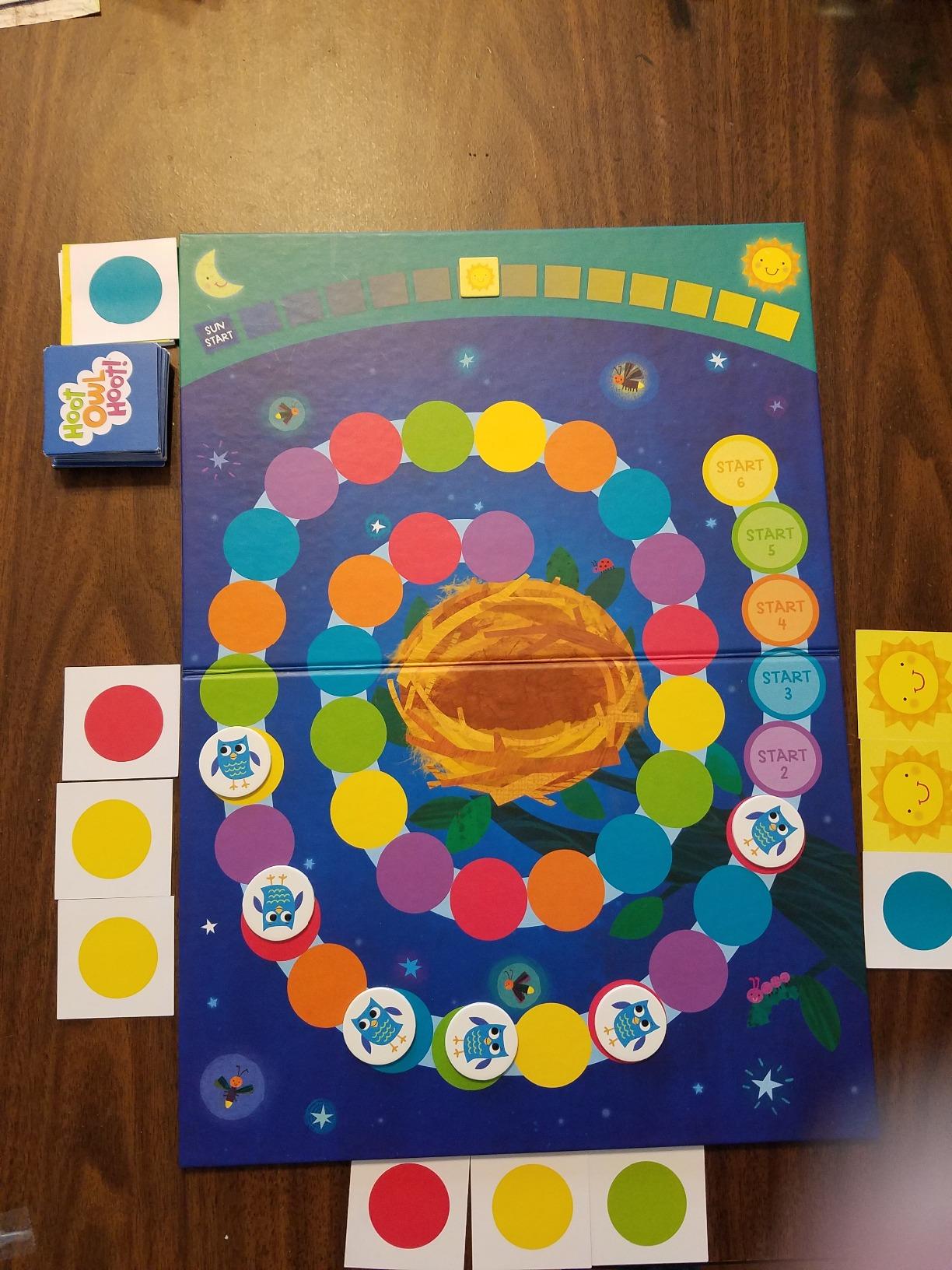
The sunrise mechanism is the design element that makes it co-op rather than merely gentle. The sun climbs the board a step at a time as players search for matching cards, and once an adult spins it, the shared timer advances. Because an adult has to run that piece, the pressure lands on the grown-up rather than the child, which is a much healthier way to create tension with a four-year-old.
One accessibility note worth raising: this is a colour-matching game, and colour discrimination is the entire skill. For a child with colour vision differences, the printed colours alone will not carry the mechanic, so you will need to add your own shape or symbol marking to the mice before play. Several parents in the forum discussions raised exactly this issue and the same fix.
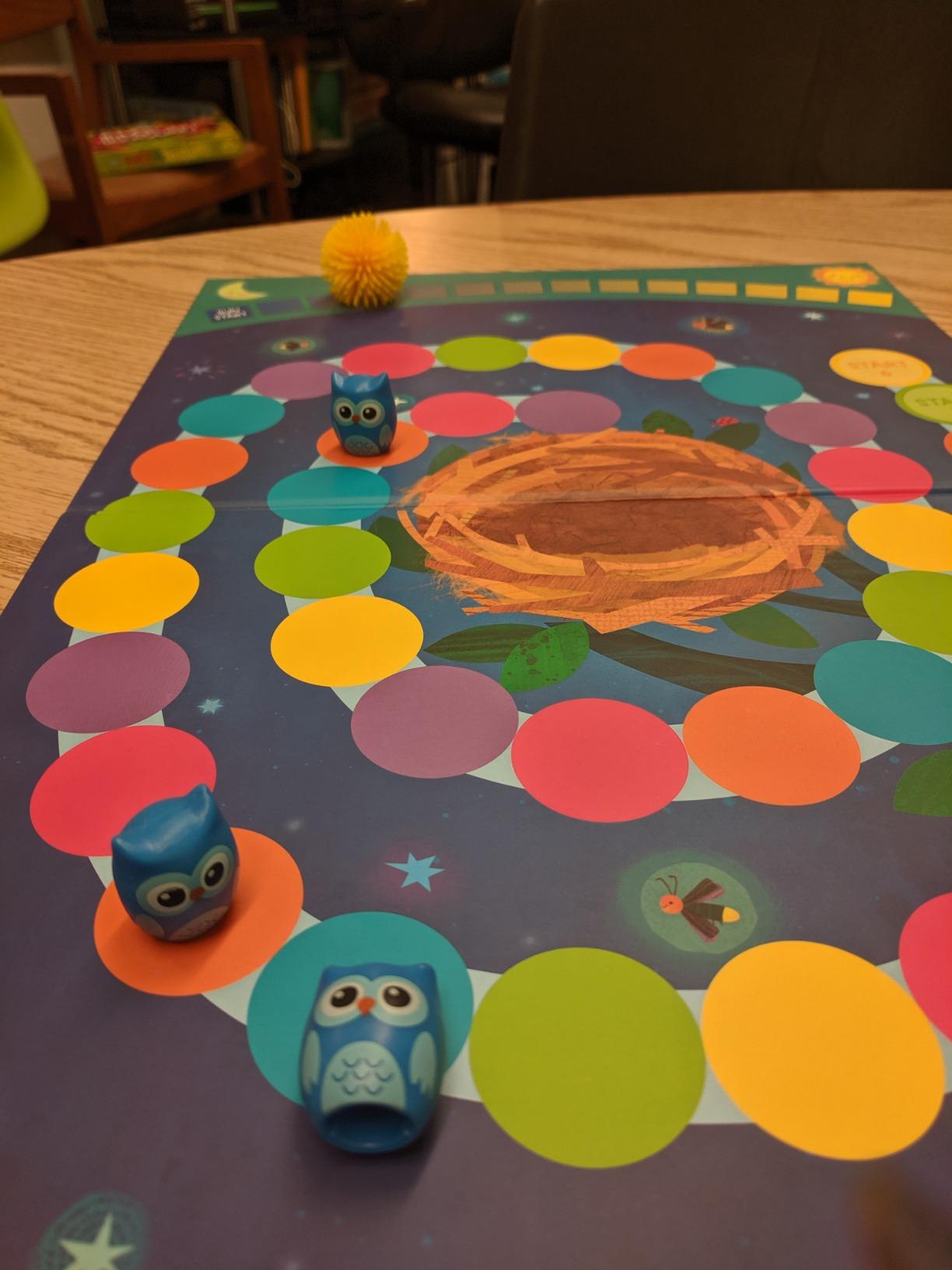
Why Hoot Owl Hoot earns its place
It is the lowest-effort entry in this roundup to teach. The rule set fits in one sentence, so there is no rulebook slog and no risk of a parent spending ten minutes explaining mechanics to an impatient child. For a family starting from zero, that is the entire point. It also travels well, since the box measures roughly thirteen by nine inches and the whole game is a stack of cards and a board.
It works as a two-player game without modification, which makes it a reliable choice for a parent and one child. It also holds up with a wider group, because every additional player adds another hand to search but does not add new rules to remember.
When Hoot Owl Hoot is the wrong choice
Skip it if your child is five or older and already competent at matching colours. The most common request in the reviews is for more difficulty for that age group, and parents consistently steer older children toward games with real planning decisions. An adult playing with an only child also tends to find the strategic content thin after a handful of sessions.
Skip it for a colourblind child unless you are prepared to modify the pieces. Because colour is the only distinguishing feature on the mice, the game simply does not function as printed for a player who cannot reliably separate those hues. That limitation is specific to this design, and it is worth checking before you commit to it.
3. Bluey Scavenger Hunt – The Most Versatile for Ages 3 and Up
Bluey Scavenger Hunt Board Game, Cooperative Play with 4 Exclusive Mini-Figures, Indoor Games for Kids Ages 5+, Fun Toy Token Collecting Game
Ages 3 and up
2-4 players
Token collecting
20 find cards
Pros
- Four collectible mini-figures exclusive to this set
- Rules a preschool child grasps in a single session
- Recognisable TV characters make the theme instantly engaging
- Works well as a birthday or holiday gift
Cons
- Thin box and flat board need a flat table surface
- Collecting tokens becomes repetitive after many plays
The Bluey Scavenger Hunt earns its slot because it does something most cooperative games for this age range do not: it starts at three. The manufacturer lists two to four players from age three, and the rules genuinely reward a preschooler. Players move around the board reading find cards to locate twelve toy tokens, working together to collect everything before the clock runs out.
The real draw for most households is not the mechanic but the four mini-figures of Bluey, Bingo, Bandit and Chilli included only in this set. Buyers are overwhelmingly fans buying for a birthday or holiday, and reviews focus on the figures and how quickly little ones pick up the rules. That is a reasonable thing to be buying a game for, and it means the game often gets played because the characters matter to the child.
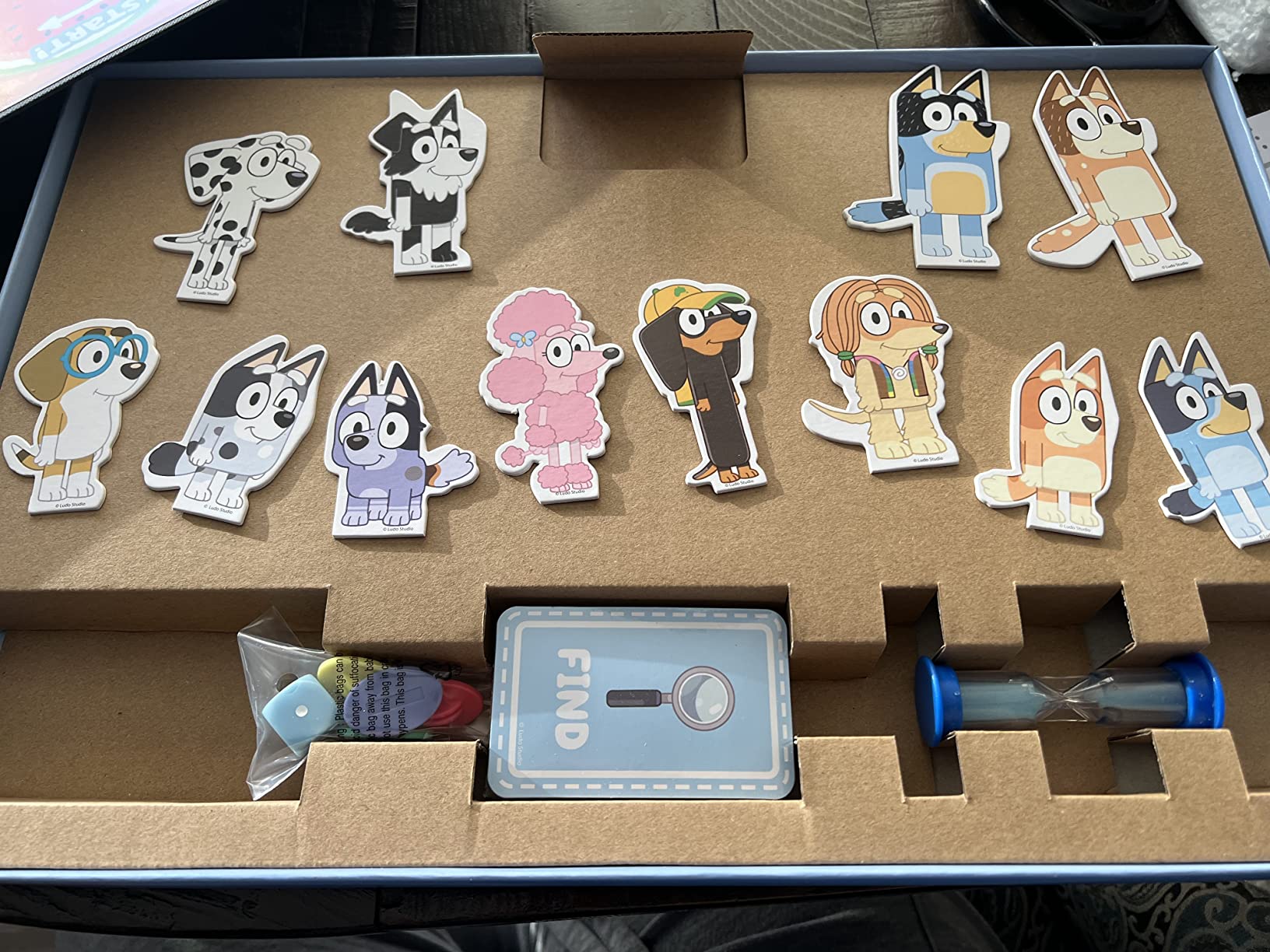
The cooperative structure is simple enough that a three-year-old and a seven-year-old can play it together without a gap in participation, which is not true of most games at this end of the range. Every player searches, every player moves, and the only real decision is which card to reveal next. That flatness is also the limitation, and older children tend to play it out quickly once the tokens are familiar.
Mechanically it is a light token-collecting game rather than a strategy game, so treat it as an entry point. In our plays it worked best as the first game of the evening while the adults made dinner, with a more demanding title taking over once the whole household was at the table.
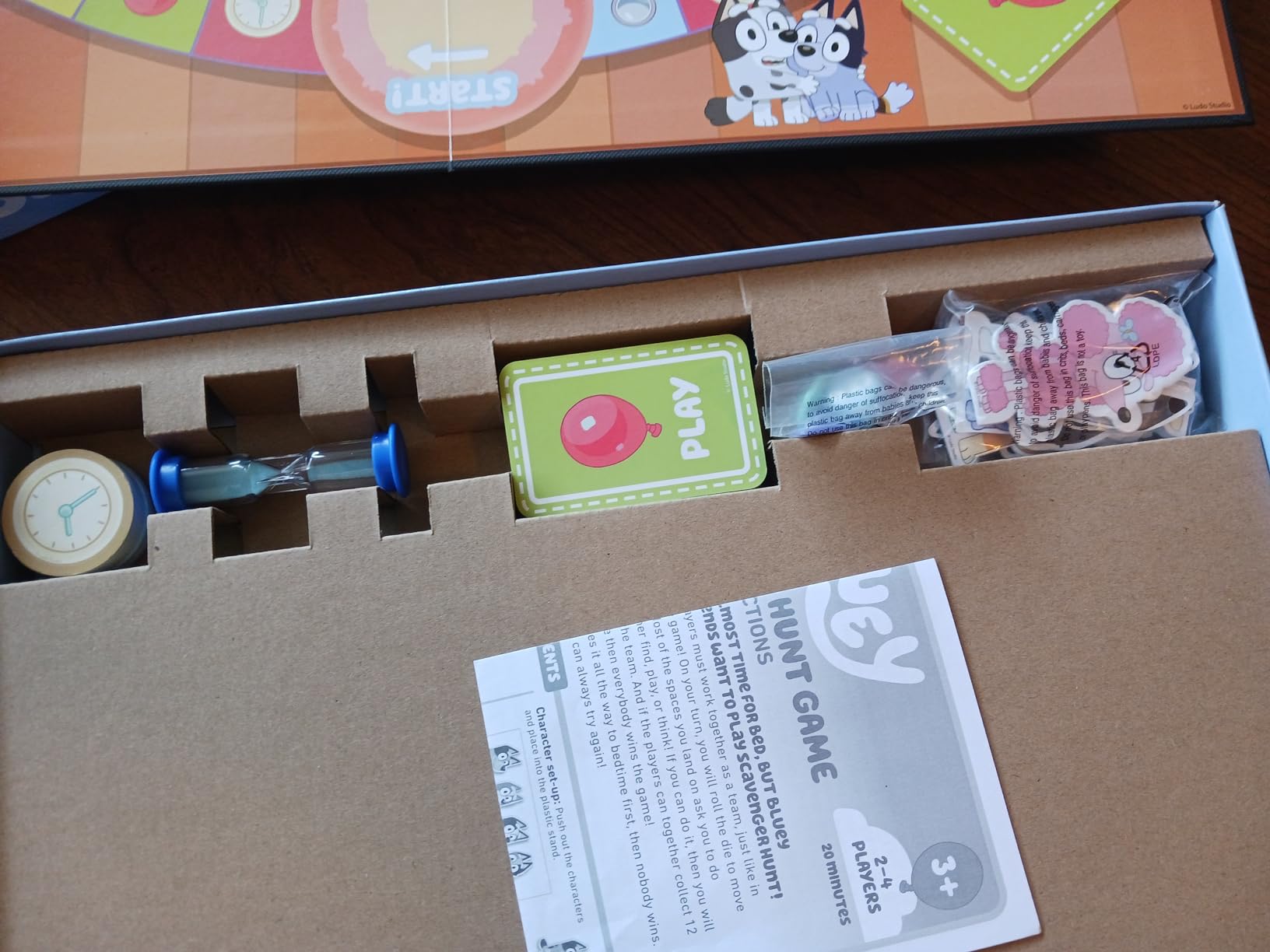
Where this game earns its keep
It is a strong birthday gift for a Bluey household, particularly if the child is three or four and would otherwise be handed a game above their level. The included mini-figures are exclusive to this set, which gives the box a collectible hook that most cooperative preschool games do not have. The board measures about twenty by fifteen inches, so it does need a clear table rather than a lap.
Because the rules require no reading at all, it is also a good choice for a pre-reader. There is nothing on the cards that an adult has to interpret for the child, and the character names can simply be called out in play.
When to skip it
Skip it if your child is not a fan of the show, since the theme is doing most of the motivational work. Also skip it if you want a game with meaningful decisions, because collecting tokens is a repetitive loop once the board layout is learned. Reviewers note that the novelty fades after repeated plays, and the flat cardboard board needs a level surface, which rules it out for travel and picnics.
4. Race to the Treasure – Best Co-op Game for Path Building
Peaceable Kingdom Race to the Treasure! Cooperative Path Building Game for 2 to 4 Kids Ages 5+
Ages 5 and up
2-4 players
About 20 minutes
Path building
Pros
- Building the path together keeps every player involved all round
- Award-winning design with no reading required
- Compact and quick to clear up and store
- Around 20 minutes fits most evenings
Cons
- The path can leave gaps that stall play and slow the round
- Cards get lost easily because the stack sits open
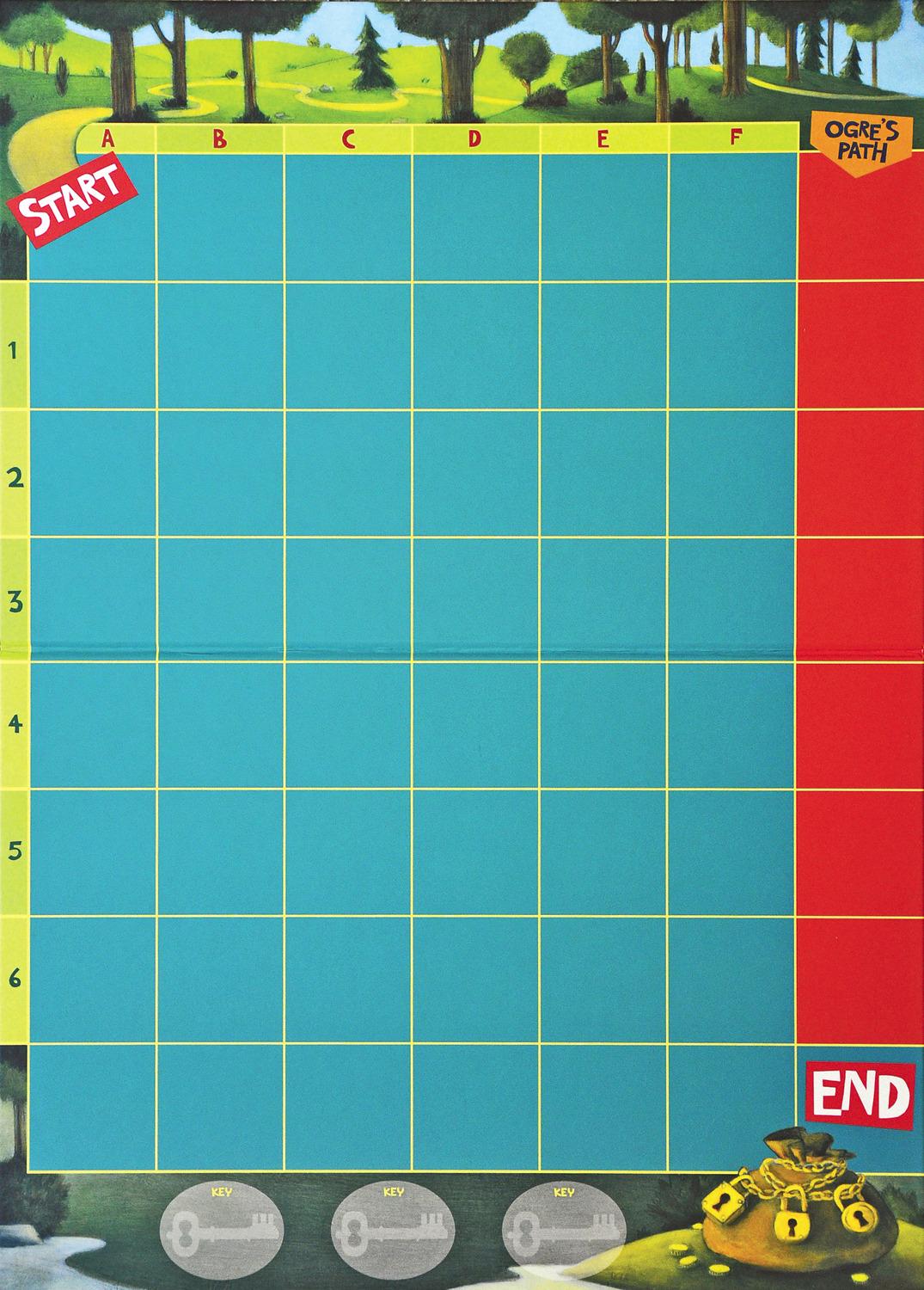
Race to the Treasure replaces the usual race-to-the-finish structure with a race to build the road. Players lay path cards from the cave toward the treasure while the ogre advances along the same track, so the group is simultaneously constructing progress and blocking a threat. It runs for about twenty minutes, handles two to four players from age five, and needs no reading at any point.
The tactile path building is the reason this game stays interesting longer than its simplicity suggests. Every card is a physical tile you place, and watching a road emerge from a jumble of cards gives young children a visible sense of collective progress. Parents consistently describe the packaging as frustration-free, which for a game with loose cards and a fold-out board is a genuine advantage rather than marketing language.
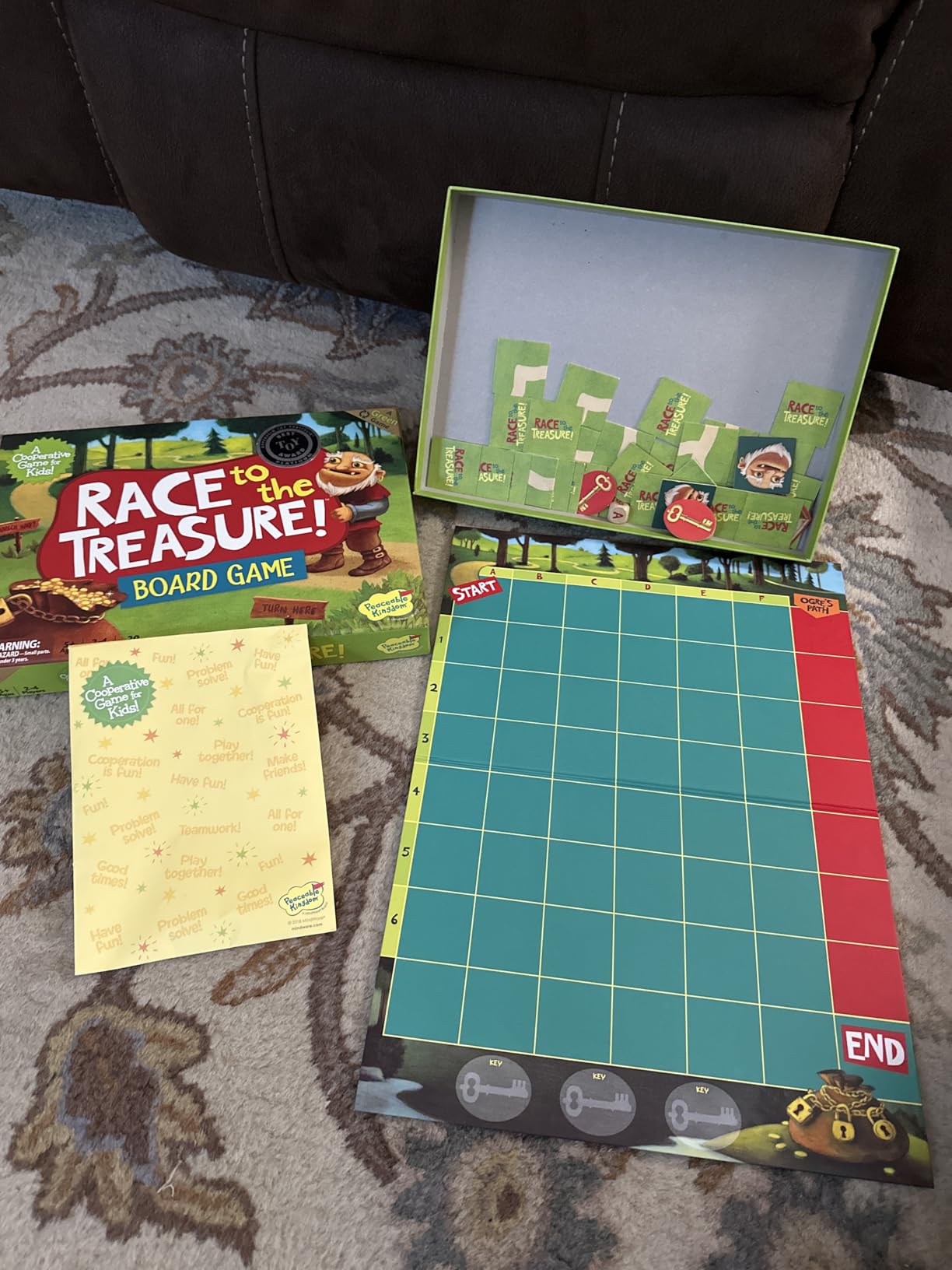
Strategy comes from deciding when to bank a safe path and when to gamble on a card that moves you further but might jump you ahead of the ogre. That is a real decision for a six-year-old and a genuinely tense one for an adult. The theme does the work of making abstract risk feel concrete, and it does it without a single line of rules text.
The most common complaint concerns gaps in the constructed path, which can stall a round while players work out how to bridge them. We saw this twice in eight plays. The second complaint is logistical: the card stack sits open beside the board and the small cards are easy to misplace, particularly with younger siblings crawling across the table.
Who should buy this one
Buy it if you have children aged five to eight who enjoy building and arranging rather than reading or recalling. It is a good fit for a two-player parent-child session, since two players can still race the ogre and the decisions remain meaningful. It is also one of the few games here that packs small enough to be genuinely portable.
It works well as a bridge title between a preschool colour game and a heavier strategy game. A child who finds Outfoxed too easy but is not ready for a tactical adventure will get exactly the right amount of pressure here.
When to choose something else
Skip it if your table dislikes fiddly components or loses cards under pressure, because the path cards are small and easy to knock loose. Skip it for a child who is already reading fluently and hungry for deeper decisions, since the decision space here is narrow. It is also a poor fit for travel unless you can keep the cards contained, given how quickly they scatter.
5. Dinosaur Escape – Best Co-op Game With Real Memory Pressure
Peaceable Kingdom Dinosaur Escape Cooperative Memory Game of Logic and Luck for 2 to 4 Kids Ages 4+
Ages 4 and up
2-4 players
About 10 minutes
Memory and strategy
Pros
- Blends memory and luck so kids stay alert every turn
- Very quick 10-minute rounds suit small children
- Volcano timer creates genuine tension with no losers
- One of the strongest entries in the cooperative range
Cons
- Volcano piece assembly takes a little practice to understand
- Memory element is short enough that older kids solve it fast
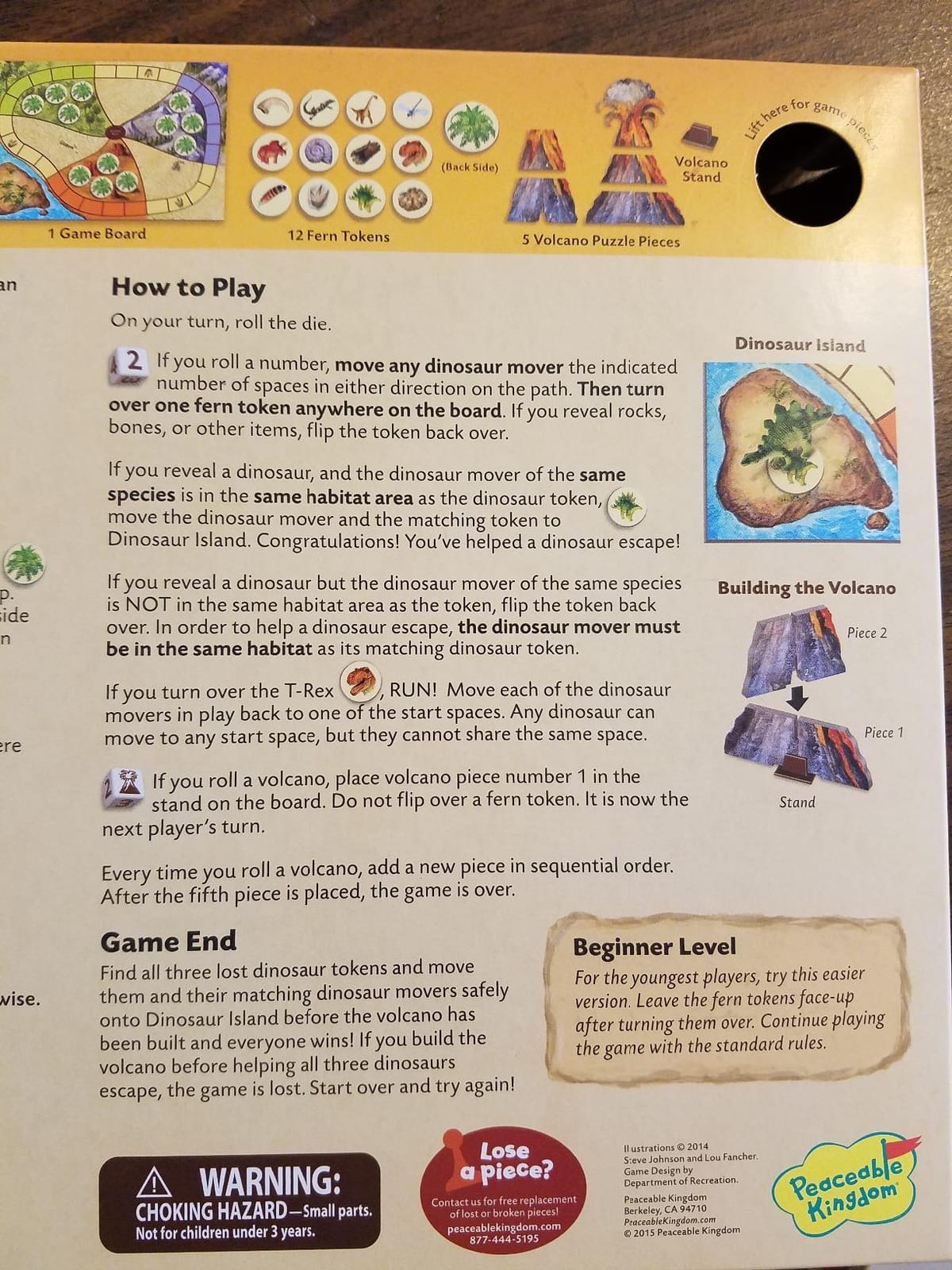
Dinosaur Escape is the game we recommend when a parent wants a preschool co-op title with more tension than pure colour matching. Players move three dinosaur movers around the island board, flipping reversible fern tokens to uncover matching dinosaurs, while a volcano puzzle builds piece by piece above the board. The manufacturer lists ten minutes of play, two to four players and ages four and up.
The volcano is the pressure source. It assembles in front of everyone, so the whole group can see exactly how much time the run has left, and no single player controls it. That is a much more elegant timer than a mechanical countdown, because it is readable by a child who cannot yet tell time. In our plays the memory element added just enough tension that no one was bored, even the adult.
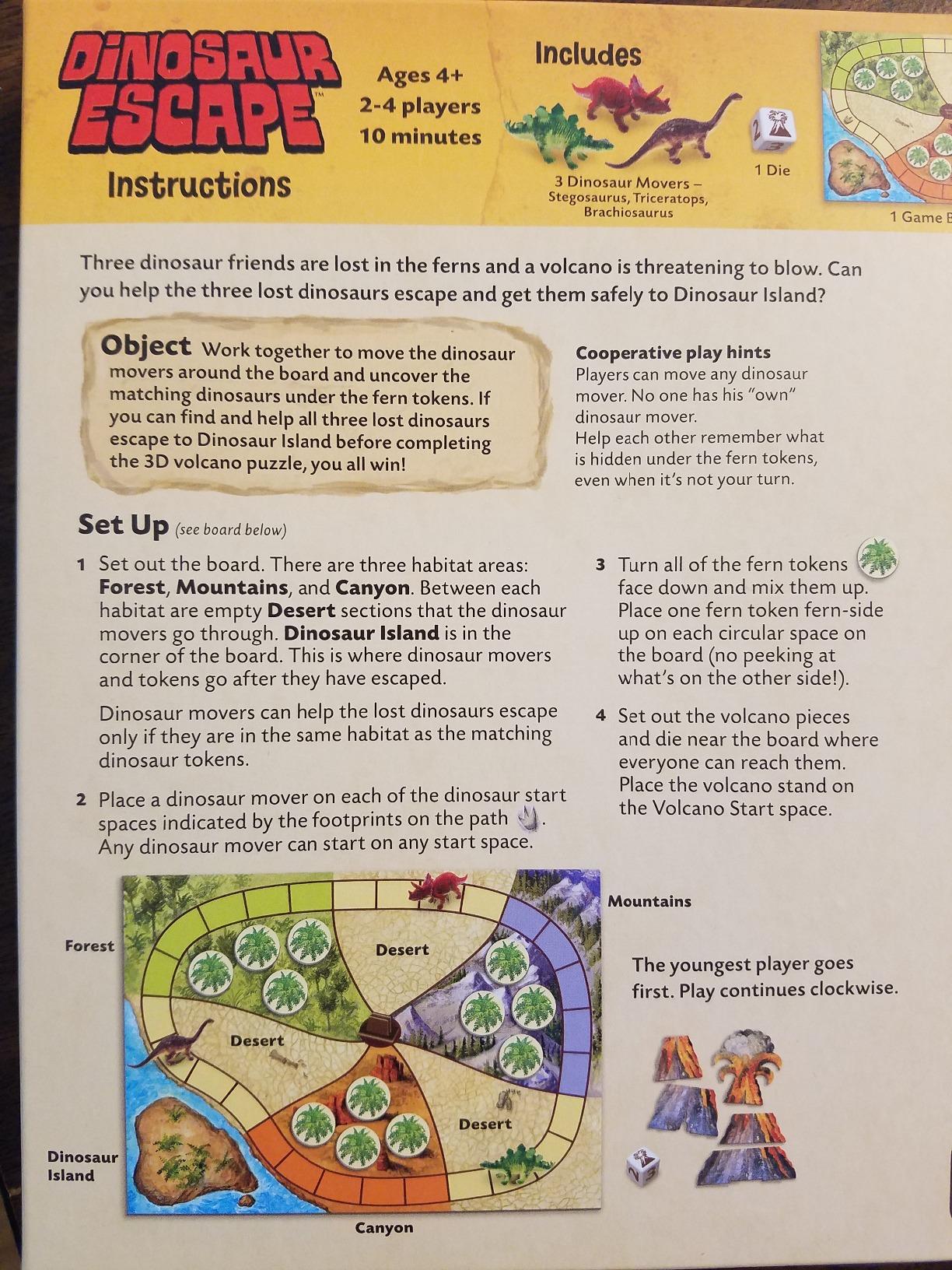
What we like most is the mix. Many cooperative games for this age group are pure luck or pure matching, which makes the outcome feel arbitrary. Adding memory to a small amount of luck means the group has something to talk about, and the kids start narrating where they remember a fern was flipped. That conversation is the actual skill being built here.
Two caveats. The volcano assembly is the fiddliest part of setup and does take a practice round before it makes sense to a child. And the memory puzzle is compact enough that older children solve it quickly, so the game stops being a challenge for them well before it stops being fun for a four-year-old.
Best reasons to pick it
Choose it for a household with a three-year-old and a six-year-old who need to share one game. The memory mechanic is age-appropriate for both and neither child feels like the weak link. It is also a good two-player pick, since two players can cover the board without the game stalling.
The short play time makes it ideal for a waiting room, a restless afternoon, or the twenty minutes before dinner when nobody is ready to commit to a full session. Owners frequently compare it favourably to the rest of the same range precisely because it holds attention longer than its younger siblings.
When it is not the right game
Skip it if setup time is the enemy in your house, because the volcano tower needs assembling and explaining. Skip it for a child aged seven or above who wants a real challenge. And skip it if your family hates losing components, since the set includes twelve reversible fern tokens and five volcano pieces that are easy to misplace.
6. Mermaid Island – The Best Co-op Game for Big Family Groups
Peaceable Kingdom Mermaid Island Award Winning Cooperative Board Game for 2 to 6 Kids Ages 5+
Ages 5 and up
2-6 players
About 15 minutes
Spin and move
Pros
- No reading required so mixed ages play together well
- High player count makes it the best option for larger sibling groups
- Bright artwork that young children respond to immediately
- Good Housekeeping Best Toy Award winner
Cons
- Very easy to win once the mermaids build a lead
- Spin-and-move format offers little strategic depth
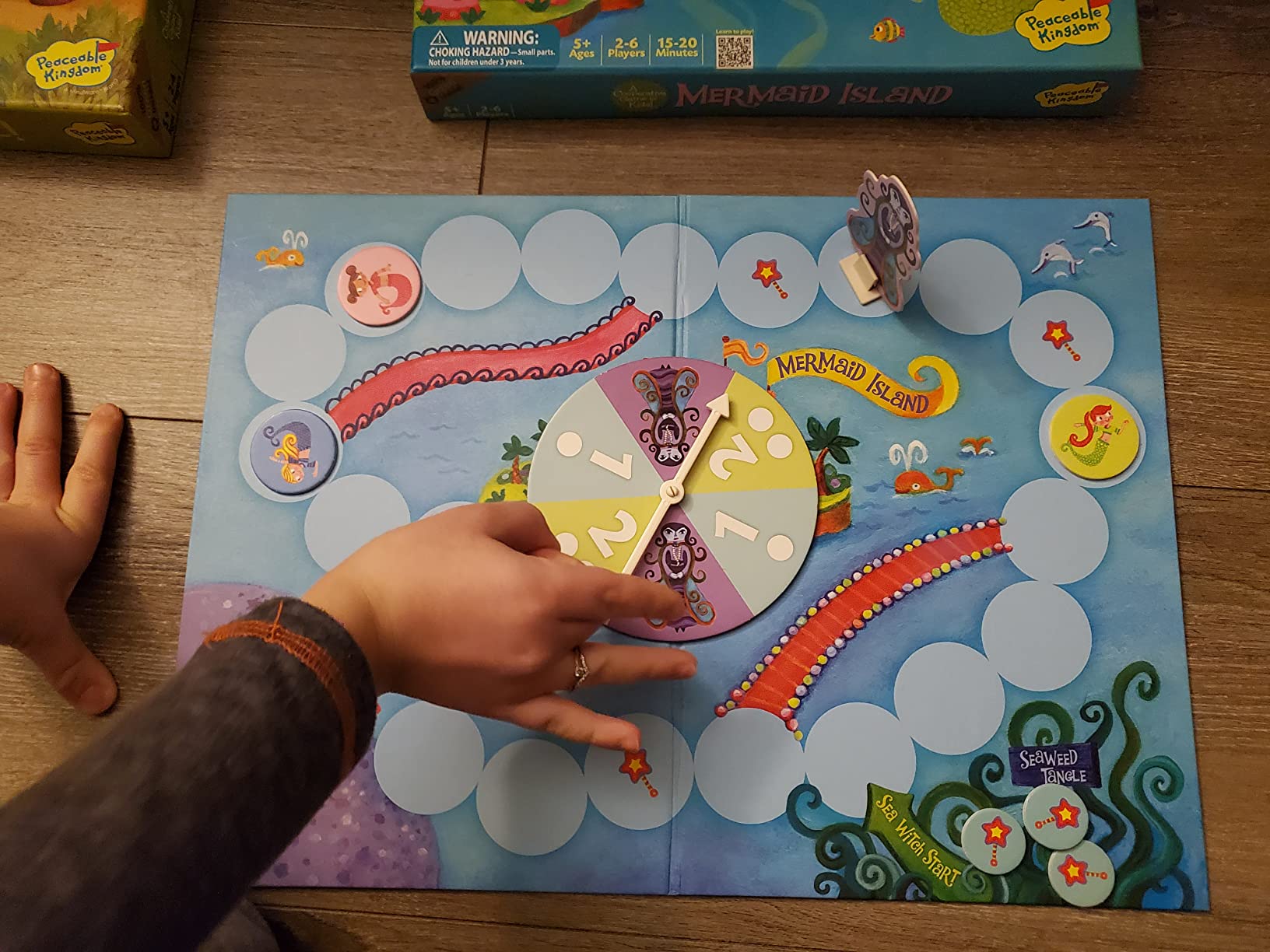
Mermaid Island is the pick for the table that keeps growing. The manufacturer lists two to six players from age five, with about fifteen minutes of play, and that six-player ceiling is the reason it earns a spot in a list otherwise dominated by two-to-four games. Players spin and move three mermaid tokens toward the island while the sea witch advances on the same track, collecting wands along the way to defeat her.
What surprised us was how early it works. Parents and preschool teachers describe it as one of the very first cooperative games a child can genuinely play alone, and several note that the practical lower bound is closer to three than the stated five. With no reading required and a single meaningful decision per turn, a three-year-old and a six-year-old can share the table without the gap in participation that usually shows up.
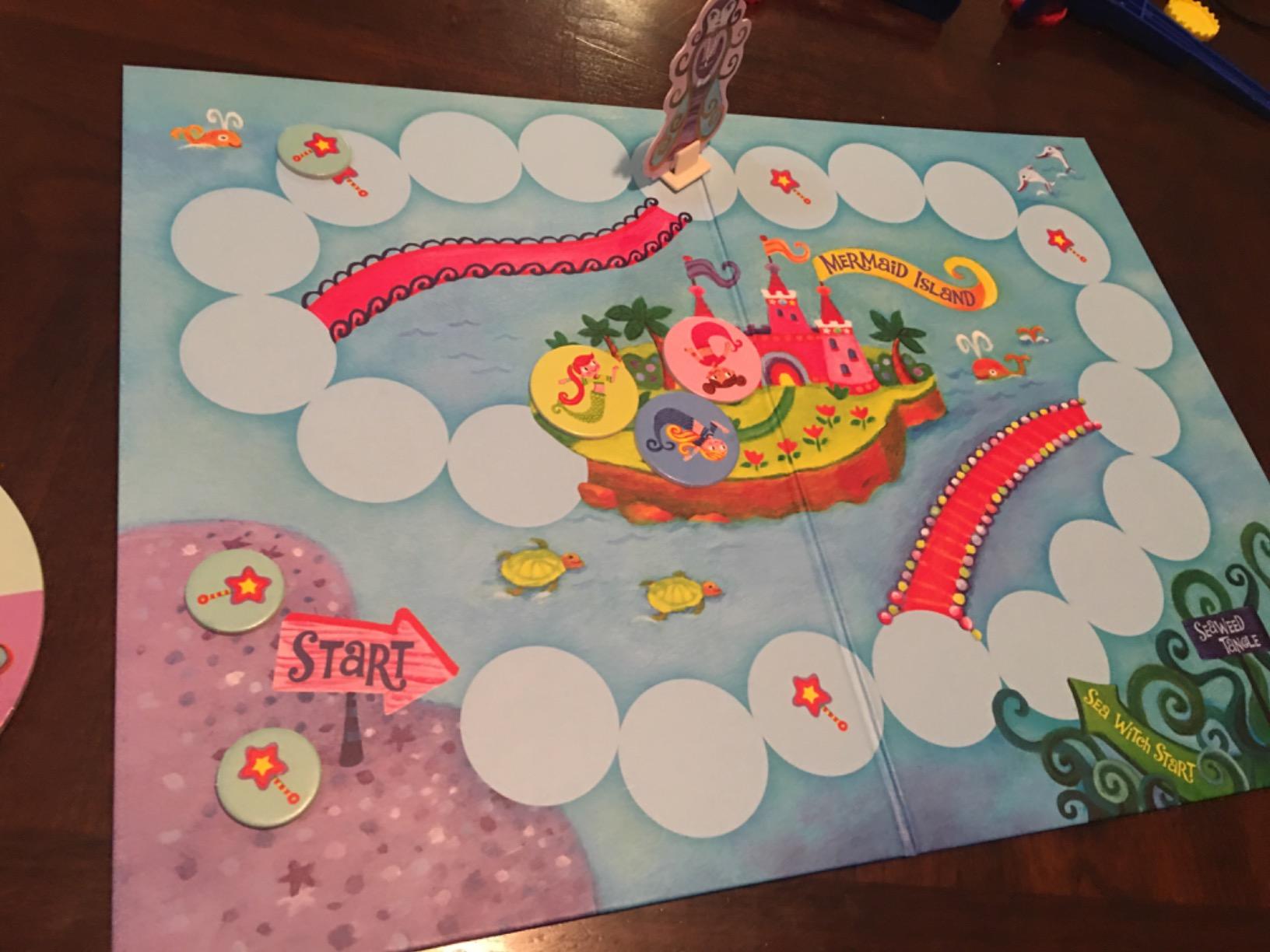
The artwork carries a lot of the load at this age. Bright, friendly ocean imagery gets a reluctant child to the table before a single rule has been explained, which is half the battle with a preschool group. It is also a Good Housekeeping Best Toy Award winner, which is the kind of external validation worth knowing about when you are buying for someone else’s child.
The honesty here is simple: this game is easy. Once the mermaids build a lead the suspense drains, and the spin-and-move format does not ask for planning beyond the next turn. Reviewers with older children recommend using it as a stepping stone to a harder title such as Dinosaur Escape rather than as a long-term fixture.
Where Mermaid Island earns its slot
It is the answer to a six-player game night, and there are not many cooperative titles that handle that number without slowing to a crawl. It also works well as a parent-child game for two, since the spinner gives each turn equal weight regardless of age. Because there is no reading anywhere in the game, you can hand it to a pre-reader without adapting a single component.
It is a useful second game for families who have already exhausted the preschool shelf. When the easy colour games start feeling flat, this gives you one more low-pressure option that still involves a shared enemy and a visible race.
When to skip it
Skip it if you have players aged eight and above, because the difficulty will embarrass an older child. Skip it if your family wants a game with genuine strategic depth or high replay value. And skip it for a child who dislikes games where the theme is more important than the decision, since almost nothing here depends on planning.
7. Count Your Chickens – The Best First Board Game for Toddlers
Peaceable Kingdom Count Your Chickens Cooperative Board Game
Ages 3 and up
2-4 players
About 15 minutes
Counting game
Pros
- Strong for one-to-one counting correspondence in toddlers
- Quick to explain to a first-time board gamer
- Bright colours that hold a three-year-old's attention
- Keeps grandparents and the whole family playing
Cons
- 40 small cardboard chicks are a choking hazard around very young siblings
- Counting every chick gets cumbersome and older kids lose interest
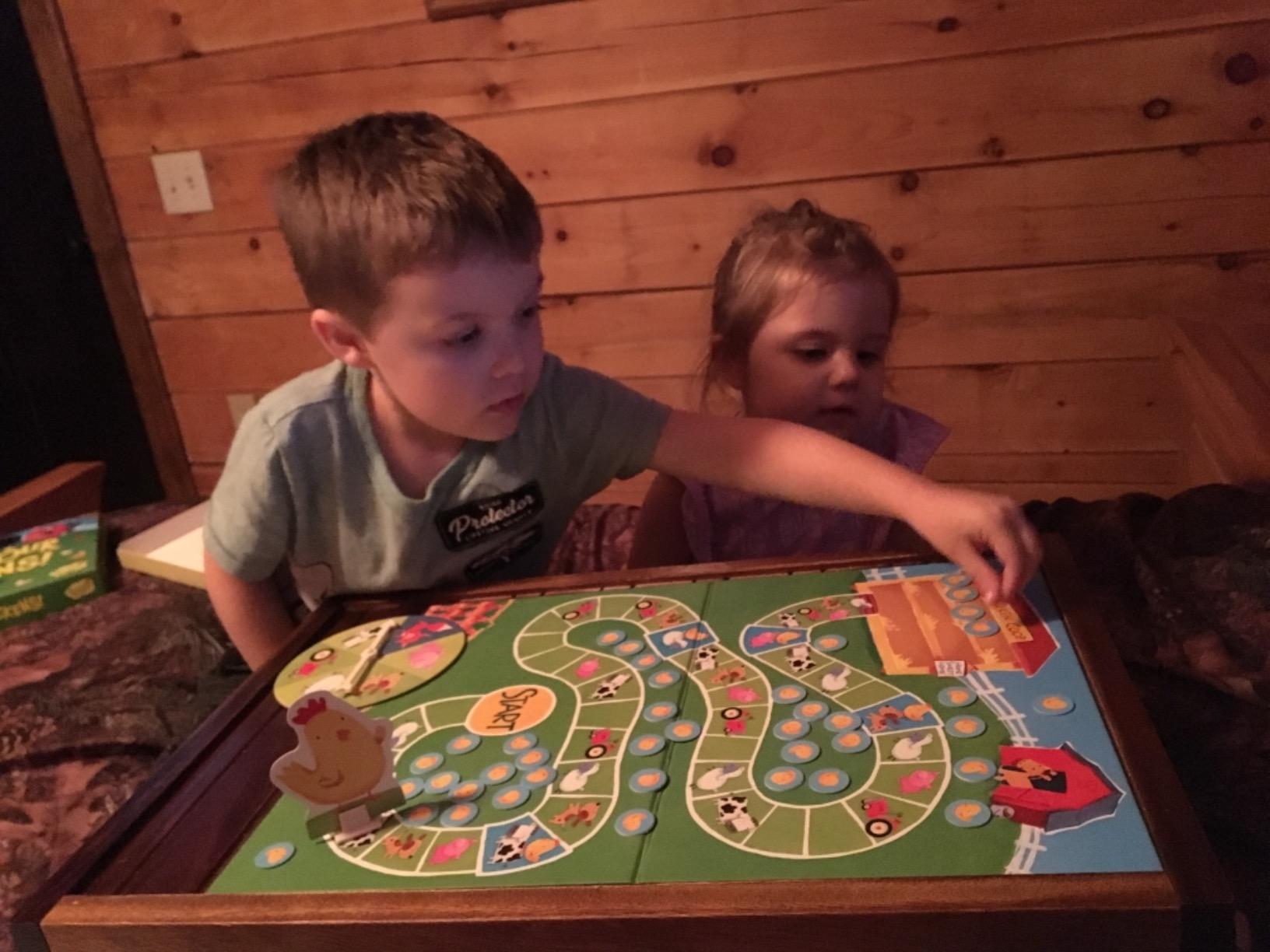
Count Your Chickens does one thing and does it well: it teaches a toddler to count by making counting the game. Players spin and move a mother hen around the board, collecting chicks as they go, with the goal of getting the whole brood back to the coop before a fox reaches them. The manufacturer lists ages three and up, two to four players and about fifteen minutes of play.
For a child who has never held a game piece with intent, this is the cleanest introduction we have found. The turn structure is obvious, the goal is visible, and counting correspondence happens naturally rather than as a lesson. It was the game our youngest picked up fastest during testing, and reviewers consistently describe it as one of the best first board games for toddlers.
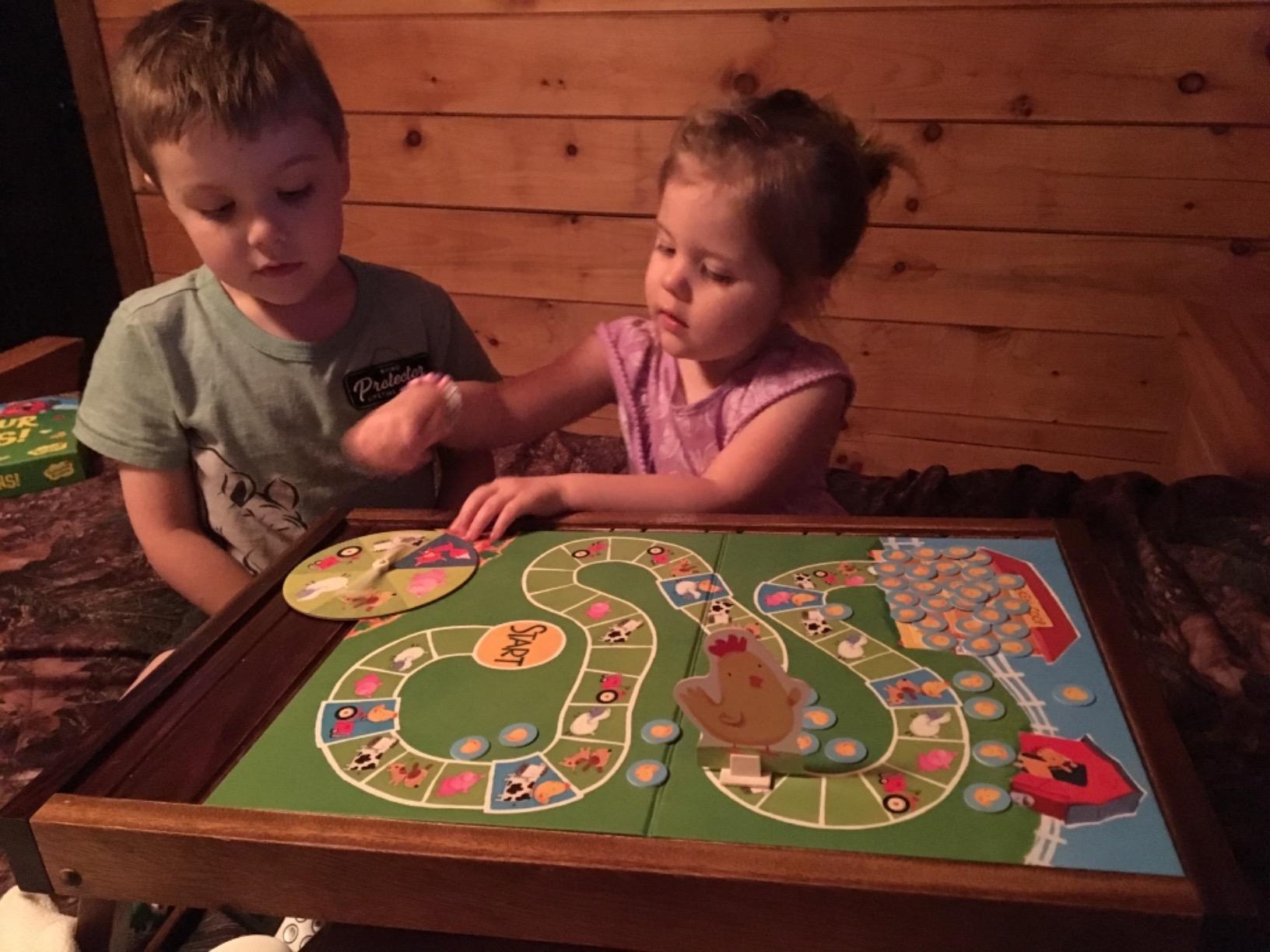
There is a real social benefit hiding underneath the arithmetic. Because everyone works toward the same coop, a toddler who drops a chick off the board is not costing their team a point, they are simply needing help. In our plays that turned a common source of frustration into an automatic request for help, which is a small thing that matters with a three-year-old.
The drawbacks are practical. Forty small cardboard chicks sit in the box and forty small cardboard chicks end up under the sofa, and the manufacturer carries a choking hazard warning for small parts, which is worth respecting if there is a younger sibling in the house. Counting every chick also becomes tedious fast, and older children lose interest quickly. Several parents in the reviews steer children past five toward Hoot Owl Hoot instead.
Who should start here
Start here if your child is between three and five and has not yet played a board game with rules. It needs no reading, has one obvious decision per turn and finishes in about fifteen minutes. It is also an easy game to bring to a grandparent house, because the components are simple enough that an older relative can run it without instructions.
For a two-player session, it is a natural fit with a parent and a toddler since the counting practice happens regardless of how many players are at the table. It also works well in a classroom, where a teacher can use it to introduce turn-taking to a group of very new players.
When to pick a different title
Pick something else if you have a child under three in the room, given the forty loose pieces and the small-parts warning. Pick something else if your five-year-old is ready for more than counting, because the strategic content runs out quickly. And pick something else if tidying up is a factor, because this game generates more sweeping and picking up than any other entry here.
8. Wildcraft – The Best Cooperative Game That Teaches Something
Wildcraft! Cooperative Games for Kids 4+, Learn 25 Herbs, Family Game
Ages 4 and up
1-4 players
Herb learning game
Family mission
Pros
- Genuinely educational about herbal uses without feeling like school
- Artwork appeals to adults as well as children
- Relaxing non-competitive play for the whole family
- Rules adapt easily for different ages and time available
Cons
- Guide and storybook are downloads rather than printed copies
- A full game runs long enough to lose a four-year-old's attention
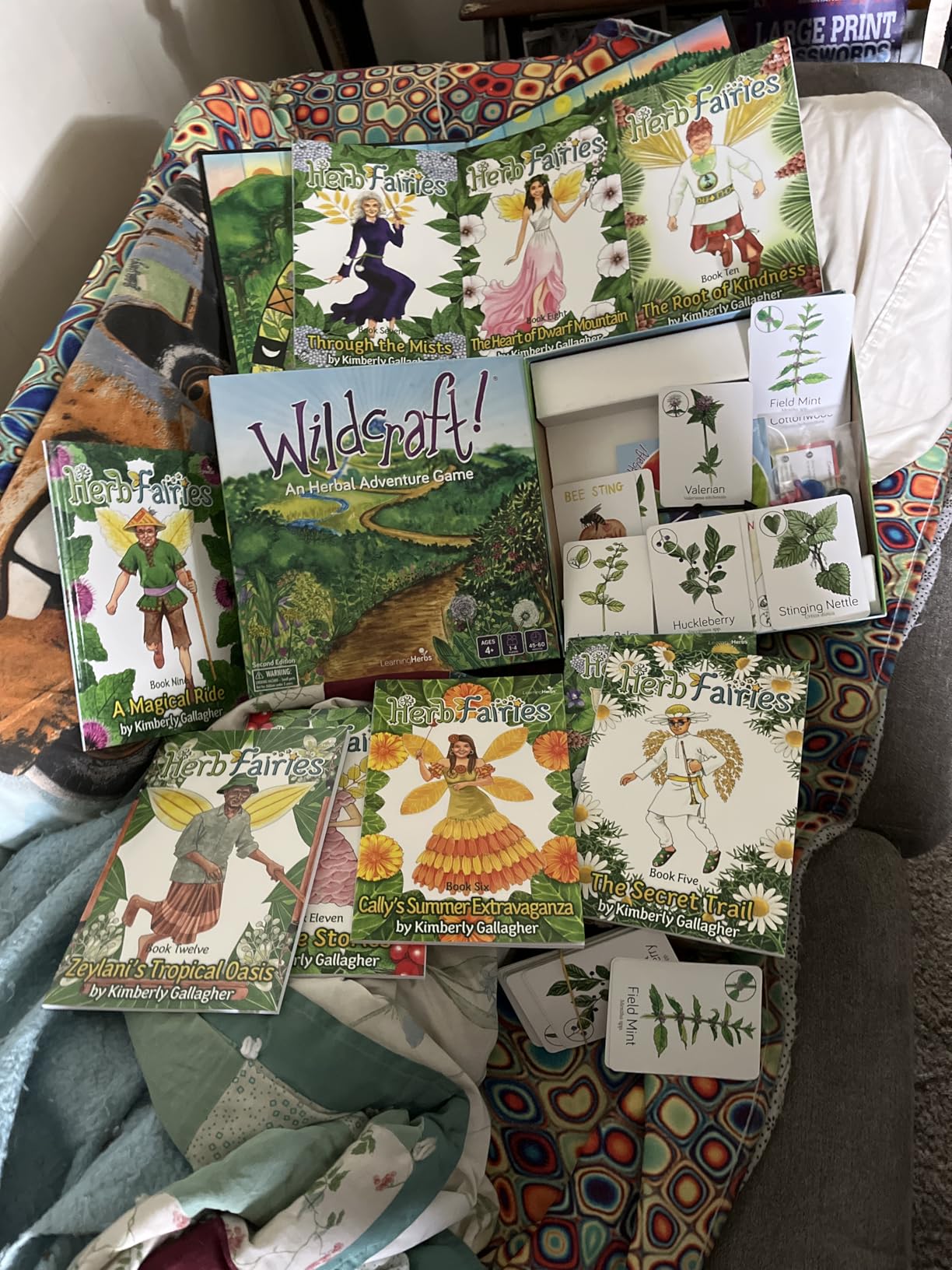
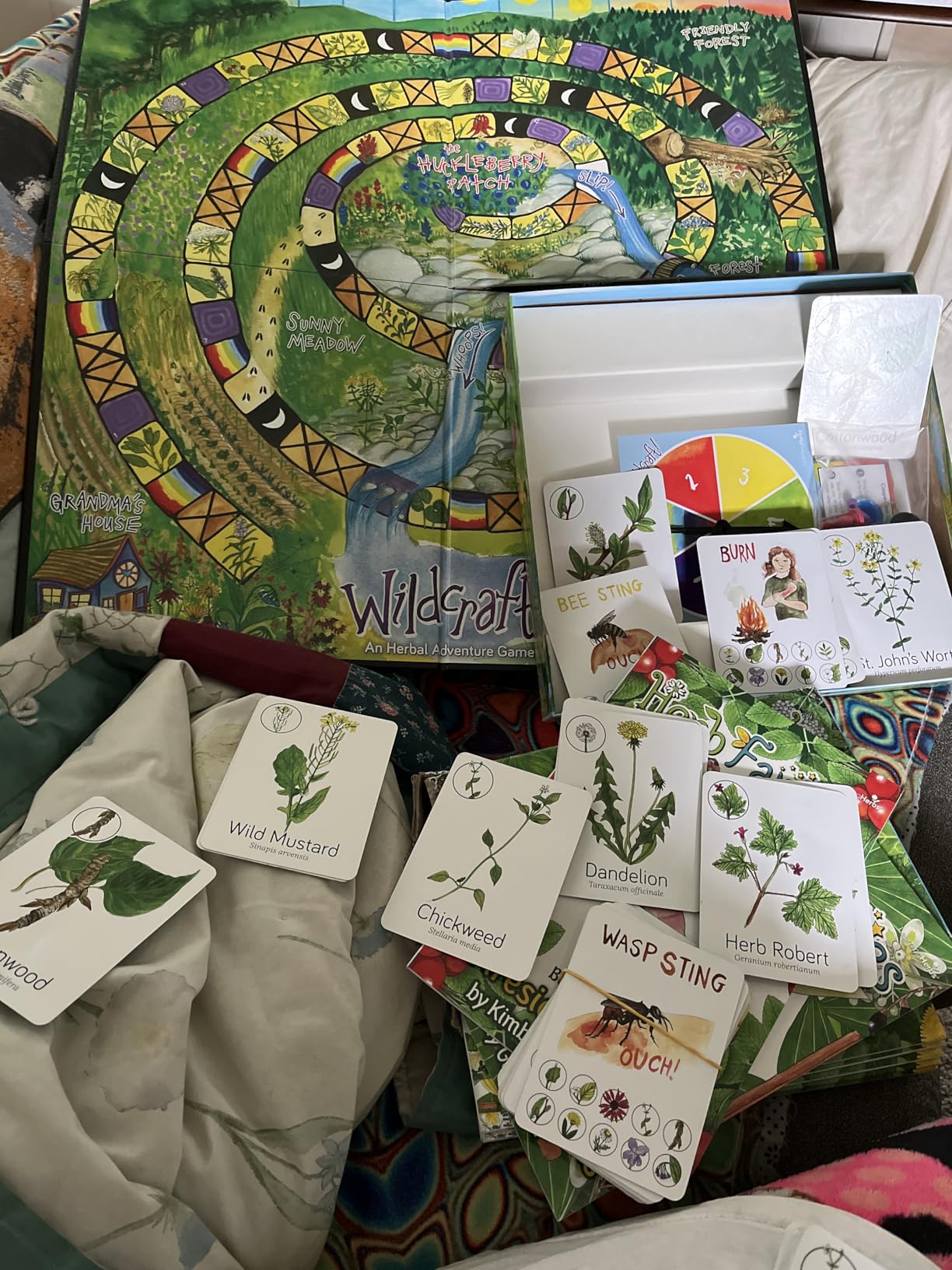
Wildcraft is the outlier in this roundup, and the reason is the subject matter. Instead of fantasy creatures, the family joins an imaginary foraging expedition through forests, trails and waterfalls, gathering twenty-five edible and medicinal herbs to deliver to a grandmother’s house. It is listed for one to four players from age four, and the educational objective is herbs rather than hand-eye coordination.
What impressed us was the accuracy of the content. Reviewers with gardening backgrounds single out the depth and correctness of the plant information, and adults frequently enjoy playing it as much as the children do. That combination is unusual. Most cooperative games for kids are pitched entirely at the kids, and an adult playing one is usually just supervising rather than participating. Here the adults are learning alongside.
The pacing suits a home without young toddlers. Because the rules adapt to the time available and the ages present, we could play a shortened version on a weeknight and a full expedition when grandparents were visiting. It is one of the few games in this list that genuinely scales down rather than simply being cut short.
The main complaint is digital rather than physical. Three supporting resources, including a storybook, a pocket plant guide and a colouring book, are downloads that you have to find, print and laminate yourself. Buyers without a printer were disappointed, and that is worth knowing before you commit. A full game also runs long enough to lose the attention of a four-year-old.
Best fit and best reasons
It suits a family with a child who asks constant questions about nature, because the game answers them through play rather than through conversation. It is equally good for a mixed-age table where the youngest player is four and the oldest is an adult, since nothing about the game embarrasses the grown-up. The materials are also recycled, recyclable and non-toxic, which matters if you have a mouthing three-year-old in the house.
It is a good choice for a rainy weekend when you want something calmer than a race. There is no countdown clock and no monster chasing anyone; the tension comes from planning the route together, which makes it a genuinely different texture from everything else here.
When to skip it
Skip it if you have no printer and no interest in printing things, since the extras are a meaningful part of the value. Skip it for a family with a child under five who needs a short session, because a full game outlasts a four-year-old’s attention span. And skip it if your child wants competition, because this one has no edge at all.
9. Feed the Woozle – The Best Cooperative Game for Active Play
Peaceable Kingdom Feed the Woozle Cooperative Game
Ages 3 and up
2-5 players
About 15 minutes
Gross motor play
Pros
- Funny nonsense snack names that make children giggle
- Three difficulty levels give the game real longevity
- Walking the room with a spoon adds genuine gross motor play
- No reading required so it works from about age three
Cons
- The three-sided Woozle does not stand securely on its own
- Can feel repetitive for an adult playing one-on-one
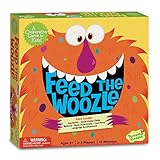
Feed the Woozle is the only game in this list where players get up and walk around. A hairy creature with a wide-open mouth sits in the centre of the table, and the group spins to reveal cards describing silly snacks like hairy pickles and fuzzy donuts. If that card matches the snack currently on the spoon, a player has to walk to the Woozle and drop it in without wobbling. It handles two to five players from age three in about fifteen minutes.
That physical element is the reason it works with children who cannot sit still. A three-year-old who has bounced through every board game on the shelf will often stay engaged here because the rules require movement, balance and fine motor control. Special education teachers and parents single it out as a rare cooperative game that genuinely works from toddler age.
The three difficulty levels are the quiet strength here. Because the game grows with the child, a family that starts it at three can still play a meaningful version three years later without buying anything else. The humour matters more than it sounds. The snack names are deliberately absurd, and reviewers cite the silliness of them as the single most common reason for repeat play.
Two limitations. The three-sided Woozle balances precariously on its stand and needs a steady hand or a flat surface to stay put. And an adult playing one-on-one with a single child will find the loop repetitive fairly quickly, since there is less to manage with fewer players.
Why it belongs in a co-op list
It is one of very few cooperative games that works for a group of five young children, which covers the larger sibling scenario that Mermaid Island also serves. It needs no reading at all, and the dexterity requirement means children of different ages can contribute differently without anyone feeling left out. For a child who finds board games too abstract, the physical action makes the goal immediate.
It also travels in a small box, which makes it a decent option for a playdate or a visit to grandparents where you need something that runs in fifteen minutes and needs no table surface.
When to skip it
Skip it if your space is small or the table is the only option, because the game requires walking around and a stable surface for the Woozle. Skip it if you are playing with one child and want a game that holds an adult’s attention for a long session. And skip it if your children dislike messy, noisy play, since dropping a spoon mid-carry is part of the fun.
10. My First Castle Panic – The Best Co-op Game to Bridge Into Strategy
Fireside Games My First Castle Panic Fantasy Board Game
Ages 4 to 8
Up to 4 players
About 20 minutes
Tower defence
Pros
- Icon-based cards mean no reading required and instant comprehension
- A 20-minute round fits neatly into bedtime routines
- Harder to lose than the standard version which reduces anxiety
- Sturdy colourful components sized for small hands
Cons
- Card quality is thin and cards wear with heavy use
- Basic gameplay is limited so expansions need the full-sized game
My First Castle Panic is a deliberately simplified tower defence game for four players aged four to eight. Monsters walk a fixed path toward a standing castle, and the group matches icon cards to move pieces and clear the route before anything reaches the walls. The manufacturer suggests about twenty minutes a round, and in our plays it consistently finished close to that mark.
It works as a bridge. Children move up from preschool colour games into something with genuine planning, but the icon-based cards remove the reading barrier entirely, so a four-year-old can participate on turn one. Families describe it as an ideal gateway into strategy, and it is not unusual for children to ask for the larger Castle Panic once they have outgrown this version.
Two things stand out. First, it is noticeably harder to lose than the standard game, and that matters more than it sounds, because losing repeatedly is what drives children away from cooperative play. A parent on a forum described it in exactly those terms and it matched our experience. Second, the components are built for small hands: a sturdy standing castle, thick wall pieces and large monster tokens.
The honest drawback is durability. Reviewers commonly flag that the cards are thin and wear quickly under heavy use, and we would not expect this box to survive being handled by a toddler twice a week for years. The core system is also basic, so the replay ceiling is lower than the larger version it is derived from.
Who should buy it
Buy it for a child between four and eight who has finished colour-matching games and needs something with more structure. It suits a mixed table of a four-year-old and a seven-year-old, since the icons carry the meaning and the adults can narrate lightly. It also works for two players, with one parent and one child managing the icon cards together.
It is a good choice for a household that wants a strategy game without a rulebook, and for a child learning to lose gracefully since the shared castle gives everyone a reason to keep trying.
When to skip it
Skip it if you expect a long-lived game, because the card wear and the limited system mean you will likely outgrow it. Skip it if your child needs reading practice, since there is no text anywhere in the components. And skip it if you want a heavier challenge, because this version deliberately removes most of the depth in the full game.
11. Snug as a Bug in a Rug – The Best Co-op Game for Multi-Age Toddlers
Peaceable Kingdom Snug as a Bug in a Rug Award Winning Cooperative Preschool Skills Builder Game for 2 to 4 Kids ages 3+
Ages 3 and up
2-4 players
Three game levels
Built-in spinner
Pros
- Three difficulty levels let a 2.5 and a 5 year old play together
- Oppenheim Toy Portfolio Platinum award winner
- Included die means no two games play the same
- Sliding bugs under the rug is a tactile hit with toddlers
Cons
- Board is not magnetic so bugs get knocked out of position
- 24 loose bug pieces are easily lost during play
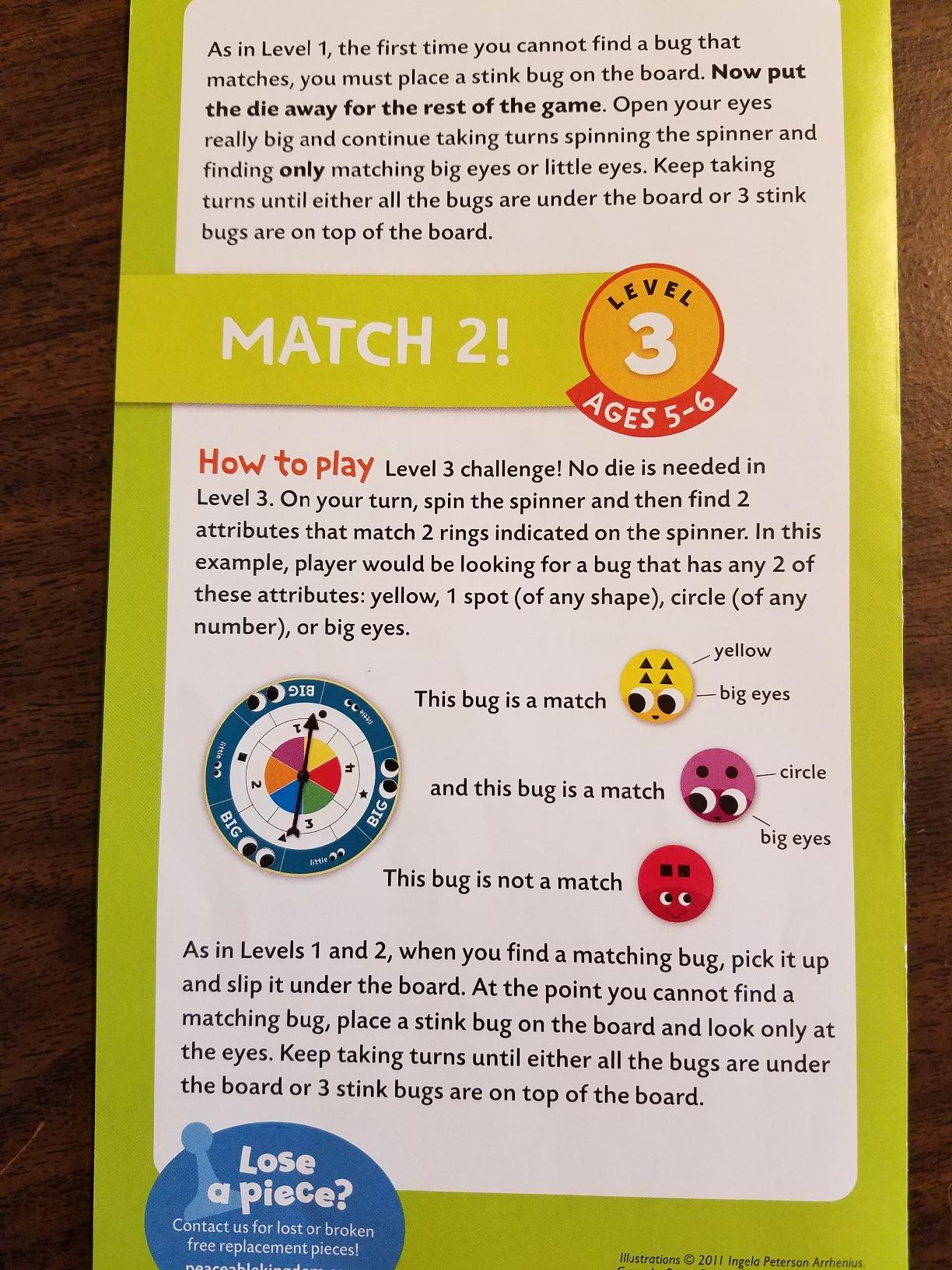
Snug as a Bug in a Rug covers preschool skills without feeling like preschool practice. Players move brightly coloured bugs across a board and slide them under a fabric rug to match the colours, numbers or shapes showing underneath, depending on which of the three levels is in play. The set includes a board with a built-in spinner, twenty-four bugs and a die, and the manufacturer lists ages three and up for two to four players.
The three-level structure is the reason it stays in rotation. A two-and-a-half-year-old and a five-year-old can share the same box, with the older player on a higher level and the younger one matching colours only. Reviewers repeatedly name it as the most-played game in families that own several titles in the same range, which tells you something about longevity.
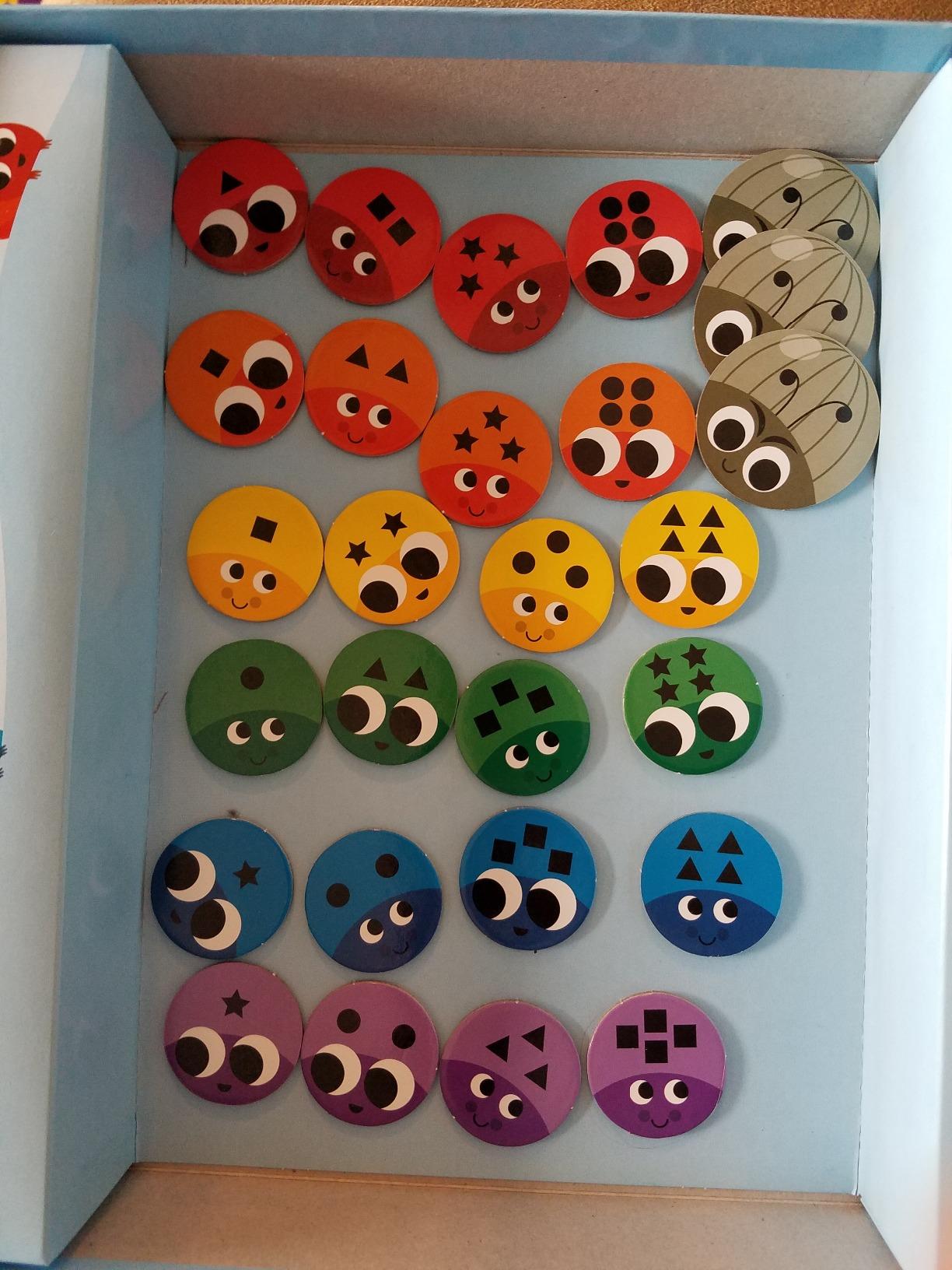
The physical design is the appeal. Sliding a bug under a rug is a tactile action that toddlers understand immediately, and the included die adds enough variation that no two sessions feel identical. It is also an award winner, carrying the Oppenheim Toy Portfolio Platinum award, which is worth knowing when you are buying for someone else.
The gripes are consistent across reviews. The board is not magnetic, so bugs shift and jump out of position constantly and someone has to correct them between turns. Twenty-four loose bug pieces are also easily lost during play, which is a real issue in a house with a vacuum-averse corner.
Best fit for this game
It fits a household with children aged two and a half to five, particularly one with a wide age spread. It is a strong two-player parent-child choice because the levels let the adult and the child work on different challenges without either feeling mismatched. It also works for a five-player-plus group only in the sense that the extra players take turns rather than playing simultaneously.
It suits parents who want screen-free play that keeps a toddler genuinely busy rather than supervising a tablet. The whole game runs inside the box and the board is small, so it travels reasonably well and stores flat.
When to skip it
Skip it if losing pieces will drive you mad, because twenty-four bugs plus three stink bugs is a lot of small items. Skip it if you need a magnetic board. And skip it for a child over six, since all three levels will be solved quickly and there is no deeper system to move on to.
12. Baby Dinosaur Rescue – The Best Cooperative Game for Classrooms
Baby Dinosaur Rescue Cooperative Board Game for Kids Ages 4+, Family Fun
Ages 4 and up
2-4 players
About 20 minutes
Image matching
Pros
- Image-based cards make it a genuine first game for pre-readers
- The advancing lava token creates understandable tension
- Bright dinosaur artwork holds a four-year-old's attention
- Short 20-minute rounds suit classroom use
Cons
- Simple enough that older children quickly play it out
- Thin cardboard components wear at the folds with regular use
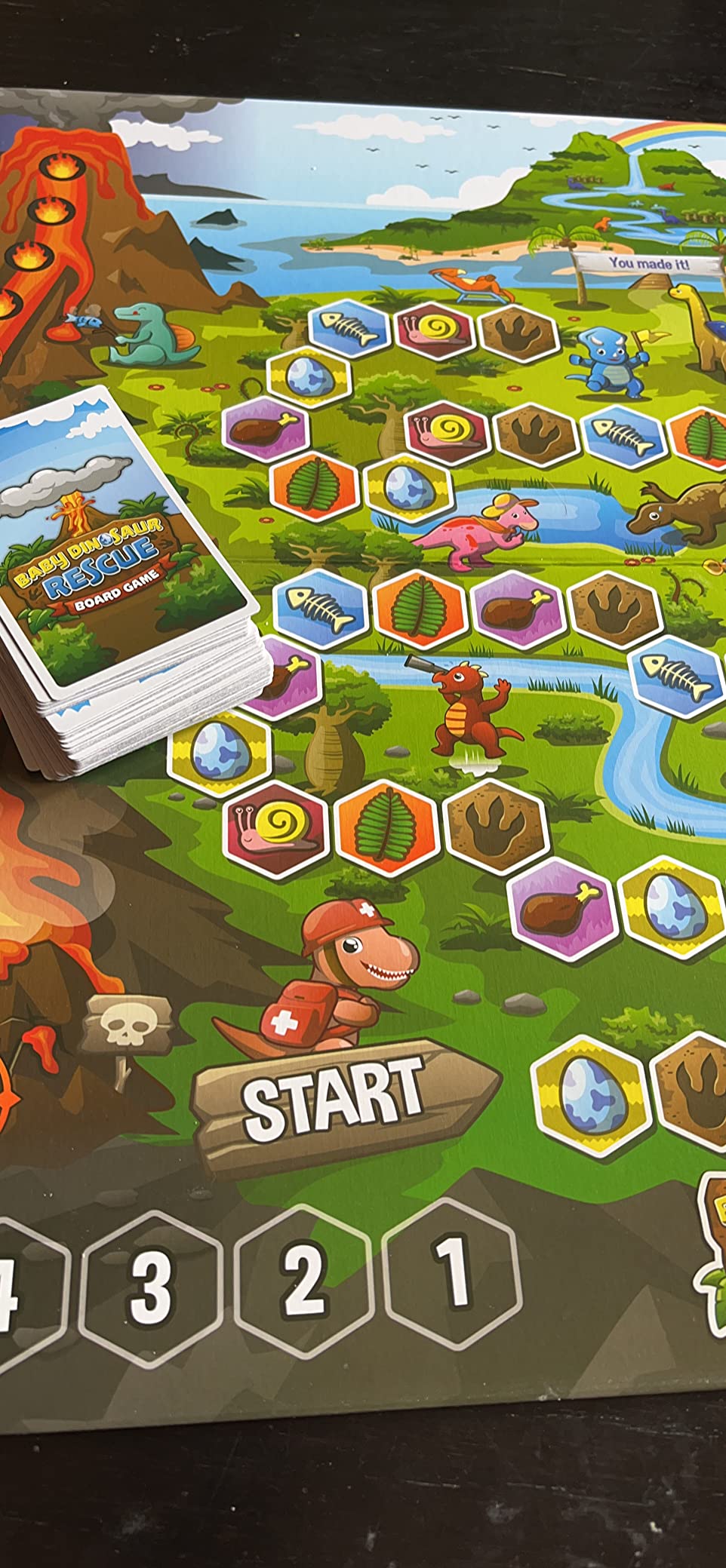
Baby Dinosaur Rescue is a straightforward rescue race with a lava timer. Players move baby dinosaurs across the valley toward Dinosaur Island while a lava token advances along the path behind them, using image-based item cards so that nothing needs to be read. It handles two to four players from age four with about twenty minutes of play, and the box contains a board, dinosaur tokens, a lava token and a card set.
Its strongest feature for young children is that the entire game is picture-based. Parents describe it as an easy first cooperative game for a four-year-old who cannot yet read, and that is accurate. There is no adult narration required, which removes the bottleneck that forum discussions identify as one of the most common frustrations with game night.
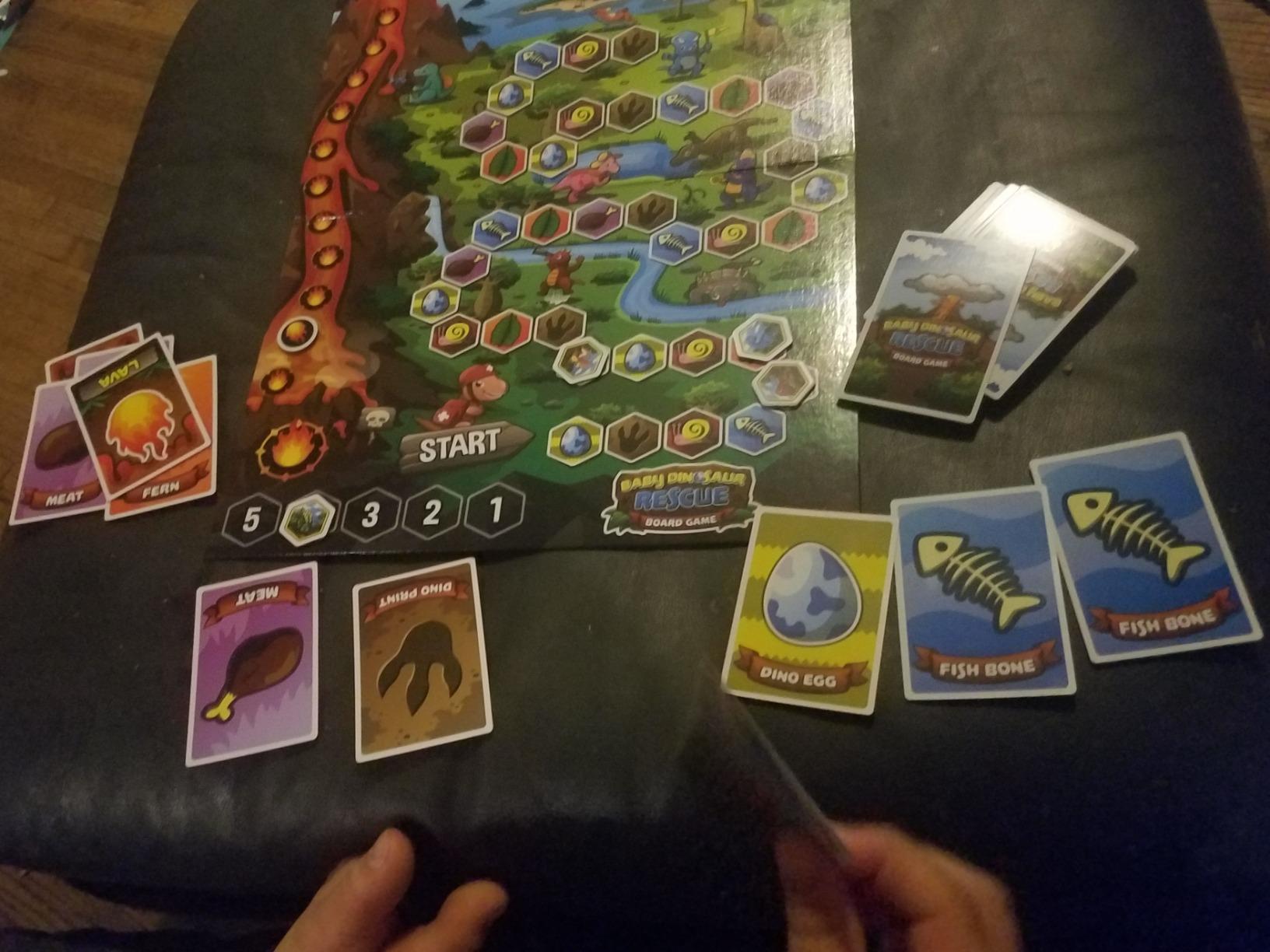
The lava mechanic is the part that works. It is a single visible token advancing along a fixed track, which a four-year-old can understand instantly and which creates just enough pressure to make the turns matter. Reviewers consistently point to it as the detail that turns a token-moving game into something tense, and the bright dinosaur artwork does the job of getting reluctant players to the table.
The limits are honest ones. The strategic depth is modest, so older children play it out quickly, which makes it a bridge title rather than a fixture. The cardboard components wear at the folds with regular use, and the board is thin, so heavy-handed four-year-olds shorten its life.
Why it works so well in groups
It suits a classroom or homeschool group where the adult is running several tables at once, because the rules can be explained in a sentence and enforced by the board itself. Short rounds mean you can fit it into a lesson break. It is also a fair two-player game, which makes it a good option for a parent with one child during a quiet afternoon.
The image cards mean it works for children at genuinely mixed reading levels, including pre-readers. That is a narrower advantage than it sounds, because plenty of cooperative games claim no reading is needed and then put words on the boards.
When to skip it
Skip it for children aged eight and up, who will find the decisions obvious. Skip it if durability matters to you, because the cardboard board and tokens are the first thing to fail. And skip it if your family already owns a lava-timer rescue game, because the structure repeats what other dinosaur rescue titles on this list already provide.
13. Minecraft Heroes of the Village – The Best Co-op Game for Minecraft Fans
Ravensburger Minecraft Heroes of The Village | Cooperative Board Game | Exciting & Unpredictable | Perfect for Families and Minecraft Enthusiasts | Suitable for Kids & Adults
Ages 7 and up
2-4 players
About 25 minutes
Modular tile map
Pros
- Translates Minecraft world building into a genuinely cooperative format
- Map layout changes every game which gives strong replay value
- High-quality wooden blocks and tiles that feel premium
- Works as a bridge for kids and parents who play Minecraft together
Cons
- Reading and spelling components rule it out for younger children
- Rules take a while to click for families new to the theme
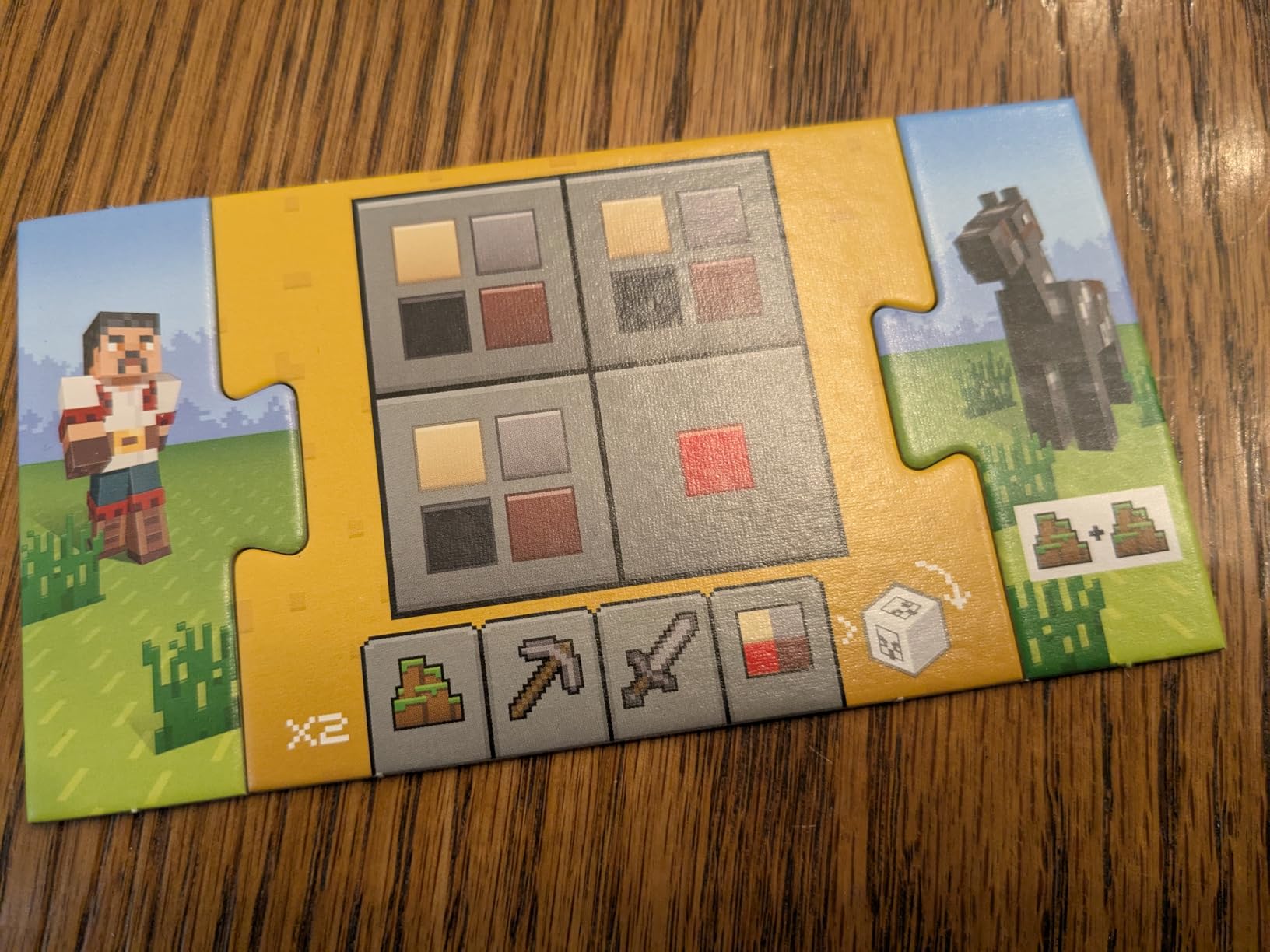
Minecraft Heroes of the Village takes the world-building loop children already know on screen and turns it into a cooperative board game for two to four players from age seven. The box holds 25 wooden blocks, 18 world tiles, four inventory cards, six pet tiles, nine buildings with three bases, 12 mob tokens, two dice and a pouch, and the suggested play time is around twenty-five minutes.
Replay value is the headline feature here. Because the world tiles are laid out differently every game, no two sessions resolve the same way, and fans of the series rate that variation highly. It also functions well as a bridge between a child and a parent who play the video game together, giving that shared interest a screen-free outlet.
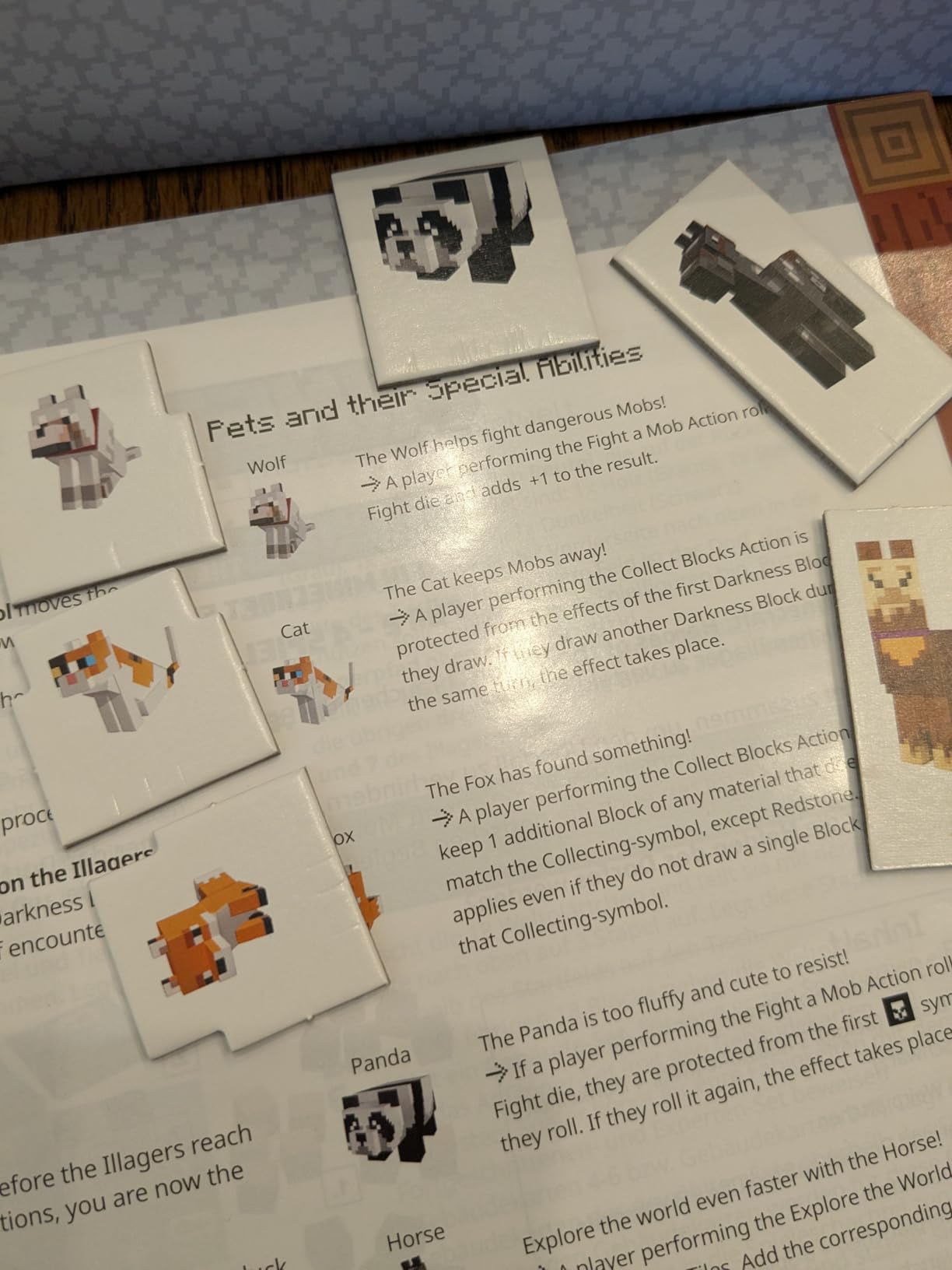
The component quality is a genuine strength. Wooden blocks and tiles feel substantial in the hand and survive the treatment that cardboard does not, and the overall build quality reflects the publisher’s long track record in children’s games. For a game aimed at seven-year-olds, that durability is worth paying for.
Two limits explain why this entry sits lower in the roundup than the preschool titles above it. The first is reading: inventory cards and the name-spelling elements put a firm floor at about seven, so it does nothing for a five-year-old. The second is the rulebook, which takes time to work through before the game clicks for families unfamiliar with the theme.
Who this is right for
Buy it for a household where the seven-to-twelve age range has already outgrown preschool cooperative games but does not want a heavy strategy title. It works as a two-player game with a parent and one child because the modular layout keeps both players engaged across the whole session. The twenty-five-minute runtime also sits neatly between a quick game and a long one.
It is a good birthday gift for a Minecraft enthusiast, particularly one who already owns the video game and wants the same world on the table. The theme does a lot of the work in getting a child interested in trying it.
When to skip it
Skip it if any player is under seven, because the reading load is not optional. Skip it if your family wants a game they can start playing within five minutes, since the rules take real effort to absorb. And skip it if you want deep strategy, because the difficulty sits in the middle of this roundup rather than at the top.
14. Forbidden Jungle – The Best Co-op Game for Ages 10 and Up
Gamewright – Forbidden Jungle – Cooperative Board Game
Ages 10 and up
2-5 players
30-45 minutes
Tactical adventure
Pros
- Tile shifting mechanic adds a real puzzle layer beyond earlier titles
- Distinct player roles make each character feel meaningful
- Well-made plastic miniatures and tiles built to last
- Adjustable starting threat level scales difficulty
Cons
- About an hour needed to learn the rules and play the first game
- Winning is genuinely difficult which can frustrate younger players
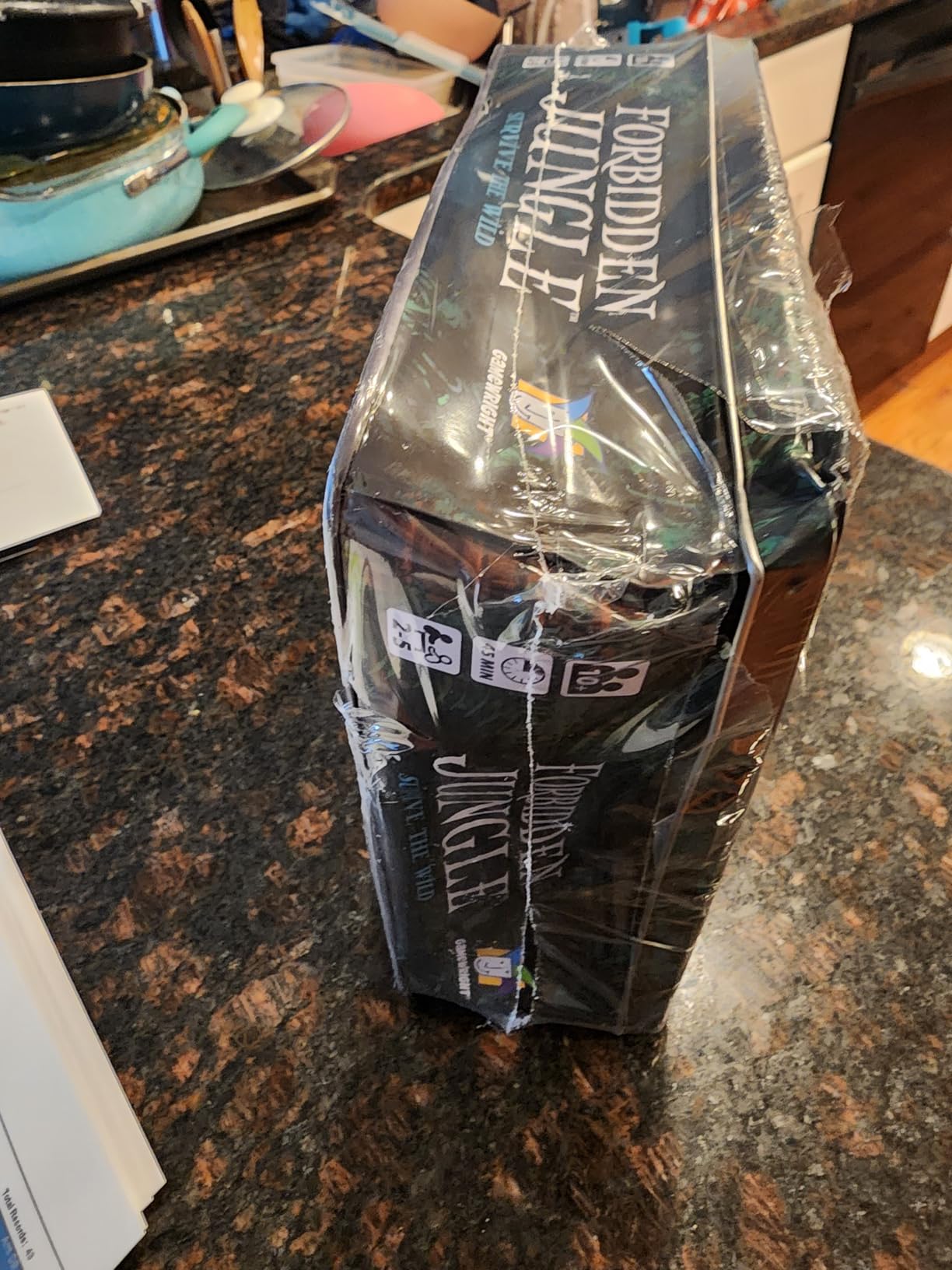
Forbidden Jungle is the most demanding game in this roundup, and we include it because a family eventually needs somewhere to go after the easier titles stop working. It is listed for two to five players from age ten, with sessions of thirty to forty-five minutes, and the box contains 44 cards, 47 miniatures, tiles and pawns.
The mechanic that separates it from lighter cooperative games is tile shifting, which adds a spatial puzzle layer that puzzles of this age will not exhaust. Each player also has a distinct role with its own abilities, so the group genuinely needs everyone rather than five people independently solving the same problem. The adjustable starting threat level lets you tune how hard the game pushes back.
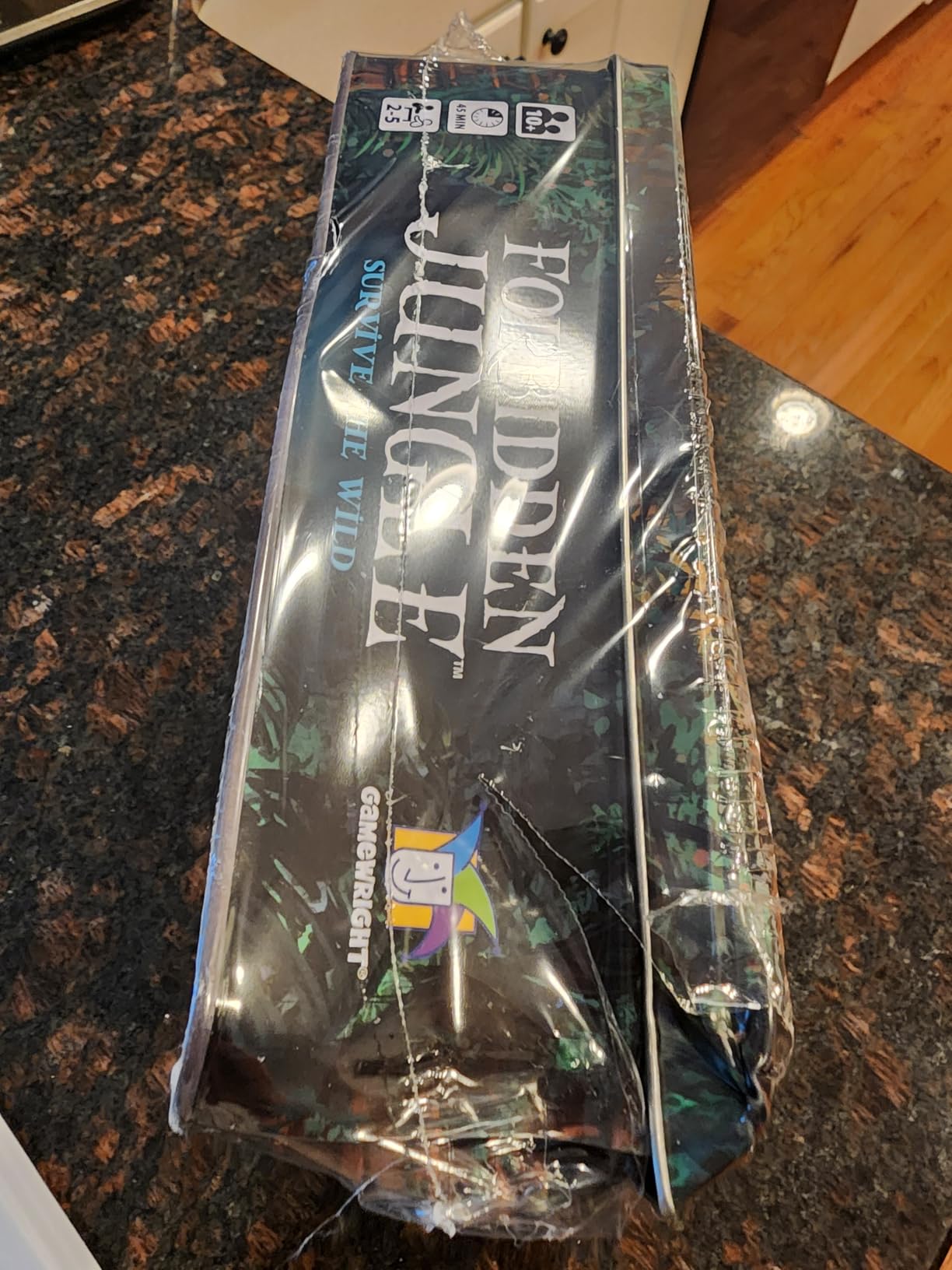
The plastic miniatures and tiles are well made and will survive years of play, which is a meaningful difference from the cardboard components in the younger games here. The artwork is also pitched to hold an adult’s attention, so this is a game families play together rather than a game adults supervise.
Two honest warnings. Reviews are consistent about a steep learning curve, with close to an hour needed to get through the rules and play the first game properly. And winning is genuinely hard, which can frustrate younger players even at the stated age of ten. Use the adjustable threat level or this will test patience.
Who should buy it
Buy it for a household with children aged ten or above who have already worked through the preschool and family tiers and still want screen-free play that holds their attention. It works for two players as well as five, and the distinct roles mean a parent and a child are contributing equally rather than the parent steering.
It suits a family that is comfortable with a longer evening session, because forty-five minutes is a real commitment compared with fifteen-minute titles. The build quality also means it is a game likely to stay in the collection rather than being resold after a month.
When to skip it
Skip it if you have a child under ten who struggles to lose, because the difficulty is real and repeated failure is the most likely outcome early on. Skip it if you need a game you can teach in five minutes. And skip it if your household prefers short sessions, since there is no quick version of this one.
15. Ghost Fightin Treasure Hunters – The Best Co-op Game With Two Modes
Mattel Games Ghost Fightin’ Treasure Hunters Anniversary Edition Game
Ages 8 and up
2-4 players
Two modes
Basic and advanced
Pros
- Two modes in one box serve co-op nights and competitive play
- Cooperative mode offers basic and advanced difficulty options
- Award-winning design with a clear tense race against the haunting
- Large plastic components hold up to repeated family use
Cons
- Head Haunter mode creates strong imbalance with older children
- Better suited to ages 8 and up than to younger players
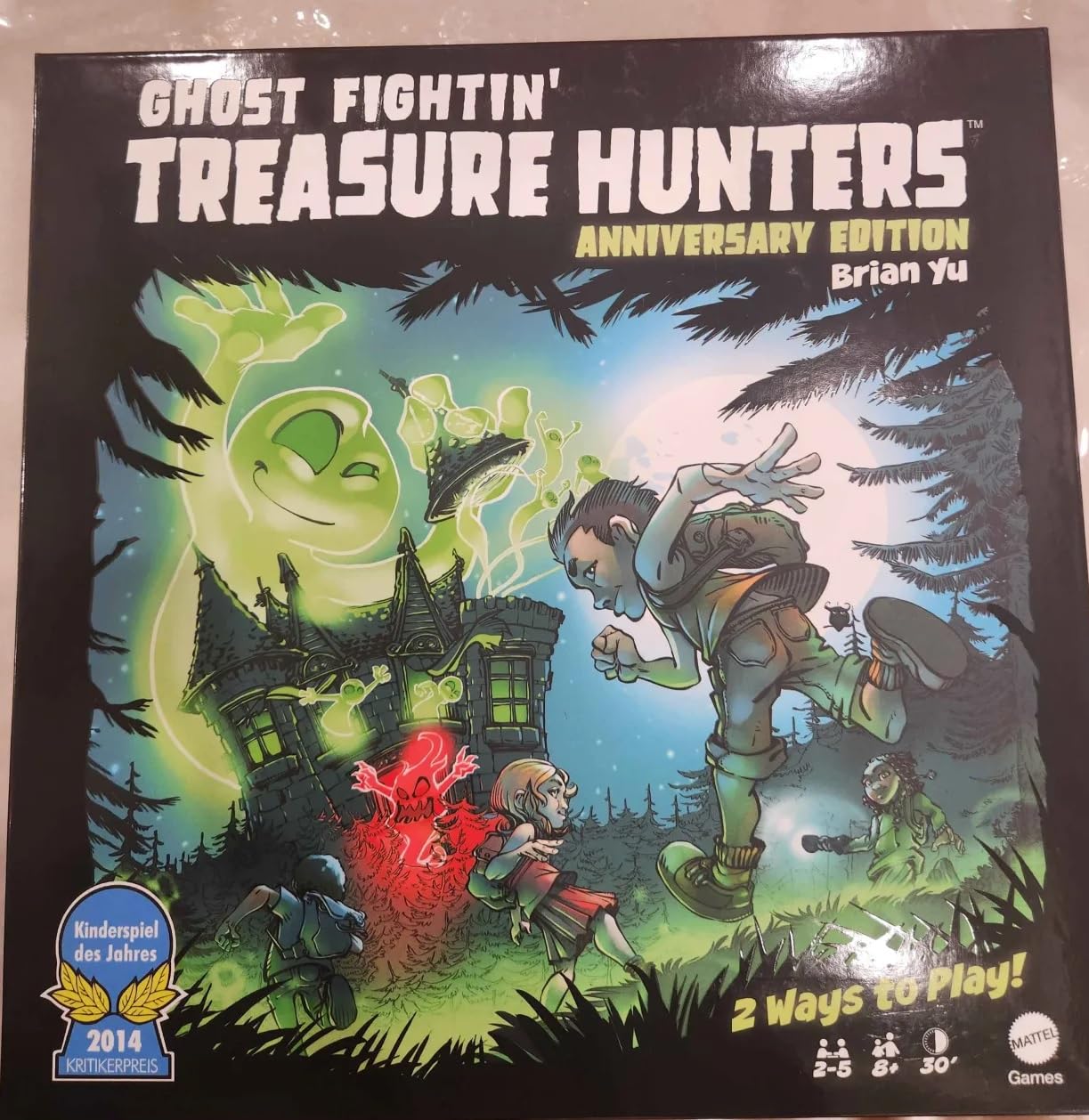
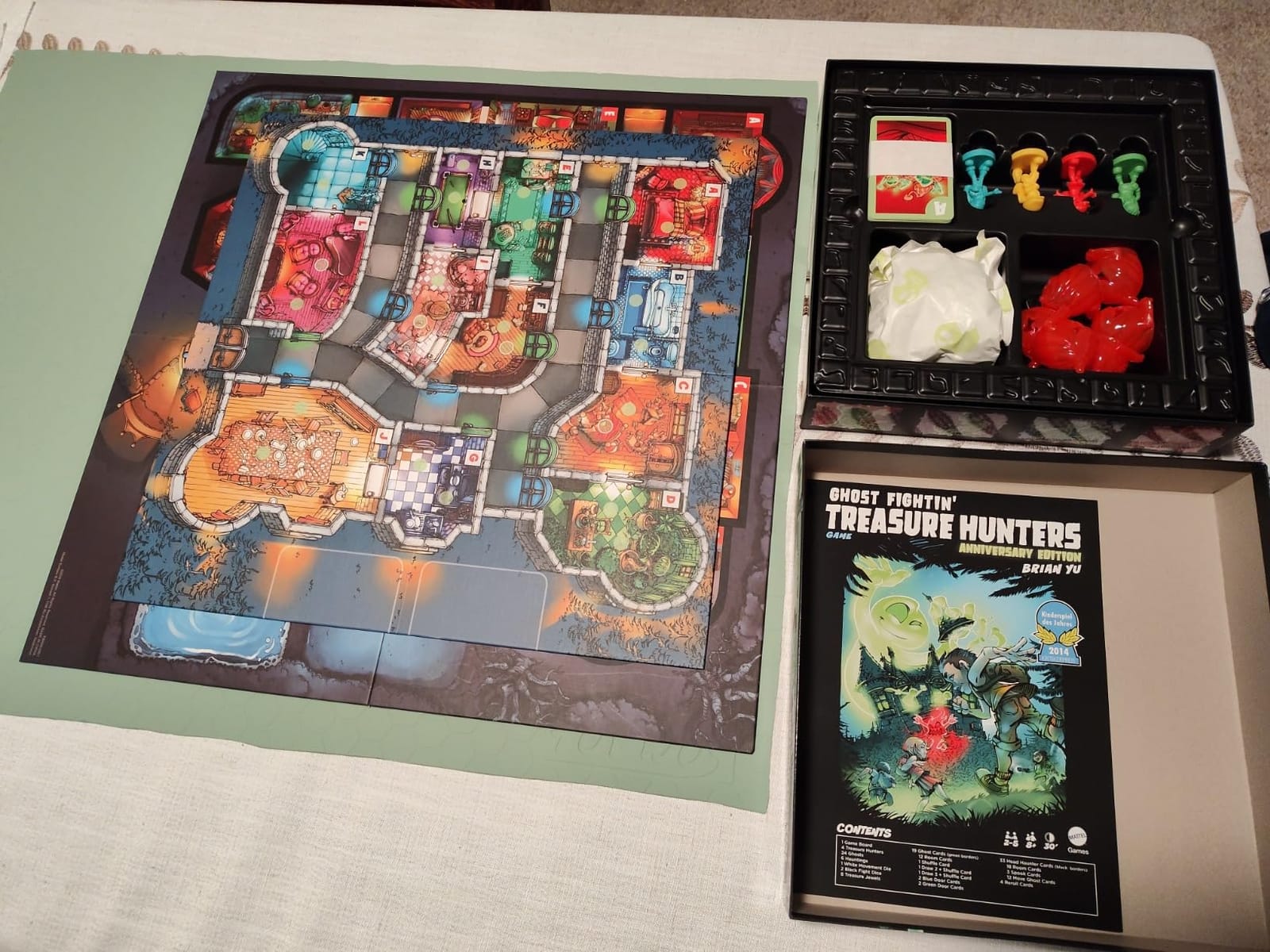
Ghost Fightin Treasure Hunters arrives in an anniversary edition that bundles everything: a board, four treasure hunter movers, 24 ghost movers, six haunting figures, eight treasure jewels, 56 cards, a movement die, two fight dice and rules. It is listed for two to four players from age eight, and it won the 2014 Kinderspiel des Jahres award.
What makes it unusual in a list of cooperative picks is the second mode. Alongside cooperative play, the game includes Head Haunter, where one person controls the ghosts against up to four other players. Families use the cooperative setting with younger children and switch modes once the group can handle competition, which makes one box work for both halves of a family.
Within cooperative play there are basic and advanced settings, and the advanced one is where adults get their challenge. That matters, because the most common criticism of cooperative games for kids is that they become uninteresting for parents after a handful of plays. The advanced option keeps the game worth returning to for the older end of the table.
The tension comes from a clear, readable race. Players work together to collect eight treasure jewels and escape a haunted house before six of the rooms become haunted, and every room that flips changes the maths for everyone. The large plastic components hold up well to repeated family use, which is not always true of this category.
Where this game fits best
It suits a family with children aged eight and above who have outgrown the preschool shelf but do not want a heavy tactical game. It works for two players, with a parent and a child splitting the work of clearing rooms. The cooperative mode also works well in a classroom, because the advanced setting gives older students something to argue about.
It is the only game here that serves both a cooperative night and a competitive night without buying a second box, and for a family with children on both sides of the Head Haunter age line that is genuinely useful.
When to choose something else
Skip it for children under eight, who will find both the card management and the haunt timer too much. Skip it if you want a pure cooperative game with no competitive option, and you should know that Head Haunter can create real imbalance with a group of older children. If you want short sessions, plan accordingly, since a full game is longer than the preschool titles.
How to Choose a Cooperative Board Game for Kids
Start with the youngest player’s actual age rather than the printed number. The box age is a guide, and every entry above has families reporting success below or above it. If a game lists five and up, a determined four-year-old may manage with a parent reading aloud; if it lists ten and up, a seven-year-old will not enjoy being handed it regardless of what the box claims.
Next, check how much decision-making the game actually demands. A game with one obvious action per turn will hold a preschooler but bore an eight-year-old. A game with a hundred components and forty minutes of rules will hold a twelve-year-old and lose everyone else. Counting the components is a useful shortcut, because component count tracks decision count closely in this category.
Third, plan around the limits in your household. Reading load matters more than any other accessibility factor for pre-readers, so check whether the box says no reading required and verify it, because several games on this list claim it and mean it. Colour-matching games need separate consideration for colourblind children, since hue is the only distinguishing feature. And note the small-parts warnings, which appear on nearly every product rated for ages three and four.
Teaching a new co-op game without a rulebook slog
Say the goal in one sentence before you touch a component. In Outfoxed it is find the fox; in My First Castle Panic it is keep the monsters off the castle. Children fix a goal far faster than a rule set, and everything else in the rules only makes sense once the goal is clear.
Then play one round with your hands over the pieces and let them ask questions. You are not teaching, you are answering, which feels completely different from lecturing. The second round is where you start giving the choices back.
Finally, add the alpha gamer rule if you need it. The most common co-op complaint among parents is the adult taking over, so agree in advance that the deciding player rotates each turn. It sounds trivial and it is not, particularly in games like Forbidden Jungle where an experienced adult will otherwise solve the puzzle before anyone else has finished reading it.
Handling the game the family keeps losing
Repeated loss is the most common reason children abandon cooperative games, and the forum discussions are consistent about it. Choose an adjustable game when you can, since games with a threat level or difficulty setting let you soften the opening session without permanently simplifying the game. If a title has no adjustment, play the first two sessions with a deliberately loose strategy and celebrate the small wins rather than the outcome.
And when a child wants to give up mid-game, that is information rather than a problem. It usually means the game is too hard for them right now, and the fix is a step down rather than more encouragement. Our premium board game guide for families covers the harder end of the range if you need the reverse move. For a wider mix of formats, see our picks of big-box board games for game nights.
Frequently Asked Questions
What is the best cooperative board game for kids?
Outfoxed is our top pick overall because it fits four players from age five, runs in 15 to 20 minutes, needs no reading during play and leaves nobody eliminated. For children under five, Hoot Owl Hoot or Count Your Chickens are better fits, and for ages ten and up Forbidden Jungle is the harder option.
What are some good co-op games for kids?
For ages three to five try Bluey Scavenger Hunt, Count Your Chickens and Snug as a Bug in a Rug. For ages five to eight try Outfoxed, Race to the Treasure and My First Castle Panic. For ages eight and up try Minecraft Heroes of the Village and Ghost Fightin Treasure Hunters.
Which cooperative board games require no reading?
Every title in this roundup except Minecraft Heroes of the Village can be played without reading. Outfoxed, Hoot Owl Hoot, Race to the Treasure, Mermaid Island, Count Your Chickens, Feed the Woozle, My First Castle Panic and Baby Dinosaur Rescue all use icons, pictures or colour coding rather than text.
What is the best cooperative board game for two players?
Outfoxed, Hoot Owl Hoot and My First Castle Panic all work well with one parent and one child. Hoot Owl Hoot is the simplest of the three to set up and explain, while Outfoxed offers more deduction for an older child. Forbidden Jungle is the pick once both players are ten or above.
Why are cooperative games better for kids than competitive games?
Cooperative games remove the two biggest problems with kids game night, which are sore losers and sibling conflict, because there is no opponent and nobody is eliminated. Because the information stays open, parents can coach freely without upsetting the balance, and children practise negotiation and shared decision-making instead of bluffing opponents.
How do you teach a cooperative board game to young children?
State the shared goal in one sentence before opening the box, then play one round with your hands off the pieces and answer whatever questions come up. From the second round onward, start handing the decisions back. Rotating who makes the deciding move each turn prevents an adult from taking over the game.
Best Cooperative Board Games for Kids: The Final Call
Outfoxed is the single best cooperative board game for kids in 2026, and it is the one we recommend when a family will only buy one. For children under five, start with Hoot Owl Hoot or Count Your Chickens. When the easy games stop landing, My First Castle Panic bridges the gap, and Forbidden Jungle is where a family ends up once the children are ten or older.
Pick any title from this list and play it twice before buying another. Cooperative games get better the second time, because the first session is mostly rule learning and the second is the first real game. Our broader family picks are collected in the strategy game guide if your table has grown up faster than your children.