
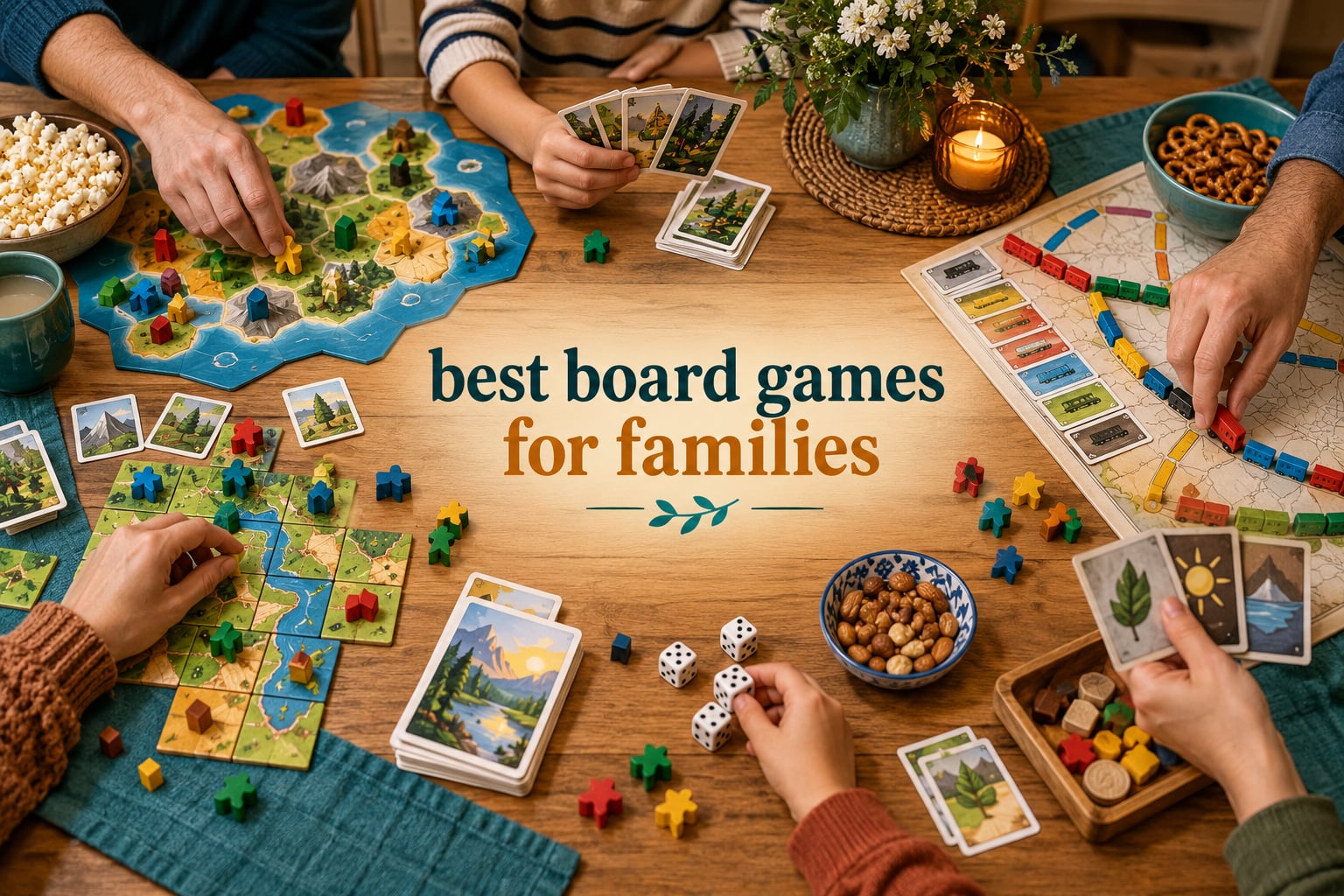
The best board games for families are the ones any mix of ages can learn in under five minutes, finish in 45 minutes or less, and still want to replay. After putting eleven family staples through real game nights with mixed-age groups, the four that keep coming back to the table are CATAN, Splendor, Azul and Ticket to Ride. Two more earn permanent shelf space for very different reasons: Sequence when a big group shows up, and Wingspan when the adults want a game that respects them too.
We narrowed eleven candidates using five criteria: how fast the rules teach, whether the player count fits a real household, whether the youngest player can compete without being punished, how long a game runs, and whether the components survive a decade of weekly use. Every pick below carries its manufacturer player count, age recommendation and playing time so you can check the fit before you buy, not after you unpack it.
Last updated 2026. The lineup leans toward modern strategy and party hybrids rather than licensed character editions, because a character game gets outgrown in a year while a good engine game keeps changing shape as players get better.
- CATAN — collect ore, brick, lumber, grain and wool, then trade and build settlements to win the island.
- Splendor — gather gem tokens and recruit noble patrons in an elegant 30-minute engine race.
- Ticket to Ride — claim train cards and connect cities across a map without a heavy rulebook.
- Azul — draft resin tiles onto a mosaic wall and complete rows, columns and patterns.
- Wingspan — build a wildlife preserve by drafting birds that chain food, eggs and powers together.
- Carcassonne — lay landscape tiles and score meeples across cities, roads, fields and monasteries.
- Rummikub — lay numbered tiles in runs or groups and go out first using every tile you hold.
- HUES and CUES — give one-word colour clues and guess one of 480 colour squares as a team.
Table of Contents
Top 3 Board Game Picks for Families

CATAN Board Game
- Trade resources and build settlements
- 3-4 players ages 10 and up
- 60-90 minute sessions

Splendor Gem Trading
- Engine building with gem tokens
- Race to 15 prestige points
- 2-4 players
- About 30 minutes

Ticket to Ride Refresh
- Claim train cards to link cities
- 2-5 players ages 8 and up
- 30-60 minute playtime
How We Picked These Family Board Games
Every game here was judged against the same five tests, and any game that failed two of them dropped off the list.
Teachability. Can a non-gamer understand it in one explanation? This was the single biggest filter. A game that takes ten minutes to teach loses an hour of playtime and half the table’s attention before the first turn.
Group-size fit. We checked the printed player count against real household sizes of two, three, four and six or more. A game that technically supports six players but breaks at five is not a six-player game.
Age fit. We used the manufacturer’s recommended age but treated it as a floor, not a target. The recurring complaint on family forums is that a box marked eight and up is either too slow for a six-year-old or too thin for a fifteen-year-old.
Play time. Most of these finish in 35 minutes or less. Games that run past 90 minutes only stayed if the extra length buys real decisions.
Replay value and durability. A family game earns shelf space by surviving a decade of use, so we paid attention to component counts, replacement parts and how much randomness flattens the second playthrough.
Spec details come from the manufacturer listings, and the pros and cons come from the pattern across thousands of owner reviews rather than from any single enthusiastic review.
The Best Board Games for Families at a Glance (2026)
| Product | Specifications | Action |
|---|---|---|
| CATAN Board Game |
|
Check Latest Price |
| Splendor |
|
Check Latest Price |
 Wingspan Wingspan |
|
Check Latest Price |
 Azul Azul |
|
Check Latest Price |
 Carcassonne Carcassonne |
|
Check Latest Price |
| Ticket to Ride |
|
Check Latest Price |
 Sequence Sequence |
|
Check Latest Price |
 Rummikub Rummikub |
|
Check Latest Price |
 HUES and CUES HUES and CUES |
|
Check Latest Price |
 Blank Slate Blank Slate |
|
Check Latest Price |
 Herd Mentality Herd Mentality |
|
Check Latest Price |
1. CATAN — the Best Family Board Game Overall
CATAN Board Game – Embark on a Journey of Discovery and Trade! Civilization Building Strategy Game, Family Game for Kids & Adults, Ages 10+, 3-4 Players, 60-90 Minute Playtime, Made by CATAN Studio
3-4 players
Ages 10 and up
60-90 minutes
95 resource cards, 60 wooden roads, 19 hexes
Pros
- Deep trading and building strategy that stays fresh
- Blend of luck and meaningful decisions
- Wooden pieces and detailed terrain hexes
- Plays smoothly at three or four players
Cons
- Longer session than a typical family filler
- Direct trade turns can get confrontational
- Heavy box full of small pieces is hard to travel with
CATAN is the game I put in front of a family first when someone asks for a recommendation with no further context. You roll dice, collect resources from the terrain hexes, and spend them on settlements, cities and roads until you hold the most victory points. That loop has been in families for decades and it still works because the rules are one page long and the decisions pile up fast.
The thing I did not expect is how well it holds a mixed table. A ten-year-old can grab the biggest resource pile on their turn without being told what to do, while an adult is still calculating two turns ahead on the robber. Nobody needs a role or a special power to matter.
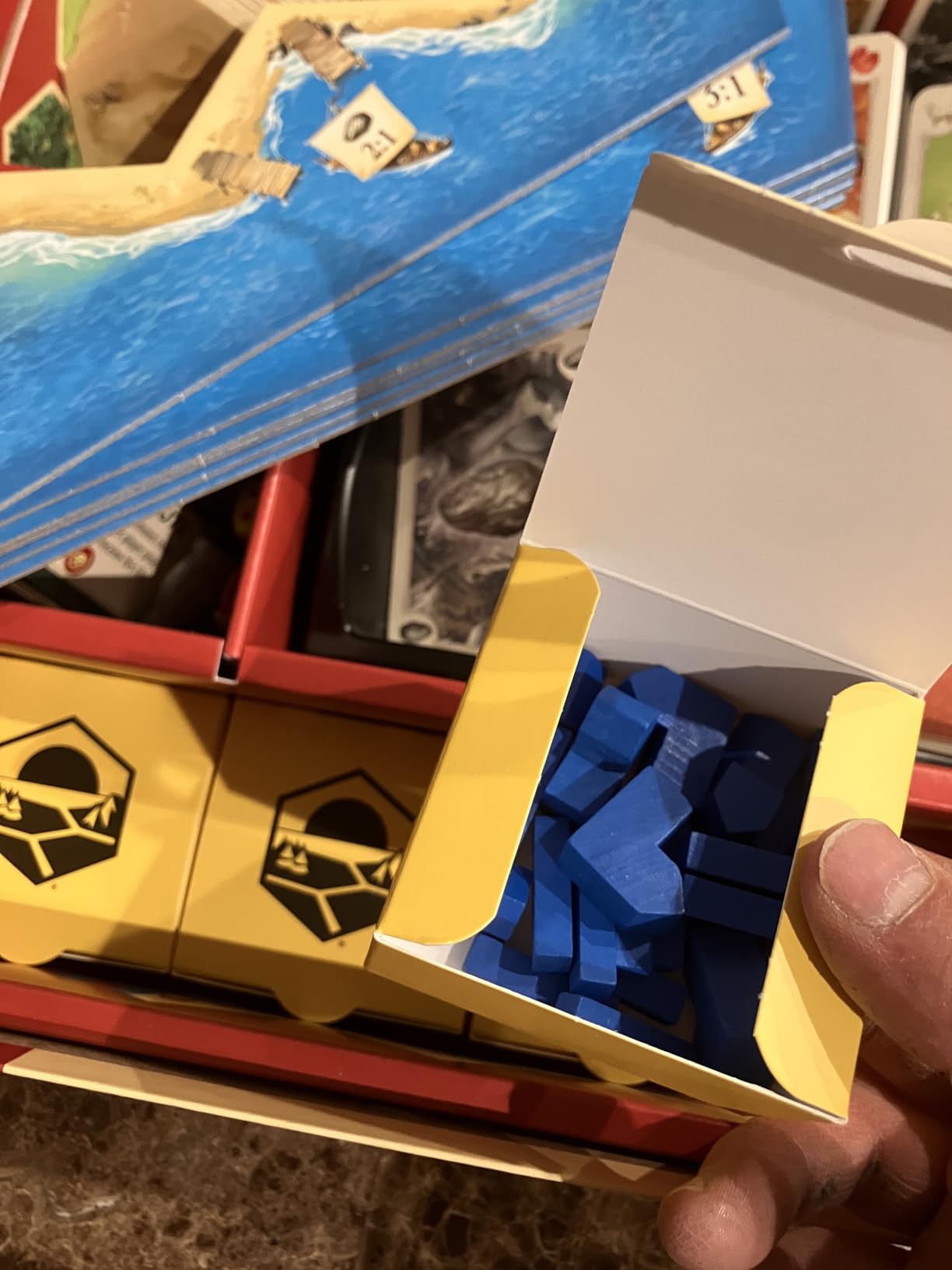
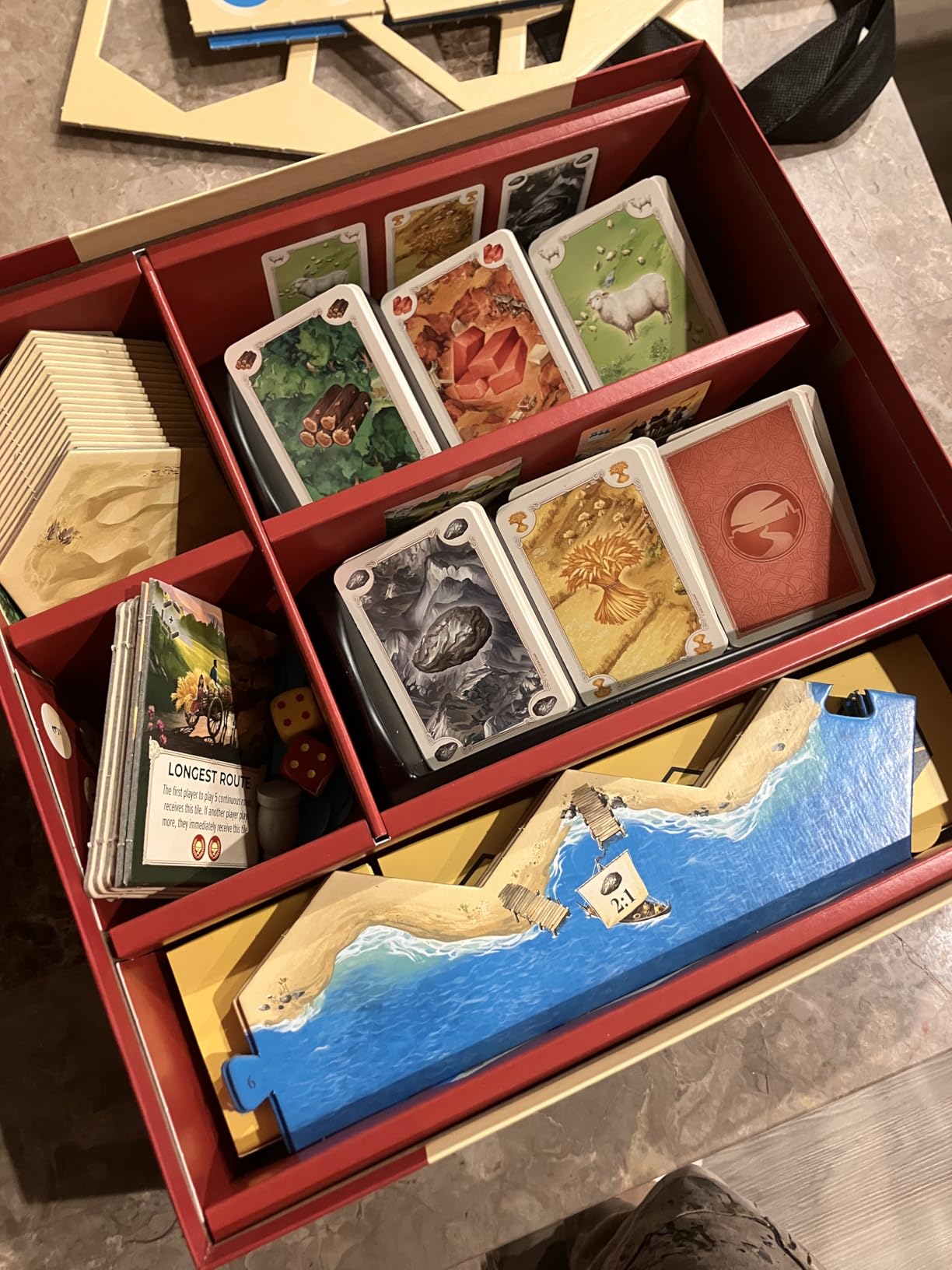
Component quality is the other reason this one has survived so many households. The box includes 95 resource cards, 25 development cards, 16 wooden city tokens, 20 wooden settlements, 60 wooden roads, 19 terrain hexes, 9 harbor pieces, dice and a printed rulebook with an almanac. Nothing in there feels like filler.
Our own group has the slowest turns of anything on this list, though. Expect a 60 to 90 minute game rather than a 30 minute one, and expect the trading phase to produce actual negotiation. If your family argues over trades, read the trading rules before the first game so expectations are set.
How CATAN plays with a mixed-age group
At three or four players, the map stays open and nobody gets boxed out early. Children aged ten and up handle the dice and placement fine, and the wooden pieces are satisfying rather than fiddly. If you have a younger child at the table, give them a job outside the turn structure: sorting resources into piles or counting building costs.
What to watch for in CATAN
The box lists ages ten and up and a 907 g weight, so it is not a portable game and it is not a game for a seven-year-old sitting in on the main decisions. The heavier issue is turn tempo: if your group dislikes dead time between turns, pick something from this list with simultaneous turns instead.
2. Splendor — the Best Family Board Game for a 30-Minute Night
Asmodee Splendor Gem Trading Strategy Board Game, 2-4 Players
2-4 players
Ages 10 and up
About 30 minutes
40 plastic tokens, 90 development cards, 10 noble tiles
Pros
- Only three actions per turn so it teaches in minutes
- Elegant gem reservation tactics
- Consistently high satisfaction across thousands of owners
- Compact box that stores and travels easily
Cons
- Less player-to-player blocking than direct-trade games
- Light on theme and tactile components
- Repetitive once strategies are memorised
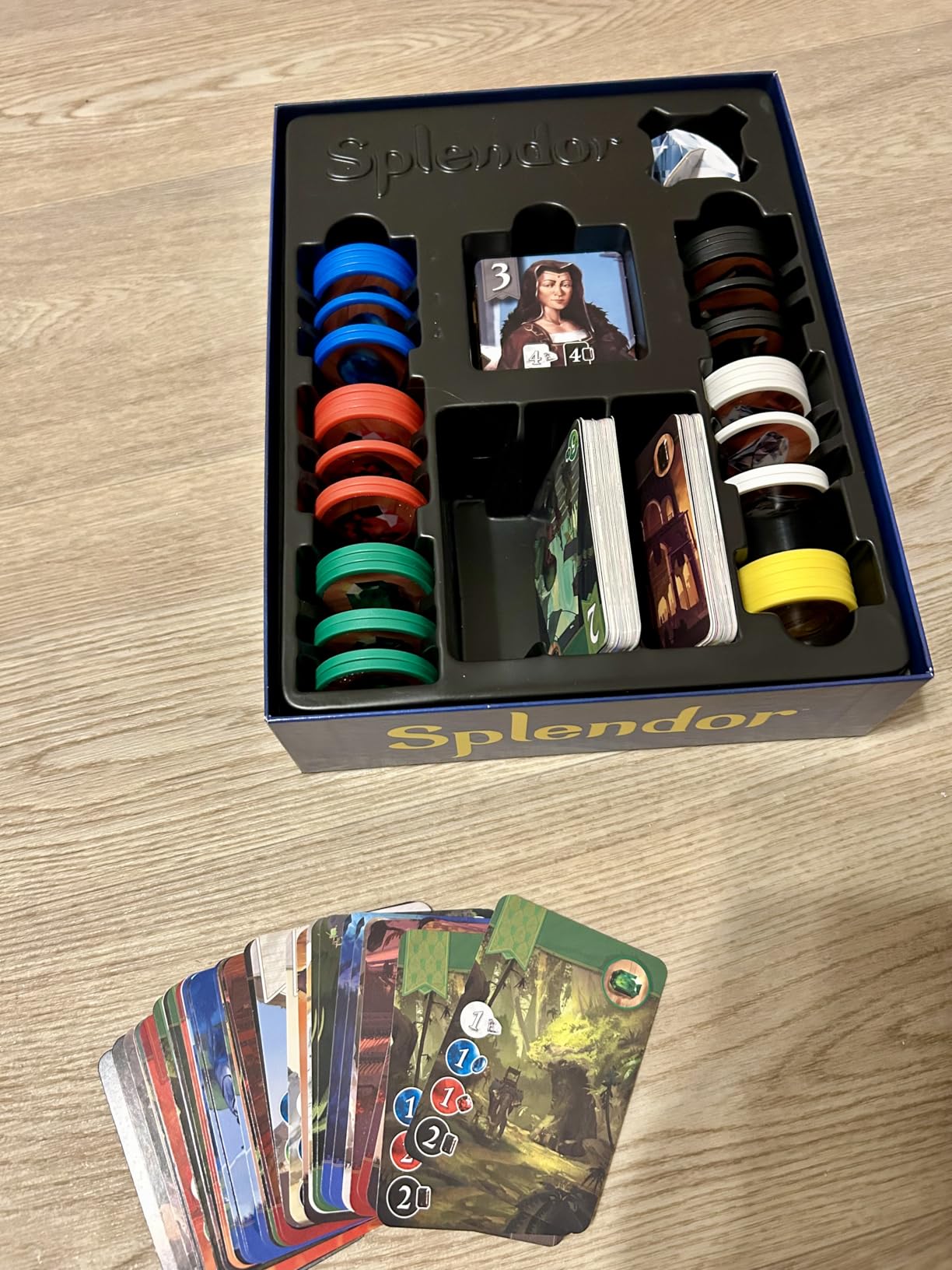
Splendor answers the family game night problem more cleanly than anything else here. Your turn is three actions: take one gem, take a different gem, or reserve a card and take a gold. That is the entire ruleset on a turn, and it scales from a two-player duel to a four-player table without a single rule change.
You use cards to buy development bonuses, and those bonuses generate gold and prestige. Noble tiles are worth more prestige but cost fifteen gold, so deciding when to chase a noble instead of another bonus card is where the tension actually lives. It reads like a simple game and plays like a real engine builder.
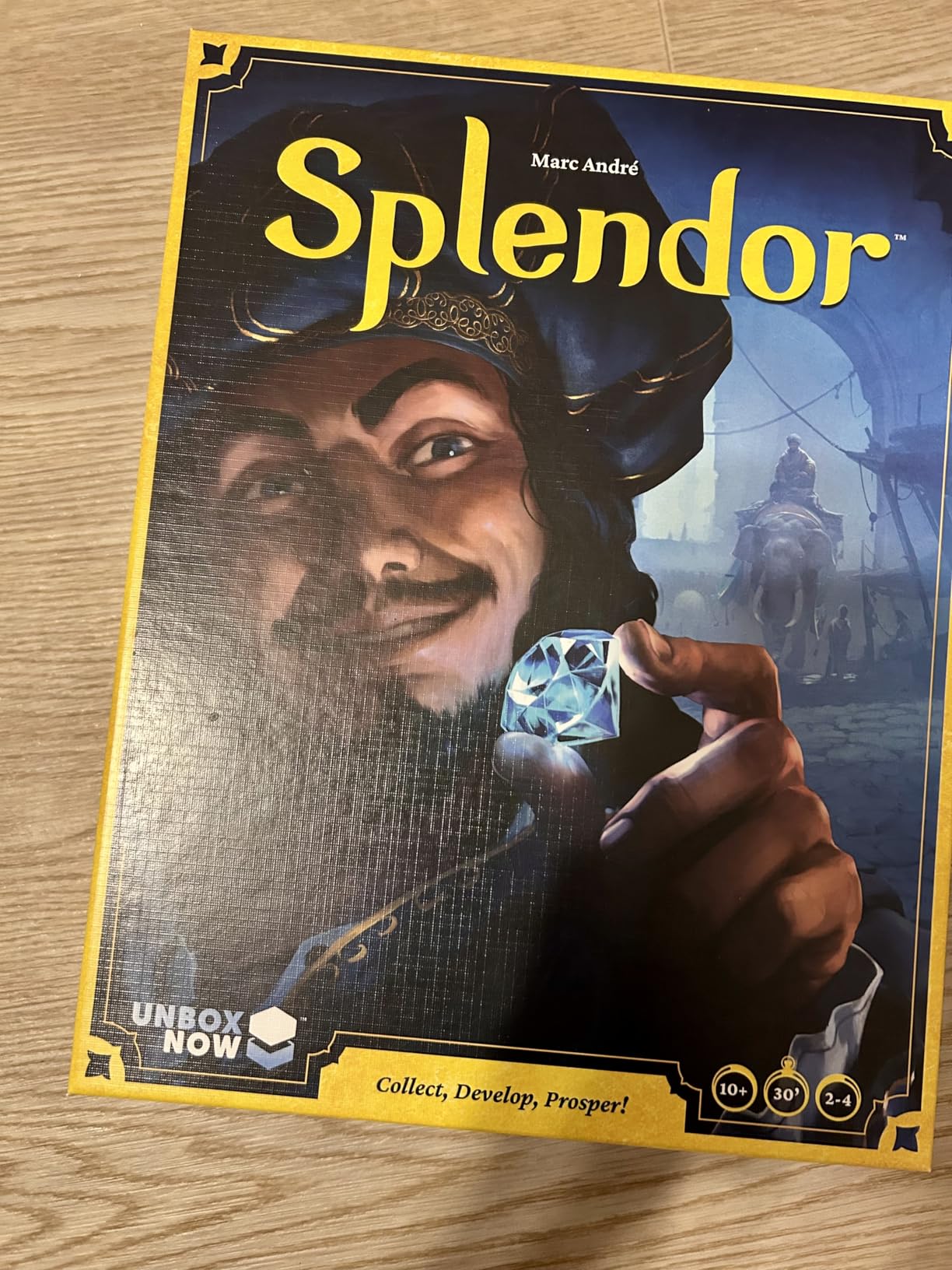
The component list is short: 40 plastic tokens, 90 development cards, 10 noble tiles and a rulebook. That means setup is genuinely fast, which matters more than it sounds when you have six people waiting.
What you give up for that speed is direct interaction. Nobody blocks anyone else in Splendor, so a competitive family will find it calmer than CATAN. That is a feature in a house with younger kids and a limitation in a house with two very competitive older children.
Who Splendor suits at the table
The 2-4 player count makes it the safest choice on this list for a household of three plus one guest. The listed age is ten and up, which is where the reservation decision starts to feel like a real trade-off rather than an obvious yes.
What to watch for in Splendor
Once a group learns the three opening patterns, the strategic ceiling flattens. Reviewers consistently note the game can feel repetitive once strategies are memorised, so expect to rotate it out once your household has had ten or so games with it.
3. Wingspan — the Best Family Board Game When Teens Are Involved
Stonemaier Games: Wingspan by Elizabeth Hargrave
1-5 players
Ages 14 and up
About 70 minutes
170 bird cards, 103 food tokens, 75 wooden eggs, dice tower
Pros
- Production quality art and tactile wooden eggs
- Thematic powers that mirror real bird behaviour
- High replay value with 170 unique bird cards
- Solo play supported by the Automa deck
Cons
- A 70 minute session and a 2.3 kg box
- Steeper learning curve for younger children
- Popular bird combos get contested hard
- Printed age recommendation reads 14 and up
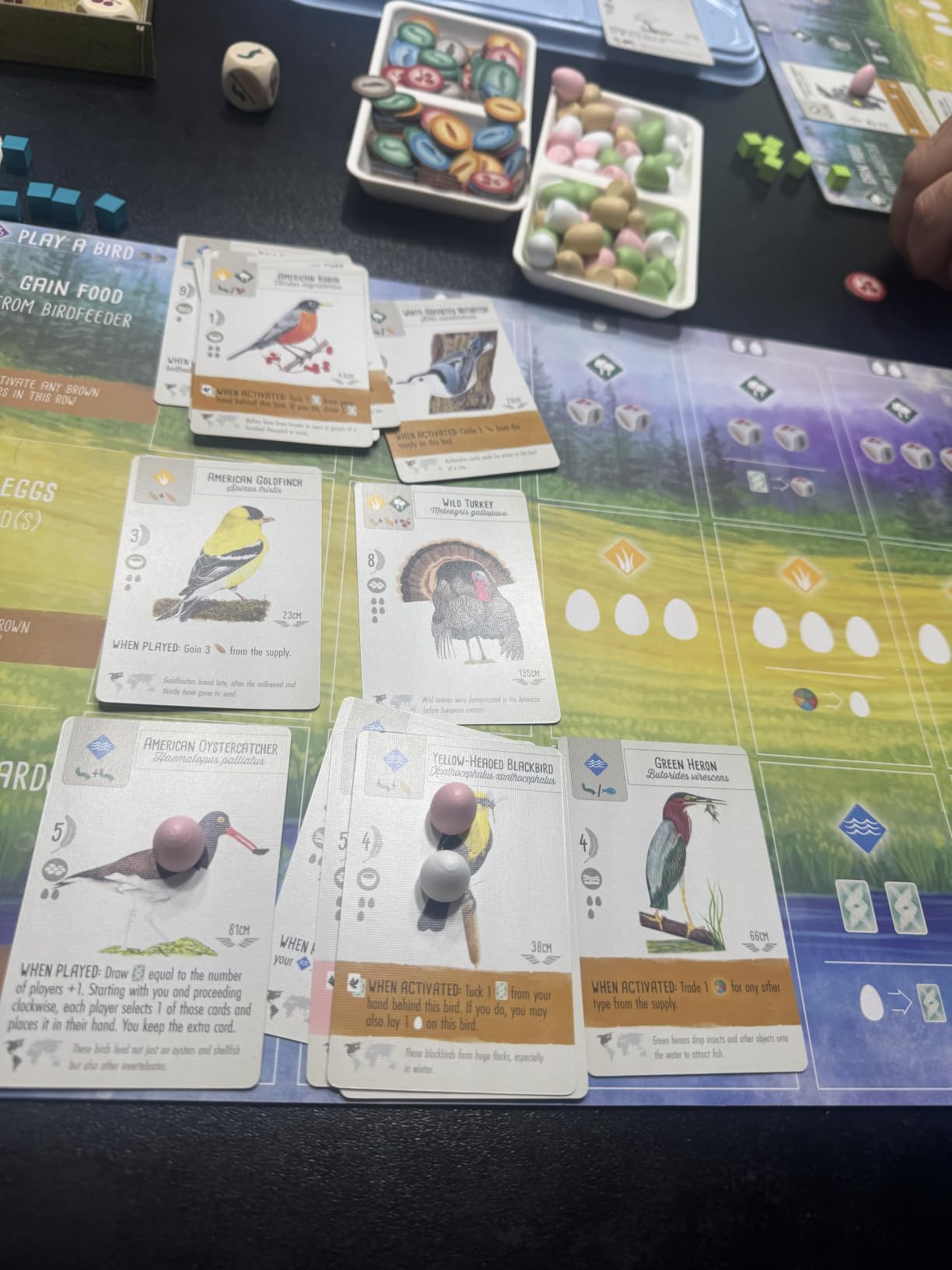
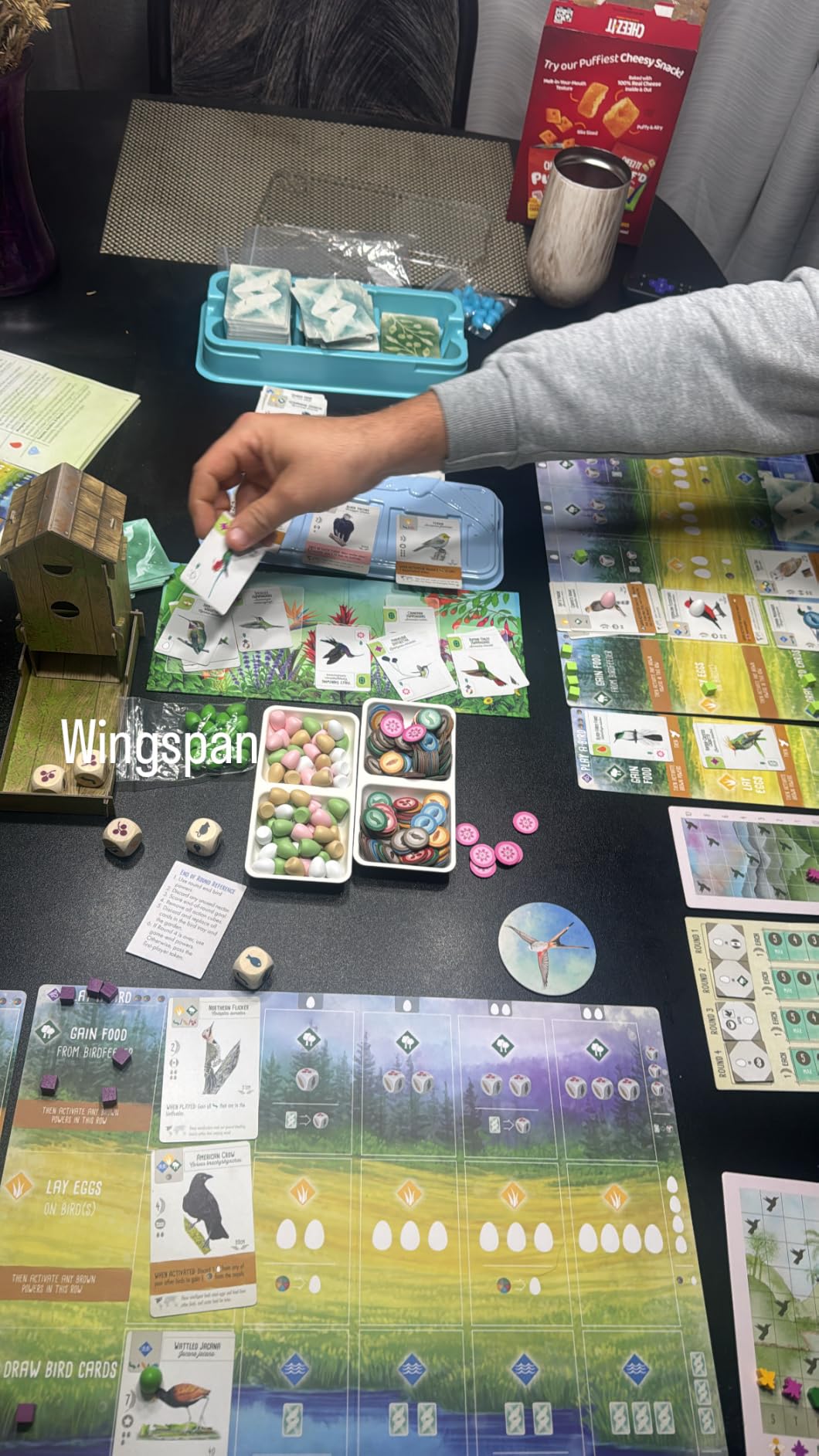
Wingspan is the pick I recommend when the family table includes a twelve-year-old who has started calling baby games baby games. You are building a wildlife preserve: each turn you gain food, then lay eggs, then play bird cards into your engine, and the birds chain off each other in ways that feel like a real ecosystem rather than an abstract engine.
The replay value comes from sheer card count. There are 170 unique bird cards, 26 bonus cards, 103 food tokens, 75 egg miniatures, five player mats, a wooden dice tower and a goal mat with eight goal tiles. Nobody plays the same engine twice.
It also plays solo, which matters in a household with one child or one partner who does not want to game. The 16 Automa solo cards stand in for the missing players and run the same engine an opponent would.
Set collection is where this gets contentious. The most desirable birds get fought over by experienced players, and that competition is exactly what keeps a teen interested but exactly what a nine-year-old finds frustrating. That is the trade-off of the whole design.
Where Wingspan fits in a household
This is a best-game for a family that has already moved past gateway games and wants an adult-legitimate title that still plays cooperatively in tone. The manufacturer lists 1-5 players and a recommended age of 14 and up, and a first-time group gets a swift-start teaching guide in the box.
What to watch for in Wingspan
Two things. The session runs about 70 minutes, so it is not a weeknight filler. And at 2.3 kg it is a two-person-carry game, not something you bring to a restaurant.
4. Azul — the Best Family Board Game for Ages 8 and Up
Azul Mosaic Tile-Placement Strategy Board Game, 2-4 Players, 30-45 Min
2-4 players
Ages 8 and up
30-45 minutes
100 resin tiles, 4 player boards, 9 factory displays
Pros
- Rules teach in a couple of minutes for ages 8 and up
- Drafting and denial create real tactical tension
- Bright resin tiles read well across the table
- Scales cleanly from two players to four
Cons
- Final board payoff varies with the tile draws
- Scoring can punish less experienced players
- Two-player games expose the fixed factory structure
Azul is the lowest age rating on this list that still gives a teenager something to think about. Players draft coloured resin tiles from shared factory displays and place them on their own mosaic wall, scoring rows, columns and matching colour patterns. Because everyone wants the same tiles, drafting becomes a quiet form of denial, and the whole game turns on who took what.
The rule explanation is short enough to say out loud in one pass: take a tile, place it legally, score your patterns. The 45-minute estimate matches what we see on a four-player table, and the resin tiles have survived repeated handling without chipping in our own copy.
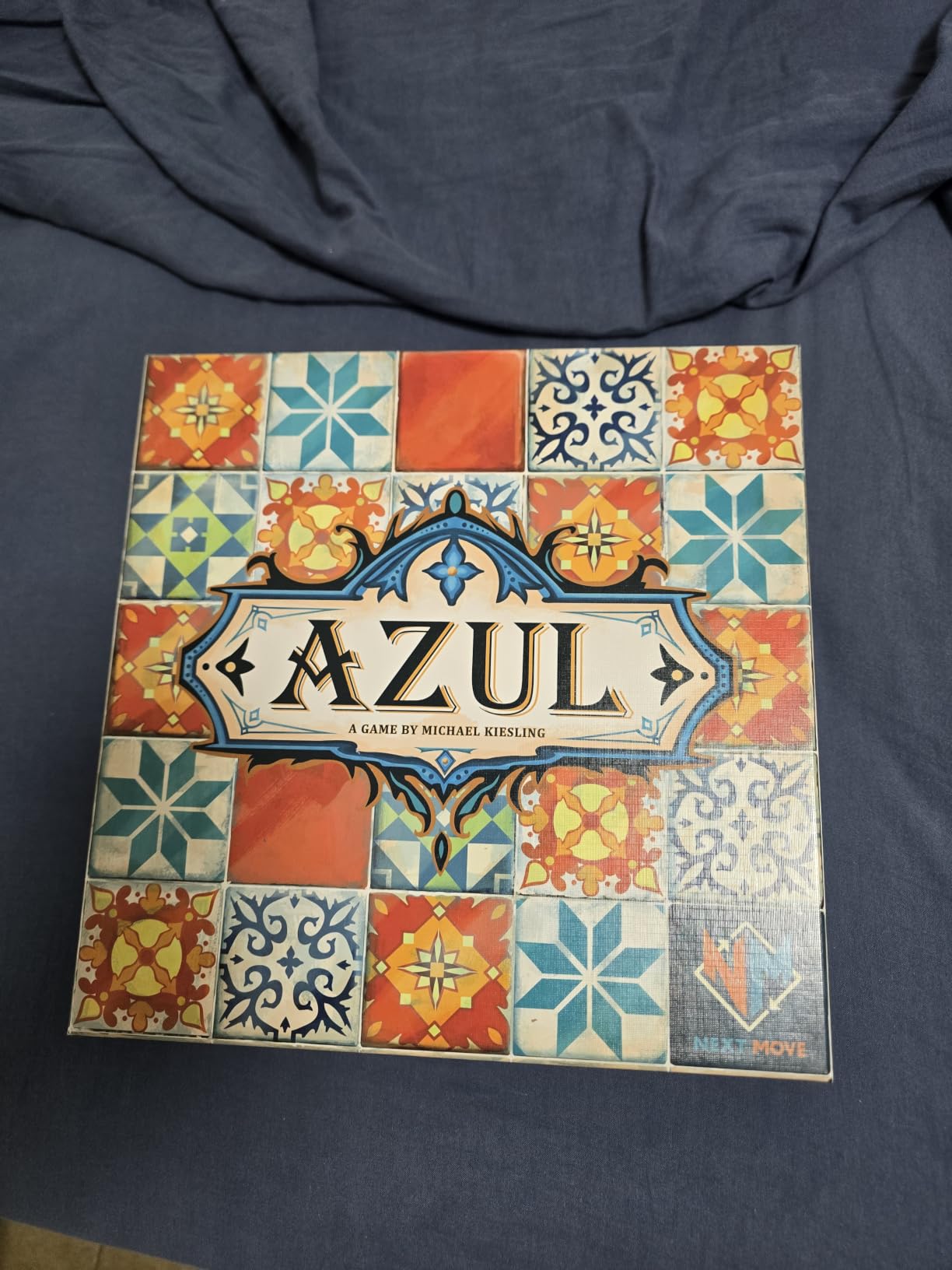
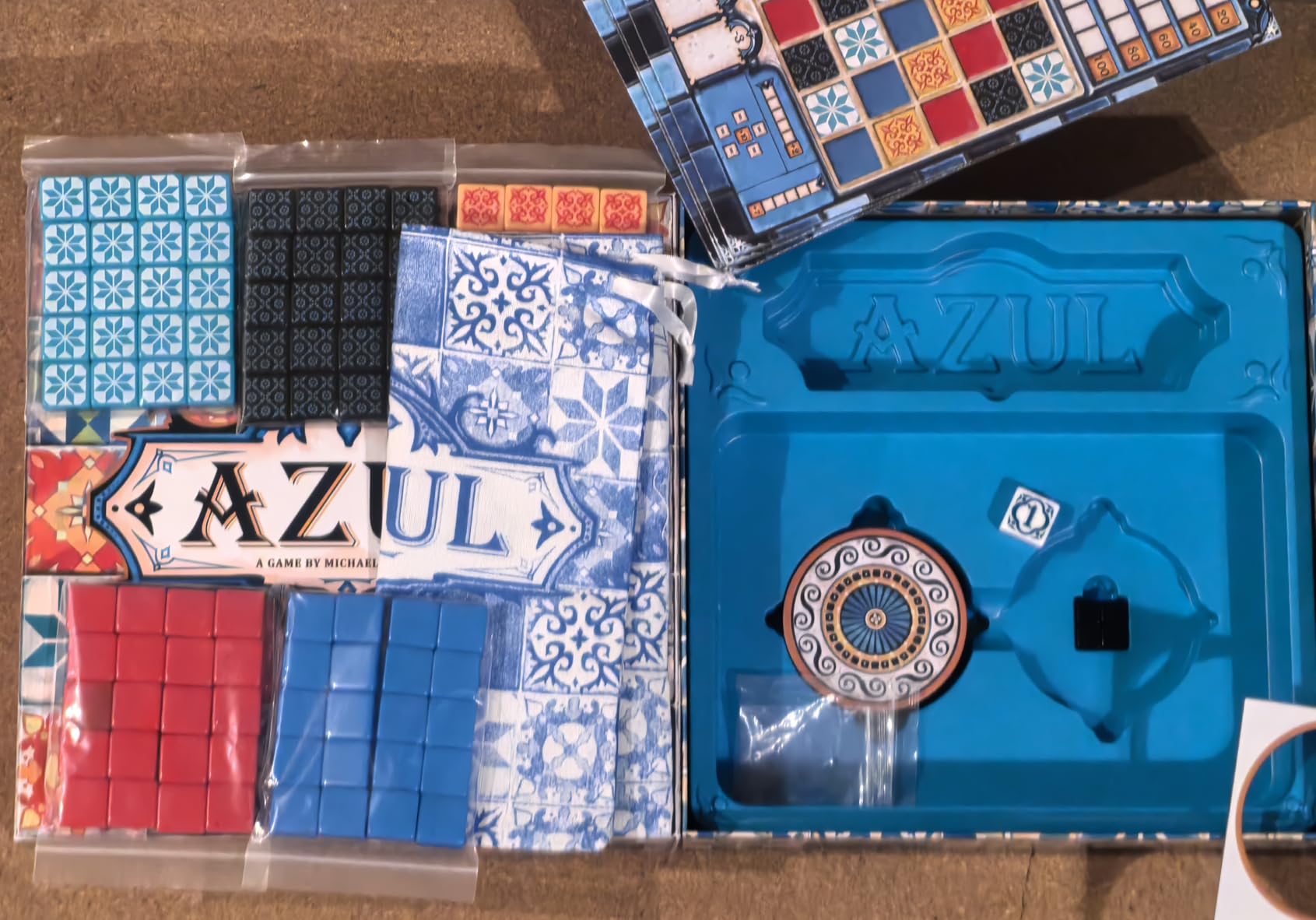
The box holds 100 resin tiles, 4 player boards, 9 factory displays, 4 scoring markers, a starting player marker and a linen bag. The linen bag matters more than it sounds, since loose tiles inside the box are the fastest way to lose one.
Where Azul frustrates people is scoring. A beautiful first half can be undone by a bad final round, and less experienced players often cannot see that coming. If your group is new to modern strategy, play one throwaway game before you count the results.
How Azul handles a wide age gap
Because scoring is printed right on the wall, a child can watch their pattern fill and understand why it is worth points. That visibility is what lets a nine-year-old and a forty-five-year-old sit at the same board without one of them feeling like a passenger. It is also one of the few entries here rated for ages 8 and up.
What to watch for in Azul
The listed count is 2-4 players, and the reviewer feedback notes that two-player games expose the fixed factory structure more than multiplayer does. If you are a two-player household, expect the draft to feel more constrained.
5. Carcassonne — the Best Family Board Game for a Wide Age Gap
Carcassonne Tile Placement Strategy Board Game, 2-5 Players, 35 Min
2-5 players
Ages 7-16
About 35 minutes
Includes The Abbot and The River mini-expansions
Pros
- Intuitive tile-laying rules a child can follow
- Random tile draw produces a different board each time
- Meeples add strategy without heavy complexity
- Two mini-expansions included in the box
Cons
- Overlapping placements can spark arguments with younger players
- Depth drops once the core loop is mastered
- Bonus tile distribution can feel uneven
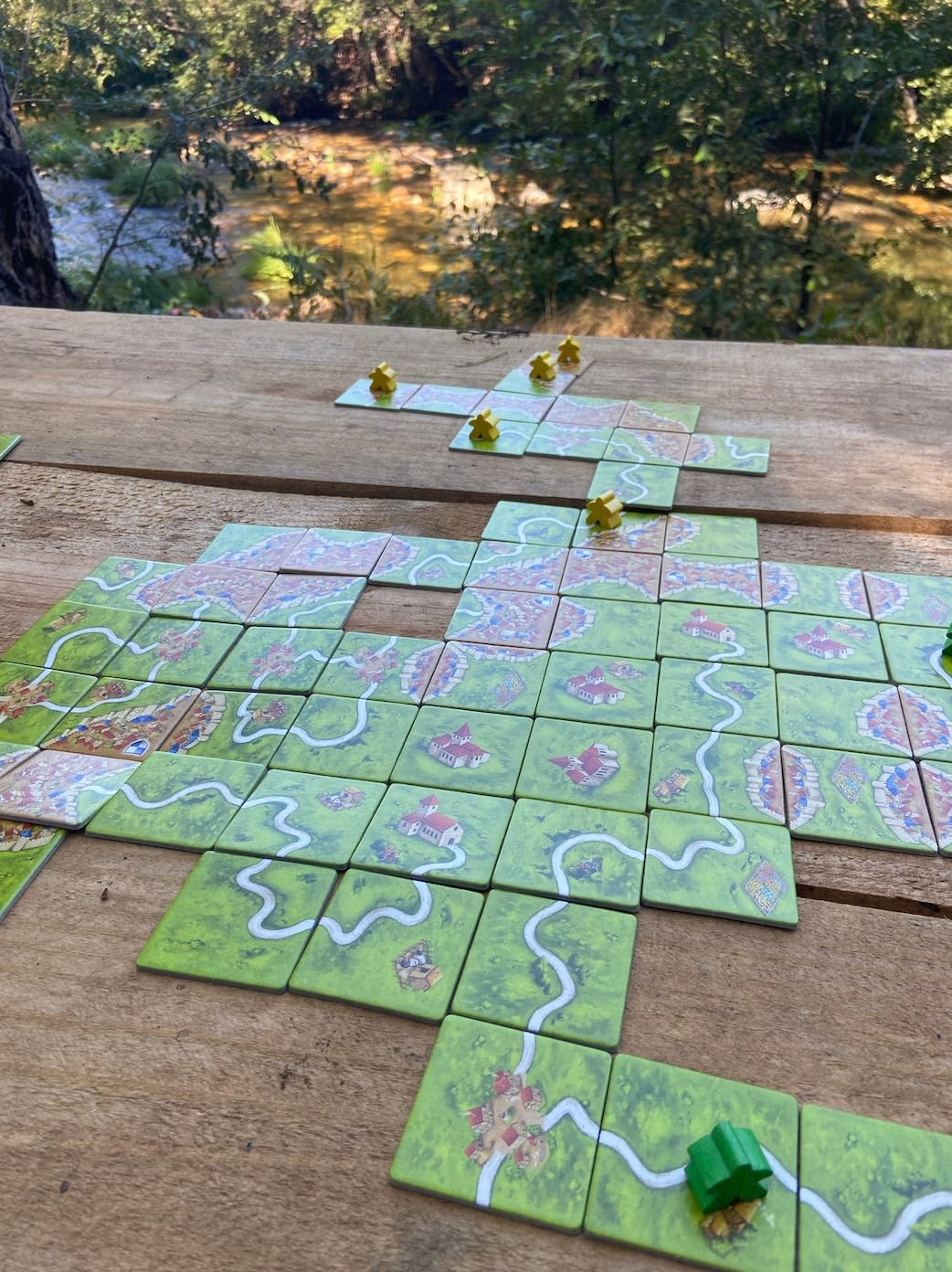
Carcassonne is the answer to the question family forums ask most often: what works when a six-year-old, two teens and a grandparent all want to play the same game? You draw a landscape tile, place it edge to edge, and put meeples on the features you complete. A knight scores the longest road, a monk scores a completed monastery, and a farmer counts fields.
The manufacturer recommends ages 7 to 16, and that spread is unusually honest for a family game. The rules are intuitive enough that a child grasps placement in one turn, and the scoring is deep enough that an adult keeps finding new angles.
Two mini-expansions, The Abbot and The River, ship in the box. They are small but they change how the base game plays, and having them included adds replay value you would otherwise have to buy separately.
There is one real flashpoint: placing a tile on top of another player’s city or road is legal and is the sharpest strategic move in the game. With younger children, that reads as cheating until you explain it. Decide the house rule before the second game, not during the first argument.
Why Carcassonne works for multi-generational play
Turns are fast, which keeps a six-year-old engaged, and the board itself is the scoreboard, which keeps a teenager interested. At 2-5 players and about 35 minutes it fits the group shape most family gatherings actually produce, and no player is eliminated before the end.
What to watch for in Carcassonne
Once your household has mastered the core loop, the strategic depth is thinner than heavier tile games here. Reviewers consistently report that it becomes less interesting to serious strategists while staying perfectly pleasant for everyone else.
6. Ticket to Ride — the Best Family Board Game for First-Time Players
Asmodee Ticket to Ride Board Game (2025 Refresh) – A Cross-Country Train Adventure for Friends and Family, Strategy Game for Kids & Adults, Ages 8+, 2-5 Players, 30-60 Minute Playtime
2-5 players
Ages 8 and up
30-60 minutes
225 plastic trains, 110 train cards, 33 destination tickets
Pros
- Picture-based cards that do not depend on reading
- Enough route building to keep adults engaged
- Every playthrough differs with ticket and card draws
- Reliable fit for a standard one-hour game night
Cons
- Gentler than aggressive route builders
- Strategy is slow to click for younger players
- Train cards wear out with frequent play
- Board space gets tight at four to five players
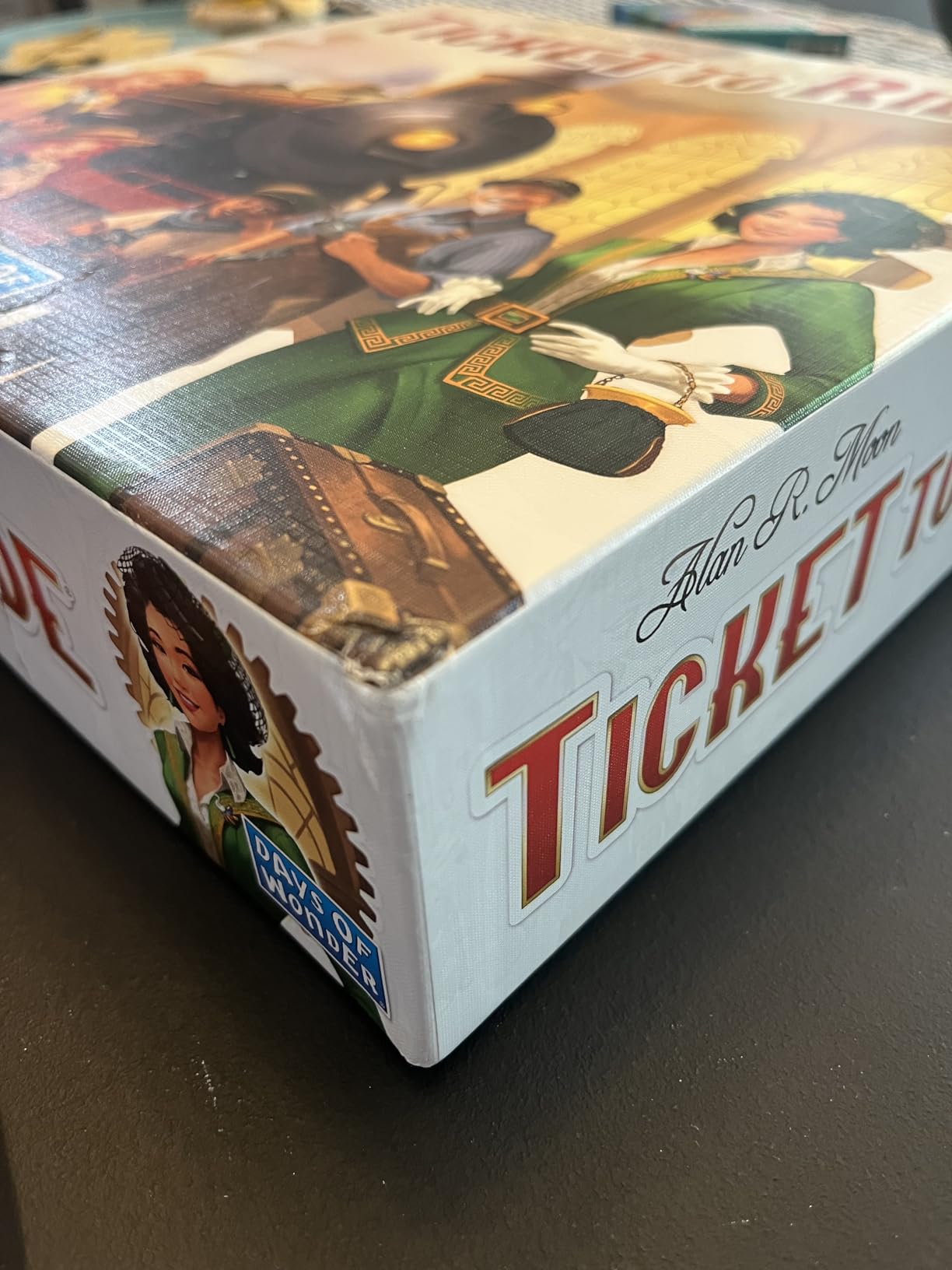
Ticket to Ride is the most forgiving gateway game here. You draw train cards, then claim a route between two cities on a North America map, trying to complete the destination tickets in your hand. No trading, no robber, no attacking anyone’s buildings. The whole tension is planning your own network against the cards you happen to draw.
Because the destination cards show pictures of cities rather than words, a child who cannot yet read can absolutely play this. That single design choice is why it keeps appearing on lists of games for children and adults at the same table, and it is the reason it works when someone in the group has never played a board game at all.
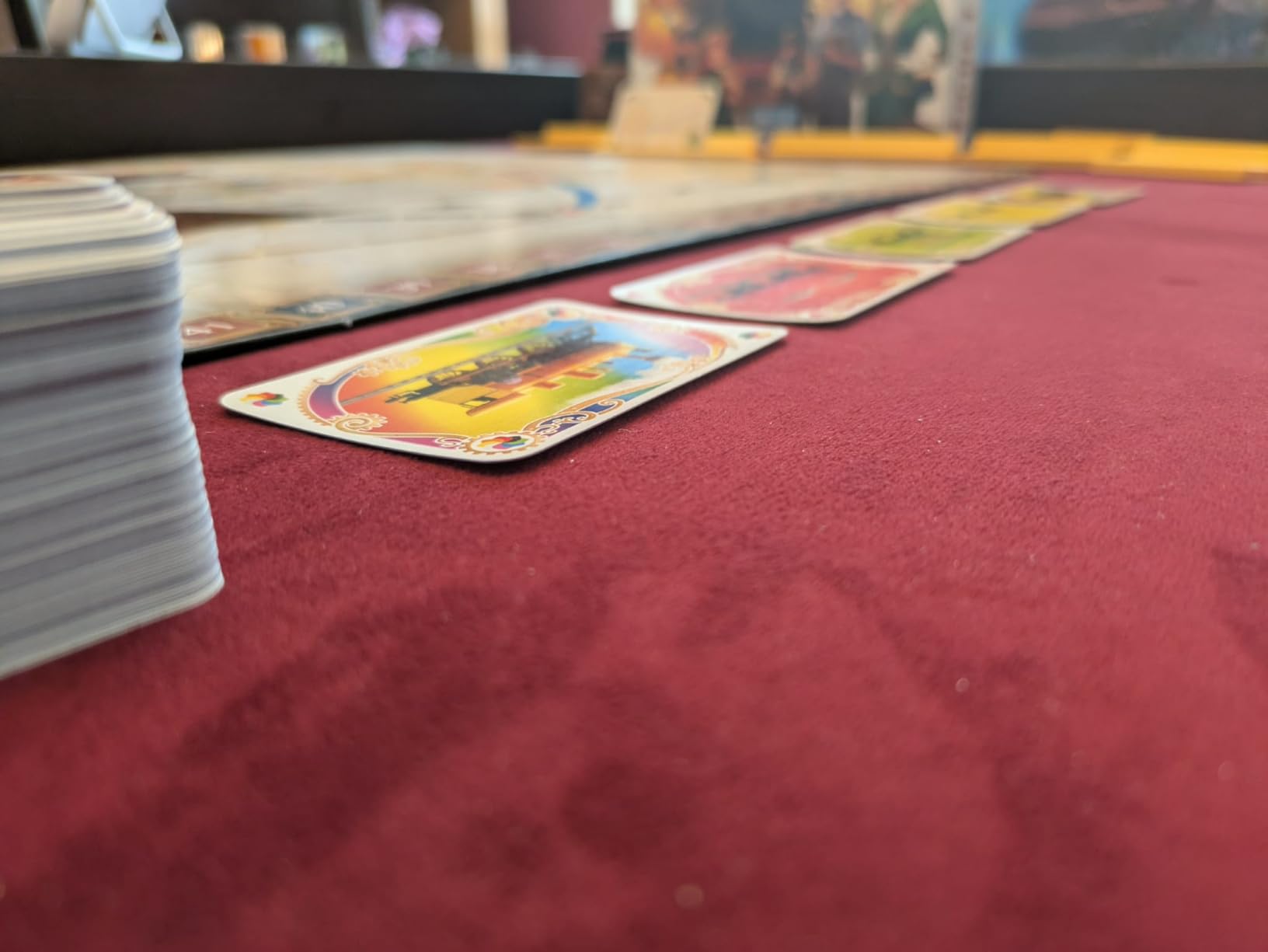
This is the current refresh listing, and the box carries 1 game board, 225 plastic trains in 5 colours, 110 train cards, 33 destination tickets, a longest path bonus card, 5 wooden scoring markers and a rules booklet. The 225 trains are plastic rather than wooden, which keeps the weight down to about 1.26 kg for a game this large.
What you give up is bite. Route building without targeted interference means fewer arguments and a gentler night, which is a feature in a mixed house and a disappointment for two siblings who want a real fight. The longer strategies also take a few games before a new player stops making obvious mistakes.
Why Ticket to Ride teaches faster than anything else here
There is no phase where you have to explain something separately. Drawing, claiming a route, scoring the ticket, repeat. We have taught this one across a table in under three minutes with a seven-year-old picking up the concept by the second turn, which no other game on this list managed.
What to watch for in Ticket to Ride
The board gets cramped at four or five players, and reviewers note the cards wear out under frequent play. If your household will run this weekly for years, expect to replace the card deck eventually.
7. Sequence — the Best Family Board Game for Large Gatherings
SEQUENCE- Original SEQUENCE Game with Folding Board, Cards and Chips by Jax ( Packaging may Vary ) White, 10.3″ x 8.1″ x 2.31″
2-12 players
Ages 7 and up
Folding 19.75 inch board
135 chips, 2 decks of cards
Pros
- Learnable in under five minutes
- Scales from two players to twelve in teams
- Portable folding board and durable chips
- Card luck plus board strategy in one box
Cons
- Round chips are a choking hazard for very young children
- Repetitive once common openings are learned
- Needs a large table surface
- Young players can hit rough losing streaks
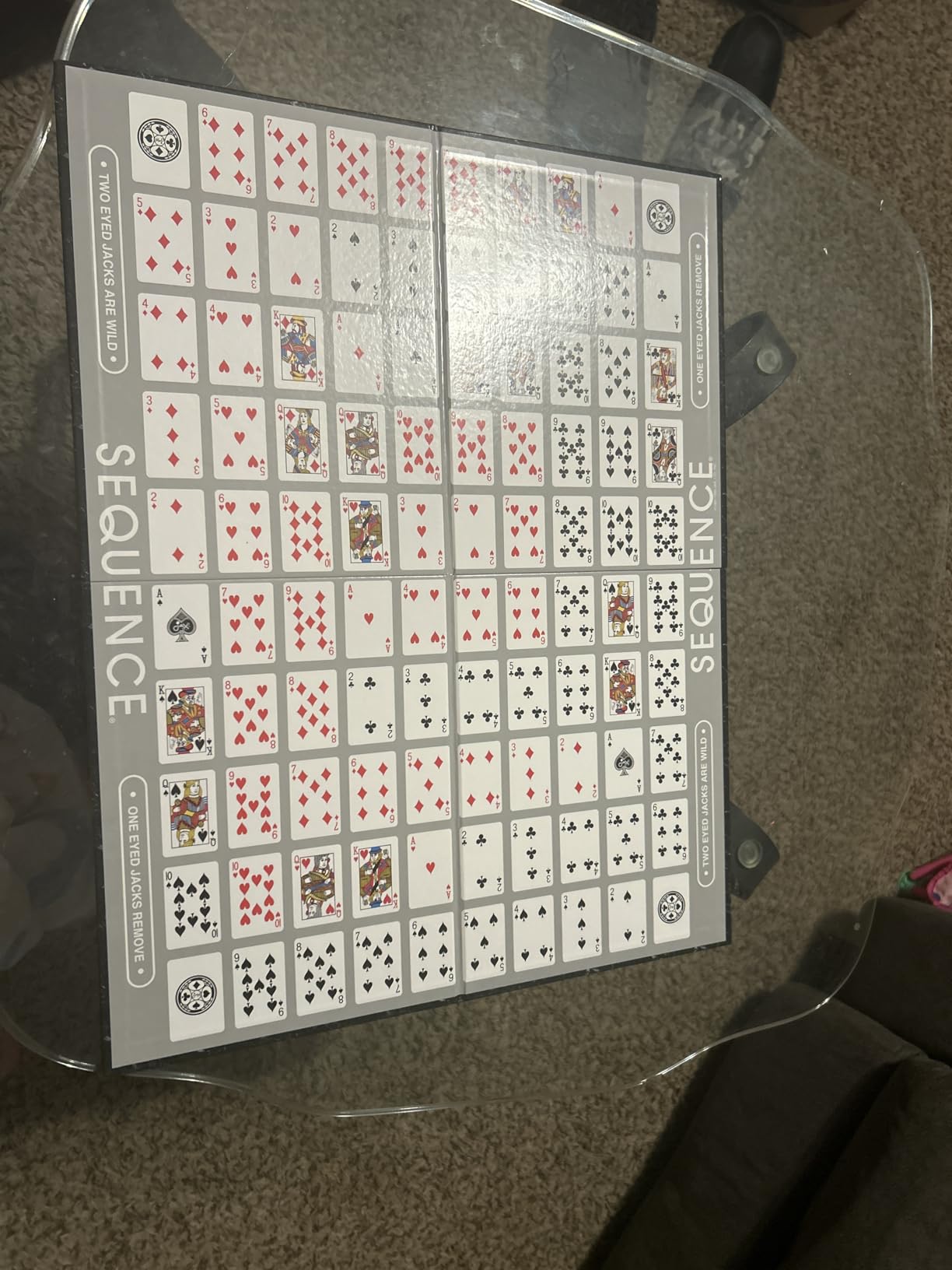
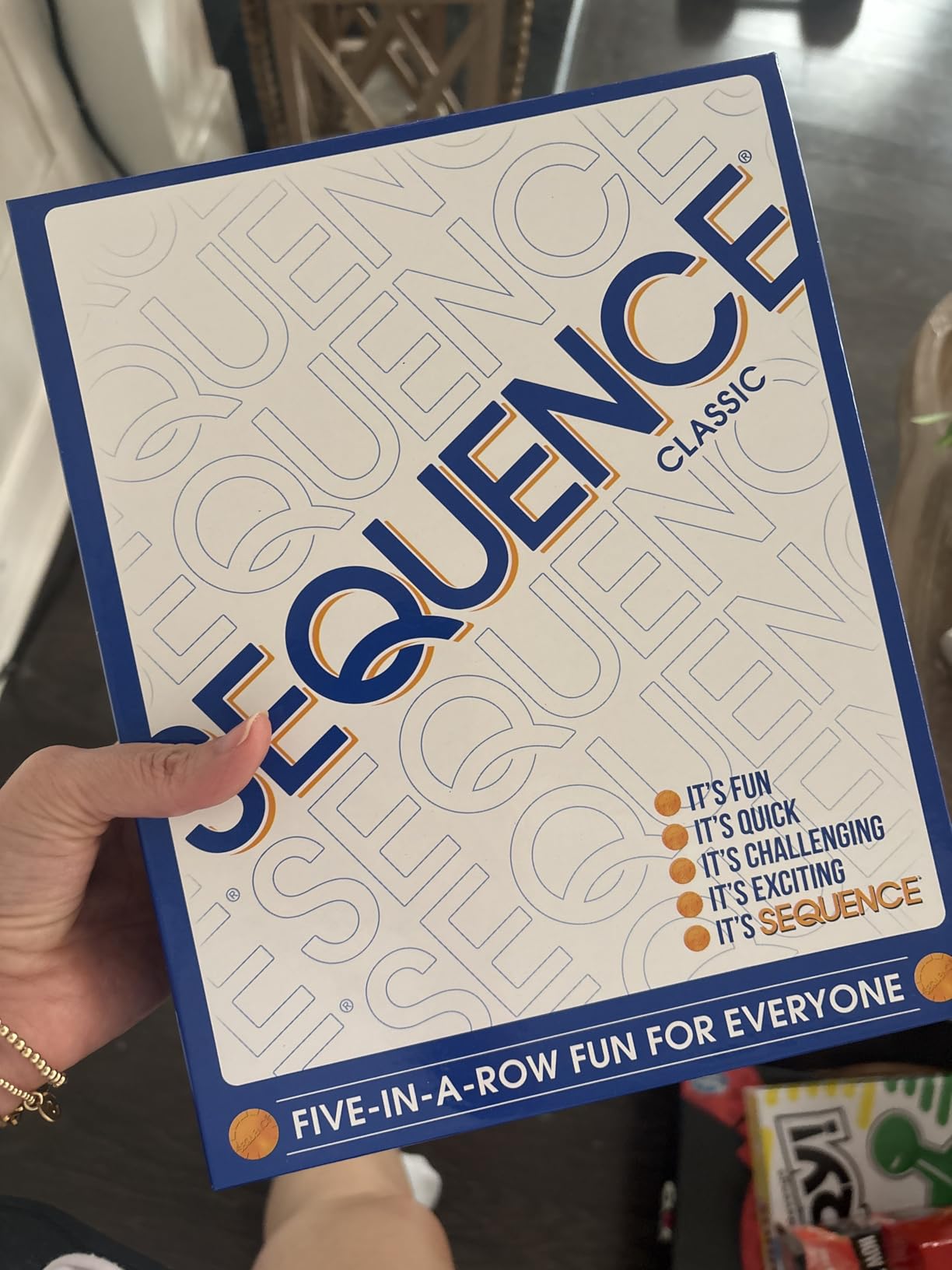
Sequence is the answer to holiday gatherings. It supports 2 to 12 players, and at larger counts you split into teams, which turns a set of relatives into a single opponent instead of eight separate scoreboards. You play a card and place a matching chip; get five in a row and you score a sequence.
The rules fit in about a minute, and the components are 1 folding game board measuring 19.75 by 15.25 inches, 135 playing chips in three colours and 2 decks of Sequence playing cards. The folding board is the detail that matters most for small homes, since it stores flat against a shelf.
It also plays well for two. That is unusual for a game marketed at parties, and it is the reason this one earns a permanent spot on a two-player shelf as well as a twelve-player one.
Two honest warnings. The listing carries a small parts choking hazard, so the round chips need to stay away from children under three. And with luck-heavy card draws, a young player can lose several hands in a row and lose interest, which is the main reason we keep it above six players rather than below.
When Sequence is the right call
Reach for it when the group is bigger than five, when relatives of very different ages are sharing a table, or when you have 20 minutes and no interest in teaching anything. It is also the safest filler between heavier games.
What to watch for in Sequence
Reviewers note that it loses novelty once players learn the standard openings, so it tends to work better as a party centrepiece than as the only game in the box.
8. Rummikub — the Best Family Board Game for Two Players
Pressman Rummikub – The Original Rummy Tile Game | Exciting Family Game of Strategy and Luck | Promotes STEM Skills | For Kids, Teens, Adults | 2-4 Players, Ages 8+
2-4 players
Ages 8 and up
106 numbered tiles and 4 racks
Compact 10.5 inch square box
Pros
- Fast-paced and easy to pick up across generations
- Rules many adults already know
- Rewards sequencing and pattern recognition
- Compact box that stores easily
Cons
- Tile luck can decide a round for younger players
- Jokey deliberation can stall the pace
- Two-player tile distribution less balanced in some editions
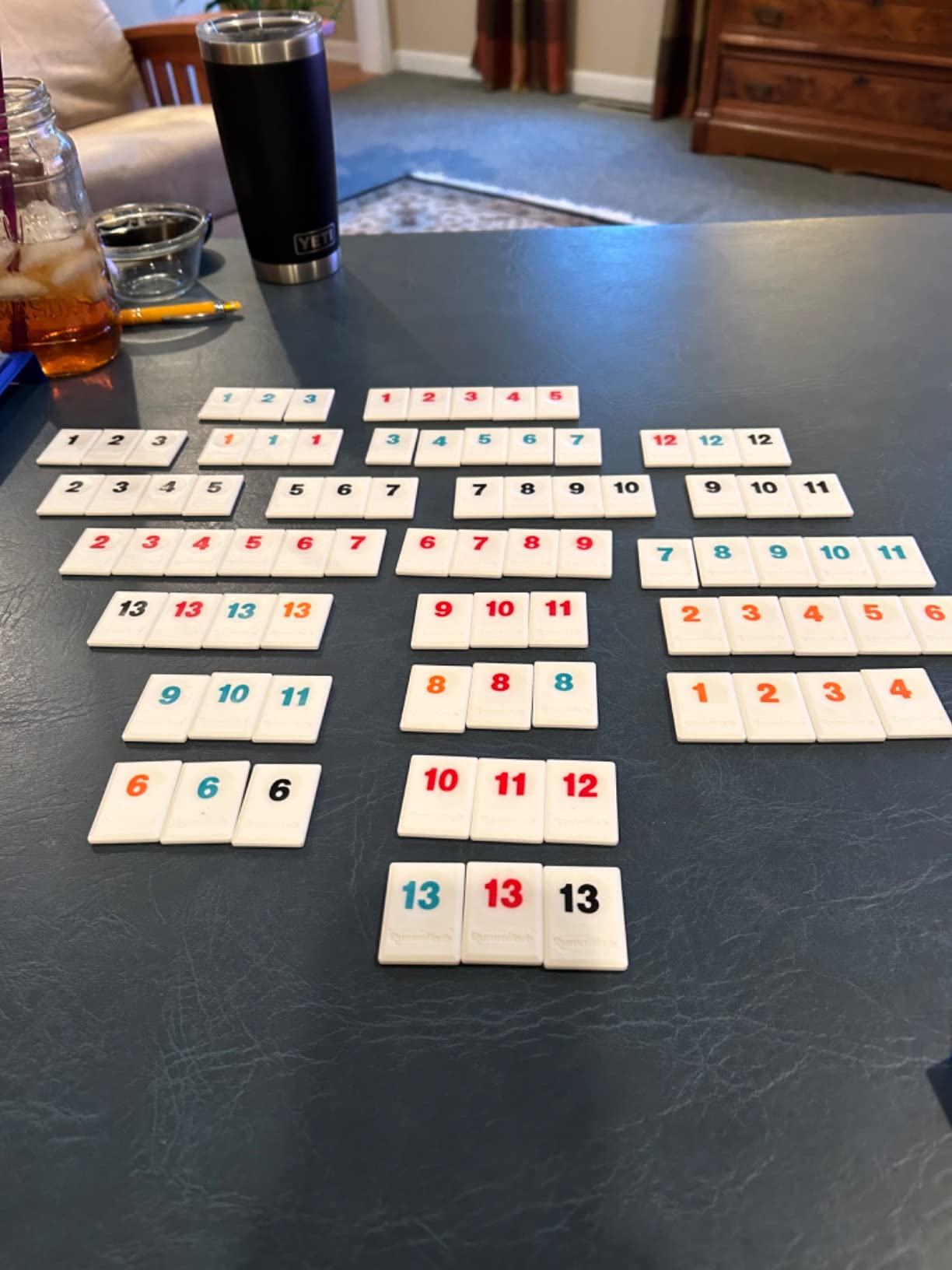
Rummikub is a two-player game with no filler. You lay numbered tiles in runs or groups, rummy style, and the first player to use every tile in their rack wins. There is a bonus for using all 14 tiles in one meld, which creates the only real decision in the game: go out safely now, or hold a set and chase the bonus.
The 106 numbered tiles and 4 racks fit a box barely larger than a hardback book, and the whole game runs at the pace of shuffling and dealing. Nothing here needs a rulebook read in advance, and most adults pick up the concept of runs and groups within one turn.
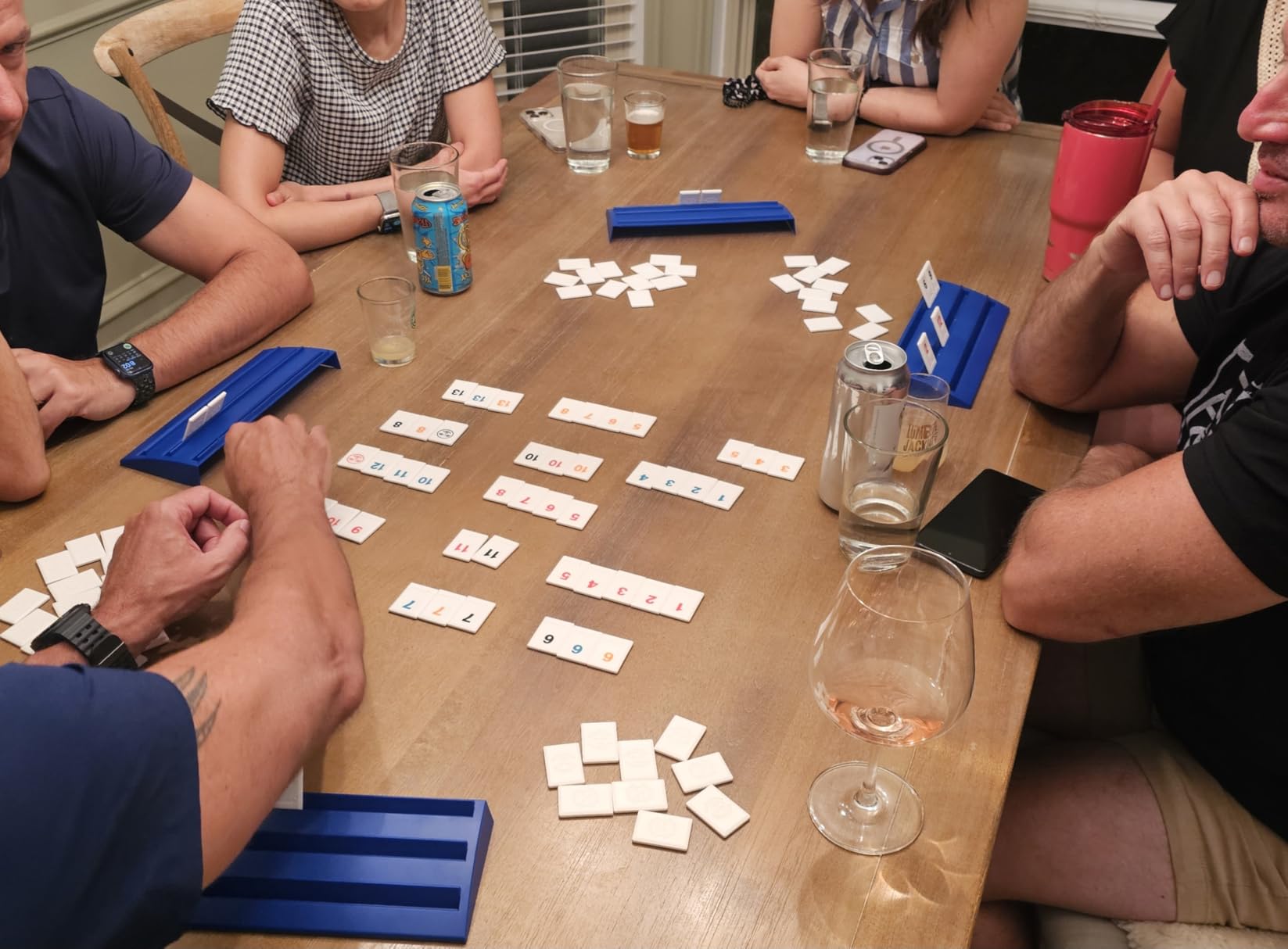
It is also the game on this list that stretches the widest age range in practice. A child who can count to fourteen and match numbers plays competitively against an adult with no rule adjustment, which is rarer than it sounds in family gaming.
The catch is randomness. Players draw replacement tiles on every turn, so a young player can hit a long streak of draws that end their game before it starts. Experienced players also stall deliberately over a tricky board, which is funny once and irritating by the fourth round.
Why Rummikub suits two-player households
Two players get a clean, fast duel with no downtime, and the decision space is tight enough that each round resolves in seconds. It is one of the few entries here that is genuinely better at two than at four, which makes it a strong companion to the heavier games above.
What to watch for in Rummikub
Reviewers flag that the two-player tile distribution is less balanced in some editions. If a round ends early and feels unfair, that is the reason, and re-dealing usually fixes it.
9. HUES and CUES — the Best Family Board Game for a Ten-Player Table
HUES and CUES – Vibrant Color Guessing Board Game for 3-10 Players Ages 8+, Connect Clues and Guess from 480 Color Squares
3-10 players
Ages 8 and up
About 30 minutes
480 colour squares, 100 colour cards, 30 player pieces
Pros
- Fast to learn and easy to explain to mixed ages
- Handles from 3 to 10 players for big families
- Builds communication and creative thinking
- Colour squares read easily across a large table
Cons
- Lighter decision weight than strategy games
- Near-identical hues are hard for some colour vision profiles
- Less satisfying for competitive players
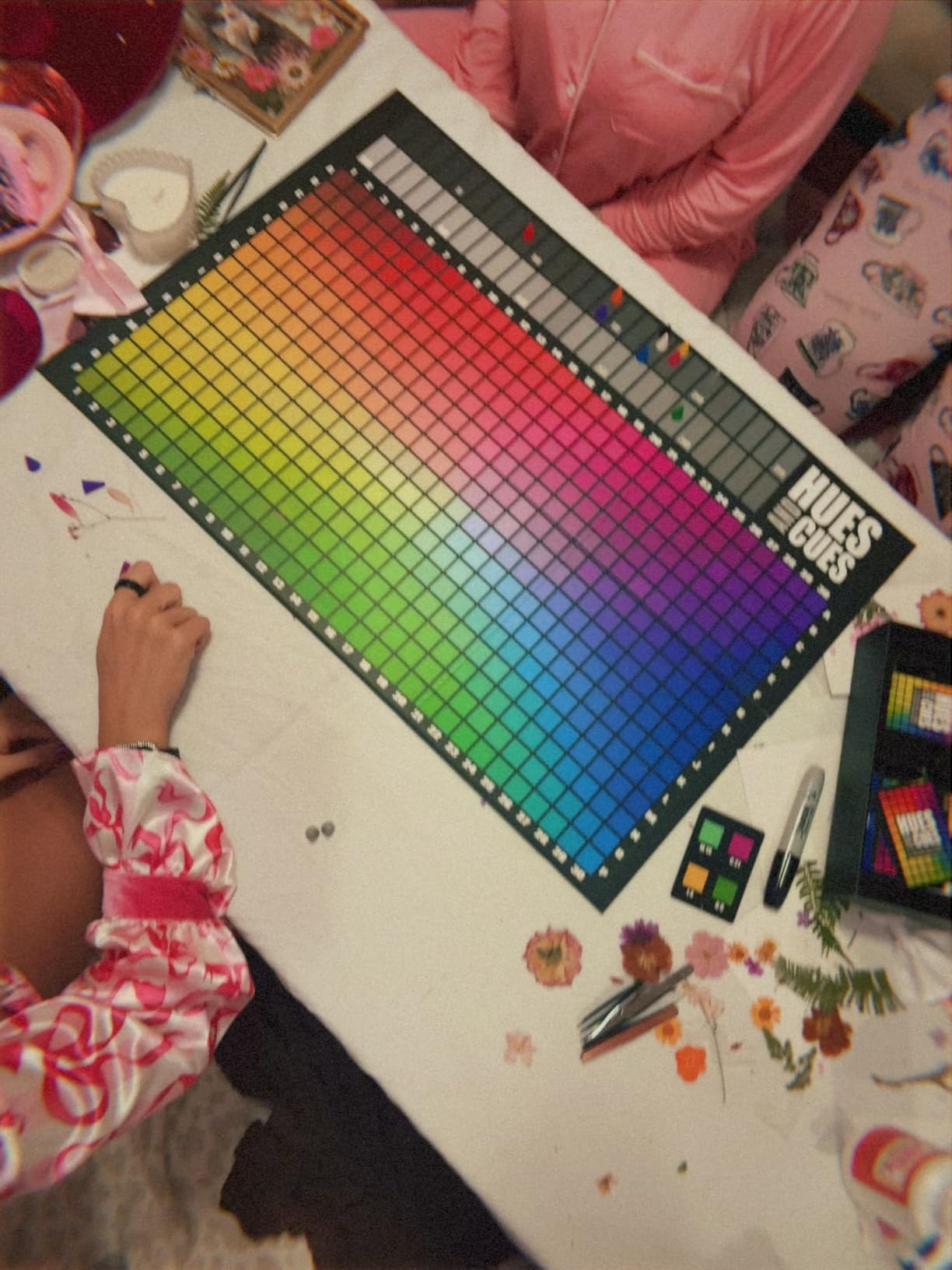
HUES and CUES splits the group into teams. One player sees a colour square from the set of 480 and describes it out loud, while the rest of the team writes clues on a frame and then tries to guess the square number. The clues are shown together at the end, which is where the comedy happens.
The listed count of 3 to 10 players makes this the widest family table on the list short of a twenty-person party game, and at about 30 minutes it fits into an evening without dominating it. It is a natural bridge game to set out first while dinner finishes.
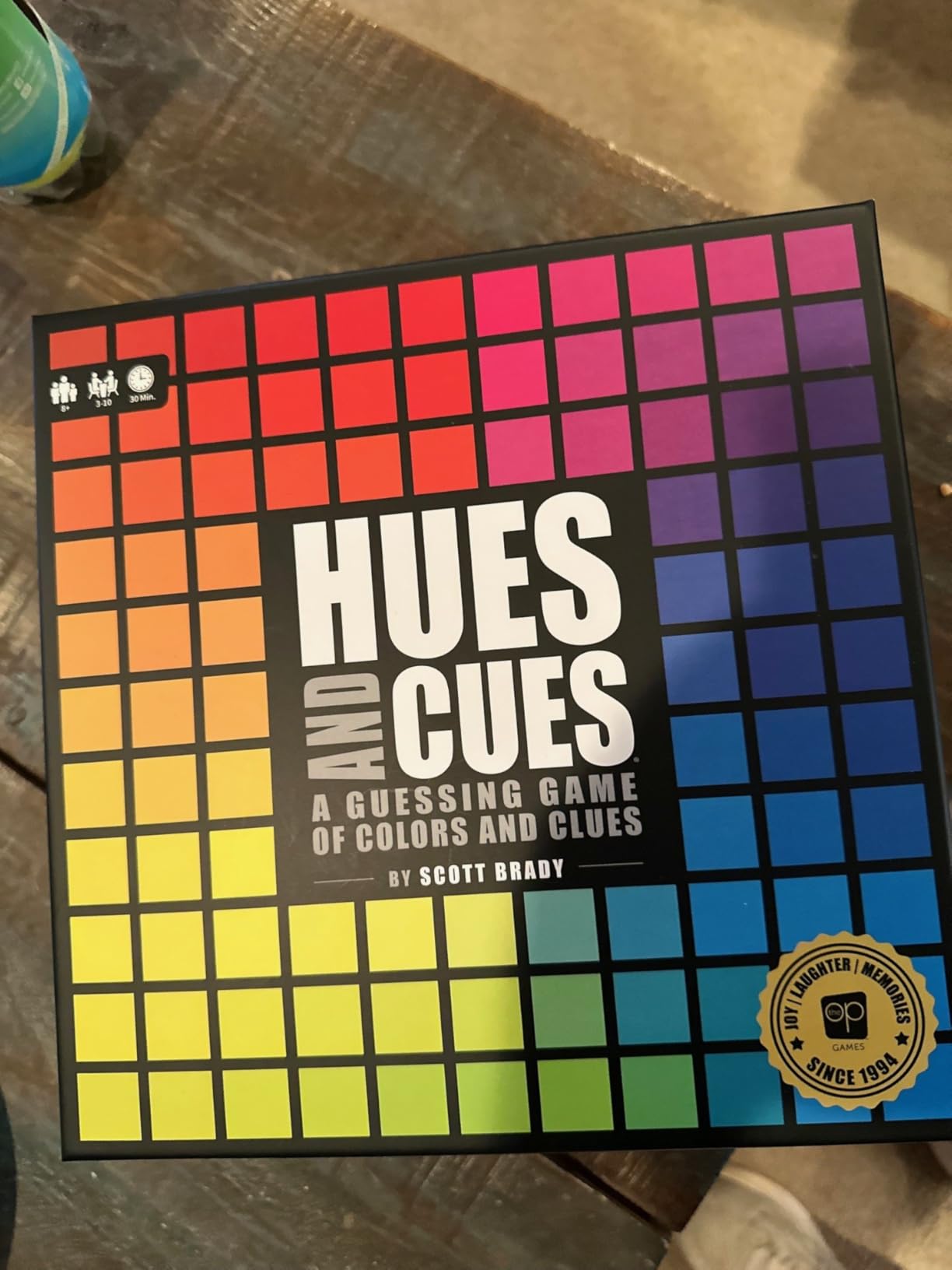
The box includes a game board, 100 color cards, 30 player pieces, a printed rulebook and a scoring frame. It also carries a small parts choking hazard, so it is not aimed at toddlers despite the family positioning.
This is a light game. It has fewer meaningful decisions than the strategy entries here, and two players who like competition will find the scoring thin. The counterargument is that it is often the one game everyone finishes, which counts for something in a group of mixed ages.
Who HUES and CUES works for
Groups with a wide spread of reading levels, large families, and any table where conversation matters more than optimisation. Reviewers also note it encourages creative thinking and communication, which makes it a decent choice for a playdate.
What to watch for in HUES and CUES
Because the squares are numbered and there are 480 of them, the numbers have to be printed and read. For players with colour vision differences, near-identical hues can be genuinely difficult. Worth testing at a store table before committing.
10. Blank Slate — the Best Family Board Game for Bluffing
Blank Slate Board Game, A Party Game of Addicting Predictions
3-8 players
Ages 8 and up
20-35 minutes
Scoreboard, 8 dry-erase slates, 250 word cue cards
Pros
- Learns in under a minute with no strategy background
- Scales to larger groups and creates real laughs
- Compact and portable for travel
- Replay value comes from players' own answers
Cons
- Dry-erase slates and markers wear down over time
- Markers dry out quickly if left uncapped
- Shallow gameplay for competitive players
- Weak with very small player counts
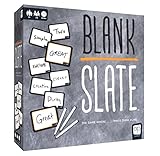
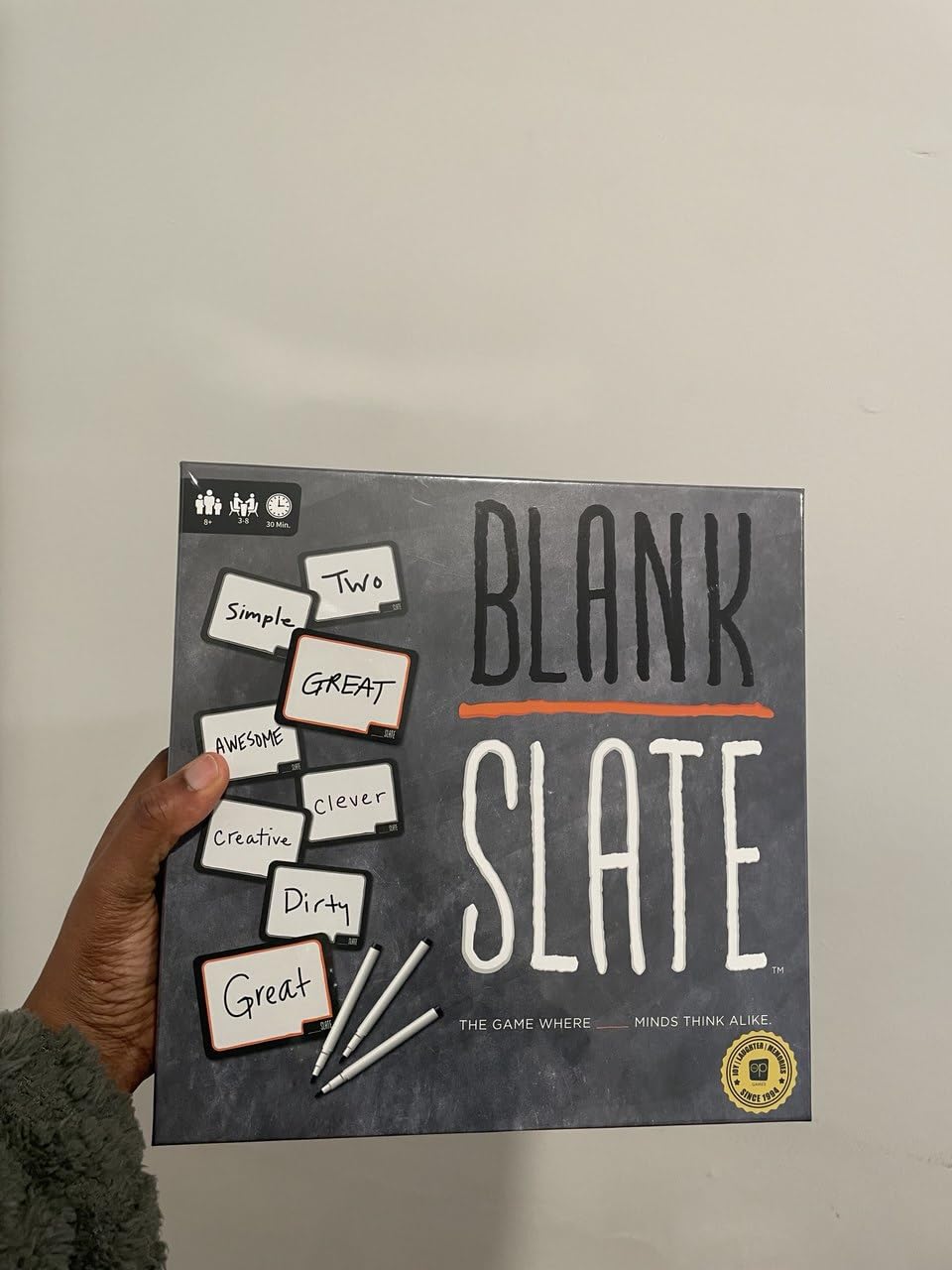
Blank Slate is a bluffing game with no bluffing vocabulary to teach. Everyone writes an answer to a cue on a dry-erase slate, and you score points if your answer matches someone else’s but not the official one. Trying to guess what your partner will write is the entire strategic layer, and it is surprisingly tense.
With 3 to 8 players and 20 to 35 minutes, it is the easiest entry on this list. One explanation, no setup beyond passing out slates, and a game that produces more noise than the strategy games above.
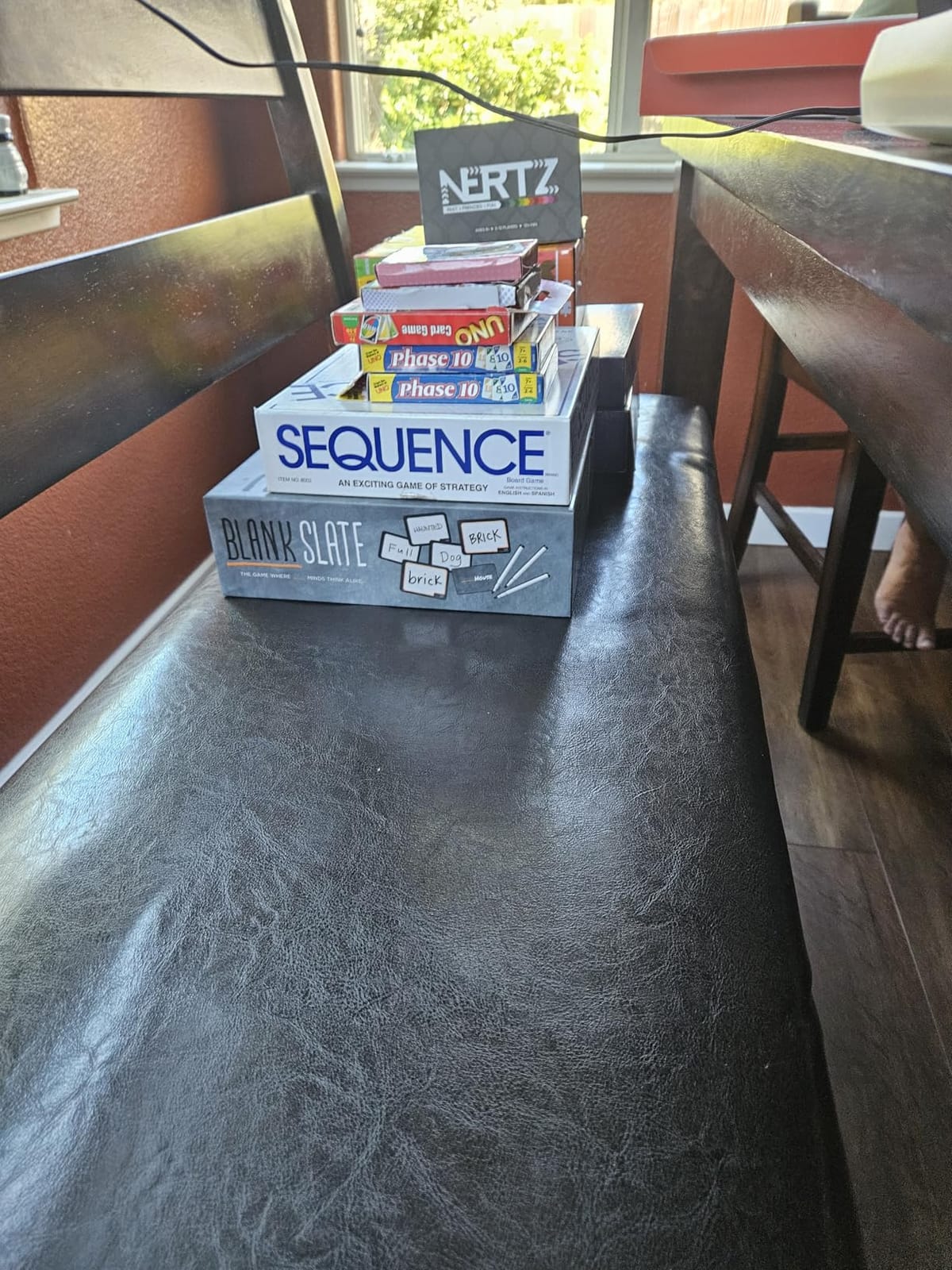
The box holds a scoreboard, 8 dry-erase slates, 250 double-sided word cue cards and rules. At 9.84 by 9.84 inches and about 0.94 kg, it packs flat into a bag, which makes it the one to take on a cottage weekend or a road trip.
The durability note is real and worth taking seriously. Reviewers repeatedly mention dry-erase slates wearing down with heavy use and markers drying out if left uncapped. Put the caps back on when the round ends, not at the end of the night.
When Blank Slate earns its place
It is strongest with five or more players and weakest with three, because the answer pool needs volume. Reviewers also note it doubles as a vocabulary exercise, which is a quiet bonus for kids learning to describe things precisely.
What to watch for in Blank Slate
The depth is genuinely shallow. Two competitive players will burn through it in a few sessions, and there is no strategy layer to deepen over time. Treat it as a group-pleaser rather than a main event.
11. Herd Mentality — the Best Family Board Game as an Icebreaker
Herd Mentality Board Game: Funny Family Party for Game Night, 4-20 Players
4-20 players
Ages 10 and up
About 20 minutes
Includes 20 extra question cards in this version
Pros
- Handles up to 20 players
- which few family games do
- 20 minute format that works as an icebreaker
- Majority vote is instantly understandable
- Good for holidays with mixed ages and skill levels
Cons
- Questions skew toward older kids and teens
- Very light on strategy
- Pink Cow of Doom penalty feels arbitrary to younger players
- Value depends on a talkative group
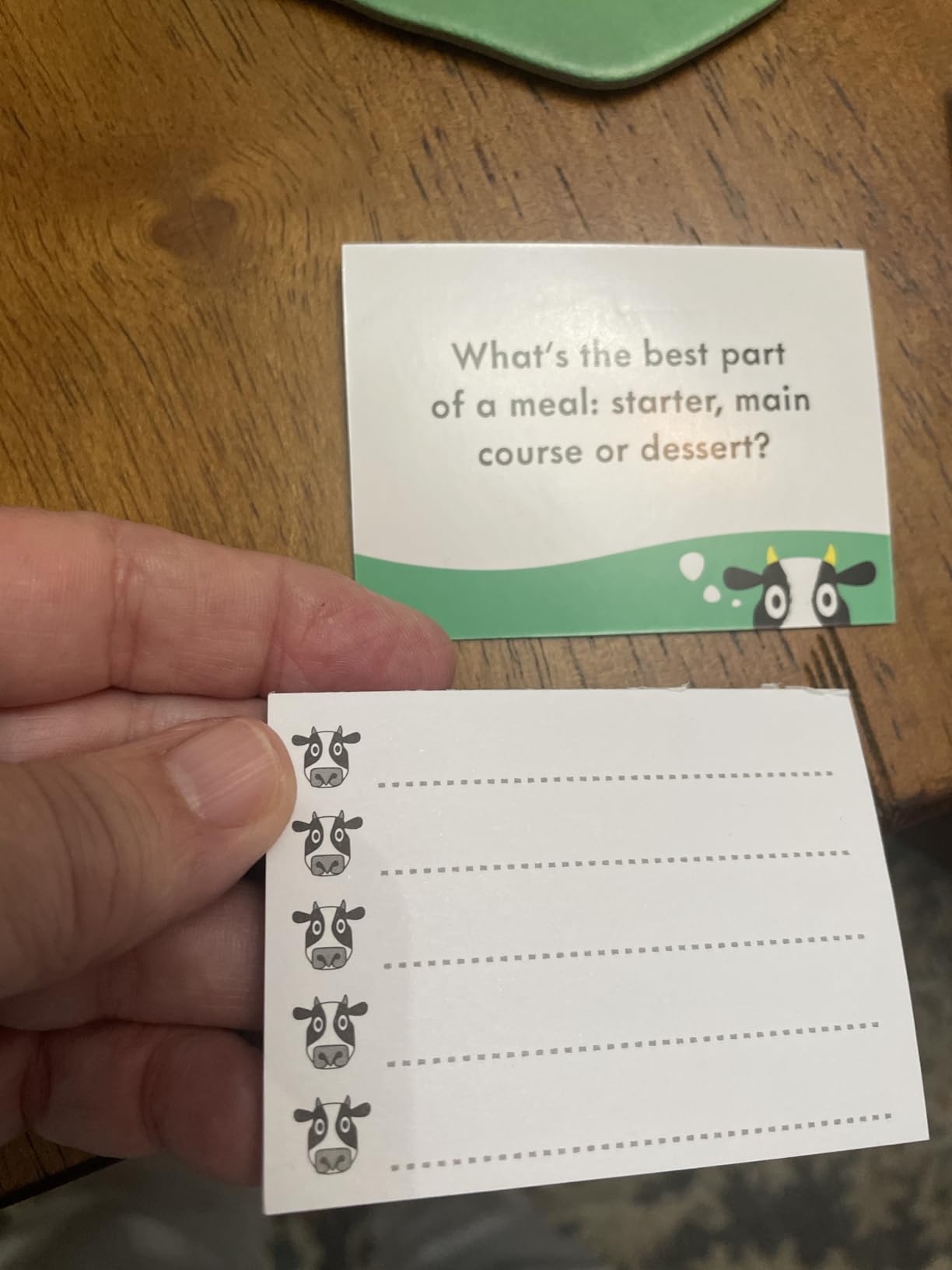
Herd Mentality is built for the moment when a big group arrives and nobody knows what to do. Everyone writes an answer to a question on a cow, and the majority answer claims the herd. If you guessed with the minority, you take the Pink Cow of Doom. Then the next question goes out immediately.
Four to twenty players and about 20 minutes per session is a combination nothing else on this list offers. For a holiday house with eight adults, four children and a set of grandparents arriving in waves, it is the single most reliable thing to put on the table first.
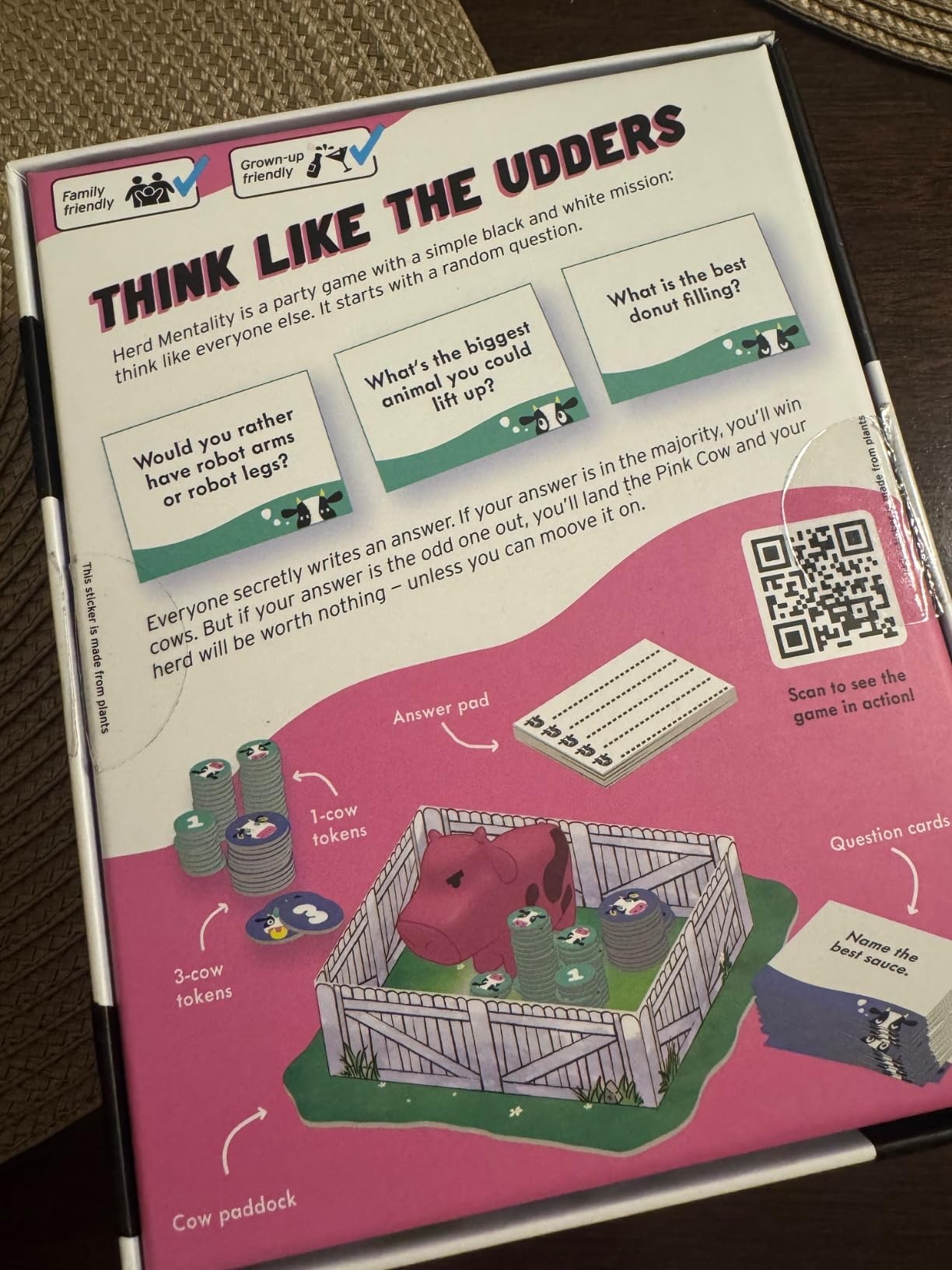
Components are light: a stack of question cards, plus 20 extra question cards in this version. The whole box is 7.4 by 5.8 inches and about 449 g, so it costs nothing to move around the house or hand to the person who arrives last.
Be honest about the ceiling. This is a party icebreaker, not a game, and the questions skew toward older children and teens rather than the under-tens. If your group is quiet, you will need to supply the social energy the game depends on.
Where Herd Mentality earns a spot
Waiting rooms, holiday dinners, and the first fifteen minutes of a gathering where relatives have not seen each other in a year. Play value depends almost entirely on the group being social and talkative, which is exactly the situation where it works.
What to watch for in Herd Mentality
It is listed for ages 10 and up and the questions skew older still. Reviewers note the Pink Cow of Doom penalty can feel arbitrary to younger players, so expect a few protests in the first round.
How to Choose a Family Board Game
Most disappointing purchases fail on one of five variables, and all five can be checked before you buy. Work through them in order rather than browsing by theme.
1. Start with the player count you actually have. Read the printed count, then check the upper end honestly. Several games on this list work at their maximum but feel cramped there. If your group is regularly five or more, look at the entries rated for 3-10 or 4-20 players rather than stretching a four-player game.
2. Match the youngest player, not the box average. The printed age is a floor. If your youngest regular player is six, treat any eight-plus recommendation as a stretch and either pair them with an adult in a team or pick a lower-age entry.
3. Check for player elimination and downtime. This is the most common family complaint on forums: a player is knocked out in round two and spends the rest of the night watching. Every game on this list avoids early elimination. Where downtime is a factor, simultaneous or team games like Sequence, HUES and CUES and Blank Slate keep everyone active every turn.
4. Cooperative or competitive? Cooperative games give you a shared win, which matters when siblings start arguing over outcomes. Competitive games give you a reason to play again tomorrow. Families with competitive children usually want competitive games, and families with sensitive players usually want the reverse.
5. Which games hold adult attention. This is where most lists fail. A game that children enjoy but adults tolerate gets played twice. A game that both enjoy gets played fifty times. Wingspan, Azul, Splendor and CATAN all hold up for an adult who games regularly.
Two more filters are worth applying. Check noise and mess, because some games create enough clatter to set off sensory-sensitive children. And check portability, because the best family game in the world is the one that fits in the bag when you travel.
If you want deeper strategy games rather than family gateways, our guide to the best strategy board games for adults covers the step up. For cooperative play specifically, see our picks for the best cooperative board games for families. And if your table is big and your floor space is not, our big-box board game roundup is worth a look.
How to Teach a New Family Game in Five Minutes
Rules teaching is the single biggest reason a game night dies early. Six practical habits fix most of it.
Read the one-page summary, not the rulebook. Most modern games ship with a teach-at-a-glance card showing setup and one turn. Use it and ignore the rest until the group is already playing.
Watch a rules video first, alone. A five-minute video teaches more than a five-minute explanation from a parent who has forgotten the rules. Show the group a single completed turn, then start.
Teach only the first turn. Explain drawing, taking and playing, then deal and stop talking. The remaining rules are only interesting once players want to play.
Let a child teach a phase. After two rounds, hand the rules to whoever is most invested. Ownership removes the argument about whether a move was legal.
Set a hard time limit before you start. Decide when the game ends before anyone is invested in the outcome. An abrupt stop at the 45-minute mark is far less painful than an argument at turn nine.
On this list, Ticket to Ride and Sequence hit the five-minute mark almost every time. Wingspan and CATAN will not, no matter how well you prepare, so plan a longer evening for those.
Games We Did Not Put on This List
Plenty of popular family games missed our criteria, and the reasons are worth stating plainly.
Licensed character editions aged poorly in our testing. A licensed superhero or cartoon theme edition can be brilliant for a specific child and irrelevant two years later. We favoured games that do not need a character licence to work.
Classic competitive staples like Monopoly, Risk and Battleship have real appeal but produced consistent friction in mixed-age play. We left them off because the losses feel personal to younger players.
Fast-paced dexterity games with loud components were excluded for sensory reasons. Parents and children with sensory sensitivities consistently flagged this category as the one they avoid at gatherings.
Heavy luck-driven games were cut when nothing happened between rolls. If a turn involves no decision, five-year-olds lose interest and experienced players tune out.
Games with long rulebooks lost their slot even when the underlying design was good. If it cannot be taught in one pass, it will not survive a family game night with guests who came to play, not to study.
Frequently Asked Questions
What is the best board game for the entire family?
CATAN is the best all-round pick here because it teaches in one explanation, runs at 3-4 players and keeps both children aged ten and up and regular adult players engaged. For shorter nights, Splendor finishes in about 30 minutes, and for the fastest setup, Sequence works with anywhere from 2 to 12 players.
What are the top 5 family board games right now?
Our five most reliable family picks are CATAN for overall depth, Splendor for a 30-minute evening, Ticket to Ride for first-time players, Azul for ages 8 and up, and Sequence for very large groups. Each has a different player count and age floor, so match the one that fits your household rather than buying all five.
What board games work well with a wide age gap?
Carcassonne is rated from ages 7 to 16 and scores on the board itself, so younger players see their progress directly. Azul works from ages 8 and up, Rummikub from 8, and Ticket to Ride from 8 because its destination cards use pictures rather than text. Games where one player is eliminated early are the ones to avoid here.
What are good family board games for a large group of six to ten players?
HUES and CUES handles 3 to 10 players in about 30 minutes, Sequence supports 2 to 12 in teams, Blank Slate covers 3 to 8 players in 20 to 35 minutes, and Herd Mentality runs with 4 to 20 players in about 20 minutes. Carcassonne and Ticket to Ride stretch to five players but get tight above that.
Are cooperative board games better for families than competitive ones?
It depends on the family. Cooperative games reduce the number of arguments because everyone shares one outcome, which suits sensitive or younger players. Competitive games give a reason to play again the next night. If your family has competitive children, competitive games work better, and if arguments are frequent, cooperative ones will save the evening.
How do I choose a board game for family game night?
Check five things: the player count against your real group size, the age rating against your youngest player, whether anyone can be eliminated early, whether the game runs inside a 45 minute window, and whether the components will survive weekly use. Start with the youngest player and the smallest player count you actually have, not the largest.
The Verdict on the Best Board Games for Families
CATAN takes the top spot because it is the only game on this list that gives a ten-year-old a real turn and an experienced adult a real problem in the same round. Splendor earns the second slot for households that need an evening, not an event, and Ticket to Ride takes the third because nothing else teaches faster or forgives a new player more easily.
Match the rest to your household. Azul and Carcassonne cover the wide-age-gap table. Wingspan is the pick once teens stop tolerating family games. Rummikub and Sequence cover two-player and twelve-player situations. HUES and CUES, Blank Slate and Herd Mentality are your large-group and holiday tools.
Pick the one whose player count matches the people actually at your table tonight, set a time limit before the first turn, and put the phones in another room. If you want the deeper end of the shelf, our premium family board game picks go deeper on heavier designs.