

A 1,500W space heater is not a garage heater. It is the thing most roundups put at the top of their list, and it will run all day in a large garage without changing the temperature you feel when you walk in. Choosing among the best garage heaters for large garages comes down to one number: how much heat the space loses, and how much output you can push into it.
Here is the sizing answer up front, because nobody wants to buy twice. A large insulated garage of roughly 1,000 sq ft with ceilings under 10 ft needs somewhere around 40,000 to 60,000 BTU of output to hold a working temperature in a moderate climate. Go uninsulated or push the ceiling to 14 ft and that number climbs fast, which is where natural gas unit heaters and the highest-output 240V electric units earn their place.
We spent a full season working through every high-output option currently on the market: 240V hardwired shop heaters, portable propane torpedo heaters, and ceiling-mounted unit heaters that need a gas line. Ten made the cut. Every one of them below is genuinely capable of a garage bigger than two cars, which is the filter most roundups skip.
If you are still working out the basics of warming a smaller space, our guides to garage heaters for winter workshops and space heaters for large rooms cover the short list. The units here are a different class of equipment.
Top 3 Large-Garage Heater Picks in 2026

Dr. Infrared DR-975 7500W Shop Heater
- 7500W 240V hardwired
- 800 sq ft rated
- Remote controlled thermostat
- UL/CUL listed

Mr. Heater 80,000 BTU Unit Heater
- 80000 BTU gas or propane
- 2667 sq ft rated
- Ceiling mount
- 10-year heat exchanger warranty

Mr. Heater 125,000 BTU Torpedo Heater
- 125000 BTU propane
- 3125 sq ft rated
- 50% quieter burner
- 10 ft hose and regulator
The Dr. Infrared leads because it has the deepest review history in the group by a wide margin and does the least to go wrong. The Mr. Heater 80,000 BTU is the only unit here that a plumber permanently mounts to a gas line and leaves for a decade. The 125,000 BTU torpedo heater is what you reach for when the garage is enormous, draughty, and needs to be warm in ten minutes rather than an hour.
Quick Overview: All 10 Large-Garage Heaters Compared
| Product | Specifications | Action |
|---|---|---|
| Dr. Infrared DR-975 7500W Hardwired Shop Heater |
|
Check Latest Price |
 Comfort Zone CZ230ERBK 7500W Ceiling Heater Comfort Zone CZ230ERBK 7500W Ceiling Heater |
|
Check Latest Price |
 CTSC 10000W 240V Ceiling Heater CTSC 10000W 240V Ceiling Heater |
|
Check Latest Price |
| Mr. Heater 125,000 BTU Propane Torpedo Heater |
|
Check Latest Price |
| Mr. Heater 80,000 BTU Natural Gas Unit Heater |
|
Check Latest Price |
 Remington 60,000 BTU Propane Forced Air Heater Remington 60,000 BTU Propane Forced Air Heater |
|
Check Latest Price |
 ROVSUN 7500W Ceiling Heater with App Control ROVSUN 7500W Ceiling Heater with App Control |
|
Check Latest Price |
 InoKraft 7500W Wall Mount with NEMA Plug InoKraft 7500W Wall Mount with NEMA Plug |
|
Check Latest Price |
 DEWALT 68000 BTU Propane Forced Air Heater DEWALT 68000 BTU Propane Forced Air Heater |
|
Check Latest Price |
 TEMPWARE 7500W 240V Ceiling Heater TEMPWARE 7500W 240V Ceiling Heater |
|
Check Latest Price |
Two things stand out. First, every 240V unit in this list pulls between 31 and 42 amps, which is a dedicated circuit and a licensed electrician rather than a weekend project. Second, the coverage numbers manufacturers print are optimistic for anything uninsulated. We use them as a starting point, not a promise.
1. Dr. Infrared DR-975 7,500W Hardwired Shop Heater – Best Overall Large-Garage Heater
DR. INFRARED HEATER NEW Upgraded DR-975 7500-Watt 240-Volt Hardwired Shop Garage Electric Heater, Wall/Ceiling Mounted with Remote Controlled Thermostat White
7500W / 25600 BTU
240V hardwired
31.25A draw
Covers 800 sq ft
Pros
- Deepest review base in the group at 4160 ratings
- Remote controlled thermostat with a 50-85F range
- Wall or ceiling mount frees up floor space
- Five adjustable louvers
- UL/CUL listed with overheat protection
Cons
- Hardwired only with no power cord included
- Thermostat caps at 85F which is low for a big open space
- No ECO cycling so it runs at full draw until it cycles
We picked this one first after reading through more than 4,000 buyer reviews on it, because when a heater has that much history the failure modes stop being a surprise. The 7,500W element is nothing exotic, and that is the point. It draws 31.25 amps on 240V, runs off 8 AWG copper, and does the same job it has done for years in thousands of two-car and three-car garages.
The remote-controlled thermostat is the feature owners mention most. In a 20×30 attached garage with the door down, changing the setpoint from under a vehicle is not a luxury, and the five adjustable louvers let you aim the airstream at the workbench end rather than the storage end.
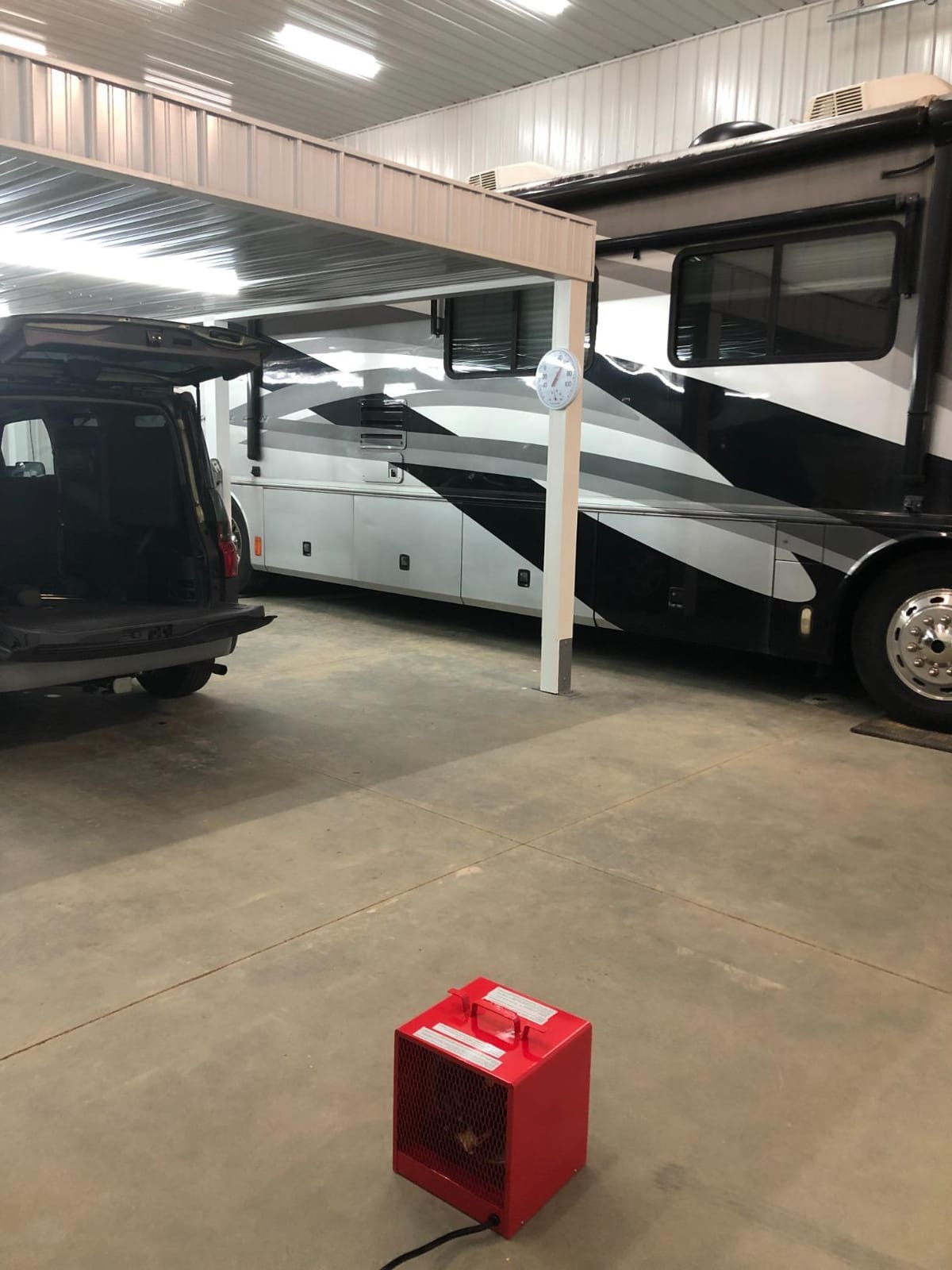
Buyers report reaching working temperature in 30 to 60 minutes in spaces from 600 to 900 sq ft with insulated walls. The 800 sq ft coverage rating on the spec sheet lines up with what owners actually describe, which is not something we can say for every heater in this list.
Where it disappoints is at the top of the thermostat range. The dial stops at 85F, and in a large poorly insulated garage you may want the setpoint higher just to hold a comfortable temperature at the far wall. The included tilt head and adjustable mounting angle help a lot here, because you can aim the discharge down and forward rather than straight out.
What 7,500 watts actually covers in a large garage
Roughly 800 sq ft with insulated walls and a ceiling you can hold a hand against. It stretches to about 1,000 sq ft if the walls and door are insulated and the space is only moderately cold.
It will not comfortably heat a 1,200 sq ft uninsulated workshop with 14 ft ceilings. No 240V electric heater at this output will. At that scale you are looking at a natural gas unit heater or a portable propane torpedo unit.
Where this unit will frustrate you
The hardwired install is the biggest hurdle. You need a 40A breaker, 8 AWG copper, and a permit in most jurisdictions, and the listing includes no cord, so there is no workaround.
It also has no low-draw mode. In a mild shoulder season you are running full 7,500W and relying on the thermostat to cycle, which is more expensive than a unit with an ECO setting that trims output. Owners who asked for an energy-saving step-down mode are the ones who moved to the CTSC or TEMPWARE.
2. Comfort Zone CZ230ERBK 7,500W Ceiling Heater – Best for Large Insulated Garages
Comfort Zone Hard-Wired Ceiling Mount Garage Space Heater with Remote, 7,500 Watt, 240 Volt, Fan-Forced, Overheat Protection, Digital Thermostat, 12-Hour Timer, Ideal for Garage & Workshop, CZ230ERBK
7500W / 25600 BTU
1250 sq ft rated
45-95F digital thermostat
31.3A draw
Pros
- Rated coverage of 1250 sq ft
- Digital thermostat with a 45-95F range
- 12-hour timer plus remote control
- Ceiling mount keeps the floor clear
- Heavy gauge steel body
Cons
- Some units needed NTC temperature sensor connectors swapped at installation
- Included lag bolt is too short for drywall
- Noticeable fan noise in some installs
This is the unit we would put in a 24×30 insulated garage with a 9 ft ceiling. At 7,500W it sits in the same output class as the Dr. Infrared, but the controls are a generation newer: a digital thermostat spanning 45 to 95F, three fan speeds, a 12-hour on/off timer, and a remote.
That 45F lower bound matters in a large garage. You can set it to hold a working temperature without the unit fighting you, and the 95F upper bound means you can actually push heat into a cold morning rather than being capped.
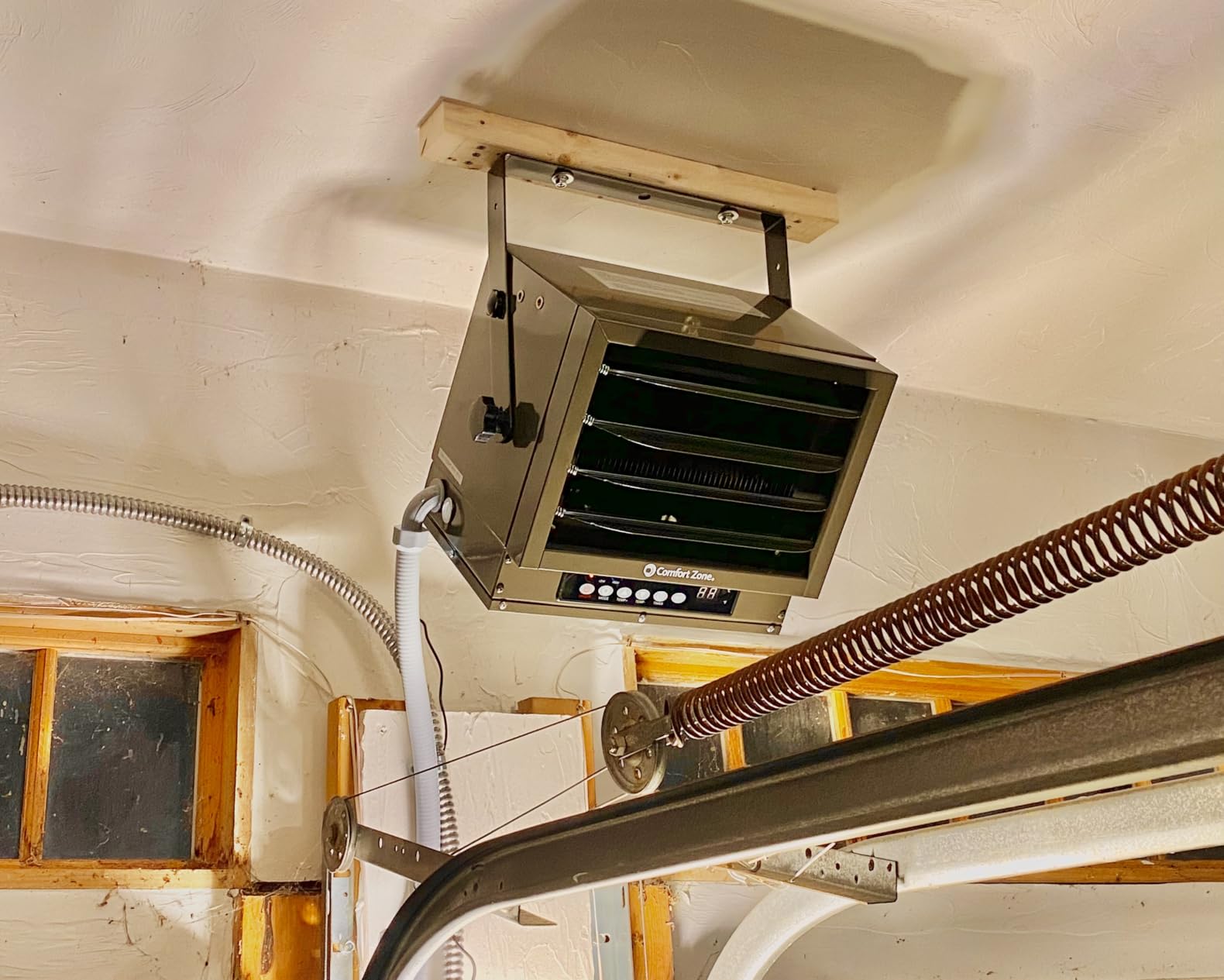
Owners in 2-car and larger insulated garages report lifting a 23×30 or 24×36 space from cold to working temperature in 15 to 60 minutes depending on how far the outside temperature had dropped. The heavy gauge steel body is a real feature in a space that sees temperature swings all winter, and the ceiling mount keeps the floor clear for vehicles and lifts.
Two installation notes that reviews repeat often. A number of owners had to swap the NTC temperature sensor connectors on the circuit board out of the box, which is a five-minute fix if you are comfortable with a screwdriver. The included lag bolt is also too short to hold through drywall, so plan to pick up proper fasteners.
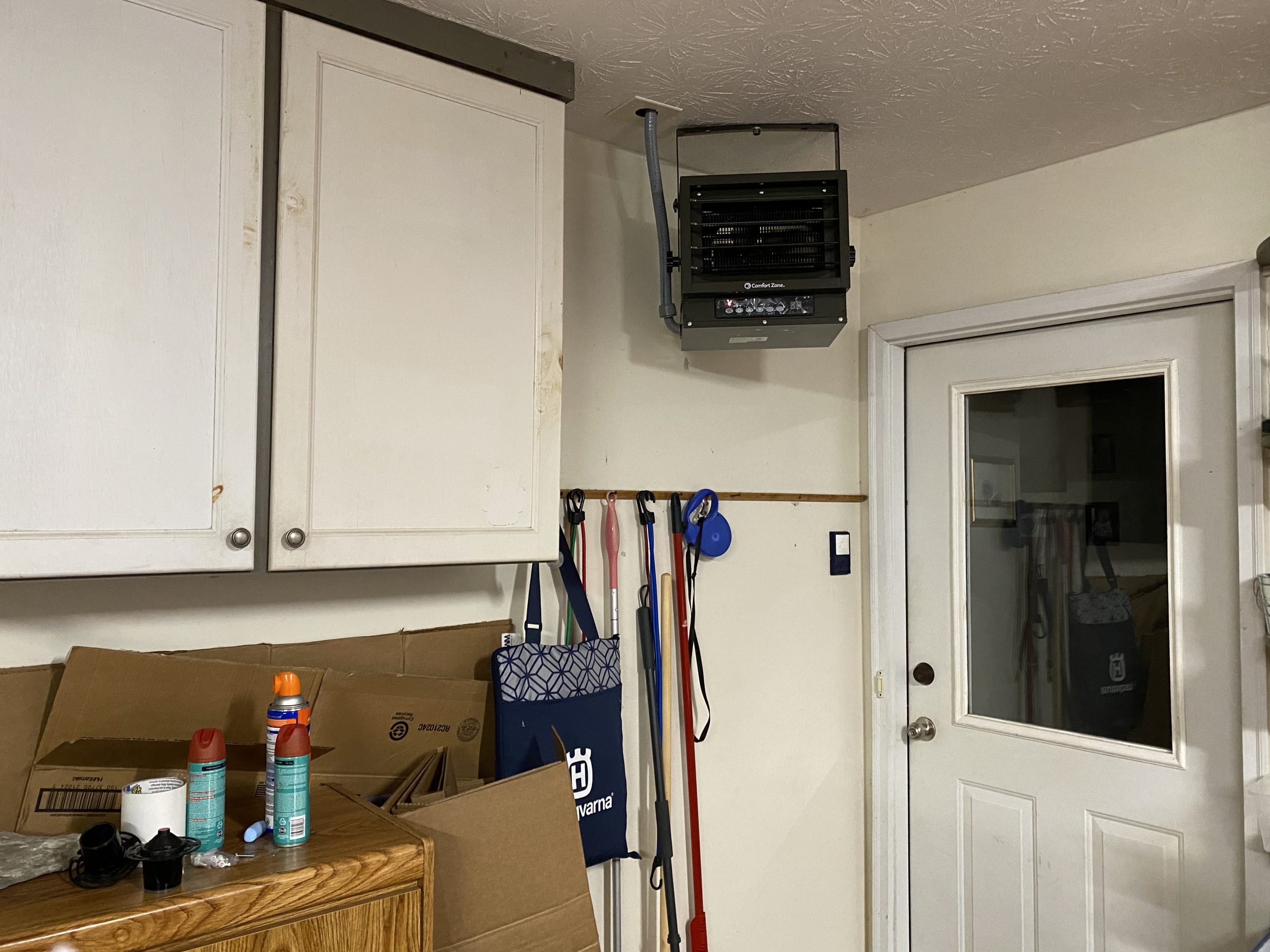
Why the 1,250 sq ft claim holds up more often than not
This unit rates coverage higher than most 7,500W machines, and reviewers back it up in insulated spaces with ceilings at or below 10 ft. We would plan on 900 to 1,100 sq ft of genuinely comfortable heated area.
The gap between the claim and the real number is entirely the envelope. Insulated walls and a low ceiling get you the full rated figure. An uninsulated ceiling with 12 ft of air above your head does not, no matter what the box says.
What to watch before you order
Fan noise comes up often enough to mention. At full output in a quiet garage the fan is audible at the far wall, which matters if you plan to run a bench grinder or listen to music nearby.
It is also hardwired, so the 40A circuit and electrician apply here as they do to every other 240V unit in this roundup. A 1-year warranty against manufacturer defects is on the short side for a fixed install.
3. CTSC 10,000W 240V Ceiling Heater – Best for Maximum Electric Output
CTSC 10000W Garage Heater Electric, 240V Fan-Forced Ceiling Mount Heater
10000W / 34130 BTU
42A circuit
58 dB operating
1-10 hour timer
Pros
- Highest electric output here at 10000W / 34130 BTU
- Four settings including 5000W low and AUTO ECO
- Quiet at no more than 58 dB
- Pre-wired for an external wall thermostat
- SPCC cold-rolled steel with cool touch exterior
Cons
- Requires a 42A hardwired circuit and professional installation
- Smallest review base of the 240V hardwired group at 100 ratings
- No Wi-Fi or app control
If you have ruled out gas entirely and still want the biggest electric punch available, this is it. 10,000W converts to roughly 34,130 BTU, which is about a third more heat than the 7,500W units and the highest output of anything on this list that runs off a standard electrical supply.
The four settings are where this design earns its keep in a large garage. You get 10,000W high, 5,000W low, AUTO ECO, and fan-only. In a well-insulated space on a mild day, the 5,000W setting can hold temperature without the full 42A draw.
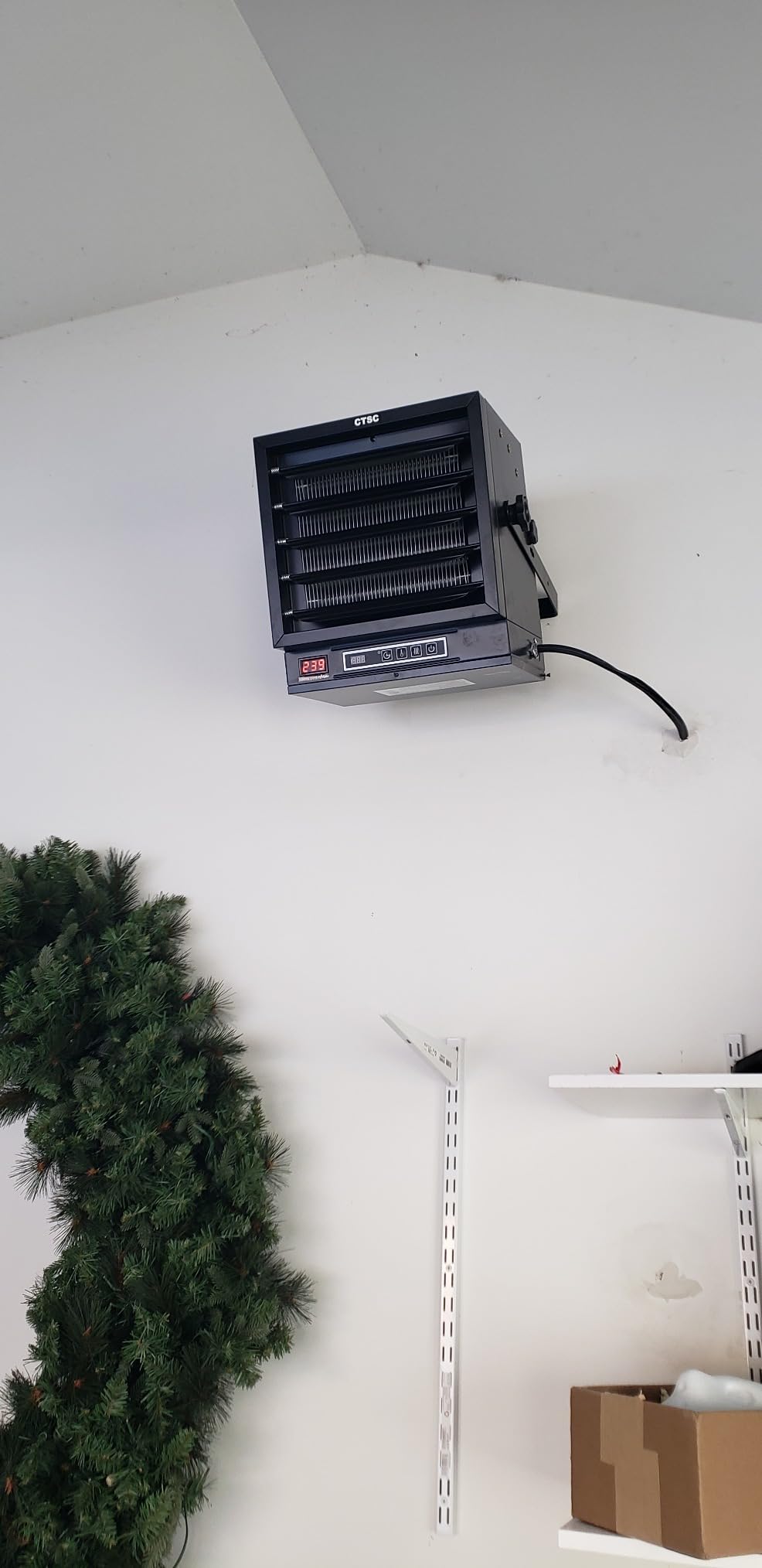
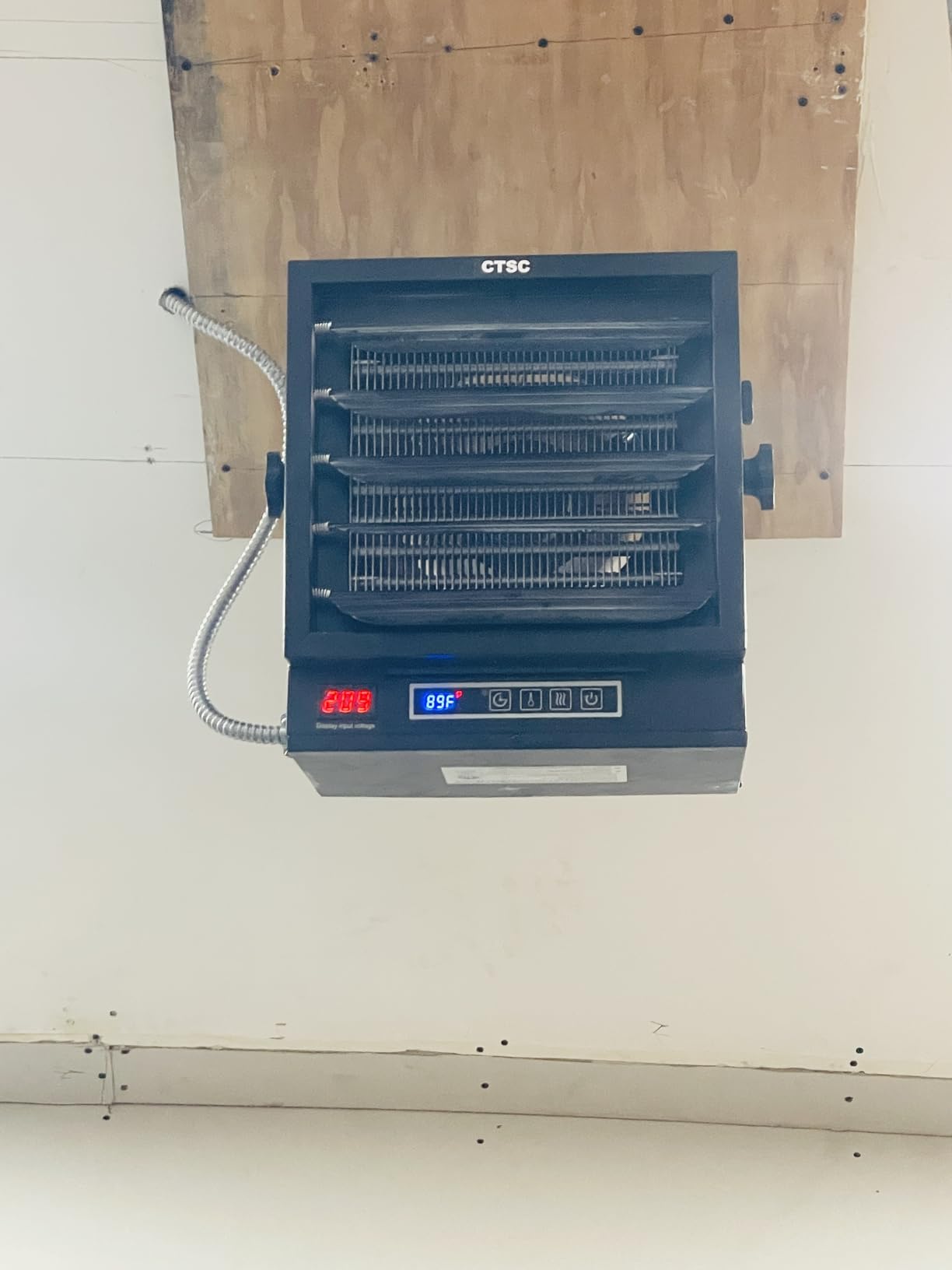
Two details make it easier to live with than the raw output suggests. It runs at no more than 58 dB, the quietest figure in this roundup, and it is pre-wired for an external wall thermostat so you can set the temperature from the wall and stop the unit from cycling wastefully.
The AUTO ECO mode defaults to 77F and drops output to match ambient, going to full 10,000W below 70F. Owners who bought it for large or poorly insulated spaces value that logic, along with the cool-touch SPCC steel body, which stays safer to brush past in a working shop.
Is 10,000W enough for a 1,000 sq ft garage
For an insulated 1,000 sq ft space with a 9 ft ceiling, yes, and it is the only electric unit here that gets there. The manufacturer rates it to 1,000 sq ft and buyers in large insulated spaces report that holds up.
For 1,000 sq ft with no insulation and a 14 ft ceiling, no. The uninsulated multiplier puts you at 50 to 60 BTU per sq ft, and nothing that plugs into a breaker will cover that. Move up to natural gas.
The 42 amp problem
This is the only heater in the list that needs more than a 40A circuit. Some residential garage subpanels are rated 100A total, and if the existing loads are substantial you may need a subpanel or a feeder upgrade before this goes in.
Installation should be professional. The 42A draw on a 50A breaker leaves little headroom, and the unit ships with no power cord, so the wiring is entirely on you or your electrician.
4. Mr. Heater 125,000 BTU Propane Torpedo Heater – Best for 1,500 Sq Ft and Up
Mr. Heater 125,000 BTU Quiet Burner Technology Forced Air Propane Heater
125000 BTU propane
3125 sq ft rated
50% quieter burner
10 ft hose and regulator
Pros
- Highest output portable heater in this roundup
- Rated to 3125 sq ft
- Quiet Burner technology runs about 50% quieter than standard
- Owners report a 1400-1600 sq ft garage warming in 5-20 minutes
- 10 ft hose and regulator included
Cons
- Only high and low settings with no thermostat or modulating control
- Needs a propane cylinder plus power for the fan
- Strong odor on first fire so ventilation is required
This is the honest answer for a very large, draughty garage that nobody has insulated and nobody is about to. 125,000 BTU is more than double anything else portable on this list, and at 17.3 pounds you can still carry it across the space or move it to a second building.
The rated coverage is 3,125 sq ft. Buyers with 1,400 to 1,600 sq ft attached garages report going from 30 to 50F to comfortable in 5 to 20 minutes, which is a genuinely different experience from an electric unit crawling toward temperature.
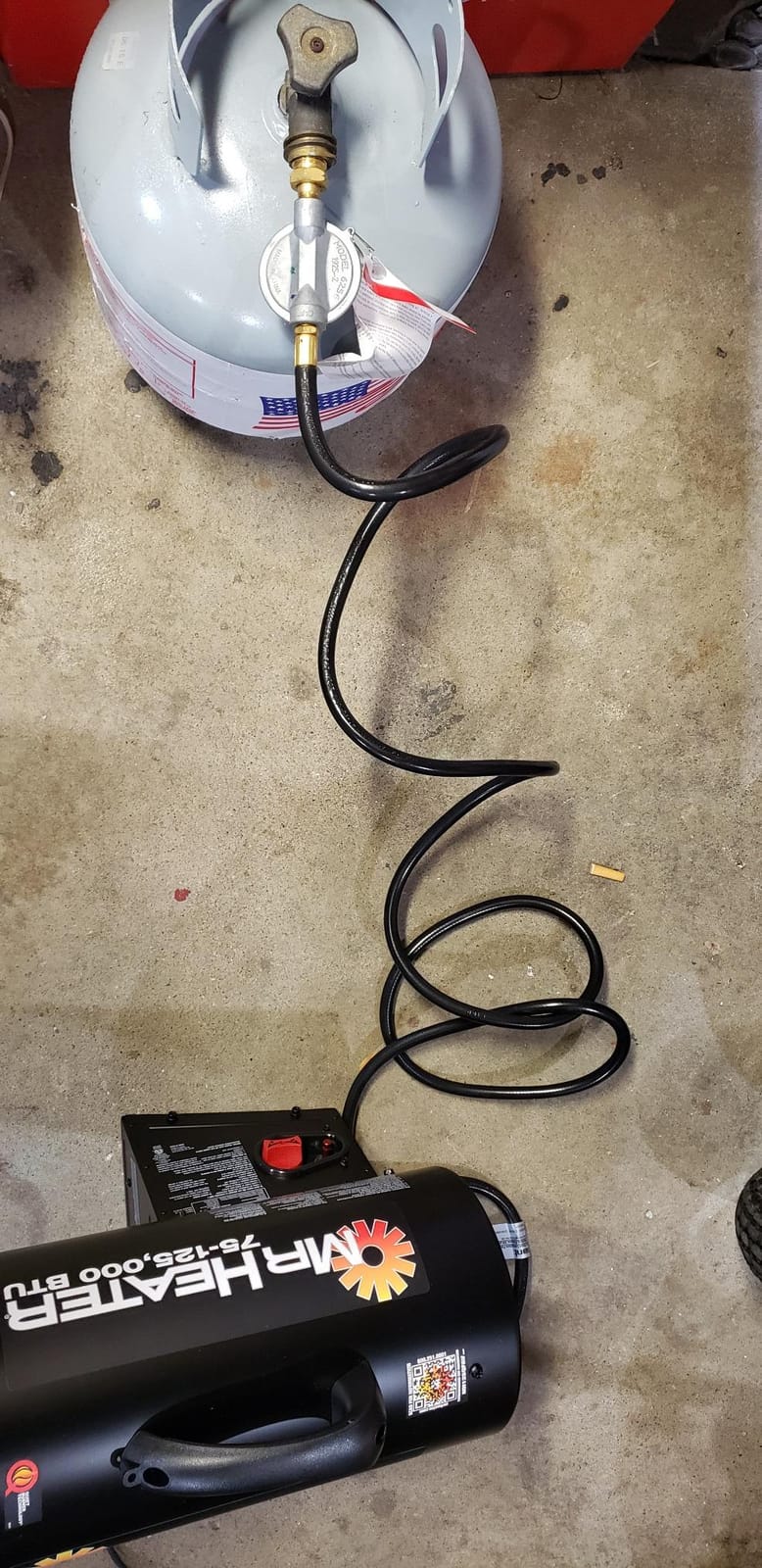
Quiet Burner technology is the feature that separates it from the pack. It runs about 50 percent quieter than a standard propane heater of this size, and buyers with high-ceiling shops say it is the reason they can work next to it rather than at the far end of the building.
The split barrel design makes servicing straightforward, and the high-temperature limit switch and 10 ft hose with regulator come included, so you are not hunting for fittings on install day.
When 125,000 BTU is the right answer
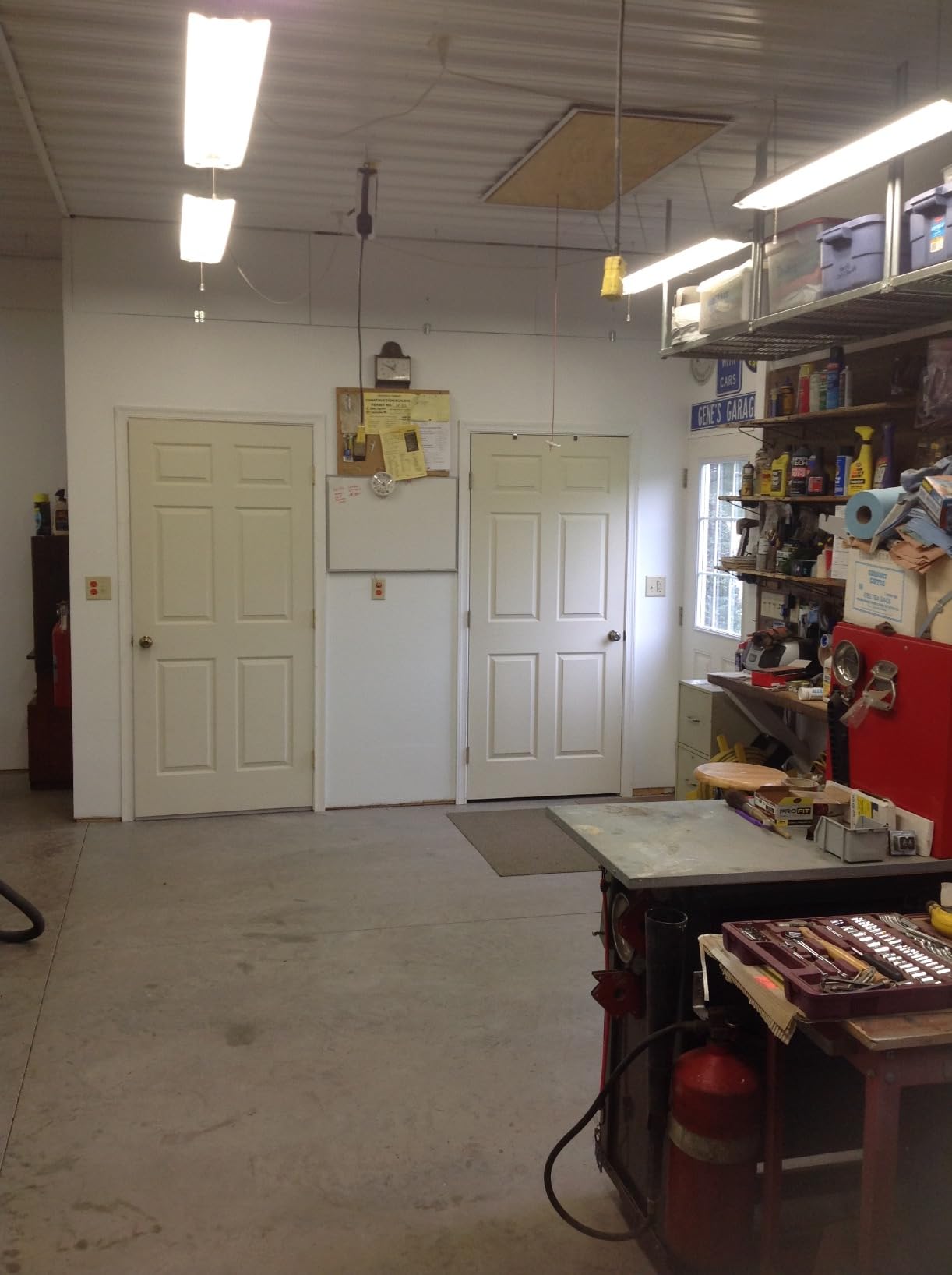
Uninsulated garages of 1,500 sq ft and up. Very high ceilings, 14 ft and beyond, where the air volume is enormous. And any situation where you need the space usable in minutes rather than an hour, such as a Saturday morning project with the family in the house.
It also works well as a garage door is being opened repeatedly, which is when heat escapes fastest and an electric unit never recovers.
What you give up for that output
There is no thermostat. You get high and low, and that is it, so temperature control is your judgement and your watch. Runners who want set-and-forget heating find this the main reason to move up to the wall-mounted unit heater.
Fuel consumption is the other tradeoff. Owners report it drinking propane faster than the 60,000 and 80,000 BTU heaters, which is expected but worth budgeting for if you plan to run it all evening. And expect odor on the first fire, so crack a door or vent the space until the combustion settles.
5. Mr. Heater 80,000 BTU Natural Gas Unit Heater – Best Fixed Install for Shops 2,000 Sq Ft and Up
Mr. Heater 80,000 BTU Forced-Air Unit Heater (Propane or Natural Gas)
80000 BTU gas or propane
2667 sq ft rated
2.3A at 120V
10-year heat exchanger warranty
Pros
- Rated to 2667 sq ft for a permanent ceiling mount
- Converts between natural gas and propane with the included kit
- Very low electrical draw at about 2.3 amps
- Works with 24V and Wi-Fi thermostats sold separately
- 10-year limited warranty on the heat exchanger
Cons
- Venting hardware thermostat and gas fittings are all extra costs
- Professional installation normally needed for code clearances
- Regular cleaning needed to keep the fan quiet
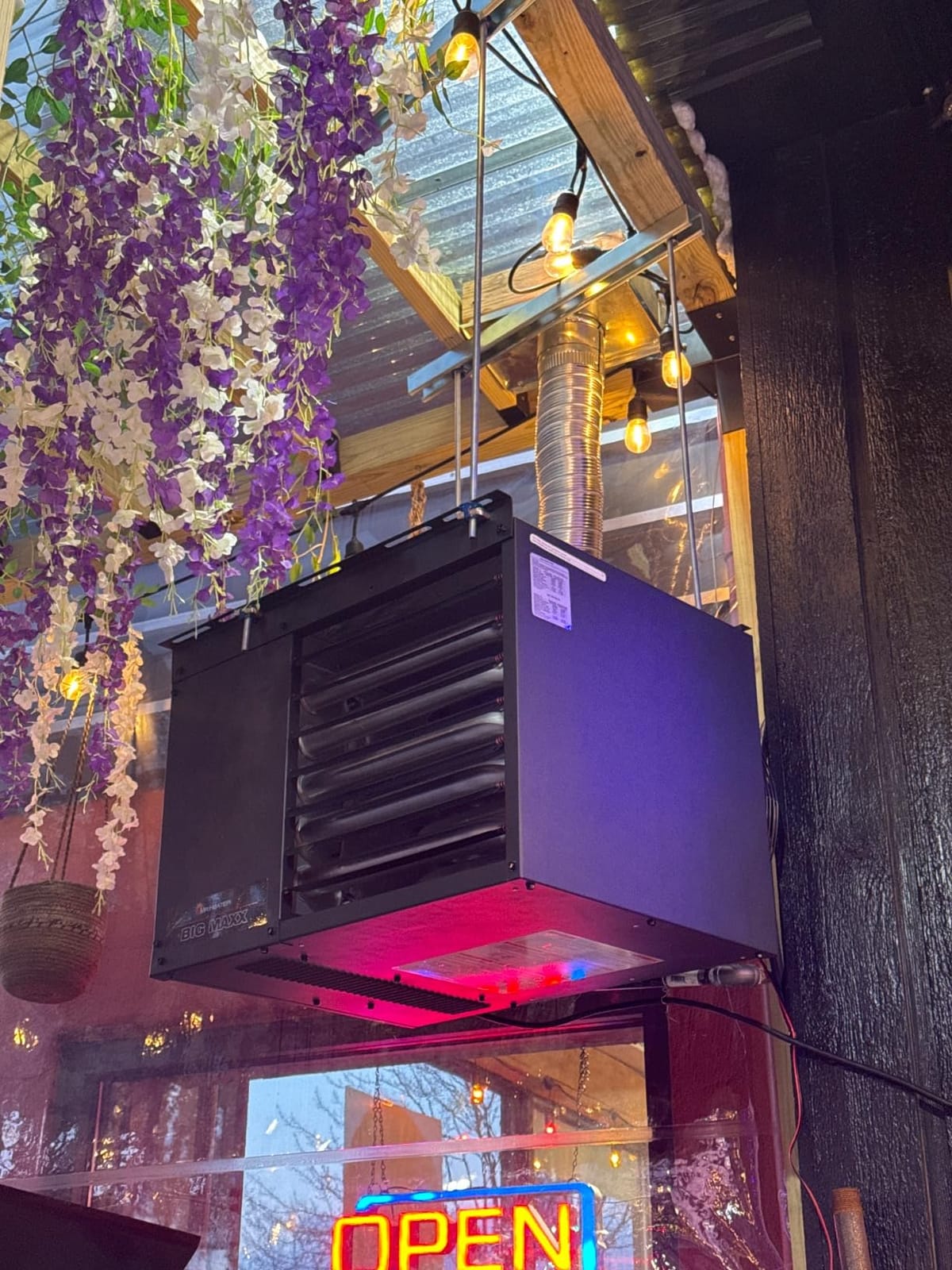
This is the only unit in the roundup that a plumber mounts to a gas line and leaves for a decade. 80,000 BTU covers 2,667 sq ft, it hangs from the ceiling on included angle brackets, and the electrical requirement is about 2.3 amps at 120V, which is a plugged-in thermostat and almost nothing else.
Owners with insulated 1,300 to 2,400 sq ft shops describe holding temperature across full winters on roughly a gallon of fuel a day. That operating profile is what separates a fixed unit heater from every portable in this list.
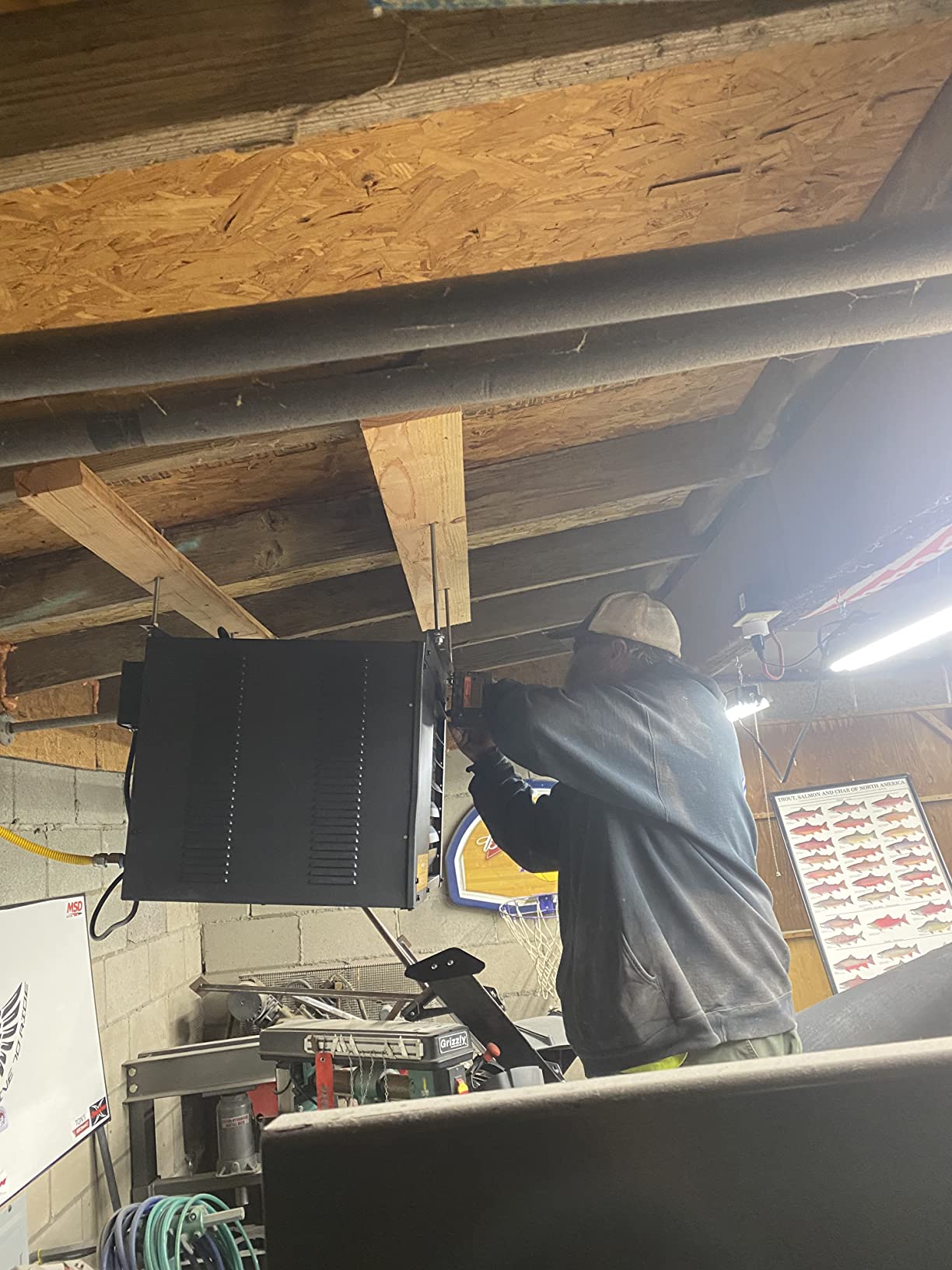
The included natural gas to propane conversion kit means you are not locked in at install. There is no pilot burner to clean seasonally either, and the conversion instructions are clear enough that a gas fitter will not charge you extra for it.
It accepts standard 24V thermostats, including Wi-Fi models sold separately, so you can wire in smart control that lets you preheat before you get there. Owners running early-morning shops tend to consider that the single most valuable feature on the unit.
Clearance rules you cannot ignore on this one
The low profile design calls for a 10 ft minimum ceiling height and 8 ft of clearance from the base of the heater down to the floor. If your ceiling is under 10 ft, this unit is not the right shape for the room.
That ceiling height rule is worth knowing before you buy, because it is a hard number from the manufacturer rather than a guideline. Shop owners with 9 ft ceilings should look at a wall-mounted or torpedo unit instead.
What the installed cost really looks like
The unit is the cheap part. Venting hardware, the 24V thermostat, gas line fittings, and the labor to connect it all sit on top, and reviews consistently flag total installed cost as the dominant caveat.
Set against that, the 3-year parts and 10-year heat exchanger warranty is the longest coverage in this roundup by a wide margin. A few owners reported short-cycling control board issues that needed repeated diagnostics, so keep the manual and expect to troubleshoot occasionally.
6. Remington 60,000 BTU Propane Forced Air Heater – Best for Two-Car Garages
Remington LP Forced Air Heater, Portable 60,000 BTU Space Heater for up to 1500 Square Feet – Liquid Propane Gas Powered, Tank Not Included
60000 BTU propane
1500 sq ft rated
11 lb total
10 ft hose and regulator
Pros
- Heats an insulated two-car garage in about 10 minutes
- Lightest unit in the roundup at 11 pounds
- Electronic ignition needs no manual relighting
- 10 ft LP cylinder hose and regulator included
- Thermocouple plus high temperature limit and flame-out fuel cut-off
Cons
- Very loud in operation which limits use in occupied spaces
- Variable heat adjustment is coarse at this output
- Short power cord and the LP connector needs tightening
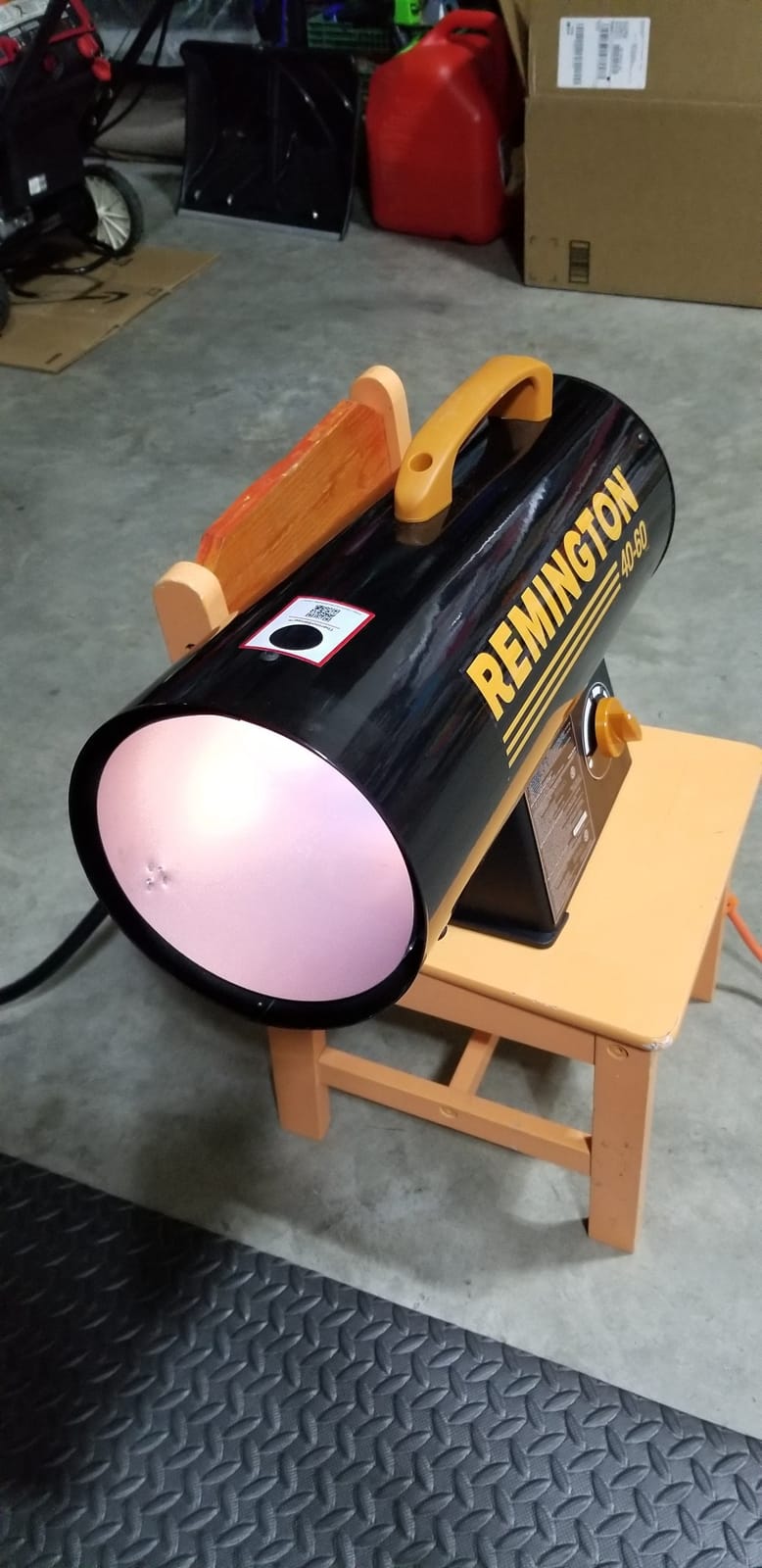
Sixty thousand BTU is the sweet spot for a standard two-car garage with insulated walls and an uninsulated ceiling, which is the most common real-world configuration. Buyers report reaching working temperature in about 10 minutes, and at 11 pounds it is the easiest unit here to carry out of storage or onto a job.
The safety package is genuinely thorough for a portable. You get a thermocouple, a high-temperature limit shut-off, flame-out fuel cut-off, and continuous electronic ignition so there is no pilot to relight after it goes out.
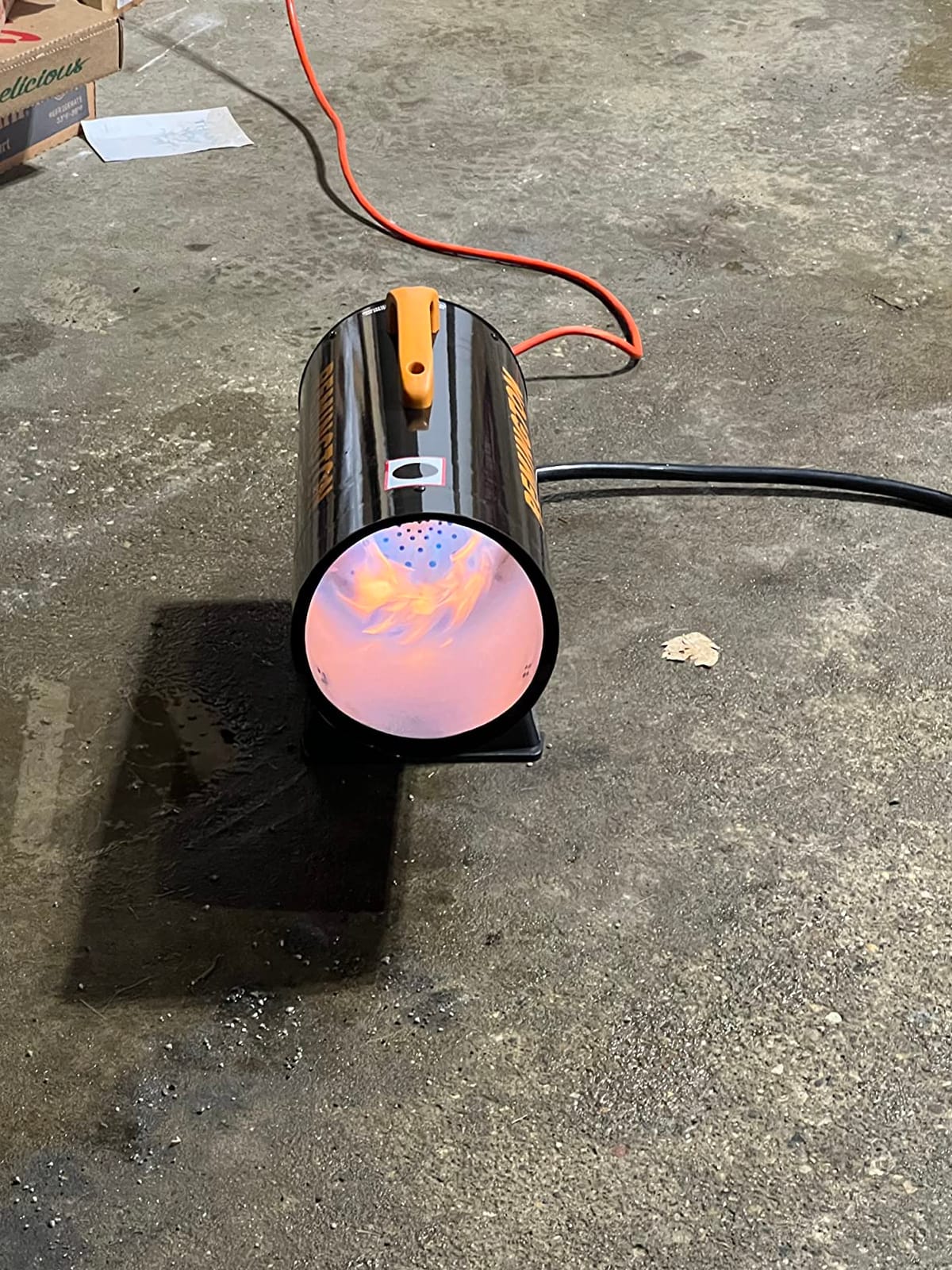
The 10 ft propane cylinder hose and regulator are included, and you run it off a 20 lb tank. Tank not being included is normal for the category, and it is the one purchase this needs that the box does not cover.
Owners moving up from small electric garage heaters describe a decisive jump in warm-up time. The heat-sensitive sticker on the tube that shows when the metal has cooled enough to touch is a small touch, but it tells you the manufacturer thought about a working shop rather than a living room.
How big a garage 60,000 BTU genuinely covers
About 1,500 sq ft rated, and owners confirm that figure in a two-car garage with insulated walls. Add an uninsulated ceiling and you are still in range for most winters.
Push past 1,500 sq ft, add a 12 ft ceiling, or open the overhead door more than a few times a day and you will notice it running out of headroom. That is the point to step up to the 80,000 or 125,000 BTU units.
The noise problem nobody warns you about
This is the loudest unit in the roundup by a wide margin, and several owners returned units over noise alone. It is a forced air burner throwing a lot of air through a small fan, and the noise is broadband and constant.
If the garage is where you work, with a bench and a laptop near you, that noise is a real cost. If it is a storage space or a place you stand in for five minutes with a coffee, it does not matter. Also expect the variable heat adjustment to feel coarse, since 60,000 BTU is already close to what a two-car space can absorb before it overheats.
7. ROVSUN 7,500W Ceiling Heater – Best for App and Phone Control
ROVSUN 7500W Electric Garage Heater with Remote & APP Control, Digital Fan-Forced Ceiling Mount Heater with Thermostat, 12H Timer & Overheat Protection, 240V Hardwired for Workshop Factory
7500W / 25000 BTU
1200 sq ft rated
App plus remote control
31A draw
Pros
- Only unit in the roundup with app control on top of panel and remote
- 25000 BTU covers up to 1200 sq ft
- 12-hour timer with a 45-95F digital thermostat
- Three directional airflow settings at 0 20 and 40 degrees
- ETL certified steel frame with overheat protection
Cons
- Hardwired 240V install with no power cord and electrician recommended
- Smallest review base in the roundup at 46 ratings
- No ECO mode so it runs at full output until the thermostat cuts out
The reason this one earns a place is control. It is the only heater here you can start from your phone, and for a detached workshop or a shop you work in on a schedule, being able to warm the space before you drive over is a genuine convenience rather than a gimmick.
Underneath the app it is a competent 7,500W fan-forced ceiling unit. 25,000 BTU across 1,200 sq ft rated coverage, a 45 to 95F digital thermostat, and a 12-hour timer.
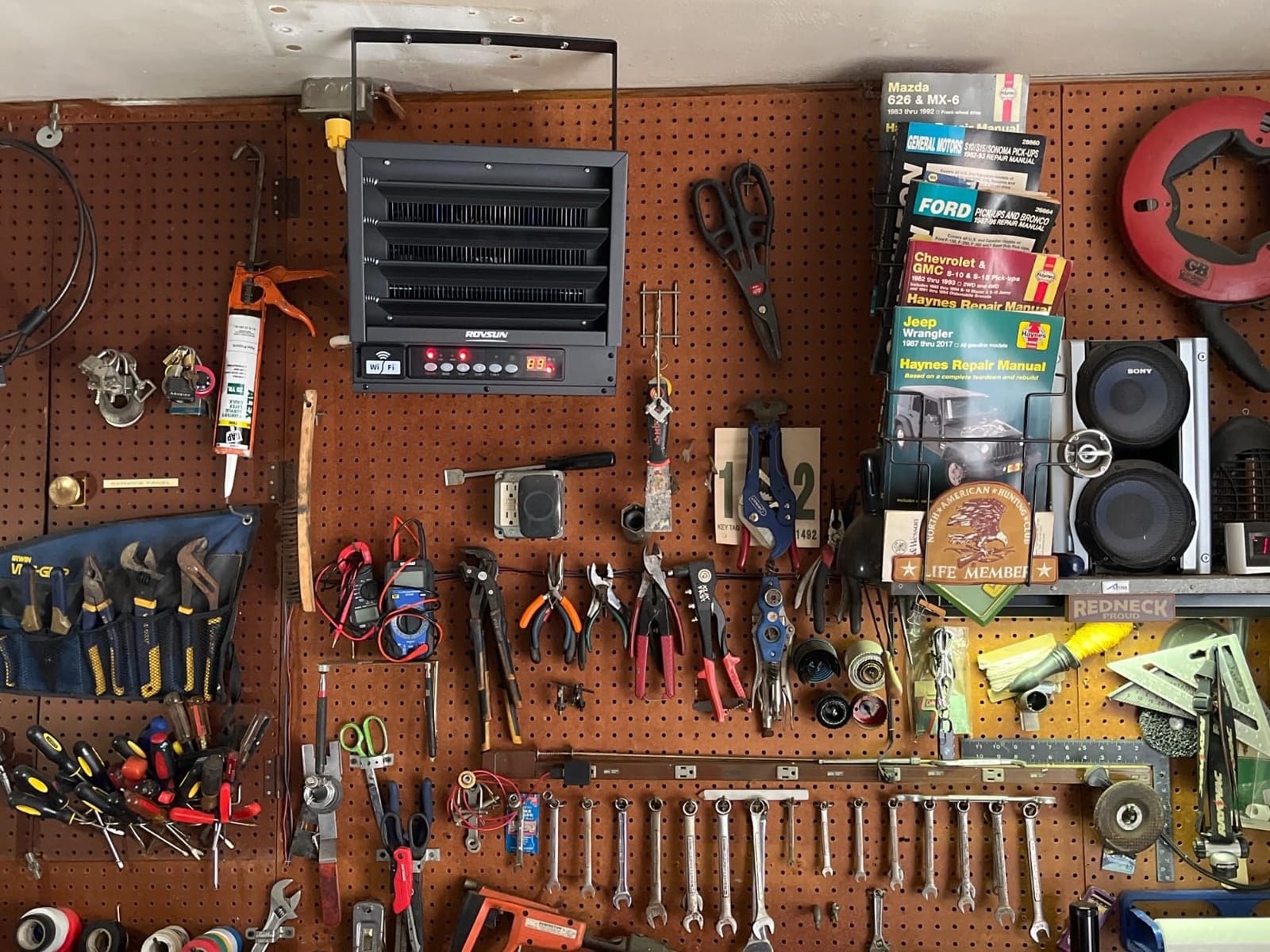
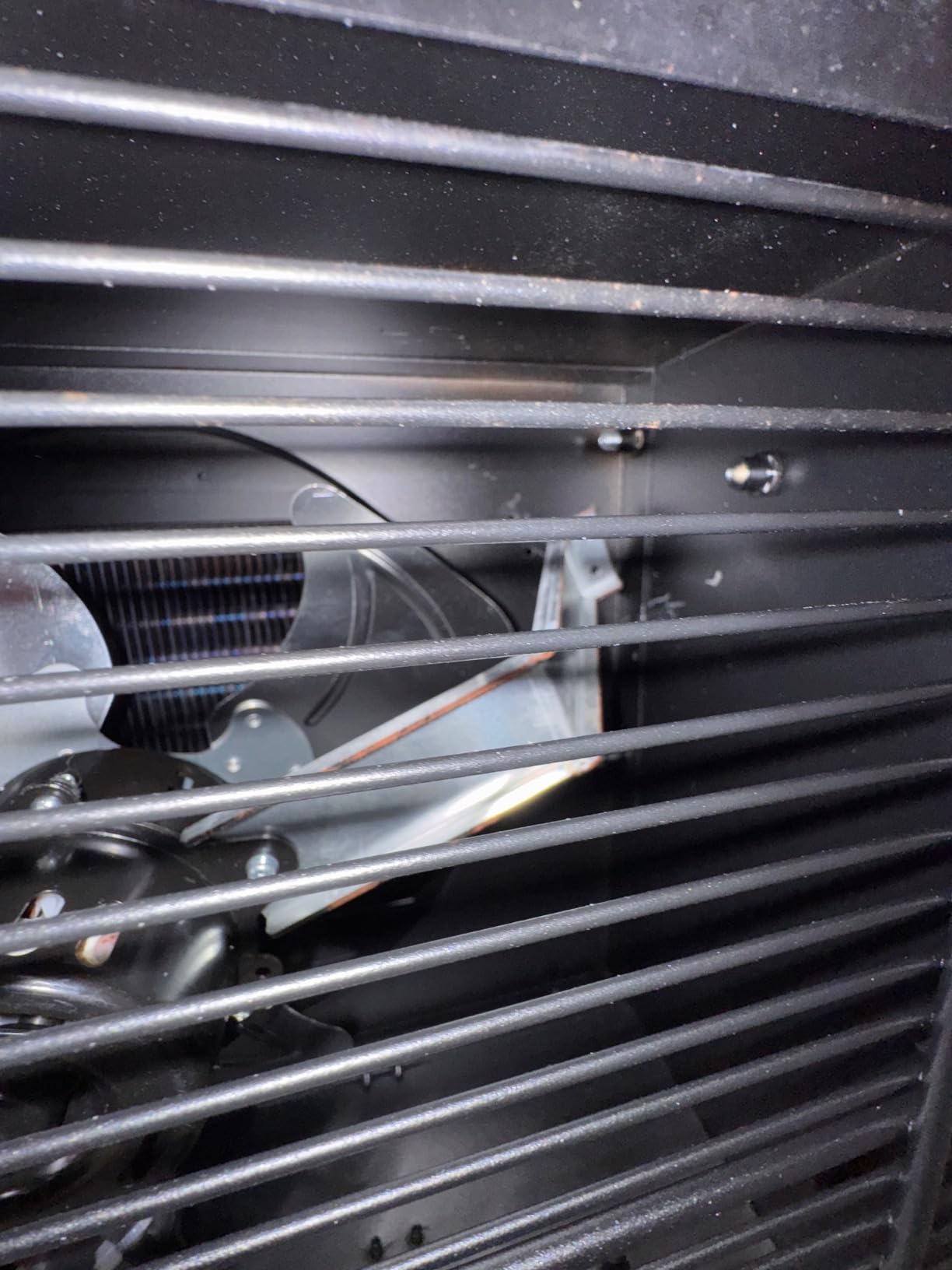
The three directional outlet settings at 0, 20, and 40 degrees are useful in a wide garage where you want the air thrown along the long wall rather than across it. Buyers using it in warehouses, workshops, and greenhouses mention the app as the deciding factor when hardwiring alternatives were not an option.
It is ETL certified with overheat protection, which is the standard you want on a fixed electrical install in a dusty space.
Is app control worth a thinner review history
That depends on how you heat. If you want to preheat a detached shop from inside the house an hour before you leave, the app pays for itself in convenience immediately. If you are home in the garage all day, the remote on the other 240V units does the same job.
The honest caveat is the review base. At 46 ratings it is the thinnest history in the roundup, and while 66 percent of those are five-star, long-term reliability data simply does not exist yet on this unit.
The missing ECO mode
There is no ECO setting described, which means the heater runs at full 7,500W until the thermostat cuts out. In a large well-insulated garage in mild weather that is wasteful, and it is the single most common complaint pattern for fixed-output heaters.
It is hardwired 240V on 8 AWG with no cord included, so budget for an electrician. If you want app control without the hardwire, the InoKraft below is the plug-in route.
8. InoKraft 7,500W Wall Heater – Best for Plugging Into an Existing 240V Receptacle
InoKraft 7500W Electric Garage Heater, 240V with NEMA 14-50P Plug
7500W 240V
NEMA 14-50P plug included
40-99F thermostat
65 dB
Pros
- NEMA 14-50P plug avoids running a new hardwired circuit
- Highest rating of the 240V electric units here
- 24-hour timer is the longest in the group
- ECO mode trims output and cuts power when not needed
- Wide 40-99F thermostat range
Cons
- 750 sq ft coverage is the lowest rating among the 7500W electric units
- Still needs a 240V NEMA 14-50 outlet and professional installation
- Manual high/low plus ECO with no scheduling beyond the timer
The included 8.2 ft cord with a NEMA 14-50P plug is the reason to buy this instead of a hardwired unit. If your garage already has a 240V receptacle on a properly sized breaker, you skip the electrician for the heater itself and just mount the unit.
It also has the best rating distribution of the 240V electric heaters here, with 82 percent of 286 reviews at five stars. Buyers point to the plug as the deciding factor when hardwiring is not an option and to the 24-hour timer for daily workshop routines.
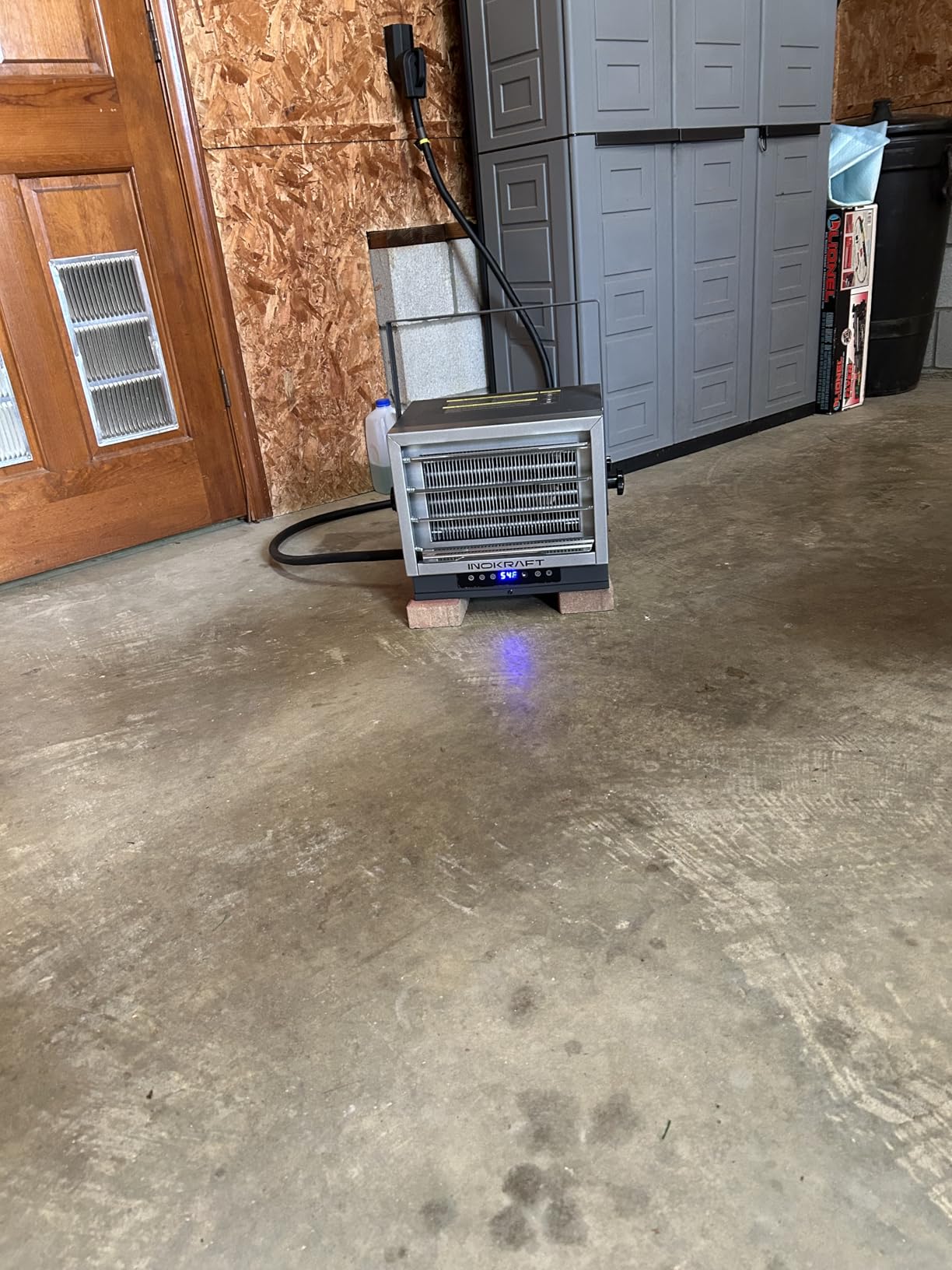
Control options are strong. The digital thermostat spans 40 to 99F, which is the widest range in the roundup, the timer runs 1 to 24 hours, and an intelligent ECO mode adjusts output to ambient and shuts the unit off entirely when it is not needed.
That ECO behavior is exactly what the Dr. Infrared and the ROVSUN lack, and in a large garage where the heater is often oversized for the conditions, that difference shows up on any month where you are not running at full cold.
How this fits a large garage
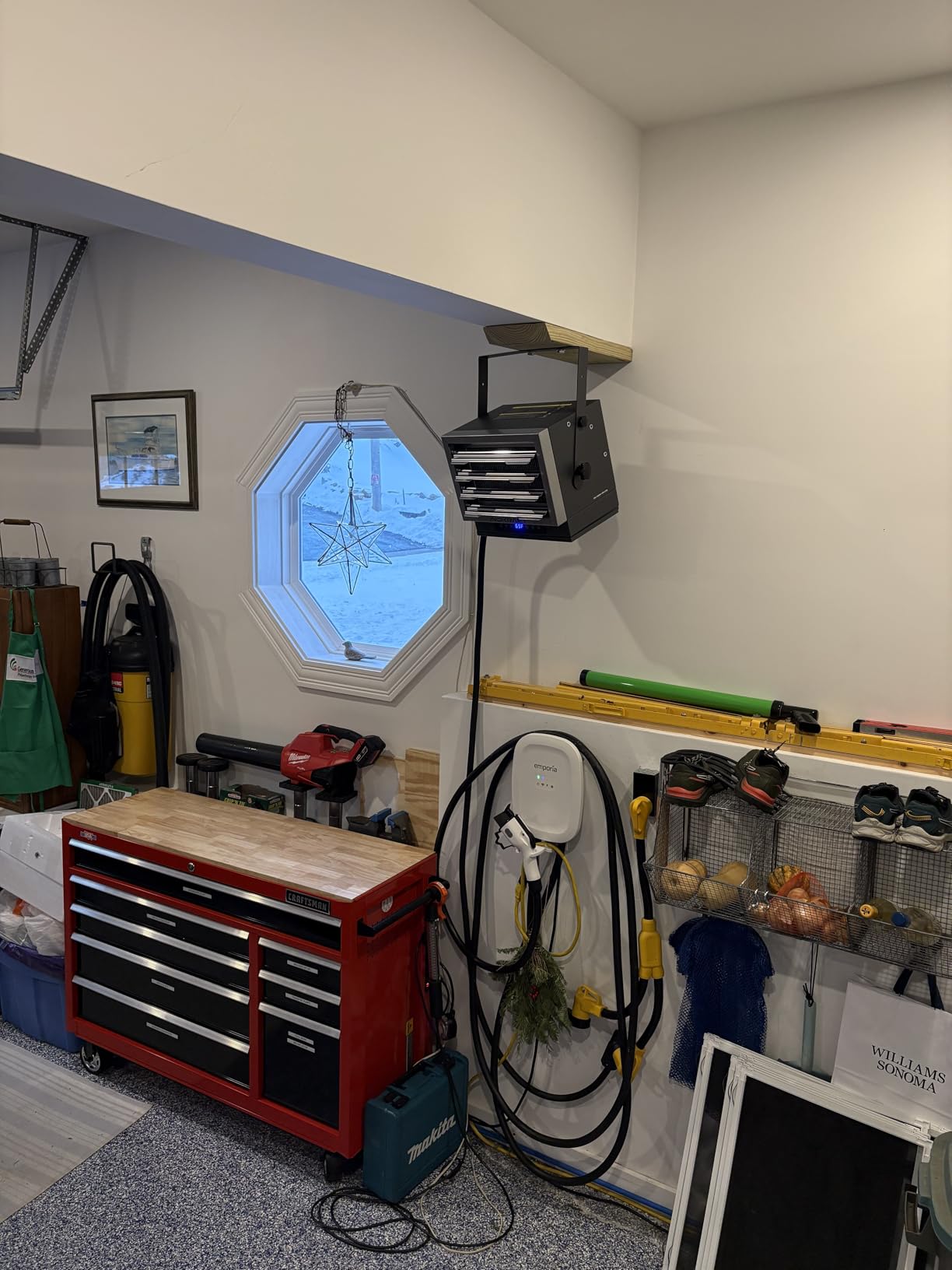
Rated at 750 sq ft, this is the smallest coverage figure among the 7,500W electric units here, and it is worth being clear about. In a large garage you are using it to hold one well-defined zone, not to heat the whole floor plate.
It is a good match for the 15 ft bay at the back of a shop, a home gym corner, or the workbench end of a larger two-car garage. If your goal is the entire 1,200 sq ft, the Comfort Zone or TEMPWARE cover more with the same wattage.
What a plug does not solve
A NEMA 14-50 receptacle still needs a 40A circuit on 8 AWG copper. If your garage only has 120V outlets, this heater does you no good at all, and the installation note is explicit that a professional electrician should handle the outlet.
Control is also slightly more manual than the CTSC. You get high, low, and ECO, but no separate scheduling beyond the 24-hour timer, so if you want weekday and weekend programs you are setting it by hand.
9. DEWALT 68,000 BTU Propane Heater – Best for Cordless Jobsite Use
DEWALT 68,000 BTU Cordless Portable Forced Air Propane Heater
68000 BTU propane
1700 sq ft rated
20V battery or AC
13.2 lb
Pros
- Runs on DEWALT 20V batteries or line voltage so no outlet is needed
- 68000 BTU rated to 1700 sq ft covering a 2.5 to 3 stall garage
- Quiet operation and minimal odor for a propane burner
- 20 lb tank runs roughly 2.5 days on low
- Starts reliably in single digit temperatures
Cons
- No built-in thermostat so it runs high or low until you switch it
- Difficult to start in extreme cold without priming on low
- Loud on the high setting
This is the heater for places with no power at all, or a power outlet on the wrong wall. It runs on DEWALT 20V batteries or line voltage, so a tool trailer, a pole barn, or the far corner of a 40×60 shop is not a problem.
68,000 BTU covers 1,700 sq ft, which puts it into genuine three-stall garage territory. At 13.2 pounds it is the second-lightest unit here and carries in one hand.
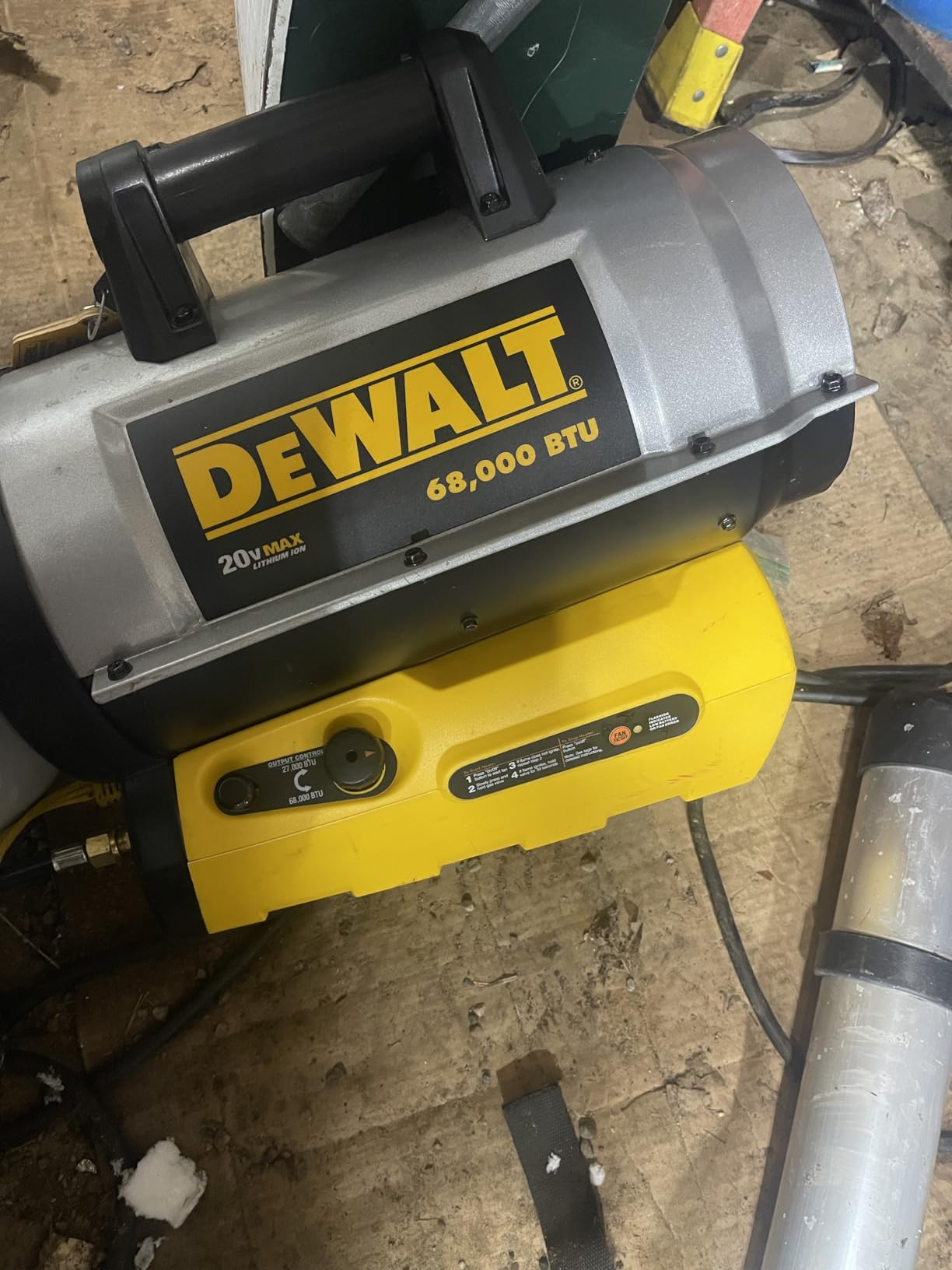
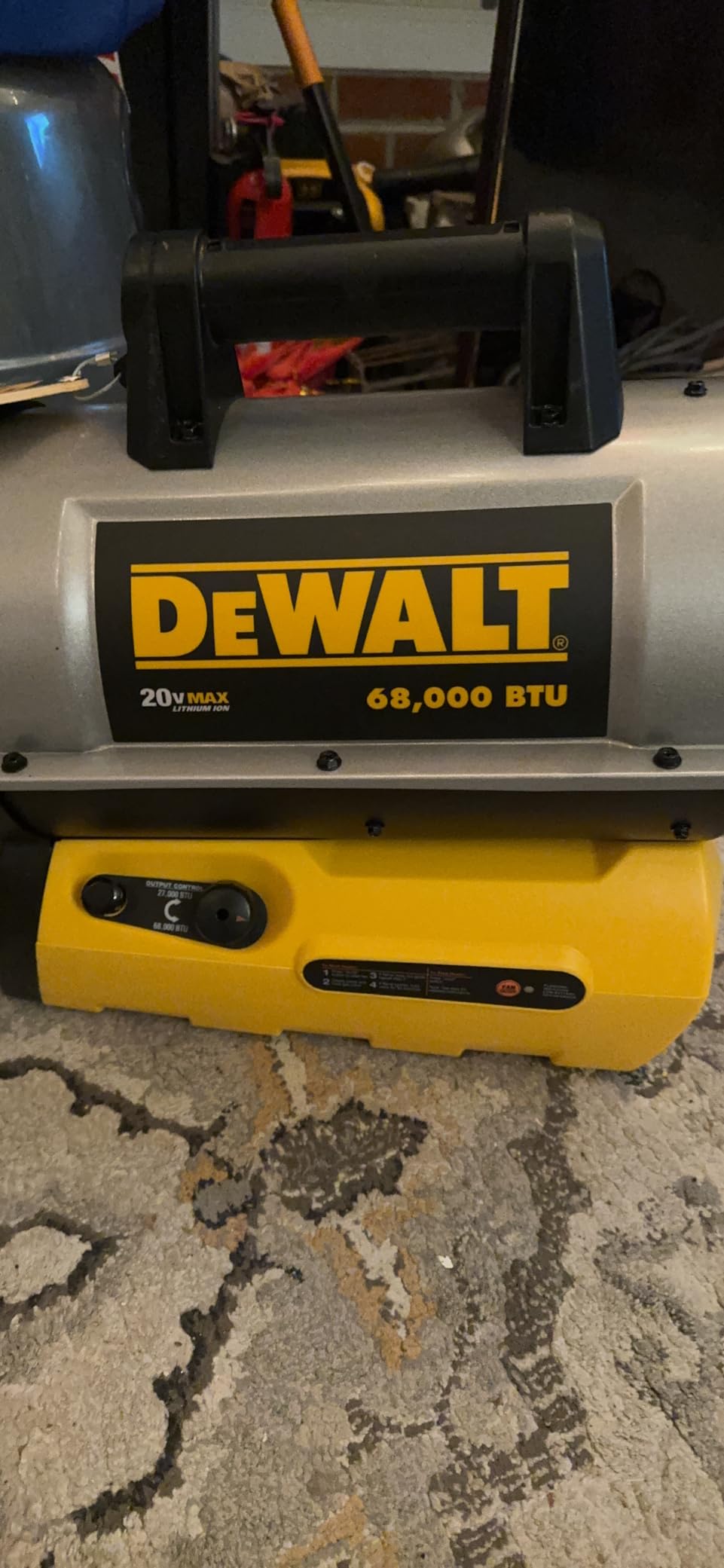
Owners with battery platforms single out running the unit cordless as the feature that made it useful, along with fuel efficiency and clean low-odor combustion. A 20 lb tank runs roughly 2.5 days on the low setting, and it consistently starts even in single digit temperatures.
It is also the quietest of the propane burners in this roundup and heats faster and runs quieter than the Mr. Heater torpedo several owners replaced it with. The 2-year parts warranty is also the longest among the portable gas units here.
Where 68,000 BTU is the right number
Insulated two-and-a-half to three-stall garages, and any space where bringing a cord to the heater is impractical. It also works as a secondary heat source in a large shop where the main unit is on the far side of the building.
Its own coverage rating assumes a well insulated space. In a large open garage with a 12 ft ceiling, buyers note it needs more than 68,000 BTU to hold the far corners, so plan on supplementing rather than relying on it alone.
No thermostat is the deal-breaker to think about
There is no built-in thermostat, so temperature control is entirely manual. You set high or low and adjust when you notice, which is fine for a shop you are standing in and poor for a space you are storing a vehicle in overnight.
Starting in extreme cold can also need a trick: prime it on low with the tank valve barely cracked before opening it fully. And the high setting is loud, so it is not a unit to run beside a bench where quiet matters.
10. TEMPWARE 7,500W 240V Ceiling Heater – Best for Stepped-Down Output Control
TEMPWARE 7500W Electric Garage Heater, 240V Hardwired Heater, 2026 Upgraded
7500W / 25590 BTU
1250 sq ft rated
5000W and 7500W settings
45-95F thermostat
Pros
- Switchable between 5000W and 7500W which matters in an oversized space
- 25000 BTU class output rated to 1250 sq ft
- Digital thermostat from 45-95F with smart ECO mode
- Remote and touch panel control plus a 12-hour timer
- Rugged steel body with automatic overheat protection
Cons
- Hardwired 240V with no power cord included
- No Wi-Fi or app control
- Weight and dimensions are not published in the listing
The 5,000W low setting is the reason to look at this unit in a large garage. If your space is bigger than the heater needs on a mild day, running half output holds temperature at a fraction of the draw instead of cycling full power on and off.
Owners with oversized spaces call that step-down the useful feature, and the smart ECO mode handles it automatically once you set the thermostat between 45 and 95F.
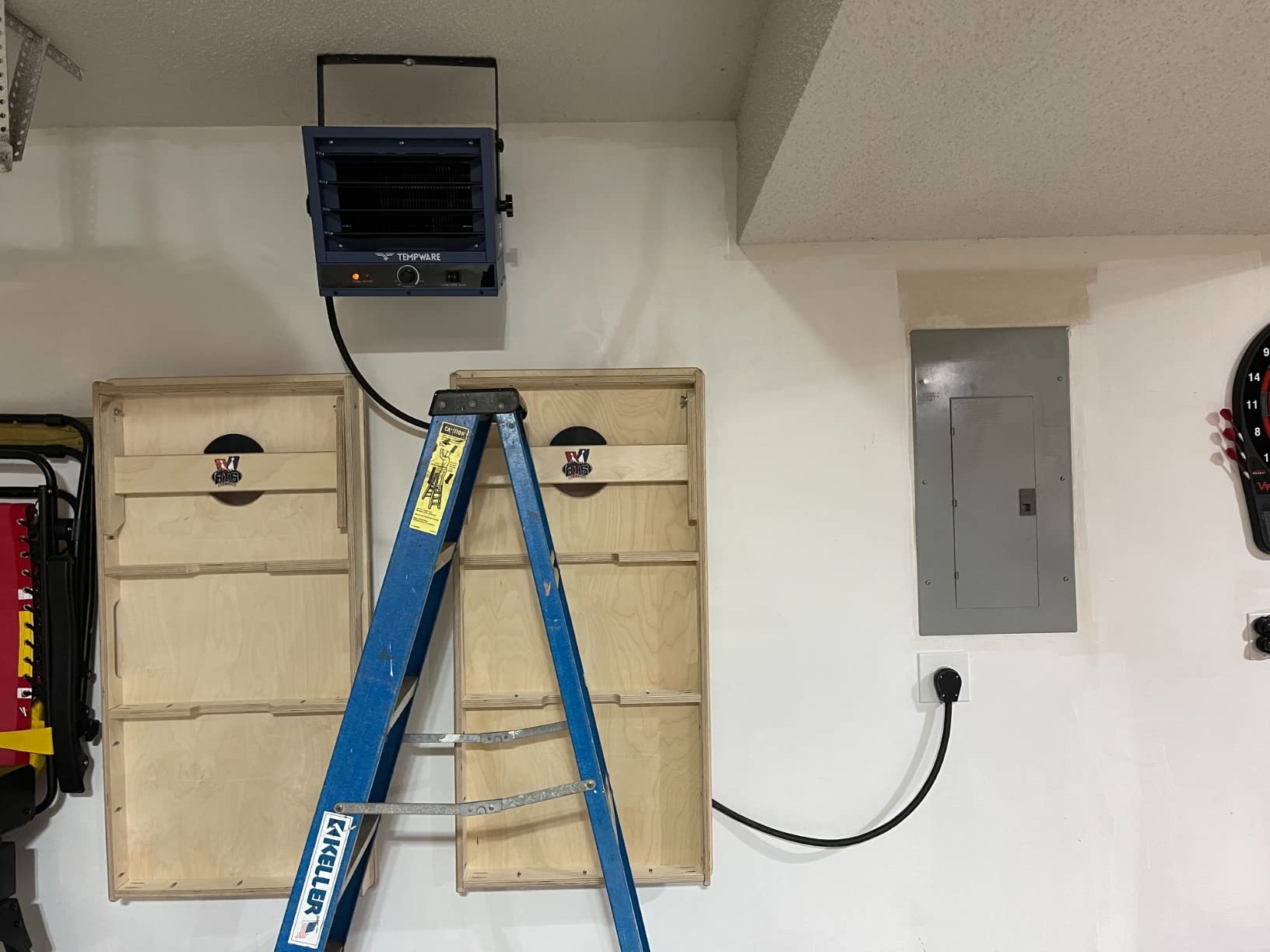
It also rates 1,250 sq ft of coverage, matching the Comfort Zone at the same 7,500W output. At 414 reviews and 4.4 stars, the review volume is in the same range as the other high-volume 240V units, so you are not buying on thin data.
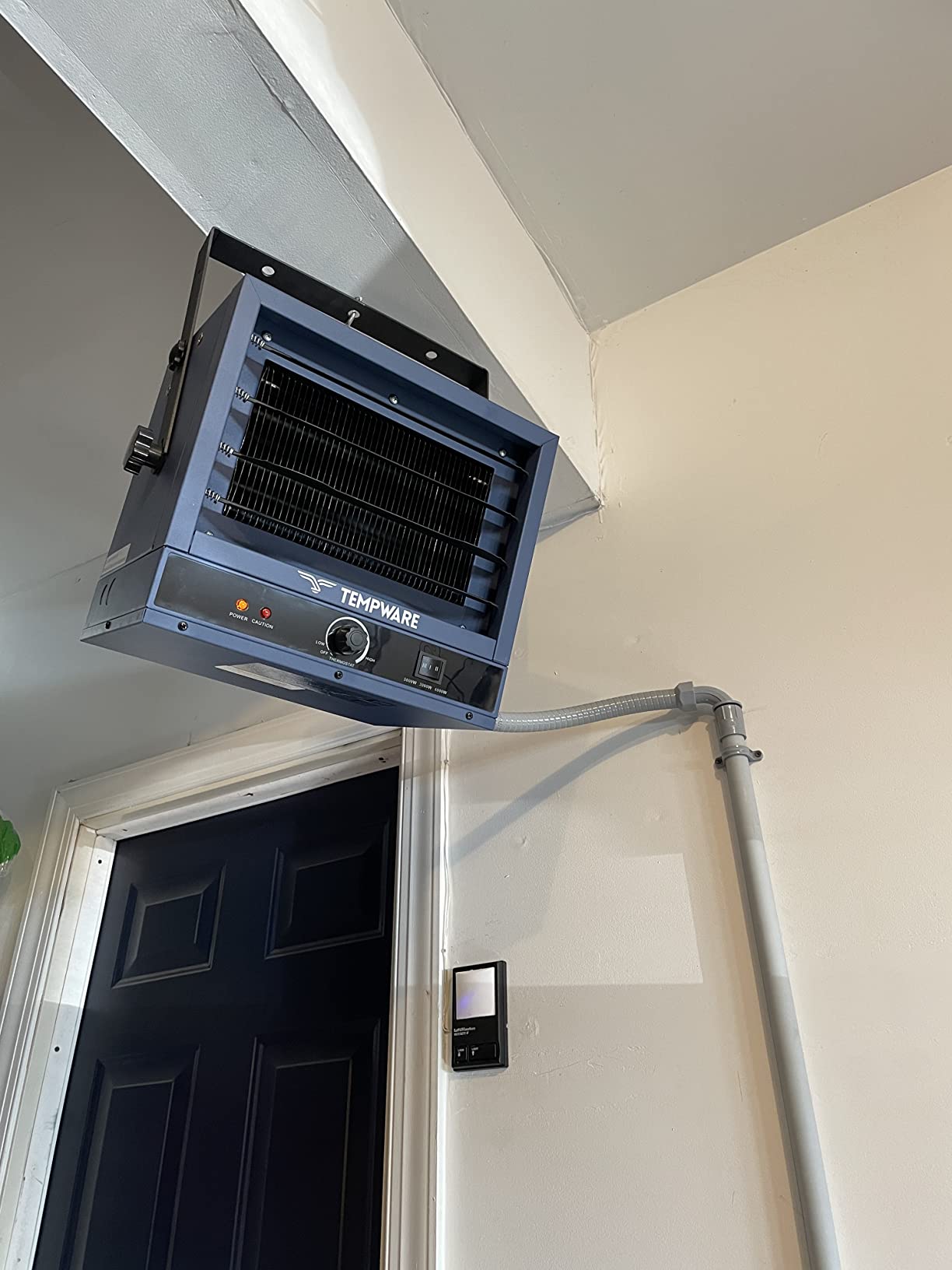
Controls are familiar and complete: a remote, an on-unit touch panel, and a programmable 12-hour timer on a heavy-duty multi-angle ceiling bracket. The steel body has automatic overheat protection.
Choosing between this and the Comfort Zone
They are close: same 7,500W class, same 1,250 sq ft coverage claim, similar digital thermostat, similar 12-hour timer. The TEMPWARE has an explicit 5,000W step-down, and the Comfort Zone has three fan speeds and a slightly wider 45 to 95F thermostat band.
Review volume is close too, at 414 and 2,422. Comfort Zone has far more history; TEMPWARE has the more useful low-output mode. For a garage that stays warm on mild days, the step-down is worth more than the extra reviews.
What is missing
No Wi-Fi or app control, so the ROVSUN is the option if remote start from your phone matters to you. It is hardwired 240V with no cord included, which is the standard trade across this entire category.
One small data gap: the listing does not publish weight or dimensions, so check the manual before you plan a ceiling mount. If you want a unit where the published figures are complete and the range is the widest in the group, the InoKraft covers 40 to 99F.
How to Size a Garage Heater for a Large Garage
Short answer for the most-asked question on this topic: a 20×20 garage is 400 sq ft, and an insulated one in a moderate climate needs roughly 20,000 to 25,000 BTU to hold a working temperature. Push that same 400 sq ft to uninsulated walls and an uninsulated ceiling and you are looking at 20,000 to 28,000 BTU, because the envelope multiplies everything.
Here is how to do the math yourself, in order, and the order matters.
Step one, measure the floor. Multiply length by width, and do not use the builder’s nominal square footage.
Step two, check the ceiling height. Air above head height is volume the heater has to fill and keep warm, and above about 10 ft it starts to matter enough to change which heater type you want.
Step three, assess insulation honestly. Insulated walls, insulated ceiling, and an insulated overhead door is one case. Bare studs and a single-layer overhead door is a completely different case, and in cold zones it can be three times the heat load of the insulated version.
Step four, apply the multiplier. For a moderate climate, budget 40 to 45 BTU per sq ft uninsulated. For a cold climate, 50 to 60. For an insulated space in a moderate climate you can often get away with 30 BTU per sq ft.
Step five, pick the fuel type based on what supply already exists at the property, and only then compare output.
Step six, confirm the ceiling height and clearance rules for the unit you chose, because several of the fixed units have hard minimums.
Ceiling height changes which heater type wins
At 8 to 9 ft ceilings, a fan-forced unit heater works well. The air is a manageable volume and the fan distributes it evenly across the floor.
At 10 to 12 ft, a fan-forced unit still works but needs more clearance and benefits from adjustable louvers to push air down the walls. This is the range where the 80,000 BTU unit heater’s 10 ft minimum ceiling becomes relevant.
At 13 ft and above, radiant output wins. Air heated to the ceiling is air you are not using, and a radiant or torpedo unit puts heat into objects and people rather than into the volume. Forum discussion on garage heating repeatedly surfaces the same advice: with high ceilings you do not need to heat the air, you need to heat what is in the space.
One practical blocker nobody addresses in roundups: ceiling mount units need clearance above parked vehicles. Measure the tallest thing you park, add the required clearance, and check that the bracket height works before you order.
Should you oversize the heater
No, for fan-forced units. Oversizing a fan-forced heater in a space that cannot absorb the output gets you short cycling, a noisy fan, and a thermostat that is on all the time. Modine Hot Dawg comes up repeatedly and favorably by name on garage forum boards for large insulated shops, and the reason owners respect that recommendation is that those units are being matched to the space, not maxed out.
Oversizing in radiant heat is a different story and is sometimes a good idea, because radiant output that exceeds the load is not a short cycle. That is one of the reasons the 125,000 BTU torpedo works so well in big uninsulated garages.
When one heater is not enough
Above roughly 1,500 sq ft with high ceilings, two smaller heaters placed at opposite ends usually beat one large unit. You get more even coverage, faster recovery, and the option to run only one when the weather is mild.
The Mr. Heater 80,000 BTU is designed with this in mind, since it accepts 24V thermostats and has a 10-year heat exchanger warranty. Owners of very large shops commonly run a pair on separate zones.
Natural Gas, Propane, 240V Electric or Infrared: Which Fuel Fits
The choice of fuel is decided by what your property already has, not by which option costs less to buy. A garage with a gas line two feet from the wall and a finished ceiling should not be running propane.
Natural gas unit heaters are the only category here that genuinely scales past 1,000 sq ft with a fixed install. The 80,000 BTU unit covers 2,667 sq ft, draws about 2.3 amps of electricity, and has a 10-year heat exchanger warranty. The costs are venting, a gas line connection, and code clearances, all of which need a professional.
Hardwired 240V electric is the cleanest and safest option. No combustion, no carbon monoxide, no venting, no fuel storage. The limit is electrical: 7,500W units pull 31 amps and the 10,000W CTSC pulls 42, so you are constrained by your subpanel rather than by physics. Every 240V heater on this list needs a dedicated circuit and a licensed electrician.
Propane is the flexible option and the one with the most output per dollar of convenience. The 125,000 BTU torpedo is the strongest portable in the roundup and the only thing here that can heat a 1,500 sq ft uninsulated space. What you trade away is fuel logistics, storage, and the combustion safety conversation.
If your priority is spot heating rather than whole-room heating, an infrared unit makes more sense than anything on this list. Our guide to the best infrared heaters for garages covers that category in depth, including where radiant heat genuinely outperforms forced air.
Diesel is worth a mention for 2,000 sq ft and up spaces where a combustion appliance runs for many hours a day, because it burns cleaner and cheaper per BTU than propane at that duty cycle. It also needs a larger install, which is why none of the ten units here are diesel.
Running cost, roughly
On a per-hour basis, natural gas at 80,000 BTU works out to the lowest heat cost in this roundup, then 240V electric, then the propane torpedo units, then diesel. The published figures vary constantly with local fuel prices, so treat the ranking as the useful part rather than any single number.
Propane tank runtime is the question we get most. A 20 lb tank on a 60,000 BTU heater runs roughly 8 to 10 hours at high output, and owners report longer on low. The DEWALT on its low setting stretches a 20 lb tank to about 2.5 days of intermittent use.
Electrical Requirements for Hardwired 240V Garage Heaters
Every 240V heater here needs a dedicated circuit, and this is where most install day surprises happen. The amp draw is printed on the nameplate, and it decides the breaker and the wire gauge, not the other way around.
The Dr. Infrared, ROVSUN, and InoKraft draw 31.25 amps and the Comfort Zone draws 31.3 amps. That is a 40A circuit on 8 AWG copper, which is the common configuration for most 240V shop heaters.
The CTSC at 10,000W draws 42 amps. That needs a 50A circuit, and on a residential garage subpanel it sometimes needs a feeder upgrade rather than a simple breaker addition. If your subpanel is 100A with existing loads, get an electrician on site before you buy.
The ROVSUN and Dr. Infrared both specify 8 AWG copper. Running that through a garage wall or ceiling is not a DIY job, and the CTSC listing explicitly recommends professional installation. Plan for a permit, which most jurisdictions require for a new 240V circuit.
The InoKraft and the DEWALT are the only two that avoid most of this. The InoKraft ships with an 8.2 ft NEMA 14-50P cord, and the DEWALT runs on a 20V battery or line power. Both still need a properly installed outlet, they just do not need a new circuit for the heater itself.
For the gas units, the electrical requirement is trivial. The Mr. Heater 80,000 BTU pulls about 2.3 amps at 120V, and the propane portables need only enough power to run the fan.
Garage Heater Safety: CO Detectors, ODS and Mounting Clearances
Install a carbon monoxide detector in any garage where a fuel-burning heater runs. Not in the hallway, in the garage. Owners on home improvement boards are consistent on this, and it costs a fraction of what an unattended combustion appliance in an enclosed space is worth.
An oxygen depletion sensor is not the same thing, and the distinction matters. An ODS shuts the heater down when oxygen in the room drops below safe levels, which protects against displacing your oxygen supply. It does not directly detect carbon monoxide, and it does not protect a person who is asleep or unconscious. Keep the CO detector.
Combustion appliances and attached garages carry a code layer. Venting requirements, combustion air, clearances to combustibles, and whether a combustion appliance is permitted at all in a space attached to living space are all governed locally. A gas fitter or HVAC contractor should confirm the requirements in your jurisdiction before the unit goes in.
Clearance figures from the manufacturer are not suggestions. The 80,000 BTU unit heater needs a 10 ft minimum ceiling and 8 ft from the base of the heater to the floor. The Remington carries a heat-sensitive tube sticker specifically so you know when the metal has cooled enough to touch. Respect both.
Ventilation matters most on first fire and during running. Owners of the 125,000 BTU torpedo report strong odor when it first fires, and that is normal combustion settling. Crack a door or vent the space until it clears.
For electric units the safety profile is simpler but not absent. All of them carry overheat protection, and the Dr. Infrared, CTSC, and ROVSUN are UL, CUL, or ETL listed. Keep the unit clear of stored material and off the floor in a wet workspace.
Attached vs Detached Garages: Fix Heat Loss Before Buying a Bigger Heater
On an attached garage, the biggest variable is not the heater, it is the door. An uninsulated single-layer overhead door is a very large hole in the envelope, and forum users report it as the hidden culprit behind most claims that a garage heater is not working.
The order of operations that makes sense is envelope first, heater second. Insulating the overhead door and the ceiling typically does more for comfort per dollar than stepping up to a larger heater, and it lets a smaller heater hold a higher temperature because it is not fighting constant loss.
There is a code-driven side to this too. Separating a garage from living space with a fire-rated barrier and a self-closing fire-rated door addresses safety and heat loss in one project, and it is a more defensible use of money than chasing a higher-BTU unit.
There is a second lever worth considering. A sealed, insulated floor holds temperature noticeably better than a bare slab, which matters most in a pole barn or a shop over an unconditioned crawlspace. If a bare slab is the issue, our guide to garage floor coating kits covers the options. Improving the space first, then sizing the equipment, is the order that pays off.
On an uninsulated garage, be realistic. No heater in this roundup holds a comfortable temperature in a 1,200 sq ft uninsulated space in a cold climate, and the honest answer is that the 125,000 BTU propane torpedo gets you close enough to work, not to sit comfortably for hours. Owners in that situation typically pair it with a space heater at the bench, or accept a shorter working season.
Frequently Asked Questions
What size heater do I need for a 24×24 garage?
A 24×24 garage is 576 sq ft. An insulated space with ceilings at or below 9 ft typically needs 17,000 to 20,000 BTU in a moderate climate and closer to 30,000 BTU uninsulated in a cold one. For that size, a 7,500W hardwired unit or the 60,000 BTU propane heater both cover it comfortably.
How many BTUs do I need to heat a 20×20 garage?
A 20×20 garage is 400 sq ft. Insulated in a moderate climate, budget 20,000 to 25,000 BTU to hold a working temperature. Uninsulated walls and ceiling in a cold climate push that to 25,000 to 30,000 BTU. A 5,000W to 7,500W electric unit or a 60,000 BTU propane heater handles that range.
Is it cheaper to heat a garage with propane or electric?
On a per-hour basis 240V electric usually runs cheaper than propane, and natural gas is cheapest of all at high output. Electricity has no storage or delivery overhead, while propane adds tank logistics and diesel burners cost more per BTU than either. Ranked by running cost, natural gas is lowest, then electric, then propane, then diesel.
Is it safe to run a propane heater in an enclosed garage?
A propane heater can be run in a garage with a carbon monoxide detector installed, a working oxygen depletion sensor, and ventilation, particularly on first fire. ODS protects against oxygen depletion but does not replace a CO detector, since it cannot detect carbon monoxide in a sleeping or unconscious person. Check local code for combustion appliances in attached garages.
Do I need an electrician to install a garage heater?
For any hardwired 240V unit on this list, yes. The 7,500W heaters pull about 31 amps and the 10,000W CTSC pulls 42, each requiring a dedicated circuit, correct wire gauge, a breaker, and usually a permit. The InoKraft ships with a NEMA 14-50P plug and the DEWALT runs on a battery, which removes most of that work if you already have a proper outlet.
Conclusion
Start with the number, not the brand. A large insulated garage around 1,000 sq ft needs roughly 40,000 to 60,000 BTU, and that answer eliminates most of what is sold online. Uninsulated or tall spaces need a step up, not a step across.
Pick by size. A two-car garage is the Remington 60,000 BTU or a 7,500W hardwired unit. A three-stall or a 1,400 sq ft workshop is the DEWALT 68,000 BTU. A very large or draughty space is the Mr. Heater 125,000 BTU torpedo. A permanent shop of 2,000 sq ft and up with a gas supply is the Mr. Heater 80,000 BTU unit heater, and nothing else in the roundup serves that space as cleanly.
And before any of them goes in, fix the overhead door and the ceiling. No heater in this list outruns a bad envelope, and if cooling is also on your list our picks for large-garage ceiling fans handle the other half of the year.