
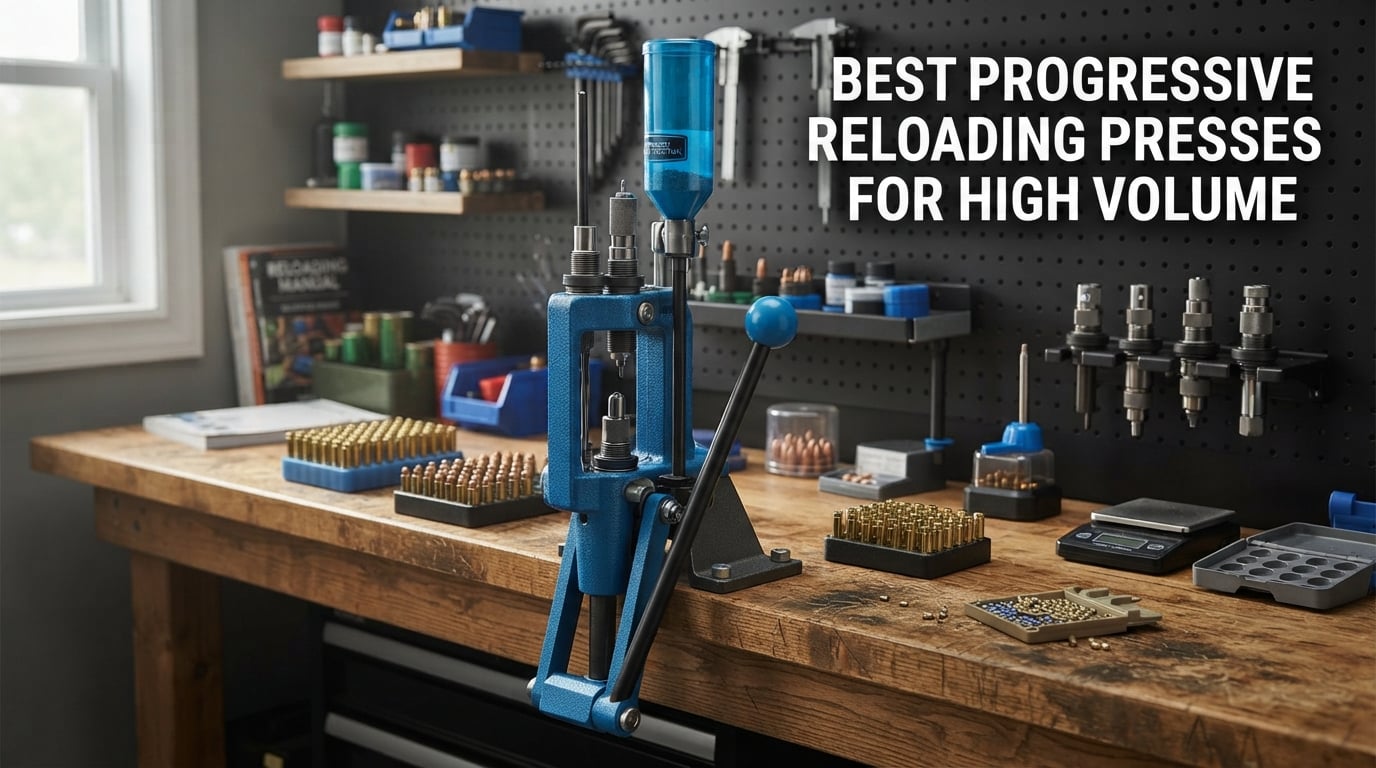
A progressive reloading press performs several loading operations at once. Each pull advances cases around a shell plate so resizing, depriming, primer seating, powder charging, bullet seating, and crimping can happen at different stations in the same cycle. That is why the best progressive reloading presses for high volume are built around repeatable movement, sensible die access, and a workflow you can monitor without rushing.
For this guide, I compared the eight product records supplied for this article rather than inventing a rounds-per-hour ranking. The listings confirm features such as auto or manual indexing, station count where stated, feeder equipment, cartridge setup, warranty coverage, dimensions, and customer ratings. They do not give like-for-like output tests, so any honest choice has to begin with how the press is configured and how carefully you prepare brass and components.
My short answer is that the Dillon XL750 is the clearest all-around pick here for a dedicated high-volume bench because it combines auto-indexing with a lifetime warranty and a strong 4.8 out of 5 listing rating. The Hornady Lock-N-Load Ammo Plant makes more sense when a case feeder and pistol bullet feeder belong in the starting setup, while the Lee Six Pack Pro stands out when six stations and a deliberately simple indexing mechanism matter most. Every press below can support a productive routine, but none makes inspection, correct die setup, or safe powder handling optional.
Table of Contents
The three strongest high-volume choices answer different loading needs

The XL750 is the selection for the reloader who wants automatic indexing and a press listing that emphasizes consistency, reliability, and precision. Its 39-pound aluminum build and lifetime warranty are meaningful for a bench that sees regular use. Dillon forum discussions also repeatedly point to long-term service as a reason owners stay with the platform, although that is user experience rather than a measured comparison.
The Six Pack Pro is the more stripped-back answer: six stations, automatic indexing with one moving part, and a substantial 28.4 mm ram supported by solid steel. The Breech Lock Pro earns the third card for its modular approach and stated cartridge changeover in seconds. Neither claim means a new reloader should skip a deliberate setup session; it means their designs give different priorities to simplicity and changeover speed.
These eight progressive presses give a quick high-volume overview in 2026
| Product | Specifications | Action |
|---|---|---|
| Dillon Precision XL750 |
|
View Product Details |
 Lee Precision Six Pack Pro Lee Precision Six Pack Pro |
|
View Product Details |
 Dillon Precision RL550C Dillon Precision RL550C |
|
View Product Details |
 Lee Breech Lock Pro Lee Breech Lock Pro |
|
View Product Details |
 Frankford Arsenal X-10 Frankford Arsenal X-10 |
|
View Product Details |
 Lee Pro 4000 9mm Kit Lee Pro 4000 9mm Kit |
|
View Product Details |
 Hornady Lock-N-Load Ammo Plant Hornady Lock-N-Load Ammo Plant |
|
View Product Details |
 Lee Pro 1000 40 S&W Kit Lee Pro 1000 40 S&W Kit |
|
View Product Details |
A high-volume reloading press is more than a fast handle. The shell plate has to index consistently, primers and powder need close observation, and the rest of the bench has to keep up with it. A case feeder or bullet feeder can reduce repetitive handling, but it also adds another system that needs correct adjustment and periodic cleaning.
The table intentionally lists verified design features instead of unsupported output figures. Production rate changes with cartridge type, case preparation, primer loading, component availability, interruptions, and the operator’s inspection routine. Treat every press as a platform: compare the stated capabilities first, then confirm the caliber-specific equipment and accessories that fit the loads you actually make.
1. The Dillon Precision XL750 is the best all-around auto-indexing choice
Dillon Precision Base XL750 Progressive Reloading Machine, Auto-Indexing to Improve Efficiency, Designed for Consistency, Reliability, and Precision – No Caliber Conversion
Auto-indexing
39 lb aluminum press
Lifetime warranty
Pros
- High-speed progressive design
- Auto-indexing
- Lifetime warranty
- Consistency focus
Cons
- No caliber included
- Dies sold separately
I place the Dillon Precision XL750 first because its verified feature set is focused on the part of bulk loading that is hard to fake: repeatable auto-indexing. Dillon describes the machine as designed for consistency, reliability, and precision, and the listing records a 4.8 out of 5 rating from 26 reviews. That is a small review pool, but 90 percent of those recorded ratings are five-star.
The bare XL750 is offered in no-caliber and cartridge-specific variants, including 9mm, .38 Special, .45 ACP, .223/5.56, and .308 W. A reloader who wants the best progressive reloading presses for high volume in common pistol or rifle cartridges should confirm the exact variant before treating this base machine as a ready-to-load package. The listing specifically says no caliber is included in the base version and that dies are sold separately.
Its listed 39-pound weight and aluminum material point toward a press that benefits from a solid bench and sound mounting. In a long batch, I would rather have the press secured and the handle path clear than chase an advertised speed number. Auto-indexing moves the shell plate for you, yet the operator still needs to watch primer seating, powder charges, case position, and the finished round.
The lifetime warranty is a major part of the XL750’s long-term appeal, and forum discussion supplied for this guide repeatedly praises Dillon support. That does not erase the need for good setup, but it does distinguish this record from machines with shorter stated coverage. For an owner planning frequent sessions over many years, warranty terms are as practical as a feature on the toolhead.
Auto-indexing suits repeat pistol and rifle loading sessions
The XL750 suits reloaders who want the shell plate to advance automatically while they maintain a steady, deliberate handle stroke. This is useful when the same cartridge occupies much of the bench time and the setup can stay in place for a meaningful run.
I would keep components, a loading block for checks, and a clear place for completed rounds within easy reach. A progressive press rewards an orderly sequence, and auto-indexing works best when the rest of the sequence is equally predictable.
Caliber-specific planning matters before the base press arrives
The base listing’s no-caliber status is the key decision point. You need to verify the compatible caliber configuration, die set, and other supporting equipment rather than assume they are included.
This press is a strong fit when you accept that up-front planning step and want a durable automatic-indexing foundation. It is a weaker fit for someone who wants a complete cartridge kit stated in the product record.
2. The Lee Precision Six Pack Pro is the strongest six-station simplicity pick
Lee Precision 91823: Six Pack Pro Reloading Press
Six stations
Automatic indexing
28.4 mm ram
Pros
- Six stations
- One-part auto indexing
- Large steel-supported ram
- Handles magnum cases
Cons
- Limited stock availability
- Dies required
The Lee Precision Six Pack Pro earns its place because the verified record puts useful capacity and a simple mechanism together. It has six stations, accepts any brand of die according to the listing, and uses automatic indexing described as having just one moving part. That is a compelling combination for someone who wants to dedicate stations to a well-planned die layout without adding unnecessary complexity.
Its 4.6 out of 5 rating comes from 16 recorded reviews, with 76 percent shown as five-star. I would read that as encouraging rather than conclusive, because 16 reviews are not a broad field sample. The more concrete facts are the six stations, the replaceable indexing component that needs no tools, and the stated ability to work with the largest magnum rifle cases.
Lee specifies a 28.4 mm ram moving through 82 mm of solid steel, more than 7,300 square mm of solid ram support, and all-steel linkage associated with its Classic Cast 50 BMG press. Those specifications explain why this is not merely a light-duty convenience press. The spent-primer tube is also a useful housekeeping feature because gritty spent primers belong contained, not accumulating around the press.
Forum conversations often center on primer systems when reloaders compare progressive presses, especially across Lee models. That is a good reminder to operate any priming setup slowly enough to feel its normal movement and stop when it changes. The Six Pack Pro’s simple indexing design can reduce one source of adjustment, but primer seating and powder charging still deserve individual attention.
Six stations give a flexible die layout for monitored production
Six stations are valuable when your chosen sequence needs room for more than the basic resizing, powder, seating, and crimping operations. The actual die arrangement depends on cartridge and tools, so I would map it on paper before installing anything.
The record’s claim that any brand of die can be used gives experienced reloaders latitude when they already own dies. That flexibility is useful for a bench that handles different established setups rather than a single fixed recipe.
The large ram suits reloaders who include larger rifle cases
The stated stroke and clearance for the largest magnum rifle cases make this an unusual candidate for a mixed handgun-and-rifle bench. A buyer should still verify cartridge-specific tooling and the complete setup requirements for each load.
I would choose the Six Pack Pro when six stations and a heavy ram matter more than an all-in-one feeder package. It is less attractive when limited stock availability would delay a build or when a fully packaged system is the goal.
3. The Dillon Precision RL550C is the best controlled manual-indexing platform
Dillon Precision RL550C Reloading Machine — Manual Index Progressive Reloading Press, Fast and Easy Caliber Swaps, Over 160 Cartridge Compatibility | 9mm
Manual indexing
160+ cartridges
Lifetime warranty
Pros
- Manual control
- Removable toolhead
- Case-activated powder measure
- 160+ cartridges
Cons
- Dies not included
- Manual indexing needs operator input
The Dillon Precision RL550C is progressive, but it deliberately leaves shell-plate indexing in the operator’s hands. That distinction matters. I would not select it for the person whose only goal is the fewest possible movements, yet I would put it high on the list for a reloader who values a pause point between operations and wants to stay closely involved with each advance.
The listing shows a 4.5 out of 5 rating from 38 reviews and notes over 160 cartridge compatibility. Its removable toolhead keeps die and powder settings intact, which is a very practical answer for a bench that moves among established cartridge setups. The lifetime warranty and made-in-USA claim add to the case for a platform intended to stay in service.
The RL550C uses a case-activated powder measure, meaning powder is dispensed only when a case is present. That is a useful design detail for reducing a specific kind of powder spill, but it is not a substitute for visually confirming charges. On every progressive ammunition press, an interruption deserves a reset: stop, identify every station’s status, and continue only when the sequence is clear.
The greaseable lower pivot pin is another small but meaningful specification. High-volume work includes maintenance time, and a point designed for lubrication gives the owner a documented service task instead of a mystery. Cleanliness matters too; forum users repeatedly connect jams to poorly prepared cases, so brass preparation should precede the loading run rather than happen beside it.
Manual indexing gives careful reloaders an intentional pause
Manual indexing gives you direct control over when a case advances. That can be attractive during the learning phase or when a particular loading step needs a deliberate check before the shell plate moves.
The tradeoff is simple: the operator must make every advance correctly. A reloader who becomes distracted may prefer an auto-indexing design, while a hands-on operator may value the extra control.
The removable toolhead supports organized cartridge changeovers
The removable toolhead is the RL550C feature I would prioritize for a multi-cartridge bench. Keeping installed dies and powder settings together reduces the amount of repeated setup work when returning to a previously established configuration.
That convenience does not remove the need to verify settings after installation. I would always confirm die adjustment, powder charge, primer arrangement, and cartridge dimensions before starting a larger batch.
4. The Lee Breech Lock Pro is the most modular quick-change option
Lee Precision, Breech Lock Pro Progressive Press
Modular design
Fast cartridge changes
Four bushings
Pros
- No-adjustment operation
- Modular construction
- Fast changeover
- Includes four bushings
Cons
- Lower 4.4 rating
- Standard dies required
The Lee Breech Lock Pro is a sensible choice when the bench needs modularity before it needs maximum built-in equipment. The listing says its construction allows as much or as little automation as desired, which makes it different from a press sold as a fixed, complete system. For a reloader who wants to add capability in stages, that flexibility is the main attraction.
Its record shows a 4.4 out of 5 rating from 115 reviews, the largest review count among the individual presses in this guide. The listing says it is easy to use with no adjustments and states that cartridge changeover, including primer size, can happen in seconds without adjustments. I take those claims as setup conveniences, not permission to skip a first-piece inspection whenever a change is made.
Four Breech Lock bushings, large and small priming arms, a wood-grip roller handle, and hex wrenches with built-in storage all appear in the stated components. Those small parts matter on a working bench because changeovers often fail on organization rather than on the press itself. Having the tools and bushings where they belong cuts down on the temptation to improvise mid-run.
It accepts standard 7/8 inch-14 threaded dies, a useful compatibility point for reloaders who already have conventional die sets. The product record does not list a cartridge setup or dies as included, so I would treat it as a configurable press rather than a cartridge-specific kit. That is ideal for a reloader who knows what they want to install and less convenient for someone starting from zero.
Modularity lets a reloader build the workflow in stages
The Breech Lock Pro makes sense when you want a progressive base with room to choose the degree of automation. A staged build can keep the loading process familiar while your volume and bench routine develop.
That same flexibility requires clear planning. Before adding any component, decide whether it solves a real bottleneck, such as repeated case handling, or simply makes the setup harder to observe.
Quick cartridge changes suit reloaders with several established loads
The stated quick changeover, including primer-size changes, is attractive for a bench that moves among cartridges. The included bushings are part of the system that supports that convenience.
I would use the saved time to conduct a careful confirmation run, not to rush into a large batch. Fast change hardware is most useful when paired with disciplined labels and documented settings.
5. The Frankford Arsenal X-10 is the broadest ten-station work area
Frankford Arsenal X-10 Progressive Press with 10 Stations, Case Feeder, Automatic Rotating Shell Plate and Powder Measure, For Reloading and Gunsmithing
10 stations
Integrated powder measure
Toolhead LED
Pros
- Ten-station layout
- Integrated ball bearings
- Toolhead LED
- Easy toolhead changes
Cons
- Limited eight-review base
- One-year manufacturer warranty
The Frankford Arsenal X-10 is the obvious stop for reloaders who want the most stated stations in this group. Its 10-station design gives a great deal of room for a detailed loading sequence, and the listing identifies automatic specialized stations for measuring, priming, feeding, and indexing. That does not say every accessory is included beyond what the record names, but it clearly positions the press around a wide, integrated work area.
The X-10 listing shows a 4.4 out of 5 rating from eight reviews. Eight is a very limited sample, so I would give more weight to the documented design than to the score itself. Its 94.6-pound listed weight also makes bench preparation non-negotiable; this is a substantial machine, not something to move around whenever the workspace changes.
Integrated ball bearings, an integrated powder measure, toolhead LED illumination, and a roller handle are all named in the product record. The LED is especially practical for observation, since powder level and case position are items a reloader should see clearly. It is a convenience feature, not a powder-check system, and it cannot identify an incorrect load on its own.
The record also describes easy toolhead and shell-plate changes. For a high-volume reloader who intends to run several cartridges, that can protect bench time, provided each setup is documented and verified. The stated one-year manufacturer warranty is much shorter than the lifetime coverage listed for some other products here, so warranty length should factor into the decision.
Ten stations give complex setups room without crowding
Ten stations can help a reloader lay out a process with separate room for the operations and checks they choose to use. The advantage is access and flexibility, not an automatic promise of faster finished ammunition.
I would select the X-10 for a dedicated bench where the machine can remain mounted and its configuration can stay consistent. It is not the natural choice for a compact, frequently rearranged work area because of its listed weight.
Built-in illumination helps visual checks at the toolhead
The toolhead LED directly supports a basic habit: look at the cases and powder area instead of assuming every cycle is normal. Good visibility makes it easier to notice a misplaced case or an interruption before it compounds.
Use the light alongside a defined inspection routine. A safe routine still calls for verified setup data, appropriate components, and stopping immediately when the press movement feels or looks wrong.
6. The Lee Pro 4000 9mm Kit is the focused 9mm starting package
LEE PRECISION 9mm Luger Pro 4000 Press Kit Black
9mm Luger kit
Breech Lock changes
Auto case placer
Pros
- No-adjustment operation
- Modular setup
- Breech Lock change feature
- Auto case placer
Cons
- Specific 9mm configuration
- Limited stock availability
The Lee Pro 4000 record is specific: this is a 9mm Luger press kit. That focus is helpful for a reloader whose high-volume work centers on 9mm rather than a broad mix of cartridges. Instead of beginning with a general press and identifying every compatible part, the listing identifies the cartridge directly and includes the Pro 4000 press kit.
The product record gives it a 4.3 out of 5 rating from 109 reviews, with 70 percent recorded as five-star. Its stated features mirror the Breech Lock Pro in useful ways: easy use with no adjustments, modular construction, cartridge changeover in seconds including primer size, and a Breech Lock quick-change feature. The exclusive auto case placer is the feature that most directly speaks to reducing manual case placement during a repeat 9mm session.
The kit also includes an ergonomic wood-grip roller handle. That is not a throughput measurement, but handle comfort becomes more relevant when a reloader cycles a press repeatedly. I would still pace the first longer sessions conservatively, because a smooth handle can make it easy to outpace your inspection habits.
Forum feedback included in the research warns about priming concerns across some Lee progressive discussions. That is not a finding against this specific kit, and it should not be read as one. It is a reason to treat primer setup, component cleanliness, and early test rounds as active parts of the process before committing to an extended run.
The 9mm-specific kit reduces the first setup decisions
A named 9mm Luger configuration gives this press a clearer starting point than a bare platform. That is useful for the shooter whose range practice is primarily 9mm and who wants to concentrate on one cartridge workflow.
It is less flexible as an immediate answer for someone whose main need is another cartridge. Check the full kit contents and compatibility details before assuming the 9mm configuration transfers to a different setup.
The auto case placer supports a more continuous case-handling rhythm
The auto case placer is a practical feature because every reduced touch point can make a repetitive sequence easier to manage. It should support a steady rhythm, not encourage operation without looking at the press.
I would pair it with clean, sorted cases and a clear way to separate finished rounds from components. Those habits address the interruptions and jams forum users commonly mention more directly than speed claims do.
7. The Hornady Lock-N-Load Ammo Plant is the most complete feeder-equipped system
Hornady Lock-N-Load Ammo Plant – The Ultimate Ammunition Reloading Kit for Fast Reloading – Includes Progressive Reloading Press, Bullet Feeder, Case Feeder and More – Item 095160
Case and bullet feeders
Case-activated powder drop
Lifetime warranty
Pros
- Case feeder included
- Pistol bullet feeder included
- Automatic indexing
- Lifetime warranty
Cons
- No caliber-specific die set listed
- Shipment timing can vary
The Hornady Lock-N-Load Ammo Plant is the strongest fit when the goal is to start with more of the high-volume workflow already named in the product record. The kit includes the Lock-N-Load AP press, an AP case feeder, an AP pistol bullet feeder, a case-activated powder drop, a powder cop, cartridge bins, die bushings, and other listed components. That is a much fuller equipment list than a basic press-only entry.
Its listing records a 4.3 out of 5 rating from 90 reviews. The record also specifies automatic indexing, priming, and ejection, plus a no-risk lifetime warranty. For an operator who wants to reduce repeated handling of cases and pistol bullets, the included feeder equipment is the central reason to consider it.
The powder drop is case activated, which means it works in relation to a case being present. The kit’s powder cop is also a listed component, but any indicator or die must be installed, set up, and used according to its instructions. I would still make visual confirmation part of every loading session, especially after topping off components or clearing a stoppage.
A complete system does not make setup trivial. Feeders have their own adjustments and their own need for clean, correctly oriented components. The product record lists nearly 30 tools and accessories, so I would set aside time to inventory them, build the press in stages, and document the final configuration before expecting the most from it.
Included feeders reduce two repeated handling steps
The supplied case feeder and pistol bullet feeder are what set the Ammo Plant apart in this list. They can make a high-volume pistol setup more continuous by feeding two of the items that otherwise demand frequent hand placement.
The benefit is strongest for a reloader who will keep the machine in a stable configuration for substantial runs. A short, infrequent session may not justify spending more time on a complex setup than on the actual loading.
The broad component list suits a dedicated loading station
This system makes sense when the bench can accommodate the press, feeders, bins, and accessories as an organized unit. The steel press has a listed weight of 60.4 pounds, another reason to plan the mounting surface before assembly.
I would not assume the kit includes every item needed for every cartridge simply because it is comprehensive. Confirm cartridge-specific dies, setup details, and load data before beginning a run.
8. The Lee Precision Pro 1000 is the compact .40 S&W kit choice
90682 Lee Precision, Pro 1000 Progressive Press Kit PRO Auto Disk, .40 Smith & Wesson,Multi
40 S&W kit
Auto-Drum measure
Case feeder
Pros
- Roller handle
- Easy caliber changes
- Auto-Drum powder measure
- Case feeder attachment
Cons
- Specific .40 S&W configuration
- Limited stock availability
The Lee Precision Pro 1000 in this record is a .40 Smith & Wesson kit, so its value is in being specific rather than universal. The listed components include the appropriate shell plate, an Auto-Drum Powder Measure, a caliber-specific carbide three-die set, a case feeder attachment with tubes, and a Pro 1000 primer attachment. That is a practical collection for an owner centered on that cartridge.
The listing shows a 4.3 out of 5 rating from 61 reviews, with 61 percent recorded as five-star and 21 percent as four-star. It also names a roller-handle upgrade, heavy-duty construction, easy operation, and the ability to change to other calibers. At 12.55 pounds listed, it is far lighter than the large X-10 or Hornady system, which may matter where the loading bench has limited permanent space.
The case feeder attachment and tubes are the important high-volume details here. They can help sustain case supply through a loading cycle, while the Auto-Drum Powder Measure handles powder charging as part of the stated kit. The product record does not provide an output test, so I would not attach a rounds-per-hour promise to either component.
Its stated two-year factory warranty is more limited than the lifetime coverage found on the Dillon XL750, RL550C, and Hornady Ammo Plant. That does not define the press by itself, but warranty duration belongs in a high-use decision. A machine used often should be kept clean, checked for normal movement, and paired with a readily understood support path.
The cartridge-specific kit suits .40 S&W reloaders who want fewer loose parts
The .40 Smith & Wesson-specific die set and shell plate make this a coherent starting kit for that cartridge. For a reloader who wants to work primarily with .40 S&W, having these listed components together simplifies the initial equipment check.
For any other cartridge, treat the stated ease of changeover as a reason to research the needed parts, not as proof that they are already on the bench. Record the chosen setup and inspect the first finished rounds before continuing.
The lighter listed weight fits benches with limited fixed space
A 12.55-pound listed press is easier to accommodate than the heaviest systems in this guide, though any press still needs stable mounting during operation. The compact direction can be useful for a reloader who cannot leave a larger machine permanently installed.
I would choose the Pro 1000 when the .40 S&W kit contents match the immediate project and a case feeder attachment is desired. I would look elsewhere when the need begins with a different cartridge or a more expansive station layout.
High-volume reloaders should choose the press around a complete workflow
A progressive press is a rotating, multi-station machine; a high-volume workflow is everything around it. Brass needs to be cleaned and sorted, primers need to be loaded correctly, powder and bullets need to be staged, and finished cartridges need inspection and storage. If any of those steps is disorganized, the handle becomes the least useful measure of output.
Forum users frequently mention jams when cases are not properly cleaned and a learning curve during initial calibration. I would plan the first sessions as setup sessions, even with a press marketed for easy operation. Run a small number of cartridges, check each stage, record the settings, and stop to diagnose anything that feels abnormal.
Production rate begins with consistency rather than a claimed number
A progressive press can perform several operations in one handle stroke, which is why research commonly places it far ahead of a single-stage press for bulk work. General guidance in the research puts progressive output in the 500 to 1,000-plus rounds-per-hour range under the right conditions, compared with roughly 50 to 100 rounds per hour for a single-stage press.
Those broad figures are not a promise for any product on this page. None of the eight supplied product records gives a controlled rounds-per-hour result, and real output changes with cartridge, feeder setup, experience, interruptions, and inspection. Use output goals only after your own setup has proven stable and safe.
Station count matters when the loading sequence needs extra checks
Stations hold the dies and tools used as cases advance. More stations can give you more room to arrange a sequence, but they do not automatically make a press better. The Six Pack Pro lists six stations, and the Frankford Arsenal X-10 lists 10; the right number depends on the tools and checks you expect to run.
Start by writing the sequence down: case preparation, sizing and depriming, priming, powder charging, bullet seating, crimping, and any checks you choose to add. Then confirm that the press, die set, shell plate, and cartridge configuration support that plan. A crowded or improvised toolhead is harder to monitor than a thoughtfully arranged one.
Caliber changes work best when every setting is documented
Changeovers are an overlooked source of lost loading time and mistakes. The RL550C’s removable toolhead is designed to keep dies and powder settings intact, while the Lee Breech Lock Pro and Pro 4000 records state fast cartridge changes and Breech Lock hardware. These are useful features only if the parts are labeled and the settings are verified when they return to the press.
Keep cartridge-specific components together, distinguish large and small priming equipment, and label any established toolhead or bushing setup. After a change, confirm the die adjustments, powder charge, primer operation, and finished cartridge dimensions with a small test run. Do not continue a batch because a previous label says a setup was correct.
Feeders can reduce handling without replacing observation
Case feeders and bullet feeders target two repetitive tasks, and they can be worthwhile when the same configuration stays installed for extended runs. The Hornady Ammo Plant explicitly includes both an AP case feeder and an AP pistol bullet feeder. The Pro 4000 lists an auto case placer, and the Pro 1000 kit lists a case feeder attachment with tubes.
Every feeder adds setup, alignment, and cleaning work. I would only add one when it solves a measured interruption in your routine and when you can still see what the press is doing. The aim is a smooth, observable process, not an unattended automatic reloading press.
Maintenance and primer attention protect a productive session
Progressive presses collect residue around primers, linkage, and the shell plate. The Six Pack Pro’s spent-primer tube is designed to contain dirty, gritty spent primers, and the RL550C has a greaseable lower pivot pin. Those details point to a simple rule: follow the maker’s maintenance instructions and clean the press before buildup changes how it feels.
Primer feeding deserves particular attention because forum discussions identify it as a common pain point, especially on some Lee presses. Keep the primer area clean, use the correct primer-size arrangement, and stop if seating pressure or feed behavior changes. A short pause is better than trying to force the next cycle.
A progressive press is faster than a turret or single-stage press for routine batches
A turret press typically holds multiple dies in a rotating turret, but it generally works one cartridge through the operations in sequence rather than processing several cases at different stations simultaneously. A progressive press moves multiple cases through separate stations with each handle stroke. That concurrent work is the core speed advantage for repetitive loading.
A single-stage press performs one operation on one case at a time. It is slower for batch reloading but remains a strong choice for careful load development, troubleshooting, and precision-focused rifle work. The best approach can be both: use a single-stage press where deliberate one-step control helps, then use a progressive press for an established, verified bulk load.
A progressive press answers the most common high-volume questions
What is the best progressive reloading press?
The Dillon Precision XL750 is the best all-around choice in this eight-product group for high-volume work because its listing combines auto-indexing, a 39-pound aluminum build, a lifetime warranty, and a 4.8 out of 5 rating. The Hornady Lock-N-Load Ammo Plant is the better fit when included case and pistol bullet feeders are the main priority.
What is the difference between a turret press and a progressive press?
A turret press usually rotates a die turret while one case moves through its loading steps in order. A progressive press uses a shell plate with multiple stations, so different cases can be resized, primed, charged, seated, or crimped during the same handle stroke. That makes a progressive press better suited to established, repetitive batches.
What is the difference between a progressive reloading press and a single-stage reloading press?
A single-stage press completes one operation on one case at a time, which suits careful load development and troubleshooting. A progressive press moves several cases through multiple stations at once, making it much faster for a stable bulk-loading process. Progressive loading also asks for closer process discipline because several operations are happening at once.
How fast can a progressive press reload?
General guidance places a progressive press at roughly 500 to 1,000-plus rounds per hour under the right conditions, while a single-stage press is often around 50 to 100 rounds per hour. Actual output varies with cartridge type, brass preparation, feeder setup, experience, interruptions, and inspection. The supplied records for these eight presses do not provide comparable controlled output tests.
Is a progressive press worth it for high volume?
A progressive press is worth considering when you regularly load established ammunition in substantial batches and can keep a safe, consistent workflow. It saves time by processing several cases at different stations per handle stroke. It is not the best first tool for every precision load or for a reloader who only occasionally loads a small quantity.
The Dillon XL750 is our leading choice for dedicated high-volume loading
The Dillon XL750 is my first recommendation in 2026 when auto-indexing, a substantial listed build, and lifetime warranty coverage are the priorities. Choose the Hornady Lock-N-Load Ammo Plant if supplied case and pistol bullet feeders better match the intended workflow, or the Six Pack Pro if six stations and simple automatic indexing are the deciding features.
The best progressive reloading presses for high volume are the ones you can configure correctly, inspect without distraction, and maintain as part of a repeatable routine. Compare the verified product details, confirm cartridge-specific requirements, and start every new setup with a measured test run rather than an assumed production target.