
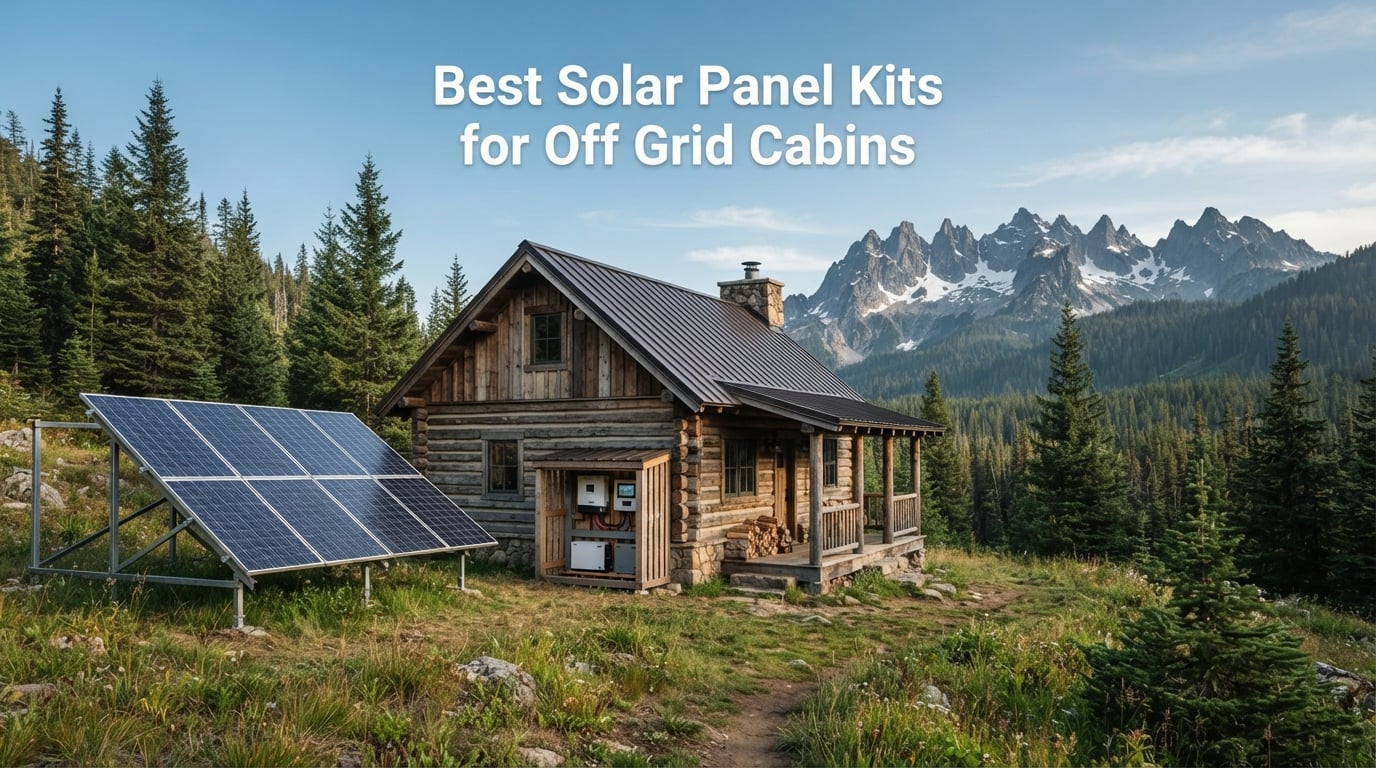
The best solar panel kits for off grid cabins match your actual daily loads, winter sun, and battery reserve—not the largest panel number on a listing. A cabin that runs lights, a compressor fridge, and device charging needs a very different setup from a weekend shelter with a few LEDs.
An off-grid solar kit turns sunlight into DC electricity, stores it in batteries, then uses an inverter when you need standard AC power. The most useful cabin solar system includes panels, a compatible charge controller, battery storage, and an inverter; a panel-only package is a starting point rather than a complete power system.
I separated the 12 listings here by what they can realistically do. The larger ECO-WORTHY systems contain panels, batteries, and inverter equipment for sustained cabin loads, while the portable EBL station is a compact self-contained solar system and the smaller panels are better for charging or maintaining a battery.
Table of Contents
Top 3 Picks Answer Different Cabin-Power Needs
The 800W ECO-WORTHY package is the strongest all-around choice because its listing combines four 200W panels, a 7.168 kWh lithium battery bank, a 3000W UPS inverter charger, and a 60A MPPT controller. The 400W 1.6 kWh ECO-WORTHY system fits a lighter cabin circuit, while EBL is the portable option for modest loads.


EBL 500W Power Station Kit
- 519.48Wh battery
- 500W output
- 100W portable panel
- 14.1 lb station
Best Solar Panel Kits for Off Grid Cabins in 2026 at a Glance
The comparison below puts complete kits beside panel-only products on purpose. Before buying, confirm whether the package includes a battery, inverter, controller, cables, and mounting hardware; these listings do not all include the same pieces.
1. ECO-WORTHY 800W 7.168kWh System Is the Best Complete Cabin Kit
ECO-Worthy 7.168KWH 800W Solar Panel Kit for RV Off Grid Complete System
800W panels
7.168kWh lithium
3000W UPS inverter
Pros
- Complete battery and inverter package
- 60A MPPT controller
- Bluetooth listed
- 800W panel array
Cons
- 12V architecture
- Only 19 listed reviews
This is the package I would put first on a serious off-grid cabin shortlist because the listing names the whole power path: four 200W panels, two 12.8V 280Ah lithium batteries, a 3000W UPS inverter charger, and a 60A MPPT controller. The stated battery capacity is 7.168 kWh, which gives it substantially more stored energy than the smaller all-in-one kits here.
That storage matters after sunset and during a cloudy stretch. The listed 3000W inverter also gives it a better starting point for loads that have a startup surge, though the final answer still depends on the surge rating and the exact appliances you plan to run.
The Included Battery Bank Makes It Suitable for Longer Stays
A 7.168 kWh battery figure is useful because it describes stored energy, not merely panel generation. Treat it as a capacity figure rather than a promise of fully usable AC energy, since inverter losses, battery protection settings, and temperature affect the energy that reaches appliances.
For a cabin with refrigeration, lighting, charging, and occasional small kitchen loads, this type of solar kit with battery and inverter gives you a complete platform to size from. List your watt-hours first, then decide whether the listed capacity leaves enough reserve for days with weak sun.
The 12V Design Needs Careful Current Planning
The product listing identifies this as a 12V system. At higher power, 12V equipment carries higher current than a comparable higher-voltage system, so cable size, fuse selection, and battery connections deserve particular attention.
Ask a qualified installer to review the supplied wiring and protection plan if you are not already comfortable with DC systems. The kit listing is strong on core components, but it does not remove the need to locate panels away from shade and follow electrical requirements.
2. ECO-WORTHY 2340W 48V System Is the High-Output Cabin Option
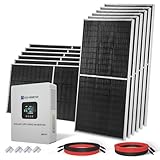
ECO-WORTHY 9.36KWH 2340W 48V Solar Power System Kit Off Grid Solar Panel Kit with 5000W 48V All-in-One Off-Grid Charge Inverter and 12pcs 195W Mono Solar Panel and Z Mounting Brackets.Plug and Play
2340W array
9.36kWh battery
5000W all-in-one inverter
Pros
- Large 2340W array
- 48V system
- 9.36kWh battery
- 5000W inverter
Cons
- Only 14 listed reviews
- Large installation footprint
This ECO-WORTHY package is the biggest listed system in the roundup: 12 195W panels create a stated 2340W array, while the package lists 9.36 kWh of battery capacity and a 5000W 48V all-in-one off-grid charge inverter. It is aimed at a cabin with higher daily demand rather than a minimalist weekend space.
The 48V format is meaningful for a larger installation because it can move the same power with less current than 12V equipment. That does not make planning optional, but it is a sensible architecture to investigate when a cabin needs several circuits or a larger inverter.
The 5000W Inverter Fits Larger Simultaneous Loads
A 5000W inverter rating provides more headroom on paper than the 1100W, 2000W, or 3000W options in this list. Check both continuous output and surge behavior against the motor loads you own, especially pumps, refrigerators, and tools.
I would not treat the inverter number as permission to run everything at once. The battery bank, charging conditions, wiring, and inverter documentation still set the practical limits of an off grid power system.
The Twelve Panels Need a Clear Mounting Plan
Twelve panels require real roof or ground-mount space, a layout, and a route for the conductors. The listing includes Z mounting brackets, but a cabin roof still needs an assessment for orientation, structure, wind exposure, and water sealing.
Forum discussions repeatedly flag tree cover as a source of disappointment. Walk the site at different times of day and consider winter sun angles before committing to a fixed array of this size.
3. ECO-WORTHY 400W 1.6kWh Kit Is a Balanced Small-Cabin System

ECO-Worthy 1.6KWH Complete Solar Panel Kit 400W 12V for RV Off Grid
400W panels
1.6kWh lithium
2000W inverter
Pros
- Panels batteries and inverter listed
- 40A MPPT controller
- Bluetooth module
- 400W array
Cons
- 1.6kWh storage is limited
- 4.0 listed rating
The ECO-WORTHY 1.6KWH kit bundles four 100W panels, two 12V 100Ah lithium batteries, a 40A MPPT controller, an upgraded 2000W inverter, and a Bluetooth module. That list makes it a clearer complete-system choice than the panel bundles that require you to add storage and AC conversion later.
Its 1.6 kWh stated battery capacity establishes the real boundary: it suits managed lighting, charging, and modest appliance use better than energy-hungry electric heat or continuous cooking. It is a useful middle step for a cabin owner who wants panels and storage in the same purchase.
The 2000W Inverter Covers Common Cabin Electronics
A 2000W inverter can serve typical plug-in electronics and small appliances within its documented limits. Add up simultaneous running watts and separately identify appliances with a motor startup surge before assigning them to this circuit.
Pure sine wave output is preferable for sensitive electronics, but this listing does not state the waveform. Verify that point in the current documentation before connecting equipment that requires pure sine wave power.
The 1.6kWh Battery Calls for a Written Load Budget
Write each load as watts multiplied by hours of use. A 10W LED lamp used for five hours needs 50Wh, while a refrigerator’s daily demand must come from its actual energy label or measured consumption.
This simple watt-hour budget stops a common off-grid mistake: choosing by panel wattage alone. Battery storage gets you through the evening; the panels need enough sun the next day to replace what you consumed.
4. ECO-WORTHY 200W Starter Kit Is the Entry-Level Complete Package
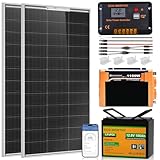
ECO-WORTHY 200 Watt 12V Complete Solar Panel Starter Kit for RV Off Grid
200W panels
100Ah lithium
1100W inverter
Pros
- Battery included
- 1100W inverter included
- 30A controller
- Two 100W panels
Cons
- Small 200W array
- Limited inverter output
This starter kit lists two 100W solar panels, a 30A charge controller, a 100Ah lithium battery, and an 1100W premium solar inverter. That is the essential equipment set a beginner expects from a solar panel kit for cabin use, rather than a panel package alone.
The 200W panel array and 1100W inverter make the intended scale clear. I would reserve it for efficient lights, charging, a small DC or carefully selected AC load, and a cabin routine that does not depend on several high-draw appliances at once.
The Included 100Ah Lithium Battery Is the Key Distinction
Battery inclusion changes the usefulness of a kit after dark. The listing specifies a 12.8V output voltage and 100Ah lithium battery, but it does not give a kWh total; multiplying the stated nominal figures gives an approximate 1.28 kWh nominal energy figure.
That calculation is a planning estimate, not a claimed delivered capacity. Keep a reserve instead of repeatedly draining any battery bank to its protection cutoff.
The 30A Controller Sets an Expansion Question
The listed controller is 30A, so do not assume you can add unlimited panel wattage later. Read the controller’s voltage and current limits, then match any future panel configuration to its approved input range.
A complete starter kit can reduce compatibility confusion, a concern raised often in off-grid discussions. Expansion still works best when you write down every component’s voltage, current, and connector requirements from the first day.
5. EBL 500W Power Station Kit Is the Simplest Portable Cabin Setup
EBL 500W Portable Power Station with 100W Portable Solar Panel 20V Outdoor
519.48Wh battery
500W output
100W portable panel
Pros
- Portable integrated power station
- 100W solar panel listed
- 14.1 lb station
- 5.0 listed rating
Cons
- 519.48Wh storage
- 500W output limit
The EBL package combines a 500W portable power station with a 100W portable solar panel and a stated 519.48Wh backup battery pack. At 14.1 pounds for the station, it is the least permanent option in this guide and one you can bring home between cabin visits.
Its small capacity and 500W output make it a companion for lights, phones, laptops, and other light-duty work—not the electrical backbone of a full cabin. That distinction is useful if you are starting with a remote cabin power plan before committing to roof wiring.
The 519.48Wh Capacity Favors Small, Predictable Loads
Watt-hours tell you how long a device may run. Divide a device’s wattage into 519.48Wh for a rough upper-bound runtime, then allow for conversion losses and changing load behavior.
For example, a 10W light is very different from a 500W cooking appliance. Keep high-watt heating devices off a small portable station unless its manual specifically approves the load and you accept the short runtime.
The Portable Panel Works Best as a Daytime Refill Tool
The included solar panel is rated at 100W. Actual solar harvest changes with panel angle, season, clouds, temperature, and shade, so treat that rating as a nameplate maximum rather than a fixed daily energy total.
Portable equipment lets you chase the sun where a forested cabin roof cannot. Secure the panel and place it where it will not be shaded, tripped over, or damaged by changing weather.
6. ECOBOSS 1000W Panel Set Is the Array-First Expansion Choice

1000W TÜV Certification Solar Panel, 10PC 100W N-Type 25.6% Solar Panels
1000W array
10 x 100W panels
25.6% listed efficiency
Pros
- Large 1000W array
- 10 matching panels
- 25.6% listed efficiency
- N-type modules
Cons
- No battery listed
- No inverter listed
ECOBOSS lists 10 100W N-type monocrystalline panels for a 1000W array, with a stated 25.6% efficiency and total listed weight of 120 pounds. It is a panel set for a cabin owner who is selecting a separate battery bank, charge controller, and inverter.
That can be a sound route when you already have compatible equipment or want control over each component. It is not a plug-and-play cabin solar system because the listing does not name batteries, an inverter, or a charge controller.
The 1000W Nameplate Requires Controller Sizing
Panel wattage must be paired with a controller that accepts the array’s voltage and current. An MPPT charge controller is commonly chosen for a larger array because it can convert higher panel voltage efficiently to the battery’s charging voltage.
Verify the electrical specifications of these panels before deciding on series or parallel wiring. Series wiring raises voltage, while parallel wiring raises current, and the controller must accept the resulting configuration.
The Ten-Panel Weight Affects the Mounting Decision
The 120-pound listed weight is for the panel set, before rails, brackets, wire, and roof hardware. Ground mounting can be easier to orient and service, while roof mounting may save yard space.
Do not select a location based only on a sunny summer afternoon. Winter shadows from trees, ridges, chimneys, and nearby cabins can take a large bite out of daily production.
7. ECO-WORTHY 400W MPPT Kit Is a Well-Equipped Panel Foundation

ECO-WORTHY 400 Watt 12 Volt Premium Solar Panel Kit :4pcs 100W Solar Panel+ 40A MPPT Charge Controller+ Bluetooth Module+ Mounting Z Brackets, 400W 12V Solar Power Off Grid System for Home, RV, Boat.
400W panels
40A MPPT
Bluetooth module
Z brackets
Pros
- 40A MPPT included
- Bluetooth module listed
- Z brackets included
- Four 100W panels
Cons
- No battery listed
- No inverter listed
This package lists four 100W panels, a 40A MPPT controller, Bluetooth module, and mounting Z brackets. It is a more complete panel-side package than a bare array because the controller and mounting hardware are named, yet you still need battery storage and an inverter for AC cabin outlets.
The stated 400W capacity is a reasonable scale for a careful small-cabin build. Its 72-pound listed weight also signals that this is a fixed-installation choice rather than a panel you will casually move around the property.
The 40A MPPT Controller Is Useful for System Monitoring
The Bluetooth module may make it easier to check controller information from a compatible device, but use the current product documentation to confirm exactly what readings and settings are available. Monitoring helps you see whether the battery is recovering daily rather than guessing.
An MPPT controller is one part of the charging chain, not battery storage itself. Match its battery settings to the chemistry recommended by your chosen battery manufacturer.
The Missing Battery and Inverter Are Deliberate Next Steps
Buying panels and a controller separately can let you choose a LiFePO4 battery bank with the storage your cabin actually needs. It also requires you to select fuses, disconnects, cables, battery monitoring, and an inverter that all work together.
If you want AC power, choose a pure sine wave inverter when your loads call for it and confirm its DC voltage matches the battery bank. Do not connect a 12V inverter to a 48V battery system or assume adapters fix a voltage mismatch.
8. ECO-WORTHY 260W Flexible Kit Is for Curved or Weight-Sensitive Surfaces

ECO-WORTHY 260Watt 12Volt Flexible Solar Panel Kit for Off Grid Home RV, Boat and Uneven Surfaces:2pcs 130W Mono Solar Panel + 30A 12V Charger Controller + Solar Cable + Tray Cable + Y Branch
Two 130W flexible panels
30A controller
Cables included
Pros
- Flexible panel format
- 30A controller included
- Cables and Y branch listed
- 22.4% listed efficiency
Cons
- No battery listed
- Listing spec field shows 130W
The product title describes two 130W monocrystalline flexible panels, a 30A 12V controller, solar cable, tray cable, and Y branch connectors. The separate product specification field lists maximum power as 130W, so confirm the current package total and electrical details before designing around the 260W title claim.
Flexible panels can make sense on uneven surfaces or where panel weight is a major concern. They are still a panel-and-controller kit, not a finished cabin power package, because no battery or inverter is listed.
The Flexible Format Solves a Mounting Constraint
A curved or irregular surface can rule out a conventional framed panel. Flexible panels address that physical constraint, but the mounting method must still protect wiring and allow the panel to operate within its documented temperature conditions.
A cabin roof often has better long-term service access with rigid framed modules. Choose flexibility for an actual surface need, not because it sounds easier than planning brackets and cable routing.
The Included Cables Do Not Eliminate Electrical Design
The listing names solar cable, tray cable, and a Y branch. Confirm connector type, conductor length, wire gauge, and voltage limits against the distance between array, controller, battery, and inverter.
Longer runs can create voltage drop, particularly in a 12V system. Place the controller according to its manual and select appropriately sized conductors and overcurrent protection for the final layout.
9. DOKIO 200W Framed Kit Is a Straightforward Panel-Only Start

DOKIO 200W 18V Solar Panel Kit Monocrystalline with Aluminum Frame and MC4, Mounting Brackets, Alligator Clips & 5m Cable for RV, Boat, Roof, Cabin, Off-Grid (Controller Required)
200W framed panel
MC4 connectors
Brackets and 5m cable
Pros
- Aluminum frame
- MC4 connectors
- Mounting brackets listed
- 5m cable included
Cons
- Controller required
- No battery or inverter
DOKIO lists a 200W 18V monocrystalline panel kit with an aluminum frame, MC4 connectors, mounting brackets, alligator clips, and a 5m cable. The title explicitly says that a controller is required, so count one as a mandatory addition rather than an optional accessory.
At a stated 24 pounds, it is a manageable rigid-panel starting point for a cabin battery project. It can charge a compatible battery through the correct controller, but it cannot by itself store energy or power standard AC outlets.
The Required Controller Must Match Both Panel and Battery
Choose a controller that supports the panel’s operating voltage and the voltage and battery chemistry of the bank you intend to charge. A controller protects the battery from improper charging and regulates the energy arriving from the panel.
The alligator clips can be convenient for temporary connections, yet a permanent cabin installation needs appropriate terminals, fusing, strain relief, and weather protection. Follow the product and battery manuals rather than improvising a permanent connection.
The 18V Panel Rating Is Not a Battery Voltage
A panel’s nominal 18V designation does not mean it is a direct substitute for a 12V battery charger. Solar panel voltage changes with sunlight and temperature, which is why the controller sits between the panel and battery.
That distinction prevents a frequent beginner error: treating every number on the label as interchangeable. Record panel voltage, controller limits, battery voltage, and inverter input voltage before you order the remaining parts.
10. ZOUPW 100W Portable Panel Is for Mobile Supplementary Charging

ZOUPW 100W Portable Solar Panel, Foldable Tempered Glass Solar Panel Kit with 20A PWM Controller for 12V Battery&Power Station, IP68 Waterproof 23.5% Efficiency for RV, Camping & Off-Grid
100W foldable panel
20A PWM controller
23.5% listed efficiency
Pros
- Foldable design
- 20A PWM controller included
- IP68 waterproof listing
- 9.36 lb
Cons
- No battery included
- No inverter included
The ZOUPW is a 100W foldable tempered-glass panel kit with a 20A PWM controller. Its listing gives a 23.5% efficiency figure, IP68 waterproof rating, and 9.36-pound weight, which points toward portable use for a battery or compatible power station.
This is not the primary array for a cabin with daily appliance loads. I see it as a useful add-on for occasional stays, a movable panel that escapes a shaded roof, or a way to maintain a modest battery when paired with compatible equipment.
The PWM Controller Fits a Simple 12V Charging Role
A PWM controller is a different design from MPPT. It can be appropriate for a simple, compatible 12V panel-and-battery arrangement, while larger arrays often lead shoppers toward MPPT equipment for its flexibility with higher panel voltages.
Controller choice must follow the array and battery specifications, not a blanket rule. Check the ZOUPW manual for approved battery types, voltage, connector details, and current limits before connecting anything.
The Foldable Panel Helps With Shade Management
Portable panels can be moved when a cabin sits under trees. Move it thoughtfully: a partly shaded solar panel can produce far less than its nameplate rating, and a changing patch of shade can matter as much as the panel’s direction.
Keep the panel facing unobstructed sky when possible and secure it against wind. A portable setup needs supervision that a properly installed fixed array may not.
11. Hoysicy 100W Kit Is a Basic 12V Battery-Maintenance Choice

Hoysicy 100W Solar Panel Kit 12V Battery Maintainer
100W panel
20A controller
16.4ft extension cables
Pros
- 20A controller included
- 16.4ft cables listed
- Monocrystalline panel
- 12V system
Cons
- No battery listed
- No inverter listed
The Hoysicy listing combines a 100W 12V monocrystalline panel, a 20A charge controller, and 16.4-foot extension cables. It is described as a battery maintainer for RV, marine, boat, and off-grid uses, which makes its most natural cabin role battery support rather than whole-cabin power.
The included cable length may be helpful for placing the panel in better sun than the battery location. Check voltage drop and the manufacturer’s connection instructions if the final distance needs to be longer.
The 100W Rating Is Best for Low Daily Consumption
A 100W panel’s daily harvest varies widely, and the number on the panel is not the number you can count on every hour. It can suit low-consumption lighting and battery maintenance when the site has good sun, but it leaves little margin for a refrigerator or power tools.
Start with a daily energy audit rather than hopeful estimates. If your list comes out far above the energy a small panel can harvest in your least-sunny season, move to a larger array and battery plan.
The Extension Cable Changes Placement, Not Capacity
A longer cable can help you set the panel in a clear patch of sun while keeping the battery indoors. It does not create extra solar energy, and undersized cable over a long run can waste some of what the panel produces.
Use the manufacturer’s specified connections and add appropriate protection near the battery. Batteries can deliver high fault current even when the panel itself seems small.
12. LEPITERY 25W Kit Is for Maintaining a Small Stored Battery

Solar Panel Kit 25W 12V Monocrystalline Battery Maintainer with10A Solar Charge Controller and Extension Cable with Battery Clips O-Ring Terminal for RV Trailer Boat Off Grid System
25W panel
10A controller
Battery clips and O-ring terminal
Pros
- Compact 25W panel
- 10A controller included
- Extension cable included
- Battery connection options
Cons
- Very low 25W output
- No battery or inverter
The LEPITERY package is a 25W 12V monocrystalline battery maintainer with a 10A charge controller, extension cable, battery clips, and O-ring terminal. Its stated 3.65-pound weight makes it compact, but 25W is firmly in the maintenance category rather than the cabin-power category.
This is a practical choice for helping a stored 12V battery avoid sitting idle, not for building a cabin solar system. The lower listed rating of 3.9 also makes it especially important to review the current product details and connection instructions before buying.
The 25W Output Is Not Enough for Normal Cabin Loads
A 25W panel may support a small trickle or maintenance task in favorable conditions, but it will not cover ordinary cabin electricity use. A single 10W light can consume a meaningful share of its daily harvest if left on for several hours.
Use it to keep expectations grounded: solar panel wattage is production capacity, while your cabin’s watt-hours are consumption. Those two numbers must be reconciled before calling a kit sufficient.
The Clips and O-Ring Terminal Serve Different Connection Needs
Battery clips favor temporary attachment, while an O-ring terminal can suit a more secure battery connection when installed correctly. In either case, follow polarity markings and the controller’s specified sequence for connecting battery and panel.
Do not use this small kit as a substitute for a properly sized charge system. It is a maintenance accessory that can complement, not replace, a larger array, battery bank, and inverter.
An Off-Grid Cabin Kit Needs Four Working Parts
A complete off-grid solar system has four jobs: panels collect energy, a charge controller manages battery charging, batteries hold energy for later, and an inverter supplies AC power. A portable power station combines several of these jobs in one enclosure, while a panel-only kit leaves the rest for you to choose.
Panels are rated in watts, batteries in watt-hours or kilowatt-hours, and inverters in watts. A good plan connects these ratings to your real use instead of assuming that one large number tells the whole story.
An MPPT Controller Matches Panel Output to Battery Charging
An MPPT charge controller tracks the panel operating point and converts available panel power to the battery charging voltage. It is commonly selected for larger or higher-voltage arrays, provided its input ratings and battery settings match the equipment.
A PWM controller can be suitable for a simple compatible 12V setup. Neither controller is a battery, and neither creates energy when the array is shaded or the sun is down.
A Pure Sine Wave Inverter Is the AC Power Decision
An inverter changes battery DC electricity into AC electricity for standard outlets. Confirm its continuous rating, surge capacity, input voltage, waveform, and any charger function against your actual appliances before making it the center of a cabin system.
For electronics and appliances that call for it, select a pure sine wave inverter. The exact product documentation, not a generic label, should be the final authority for compatibility.
A Cabin Solar System Starts With a Daily Watt-Hour Audit
The sizing method is simple: list every device, multiply its watts by its expected hours per day, and add the results. That total is your daily watt-hour demand; divide by 1,000 to express it in kilowatt-hours.
For example, four 10W lights used five hours each consume 200Wh per day. A 60W laptop used three hours adds 180Wh, making the subtotal 380Wh before refrigerator, pump, charging, or inverter losses.
Battery Storage Should Cover Nighttime and Poor Sun
Battery capacity should be chosen after you know daily demand and how long you need to operate without strong charging. Cold conditions, inverter losses, battery settings, and a run of cloudy days reduce the margin, which is why cabin owners often regret undersizing storage first.
For a seasonal cabin, consider the least-sunny period when you expect to use it. A generator backup option can be sensible for critical loads and prolonged bad weather, even when solar is the main source.
Panel Wattage Must Refill What You Use
The array needs enough production to cover your daily demand and replenish the battery during available sun. Nameplate solar panel wattage is measured under standardized conditions, while real output changes with weather, angle, shade, dirt, and temperature.
Do not buy a system based solely on a summer estimate. Winter sun is lower, days are shorter, and tree shadows can extend across the site, so build in capacity margin or plan a reduced winter load list.
Cabin Site Conditions Decide Whether Fixed or Portable Panels Fit
First check shade. A south-facing roof or ground location with clear sky may support a fixed array, while a wooded lot can make a portable panel surprisingly useful because you can move it into direct sun.
Look beyond the roofline and inspect morning, midday, and afternoon shade. Nearby ridges and leafless winter trees can change the result, so a cabin site that looks sunny in one season may not be sunny when your energy needs are highest.
Expansion Works Best When Voltage and Components Are Planned Together
Start with a complete kit if compatibility is your main concern, then check whether its controller, inverter, and battery architecture can expand. Keep a record of nominal voltage, controller input limits, cable gauges, fuses, and connector types.
Adding panels, batteries, or an inverter without that record can create unsafe mismatches. The frequent advice from off-grid communities to begin with a complete kit comes from this practical problem, not because every package is equally expandable.
DIY Installation Is Appropriate Only When the Design Is Clear
A DIY solar kit can be approachable for a small, documented system if you understand polarity, conductor sizing, overcurrent protection, mounting, and battery safety. Read every component manual before making connections and obey local electrical and building rules.
Bring in a qualified professional when the system is large, roof work is involved, AC circuits need integration, or the design is uncertain. Professional review is often cheaper than repairing damaged equipment or discovering an unsafe installation after the fact.
Frequently Asked Questions Give the Short Answers
What is the best off-grid solar kit?
The best off-grid solar kit is the one whose panels, battery storage, controller, and inverter match your cabin’s daily watt-hour use and least-sunny season. In this list, the ECO-WORTHY 800W 7.168kWh package is the strongest complete option because it lists panels, lithium batteries, a 3000W inverter charger, and a 60A MPPT controller.
What is the 33% rule in solar panels?
The phrase is used inconsistently, so do not treat it as a universal solar design rule. Size a cabin system from measured or documented daily watt-hour demand, expected solar production, battery reserve, controller limits, and inverter surge needs rather than a single percentage.
Are off-grid solar panels worth it?
Off-grid solar can be worth it when utility service is unavailable or impractical and your cabin loads fit a carefully sized system. Its value depends on sunlight, shade, battery storage, seasonal use, installation needs, and whether you retain a generator for extended poor weather.
What are the common problems with off-grid solar?
Common problems are undersized panels, too little battery storage, winter and cloudy-day shortfalls, tree shade, voltage or component mismatches, and ignoring motor startup surge. A written watt-hour audit, site shade check, compatible equipment list, and backup plan address most of these problems.
The Right Kit Is the One That Meets Your Cabin Load
The best solar panel kits for off grid cabins in 2026 range from battery maintainers to large complete systems, so the right pick comes from your watt-hour audit rather than a headline wattage. Choose the 800W or 2340W complete ECO-WORTHY systems for higher-demand plans, consider the 400W complete options for controlled small-cabin use, and treat the smaller panel kits as building blocks or supplemental charging.
Before ordering, verify the current listing contents, voltage compatibility, controller limits, mounting plan, and battery reserve for your least-sunny season. That homework makes an off-grid cabin feel dependable instead of fragile.